Free Walking Tour Rio de Janeiro: Opera, Lapa and Port

From a Paris-style opera house to a tile mosaic, a colonial aqueduct and a museum on an old pier: Rio's historic centre in one easy walk.

6 Stops 4.6 km ~1 h 4 min walking
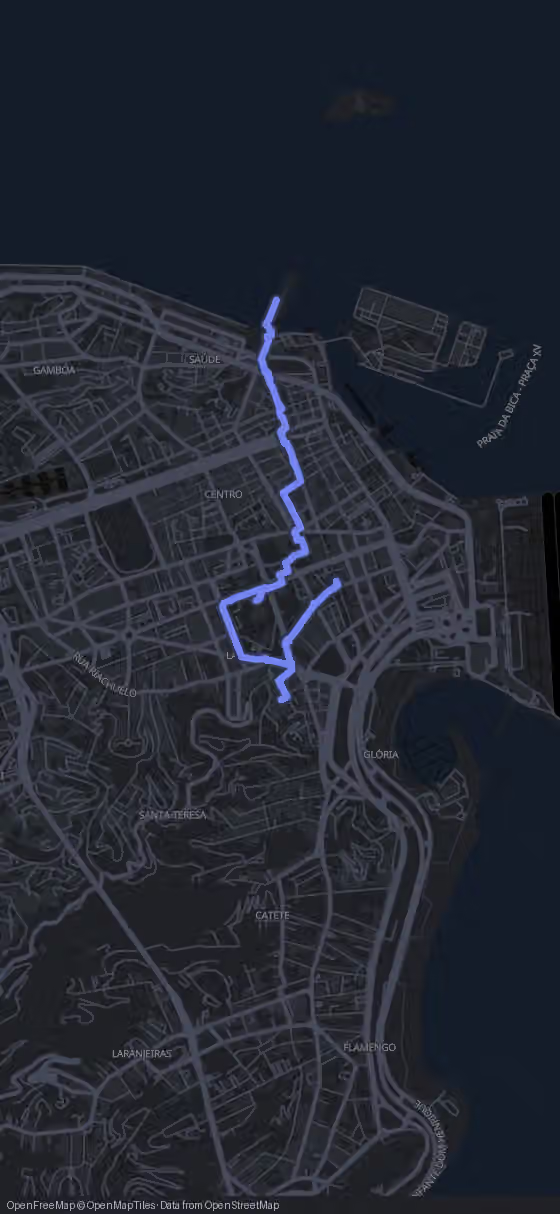
Route map for the Rio de Janeiro walking tour
Stop 1 of 6
1030 m·13 min
Theatro Municipal
Head south-west toward Escadaria Selaron
Welcome to Rio de Janeiro. I'm Alex, and our first story begins with one artist's life work spread across a staircase.
Try this tour with Alex

Rio de Janeiro on Foot: What This Walk Covers

Six stops lead from the Theatro Municipal via the Escadaria Selarón, the Arcos da Lapa, the Metropolitan Cathedral and the Confeitaria Colombo to the Museum of Tomorrow: 4.6 km and 1 h 4 min of pure walking, about five hours with visits.

Selarón, the arches, the cathedral and the café are free to enter; the theatre's guided tour and the museum charge admission. Map and GPS route run free in your browser, and the AI Tour Guide is optional.

Open free GPS & optional AI Tour Guide
View of Rio de Janeiro

The Route

Walking Map of Rio de Janeiro: Centro, Lapa and the Port

6 stops 4.6 km 1 h 4 min walking
Tap to load interactive map

The 6 stops along this route

  1. Theatro Municipal in Rio de Janeiro, stop 1 on the self-guided walking tour
    1Theatro Municipal
  2. Escadaria Selarón in Rio de Janeiro, stop 2 on the self-guided walking tour
    2Escadaria Selarón
  3. Arcos da Lapa in Rio de Janeiro, stop 3 on the self-guided walking tour
    3Arcos da Lapa
  4. Metropolitan Cathedral in Rio de Janeiro, stop 4 on the self-guided walking tour
    4Metropolitan Cathedral
  5. Confeitaria Colombo in Rio de Janeiro, stop 5 on the self-guided walking tour
    5Confeitaria Colombo
  6. Museum of Tomorrow in Rio de Janeiro, stop 6 on the self-guided walking tour
    6Museum of Tomorrow
  7. That's the full route.

    Walk it with an AI Tour Guide talking you through every one of these streets.

    Start free in your browser
    You made it

Your Rio de Janeiro Walking Tour From Opera House to Pier

  1. 1

    Theatro Municipal

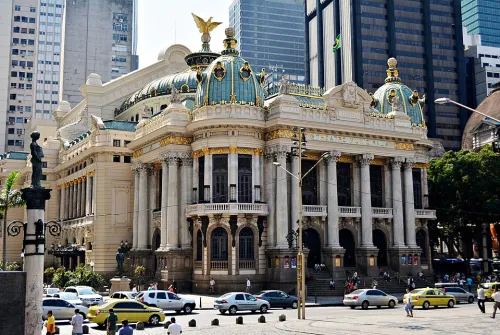
    Theatro Municipal in Rio de Janeiro, stop 1 on the self-guided walking tour

    You start on Cinelândia square, facing an opera house that would look at home in Paris, and that is no accident. The Theatro Municipal was modelled on Charles Garnier's Paris Opéra, built in an eclectic style and is often counted among the most beautiful and important theatres in Brazil. Look up at the outer walls: they carry the names of classic European and Brazilian artists. The National Library and the National Fine Arts Museum stand close by, part of the same grand set piece.

    The idea is older than the building. In the late 19th century Rio, then Brazil's capital, had a lively theatre scene but only two houses, the Lyric and St. Peter, and both audiences and companies complained about them. In 1894, after the Proclamation of the Republic, the playwright Artur Azevedo campaigned for a new theatre with a resident company along the lines of the Comédie Française. The result was a municipal law ordering the construction, and even a tax to pay for it. The law was ignored, and the money never went into the theatre.

    It took the next century to get it done. Mayor Francisco Pereira Passos was remaking the centre, opening the Avenida Central in 1903, today Avenida Rio Branco, as a Parisian boulevard lined with eclectic architecture. The theatre became the brainchild of his son, Francisco de Oliveira Passos, working with Albert Guilbert, and a symbol of the young Republic's new era. Construction began in 1905 on 1,180 wooden piles driven down into the groundwater.

    Going inside means joining a guided tour, which costs entry and runs only at set times. It is worth it if you love architecture or opera; otherwise the facade and the square tell most of the story. From here it is 960 m, about 14 min, to Lapa and a very different kind of artwork.
    Hours
    Guided tours Wed 16:00, Thu–Fri 11:00, 14:00, 16:00, Sat 11:00, 12:15; Sun–Mon closed for regular visits
    Price
    R$ 20 full, R$ 10 half (guided tour)
  2. 2

    Escadaria Selarón

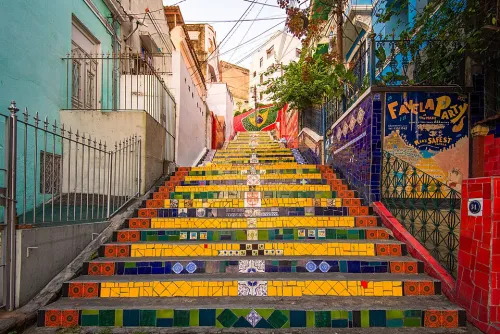
    Escadaria Selarón in Rio de Janeiro, stop 2 on the self-guided walking tour

    Blue, green and yellow tiles, the colours of the Brazilian flag, cover this entire flight from Rua Joaquim Silva up to Rua Pinto Martins, officially Rua Manuel Carneiro, where Lapa meets Santa Teresa. It runs 125 metres and holds more than 2,000 tiles, ceramics and mirror pieces from over 60 countries. Take your time and look for tiles from your own country among them.

    The man behind it was Jorge Selarón, born in Chile in 1947. He worked as a painter and sculptor in more than 50 countries before settling in Rio in 1983. In 1990 he began repairing the run-down flight in front of his house, and the neighbours laughed at his colour choice. What started as a side project next to his painting became an obsession. He was constantly short of money and sold his paintings to keep buying tiles.

    At first those tiles came from building sites and piles of rubbish in Rio's streets; later, visitors from around the world donated most of them. As soon as one section was done, Selarón started reworking another, so the piece never stood still. He called it his tribute to the Brazilian people and said this crazy and unique dream would only end on the day of his death.

    Look out for one recurring motif: about 300 tiles were painted by Selarón himself and show a pregnant African woman. He never explained them beyond calling them a personal problem from his past. Entry is free and open at all hours. His work even spilled over to the foot of the Arcos da Lapa, which is where you head next, just 440 m and 6 min away.

    Hours
    Accessible 24/7
    Price
    Free
  3. 3

    Arcos da Lapa

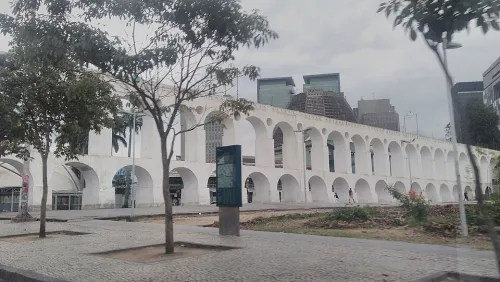
    Arcos da Lapa in Rio de Janeiro, stop 3 on the self-guided walking tour

    The white double row of arches in front of you is the Carioca Aqueduct, Aqueduto da Carioca, though everyone calls it the Arcos da Lapa. It was built in the middle of the 18th century to bring fresh water from the Carioca River on the Santa Teresa hill down to the city, and it is a textbook example of colonial architecture and engineering.

    The need was real. Early Rio sat among swamps with bad water, and fresh water had to be carried by hand from distant streams. Plans for canals from the Carioca's source existed from at least 1602, but money and technical trouble kept stopping them; by the end of the 17th century only a few hundred metres were finished. After 1706 the authorities pushed harder, and under governor Aires de Saldanha it was decided to extend the canals from the Campo da Ajuda, today's Cinelândia where you started this walk, to what is now Largo da Carioca.

    That first aqueduct was completed in 1723 and fed a Baroque fountain on Santo Antônio square, to the great relief of the city. By 1744 it was already in poor shape, so governor Gomes Freire de Andrade ordered a bigger one. The Portuguese military engineer José Fernandes Pinto Alpoim took inspiration from aqueducts in Portugal such as Lisbon's Águas Livres, and the new structure opened in 1750.

    Its second life began at the end of the 19th century, when the arches became the bridge for the Santa Teresa tramway linking the centre with the neighbourhood up the hill. The site is free and open around the clock. Next comes Rio's most modern church: 890 m, about 12 min, to the Metropolitan Cathedral.

    Local name
    Aqueduto da Carioca
    Hours
    Accessible 24/7
    Price
    Free
  4. 4

    Metropolitan Cathedral

    Metropolitan Cathedral in Rio de Janeiro, stop 4 on the self-guided walking tour

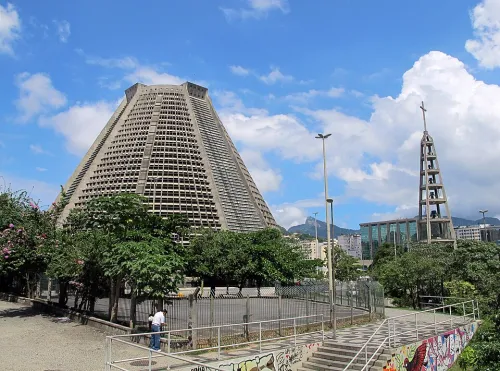
    Nothing about this building looks like a traditional cathedral. The Catedral de São Sebastião is a huge truncated cone in modernist style on Avenida Chile, designed by Edgar Fonseca, a professor at the Pontifical Catholic University of Rio. Locals often just call it the Catedral or the Catedral Nova.

    The archdiocese needed it because the 19th-century church of Nossa Senhora do Monte do Carmo had grown too small. Only after long negotiations with the government of the state of Guanabara did it get a plot in the centre. Cardinal Jaime de Barros Câmara laid the foundation stone on 20 January 1964, and Ivo Antônio Calliari led the works.

    Building took 15 years. Cardinal Eugênio de Araújo Sales celebrated Christmas Mass inside as early as 1972, consecrated the main altar on 16 November 1976 for the archdiocese's 300th anniversary, and dedicated the finished cathedral on 15 August 1979. With that, the seat of the archbishop moved here from the old cathedral of Carmo.

    Popes have come several times: John Paul II in 1980 and again in 1987, and Pope Francis during World Youth Day in 2013, on his first trip abroad as pope. Entry is free, and stepping inside is the only way to grasp the scale of the cone, so do it. From here it is 840 m, about 11 min, back into the Belle Époque.

    Local name
    Catedral de São Sebastião do Rio de Janeiro
    Hours
    Mon–Sun 07:00–17:00
    Price
    Free admission
  5. 5

    Confeitaria Colombo

    Confeitaria Colombo in Rio de Janeiro, stop 5 on the self-guided walking tour

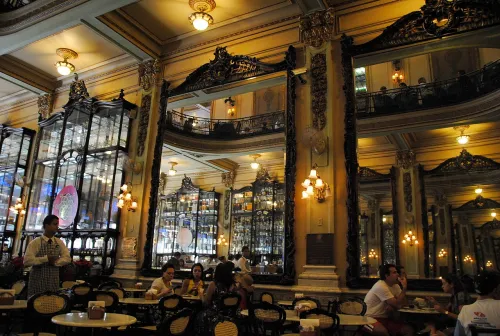
    Walk in and you step into Rio as it looked when it was the Republic's capital. Two Portuguese immigrants, Joaquim Borges de Meireles and Manuel José Lebrão, founded the Confeitaria Colombo in 1894, and it has been listed among the most beautiful cafés in the world.

    Most of what you see dates from a refit between 1912 and 1918 with an Art Nouveau touch: huge crystal mirrors brought from Antwerp in frames of carved jacaranda wood, and furniture carved at the same time by the craftsman Antônio Borsoi. In 1922 a second floor with a tea salon was added. Look up through the opening in the ground-floor ceiling to see its skylight with stained glass.

    The guest list reads like a who's who of Brazil: the composer Chiquinha Gonzaga, the poet Olavo Bilac, Rui Barbosa, Villa-Lobos, Lima Barreto, Getúlio Vargas, Juscelino Kubitschek, and royal visitors such as Albert I of Belgium and Elizabeth II. Since 2002 the Espaço Memória has displayed old china, silverware, photos, menus and packaging from the café's history. The upper floor now houses the Cristóvão restaurant, named, like the café, after Christopher Columbus.

    Entry is free, and this is the natural place for a pause on the walk. Then comes the longest leg of the route: 1,440 m, about 20 min, to the waterfront.

    Hours
    Mon–Fri 11:00–18:00, Sat 11:00–17:00, Sun closed
    Price
    Free admission
  6. 6

    Museum of Tomorrow

    Museum of Tomorrow in Rio de Janeiro, stop 6 on the self-guided walking tour

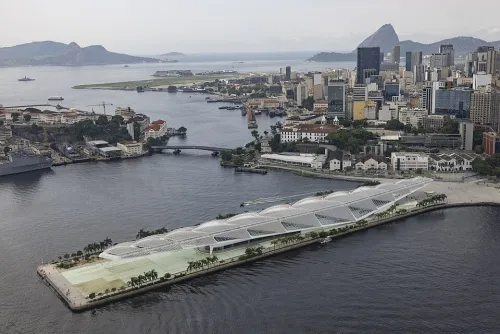
    The walk ends with a leap from the Belle Époque into the future. The Museum of Tomorrow, Museu do Amanhã, sits on the Píer Mauá next to Praça Mauá, a disused pier turned into an organic, sustainable building by the Spanish architect Santiago Calatrava. Watch the roof: solar spines move along the skylight, designed to adapt to changing conditions.

    It opened on 17 December 2015 in the presence of President Dilma Rousseff and drew about 25,000 visitors on its first weekend. The museum was one of the anchors of Porto Maravilha, the project to revive the port area, and was meant to strengthen Rio's cultural and international identity.

    Before the opening it received a gift for its open-air collection: Puffed Star II by the American artist Frank Stella, a twenty-point metal star six metres across that had been shown in New York. It now stands in the reflecting pool facing Guanabara Bay.

    Inside, the museum mixes art and science and warns about climate change, environmental damage and social collapse. The main exhibition is mostly digital and built around ideas rather than objects, drawing on real-time data about climate and population from space agencies and the United Nations. It charges admission and is worth it if science and the future interest you; if not, the building and the star are the highlight from outside.

    Local name
    Museu do Amanhã
    Hours
    Thu–Tue 10:00–18:00, Wed closed
    Price
    R$ 40 full, R$ 20 half
Walking tour route map of Rio de Janeiro Route loaded
Theatro MunicipalEscadaria SelarónArcos da LapaMetropolitan Cathedral+2
All 6 stops are already on the map.
You just press start.
AI Tour Guide

You've read the route. Now walk it with a guide in your ear.

Press start wherever you are, even hundreds of kilometres from Rio de Janeiro, and the guide begins telling its stories right away. In the city, pick any of the 6 stops to start from: it leads you there, then talks with you the whole route, asking, listening, remembering, and shaping the tour around your answers.

6stops 4.6km 1 h 4 minwalking 13languages
▶Start the tour free

Free to start · Runs in your browser · No app, no download

Shorter Ways to Walk Rio de Janeiro's Centro

Not every day has room for the full walk to the port. These cuts keep the route's order and still make sense on their own.

Opera and Lapa

Stops: 1, 2, 3

For a first taste of Rio's centre in under two hours. Walk from the Theatro Municipal to the Escadaria Selarón and on to the Arcos da Lapa: 1,400 m and 20 min of walking. Selarón's mosaic and the aqueduct are free; only the theatre's guided tour costs entry.

Classic Centro without the museum

Stops: 1, 2, 3, 4, 5

For anyone who prefers history and architecture over exhibitions. You end at the Confeitaria Colombo with a coffee instead of heading to the port: 3,130 m and 43 min of walking. Everything except the theatre's guided tour is free to enter.

Cathedral, café and waterfront

Stops: 4, 5, 6

For a second day or an afternoon slot. Start at the Metropolitan Cathedral, stop at the Confeitaria Colombo and finish at the Museum of Tomorrow: 2,280 m and 31 min of walking. The cathedral and café are free; the museum charges admission.

How Long Does This Walk Through Rio de Janeiro Take?

The pure walking time is 1 h 4 min over 4.6 km, with no leg longer than the 20 min from the Confeitaria Colombo to the Museum of Tomorrow. Looking only at the outsides, you are done in about two and a half hours.

With the theatre's guided tour, a proper coffee at the Colombo and a visit to the Museum of Tomorrow, plan on about five hours. The museum takes the biggest share, so if time runs short, it is the visit to trim. The Opera and Lapa variant fits into under two hours, the classic Centro variant into about three, and the cathedral to waterfront stretch into about three hours with the museum.

Before You Start Walking Rio de Janeiro

  • Start: The recommended start is the Theatro Municipal on Cinelândia square. You can join at any stop, but the order here follows the city's story from the opera to the port.
  • Finish: The walk ends at the Museum of Tomorrow on the Píer Mauá by Praça Mauá, not where you began.
  • Timing: The theatre is visited inside only on guided tours at set times, and the cathedral, café and museum all keep daytime hours with some closing days. Check them before you pick your day and set off in the late morning.
  • Admission: The theatre's guided tour and the Museum of Tomorrow charge admission. The Escadaria Selarón, the Arcos da Lapa, the Metropolitan Cathedral and the Confeitaria Colombo are free to enter.
Walking tour route map of Rio de Janeiro
AI Tour Guide

Your Rio guide is ready whenever you are.

Press start and a voice AI Tour Guide takes it from here: leading the route through Rio de Janeiro, telling the stories, and turning your walk into a real back-and-forth conversation. No app or download is needed; it runs in your browser.

6stops 4.6km 1 h 4 minwalking 13languages
▶Start the tour free

Free to start · Runs in your browser · No app, no download

What Your Guide Adds Between Opera and Pier

On this walk the AI Tour Guide works like a companion who knows Rio's past: it greets you at the Theatro Municipal, tells the stories as you go and notices whether you light up at architecture, music or colonial history, then leans into that. Ask who Chiquinha Gonzaga was before you sit down at the Colombo, or what Pereira Passos changed beyond his new avenue, and the conversation follows your curiosity while the route stays the same. Interrupt it whenever you like.

A Real Conversation A voice AI Tour Guide greets you, leads the whole route, and tells the stories and facts as you walk, asking what you want to see and keeping a real conversation going. Not a recording you press play on.
Map Navigation Follow the route on the map and walk at your own pace. You choose where to start and when to move to the next stop.
Ask Anything Curious about a building you pass? Ask your AI Tour Guide on the spot and the conversation carries on.
13 Languages Switch language anytime. No separate tour needed.
Start free in your browser

Common Questions About Walking Rio's Centro

Can I see inside the Theatro Municipal without a performance ticket?

Yes, on a guided tour. Tours run only at set times and cost entry, so plan your start around a tour slot if the interior matters to you.

Is the Escadaria Selarón ever finished?

Jorge Selarón never meant it to be. He kept replacing sections and called the work never complete, a dream that would only end on the day of his death.

Do I need to pay to walk into the Confeitaria Colombo?

No, entry is free, so you can step in to see the Antwerp mirrors and the stained glass skylight. Sitting down for coffee or cake is up to you.

Is the Museum of Tomorrow worth it if I only have a short time?

The exhibition is mostly digital and built around ideas such as climate and the future rather than objects, so it rewards an unhurried visit. If you're short on time, Calatrava's building and Frank Stella's star in the reflecting pool can be seen from outside.

Is there a similar walk elsewhere in South America?

If your trip heads west, try the walking tour of Puerto Iguazú or, further south, Punta del Este.

Is the tour really free?

Yes. The whole tour is free: the route, the interactive map and the navigation cost you nothing. Only the voice AI Tour Guide is optional and paid: you test it with 100 free credits, then you pay either €5 per hour or €19.99 for this whole tour, with no time limit. Admission to one of the 6 stops is not included: Museum of Tomorrow charges its own entry fee.

Do I need to download an app?

No. Everything runs in your phone browser. Open the route and start walking, no download and no sign-up required.

Do I need to book the walking tour in advance?

No booking needed. This self-guided tour is available anytime. Open the route in your browser and start walking. The AI Tour Guide works instantly, no app, no reservation required.

What languages is the AI Tour Guide available in?

The AI Tour Guide speaks 13 languages, so you take the tour in your own language and can switch at any time.

Can I skip stops or change the route?

Yes. Skip any stop, spend extra time at places you like, or start the route from any point. It is your walk, you set the pace.
Image credits
▶ Start free in your browser Runs in your browser, no app, no download