Free Walking Tour Kotor: Sea Gate to the City Walls

Seven stops, 0.6 km, 8 minutes on foot: a Venetian gate, a leaning clock tower, a cathedral consecrated in 1166 and the walls that climb Kotor's mountain.

7 Stops 0.6 km ~8 min walking
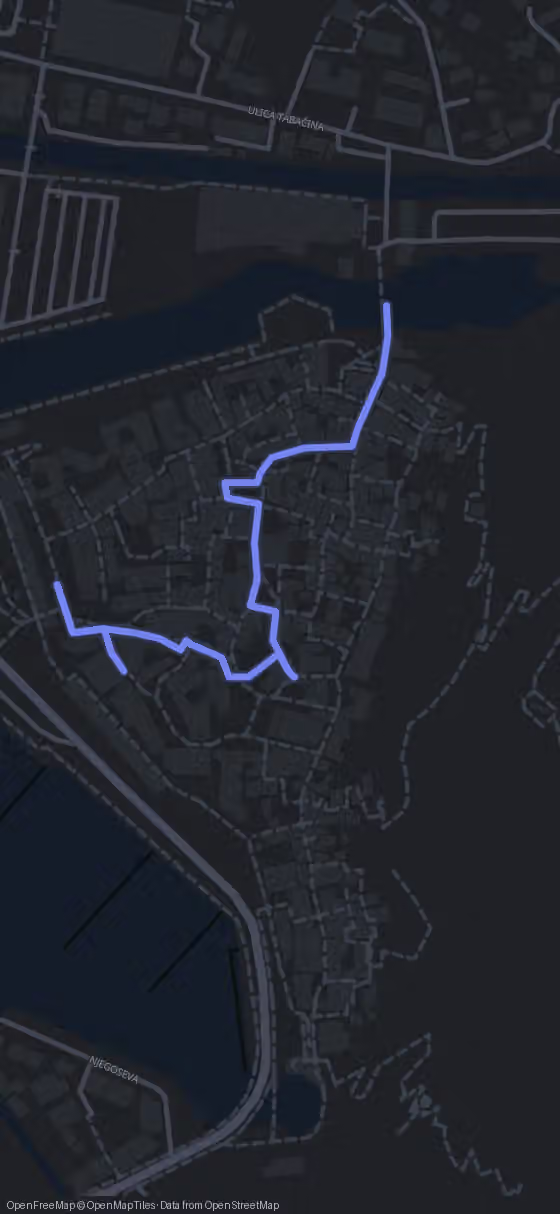
Route map for the Kotor walking tour
Stop 1 of 7
70 m·1 min
Sea Gate
Head north-west toward Kotor Town Square
Dobar dan, welcome to Kotor. I'm Alex, and one tiny church here tells a surprisingly generous story of two faiths.
Try this tour with Alex

Kotor's Old Town Route at a Glance

Seven stops inside Kotor's Old Town, from the Sea Gate to the entrance of the Kotor City Walls: 0.6 km and 8 minutes of pure walking. With the interiors that are worth it, plan about two hours, and the walls on top.

The gate, the squares and the Clock Tower are free. The Cathedral of Saint Tryphon, the Maritime Museum of Montenegro and the walls charge admission. The GPS route in your browser is free; the AI Tour Guide is optional.

Open free GPS & optional AI Tour Guide
This short shows highlights of the route. All 7 stops follow below.

The Route

Walking Map of Kotor's Old Town

7 stops 0.6 km 8 min walking
Tap to load interactive map

The 7 stops along this route

  1. Sea Gate in Kotor, stop 1 on the self-guided walking tour
    1Sea Gate
  2. Kotor Town Square, stop 2 on the self-guided walking tour
    2Kotor Town Square
  3. Clock Tower in Kotor, stop 3 on the self-guided walking tour
    3Clock Tower
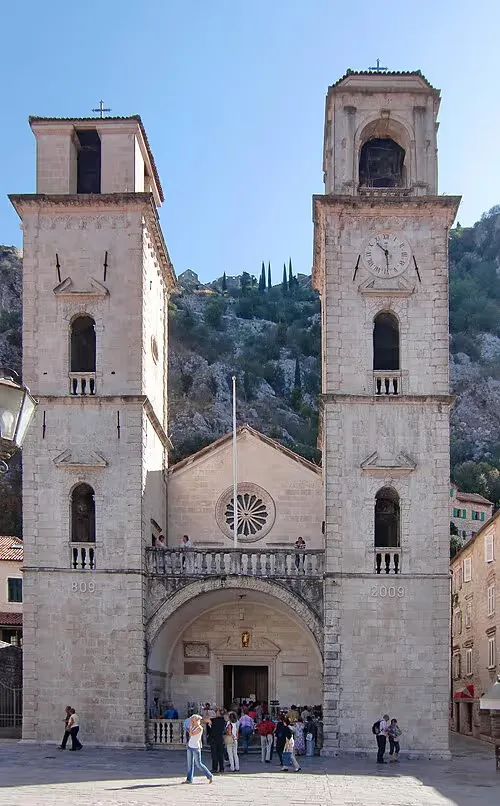
  4. Cathedral of Saint Tryphon in Kotor, stop 4 on the self-guided walking tour
    4Cathedral of Saint Tryphon
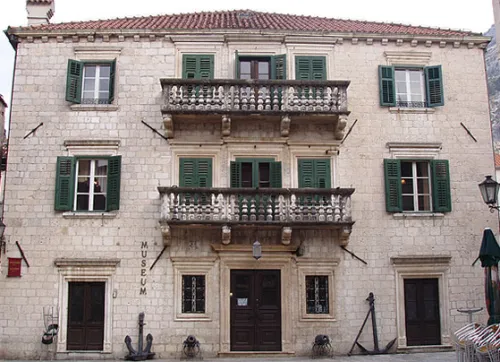
  5. Maritime Museum of Montenegro in Kotor, stop 5 on the self-guided walking tour
    5Maritime Museum of Montenegro
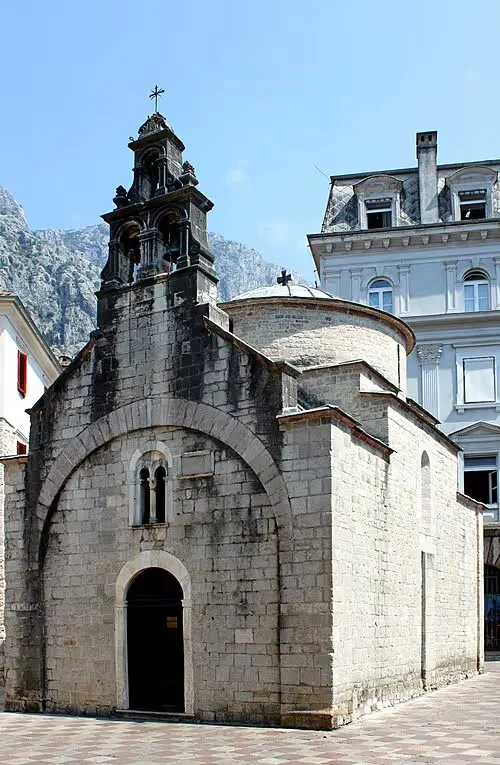
  6. Church of St. Luke in Kotor, stop 6 on the self-guided walking tour
    6Church of St. Luke
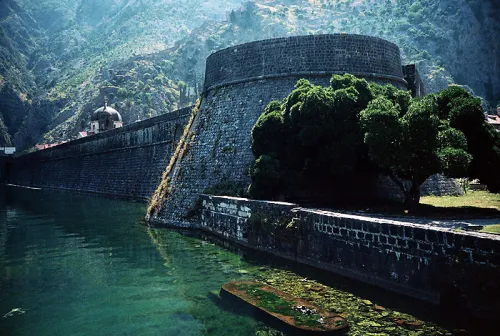
  7. Kotor City Walls, stop 7 on the self-guided walking tour
    7Kotor City Walls
  8. That's the full route.

    Walk it with an AI Tour Guide talking you through every one of these streets.

    Start free in your browser
    You made it

Your Kotor Walking Tour Through the Old Town, Stop by Stop

  1. 1

    Sea Gate

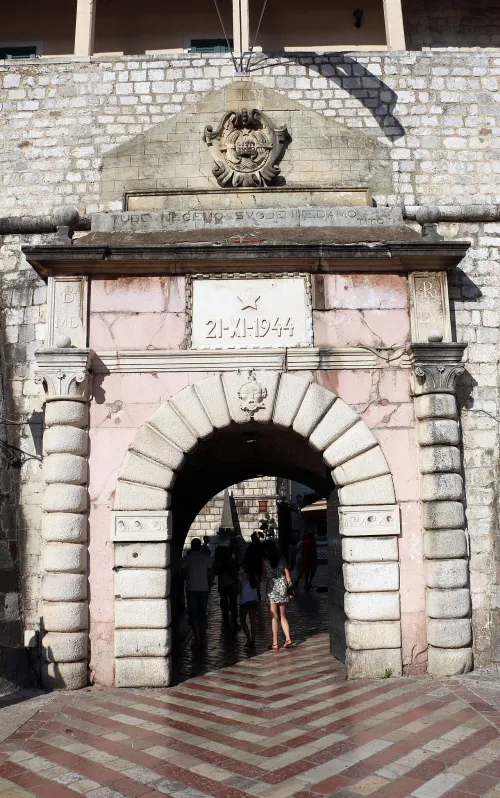
    Sea Gate in Kotor, stop 1 on the self-guided walking tour

    Your walk begins at the Sea Gate, Vrata od Mora in Montenegrin, the main entrance to Kotor's Old Town. It is also known as the West Gate and is the biggest of the town's three gates. The Venetians built it in the 16th century, during the long period when Kotor belonged to their republic, and they made sure everyone arriving knew who ruled here.

    Look up before you walk through. Above the archway sits a winged lion of St. Mark, the emblem of the Venetian Republic, carved in the 15th century and so older than the gate it now crowns. Under it is a relief of the Madonna and Child flanked by two saints: Saint Bernard and Saint Tryphon, Kotor's patron, whose cathedral you will reach a few minutes from now.

    The gate is free and open at all hours, so it is an easy place to start the free GPS route at whatever time suits you. From here it's 80 m, about a minute, onto Kotor Town Square.

    Local name
    Vrata od Mora
    Hours
    Freely accessible, no opening hours
    Price
    Free
  2. 2

    Kotor Town Square

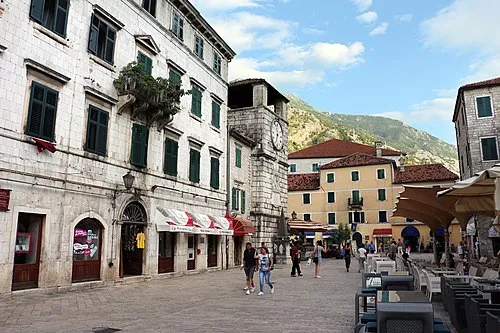
    Kotor Town Square, stop 2 on the self-guided walking tour

    This is Trg od Oružja, the Arms Square, the main and largest square in Kotor. The name goes back to Venetian times, when munitions were made and stored here. Today the same space is full of shops, banks, cafés, bakeries and pastry shops, and it is lined with some of the town's important historic buildings.

    On the western side stands the Rector's Palace, built in the 17th century. It once housed the town's Venetian authority and is now part of the luxury Hotel Cattaro, so you can admire its façade but it is not a sight you visit.

    The building known as Napoleon's Theatre has the better story. It dates from the 17th century and became a theatre in 1810, under French rule, making it one of the first theatres built in the Balkans. It stayed a stage until the late 19th century, served as the Town Hall during the 20th century and today holds the reception of the same Hotel Cattaro.

    Your next stop is already in view: the Clock Tower, with the pillory in front of it. It's 100 m, about a minute's walk.

    Hours
    Freely accessible, no opening hours
    Price
    Free
  3. 3

    Clock Tower

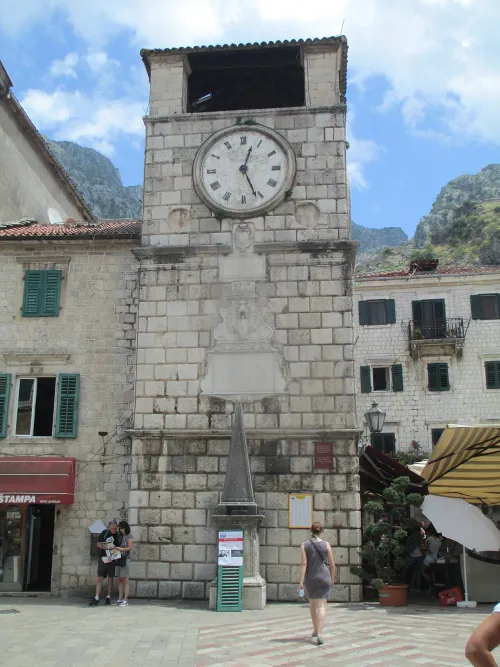
    Clock Tower in Kotor, stop 3 on the self-guided walking tour

    The stone Clock Tower has stood at the entrance to the Old Town since 1602. Look closely and you will see it is not quite straight. The tower leans slightly, damaged by the earthquakes of 1667 and 1979, two dates you will meet again at the cathedral.

    It is also a building of two styles. Parts of it are Baroque, while the northern and eastern façades were built in Gothic style, so walk around it and compare the sides.

    At its base stands the Pillar of Shame, a reconstructed medieval pillory. Convicted criminals were put on public display here, in the busiest spot in town, where everyone coming through the gate would see them. It's a small stone column, easy to miss among the café tables, and one of the more vivid reminders of how the town once kept order.

    The tower and the pillory are free to see at any hour. The Cathedral of Saint Tryphon is 80 m on, about a minute away.

    Hours
    Freely accessible, no opening hours
    Price
    Free
  4. 4

    Cathedral of Saint Tryphon

    Cathedral of Saint Tryphon in Kotor, stop 4 on the self-guided walking tour

    The cathedral is one of the symbols of Kotor. Its story starts in 809, when a church was built here and a Kotor citizen, Andrea Saracenis, who paid for it, bought the relics of Saint Tryphon from Venetian merchants. The Byzantine emperor Constantine VII Porphyrogenitus mentioned that first church in his work De Administrando Imperio. For centuries people believed it had been round; excavations in 1987 showed it was a vaulted building instead, and the mix-up may come from a mistranslation of the emperor's text.

    The cathedral you see now was begun in 1124 under Bishop Ursacius and consecrated on 19 June 1166 by Bishop Maio, together with five more bishops and eight abbots, in front of Kotor's nobility and the Byzantine governor Isaac. It is Romanesque with Byzantine elements, but earthquakes in 1537, 1563, 1667 and 1979 forced repeated rebuilding, and each repair added the taste of its time, especially Renaissance and Baroque touches.

    The western façade shows this best. The original towers and front fell in 1667; the replacements are uneven, the northern tower 33 m high and the southern 35 m, along with new portals, a rose window, a terrace and a porch.

    Is it worth paying to go in? If you pay for only one interior in the Old Town, make it this one. It is a three-aisled basilica, 35.21 m long and 17.47 m wide, with a dome over the middle bay and an apse at the end of each aisle; the main apse holds a fine Gothic triple window. The bishop's residence and the Drago Palace stand on the same square.

    The Maritime Museum of Montenegro is 100 m on, about a minute away, in the baroque Grgurina Palace.

    Price
    4 EUR
  5. 5

    Maritime Museum of Montenegro

    Maritime Museum of Montenegro in Kotor, stop 5 on the self-guided walking tour

    The Pomorski muzej is the only museum of its kind in Montenegro, and it tells the story of the seafaring Bay of Kotor. It is housed in an 18th-century baroque palace of the noble Grgurina family, on the Square of the Boka Navy in the middle of the Old Town.

    Its roots go back to the Boka Navy, the old brotherhood of local seafarers. Their collection of historic objects was started around 1880 and opened to the public in 1900. Members began collecting in earnest early in the 20th century, and a town council session in 1906 set up an antiquities society under councillor Ivan Radimir, though little came of it until the museum itself was founded in 1938. At first it took only one floor of the present building; after the Second World War it moved into the whole palace.

    The museum is more than display cases. It hosts book launches, painting exhibitions and concerts, and its large terrace serves as a venue for receptions during summer events. A conservation workshop with two conservators looks after the museum's pieces and also helps with artefacts from across the town, since many valuable objects sit in private collections.

    Go in if ships, sailors and the history of the bay interest you; if you are short on time, the façade is enough. You buy your ticket at the desk. The Church of St. Luke is only 50 m on, about a minute away.

    Local name
    Pomorski muzej
  6. 6

    Church of St. Luke

    Church of St. Luke in Kotor, stop 6 on the self-guided walking tour

    This small church on St. Luke's Square is one of the oldest in Kotor. It was built in 1195 as an Orthodox church, in the time of the Serbian Nemanjić dynasty. The founders' inscription survives on the western façade: Mauro Kacafrangi built it with his wife Bona, during the reign of Grand Župan Nemanja and his son Vukan. Frescoes were painted soon after; only small fragments remain on the south wall.

    Its later history mirrors the town's. Under Venice the church was Roman Catholic. In the mid 17th century it was returned to the Orthodox community, but the Catholic altar on the south wall stayed, and for a time both the Orthodox liturgy and the Catholic Mass were held here. That is why you may hear it called the church with two altars, although Napoleonic authorities removed Latin altars from all Orthodox churches in 1810. A Venetian report from 1768 describes it as the only church in town where the daily service was held in Serbian.

    St. Luke's came through the 1979 earthquake with little damage, unlike so much around it. It keeps relics of Saint Luke, of five martyrs and of Saint Barbara.

    In summer you can step in freely at any time, and it is well worth a few quiet minutes. The rest of the year it opens only for ceremonies such as baptisms and weddings, so you'll admire it from the square. The last leg to the Kotor City Walls is 160 m, about 2 minutes.

    Hours
    Summer: freely accessible at any time. Autumn/winter/spring: no regular visitor access, church opens only for ceremonies (baptisms, weddings etc.).
    Price
    Free
  7. 7

    Kotor City Walls

    Kotor City Walls, stop 7 on the self-guided walking tour

    The route ends at the walls, part of a whole fortification system of ramparts, towers, citadels, gates, bastions, forts and cisterns that protected medieval Kotor and reaches up the mountain of St. John. Illyrian, Byzantine, Venetian and Austrian military builders all left their mark. In 1979 the walls, together with the Old Town and its natural surroundings, became a UNESCO World Heritage Site, the only cultural one in Montenegro; in 2017 they were also listed among the Venetian Works of Defence.

    The mountaintop was already fortified in Illyrian times, and Emperor Justinian I rebuilt the fortress in the 6th century. The walls got their present shape after 1420, when the independent Republic of Cattaro came under Venice, and held out against two Ottoman sieges. Then the owners changed fast: the Habsburgs in 1797, Napoleon's Kingdom of Italy in 1805, Russian troops under Dmitry Senyavin until 1807, and the French Illyrian Provinces from 1810.

    The best story belongs to the British captain William Hoste. With his ship HMS Bacchante, he hauled cannon up to positions above the fort using block and tackle, a move called unmilitary at the time, and began shelling. After a ten-day siege the French garrison surrendered on 5 January 1814.

    The walls charge admission, though Montenegro residents, younger children, disabled visitors and eligible school groups go free. The ticket booths keep seasonal hours; in winter they are closed and you climb at your own risk. Staying on the walls or climbing at night is prohibited. If you have the energy, this is the way to finish: from the Old Town's streets you climb into its defences.

    Hours
    Daily: Mar–Apr 08:00–18:00; May–Sep 07:00–20:00; Oct–Nov 08:00–17:00. Dec–Feb toll booths closed; climb at own risk. Staying on/climbing after 22:00 is prohibited.
    Price
    15 EUR individual ticket; fee exemptions include Montenegro residents, children under 12, disabled visitors and eligible school groups.

Walking tour route map of Kotor Route loaded
Sea GateKotor Town SquareClock TowerCathedral of Saint Tryphon+3
All 7 stops are already on the map.
You just press start.
AI Tour Guide

You've read the route. Now walk it with a guide in your ear.

Press start wherever you are, even hundreds of kilometres from Kotor, and the guide begins telling its stories right away. In the city, pick any of the 7 stops to start from: it leads you there, then talks with you the whole route, asking, listening, remembering, and shaping the tour around your answers.

7stops 0.6km 8 minwalking 13languages
▶Start the tour free

Free to start · Runs in your browser · No app, no download

Shorter and Longer Ways to Walk the Route

The stops sit so close together that the real difference between versions is how many doors you go through and whether you take on the walls.

The quick Venetian core

Stops: 1, 2, 3, 4

For a short visit: gate, square, Clock Tower and cathedral. 260 m and about 3 minutes of walking. The only possible cost is the cathedral ticket if you go inside.

The whole Old Town, no climb

Stops: 1, 2, 3, 4, 5, 6

For history and museum lovers who would rather stay at street level. 410 m and about 5 minutes of walking. You pay admission for the cathedral and the museum, the latter at its desk; St Luke's is free when it is open.

The full route up to the walls

Stops: 1, 2, 3, 4, 5, 6, 7

For anyone with energy and a few hours. 0.6 km and 8 minutes of walking to the walls entrance, then the climb. Budget for tickets to the cathedral, the museum and the walls.

How Long the Kotor Tour Takes, With and Without the Walls

The walking itself barely registers: 8 minutes in total, no leg longer than 160 m. Your time goes into looking. At an easy pace with everything seen from outside, an hour is plenty for the Old Town stops.

Go inside the cathedral and spend a proper while in the museum and you are close to two hours before you reach the walls. The climb then needs its own generous block of time, so keep half a day free if you want everything. The quick core version fits into well under an hour, the version without the walls into roughly two.

Before You Set Off at the Sea Gate

  • Start and finish: The recommended start is the Sea Gate, but you can join at any stop. The route ends at the entrance to the Kotor City Walls.
  • When to go: If you want to climb the walls, start in the morning so you have plenty of time before the ticket booths close. St Luke's is only open to visitors in summer.
  • What it costs: The route, map and GPS navigation are free. The cathedral, the walls and the museum charge admission; the museum ticket is paid at its desk. The AI Tour Guide starts with 100 free credits; after that you choose €19.99 for this tour with no time limit, or €5 per hour.

Food and Breaks Along the Old Town Route

The Old Town is small enough that a coffee, a pastry or a proper meal is never more than a few minutes off the route. Some of the better value sits just outside the walls.

Pescaria DekaderonA good breakfast stop before you go into the cathedral. (Opposite the Cathedral of Saint Tryphon)
The Square PubBurgers are the thing here, and the gourmet stuffed burger is the one to order. (Across from the Cathedral of Saint Tryphon)
Senso BakeryCrispy, flaky croissants and krempita, the local custard slice. (In the Old Town)
Marshall's GelatoComes in small, medium and large cups.
Konoba Scala SantaKotor's oldest restaurant, open since 1931, with an open fireplace and low wooden beams. Known for its fish stew, with pasta, risotto and seafood also on the menu. The terrace on the square is summer only. Book at least two days ahead. (Trg od Salate)
La Catedral Pasta BarOutdoor seating only. Pistachio cream pasta and a carbonara made with eggs, not cream. Reserve two days ahead or expect a long wait at lunch and dinner. (A small side street in the Old Town)
BBQ TanjgaA no-frills, family-run grill with huge marinated meat platters, plus sandwiches and half a roast chicken with potatoes and four salads. Expect to queue for a seat, then wait again for the food. (Just outside the Old Town near the Gurdić Gate)
Restobar TaracaA riverside terrace facing the old walls and one of the few places in Kotor with a real vegan and vegetarian menu. The falafel bowl is the standout. (North side of the Old Town on the Skurda River, near the Ladder of Kotor hike)
Gradska pijaca food marketThe local market; go at the weekend, when farmers bring their produce. (Outside the Old Town walls, between the Sea Gate and the Southern Gate)

Tourist Traps to Avoid in Kotor's Old Town

  • Fish of the day without a menu: A waiter offers the catch of the day verbally, and the bill shows a shocking price for one fish. Fish priced per kilo without a stated portion and unrequested bread or cover charges work the same way. Ask for a printed menu with prices before you sit down.
  • Restaurants that call you in from the square: English-only menus, photos of the food and waiters pulling you in from the street are the warning signs. Walk two streets toward the Skurda River for similar quality at lower prices.
  • Card conversion and unbranded ATMs: When paying by card, decline conversion to your home currency and pay in euros. Avoid unbranded ATMs in the Old Town: high fees and a known target for card skimmers. Count your change when breaking large notes.
Walking tour route map of Kotor
AI Tour Guide

Your guide is ready when you reach the Sea Gate.

Press start and a voice AI Tour Guide takes it from here: leading the route through Kotor, telling the stories, and turning your walk into a real back-and-forth conversation. No app or download is needed; it runs in your browser.

7stops 0.6km 8 minwalking 13languages
▶Start the tour free

Free to start · Runs in your browser · No app, no download

What the AI Tour Guide Adds in Kotor

On a route this compact, the AI Tour Guide gives you the conversation the short walks leave room for. It greets you at the Sea Gate, tells the stories of each place as you go, asks what caught your interest and builds on it, so if Venice's centuries hold you, it follows that thread through the squares. You might ask what a sailor's life in the Bay of Kotor was like, or how the town recovered after the 1979 earthquake, and interrupt it whenever you like. The GPS route stays free; the guide is there when you want company.

A Real Conversation A voice AI Tour Guide greets you, leads the whole route, and tells the stories and facts as you walk, asking what you want to see and keeping a real conversation going. Not a recording you press play on.
Map Navigation Follow the route on the map and walk at your own pace. You choose where to start and when to move to the next stop.
Ask Anything Curious about a building you pass? Ask your AI Tour Guide on the spot and the conversation carries on.
13 Languages Switch language anytime. No separate tour needed.
Start free in your browser

Common Questions About Walking Kotor

Can I go inside the Church of St. Luke outside summer?

Usually not. In summer you can walk in at any time; the rest of the year the church only opens for ceremonies such as baptisms and weddings, so you'll see it from the square.

Can I climb the Kotor walls in winter?

Yes, but in winter the ticket booths are closed and you climb at your own risk. Staying on the walls or climbing at night is prohibited all year.

Who gets into the walls for free?

Montenegro residents, younger children, disabled visitors and eligible school groups don't need a ticket.

Can I combine Kotor with Dubrovnik?

Dubrovnik is 59 km away, and the Dubrovnik walking tour works the same way: free GPS route, optional AI Tour Guide.

Is the tour really free?

Yes. The whole tour is free: the route, the interactive map and the navigation cost you nothing. Only the voice AI Tour Guide is optional and paid: you test it with 100 free credits, then you pay either €5 per hour or €19.99 for this whole tour, with no time limit. Admission to 3 of the 7 stops is not included: Cathedral of Saint Tryphon, Maritime Museum of Montenegro and Kotor City Walls charge their own entry fees.

Do I need to download an app?

No. Everything runs in your phone browser. Open the route and start walking, no download and no sign-up required.

Do I need to book the walking tour in advance?

No booking needed. This self-guided tour is available anytime. Open the route in your browser and start walking. The AI Tour Guide works instantly, no app, no reservation required.

What languages is the AI Tour Guide available in?

The AI Tour Guide speaks 13 languages, so you take the tour in your own language and can switch at any time.

Can I skip stops or change the route?

Yes. Skip any stop, spend extra time at places you like, or start the route from any point. It is your walk, you set the pace.
Image credits
▶ Start free in your browser Runs in your browser, no app, no download