Free Walking Tour Ostuni:Gate, Cathedral and Column
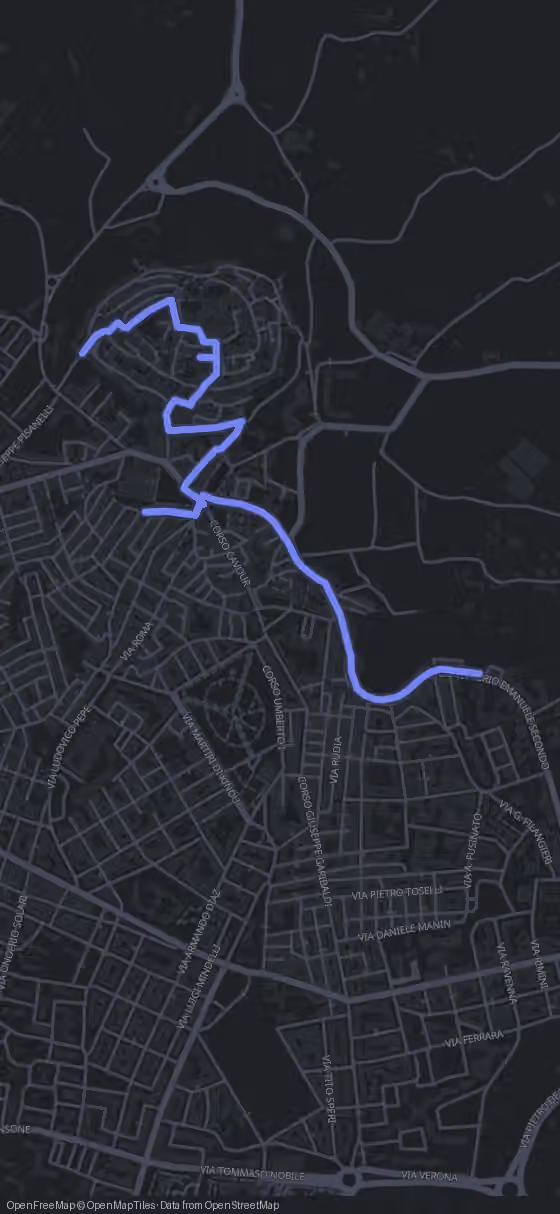
Seven stops on 1.6 km: through a 15th-century gate to a cathedral of pale local stone, a 27,000-year-old burial and a baroque column raised against the plague.
Only the museum charges admission; everything else is free. The GPS route runs free in your browser and leads you from stop to stop, and the optional AI Tour Guide can tell the stories as you go.
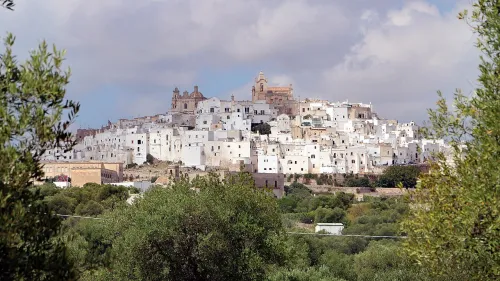
Begin at the gate, because Porta Nova sets the terms for everything that follows. It is a 15th-century opening in the Aragonese city wall, the defensive ring that once closed off the old town. Pass through it and you are inside the historic centre, which climbs towards its cathedral on the highest ground in the city.
Take a moment before you go through. The gate was built to control who came in and out, and the wall it belongs to was the town's protection for centuries. Today it is simply part of the street: nobody sells tickets, nobody locks it at night, and you can walk through at any hour.
That is also the best introduction to this walk. Most of what follows is public space you simply wander through, and only one stop asks for a ticket.
From here it is 220 m and about 4 min through the alleys of the old town to Arco Scoppa, where church power announces itself above your head.
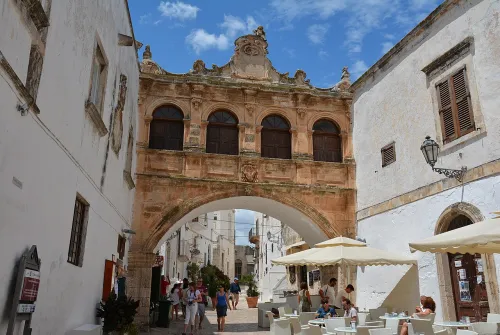
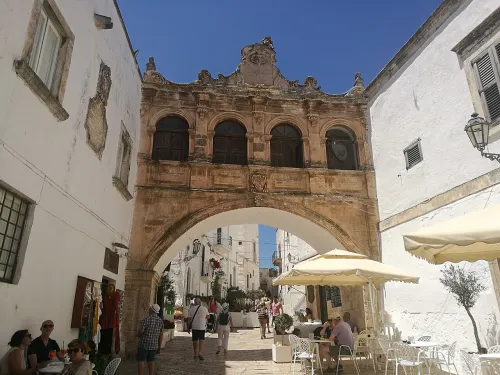
The first alley stretch ends at Largo Trinchera, also signed as Piazza Giovanni Paolo II, where Ostuni keeps one of the oddest structures on this route. Arco Scoppa is a baroque arch built in 1750, and it has one job: it connects the bishop's palace with the former seminary across the street.
Look up as you walk under it. The arch is a bridge between two church buildings, a way for clergy to cross without stepping into the lane, and at the same time a statement that this corner of town belonged to the bishop. It is free and visible at any hour, and you could pass beneath it in a few strides.
Give it longer than that. The arch only makes sense as a group with the buildings it links, the palace on one side and the seminary on the other, so stand back and take in all three before moving on.
The cathedral is just 20 m away, about a minute. On that short stretch you pass the Orizzonti Arte Contemporanea gallery and the Diocesan Museum of Ostuni. The route now shifts from the church's power to the church itself.
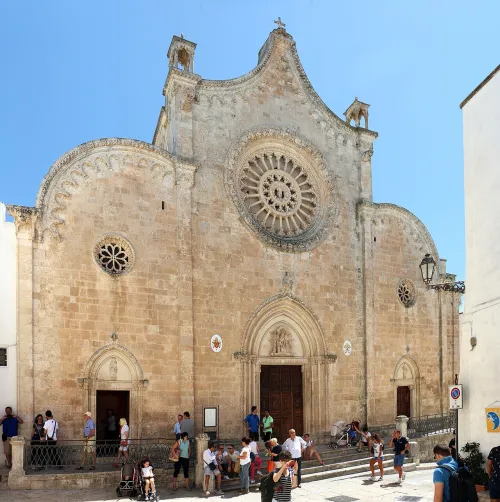
Ostuni Cathedral, the Concattedrale di Santa Maria Assunta, is dedicated to the Assumption of the Virgin. Its story goes back further than the building you see: before the year 1000 a church following Orthodox rites stood here. Frederick II of Swabia had the present Romanesque church built in 1228 and 1229, mostly in pietra gentile, the soft, easily carved local limestone with its delicate colour.
Then came the earthquake of 1456, which badly damaged the church. It was rebuilt again between 1469 and 1495, this time in Gothic style, and in the 15th century the facade received its elegant rose window. Look for it first; the church once had four of them. Then find the portal dedicated to San Biagio, Saint Blaise, one of the city's patrons, whose figure is carved on it.
The interior is free and worth half an hour if churches interest you. Artworks cover the ceiling and altars. The Cappellone dell'Immacolata was decorated in the 18th century, the apse holds an altarpiece of the Assunta, and the chapel of Santa Maria della Sanità has a fresco of Saint Catherine of Alexandria. In a niche of the inner facade stands a 15th-century statue of Christ, and one chapel honours all four patron saints of Ostuni: Blaise, Augustine, Orontius and Irene. The sacristy keeps a large, venerated icon of Saint Oronzo.
Some of what you see was hidden for a long time: a restoration in the 1970s removed later stucco that covered Romanesque and Gothic details. Not everything survived the centuries, though; a canvas of Santa Lucia by Palma il Giovane was stolen. The building has been a National Monument since 1902.
Museum of Pre-Classical Civilizations of the Southern Murgia
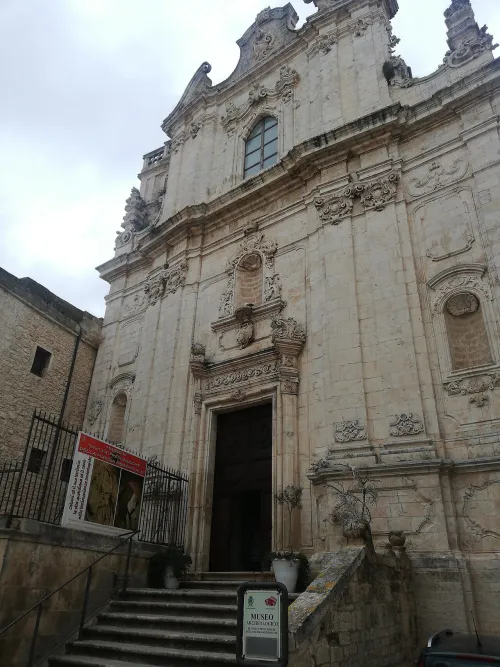
The Museum of Pre-Classical Civilizations of the Southern Murgia takes you much further back than the cathedral. It opened on 14 May 1989 in the former Carmelite monastery of Santa Maria Maddalena dei Pazzi, together with the attached church of San Vito Martire. It started with finds from the countryside around Ostuni and over time gathered material from almost the entire southern Murgia.
Its centrepiece is the Donna di Ostuni, also known as Ostuni 1: a woman of about 20 who died around 27,000 years ago while pregnant, the remains of an advanced foetus still within her. She was buried with care. Around her wrists lay bracelets of pierced shells, the right one combining several kinds of sea snail shells with a pierced deer canine, and on her head a cap of about six hundred shells bound with red ochre, along with stone tools and animal remains.
The rest of the collection runs from the Palaeolithic to the metal ages: pottery, ornaments, flints and stone tools. A second focus is the Messapian period, with grave goods from tombs, jugs and vases including a trozzella with geometric decoration, coins and votive terracottas. An exhibition opened in 2005 presents Messapian and Greek inscriptions from the sanctuary of Agnano.
This is the only stop with an entrance fee. If prehistory moves you, give it an hour; if you are short on time, it is the stop to drop.
From here the longest leg begins: 540 m, about 8 min, down to Piazza della Libertà.
Local name
Museo di civiltà preclassiche della Murgia Meridionale
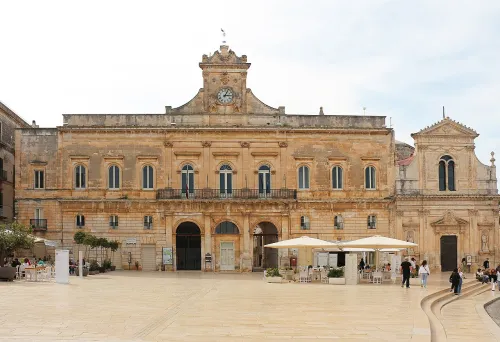
Piazza della Libertà opens up after the tight alleys, and the first building to read is Palazzo San Francesco, which needs an honest label: it is Ostuni's town hall.
A Franciscan monastery stood on this spot from the 14th century. In the 19th century it was rebuilt, and today it wears a neoclassical facade and houses the municipal offices. So as a visitor you get the facade and the square, and that is the whole stop, done properly.
Walk the length of the front and notice the scale: a monastery's footprint still gives this government building its size. Then turn round, because the square holds the next stop, just 100 m and a minute away.
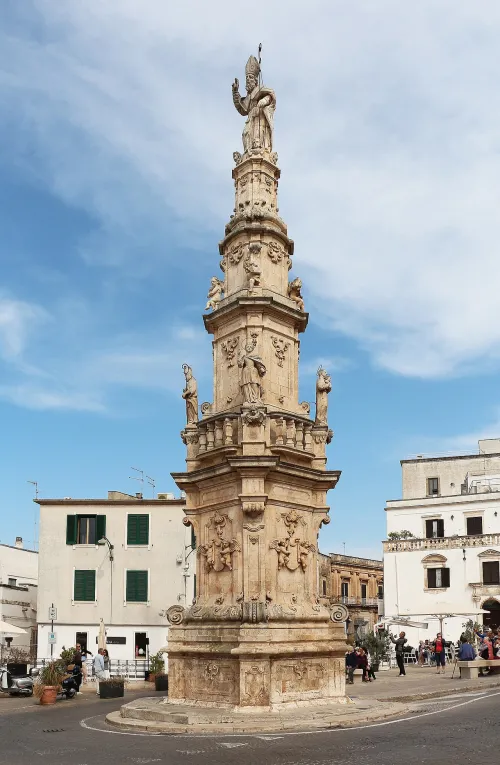
The Colonna di Sant'Oronzo, also called the guglia, rises about twenty metres over Piazza della Libertà. The Ostuni sculptor Giuseppe Greco made it in 1771 as an act of devotion and gratitude to the city's protector, Saint Oronzo, for saving Ostuni from the plague. You met him already in the cathedral sacristy, on the icon.
Read the column from the bottom up. Above a first base rise four levels of baroque decoration, rich with cartouches bearing Latin phrases, angels and frames. At the very top stands Saint Oronzo, giving his blessing and turned towards the old town he is said to have protected.
The richest level is the second, ringed by a slightly projecting balustrade with a saint at each of its four corners. Santa Lucia is the surest identification. A bishop saint with a book is probably Saint Augustine of Hippo, and a Jesuit holding a child is taken to be San Bernardino Realino of Lecce. The fourth figure is attributed to Saint Irene, though she has lost an arm and the palm of her martyrdom. Augustine and Irene are two of the patron saints you saw honoured in the cathedral chapel.
Entry is free and the column stands open at any hour. The last leg is the longest: 600 m and about 9 min, passing the Piazzetta Martiri delle Foibe on the way to the viewpoint.
The walk ends at the Corso Vittorio Emanuele II Viewpoint. It is free and open at any hour, so there is no rush: take your time here after the alleys, the churches and the square.
This is a good place to look back over what you have walked, from the Aragonese gate and the bishop's arch to the cathedral of Frederick II and the plague column. The route does not return to Porta Nova, so plan your next move from here.
All 7 stops are already on the map. You just press start.
AI Tour Guide
You've read the old town. Now walk it with a guide in your ear.
Press start wherever you are, even hundreds of kilometres from Ostuni, and the guide begins telling its stories right away. In the city, pick any of the 7 stops to start from: it leads you there, then talks with you the whole route, asking, listening, remembering, and shaping the tour around your answers.
Free to start · Runs in your browser · No app, no download
Shorter Ways Through Ostuni
Not every visit needs all seven stops. These cuts follow the recommended order and keep the walking short.
Old town core with the museum
Stops: 1, 2, 3, 4
For history and archaeology lovers with limited time: gate, arch, cathedral and museum lie close together, 320 m and about 6 min of walking in total. The cathedral is free, the museum charges admission. With both interiors, plan roughly an hour and a half.
Piazza della Libertà and the viewpoint
Stops: 5, 6, 7
If you already know the upper old town or arrive in the newer centre: town hall facade, the Sant'Oronzo column and the walk to the viewpoint add up to 700 m and about 10 min on foot. All three stops are free; half an hour is enough.
The full walk, outside only
Stops: 1, 2, 3, 4, 5, 6, 7
For a first look on a tight schedule or outside opening times: all seven stops, 24 min of walking, nothing to pay. Skip the museum, look at the cathedral facade and portals, and you are done in about 45 minutes.
How Long the Ostuni Tour Takes, With and Without Interiors
The walking itself takes 24 min over 1.6 km, and most legs are short: the arch, the cathedral and the museum sit within 100 m of each other. The two longer stretches come after the museum, 540 m to Piazza della Libertà and 600 m out to the viewpoint.
Realistically, give the cathedral interior about half an hour and the museum about an hour, plus a few minutes at each outdoor stop. That makes about two hours for the whole route. Leave out the museum and you need about an hour and a quarter; stay outside everywhere and about 45 minutes is enough.
Before You Set Off in Ostuni
Start: Porta Nova is the recommended start, but you can join at any stop and follow the order from there.
Finish: The walk ends at the Corso Vittorio Emanuele II Viewpoint, not back at the gate, so plan your way onward from there.
Best time: Go when the cathedral and the museum are open, since both keep set daytime hours with a break around midday at the cathedral. The gate, the arch, the column and the viewpoint can be seen at any hour.
Admission: The Museum of Pre-Classical Civilizations of the Southern Murgia is the only stop with an entrance fee. The cathedral and all other stops are free.
AI Tour Guide
Your guide is ready whenever you reach the old town.
Press start and a voice AI Tour Guide takes it from here: leading the route through Ostuni, telling the stories, and turning your walk into a real back-and-forth conversation. No app or download is needed; it runs in your browser.
Free to start · Runs in your browser · No app, no download
What the AI Tour Guide Adds in Ostuni
Ostuni packs a lot of saints, bishops and centuries into a small space, and the AI Tour Guide is good at joining them up as you walk: it starts the conversation at each stop, tells the stories, asks what caught your eye and remembers it for later. Curious what the Latin cartouches on the column actually say, or how the Messapians lived around Ostuni before the Romans? Ask, and the conversation goes there. It does not change the route; the free GPS navigation still leads you from stop to stop.
A Real Conversation
A voice AI Tour Guide greets you, leads the whole route, and tells the stories and facts as you walk, asking what you want to see and keeping a real conversation going. Not a recording you press play on.
Map Navigation
Follow the route on the map and walk at your own pace. You choose where to start and when to move to the next stop.
Ask Anything
Curious about a building you pass? Ask your AI Tour Guide on the spot and the conversation carries on.
13 Languages
Switch language anytime. No separate tour needed.
Ostuni was once the seat of its own diocese. Since 1986 the cathedral has been a co-cathedral of the Archdiocese of Brindisi-Ostuni, sharing that role with the cathedral in Brindisi.
Can I combine Ostuni with another town on the same day?
Yes. Alberobello is 29 km away and Polignano a Mare 42 km, both easy pairings. Lecce at 65 km and Matera at 82 km are bigger walks that deserve their own day.
How do I get back to Porta Nova after the viewpoint?
The route ends at the Corso Vittorio Emanuele II Viewpoint. If you need to return to the gate, simply retrace the walk in reverse or let your map lead you back.
Is the tour really free?
Yes. The whole tour is free: the route, the interactive map and the navigation cost you nothing. Only the voice AI Tour Guide is optional and paid: you test it with 100 free credits, then you pay either €5 per hour or €19.99 for this whole tour, with no time limit. Admission to one of the 7 stops is not included: Museum of Pre-Classical Civilizations of the Southern Murgia charges its own entry fee.
Do I need to download an app?
No. Everything runs in your phone browser. Open the route and start walking, no download and no sign-up required.
Do I need to book the walking tour in advance?
No booking needed. This self-guided tour is available anytime. Open the route in your browser and start walking. The AI Tour Guide works instantly, no app, no reservation required.
What languages is the AI Tour Guide available in?
The AI Tour Guide speaks 13 languages, so you take the tour in your own language and can switch at any time.
Can I skip stops or change the route?
Yes. Skip any stop, spend extra time at places you like, or start the route from any point. It is your walk, you set the pace.