Free Walking Tour Dubrovnik: Walls, Stradun and Old Port

Start at a fortress on a sea rock, pass through Pile Gate and follow Dubrovnik's polished main street to the harbor where the Republic built its galleys.

12 Stops 2.1 km ~30 min walking
Route map for the Dubrovnik walking tour
Stop 1 of 12
250 m·3 min
Fort Lovrijenac
Head east toward Pile Gate
Welcome to Dubrovnik. I'm Alex, and our first story begins with a fortress designed to betray any invader who captured it.
Try this tour with Alex

Dubrovnik's Old Town Route at a Glance

12 stops from Fort Lovrijenac on its rock outside the walls to the Franciscan Monastery on the Stradun: 2.1 km and 30 min of pure walking. Seen from outside, it takes about two hours; with the walls, the fort and the main interiors, plan close to eight hours including lunch.

Pile Gate, Onofrio's Large Fountain, the Church of St. Blaise, the Jesuit Stairs and the Old Port are free. Fort Lovrijenac, the Dubrovnik City Walls and the Rector's Palace charge entry. The GPS route in your browser is free; the AI Tour Guide is optional.

Open free GPS & optional AI Tour Guide
This short shows highlights of the route. All 12 stops follow below.

The Route

Walking Map of Dubrovnik's Old Town Route

12 stops 2.1 km 30 min walking
Tap to load interactive map

The 12 stops along this route

  1. Fort Lovrijenac in Dubrovnik, stop 1 on the self-guided walking tour
    1Fort Lovrijenac
  2. Pile Gate in Dubrovnik, stop 2 on the self-guided walking tour
    2Pile Gate
  3. Dubrovnik City Walls, stop 3 on the self-guided walking tour
    3Dubrovnik City Walls
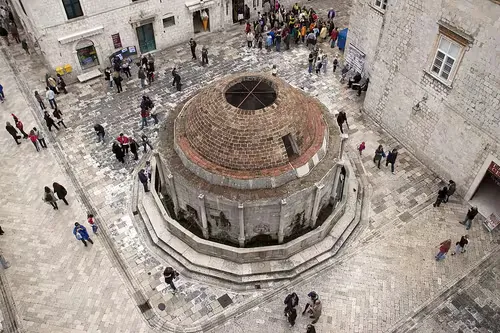
  4. Onofrio's Large Fountain in Dubrovnik, stop 4 on the self-guided walking tour
    4Onofrio's Large Fountain
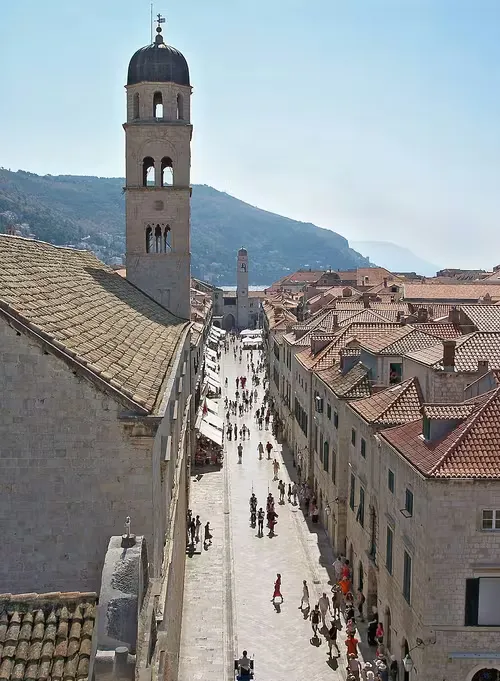
  5. Stradun in Dubrovnik, stop 5 on the self-guided walking tour
    5Stradun
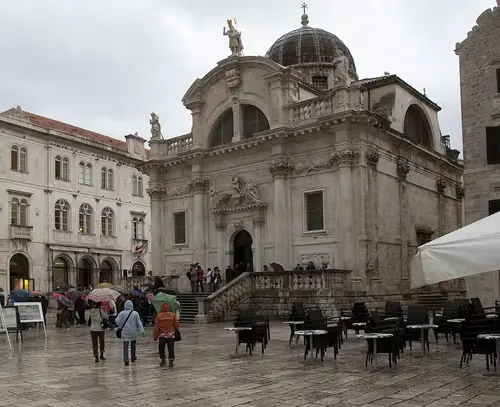
  6. Church of St. Blaise in Dubrovnik, stop 6 on the self-guided walking tour
    6Church of St. Blaise
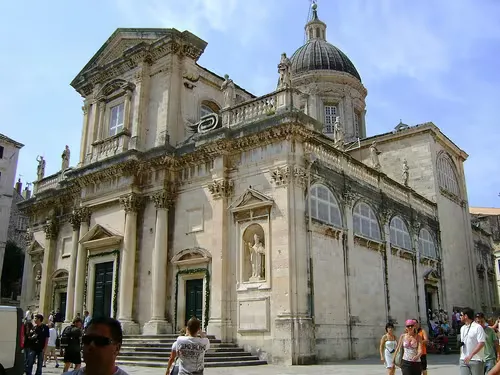
  7. Dubrovnik Cathedral, stop 7 on the self-guided walking tour
    7Dubrovnik Cathedral
  8. 8Jesuit Stairs
  9. Old Port in Dubrovnik, stop 9 on the self-guided walking tour
    9Old Port
  10. Rector's Palace in Dubrovnik, stop 10 on the self-guided walking tour
    10Rector's Palace
  11. Sponza Palace in Dubrovnik, stop 11 on the self-guided walking tour
    11Sponza Palace
  12. Franciscan Monastery in Dubrovnik, stop 12 on the self-guided walking tour
    12Franciscan Monastery
  13. That's the full route.

    Walk it with an AI Tour Guide talking you through every one of these streets.

    Start free in your browser
    You made it

Your Dubrovnik Walking Tour, from Sea Fortress to Friary

  1. 1

    Fort Lovrijenac

    Fort Lovrijenac in Dubrovnik, stop 1 on the self-guided walking tour

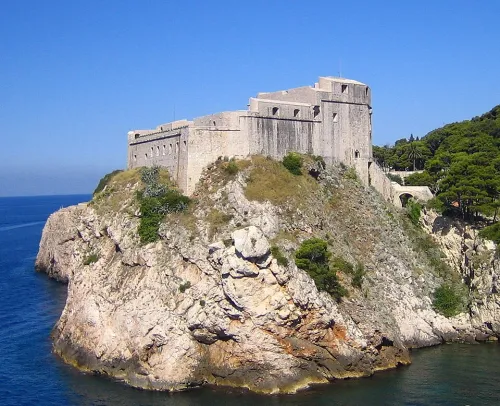
    Your walk begins outside the walls, on a 37 metre rock west of the Old Town. Fort Lovrijenac is a triangular, sharply pointed fortress whose ground plan simply follows the shape of the rock, which earned it the nickname "Gibraltar of Dubrovnik". Because the fort is not the same height all round, its inside is laid out as three terraces, each with its own parapet, and at the very heart sits a square courtyard under great vaults.

    The story of its founding is a race against Venice. Venice is said to have planned a hostile fortress on exactly this spot, and Dubrovnik built its own here first; some accounts date this to 1018 or 1038 and claim it went up in just three months. The first written record only appears in 1301, when the fort's commander was elected. The building took real shape in the 14th century and was reworked in the 15th and 16th, notably by the master builder I. K. Zanchi from Pesaro, with repairs after the earthquake of 1667.

    Look at the walls and you notice a striking difference. On the exposed sides they are up to twelve metres thick, while the side facing the city is only 60 centimetres. The widest face points toward the nearby Bokar fortress and once guarded the small harbor of Kolorina. A garrison of 25 soldiers and a commander served ten cannons here.

    Going in is worth it if you like fortifications or Game of Thrones, which used the fort as the Red Keep backdrop, and your walls ticket covers it on the same day. Then head down 250 m, about 4 min, to Pile Gate.
    Hours
    Daily 8:00–19:30
  2. 2

    Pile Gate

    Pile Gate in Dubrovnik, stop 2 on the self-guided walking tour

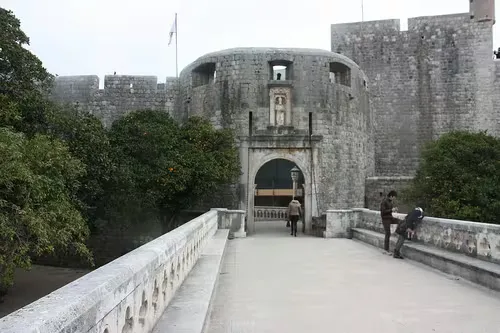
    Pile Gate is the western entrance to the Old Town and traditionally a visitor's first encounter with the city. The district and the gate share the name Pile, a word of Greek origin that simply means gate. You approach over a stone bridge on three arches, with stone benches along its parapet, built in 1471 by Paskoje Miličević, the city engineer whose name you will meet again at the harbor and the Sponza Palace.

    The stone bridge ends in a wooden drawbridge. In the days of the Republic it was raised at a fixed hour each night and lowered again early in the morning to let in people from the suburbs and the traders. The keys to the city gates were kept in the guardhouse of the Rector's Palace.

    The gate is really two. The outer gate, a Renaissance arch from 1573, sits in the wall of a semicircular fortress, with a statue of St. Blaise, the city's patron, above it. Between the outer and inner gates you can still see remains of the old Pile fortress, which existed as early as 972 and was pulled down in 1818. The inner gate, a Gothic arch from 1460, replaced an older gate recorded in the 13th century; its St. Blaise was carved by Ivan Meštrović, one of the finest Croatian sculptors of the 20th century.

    Pile Gate is free and open around the clock. From here it is 300 m, about 5 min, to the walls.

    Local name
    Vrata od Pila
    Hours
    Open 24/7
    Price
    Free
  3. 3

    Dubrovnik City Walls

    Dubrovnik City Walls, stop 3 on the self-guided walking tour

    The Dubrovnik City Walls wrap the entire Old Town: 1,940 metres long and up to 25 metres high, between four and six metres thick on the land side and between one and a half and three metres toward the sea. Towers guard all four sides. They were built for defence between the 13th and 17th centuries, and when the enclosure began, the town's area was already fixed and could never grow again.

    Every threat left its mark. In the 14th century fifteen square towers went up; when gunpowder arrived, the ramparts were thickened against artillery, and fear of Venice led the city to wall up every unneeded opening toward the harbor. The fall of Constantinople in 1453 prompted the Minčeta tower, and the wars between the Turks and Venice brought the towers of St. John and Revelin and the bastion of St. Margaret. Because danger was always close, the work went remarkably fast. The walls took on their present look in the 15th and 16th centuries.

    Behind them lived around 2,000 people when the city statute was written in 1272, rising to about 6,000 in the 15th century. That the walls were declared a cultural monument in 1921 is mostly thanks to the historian Lukša Beritić and the conservator Marko Murat. Today they draw huge numbers: 865,237 visitors in 2013 alone.

    For most first visitors the circuit is the reason to come, so it is worth the ticket. Go early: the busiest hours run roughly from 10:00 until 16:00. Opening times are posted at the ticket office. Coming down near Pile, it is 240 m, about 3 min, to Onofrio's Large Fountain.

    Local name
    Dubrovačke gradske zidine
  4. 4

    Onofrio's Large Fountain

    Onofrio's Large Fountain in Dubrovnik, stop 4 on the self-guided walking tour

    Just inside Pile Gate, in front of the convent of the Poor Clares, stands a polygonal fountain with sixteen stone masks, each spouting water. Onofrio's Large Fountain was built in 1438 by the Neapolitan builder Onofrio della Cava as the end point of Dubrovnik's new water supply.

    That supply was remarkable. Fresh water was brought in from a spring twelve kilometres away, a project with no known equal in Europe at the time, and it stayed in use until the end of the 19th century. In the city centre, people could draw water at two places, this large fountain and the small Onofrio fountain, plus a handful of minor ones.

    Originally the fountain was richly decorated; what you see now is its shape after the great earthquake of 1667. It even has a literary role: part of the Renaissance comedy Novela od Stanca by the Dubrovnik playwright Marin Držić is set here.

    The fountain is free and open day and night. Only 100 m, about 1 min, on, the Stradun opens in front of you.

    Local name
    Velika Onofrijeva česma
    Hours
    Open 24/7
    Price
    Free
  5. 5

    Stradun

    Stradun in Dubrovnik, stop 5 on the self-guided walking tour

    The Stradun, also called Placa, is the main street of the Old Town and of Dubrovnik as a whole. It runs east to west between Pile Gate and Ploče Gate, framed at each end by a fountain, the large and small Onofrio fountains, and by a bell tower, the City Bell Tower and that of the Franciscans. The name Placa comes from the Latin platea, street; Stradun came from the Venetians and was a mocking word for a big street.

    Look down at the paving: the stone blocks are worn as glossy as a wooden parquet floor, which is why locals call it a street-salon. The street took on its role in the 12th century, but its uniform look dates from after the catastrophic earthquake of 1667. Older paintings show buildings that varied far more, many with arcades like the Sponza Palace and some more ornate.

    After the quake the Republic's statute laid down how houses were to be built. The ground floor was always a shop with a so-called knee door, the large storeroom was entered from the side street, living space was on the first floor and bedrooms on the second. Kitchens went into the attic, because a fire after the earthquake had destroyed many buildings, and putting them up top stopped flames spreading.

    The street itself is open at all hours. The Stradun ends at Luža square below the City Bell Tower; walk 260 m, about 3 min, past the gallery War Photo Limited, to the Church of St. Blaise.

    Hours
    Daily: Open 24 hours (shops 09:00–22:00)
    Price
    Free
  6. 6

    Church of St. Blaise

    Church of St. Blaise in Dubrovnik, stop 6 on the self-guided walking tour

    St. Blaise is the patron of Dubrovnik and was the protector of the independent Republic of Ragusa, and his church shows it: a Baroque facade divided by four Corinthian columns, crowned by a semicircular gable and a balustrade with three statues by Marino Gropelli, St. Blaise in the middle flanked by Faith and Hope, with angels on the portal.

    The first church here was a vow in a crisis. In February 1349, a month after the Black Death reached Dubrovnik, the Great Council decided to build a Romanesque church for its protector. Because the plague had killed so many heirs and executors, property that fell back to the state paid for it, and the craftsmen Andelo Lorrin, Butko and Mihajlo Petrović finished it in three years. It soon ranked second only to the cathedral, survived the 1667 earthquake fairly well and then burned down in 1706.

    The building you see dates from 1715. The Venetian architect and sculptor Gropelli modelled it on Sansovino's church of San Maurizio in Venice: a single square nave on the plan of a Greek cross, a central oblong dome and a barrel-vaulted, richly Baroque interior. On the main altar of white and coloured marble, look up into the high niche for the gilt silver Gothic statue of St. Blaise, made in the 15th century by an unknown local master.

    Entry is free, and it is worth timing your morning so you get inside. The cathedral is only 70 m, about 1 min, away.

    Local name
    Crkva sv. Vlaha
    Hours
    Daily: 08:00–12:00, 16:30–19:00
    Price
    Free
  7. 7

    Dubrovnik Cathedral

    Dubrovnik Cathedral, stop 7 on the self-guided walking tour

    Dubrovnik Cathedral is dedicated to the Assumption of the Virgin Mary and is the seat of the diocese. The Baroque church you see was built between 1671 and 1713 on the site of a Byzantine and then a Romanesque cathedral that the great earthquake of 1667 destroyed completely.

    Its predecessor came with a royal legend. Richard the Lionheart, returning from the Third Crusade in 1192, is said to have survived a shipwreck near Lokrum and given 100,000 ducats in thanks, an enormous sum then. That Romanesque church was the first Romanesque basilica on the eastern Adriatic, unusually tall, and it influenced church building across the region; you can see it in paintings of Dubrovnik before the quake. After 1667 the Church of St. Blaise stood in as cathedral.

    The rebuilding owed much to Stjepan Gradić, a priest and diplomat who raised money and found the architect Andrea Buffalini from Urbino. The thrifty Senate accepted his designs in 1671, and when the church was finished it placed a marble plaque on the facade in thanks to Gradić.

    Inside, look for Titian's Assumption over the main altar and the unique altar of St. John of Nepomuk in purple marble. The treasury holds gold and silver reliquaries and a 16th century Madonna and Child after Raphael, and above all the head reliquary of St. Blaise from the 11th or 12th century, shaped like a Byzantine imperial crown with enamel medallions and gems, the work of Dubrovnik goldsmiths. The treasury has its own small ticket at the door. Then walk 120 m, about 2 min, to the Jesuit Stairs.

    Local name
    Dubrovačka katedrala
  8. 8

    Jesuit Stairs

    The Baroque Jesuit Stairs were designed by Pietro Passalacqua in 1738, who modelled their elegant curves on the famous Spanish staircase in Rome. Take a moment to look at how the lines swing outward and back again.

    Millions now know them from Game of Thrones, where they were the setting for the Walk of Shame, and that fame brought a marked rise in visitors to the city. They are free and open at all hours. From here it is 270 m, about 4 min, down to the Old Port, passing the Maritime Museum on the way.

    Hours
    Open 24/7
    Price
    Free
  9. 9

    Old Port

    Old Port in Dubrovnik, stop 9 on the self-guided walking tour

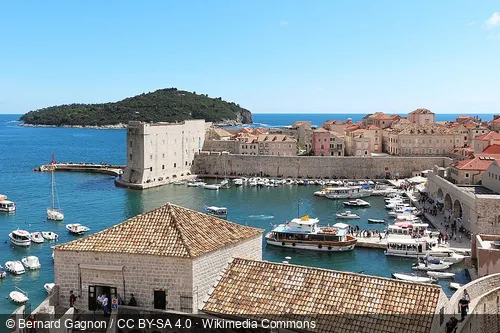
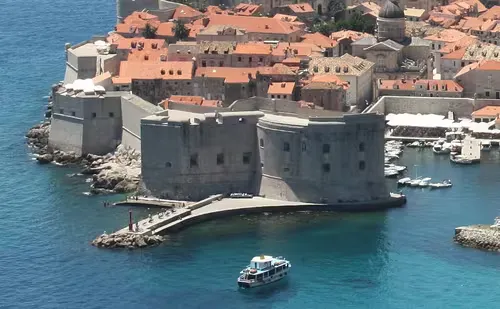
    The Old Port sits right against the city walls and is part of the Old Town. Do not confuse it with Dubrovnik's other two harbors, the commercial port in Gruž and the ACI marina at the mouth of the Dubrovačka rijeka. Its present form goes back to the 15th century and to Paskoje Miličević, the same builder who made the Pile bridge.

    From the walled town you reached the harbor through the Ponta Gate, built in 1476, or the Fish Market Gate from 1381. The fortress of St. John, built in the 14th century specifically for the harbor, guarded it together with Revelin outside the walls, the work of Antun Ferramolino. At night a chain was stretched from the tower of St. Luke to the fortress of St. John to close the port.

    Toward the sea, the breakwater Kaše from 1485 and a mole from 1873 that locals call Porporela held back hostile ships, which could then be fired on from Revelin and above all from St. John.

    The most striking feature is the row of three great vaulted arches, from the 12th century and enlarged in the 15th. There were originally four, but the fourth was later walled up. Known as the Arsenal, this was a shipyard where the city's war galleys were built and repaired; small boats are still repaired here, and part of it is now a café. Then walk 110 m, about 2 min, to the Rector's Palace.

    Hours
    Open 24/7
    Price
    Free
  10. 10

    Rector's Palace

    Rector's Palace in Dubrovnik, stop 10 on the self-guided walking tour

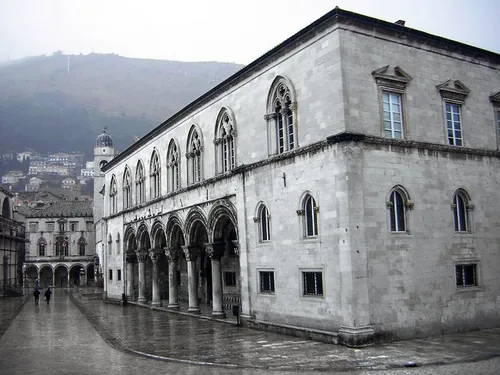
    Until 1808 the Rector's Palace was the seat of government of the autonomous Republic of Ragusa. Its two storeys mix late Gothic and early Renaissance, based on 15th century plans by Onofrio della Cava, the builder of the fountain at Pile, together with Giorgio da Sebenico and Salvi di Michele.

    The name is a small lesson in how the Republic worked. In Croatian the head of state was called knez, prince, so the palace is Knežev dvor and many translations speak of a prince's palace. But this ruler was not a monarch: he was elected and changed every month, which is why the Latin and Italian title of rector stuck.

    The building started as a fortress. A castellum is first mentioned in 1272, and it is still bound into the city wall. During the 14th century its defensive role faded, and in 1349 the records speak of a palatium for the first time. When the Stradun was laid out, the Great Council decided to turn the castle into a grand seat of government; the works began in 1388 and were finished around 1425. The palace was damaged and restored several times until the 19th century.

    Inside is worth it if the Republic's government interests you; entry is ticketed. The Sponza Palace is 160 m, about 2 min, away.

    Local name
    Knežev dvor
    Hours
    Summer (1.4-31.10): daily 9:00–18:00 | winter (1.11-31.3): 9:00–16:00, Monday closed
    Price
    15 EUR
  11. 11

    Sponza Palace

    Sponza Palace in Dubrovnik, stop 11 on the self-guided walking tour

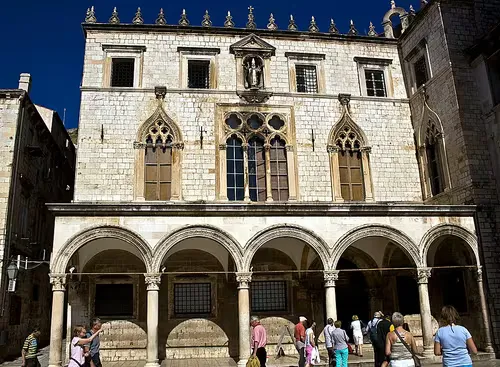
    The Sponza Palace, also called Divona, is a Gothic and Renaissance palace built between 1516 and 1521 by Paskoje Miličević and the Andrijić brothers from Korčula. Its arcaded front gives you an idea of how many buildings on the Stradun looked before the 1667 earthquake.

    It was built as the customs house, where goods from all over the world were cleared, and its arcaded courtyard became the liveliest trading place and meeting point of the Republic's merchants. Over time it also held the state treasury, a bank, a school and the mint, founded in 1377 and working in this building until the Republic fell. At the end of the 16th century it became a cultural centre too, home of the Academy of the Concordant, the first literary institution in Dubrovnik.

    In the courtyard, look for the relief medallion by the French sculptor Bertrandus Gallicus with the monogram of Jesus between two angels; the storerooms were named after saints. Over the vaulted passage a Latin inscription warns: we are forbidden to cheat and use false weights, and when I weigh goods, God himself weighs them with me.

    In 1921 the palace was returned to the city and declared a monument, largely thanks to the conservator Marko Murat. Today it houses the State Archives of Dubrovnik, and the courtyard is free to enter. Then walk 240 m, about 3 min, back along the Stradun to the Franciscan Monastery.

    Local name
    Palača Sponza
    Hours
    State Archives reading room: Mon–Fri 8:15–15:00, Sat 8:15–13:00
    Price
    Free
    Website
    dad.hr ↗
  12. 12

    Franciscan Monastery

    Franciscan Monastery in Dubrovnik, stop 12 on the self-guided walking tour

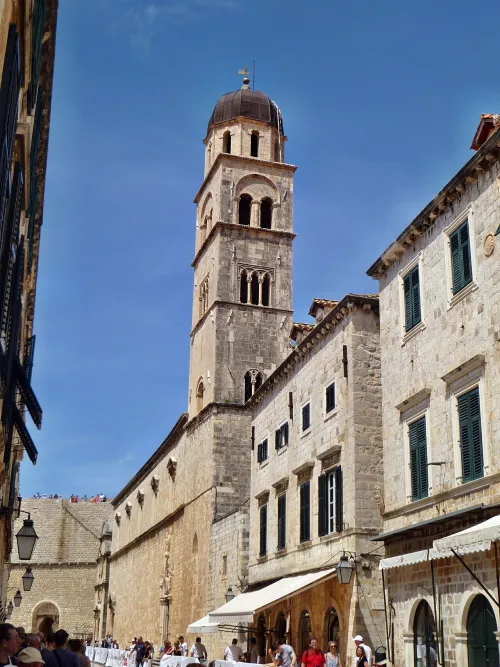
    The Franciscan Monastery near Pile Gate is a large complex of friary, church, library and pharmacy. The first friary stood outside the walls in the 13th century; the move inside began in 1317, and building went on for centuries.

    The 1667 earthquake destroyed the church, but its decorated portal facing the start of the Stradun survived. It was carved in 1498 in Gothic style by the workshop of the brothers Leonard and Petar Petrović: an almost life-size Pietà in the lunette, framed by St. Jerome, who holds a model of the church as it looked before the quake, and St. John the Baptist, with God the Father above.

    Inside, the church was rebuilt as a Baroque single nave. The marble pulpit survived the earthquake, the main altar with the risen Christ between four twisted marble columns is by Celia from Ancona from 1713, and the five side altars were carved by the Venetian Giuseppe Sardi between 1684 and 1696. The poet Ivan Gundulić is buried here.

    The real reward is the lower cloister, built from 1360 in late Romanesque style by Mihoje Brajkov of Bar: 120 columns, twelve massive pilasters and capitals that are all different, with geometric shapes, plants, people and animals. Above it lies a Renaissance upper cloister. Ask at the entrance for the current ticket. Your walk ends here, a short way from Pile Gate.

    Local name
    Franjevački samostan i crkva
Walking tour route map of Dubrovnik Route loaded
Fort LovrijenacPile GateDubrovnik City WallsOnofrio's Large Fountain+8
All 12 stops are already on the map.
You just press start.
AI Tour Guide

You know the route now. Walk it with a guide in your ear.

Press start wherever you are, even hundreds of kilometres from Dubrovnik, and the guide begins telling its stories right away. In the city, pick any of the 12 stops to start from: it leads you there, then talks with you the whole route, asking, listening, remembering, and shaping the tour around your answers.

12stops 2.1km 30 minwalking 13languages
▶Start the tour free

Free to start · Runs in your browser · No app, no download

Three Ways to Walk Dubrovnik's Old Town

The full route works best as a day with tickets. If your time or budget is tighter, these cuts keep the walk coherent.

Free Old Town loop

Stops: 2, 4, 5, 6, 7, 8, 9, 10, 11, 12

For a first look without any tickets. You skip the fort and the walls, see the Rector's Palace from outside and step into the Church of St. Blaise and the Sponza courtyard for free. Walking time is 26 min, from Pile Gate along the Stradun to the harbor and back to the Franciscans.

Walls, fortress and Game of Thrones

Stops: 1, 2, 3, 8

For fortification lovers and Game of Thrones fans: Fort Lovrijenac, which served as the Red Keep backdrop, Pile Gate, a full circuit of the walls and finally the Jesuit Stairs of the Walk of Shame. Walking time is 19 min. One walls ticket or a Dubrovnik Pass covers both the walls and the fort on the same day.

The full day with interiors

Stops: 1, 2, 3, 4, 5, 6, 7, 8, 9, 10, 11, 12

For anyone who wants the whole story of the Republic of Ragusa: all twelve stops with 30 min of walking, the fort, the walls, the Rector's Palace and, if you like, the cathedral treasury and the Franciscan cloister, which sell their own tickets at the door.

How Long This Dubrovnik Tour Takes, With and Without the Walls

The order follows the clock. Start at Fort Lovrijenac as early as you can; give it about 45 minutes and you reach the walls shortly after 9:00. If you allow about two hours up there, you come down near Onofrio's Large Fountain a little after 11:00 and reach the Church of St. Blaise around 11:25, still in time to see it inside.

From there the cathedral, the Jesuit Stairs and the Old Port bring you to about 12:30, a good moment for lunch in a side alley. After that the Rector's Palace fits comfortably around 13:35, the Sponza courtyard before 15:00 and the Franciscan cloister until roughly 15:40.

The free loop takes about an hour and a half with short stops. The walls and Game of Thrones version needs around three and a half hours, most of it on the walls.

Before You Set Off in Dubrovnik

  • Start and finish: The recommended start is Fort Lovrijenac and the walk ends at the Franciscan Monastery near Pile Gate. You can join at any stop; the GPS navigation in your browser leads you from the last stop back to the start if you want.
  • Best day: Plan to reach the Church of St. Blaise in the morning so you can see it inside, and in winter check that the Rector's Palace is open on the day you go.
  • Tickets: If you plan the walls, buy the walls ticket or the Dubrovnik Pass before you reach the fort: both include Fort Lovrijenac on the same day, so you never pay for the fort separately. A one-day Pass costs about the same as the walls alone and adds the Rector's Palace, several museums and the city buses. Buy only officially, at the Pile or Ploče ticket offices, on citywallsdubrovnik.hr or as a Pass. From November to February the walls ticket is far cheaper.

Food and Coffee Breaks Along the Old Town Route

Eating right on the Stradun or at the harbor costs noticeably more than a few lanes away. Here is where to eat, drink and refill without paying for the view.

Budget meals in the Old Town lanesBuffet Škola, Taj Mahal with Bosnian dishes, Lokanda Peškarija with fish and the vegetarian Nishta are good value inside the walls. If you are staying in Gruž or Lapad, look out for marenda, an inexpensive midday menu served from late morning.
Coffee in a side alleyAn espresso on a Stradun or harbor terrace costs far more than in a side alley of the Old Town. Same coffee, you just stop paying for the view.
Water from Onofrio's Large FountainRefill your bottle at the 16 spouts of the fountain instead of buying bottled water. (At Onofrio's Large Fountain, beside Pile Gate)
Gelato away from the StradunPremium shops charge a lot per scoop; at Gelateria Dubrovnik the smallest portion is much cheaper.

Tourist Traps to Avoid in Dubrovnik's Old Town

  • Terraces with photo menus: An evening meal with wine here is expensive, often with a bread cover charge on top. Head uphill into the side lanes instead; the Dalmatian cooking there is just as good and the guests are more often local. (On the Stradun and at the Old Port)
  • Skip-the-line walls tickets: There is no official skip-the-line ticket for the walls. Street sellers and third-party sites charge more than the official price, and some of their tickets are handed out at the other end of town.
Walking tour route map of Dubrovnik
AI Tour Guide

Your Dubrovnik guide is ready when you are.

Press start and a voice AI Tour Guide takes it from here: leading the route through Dubrovnik, telling the stories, and turning your walk into a real back-and-forth conversation. No app or download is needed; it runs in your browser.

12stops 2.1km 30 minwalking 13languages
▶Start the tour free

Free to start · Runs in your browser · No app, no download

What the AI Tour Guide Adds Between the Walls

On this route the same names keep coming back: Paskoje Miličević built the Pile bridge, reshaped the harbor and raised the Sponza Palace, and Onofrio della Cava worked on both the fountain and the Rector's Palace. The AI Tour Guide leads you through the walk as a conversation, ties these threads together, asks whether you are here for the Republic, the churches or Game of Thrones and follows your interest, for example into how a merchant moved goods from the harbor through the customs hall. You can interrupt at any time. Start with 100 free credits; after that choose this tour all-inclusive for €19.99 with no time limit, or €5 per hour.

A Real Conversation A voice AI Tour Guide greets you, leads the whole route, and tells the stories and facts as you walk, asking what you want to see and keeping a real conversation going. Not a recording you press play on.
Map Navigation Follow the route on the map and walk at your own pace. You choose where to start and when to move to the next stop.
Ask Anything Curious about a building you pass? Ask your AI Tour Guide on the spot and the conversation carries on.
13 Languages Switch language anytime. No separate tour needed.
Start free in your browser

Common Questions About Walking Dubrovnik

How do I get from Dubrovnik airport to the start of the walk?

The airport shuttle bus runs to Pile and the bus station in a little over half an hour. From Pile the fort is a short walk. An Uber costs more than the bus, a taxi considerably more.

Where can I see Fort Lovrijenac and the walls without paying?

Gradac Park gives you the classic postcard view of the western walls and Fort Lovrijenac for free.

Is there anything special on the Stradun on 3 February?

On the Feast of St. Blaise, the city's patron, a solemn procession moves along the Stradun. The festivity is protected as intangible cultural heritage.

Can I combine Dubrovnik with a second city nearby?

Kotor lies 59 km away and Mostar 81 km, both with their own walking routes. Further up the coast, Split is 166 km away.

Is the tour really free?

Yes. The whole tour is free: the route, the interactive map and the navigation cost you nothing. Only the voice AI Tour Guide is optional and paid: you test it with 100 free credits, then you pay either €5 per hour or €19.99 for this whole tour, with no time limit.

Do I need to download an app?

No. Everything runs in your phone browser. Open the route and start walking, no download and no sign-up required.

Do I need to book the walking tour in advance?

No booking needed. This self-guided tour is available anytime. Open the route in your browser and start walking. The AI Tour Guide works instantly, no app, no reservation required.

What languages is the AI Tour Guide available in?

The AI Tour Guide speaks 13 languages, so you take the tour in your own language and can switch at any time.

Can I skip stops or change the route?

Yes. Skip any stop, spend extra time at places you like, or start the route from any point. It is your walk, you set the pace.
Image credits
▶ Start free in your browser Runs in your browser, no app, no download