Sénanque Abbey
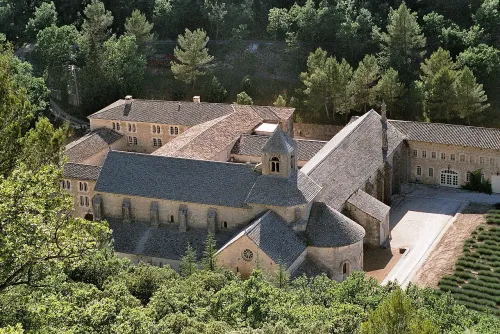
The walk ends in a narrow, secluded valley at a Cistercian abbey, Abbaye Notre-Dame de Sénanque. Monks from Mazan Abbey in the Ardèche founded it in 1148, under the patronage of Alfant, bishop of Cavaillon, and Ramon Berenguer II, Count of Barcelona and Provence. The first community was poor and lived in temporary huts. By 1152 it had grown so fast that it could found Chambons Abbey in the diocese of Viviers.
Here the Simiane name returns: the lords of Simiane became the monks' patrons and funded the abbey church, consecrated in 1178. Notice how it sits. The church forms a tau cross, with an apse that projects beyond the outer walls, and its liturgical east end points north, because the valley left no room for the usual layout.
Inside, the austerity is the point. The abbey survives remarkably untouched: church, cloister, dormitory, chapter house and the small calefactory, the one heated room, where the monks could write, so it served as their scriptorium. In the cloister, the capitals of the paired columns are cut down to the plainest leaf forms so as not to distract. Only the refectory is later, added in the 17th century.
Sénanque peaked in the 13th and 14th centuries with four mills, seven granges and large estates across Provence. In 1509 its first commendatory abbot was named, a sure sign of decline, and only about a dozen monks remained. In the Wars of Religion, Huguenots ransacked the abbey and destroyed the lay brothers' quarters. Guided tours run at set times, with several each afternoon; if Romanesque architecture is your thing, this is the visit to save energy for.
- Local name
- Abbaye Notre-Dame de Sénanque
- Hours
- Mon–Sat 09:45–11:00 & 13:00–17:00 (guided tours 10:00, 10:30, 13:30, 14:30, 15:30, 16:30, 17:00); Sun 13:00–17:00 (guided tours 13:30, 14:30, 15:30, 16:30, 17:00)
- Price
- 8 EUR adult, 6 EUR reduced (students 18-25), 4 EUR child (6-17)