Free Walking Tour Marseille: Old Port to the Bonne Mère

Eight stops on foot, from Napoleon III's unfinished palace through the Panier and the harbour forts up to the gilded Virgin on her hill, nearly all of them free.

8 Stops 7.9 km ~1 h 58 min walking
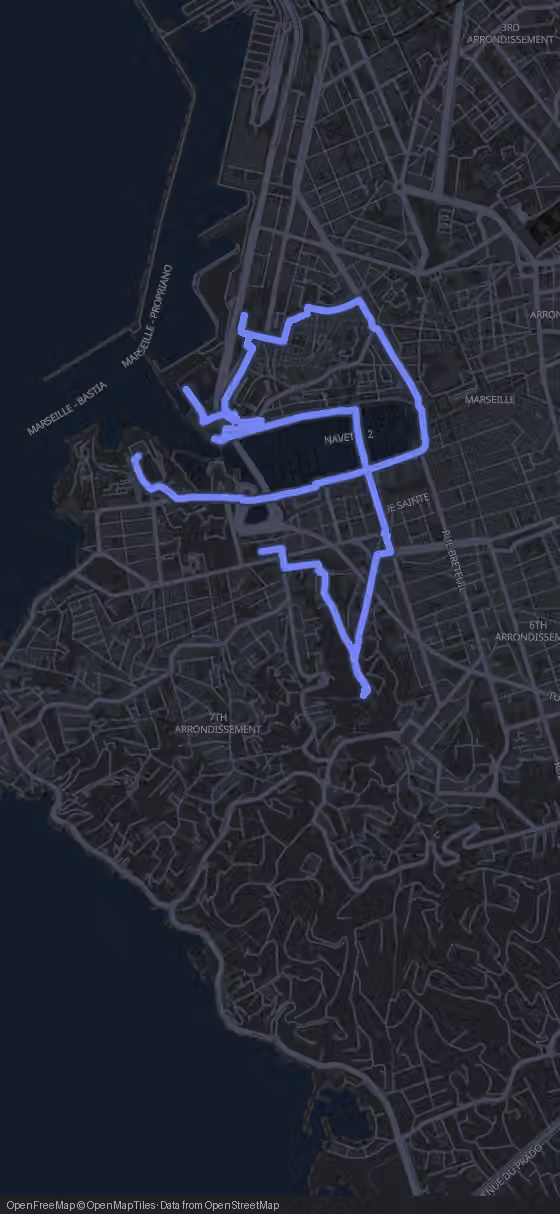
Route map for the Marseille walking tour
Stop 1 of 8
1.6 km·20 min
Palais du Pharo
Head east along the shore toward the Vieux-Port
Bonjour, welcome to Marseille. I'm Alex, and this old port has sometimes aimed its defences inward.
Try this tour with Alex

What the Route Covers

Eight stops from the Palais du Pharo via the Vieux-Port, Vieille Charité, Cathédrale de la Major, MuCEM and Fort Saint-Jean up to Notre-Dame de la Garde, ending at the Abbaye Saint-Victor: 7.9 km, 1 h 58 min of pure walking, a little over six hours with visits.

Everything is free to see except the MuCEM exhibitions, and the same ticket opens the fort's interior. Route, map and GPS navigation run free in your browser; the AI Tour Guide is optional.

Open free GPS & optional AI Tour Guide
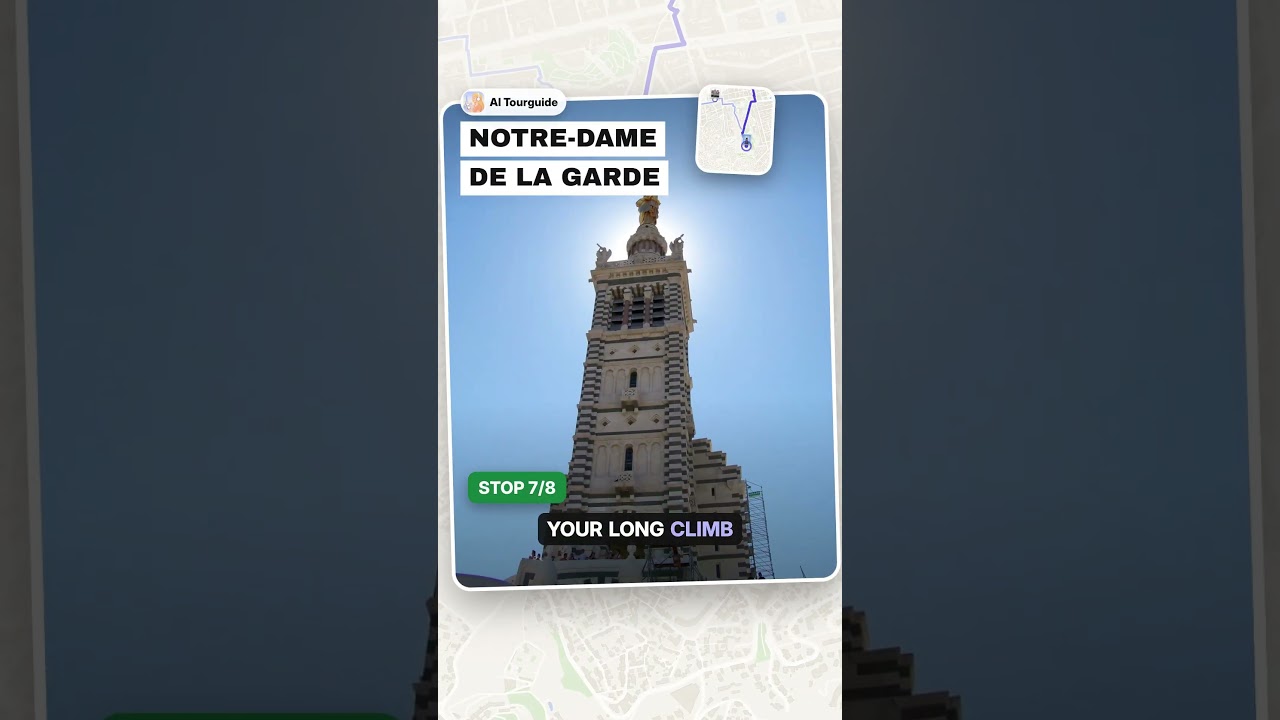
This short shows highlights of the route. All 8 stops follow below.

The Route

Walking Map of Marseille, From the Pharo to Saint-Victor

8 stops 7.9 km 1 h 58 min walking
Tap to load interactive map

The 8 stops along this route

  1. Palais du Pharo in Marseille, stop 1 on the self-guided walking tour
    1Palais du Pharo
  2. Vieux-Port in Marseille, stop 2 on the self-guided walking tour
    2Vieux-Port
  3. Vieille Charité in Marseille, stop 3 on the self-guided walking tour
    3Vieille Charité
  4. Cathédrale de la Major in Marseille, stop 4 on the self-guided walking tour
    4Cathédrale de la Major
  5. MuCEM in Marseille, stop 5 on the self-guided walking tour
    5MuCEM
  6. Fort Saint-Jean in Marseille, stop 6 on the self-guided walking tour
    6Fort Saint-Jean
  7. Notre-Dame de la Garde in Marseille, stop 7 on the self-guided walking tour
    7Notre-Dame de la Garde
  8. Abbaye Saint-Victor in Marseille, stop 8 on the self-guided walking tour
    8Abbaye Saint-Victor
  9. That's the full route.

    Walk it with an AI Tour Guide talking you through every one of these streets.

    Start free in your browser
    You made it

Your Marseille Walking Tour Through Harbour, Panier and Hill

  1. 1

    Palais du Pharo

    Palais du Pharo in Marseille, stop 1 on the self-guided walking tour

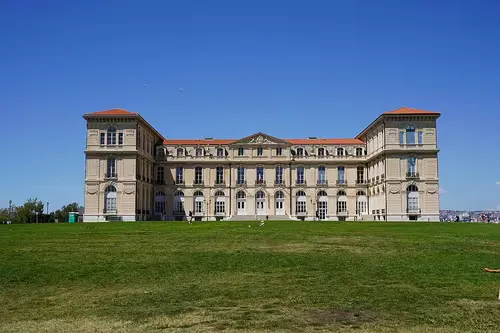
    You start with a palace built for an empress who never slept in it. The Palais du Pharo sits above the passage into the Vieux-Port, with the Jardin du Pharo around it and Fort Saint-Jean straight across the water. The grounds are free; what you come for is the façade, the gardens and the view over the harbour and the bay.

    The idea dates to 1851, when Louis-Napoleon Bonaparte, then President of France, said on a visit that he wanted a residence in Marseille. He offered a million francs of his own money, the city happily agreed, and the sum went into buying the land. Shortly before he became Emperor Napoleon III, he sent the Geneva architect Samuel Vaucher to find a site. Vaucher chose this spot facing Fort Saint-Jean and presented his plans in February 1853; Hector Lefuel reworked them, and the result resembles the Villa Eugénie in Biarritz, begun in 1854.

    Building began on 15 August 1858, Napoleon Bonaparte's birthday, and then crawled. Money ran short, and so did stone, because the new cathedral was going up at the same time. In 1861 Vaucher was blamed for the delays and replaced by Henri-Jacques Espérandieu, a name worth remembering: he also finished the cathedral and built the basilica on the hill you will climb later.

    When Napoleon III fell in 1870, after twelve years of work the palace was still unfinished. Crowds tore Napoleonic emblems and ornaments off the façade, so look for the gaps in the decoration. After the emperor's death in 1873 the city sued Eugénie, and in 1884 she gave the palace and gardens to Marseille on condition they serve the public good.

    From here it is 1,610 m, about 21 minutes, along the harbour to the Vieux-Port.
    Hours
    Daily: 07:00–21:00
    Price
    Free
  2. 2

    Vieux-Port

    Vieux-Port in Marseille, stop 2 on the self-guided walking tour

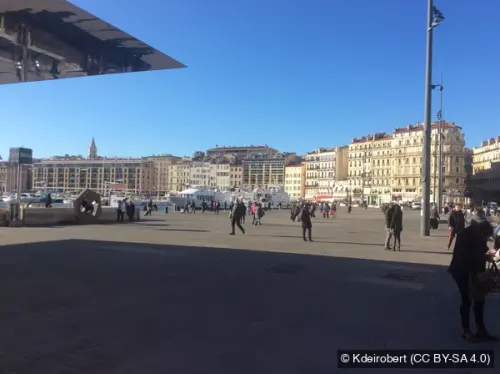
    The Vieux-Port has been the city's natural harbour since antiquity, and it is still where Marseille gathers. It lies at the end of the Canebière, the city's main street, and since 2013 it has been largely pedestrian, which is why you can stroll the quays among boats rather than traffic.

    Look out toward the harbour mouth: two forts guard it, Fort Saint-Jean on the north side and Fort Saint-Nicolas on the south. Both were built after Marseille rebelled against Louis XIV, and their guns pointed at the city as much as at the sea. You will stand inside the first one later.

    This is a place to look rather than to linger at the first table on the water, and coffee with a view is easy to find. Then turn into the old streets of the Panier: the Vieille Charité is 930 m away, about 14 minutes on foot.

    Hours
    Open 24/7
    Price
    Free
  3. 3

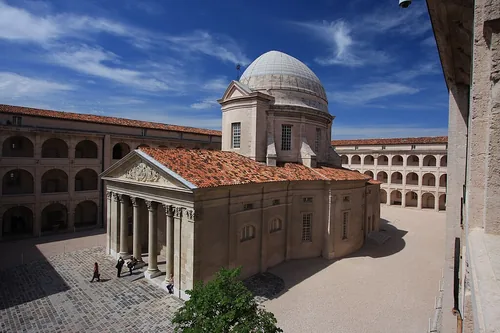
    Vieille Charité

    Vieille Charité in Marseille, stop 3 on the self-guided walking tour

    From the street the Vieille Charité gives nothing away: four walls of pink and yellow molasse stone from the old quarries of Cap Couronne, a rectangle of 112 by 96 m, and not one window facing outward. Walk through the entrance and it opens into a courtyard of 82 by 45 m, ringed by three levels of arcaded galleries, with a round Baroque chapel in the middle under an oval dome and a portico of Corinthian columns.

    Those blind walls tell you what this was. In the 17th century France treated beggars with great brutality. Guards called chasse-gueux, beggar-hunters, rounded them up; outsiders were expelled from Marseille, locals were shut away. The idea of an almshouse dedicated to Notre-Dame, mère de Charité, came in 1622, land was found in 1640 and the first pensioners arrived in 1641.

    The building you see came later and slowly. Pierre Puget drew the grand plan, work began in 1671 and, because the city's aldermen kept cutting the project, it was only finished in 1749. The chapel went up between 1679 and 1704; Puget died in 1694 and his son François completed it. It counts among Puget's most original designs, and chapel and hospice have been a listed historic monument since 1951.

    Going in is worth it for almost everyone: the courtyard is the highlight, and the permanent collections of the Musée d'Archéologie Méditerranéenne and the Musée d'Arts Africains, Océaniens et Amérindiens are free. The cathedral is only 500 m on, about 6 minutes.

    Hours
    Tue–Sun 09:00–18:00, Mon closed (except Easter Monday and Whit Monday); closed Jan 1, May 1, Nov 1, Nov 11 and Dec 25. Ticket office closes 30 min before the museum. Special summer evening openings Jul 9, Jul 30, Aug 13 and Aug 27, 19:00–23:00
    Price
    Free (permanent exhibitions: Musée d'Archéologie Méditerranéenne + Musée d'Arts Africains, Océaniens et Amérindiens)
  4. 4

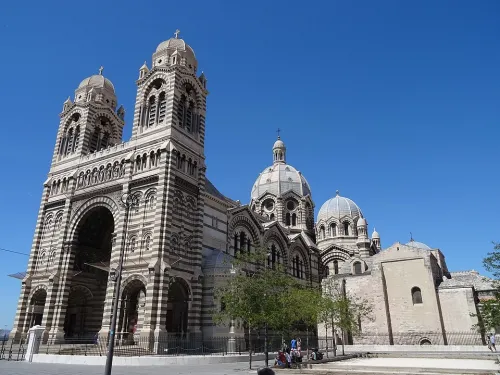
    Cathédrale de la Major

    Cathédrale de la Major in Marseille, stop 4 on the self-guided walking tour

    The striped bulk of the Cathédrale de la Major stands on the western edge of the old town, above the Quai de la Joliette. Begun in 1852 to designs by Léon Vaudoyer and Henri-Jacques Espérandieu, it mixes neo-Romanesque and Byzantine forms on a monumental scale. It was finished in 1896, made a minor basilica the same year and has been a protected monument since 1906.

    The ground beneath it is far older. Around the turn of the 5th century a bishop's church with a baptistery already stood here, and its foundations were dug up when the new cathedral was built. Saracen raids destroyed it three times, the last in 923, and by 1073 it was so dilapidated that Bishop Pons II started a complete rebuild in the year of his death.

    That Romanesque cathedral of the 11th century lost its two western bays in the Middle Ages to make room for a new city wall, so its portal moved to the south side. Of the two towers that flanked its choir, the southern one, the tour de l'Évêché, survives in its 19th-century form. The Revolution was harsh here: the diocese was abolished, the bells melted down, sculptures smashed and the furnishings sold.

    Entry is free, so go inside for a few minutes even if you only have time for a look. Then walk 840 m, about 12 minutes, to the MuCEM.

    Hours
    Daily 10:00–19:00 (Summer, 01.04.-31.10.); Daily 10:00–17:30 (Winter, 01.11.-31.03.)
    Price
    Free
  5. 5

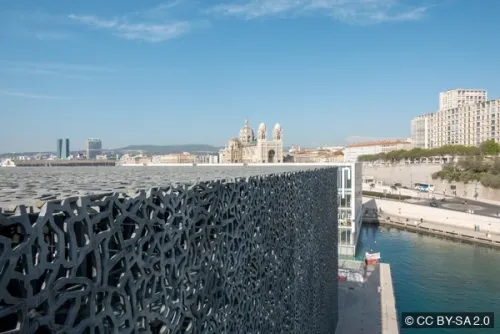
    MuCEM

    MuCEM in Marseille, stop 5 on the self-guided walking tour

    The MuCEM, the Musée des civilisations de l'Europe et de la Méditerranée, is the newest building on your walk. President François Hollande opened it on 7 June 2013, the year Marseille was European Capital of Culture, in the same year the Vieux-Port became largely pedestrian. The architect was Rudy Ricciotti, and its lace-like façade is what most people photograph.

    Here is the useful part: the outdoor spaces, the footbridge, the roof terrace of the J4 building and Fort Saint-Jean's grounds are free. The numbers show how many people come only for that: between 2013 and 2016 the museum counted 8.5 million visitors, but just 2.2 million of them went into the exhibitions. In 2015 it won the Council of Europe Museum Prize.

    Inside, it is a national museum of society devoted to the cultures of Europe and the Mediterranean, built on the collections of the former national museum of popular arts and traditions. Exhibitions range across anthropology, archaeology, history, art history and contemporary art, and the temporary shows often pick up current artistic or social questions, including the tensions that still run through the region.

    The ticket makes sense if you enjoy cultural history and have an hour or more; if you came for the architecture and the view, the free areas give you the same postcard. Fort Saint-Jean is 860 m away on the route, about 13 minutes.

    Local name
    Musée des civilisations de l'Europe et de la Méditerranée
    Hours
    Mon, Wed, Thu, Fri, Sat, Sun 10:00–19:00; closed Tue; closed May 1, Dec 25
    Price
    11 EUR
  6. 6

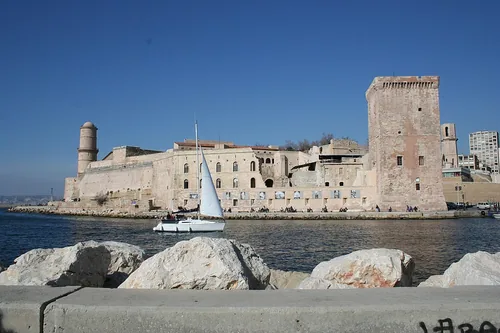
    Fort Saint-Jean

    Fort Saint-Jean in Marseille, stop 6 on the self-guided walking tour

    Fort Saint-Jean sits on a spur of rock at the southwestern tip of the Panier, guarding the north side of the harbour entrance. It is built of the same pink limestone from La Couronne as the Vieille Charité. Its name comes from the Knights Hospitaller of Saint John of Jerusalem, who set up a commandery here in the late 12th century, and remains of the first Greek settlement from the 6th century BC have been found on the site.

    Look for the oldest parts: the square tower King René built in the mid-15th century to watch the harbour passage, and the round lantern tower of 1644. The fort itself was Louis XIV's answer to a rebellious city. After royal troops besieged Marseille in March 1660, the king wanted a citadel less to defend the port than to keep the town under control and, if need be, shell it.

    The chevalier de Clerville built the first phase from 1668, expropriating the Hospitallers and many homes, and also raised Fort Saint-Nicolas across the water. From 1679 Vauban added a wide moat that could be flooded and a low gun battery. During the Revolution the fort held Philippe Égalité and two of his sons, and on 5 June 1795 royalists massacred imprisoned Jacobins here. In the Second World War German troops stored munitions inside; the explosion at the Liberation destroyed several old buildings.

    The ramparts and outdoor areas are free; the interior exhibitions need the MuCEM ticket. Now comes the longest leg: 2,160 m and about 36 minutes, uphill, to Notre-Dame de la Garde, unless you take the bus.

    Hours
    Wed–Mon 10:00–20:00, Tue closed (same hours as the MuCEM)
    Price
    Outdoor areas free; interior/exhibitions only with MuCEM combi ticket (11 EUR, together with J4)
  7. 7

    Notre-Dame de la Garde

    Notre-Dame de la Garde in Marseille, stop 7 on the self-guided walking tour

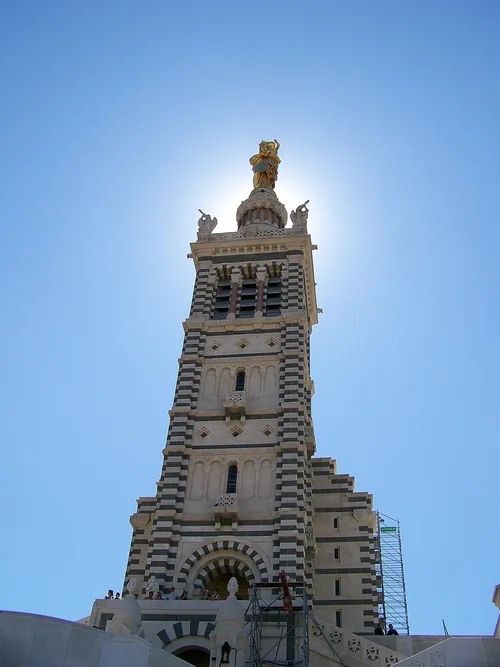
    Marseille calls her la Bonne Mère. Notre-Dame de la Garde crowns a limestone peak of 149 m, raised another 13 m by the walls of an old fort, and looks out over the whole city and the sea. On top of a 41 m bell tower and a 12.5 m turret stands an 11.2 m statue of the Virgin and Child in copper covered with gold leaf, the figure you have been seeing from the harbour all morning.

    The fort underneath was built by François I in 1536 to resist the siege of Charles V. The basilica, designed by the Protestant architect Henri-Jacques Espérandieu, the same man who took over the Pharo and the cathedral, was consecrated on 5 June 1864 and replaced a chapel first built in 1214. It has two parts: a Romanesque lower church, the crypt, cut into the rock, and above it a Romano-Byzantine upper church covered in mosaics.

    Those mosaics carry scars. Bullets hit them at the Liberation, and candle smoke blackened them over the years. The green stone brought from near Florence also proved vulnerable to corrosion, so a careful restoration of seven years, completed in 2008, repaired both. Since the Middle Ages the Virgin here has been seen as the guardian of sailors and fishermen, and with Saint Victor she protects the city.

    Entry to the basilica is free. The museum and crypt are worth a visit too; the displays, opened on 18 June 2013, cover 800 years of the sanctuary through ex-votos and works of art. Leave time for both. Then head down 1,050 m, about 16 minutes, to the Abbaye Saint-Victor.

    Hours
    Sanctuary (basilica) daily 07:00–18:00; museum/crypt daily 09:00–17:00 (last admission 17:00)
    Price
    Free entry to the basilica; some activities and guided tours are charged
  8. 8

    Abbaye Saint-Victor

    Abbaye Saint-Victor in Marseille, stop 8 on the self-guided walking tour

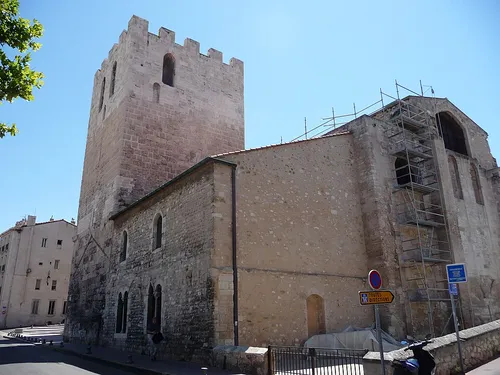
    You finish at the city's other protector. The Abbaye Saint-Victor was founded in 415 AD and still looks more like a fortress than a church. Entry is free.

    The reason to go in lies underground: the crypts sit on top of a Greek quarry from the 2nd century BC, so you stand in some of the oldest worked ground in Marseille. Every February a local procession ends here with the blessing of navettes, boat-shaped biscuits that recall the city's ties to the sea.

    After the basilica on the hill, this quiet, heavy building makes a fitting end: the Bonne Mère watches over the sailors, Saint Victor shares the job of guarding the city. If you want to return to the start, the GPS navigation can take you back to the Palais du Pharo.

    Hours
    Daily: 09:00–19:00
    Price
    Free
Walking tour route map of Marseille Route loaded
Palais du PharoVieux-PortVieille CharitéCathédrale de la Major+4
All 8 stops are already on the map.
You just press start.
AI Tour Guide

You know the route now. Walk it with a guide in your ear.

Press start wherever you are, even hundreds of kilometres from Marseille, and the guide begins telling its stories right away. In the city, pick any of the 8 stops to start from: it leads you there, then talks with you the whole route, asking, listening, remembering, and shaping the tour around your answers.

8stops 7.9km 1 h 58 minwalking 13languages
▶Start the tour free

Free to start · Runs in your browser · No app, no download

Shorter Ways to Walk It

Not every day has room for the whole loop of forts, churches and museums. These three cuts each follow the route order and keep the legs as they are.

Palace, port and Panier

Stops: 1, 2, 3, 4

For a free morning with history and no tickets: the Palais du Pharo, the Vieux-Port, the Vieille Charité with its two free museums and the cathedral. 3,040 m and 41 minutes of walking.

Harbour museums and the Panier

Stops: 2, 3, 4, 5, 6

For culture lovers who want the MuCEM exhibitions: from the Vieux-Port through the Panier to the cathedral, the MuCEM and Fort Saint-Jean. 3,130 m and 45 minutes of walking; the only ticket is the MuCEM, which also opens the fort's interior.

Fort, hill and abbey

Stops: 6, 7, 8

For an afternoon with the views: from Fort Saint-Jean up to Notre-Dame de la Garde and down to the Abbaye Saint-Victor. 3,210 m and 52 minutes of walking, most of it the climb. The fort's outdoor areas, the basilica and the abbey are all free.

How Long Does This Marseille Tour Take With Museums and the Climb?

The pure walking time is 1 h 58 min for 7.9 km. The legs are uneven: the 500 m from the Vieille Charité to the cathedral take 6 minutes, while the climb from Fort Saint-Jean to Notre-Dame de la Garde is the longest leg at 2,160 m and 36 minutes.

With sensible stays (15 minutes at the Pharo, 20 at the Vieux-Port, 40 in the Vieille Charité, 20 in the cathedral, an hour in the MuCEM, 30 minutes at the fort, 45 on the hill and 30 in the abbey) the day comes to about 6 h 20 min. Start at 09:30 and you reach the cathedral at 11:26, the MuCEM at 11:58 and the hill at 14:17, finishing around 15:50. An hour for lunch along the way puts you on the hill around 15:15 and at the abbey around 16:20.

The variants are much lighter: the palace and Panier morning takes about 2 h 15 min with its visits, the harbour museums option about 3 h 35 min, and fort, hill and abbey about 2 h 40 min.

Before You Set Off

  • Start and finish: The recommended start is the Palais du Pharo, the walk ends at the Abbaye Saint-Victor. You can join at any stop, and the GPS navigation can lead you from the abbey back to the start.
  • Best day: Pick your day with care: the Vieille Charité, the MuCEM and the fort's interior are not open every day, and they also close on some public holidays.
  • Time of day: Start in the morning. That leaves enough time for the cathedral, the basilica on the hill and its museum without rushing.
  • Costs: Only the MuCEM exhibitions cost money, and the ticket includes the fort's interior. The AI Tour Guide starts with 100 free credits; after that you choose between €19.99 for this tour all-inclusive with no time limit, or €5 per hour.

Food and Breaks Along the Route, From Panier Pizza to Navettes

The Panier is where to eat well and cheaply on this walk, the harbour front is where you pay for the view. Keep a sweet stop for the end, when the abbey's biscuits make sense.

La CaravelleThe exception to the harbour rule: coffee and croissants with a view over the boats. (Vieux-Port, above the Hotel Bellevue)
Patisserie JournoTunisian pastries and sandwiches, good for a quick bite before heading into the Panier. (Vieux-Port)
Chez ÉtienneRunning for more than 80 years, now under Pascal Cassaro. Order the moitié-moitié pizza, the fried supions with garlic and parsley, or the eggplant parmesan. (Le Panier, 43 rue de Lorette)
Four des NavettesRue Sainte, baking the boat-shaped navettes since 1781 and known as the city's oldest bakery. On Candlemas morning the Archbishop of Marseille blesses them here.
La RelèveClose to the finish. Come on a Friday for aïoli the dish: desalted cod, steamed green beans, carrots and cauliflower, boiled eggs and garlic mayonnaise. (Saint-Victor, 41 rue d'Endoume)

Tourist Traps to Avoid in Marseille Around the Old Port

  • The first waterfront café on the Vieux-Port: Most visitors sit down at the first terrace on the water. Walk five minutes inland and you eat better for about half. For an apéro, locals head to the Cours Honoré d'Estienne d'Orves, two minutes from the harbour, or to Bar Le Campagne at 41 rue Château Payan, where drinks are cheap. (Vieux-Port)
  • Bouillabaisse on the quays: Harbour bouillabaisse is expensive and rarely lives up to it; locals seldom eat it. If you want the real thing, go to Chez Michel at 6 rue des Catalans (not cheap, the fish is shown to you first) or Chez Fonfon in the Vallon des Auffes, and book ahead. (Vieux-Port)
  • Fake petitions: People with clipboards, sometimes pretending to be deaf, ask you to sign an official-looking petition, then demand money or use the distraction to pick pockets. Just keep walking.
  • The Petit Train to the basilica: It is pricey, and you get only 20 minutes at the top. City bus 60 reaches the same basilica for much less and lets you stay as long as you like.
Walking tour route map of Marseille
AI Tour Guide

Your guide is ready when you are, at whichever stop you start.

Press start and a voice AI Tour Guide takes it from here: leading the route through Marseille, telling the stories, and turning your walk into a real back-and-forth conversation. No app or download is needed; it runs in your browser.

8stops 7.9km 1 h 58 minwalking 13languages
▶Start the tour free

Free to start · Runs in your browser · No app, no download

What the AI Tour Guide Adds on This Route

This walk keeps crossing paths with the same few people: Napoleon III, Espérandieu, Puget, Vauban. The AI Tour Guide picks up those threads as a conversation, greets you at the Pharo, tells the stories as you go and notices whether you lean toward forts, faith or food. Ask it who Philippe Égalité was, what the ex-votos in the hilltop museum say about Marseille's sailors, or what life was like for the pensioners of the almshouse, and interrupt it whenever you like. It talks with you; the route stays the same.

A Real Conversation A voice AI Tour Guide greets you, leads the whole route, and tells the stories and facts as you walk, asking what you want to see and keeping a real conversation going. Not a recording you press play on.
Map Navigation Follow the route on the map and walk at your own pace. You choose where to start and when to move to the next stop.
Ask Anything Curious about a building you pass? Ask your AI Tour Guide on the spot and the conversation carries on.
13 Languages Switch language anytime. No separate tour needed.
Start free in your browser

Common Questions About Walking Marseille

Is the climb to Notre-Dame de la Garde hard, and is there a bus?

It is a steep uphill walk. City bus 60 runs from the Vieux-Port, Hôtel de Ville and the MuCEM to the foot of the basilica about every 20 minutes. A single ride is cheap, and a 'Groupe 4' ticket covers four people.

Are the MuCEM exhibitions ever free?

Yes. On certain days the permanent and temporary exhibitions are free, though busier then, and young visitors get in free or pay less. Families can buy a family ticket.

Where can I eat in Marseille on a Sunday?

Most restaurants close on Sundays. La Mercerie and Double Zero are notable exceptions, so plan a picnic or book one of those.

Can I combine this walk with a day trip?

Yes. Cassis is 16 km away and Aix-en-Provence 27 km, both with their own walking routes for a second day.

Is the tour really free?

Yes. The whole tour is free: the route, the interactive map and the navigation cost you nothing. Only the voice AI Tour Guide is optional and paid: you test it with 100 free credits, then you pay either €5 per hour or €19.99 for this whole tour, with no time limit. Admission to one of the 8 stops is not included: MuCEM charges its own entry fee.

Do I need to download an app?

No. Everything runs in your phone browser. Open the route and start walking, no download and no sign-up required.

Do I need to book the walking tour in advance?

No booking needed. This self-guided tour is available anytime. Open the route in your browser and start walking. The AI Tour Guide works instantly, no app, no reservation required.

What languages is the AI Tour Guide available in?

The AI Tour Guide speaks 13 languages, so you take the tour in your own language and can switch at any time.

Can I skip stops or change the route?

Yes. Skip any stop, spend extra time at places you like, or start the route from any point. It is your walk, you set the pace.
Image credits
▶ Start free in your browser Runs in your browser, no app, no download