

Place de la Comédie
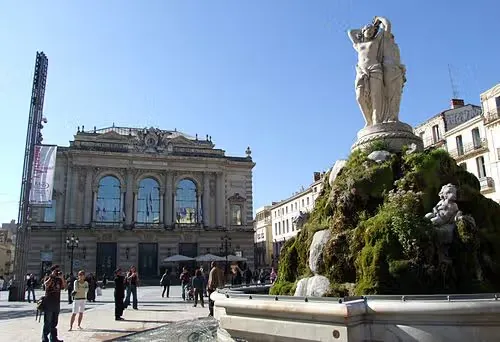
You start on Montpellier's great public square, a long rectangle about 230 metres long and 50 metres wide that runs on into the Esplanade Charles-de-Gaulle. Its name comes from the municipal theatre, the Opéra Comédie, whose monumental façade closes one side. For locals this is the hub of the city, and it has long been the natural starting point for exploring the historic centre.
The ground here was once part of the town's fortifications, near the old Porte de Lattes and the buildings of the governor of Languedoc. The first square was laid out in 1755, and its story is marked by fire: the theatre burned in 1785 and again in 1881, and was rebuilt both times.
The Comédie only became the crossroads you see today in the 19th century. During Jules Pagézy's term in office, rue Foch and rue de la Loge were cut through and the railway station opened. The city's main attractions lay elsewhere, around the market halls, the prefecture, the university and the cathedral, but the easiest way from the trains into the centre now ran straight across this square.
In the middle stands the fountain of the Three Graces, Aglaé, Euphrosyne and Thalie, by Étienne Dantoine, a sculptor from Carpentras. In 1794 it stood on the Place de la Canourgue, where the town hall was then, and it came here at the end of the 1790s. What you see today is a cast: the original moved to the Musée Fabre in 1989 and now stands in the hall of the Opéra Comédie.
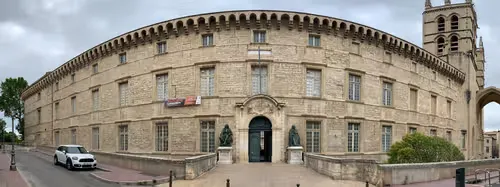
From the square it is 460 m, about 7 minutes on foot, to the Musée Fabre, the museum where the original Graces once spent several years.