Free Walking Tour Istanbul: Old City to the Bosporus

Fourteen stops on foot, from the Blue Mosque's tiles and Topkapi's courtyards across the Galata Bridge to the sultans' last palace on the Bosporus.

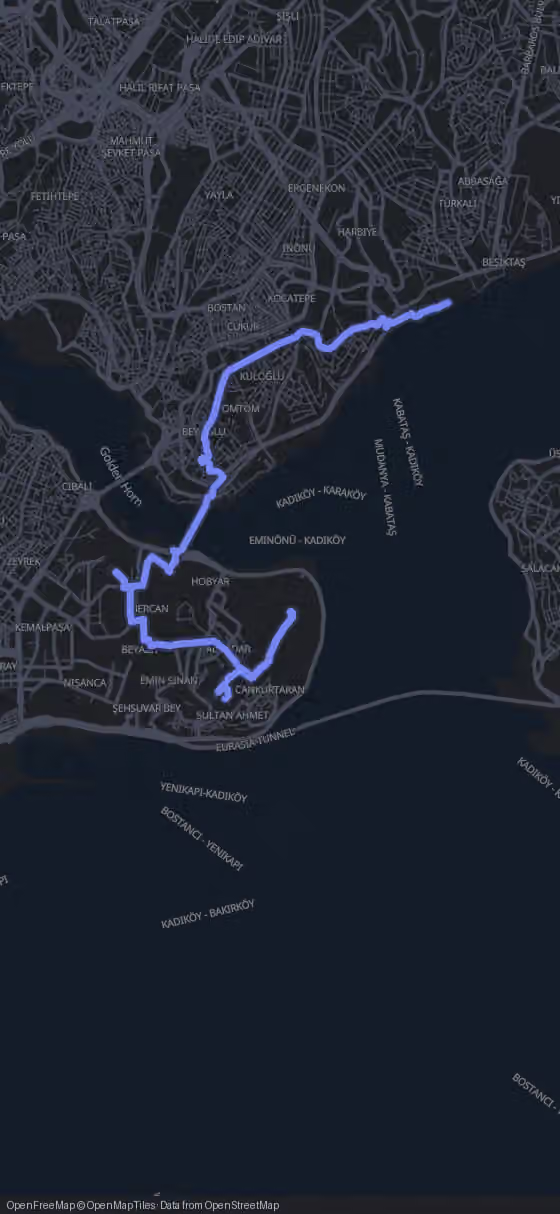
14 Stops 10.4 km ~2 h 29 min walking
Route map for the Istanbul walking tour
Stop 1 of 14
240 m·3 min
Blue Mosque
Head north-west toward the Hippodrome of Constantinople
Merhaba, welcome to Istanbul. I'm Alex, and its architects and dreamers kept testing what seemed possible.
Try this tour with Alex

What This Walk Covers

14 stops lead from the Blue Mosque to Dolmabahçe Palace: 10.4 km and 2 h 29 min of pure walking. With the main interiors and lunch, a single day comes close to 11 hours, so many people split it across two days.

Squares, mosques, both bazaars and the Galata Bridge are free. Tickets apply at Topkapi Palace, the upper gallery of Hagia Sophia, the Basilica Cistern, Galata Tower and Dolmabahçe Palace. The GPS route runs free in your browser; the AI Tour Guide is optional.

Open free GPS & optional AI Tour Guide
This short shows highlights of the route. All 14 stops follow below.

The Route

Walking Map of Istanbul: Sultanahmet to the Bosporus

14 stops 10.4 km 2 h 29 min walking
Tap to load interactive map

The 14 stops along this route

  1. Blue Mosque in Istanbul, stop 1 on the self-guided walking tour
    1Blue Mosque
  2. Hippodrome of Constantinople in Istanbul, stop 2 on the self-guided walking tour
    2Hippodrome of Constantinople
  3. Topkapi Palace in Istanbul, stop 3 on the self-guided walking tour
    3Topkapi Palace
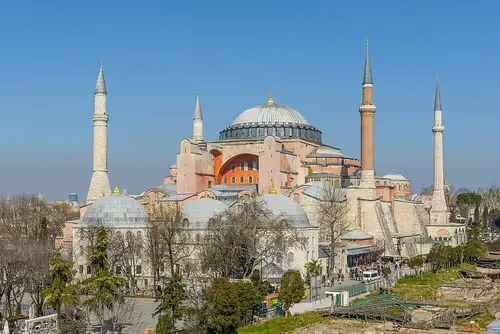
  4. Hagia Sophia in Istanbul, stop 4 on the self-guided walking tour
    4Hagia Sophia
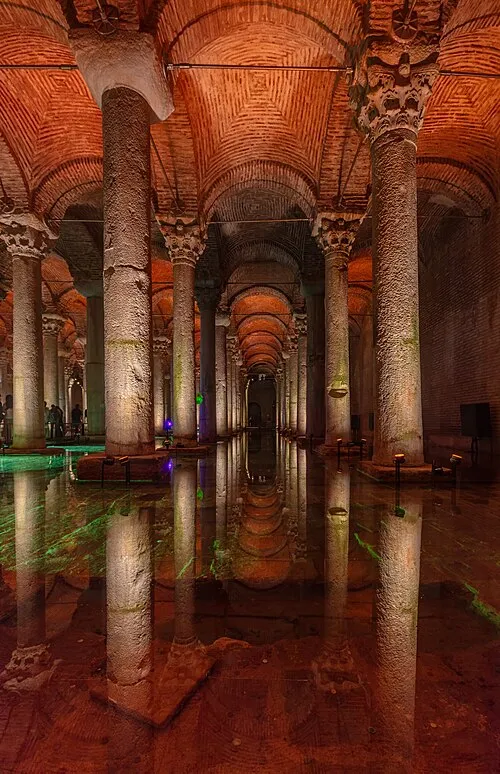
  5. Basilica Cistern in Istanbul, stop 5 on the self-guided walking tour
    5Basilica Cistern
  6. Grand Bazaar in Istanbul, stop 6 on the self-guided walking tour
    6Grand Bazaar
  7. Süleymaniye Mosque in Istanbul, stop 7 on the self-guided walking tour
    7Süleymaniye Mosque
  8. Rüstem Pasha Mosque in Istanbul, stop 8 on the self-guided walking tour
    8Rüstem Pasha Mosque
  9. Spice Bazaar in Istanbul, stop 9 on the self-guided walking tour
    9Spice Bazaar
  10. New Mosque in Istanbul, stop 10 on the self-guided walking tour
    10New Mosque
  11. Galata Bridge in Istanbul, stop 11 on the self-guided walking tour
    11Galata Bridge
  12. Galata Tower in Istanbul, stop 12 on the self-guided walking tour
    12Galata Tower
  13. Taksim Square in Istanbul, stop 13 on the self-guided walking tour
    13Taksim Square
  14. Dolmabahçe Palace in Istanbul, stop 14 on the self-guided walking tour
    14Dolmabahçe Palace
  15. That's the full route.

    Walk it with an AI Tour Guide talking you through every one of these streets.

    Start free in your browser
    You made it

Your Istanbul Walking Tour Stop by Stop, from Mosques to Palaces

  1. 1

    Blue Mosque

    Blue Mosque in Istanbul, stop 1 on the self-guided walking tour

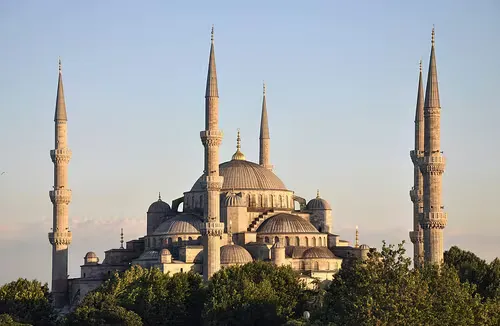
    You begin in front of the Sultan Ahmed Mosque, the building everyone calls the Blue Mosque. Take in its outline before you go in: a central dome resting on four semi-domes over the prayer hall, a large courtyard in front, and six minarets around it. Hagia Sophia stands right across from it, and that is no accident.

    Sultan Ahmed I ordered the mosque after the Peace of Zsitvatorok, a treaty seen as a blow to Ottoman prestige, hoping to win God's favour with a great building. He was the first sultan since Selim II, who died in 1574, to build an imperial mosque. Work began in 1609 and ended in 1617. With its size, its site and its six minarets, the mosque was very likely meant to rival or even outdo Hagia Sophia, which had inspired its architects.

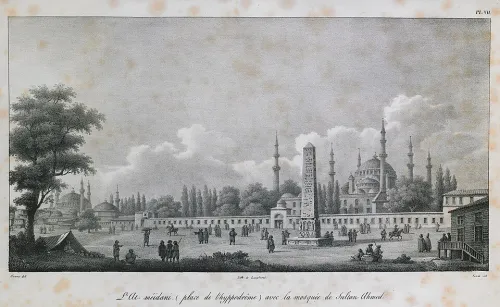
    The ground itself is older than the mosque. Here stood the bleachers of the Byzantine Hippodrome and the imperial box from which the emperor watched the races; excavations in the early 20th century turned up some of the ancient seats in the courtyard. The religious complex around it includes Ahmed's tomb and a madrasa.

    Inside, thousands of Iznik tiles and painted floral patterns in mostly blue tones give the mosque its popular name. Entry is free and worth it for everyone, half an hour is enough. It closes to visitors around each of the daily prayers, so leave a little buffer.

    Walk out the way the old race crowds once sat: 240 m and 3 minutes bring you onto the open square of the Hippodrome.
    Local name
    Sultanahmet Camii
    Hours
    Daily approx. 08:30–18:30, closed to tourists roughly 90 min around each of the 5 daily prayers; closed to visitors Friday mornings until approx. 14:30
    Price
    Free
  2. 2

    Hippodrome of Constantinople

    Hippodrome of Constantinople in Istanbul, stop 2 on the self-guided walking tour

    The long square in front of you is Sultanahmet Square, but for well over a thousand years it was the Hippodrome, the sporting and social heart of Constantinople. The Turkish name Atmeydanı, Horse Square, still remembers the chariot races.

    It is older than the imperial city. Emperor Septimius Severus gave the town, then called Byzantium, its first hippodrome in AD 203. When Constantine the Great refounded the city in 324 as Nova Roma, a name that never caught on, he greatly enlarged it. His Hippodrome was about 450 m long and 130 m wide and held around 100,000 spectators.

    Picture the layout as you walk: the starting gates stood at the northern end, the curved tribune called the sphendone at the southern end, where its lower part still survives. Down the middle ran the spina, the barrier of the racecourse, lined with monuments. One of them is the monolithic obelisk; look at its base, where relief carvings show how it was raised.

    The square is open day and night and free, so this is a quick stop of a quarter of an hour. From here it is 1210 m and 17 minutes to the gates of Topkapi Palace.

    Local name
    Atmeydanı
    Hours
    Open 24/7
    Price
    Free
  3. 3

    Topkapi Palace

    Topkapi Palace in Istanbul, stop 3 on the self-guided walking tour

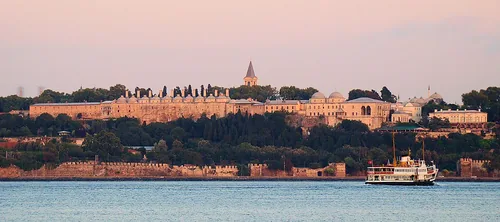
    Topkapi Palace was the seat of Ottoman government for about 380 years. Sultan Mehmed II had it built in 1478, and from here the empire was run, for roughly 400 of its 600 years, until Abdülmecid moved the court to Dolmabahçe Palace, where this walk ends. At times close to 4,000 people lived inside its walls.

    What you walk through today is a fraction of the original: the palace once spread over about 700,000 m², today it covers 80,000 m². Even after the sultans left, officials kept living here and the palace never lost its importance. The chamber of the Holy Relics, the Hırka-i Saadet, which the sultan and his family visited during Ramadan, was given special care and maintained every year.

    The palace slowly turned into a museum before it officially became one. Under Abdülmecid the treasury was shown to the British envoy, and showing its treasures to foreigners became a custom; Abdülaziz had glass display cases made in Empire style for them. By Atatürk's order the palace opened to the public on 3 April 1924.

    If you pay for only one interior on this walk, make it this one, and allow about two hours. The combined ticket includes Hagia Irene and the Harem; if your time is short, the Harem is the part to choose consciously.

    From the palace it is 680 m and 9 minutes back to Hagia Sophia.

    Local name
    Topkapı Sarayı
    Hours
    Ticket office 09:00–17:00, closed Tuesdays (also closed New Year's Day and first day of Ramadan Feast)
    Price
    2750 TRY foreign visitors (Palace + Hagia Irene + Harem combined ticket); Harem alone as separate add-on 1050 TRY
  4. 4

    Hagia Sophia

    Hagia Sophia in Istanbul, stop 4 on the self-guided walking tour

    Hagia Sophia means Holy Wisdom, Greek words for one of the attributes of God in Christian theology. Emperor Justinian I had it built as the cathedral of the Patriarch, and it was finished in 537 after five years of work. Isidore of Miletus and Anthemius of Tralles led some 10,000 workers, and the emperor spent a fortune on it.

    Look closely at the columns, doors and stones: some were brought from older buildings and temples, which makes the building even older than its date. As a domed basilica that merges a central plan with a long hall, it is a turning point in the history of architecture. For a thousand years it was the centre of the Eastern Orthodox Church and held a wealth of relics, among them a silver iconostasis 15 m high.

    Its later history reads like the city's own. After the conquest of 1453 Mehmed II turned it into a mosque. In 1935 it became a museum, in 2020 a mosque again, and since 2024 the upper floor has served as a museum.

    The paid ticket covers the upper gallery and mosaics museum section, the part to see if Byzantine mosaics interest you; give it about 45 minutes. Check the visiting times at the entrance, since prayer times shape the day in a working mosque.

    The Basilica Cistern lies only 280 m and 4 minutes away.

    Local name
    Ayasofya
    Price
    25 EUR foreign visitors (upper gallery / mosaics museum section)
  5. 5

    Basilica Cistern

    Basilica Cistern in Istanbul, stop 5 on the self-guided walking tour

    Under your feet lie several hundred ancient cisterns, and the Basilica Cistern is the largest of them. It was built in the 6th century under Justinian I, the same emperor as Hagia Sophia. Its name comes from the Stoa Basilica, a great public square above it, where a basilica of the early Roman age had stood as a centre of trade, law and art, with gardens and a colonnade facing Hagia Sophia. Historical texts say 7,000 enslaved people worked on the cistern.

    Then the city forgot it, all but the locals who kept drawing water through their houses. In 1565 the French traveller Petrus Gyllius described being rowed between the columns and watching fish swim beneath his boat.

    Modern restoration brought it back. Between 1985 and 1987 more than 50,000 tons of silt were removed, uncovering the column bases carved with Medusa heads, and wooden walkways allowed it to open as a museum in 1987. A second restoration between 2020 and 2022 replaced corroded iron ties with stainless-steel rods anchored by star-shaped plates for earthquake safety; look up and you can spot them. Today only a little water is left.

    It is one of the most expensive sights in the city, and free cisterns exist, so go in if the Medusa heads and the column forest are high on your list; half an hour is enough. From here it is 990 m and 14 minutes to the Grand Bazaar.

    Local name
    Yerebatan Sarnıcı
  6. 6

    Grand Bazaar

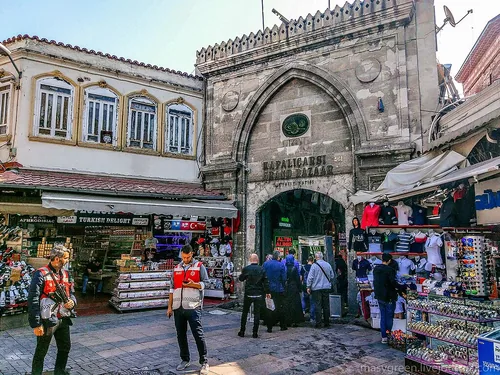
    Grand Bazaar in Istanbul, stop 6 on the self-guided walking tour

    Kapalıçarşı, the Covered Market, has 61 covered streets and more than 4,000 shops on 30,700 m², and it is often called one of the first shopping malls in the world. In 2014 it was listed as the most visited tourist attraction on earth, with 91,250,000 visitors.

    Its core goes back to the winter of 1455/56, right after the conquest. Mehmed II had a hall built for the trade in textiles and jewels, the Cevâhir Bedesten, the Bedesten of Gems. The word bedesten comes from the Persian bez, cloth, and means bazaar of the cloth sellers. When the building was finished in the winter of 1460/61, it was endowed to the foundation of the Hagia Sophia Mosque, so its rents supported the building you just left. Look for this old hall, known as the İç, Eski or Antik Bedesten, at the heart of the maze.

    The bazaar is free to enter. Wander without a plan, but shop with care: bargaining is expected and first prices are high. Nearby is a good place for lunch on a full day.

    From the bazaar it is 930 m and 13 minutes to the Süleymaniye Mosque on the Third Hill.

    Local name
    Kapalıçarşı
    Hours
    Mon–Sat 08:30–19:00, closed Sundays and during major religious holidays (Eid al-Fitr, Eid al-Adha, 3-4 days each)
    Price
    Free (shopping bazaar)
  7. 7

    Süleymaniye Mosque

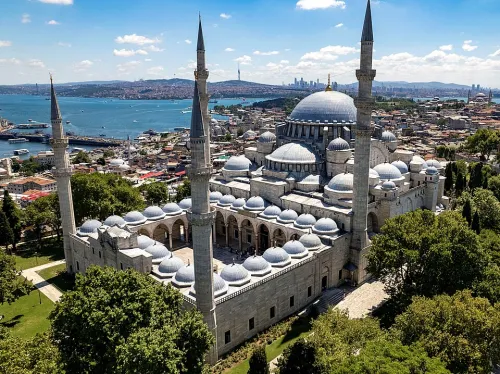
    Süleymaniye Mosque in Istanbul, stop 7 on the self-guided walking tour

    Süleymaniye Mosque crowns the Third Hill of Istanbul, and from its grounds you get a wide view over the Golden Horn. Sultan Suleiman the Magnificent ordered it, and the imperial chief architect Mimar Sinan designed it. An inscription records the foundation in 1550 and the opening in 1557, though work on the complex probably went on for a few years more.

    It counts among the masterpieces of Ottoman architecture, is one of Sinan's most important works and is the largest Ottoman-era mosque in Istanbul. Like other imperial mosques, it sits inside a whole complex: madrasas, a public kitchen, a hospital, a primary school and a cemetery.

    Walk around to the enclosed cemetery behind the qibla wall. There you find the octagonal tombs of Suleiman and his wife Hürrem Sultan. The mosque and its surroundings are one of the four parts of the UNESCO World Heritage Site Historic Areas of Istanbul.

    Entry is free and worth it for everyone. The mosque closes to visitors for a short while around each prayer, so time your visit between them.

    Suleiman and Hürrem's son-in-law built the next mosque: 680 m and 9 minutes take you to Rüstem Pasha Mosque.

    Local name
    Süleymaniye Camii
    Hours
    Daily approx. 09:00–18:00, closed roughly 30 min around each of the 5 daily prayers; Fridays opens later (~14:30) due to congregational prayer
    Price
    Free
  8. 8

    Rüstem Pasha Mosque

    Rüstem Pasha Mosque in Istanbul, stop 8 on the self-guided walking tour

    Rüstem Pasha Mosque hides in the Hasırcılar Çarşısı, the market of the strawmat weavers in the Tahtakale neighbourhood, close to the Spice Bazaar. From the street you would hardly guess what waits inside.

    Rüstem Pasha was twice Grand Vizier under Suleiman, a post comparable to a European prime minister, and married Mihrimah Sultan, daughter of Suleiman and Hürrem. Before his death in 1561 he hoped to build one last mosque of his own, partly to repair a controversial reputation. Suleiman approved the project in 1562 and gave it to Mimar Sinan; it was probably finished in 1563.

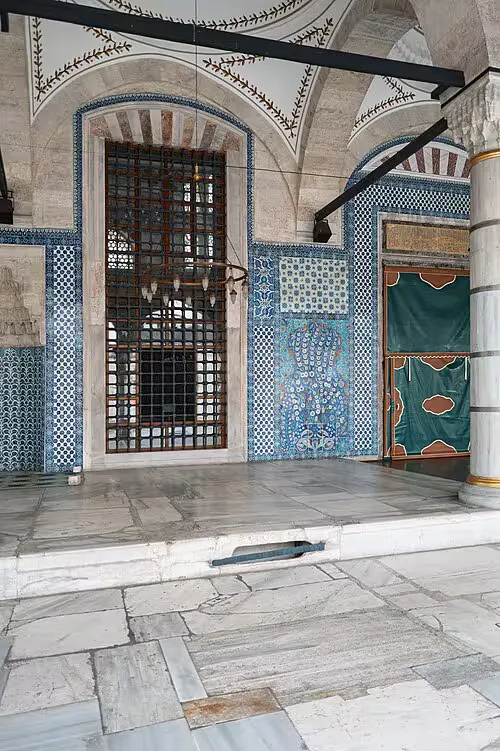
    The reason to come is the tiles. İznik tiles in many different designs cover almost every vertical surface inside and under the entrance porch, which makes this mosque unique among Sinan's many works. Rüstem Pasha may have ordered them to support the court designer Kara Memi, known for elegant floral designs. Some tiles may date from 1555, others from after the vizier's death, and with no foundation inscription the dating is still argued over.

    Entry is free, and 20 minutes here are among the best spent of the day, especially if you love decoration. The Spice Bazaar is just 210 m and 3 minutes away.

    Local name
    Rüstem Paşa Camii
    Hours
    Daily: 06:00–21:30
    Price
    Free
  9. 9

    Spice Bazaar

    Spice Bazaar in Istanbul, stop 9 on the self-guided walking tour

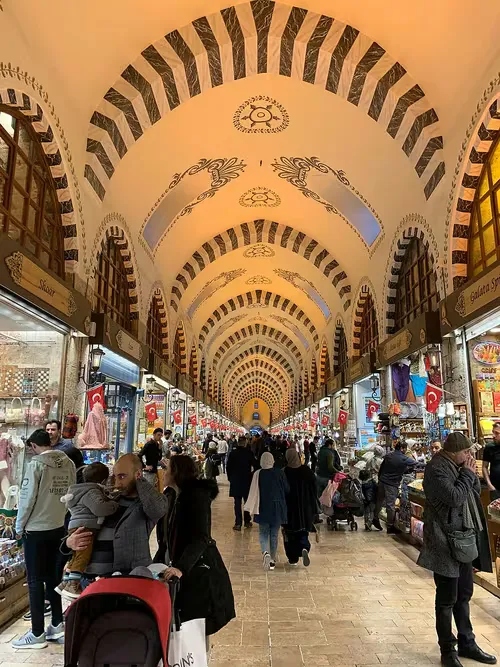
    The Mısır Çarşısı, the Egyptian Bazaar, is the city's spice market. Its plan is shaped like an L, with about 100 shops on both sides of the covered street. Spices are only part of it now: food and textiles dominate, and you will also find electronics and newspapers. Above the main entrance on the Galata Bridge side is a restaurant with a long tradition.

    This quarter was a merchants' district long before the Ottomans. In Byzantine times traders from the Italian sea republics lived here, Venetians, Pisans, Genoese and merchants from Ancona and Ragusa. Hasırcılar Street, where you just were, was the Venetians' shopping street. Jewish traders lived and sold near the Jewish Gate close by.

    In 1917 Friedrich Schrader described the bazaar at the end of the Ottoman era, when people came not only for cooking spices but for medicinal and bath herbs. Today its side doors still lead into the open market streets around it, with stalls for vegetables, fish, household goods and clothes, a lively area to drift through.

    The bazaar is free to enter. Look and taste, but buy Turkish delight elsewhere. The New Mosque is only 140 m and 2 minutes away.

    Local name
    Mısır Çarşısı
    Hours
    Daily 08:00–19:30, 7 days a week
    Price
    Free (shopping bazaar)
  10. 10

    New Mosque

    New Mosque in Istanbul, stop 10 on the self-guided walking tour

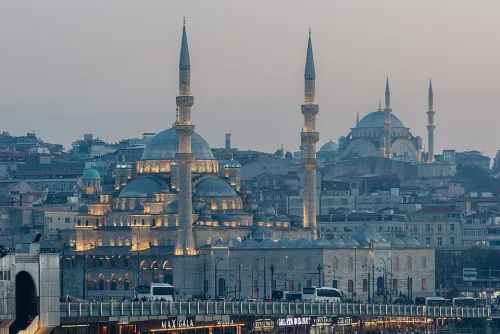
    Yeni Cami, the New Mosque, stands on the Golden Horn at the southern end of the Galata Bridge and marks the crossing from the old historic core to Beyoğlu. Its name is a little ironic: building it took more than half a century.

    Safiye Sultan, wife of Murad III and mother of Mehmed III, began it in 1597 as Valide Sultan, the queen mother, which is why it was first called the Valide Sultan Mosque. The architect Davut Ağa, an apprentice of Mimar Sinan, died in 1599 and was replaced by Dalgıç Ahmed Çavuş.

    The location was political. Eminönü was the city's leading commercial centre with a mainly Jewish population, and Safiye wanted to extend Islamic influence here, using merchants' resentment as a pretext to confiscate property. The cost drew sharp criticism, and the Janissaries in particular resented the power of the queen mother. When Mehmed III died in 1603, Safiye had to abandon the project. Another Valide Sultan, Turhan Sultan, mother of Mehmed IV, finished it in 1665, a monument of the period known as the Sultanate of Women.

    Entry is free, but the mosque closes to visitors during prayers. A quarter of an hour inside is enough. From here it is 460 m and 7 minutes onto the Galata Bridge.

    Local name
    Yeni Cami
    Hours
    Usually 09:00–18:00 for visitors; closed during prayers; Friday access may be restricted
    Price
    Free
  11. 11

    Galata Bridge

    Galata Bridge in Istanbul, stop 11 on the self-guided walking tour

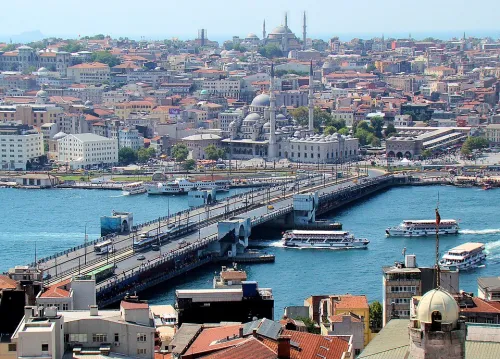
    The Galata Bridge spans the Golden Horn and links Eminönü with Karaköy, which used to be called Galata. The bridge you walk on was built in 1994 and is the fifth on this site. Since the late 19th century it has turned up again and again in Turkish novels, poems and plays.

    The idea of crossing here is old. The first recorded bridge over the Golden Horn was built under Justinian in the 6th century, further up near the land walls. In 1453, before the fall of Constantinople, the Ottomans laid their ships side by side to move troops across the water.

    Then comes the best story. Around 1502 Sultan Bayezid II asked for designs for a bridge at this very spot. Leonardo da Vinci drew a single span of 280 m, which would have been the longest bridge span in the world, but the sultan did not approve it. Michelangelo was also invited and declined. The plan rested until the 19th century, when Mahmud II opened the Hayratiye bridge further up in 1836. In 2001 the artist Vebjørn Sand built a small version of Leonardo's design near Oslo.

    The bridge is free and open around the clock; stop in the middle and watch the water traffic for a while, or try a fish sandwich. From here it is 950 m and 17 minutes to Galata Tower.

    Local name
    Galata Köprüsü
    Hours
    Open 24/7
    Price
    Free
  12. 12

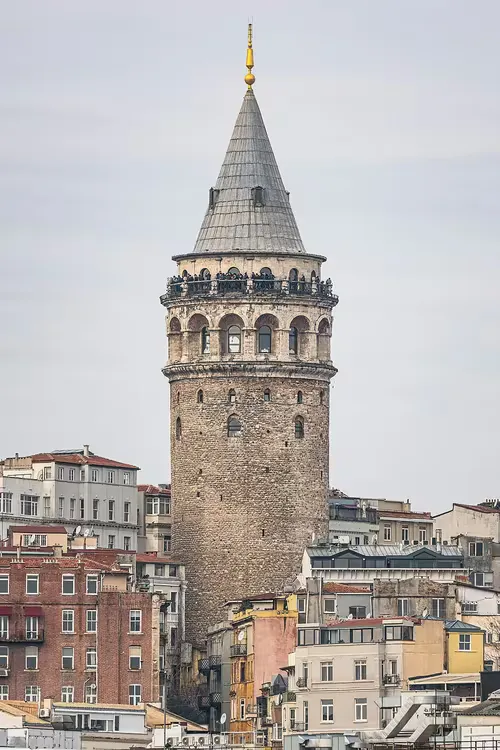
    Galata Tower

    Galata Tower in Istanbul, stop 12 on the self-guided walking tour

    Galata Tower is a symbol of Beyoğlu and of the whole city. It began as a Genoese watchtower. Allied with Byzantium, the Genoese founded a colony called Pera here in 1267 and kept pushing its borders, against their permits, up the hill. The tower, finished in 1349 as part of those new walls, was called the Tower of the Holy Cross for the cross on its top.

    When Constantinople fell on 29 May 1453, the Genoese of Pera handed the colony to the Ottomans without a fight. Parts of the walls were torn down, but Mehmed II ordered the destruction of the tower stopped and the damage rebuilt. After an earthquake in 1509 it was repaired in 1510.

    Its jobs kept changing. In the 16th and 17th centuries it held prisoners of war and served as a store; from the 18th century fire watchers used it to spot blazes. After a fire in 1794 the top was turned into a coffeehouse, another fire in 1831 changed its look again, and when a storm blew off the roof in 1875, two extra floors were added for the fire watch.

    Since 2020 the tower has been a museum and exhibition space. Go in if you want its history from the inside; otherwise its shape from the street is the picture most people come for.

    The next leg is the longest walk so far, 1810 m and 26 minutes to Taksim Square, along Istiklal Avenue.

    Local name
    Galata Kulesi
    Hours
    Daily 08:30–23:00
    Price
    30 EUR foreign visitors / 650 TRY Turkish citizens
  13. 13

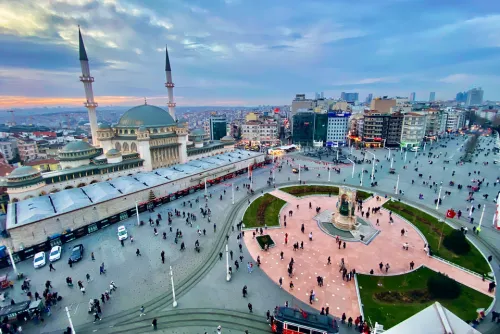
    Taksim Square

    Taksim Square in Istanbul, stop 13 on the self-guided walking tour

    Taksim Square is considered the heart of modern Istanbul, with the central station of the metro beneath it. Its name means division or distribution in Arabic: under Sultan Mahmud I, the main water lines from the north of the city were gathered here and branched off to other districts. The Ottoman stone reservoir that gave the square its name still stands along one side.

    In the middle stands the Republic Monument by Pietro Canonica, unveiled in 1928 for the fifth anniversary of the Republic of Turkey, founded in 1923 after the War of Independence. Around the square you see the Marmara Hotel to the south, the Atatürk Cultural Centre to the east, Gezi Park to the north and Taksim Mosque to the west.

    Gezi Park has its own story. A 19th-century artillery barracks, later a stadium, once stood here and was demolished in 1940 under the plans of the French planner Henri Prost. In 2013 the city wanted to rebuild the barracks as a shopping venue on the park; protesters camped there, police cleared them by force, and thousands joined the Occupy Taksim movement to save the park.

    The square is free and open at all hours; a quarter of an hour is enough. The final leg is 1780 m and 25 minutes to Dolmabahçe Palace.

    Local name
    Taksim Meydanı
    Hours
    Open 24/7
    Price
    Free
  14. 14

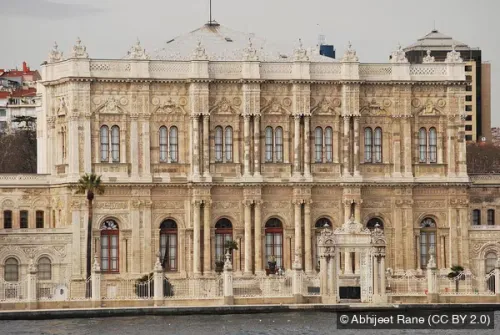
    Dolmabahçe Palace

    Dolmabahçe Palace in Istanbul, stop 14 on the self-guided walking tour

    You end where the Ottoman court ended. Dolmabahçe Palace stretches along the European shore of the Bosporus, and it exists because Topkapi Palace, where you were this morning, no longer seemed good enough. Sultan Abdülmecid I found the medieval palace lacking in style, luxury and comfort next to the palaces of European monarchs, and had this one built between 1843 and 1853 on the site of the demolished Beşiktaş Sahil Palace.

    The design came from the Armenian Balyan family of court architects, Garabet Balyan, his son Nigoğayos Balyan and Evanis Kalfa, while Hacı Said Ağa ran the works. The price was enormous: five million Ottoman lira, or 35 tonnes of gold, about a quarter of a year's tax revenue. It was paid by debasing the currency, printing paper money and borrowing abroad, and it helped push the empire into default in October 1875 and under the European-run Ottoman Public Debt Administration in 1881.

    Six sultans lived here from 1853 until the caliphate was abolished in 1924; the last royal resident was Caliph Abdülmecid II. A law of 3 March 1924 handed the palace to the new Republic, and Atatürk used it as a summer residence and did some of his most important work here.

    The combined ticket covers the Selamlik, the Harem and the Painting Museum, and it is worth it if you want to see the luxury that emptied the treasury. On a one-day walk you arrive too late for the rooms and take in the facade; for the interiors, come back on a second morning.

    Local name
    Dolmabahçe Sarayı
    Hours
    Daily 09:00–17:00, closed Mondays and on first day of Ramadan Feast / Eid al-Adha holidays
    Price
    2000 TRY foreign visitors (Selamlik + Harem + Painting Museum combined)
Walking tour route map of Istanbul Route loaded
Blue MosqueHippodrome of ConstantinopleTopkapi PalaceHagia Sophia+10
All 14 stops are already on the map.
You just press start.
AI Tour Guide

You have the route. Now walk it from Sultanahmet with a guide in your ear.

Press start wherever you are, even hundreds of kilometres from Istanbul, and the guide begins telling its stories right away. In the city, pick any of the 14 stops to start from: it leads you there, then talks with you the whole route, asking, listening, remembering, and shaping the tour around your answers.

14stops 10.4km 2 h 29 minwalking 13languages
▶Start the tour free

Free to start · Runs in your browser · No app, no download

Shorter Ways to Walk the Route

The full walk is a lot for one day. These cuts follow the same order and work well on their own or as two halves of a two-day visit.

Old City in one day

Stops: 1, 2, 3, 4, 5, 6, 7, 8, 9, 10, 11

For first-time visitors who want the Byzantine and Ottoman core. From the Blue Mosque to the Galata Bridge you cover 5.8 km with 1 h 21 min of walking. Tickets: Topkapi Palace, the Hagia Sophia upper gallery and the Basilica Cistern.

Galata to Dolmabahçe

Stops: 11, 12, 13, 14

For a second morning or anyone staying in Beyoğlu. From the Galata Bridge over Galata Tower and Taksim Square to Dolmabahçe Palace is 4.5 km and 1 h 8 min of walking, and you arrive while the palace is open. Tickets: Galata Tower and Dolmabahçe Palace. Not on a Monday.

Bazaars and Sinan's mosques, all free

Stops: 6, 7, 8, 9, 10, 11

For a free half day. From the Grand Bazaar via the Süleymaniye, Rüstem Pasha and New Mosques and the Spice Bazaar to the Galata Bridge: 2.4 km and 34 min of walking, no tickets at all. Skip Sundays and Friday mornings.

How Long Does This Istanbul Tour Take with Palaces and Bazaars?

The pure walking time is 2 h 29 min over 10.4 km. The Old City legs are short, most under a quarter of an hour; the two long ones come at the end, 26 min from Galata Tower to Taksim Square and 25 min from there to Dolmabahçe Palace.

A full day with the interiors that are worth it looks like this: Blue Mosque at 08:30 for half an hour, Topkapi Palace at 09:35 for two hours, Hagia Sophia at 11:44, the Basilica Cistern at 12:33, the Grand Bazaar at 13:17 with an hour and a half for browsing and lunch, Süleymaniye Mosque at 15:00, the Spice Bazaar at 16:02, the Galata Bridge at 16:56, Galata Tower at 17:28 for 45 minutes and Taksim Square at 18:39. You reach Dolmabahçe Palace at 19:19, close to 11 hours after starting and too late for its rooms, so on one day you see it from outside.

Split into two days, the Old City part ends on the Galata Bridge shortly after 17:00 with the same stops and pauses. Starting the Galata part at 09:00, you reach Dolmabahçe Palace at about 11:10 with the whole day open for its rooms. The free bazaar and mosque loop fills a relaxed afternoon of about three hours with visits.

Before You Set Off from the Blue Mosque

  • Start and finish: The recommended start is the Blue Mosque in Sultanahmet, the finish is Dolmabahçe Palace on the Bosporus. You can join the route at any stop and pick up the order from there.
  • Best day: Make sure Topkapi Palace, the Grand Bazaar and Dolmabahçe Palace are open on the day you pick, and keep in mind that the mosques close to visitors around prayer times.
  • Time of day: Start in the morning once the Blue Mosque has opened, so you reach Topkapi Palace early in the day.
  • Tickets: Tickets are needed for Topkapi Palace (the combined ticket covers palace, Hagia Irene and Harem, and the Harem is also sold as an add-on), the Hagia Sophia upper gallery, the Basilica Cistern, Galata Tower and Dolmabahçe Palace (Selamlik, Harem and Painting Museum).
  • Guide costs: Route, map and GPS navigation are free. The AI Tour Guide starts with 100 free credits; after that you choose €19.99 for this tour with no time limit, or credits at €5 per hour.
  • Getting around: Get an Istanbulkart right away: it works on metro, tram, bus, ferry and funicular, even for public toilets. The tram stop Beyazıt-Kapalıçarşı takes you from Sultanahmet or Sirkeci to the Grand Bazaar.

Food and Breaks Along the Route, from Köfte to Baklava

The route runs through Sultanahmet, where you choose your table carefully, into Eminönü, the city's street food quarter, and then across the water to Karaköy and Beyoğlu for baklava and coffee.

Tarihi Sultanahmet Köftecisi Selim UstaKöfte specialists since 1920, one of the few honest addresses in the tourist zone. (near Hagia Sophia)
Çorba EviA dark little room full of good soups on a busy tourist street; most visitors walk straight past it. (Sultanahmet)
Şehzade Cağ KebapCağ kebab from a horizontal spit, recommended again and again. Order an ayran with it; this is the natural lunch stop of the full day. (near the Grand Bazaar)
Murat the FishermanWhile the crowds queue at Balık Mehmet Usta, locals come here for a cheaper and tastier fish sandwich. Sit under the awning: the seagulls are bold. (Eminönü)
Pak PideCheap, very good pide close to the Spice Bazaar end of the walk. (Eminönü)
Eminönü street foodSimit with tea, roasted chestnuts, Turkish sweets, pickle juice and balık ekmek, the grilled fish sandwich sold at the Galata Bridge. (Eminönü, around the Spice Bazaar and the Galata Bridge)
Karaköy GüllüoğluThe city's baklava institution, always busy, with flaky syrup-soaked filo. (Karaköy, across the Galata Bridge)
MandabatmazThick sand coffee with a chocolatey taste and cardamom, a good pause on the long leg to Taksim. (in an alley off Istiklal Avenue)
KızılkayalarFamous for the ıslak burger, the soft wet burger, and a classic for a late-night bite. (Taksim Square)

Tourist Traps to Avoid in Istanbul's Old City and Bazaars

  • Fish restaurants with touts in Sultanahmet: Prices run two or three times higher than at local places, and grilled sea bass is the classic example: a few streets away it costs far less. Meze, water or nuts placed on the table unasked can end up on the bill. A tout shouting outside is the clearest warning sign. (around the Blue Mosque and Hagia Sophia)
  • Card payments in euros or dollars: If the card machine offers to charge in EUR or USD instead of TRY, decline: the conversion hides a markup.
  • Bazaar souvenirs: Prices for visitors are often 50 percent or more above the real value, much of it factory-made, and bargaining is expected. Locals buy neither Turkish delight at the Spice Bazaar nor souvenirs at the Grand Bazaar or next to big sights. (Grand Bazaar and Spice Bazaar)
  • Taxi meters: Insist on the meter and get out if the driver refuses. Have exact change and say the note out loud (“Here is 200 lira”). If a driver asks whether it is your first time in Istanbul, say you have been in town a while.
Walking tour route map of Istanbul
AI Tour Guide

Your guide is ready when you are, at the Blue Mosque or any stop

Press start and a voice AI Tour Guide takes it from here: leading the route through Istanbul, telling the stories, and turning your walk into a real back-and-forth conversation. No app or download is needed; it runs in your browser.

14stops 10.4km 2 h 29 minwalking 13languages
▶Start the tour free

Free to start · Runs in your browser · No app, no download

What the Guide Adds Between Emperors and Sultans

This route runs from Justinian's builders to the last caliph, and the AI Tour Guide walks it with you as a conversation: it greets you at the Blue Mosque, tells the stories of each place, asks what you care about and remembers it, so the talk at Süleymaniye already knows you lingered over tiles. It goes where the text stops: what the inscriptions in a dome say, how daily life in the Harem was organised, how one Sinan mosque differs from the next. Interrupt it whenever you like.

A Real Conversation A voice AI Tour Guide greets you, leads the whole route, and tells the stories and facts as you walk, asking what you want to see and keeping a real conversation going. Not a recording you press play on.
Map Navigation Follow the route on the map and walk at your own pace. You choose where to start and when to move to the next stop.
Ask Anything Curious about a building you pass? Ask your AI Tour Guide on the spot and the conversation carries on.
13 Languages Switch language anytime. No separate tour needed.
Start free in your browser

Common Questions About Walking Istanbul

What is ikram, and do I pay for it?

Many Istanbul restaurants bring salads, meze or bread you did not order as ikram, a free welcome. If you are unsure, ask “Ikram mi?” before you eat.

Do I need a city pass or skip-the-line tickets for these sights?

Usually not. Many visitors buy passes and skip-the-line tickets they never need; on this route you simply pay at each ticket desk.

How do I get back from Dolmabahçe Palace?

Use your Istanbulkart on public transport. If you take a taxi, make sure the meter is running.

Is the tour really free?

Yes. The whole tour is free: the route, the interactive map and the navigation cost you nothing. Only the voice AI Tour Guide is optional and paid: you test it with 100 free credits, then you pay either €5 per hour or €19.99 for this whole tour, with no time limit. Admission to 5 of the 14 stops is not included: Topkapi Palace, Hagia Sophia, Basilica Cistern, Galata Tower and Dolmabahçe Palace charge their own entry fees.

Do I need to download an app?

No. Everything runs in your phone browser. Open the route and start walking, no download and no sign-up required.

Do I need to book the walking tour in advance?

No booking needed. This self-guided tour is available anytime. Open the route in your browser and start walking. The AI Tour Guide works instantly, no app, no reservation required.

What languages is the AI Tour Guide available in?

The AI Tour Guide speaks 13 languages, so you take the tour in your own language and can switch at any time.

Can I skip stops or change the route?

Yes. Skip any stop, spend extra time at places you like, or start the route from any point. It is your walk, you set the pace.
Image credits
▶ Start free in your browser Runs in your browser, no app, no download