

Museum of Prehistoric Thera
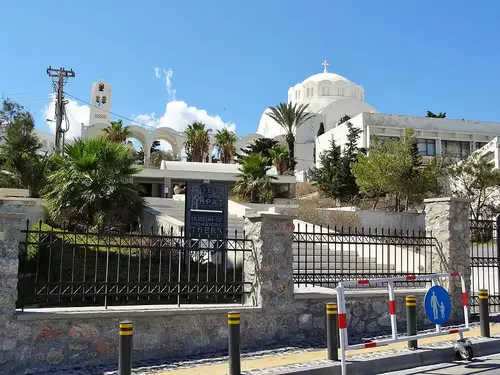
You start in Fira, at a museum standing on ground with its own story: the old Ypapanti Church stood here until the Amorgos earthquake of 1956 destroyed it. Today the building holds the finds that tell Santorini's story long before any church, from the Late Neolithic through to the Late Cycladic I period.
Most of what you'll see comes from Akrotiri, a settlement on a peninsula in the island's southwest whose history reaches back to 3300 BC and which flourished in the 17th century BC. The collections run in chronological order: Neolithic pottery, Early Cycladic marble figurines, ceramics, sculpture, jewellery, ritual objects and, above all, wall paintings, shown in great detail. Look out for the Middle Cycladic bird jugs, many of them painted with swallows, found at Ftellos, Megalochori and Akrotiri and made between the 20th and the 18th centuries BC. The displays also show how wide the island's network of contacts with the outside world was.
The digging began almost by chance. In 1867, after locals turned up old artifacts at a quarry, the French geologist F. Fouqué carried out the first excavations. Between 1895 and 1900 the German archaeologist Baron Friedrich Hiller von Gaertringen uncovered ancient Thera on Mesa Vouno, a 9th century BC settlement believed to be a Spartan colony. R. Zahn followed at Potamos, and the main work at Akrotiri was led by the Archaeological Society of Athens.
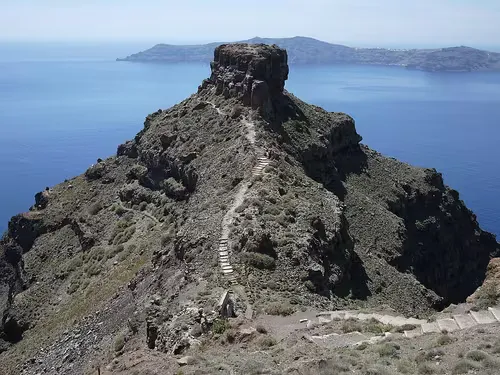
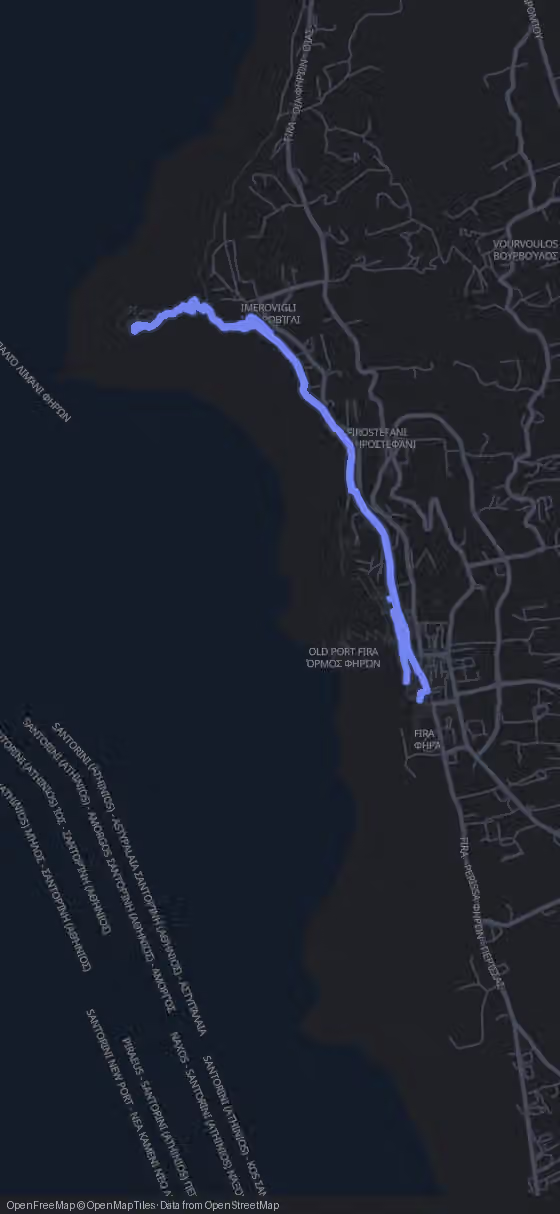
Going inside costs a ticket, and it pays off if Bronze Age art or the wall paintings draw you; give it about an hour. If you'd rather stay outdoors, skip it and pick up the walk at Skaros Rock. Either way, the next leg is the longest of the day: 2880 m, about 49 minutes, through Fira and out to Skaros Rock.