Free Walking Tour Bucharest: Athenaeum to Village Museum

Thirteen stops on one walk: Ceaușescu's vast palace, a 1724 church in the Old Town, the square where the 1989 revolt erupted and a whole village rebuilt by a lake.

13 Stops 13.7 km ~3 h 17 min walking
Route map for the Bucharest walking tour
Stop 1 of 13
1140 m·14 min
Romanian Athenaeum
Head south down Calea Victoriei toward the CEC Palace
Welcome to Bucharest. I'm Alex, and the city's great concert hall was paid for one small coin at a time.
Try this tour with Alex

Bucharest on Foot: What the Route Covers

Thirteen stops lead from the Romanian Athenaeum via the Palace of Parliament and the Old Town to the Dimitrie Gusti National Village Museum: 13.7 km and 3 h 17 min of pure walking, a full day once you go inside a few places.

Squares, parks, churches and the Old Town are free; the Palace of Parliament, the museums and the Arc de Triomphe charge entry. Route, map and GPS navigation from stop to stop are free in your browser; the AI Tour Guide is optional.

Open free GPS & optional AI Tour Guide
This short shows highlights of the route. All 13 stops follow below.

The Route

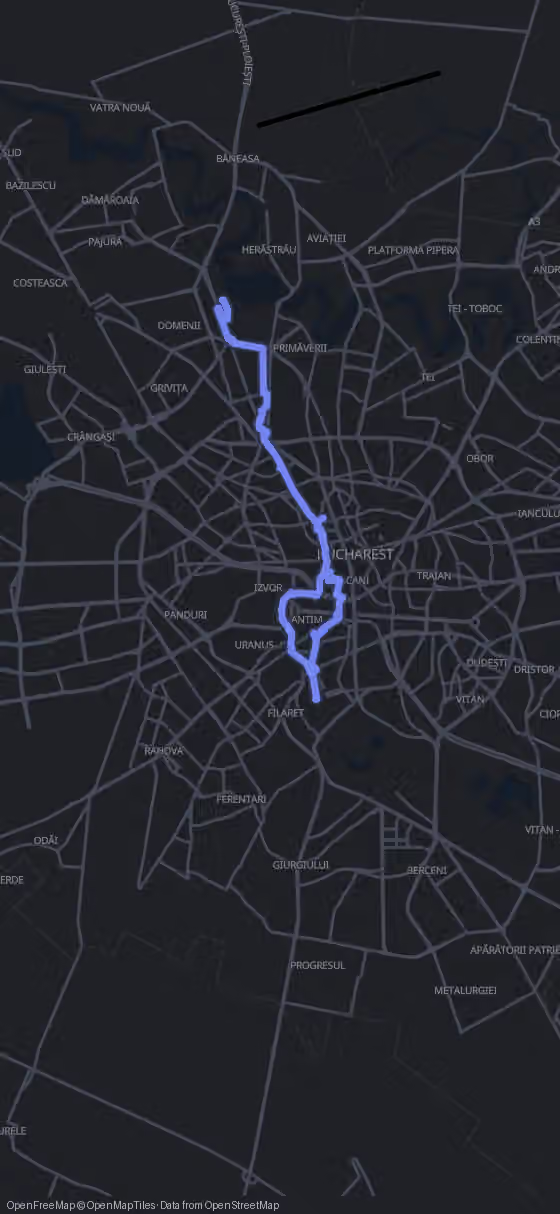
Walking Map of Bucharest from Calea Victoriei to the Village Museum

13 stops 13.7 km 3 h 17 min walking
Tap to load interactive map

The 13 stops along this route

  1. Romanian Athenaeum in Bucharest, stop 1 on the self-guided walking tour
    1Romanian Athenaeum
  2. CEC Palace in Bucharest, stop 2 on the self-guided walking tour
    2CEC Palace
  3. Palace of Parliament in Bucharest, stop 3 on the self-guided walking tour
    3Palace of Parliament
  4. Carol Park in Bucharest, stop 4 on the self-guided walking tour
    4Carol Park
  5. Patriarchal Cathedral in Bucharest, stop 5 on the self-guided walking tour
    5Patriarchal Cathedral
  6. Old Town in Bucharest, stop 6 on the self-guided walking tour
    6Old Town
  7. Stavropoleos Monastery in Bucharest, stop 7 on the self-guided walking tour
    7Stavropoleos Monastery
  8. Revolution Square in Bucharest, stop 8 on the self-guided walking tour
    8Revolution Square
  9. National Museum of Art of Romania in Bucharest, stop 9 on the self-guided walking tour
    9National Museum of Art of Romania
  10. Cantacuzino Palace in Bucharest, stop 10 on the self-guided walking tour
    10Cantacuzino Palace
  11. Museum of the Romanian Peasant in Bucharest, stop 11 on the self-guided walking tour
    11Museum of the Romanian Peasant
  12. Arc de Triomphe in Bucharest, stop 12 on the self-guided walking tour
    12Arc de Triomphe
  13. Dimitrie Gusti National Village Museum in Bucharest, stop 13 on the self-guided walking tour
    13Dimitrie Gusti National Village Museum
  14. That's the full route.

    Walk it with an AI Tour Guide talking you through every one of these streets.

    Start free in your browser
    You made it

Your Bucharest Walking Tour, from Concert Hall to Village

  1. 1

    Romanian Athenaeum

    Romanian Athenaeum in Bucharest, stop 1 on the self-guided walking tour

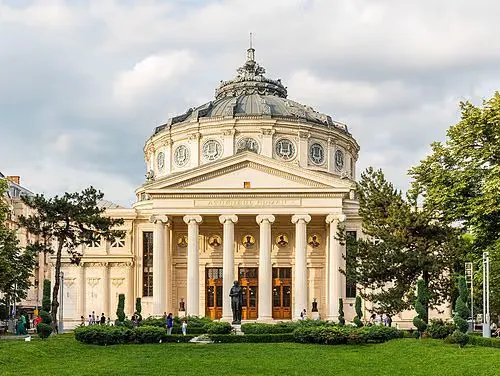
    Start in front of the round, domed concert hall with its columned portico, a small park and the statue of the poet Mihai Eminescu. The building is neoclassical with romantic touches, designed by the French architect Albert Galleron and opened in 1888, though work went on until 1897. It is home to the George Enescu Philharmonic and the George Enescu Festival.

    The Athenaeum was paid for partly by ordinary people. A cultural society founded in 1865 by figures such as Constantin Esarcu and V. A. Urechia raised money by public subscription for 28 years, and its slogan is still quoted: "Donate one leu for the Ateneu!" On 29 December 1919 Romanian leaders met here to ratify the union of Bessarabia, Transylvania and Bukovina with the Old Kingdom, the birth of Greater Romania. In 1992 a restoration costing nine million euros saved the building from collapse.

    Going in costs a fee and is worth it if you care about music or interiors: the auditorium has 600 seats in the stalls plus 52 loges, and a fresco by Costin Petrescu, 75 m long and 3 m high, runs around the circular wall. A concert is the most rewarding way to see it. From here it is 1140 m, about 16 minutes, along Calea Victoriei to the CEC Palace.
    Local name
    Ateneul Român
    Price
    15 RON; visitors with disabilities and refugees from Ukraine free
  2. 2

    CEC Palace

    CEC Palace in Bucharest, stop 2 on the self-guided walking tour

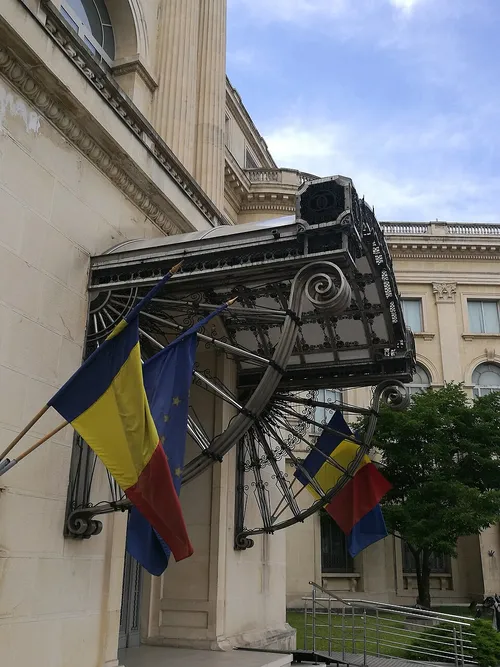
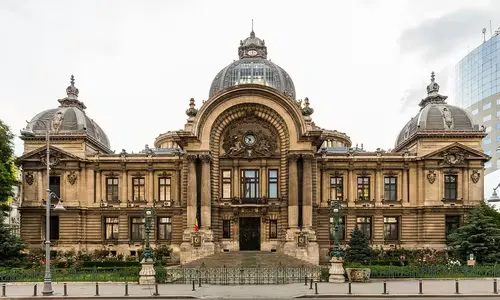
    The CEC Palace is a bank you visit from the outside, and the facade is the show. Look up at the glass and metal dome, the semicircular pediment over the entrance on paired composite columns, and the four corner blocks, each with its own pediment, coat of arms and Renaissance style cupola. Architect Paul Gottereau gave it a late 19th century French look; it stands opposite the Palace of the Posts, built in the same years.

    King Carol I and Queen Elisabeth attended the laying of the foundation stone on 8 June 1897, and the palace was finished in 1900. The savings bank itself goes back to a law of 1864 initiated by Alexandru Ioan Cuza. Before it, the site held the monastery of Saint John the Great, dating from the 16th century and restored by Constantin Brâncoveanu, until it was demolished in 1875. Today CEC Bank still has its headquarters here.

    Continue 1130 m, about 17 minutes, towards the Palace of Parliament; right after the CEC Palace you pass the National Museum of Romanian History.

    Local name
    Palatul C.E.C.
    Price
    Free (exterior only)
    Website
    cec.ro ↗
  3. 3

    Palace of Parliament

    Palace of Parliament in Bucharest, stop 3 on the self-guided walking tour

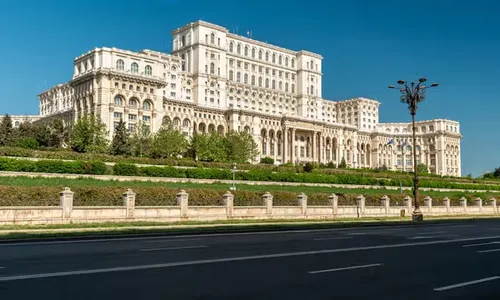
    You will see it long before you reach it. Planned before 1989 as the House of the Republic or House of the People, the Palace of Parliament measures 270 by 240 m, rises 84 m and reaches 92 m underground, with nine levels above ground and nine below. It sits on Arsenal Hill, a natural rise of about 18 m that was raised artificially on the side facing Bulevardul Libertății.

    In 2012 it was ranked the largest civilian administrative building by area, the most expensive and the heaviest in the world; by area it has since been overtaken by the parliament in Bangkok. One British newspaper called it hideous yet impressive in its own way. About 70 % of it stands unused, because much of it was shaped by Ceaușescu's ambitions and personality cult rather than by anyone's needs.

    Seeing the inside means joining a paid guided tour. If you want to understand communist Bucharest, take it; if your time is short, the exterior already tells the story of scale. Then walk 1830 m, about 26 minutes, to Carol Park.

    Local name
    Palatul Parlamentului
    Hours
    Daily 09:00–16:30
    Price
    standard tour 85 lei; students aged 19–26 (valid ID) 55 lei; children aged 7–18 40 lei; children aged 0–6 (accompanied) free
  4. 4

    Carol Park

    Carol Park in Bucharest, stop 4 on the self-guided walking tour

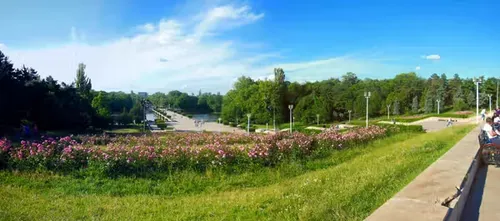
    Carol Park is a French style garden on Filaret Hill, designed by the landscape artist Édouard Redont in 1900 and opened in 1906 for the 40th anniversary of King Carol I's coronation. It originally covered 36 ha, including the 20,000 m² Lake Filaret, and hosted the 1906 Bucharest Exhibition. Of its many pavilions only the Technical Museum, first opened in 1909, and the open air Roman Arenas survive.

    Walk past the monuments: the Mausoleum, the Cantacuzino Fountain of 1870, the Zodiac Fountain of 1934, the giants' statues and a small mosque shaped monument built in 1923 as a sign of reconciliation. The communists renamed it Liberty Park and swapped the busts of Ioan Lahovary and Constantin Istrati for poets and revolutionaries such as George Coșbuc and Nicolae Bălcescu, which are still there. The park has been a listed monument since 2004.

    It is open around the clock and free, a good place to sit down after the Parliament. Next comes the cathedral hill, 1490 m or about 21 minutes away.

    Local name
    Parcul Carol I
    Hours
    Open 24/7
    Price
    Free
  5. 5

    Patriarchal Cathedral

    Patriarchal Cathedral in Bucharest, stop 5 on the self-guided walking tour

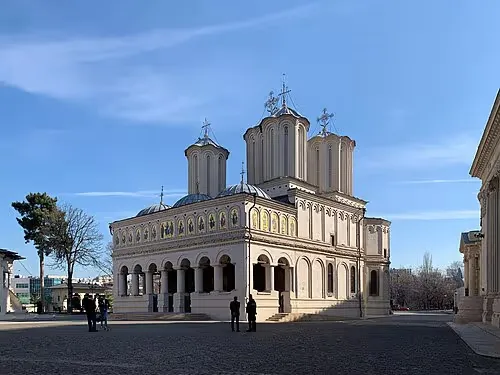
    On Patriarchate Hill stands the church of Saints Constantine and Helena, founded by Voivode Constantin Șerban and his wife Bălașa and built between 1654 and 1658. When the seat of the Metropolitan of Wallachia moved from Târgoviște to Bucharest in 1668 it became a cathedral, and since 1925 it has been the patriarchal cathedral of Romania. Nobody recorded the master builder; only the names of the two officials who supervised the work survive.

    Repeated restorations, the last between 1932 and 1935, mean the church no longer keeps its original form. Inside, the relics of Saint Dimitrie Basarabov rest in a silver reliquary, brought from Bulgaria on 13 July 1774. Around it you see the rest of the patriarchal ensemble: the bell tower, the chapel and residence, and the Patriarchal Palace, once seat of the Chamber of Deputies.

    Entry is free; step in quietly, especially during services, when you may hear the Tronos choir with its Byzantine chant. Walk 1050 m, about 16 minutes, down into the Old Town.

    Local name
    Catedrala Patriarhală din București
    Hours
    Daily: 07:00–20:00
    Price
    Free
  6. 6

    Old Town

    Old Town in Bucharest, stop 6 on the self-guided walking tour

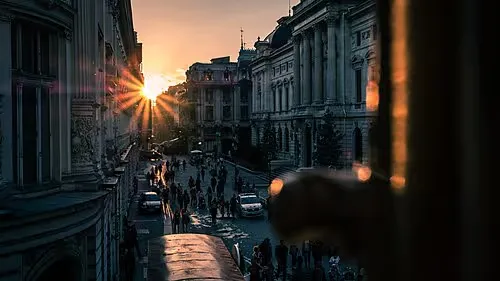
    The Old Town covers about half a square kilometre, framed by big boulevards and cut roughly in half by Bulevardul Ion C. Brătianu. The whole ensemble is a listed monument, and the city is restoring it piece by piece.

    Within it you find the Old Court, the Hanul lui Manuc inn, the churches of Stavropoleos and Saint Anton and many old buildings protected as monuments. Look for two small green spaces: the park around the Saint George New Church, and Colțea Park with the Broken Violin fountain.

    It is always open and free, so wander at your own pace. Stavropoleos is just 300 m away, about 4 minutes on foot.

    Local name
    Centrul istoric al Bucureștiului
    Hours
    Always open
    Price
    Free
  7. 7

    Stavropoleos Monastery

    Stavropoleos Monastery in Bucharest, stop 7 on the self-guided walking tour

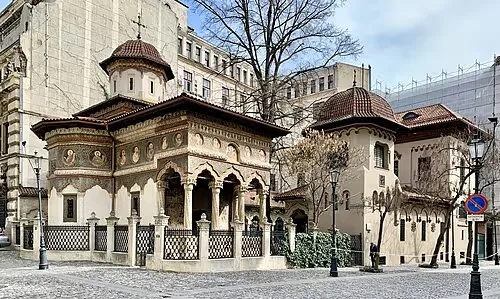
    This small church in Brâncovenesc style, dedicated to the Archangels Michael and Gabriel, is easy to miss and worth finding. Take your time with the carved stone and the painted porch; the dome fell in earthquakes and its paintings were restored at the beginning of the 20th century.

    It was built in 1724, under Prince Nicholas Mavrocordatos, by Ioannikios, a Greek monk from Pogoniani. He ran an inn here, and its income paid for the church and monastery. In 1726 he was elected Metropolitan of Stavropolis, the "city of the cross" in Greek, and the monastery took that name. He died in 1742 at 61 and is buried in his church. The inn was demolished at the end of the 19th century; a building by Ion Mincu now holds a library, early 18th century icons and fragments of wall paintings saved from churches demolished under communism.

    A community of nuns lives here, restoring old books, icons and vestments and cultivating Byzantine music, with the largest collection of Byzantine music books in Romania. Entry is free. The 1020 m, about 14 minutes, to Revolution Square lead you past the Pasajul Macca-Vilacrosse.

    Local name
    Biserica Stavropoleos
    Hours
    Daily 08:00–19:00
    Price
    Free
  8. 8

    Revolution Square

    Revolution Square in Bucharest, stop 8 on the self-guided walking tour

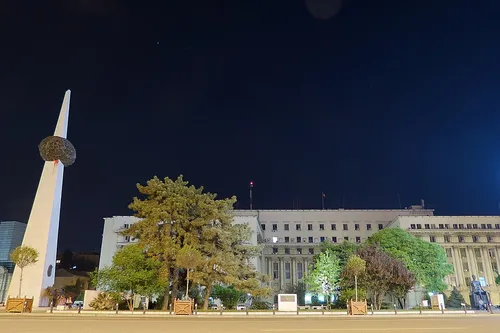
    Until 1989 this was Palace Square. Around you stand the former Royal Palace, the Athénée Palace Hotel, the University Library and the Memorial of Rebirth; the Athenaeum is part of the same square. Find the building of the former Central Committee of the Communist Party: on 22 December 1989 Nicolae Ceaușescu and his wife fled from here by helicopter. It later housed the Senate and, since 2006, the Ministry of Interior.

    Two rallies here mark the high and low of his rule. On 21 August 1968 Ceaușescu condemned the Soviet invasion of Czechoslovakia, the peak of his popularity. On 21 December 1989 he tried to repeat that scene; state media billed it as spontaneous support, and instead it turned into the revolt that ended the regime.

    Look also at the equestrian statue of Carol I. The original by Croatian sculptor Ivan Meštrović, made in 1930, was destroyed by the communists in 1948, who never paid him. The new statue by Florin Codre, unveiled in December 2010, was inspired by his model and has faced plagiarism accusations. The art museum is just 220 m away, about 3 minutes.

    Local name
    Piața Revoluției
    Hours
    Always open
    Price
    Free
  9. 9

    National Museum of Art of Romania

    National Museum of Art of Romania in Bucharest, stop 9 on the self-guided walking tour

    The museum fills the former Royal Palace. It was damaged in the 1989 revolution; the modern Romanian and international collections reopened in 2000, and the medieval collection followed in 2002, including works rescued from monasteries destroyed in the Ceaușescu era.

    Go in if you have at least an hour. The modern Romanian rooms show sculpture by Constantin Brâncuși and Dimitrie Paciurea and painting by Nicolae Grigorescu and Theodor Aman. The European gallery grew from 214 works collected by King Carol I, with El Greco, Rembrandt, Rubens, Jan van Eyck and Tintoretto, plus some Monet and Sisley. Look for Jacopo Amigoni's portrait of the singer Farinelli, a Crucifixion by Antonello da Messina and Alonso Cano's Christ at the Column.

    You buy tickets at the desk. From here it is 1230 m, about 18 minutes, up Calea Victoriei to the Cantacuzino Palace.

    Local name
    Muzeul Național de Artă al României
    Hours
    Wed–Fri 10:00–18:00; Sat–Sun 11:00–19:00; closed Mondays and Tuesdays and on 1, 2, 6, 7 and 24 January, Easter, Easter Monday, Whit Sunday, Whit Monday, May Day, 1 June, 15 August, 30 November, 25 and 26 December; free entry on the first Wednesday of the month
    Website
    mnar.ro ↗
  10. 10

    Cantacuzino Palace

    Cantacuzino Palace in Bucharest, stop 10 on the self-guided walking tour

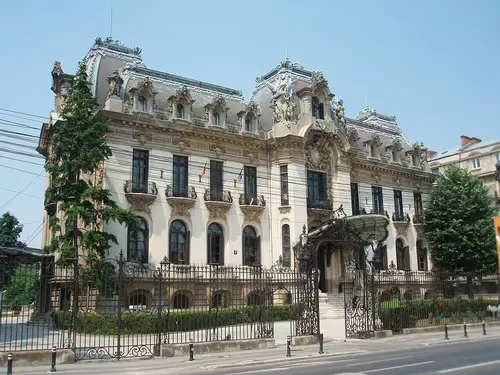
    The palace at Calea Victoriei 141 is currently closed, so this is a stop for the facade. Note the two lions at the entrance and the gates and railings in Louis XIV style that give it a princely air. Architect Ion D. Berindey built it in 1901 and 1902 in French Beaux Arts style for Gheorghe Grigore Cantacuzino, a former prime minister nicknamed "the Nabob" for his fortune, and it was famous for its balls.

    History was made here: on 10 August 1913 the Peace of Bucharest, which ended the Second Balkan War, was signed in the palace, and during the Second World War it housed the presidency of the Council of Ministers. After the Nabob's son Mihai died in 1929, the house went to his widow Maruca, who married the composer George Enescu in 1939. After Enescu's death in 1955 she willed it to become a museum in his honour, founded in 1956.

    Continue 940 m, about 14 minutes, to the Museum of the Romanian Peasant.

    Local name
    Palatul Cantacuzino
    Status
    Currently closed
  11. 11

    Museum of the Romanian Peasant

    Museum of the Romanian Peasant in Bucharest, stop 11 on the self-guided walking tour

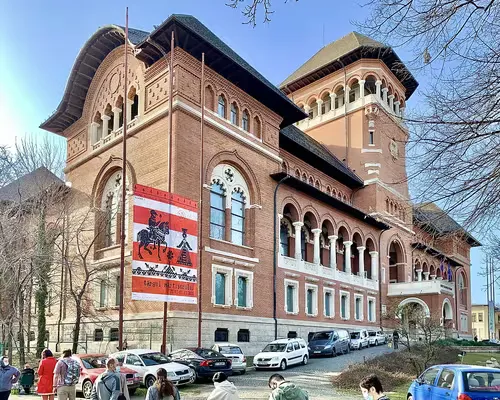
    The building on Șoseaua Kiseleff borrows traditional Romanian architecture. Designed by Nicolae Ghica-Budești and built between 1912 and 1941 on the site of the State Mint, it holds more than 100,000 objects: costumes and textiles, icons, ceramics and everyday things of village life. It was named European Museum of the Year for 1996.

    Its story mirrors the country's. Founded in 1906 by Alexandru Tzigara-Samurcaș, it gave its building to a museum of the Communist Party, then reopened on 5 February 1990, six weeks after Ceaușescu's fall. In June 1990 miners ransacked it, mistaking it for the headquarters of the National Peasants' Party. A basement room still shows relics of the communist museum with an ironic eye.

    Do not miss "the house in the house", the home of the peasant Antonie Mogoș from Ceauru, shown in deliberately unrealistic fashion as Tzigara-Samurcaș first intended; it returned here in 2002. The museum charges admission. Then walk 1990 m, about 27 minutes, to the Arc de Triomphe.

    Local name
    Muzeul Țăranului Român
    Hours
    Wed–Sun 10:00–18:00, Mon+Tue closed, last admission 17:00
    Price
    RON 20 adult; RON 10 senior; RON 5 reduced
    Website
    mntr.ro ↗
  12. 12

    Arc de Triomphe

    Arc de Triomphe in Bucharest, stop 12 on the self-guided walking tour

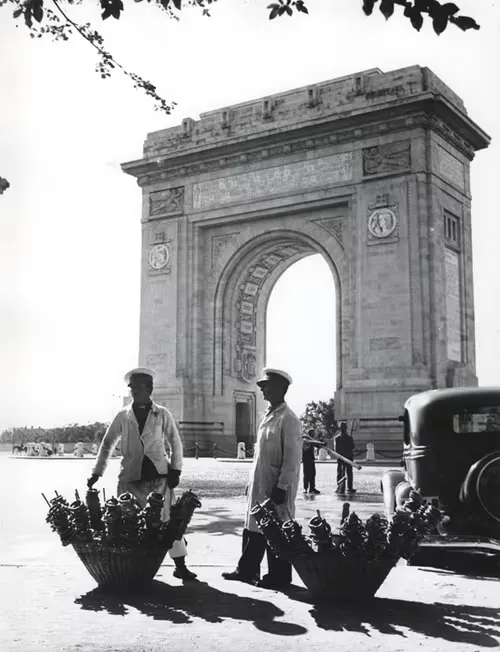
    The 27 m arch with a single opening commemorates Romania's part in the First World War, which ended with almost all lands inhabited by Romanians united for the first time. Petre Antonescu designed it; it was built in 1921 and 1922, renovated in 1935 and 1936 and again from 2014. Ten sculptors from Italy helped carve its Rușchița marble. It belongs to the same family of war memorials as the Tomb of the Unknown Soldier you saw in Carol Park.

    It had predecessors: temporary arches went up in 1848, 1859, 1878, 1906 and 1918. The 1918 one could not stand the rain, so in 1922 Mayor Matei Corbescu proposed a new wooden arch until money for a proper one could be found.

    Going inside the arch costs a fee. The last leg is 1390 m, about 21 minutes, to the Village Museum.

    Local name
    Arcul de Triumf din București
    Hours
    Summer (01.04–31.10): Tue–Fri 10:00–18:00 (last admission 17:30), Sat–Sun 11:00–19:00 (last admission 18:30), Mon closed. Winter (01.11–31.03): Tue–Sun 09:00–17:00 (last admission 16:30)
    Price
    15 RON adults, 8 RON reduced (pupils, students, retirees)
  13. 13

    Dimitrie Gusti National Village Museum

    Dimitrie Gusti National Village Museum in Bucharest, stop 13 on the self-guided walking tour

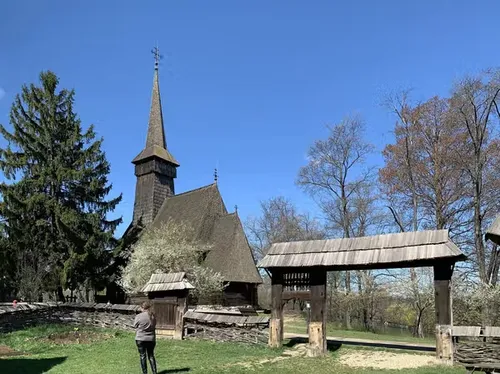
    End the walk in the countryside. On the shore of Lake Herăstrău stand real village houses that were taken apart piece by piece, carried by train, cart or boat and rebuilt here. The oldest dates from the 17th century, the newest from the 20th. Compare them as you stroll: houses from hills and mountains sit on high foundations, those from the plains on low ones, and those from regions often raided by enemies are half sunk into the ground.

    The folklorist and sociologist Dimitrie Gusti created the museum, which opened on 10 May 1936 in the presence of King Carol II and to the public a week later. He called it "the sad sound of the bells of Romania's history". It survived damage in the Second World War and fires in 1997 and 2002, and its newest wing opened in 2016.

    Plan at least an hour. The open air exhibition charges admission, and ticket sales stop a while before closing, so don't arrive too late.

    Local name
    Muzeul Național al Satului „Dimitrie Gusti”
    Hours
    Open-air exhibition summer: Wed–Sun 09:00–19:00; winter: Wed–Sun 09:00–17:00. Main entrance Kiseleff 28: summer Mon 09:00–17:00, Tue–Sun 09:00–19:00; winter daily 09:00–17:00. Last ticket 60 min before closing.
    Price
    40 RON adults
Walking tour route map of Bucharest Route loaded
Romanian AthenaeumCEC PalacePalace of ParliamentCarol Park+9
All 13 stops are already on the map.
You just press start.
AI Tour Guide

You just read the route. Now walk it with a guide who talks with you.

Press start wherever you are, even hundreds of kilometres from Bucharest, and the guide begins telling its stories right away. In the city, pick any of the 13 stops to start from: it leads you there, then talks with you the whole route, asking, listening, remembering, and shaping the tour around your answers.

13stops 13.7km 3 h 17 minwalking 13languages
▶Start the tour free

Free to start · Runs in your browser · No app, no download

Shorter Ways to Walk Bucharest

Thirteen stops in a day is a lot. These three cuts follow the same order and keep the walking manageable.

Historic south and centre

Stops: 1, 2, 3, 4, 5, 6, 7, 8, 9

For a first visit with one long day of sightseeing: concert hall, Ceaușescu's palace, Carol Park, the cathedral hill, the Old Town and Revolution Square. About 1 h 57 min of walking; entries for the Athenaeum, the Palace of Parliament and the art museum if you want them, everything else is free.

Old Town and Revolution Square

Stops: 6, 7, 8, 9

For a half day or an evening arrival: Old Town lanes, Stavropoleos and the square of 1968 and 1989, ending at the Royal Palace. Only 21 minutes of walking, and apart from the art museum it costs nothing.

Museums of the north

Stops: 9, 10, 11, 12, 13

For culture lovers on a Wednesday to Sunday: royal art, the Cantacuzino facade, peasant culture, the Arc de Triomphe and the open air village. About 1 h 20 min of walking; plan for paid entries at the museums and the arch.

How Long Does This Bucharest Tour Take on Foot?

The pure walking time is 3 h 17 min for 13.7 km. With a tour of the Palace of Parliament, an hour or two in one museum and a long stroll through the Village Museum, the whole route fills a day from morning to early evening; if you want every interior, split it over two days.

The order works for that split: the first nine stops form the historic half with about 1 h 57 min of walking, and the northern museum half from the art museum to the village takes about 1 h 20 min on foot. The Old Town loop alone is a 21 minute walk, ideal when you only have a few hours.

Before You Set Off in Bucharest

  • Start and finish: The recommended start is the Romanian Athenaeum, the finish is the Dimitrie Gusti National Village Museum; you can join the route at any stop.
  • Best days: Pick your day with care: the art museum, the Museum of the Romanian Peasant, the Arc de Triomphe and the open air village all have weekly closing days.
  • Timing: Reach the Palace of Parliament early in the day. At the Village Museum ticket sales stop a while before closing, so don't leave it too late.
  • Costs: Several interiors charge admission: the Athenaeum, the Palace of Parliament, the peasant museum, the arch, the village and the art museum. Squares, Carol Park, the cathedral, the Old Town and Stavropoleos are free.
Walking tour route map of Bucharest
AI Tour Guide

Your guide is ready at the Athenaeum whenever you are.

Press start and a voice AI Tour Guide takes it from here: leading the route through Bucharest, telling the stories, and turning your walk into a real back-and-forth conversation. No app or download is needed; it runs in your browser.

13stops 13.7km 3 h 17 minwalking 13languages
▶Start the tour free

Free to start · Runs in your browser · No app, no download

What the AI Tour Guide Adds in Bucharest

This route jumps between royal Bucharest, Ceaușescu's city and the countryside rebuilt in the north. The AI Tour Guide leads you through those layers as a conversation: it greets you at the Athenaeum, tells the stories at each stop, asks what caught your eye and remembers it, so the talk at Revolution Square builds on what you said in front of the Palace of Parliament. You can interrupt at any time, for instance to ask what stood on Arsenal Hill before the palace, or how life in Bucharest felt in the 1980s.

A Real Conversation A voice AI Tour Guide greets you, leads the whole route, and tells the stories and facts as you walk, asking what you want to see and keeping a real conversation going. Not a recording you press play on.
Map Navigation Follow the route on the map and walk at your own pace. You choose where to start and when to move to the next stop.
Ask Anything Curious about a building you pass? Ask your AI Tour Guide on the spot and the conversation carries on.
13 Languages Switch language anytime. No separate tour needed.
Start free in your browser

Common Questions about Walking Bucharest

Are there reduced tickets on this route?

Yes. The Palace of Parliament has reduced tickets for students with ID and for children, and the youngest children go free. The Arc de Triomphe offers reduced tickets for pupils, students and retirees, and the peasant museum has senior and reduced tickets. At the Athenaeum visitors with disabilities and refugees from Ukraine enter free.

Does the National Museum of Art of Romania charge admission?

Yes, entry is paid and you buy tickets at the desk. The museum also closes on a number of public holidays, so check before you go.

Is the Tomb of the Unknown Soldier still in Carol Park?

Yes. Inaugurated in 1923, it was moved to Mărășești in 1958 to make room for the Mausoleum of the Communist Heroes, brought back in 1991 and moved once more in 2007, closer to its original spot.

Where is Romania's Kilometre Zero?

In the Old Town, on the square of the Saint George New Church, next to the small park around it.

Is the tour really free?

Yes. The whole tour is free: the route, the interactive map and the navigation cost you nothing. Only the voice AI Tour Guide is optional and paid: you test it with 100 free credits, then you pay either €5 per hour or €19.99 for this whole tour, with no time limit.

Do I need to download an app?

No. Everything runs in your phone browser. Open the route and start walking, no download and no sign-up required.

Do I need to book the walking tour in advance?

No booking needed. This self-guided tour is available anytime. Open the route in your browser and start walking. The AI Tour Guide works instantly, no app, no reservation required.

What languages is the AI Tour Guide available in?

The AI Tour Guide speaks 13 languages, so you take the tour in your own language and can switch at any time.

Can I skip stops or change the route?

Yes. Skip any stop, spend extra time at places you like, or start the route from any point. It is your walk, you set the pace.
Image credits
▶ Start free in your browser Runs in your browser, no app, no download