Free Walking Tour Mariánské Lázně: Colonnades and Springs

Taste three historic springs, catch the Singing Fountain in full song and finish at a red brick English church a widow built for her husband.

7 Stops 2.3 km ~33 min walking
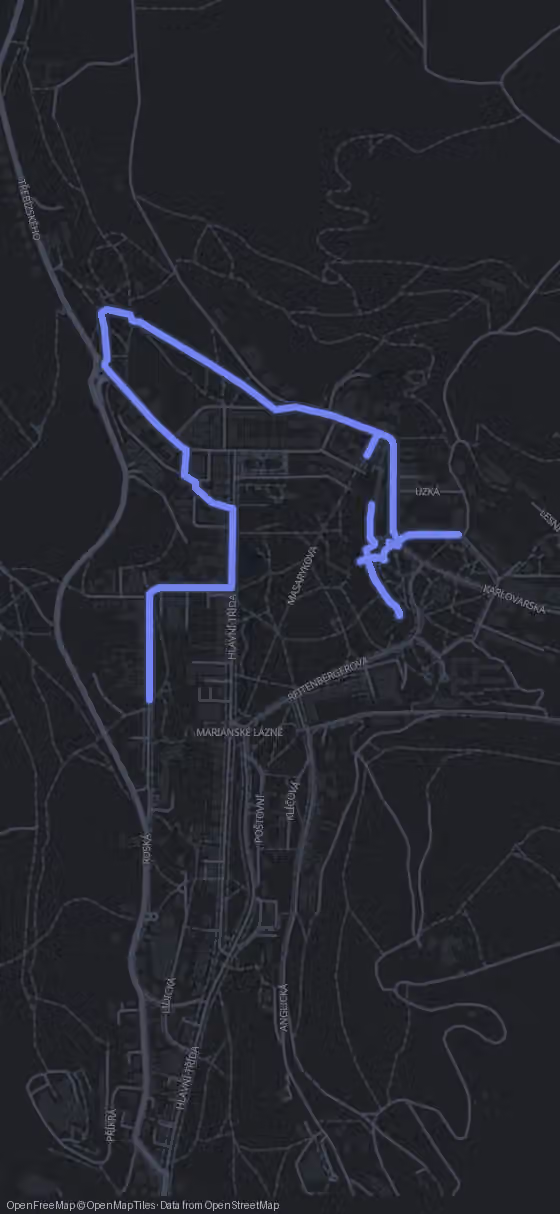
Route map for the Mariánské Lázně walking tour
Stop 1 of 7
1.75 km·22 min
Main Colonnade
Head north up the promenade toward Karolina Spring.
Welcome to Mariánské Lázně. I'm Alex, and this spa town once caught an aging poet completely off guard.
Try this tour with Alex

What to Expect on This Spa Town Walk

Seven stops, 2.3 km and 33 minutes of pure walking: from the Main Colonnade past Karolina Spring, the Singing Fountain, the Town Museum (Goethe House) and Cross Spring on to Forest Spring and the Anglican Church. With a fountain show and a few sips of spring water, plan about two and a quarter hours.

The springs, the colonnade and the fountain are free; the museum is currently closed, and the church opens only for ticketed events. The GPS route in your browser costs nothing, and the AI Tour Guide is optional.

Open free GPS & optional AI Tour Guide
This short shows highlights of the route. All 7 stops follow below.

The Route

Walking Map of Mariánské Lázně: Colonnade to English Church

7 stops 2.3 km 33 min walking
Tap to load interactive map

The 7 stops along this route

  1. 1Main Colonnade
  2. Karolina Spring in Mariánské Lázně, stop 2 on the self-guided walking tour
    2Karolina Spring
  3. Singing Fountain in Mariánské Lázně, stop 3 on the self-guided walking tour
    3Singing Fountain
  4. Town Museum (Goethe House) in Mariánské Lázně, stop 4 on the self-guided walking tour
    4Town Museum (Goethe House)
  5. Cross Spring in Mariánské Lázně, stop 5 on the self-guided walking tour
    5Cross Spring
  6. Forest Spring in Mariánské Lázně, stop 6 on the self-guided walking tour
    6Forest Spring
  7. Anglican Church in Mariánské Lázně, stop 7 on the self-guided walking tour
    7Anglican Church
  8. That's the full route.

    Walk it with an AI Tour Guide talking you through every one of these streets.

    Start free in your browser
    You made it

Your Mariánské Lázně Walking Tour Through Seven Spa Stops

  1. 1

    Main Colonnade

    Start under the long cast iron and steel roof of the Main Colonnade, one of the landmarks that define Mariánské Lázně. At 180 metres it was once the longest spa colonnade in the country, and even after the 1986 reconstruction, which cut away a market annex, it still reads as one continuous hall. Walk its full length slowly, and keep looking up: the ceiling frescoes are by Josef Vyleťal and date from that same restoration in 1986.

    What you see is the second colonnade on this site. The first was a solid masonry hall in the Empire style, built between 1823 and 1827 and founded by Abbot Karl Kaspar Reitenberger. The monastery at Teplá later ordered its replacement in cast iron and steel, the light, airy structure you are standing in today. The abbots of Teplá will keep turning up along this walk; the spa grew up very much under their hand.

    The German name, Kreuzbrunnen-Kolonnade, gives away its original purpose: it was the colonnade of Cross Spring, the town's old salt spring, which you reach later on the route. So this hall was built for walking and drinking, guests strolling with their cups between sips.

    The colonnade is free and open around the clock, so there is no pressure to see everything now; it is just as good on an evening stroll. From here it is 210 metres, about 3 minutes, to Karolina Spring.
    Local name
    Kolonáda
    Hours
    Open 24/7
    Price
    Free
  2. 2

    Karolina Spring

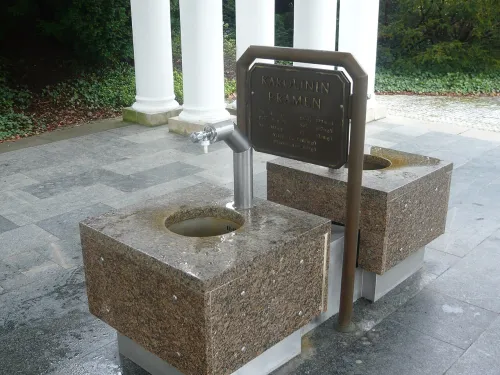
    Karolina Spring in Mariánské Lázně, stop 2 on the self-guided walking tour

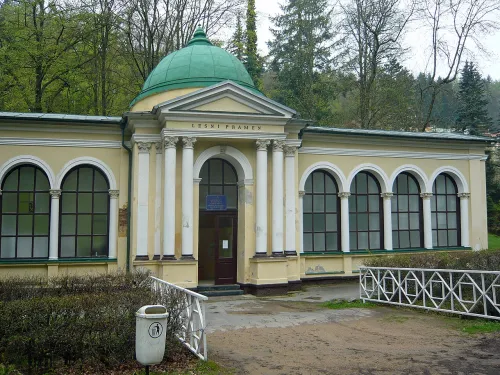
    Karolina Spring today shares its colonnade with Rudolf Spring, so you will find two springs side by side here. The ornate neo-Baroque cast iron goes back to a rebuild in 1888 and 1889, when builder Johann König worked from designs by the Viennese architects Miksch and Niedzielski, and the ironwork was cast in the engineering works at Blansko. The water stands out for its magnesium: calcium and magnesium come in a ratio of 2 to 5, which is why it has long been recommended for kidney and urinary complaints, kidney stones and tired muscles.

    The spring was discovered in 1809 and at first was simply called the New Spring. People drank right where it rose. In 1811 it received a round pavilion with a dome and eight Corinthian columns, usually credited to Josef Esch; in 1823 it was rebuilt in a very similar form, and in 1872 two wings with 24 columns were added.

    Its later life was restless. When Rudolf Spring was piped here in 1912, Karolina was dropped for a while and used only for baths in the spa buildings opposite, until Dr. Benno Winter restored it to its colonnade in 1929 and 1930. In a reconstruction that began in 1975, an identical colonnade was built 20 metres closer to the Main Colonnade and the old one was then torn down. The promenade to Cross Spring reopened in 1981, and the colonnade took its present form in 1992.

    Tasting is free, though the spring shuts for the winter. The Singing Fountain is only 130 metres, about 2 minutes, away.

    Local name
    Karolinin pramen
    Hours
    Daily 06:00–18:00 (May–Sep); closed in winter (Oct–Apr)
    Price
    Free
  3. 3

    Singing Fountain

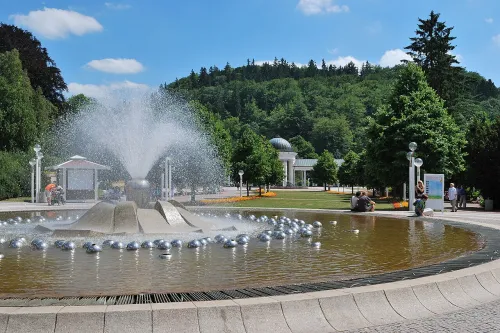
    Singing Fountain in Mariánské Lázně, stop 3 on the self-guided walking tour

    The Singing Fountain is a round basin that rises straight out of the paving, 20 metres across on the outside. In the middle, twelve stone shapes ring a stainless steel sculpture, together forming a water flower floating on the surface. It belongs to the colonnade grounds: the control room with the computer that runs the shows sits within the colonnade complex.

    The fountain grew out of the big rebuild of the colonnade area that began in 1976. Architect Pavel Mikšík was asked to design three fountains, and the central concert fountain, the one with music and a ballet of water and light, was named the Singing Fountain. It was built between 1982 and 1986 and switched on for the first time on 30 April 1986. In 2024 and 2025 it was thoroughly overhauled, with new electronics, lighting and sound and a cleaned tank.

    Most of the machinery is hidden under your feet: a plant room with ten pumps drawing 70 kW, a 25 cubic metre water tank and the switchgear. Ten water circuits are combined to make the shapes you see; 330 jets around the rim aim at the centre, and the central jet reaches 6 metres. The music follows a set programme drawn from dozens of pieces by different composers.

    The fountain only plays in season, with regular shows through the day and evening shows with light projection. Watching is free; time your arrival so you are here a few minutes before a show. Then it is 210 metres, about 4 minutes, to the Goethe House.

    Local name
    Zpívající fontána
    Hours
    Daily 07:00–22:00 (performances odd hours 07:00–19:00, plus 21:00 and 22:00 with light show; season: April 30 – October 31)
    Price
    Free
  4. 4

    Town Museum (Goethe House)

    Town Museum (Goethe House) in Mariánské Lázně, stop 4 on the self-guided walking tour

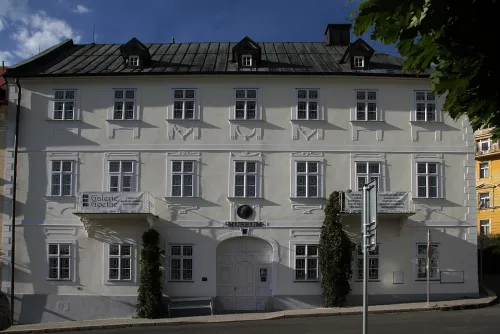
    The Town Museum is currently closed, so this is a stop to see from outside, but the house deserves a look. It stands at Goethe Square 11 and was built in 1818 by architect František Habl as the spa house At the Golden Grape, later renamed Goethe-Haus. It is the oldest surviving building of the original settlement of Mariánské Lázně. Since 2015 a poesiomat has stood in front of it.

    The second name honours its most famous guest. Johann Wolfgang Goethe came to Mariánské Lázně on visits between 1820 and 1823, and the museum keeps five memorial rooms for him on the first floor, furnished with period pieces, collection items and letters.

    The museum itself was founded in 1887 and moved into this house after its conversion between 1975 and 1979. Its collections cover famous guests including King Edward VII, the history of spa treatment with models of how springs are captured, kidney stones on display, a period lead and tin bathtub and old examination instruments, plus the story of the town from the Teplá monastery to the present, folk ceramics, pewter, porcelain and glass.

    From the Goethe House it is 340 metres, about 4 minutes, to Cross Spring.

    Status
    Currently closed
  5. 5

    Cross Spring

    Cross Spring in Mariánské Lázně, stop 5 on the self-guided walking tour

    Cross Spring sits beside the colonnade in an impressive pavilion with 72 columns, designed by local builder Antonín Thurner; the columned hall went up between 1818 and 1826. This is one of the oldest and longest-used springs in town, and the reason the Main Colonnade was built in the first place.

    Its story starts with salt. The annals of the Teplá monastery mention a salt spring here in 1710, and its original name was Salt Spring. In 1749 Damián Schultz, a pharmacist from Teplá, tidied the site and put up a tall wooden cross as a landmark, which gave the spring its present name. In 1790 a small chapel with a bell replaced the cross; it was consecrated in 1808, held Sunday services and was pulled down in 1820 to make way for a larger chapel. In 1955 and 1956 the spring was captured anew with deeper boreholes.

    Expect a salty taste: the water is strongly mineralised, high in sodium and dissolved salts, and its sulphates make it a laxative. That is why it has been used for stomach, gall bladder and liver complaints and metabolic conditions such as obesity and gout. For a walking tour, take a small sip out of curiosity rather than a full cup.

    The spring is free to visit. Next comes the longest leg so far, 560 metres and about 8 minutes, to Forest Spring in the northern part of town.

    Local name
    Křížový pramen
    Hours
    Daily 06:00–18:00
    Price
    Free
  6. 6

    Forest Spring

    Forest Spring in Mariánské Lázně, stop 6 on the self-guided walking tour

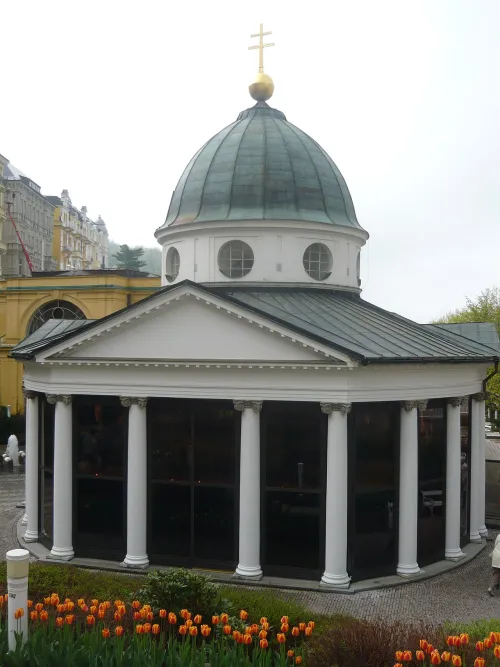
    Forest Spring rises in the spa park beside the Třebízský brook, and its surroundings are among the most beautifully laid out parkland in town. The round classicist pavilion is a protected cultural monument. Look around the grounds for the sculpture group Goethe and the Muse by the German sculptor Heinrich Drake from 1975, a memorial stone to the writer Václav Beneš Třebízský, who spent the last days of his life here in 1884, and a recent music pavilion used for orchestra concerts in summer.

    The spring was already known in 1683 under the German name Schneidsäuerling. It was captured in 1827, became Forest Spring around 1828 and got a wooden pavilion in 1830, glazed on its north and east sides in 1834. In 1840 Abbot Melchior Mahr had that replaced by a round temple with 16 Corinthian columns, and in 1869 builder Friedrich Zickler gave it the classicist look you see today. It was glazed again during a reconstruction in the second half of the twentieth century.

    The water is an iron-bearing acidulous spring at about 7.6 °C and quite unlike the others in composition. It mildly neutralises stomach acid and has been used for digestive complaints, and for gargling, rinsing and inhalation with upper respiratory problems. Guests used to flavour it with lemon juice or thin it with whey.

    Drinking is free. The pavilion closes for the winter, but the outdoor pipe right by the brook is accessible at any hour. The last leg is the longest, 890 metres and about 12 minutes, to the Anglican Church, a second building by Friedrich Zickler.

    Local name
    Lesní pramen
    Hours
    Original outdoor spring source always accessible 24/7; historic pavilion temporarily closed (winter seasonal closure Oct–Apr)
    Price
    Free
  7. 7

    Anglican Church

    Anglican Church in Mariánské Lázně, stop 7 on the self-guided walking tour

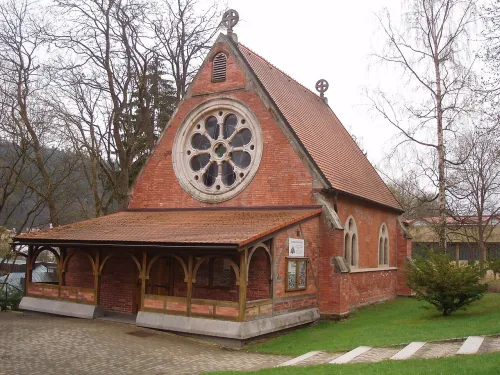
    The Anglican Church sits on a slope below Ruská street and looks as if it had been lifted out of an English village: a single nave of bare red brick, a steep tiled gable roof with a round cross at each end, a large eight-part rose window in the front and a stone portal sheltered by a wooden porch. The pointed windows, each paired with a simple rosette, show where its neo-Gothic designer was heading.

    It exists because of a widow. Ann Scott of Rondono gave 12,000 gulden to build it in memory of her late husband, John Scott of Rondono, and the Teplá monastery provided the land free of charge. The plans came from architect William Burges, the construction was led by Friedrich Zickler, and the church was consecrated to Jesus Christ in 1879. Mayor August Herzig was registered as its owner and also looked after it. The church became famous through the stays of King Edward VII between 1897 and 1909.

    After the First World War its bronze bell, which had been taken down, was hung again and the interior renewed. Formally it belonged to a London society for spreading the Anglican faith abroad, with Herzig's son, Dr. August Herzig, as administrator. After the Second World War nobody cared for it while ownership remained unclear; it was closed in 1973 and looted repeatedly into the 1990s. Burges designed a similar church in Fleet in Hampshire, largely destroyed by fire in 2015, which makes this one all the more valuable.

    Inside you would find a semicircular apse set off from the nave by a stone arch and a pointed wooden vault. The church opens one hour before scheduled events and concerts, with tickets per event, so if a concert fits your evening, it is a lovely way to end the walk. Otherwise enjoy the exterior; the route finishes here.

    Local name
    Anglikánský kostel
    Hours
    1 hour before scheduled events/concerts
    Price
    Variable (event-specific tickets)
Walking tour route map of Mariánské Lázně Route loaded
Karolina SpringSinging FountainTown Museum (Goethe House)Cross Spring+3
All 7 stops are already on the map.
You just press start.
AI Tour Guide

You know the springs now. Walk them with a guide in your ear.

Press start wherever you are, even hundreds of kilometres from Mariánské Lázně, and the guide begins telling its stories right away. In the city, pick any of the 7 stops to start from: it leads you there, then talks with you the whole route, asking, listening, remembering, and shaping the tour around your answers.

7stops 2.3km 33 minwalking 13languages
▶Start the tour free

Free to start · Runs in your browser · No app, no download

Shorter Ways to Walk the Spa Route

If you have less time or have already seen part of town, two cuts of the route work well. Both keep the recommended order.

The colonnade quarter only

Stops: 1, 2, 3, 4, 5

For a short visit or a first evening in town: the Main Colonnade, Karolina Spring, the Singing Fountain, the Goethe House from outside and Cross Spring. It is 890 m and 13 minutes of walking, everything is free, and with a fountain show you need about an hour and a half.

Parks and the English church

Stops: 5, 6, 7

For anyone who already knows the colonnade: start at Cross Spring, walk 8 minutes to Forest Spring in its park and then 12 minutes on to the Anglican Church. That is 1,450 m and 20 minutes of walking, about an hour in total. The springs are free; the church interior needs a ticket for whatever event is on.

How Long This Mariánské Lázně Spa Walk Takes

The pure walking time is 33 minutes, and the legs are short: the first four stops sit within a few minutes of each other, and only the last two legs, 8 and 12 minutes, take you out into the parks. Most of your time goes into looking, tasting and waiting for the fountain.

A sample morning: start at the Main Colonnade at 10:20 and give it twenty minutes, reach Karolina Spring at 10:43 and the Singing Fountain at 10:55, in time for the next show. Leave at 11:15, look at the Goethe House from 11:19, arrive at Cross Spring at 11:33, Forest Spring at 11:56 and the Anglican Church at about 12:28. That makes roughly two and a quarter hours. Add a concert at the church and the evening is spoken for.

Before You Set Off from the Main Colonnade

  • Start and finish: The recommended start is the Main Colonnade; you can join at any stop and pick up the route from there. The walk ends at the Anglican Church, not where it began.
  • Best season: Outside the winter everything on the route is running: Karolina Spring and the Forest Spring pavilion close for the winter, while the outdoor pipe at Forest Spring and Cross Spring stay in use all year.
  • Time of day: Go in the morning or early afternoon, while the springs are open, and set off so that you reach the Singing Fountain shortly before an odd hour.
  • Costs: Every spring, the colonnade and the fountain are free. The museum is currently closed, and the church charges only for its events. The GPS route is free; the AI Tour Guide starts with 100 free credits, after which you choose between €19.99 for this tour all-inclusive with no time limit or €5 per hour.
Walking tour route map of Mariánské Lázně
AI Tour Guide

Your guide to the colonnades is ready when you are.

Press start and a voice AI Tour Guide takes it from here: leading the route through Mariánské Lázně, telling the stories, and turning your walk into a real back-and-forth conversation. No app or download is needed; it runs in your browser.

7stops 2.3km 33 minwalking 13languages
▶Start the tour free

Free to start · Runs in your browser · No app, no download

What the AI Tour Guide Adds Among the Springs

On this route the stories are stacked layer on layer: abbots, pharmacists, a poet, a king, a widow from England. The AI Tour Guide walks you through them as a conversation, notices whether you light up at Goethe or at the engineering of the fountain, and goes deeper there. It is also the place for questions this walk leaves open, such as how a day of drinking cure was organised for a nineteenth century guest, or why a monastery put so much money into a spa.

A Real Conversation A voice AI Tour Guide greets you, leads the whole route, and tells the stories and facts as you walk, asking what you want to see and keeping a real conversation going. Not a recording you press play on.
Map Navigation Follow the route on the map and walk at your own pace. You choose where to start and when to move to the next stop.
Ask Anything Curious about a building you pass? Ask your AI Tour Guide on the spot and the conversation carries on.
13 Languages Switch language anytime. No separate tour needed.
Start free in your browser

Common Questions About Walking Mariánské Lázně

What role did Teplá Monastery play in Mariánské Lázně?

A large one. Its annals mention the salt spring as early as 1710, a Teplá pharmacist raised the cross that named Cross Spring, Abbot Reitenberger founded the first colonnade, Abbot Melchior Mahr rebuilt the Forest Spring pavilion, and the monastery commissioned the cast iron Main Colonnade and gave the land for the Anglican Church free of charge.

Why is a spring pavilion on the town's coat of arms?

When the emperor granted Mariánské Lázně its coat of arms by privilege on 1 June 1866, the pavilion of Cross Spring was chosen for it, a sign of how central that spring was to the town.

Does the walk work in the evening?

Partly. Cross Spring is closed in the evening, but the Singing Fountain plays its light shows after dark, so many people walk by day and return to the colonnade after dinner.

What can I combine with Mariánské Lázně on a longer trip?

The sister spa town of Karlovy Vary is 30 km away and makes a natural pair, while Plzeň, 55 km away, adds a historic city centre to a spa-focused trip.

Is the tour really free?

Yes. The whole tour is free: the route, the interactive map and the navigation cost you nothing. Only the voice AI Tour Guide is optional and paid: you test it with 100 free credits, then you pay either €5 per hour or €19.99 for this whole tour, with no time limit.

Do I need to download an app?

No. Everything runs in your phone browser. Open the route and start walking, no download and no sign-up required.

Do I need to book the walking tour in advance?

No booking needed. This self-guided tour is available anytime. Open the route in your browser and start walking. The AI Tour Guide works instantly, no app, no reservation required.

What languages is the AI Tour Guide available in?

The AI Tour Guide speaks 13 languages, so you take the tour in your own language and can switch at any time.

Can I skip stops or change the route?

Yes. Skip any stop, spend extra time at places you like, or start the route from any point. It is your walk, you set the pace.
Image credits
▶ Start free in your browser Runs in your browser, no app, no download