Free Walking Tour Ubud: Monkey Forest to Campuhan Ridge

Start among macaques and forest temples, cross Ubud's market, lotus temple and palace, meet its painters and end on a paved ridge between two river valleys.

7 Stops 4.3 km ~1 h 2 min walking
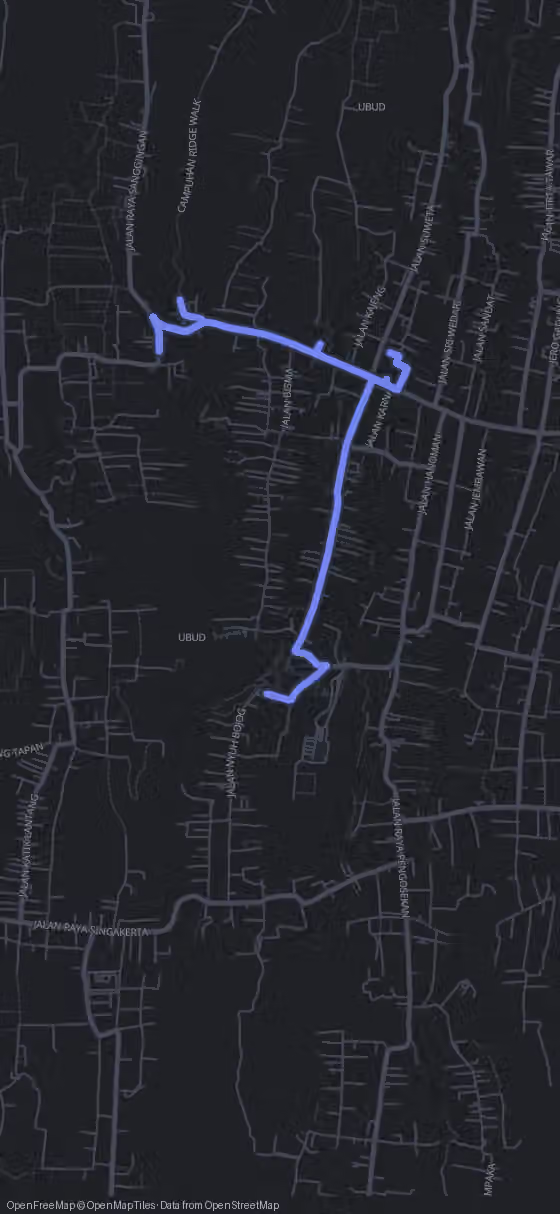
Route map for the Ubud walking tour
Stop 1 of 7
1.8 km·23 min
Sacred Monkey Forest
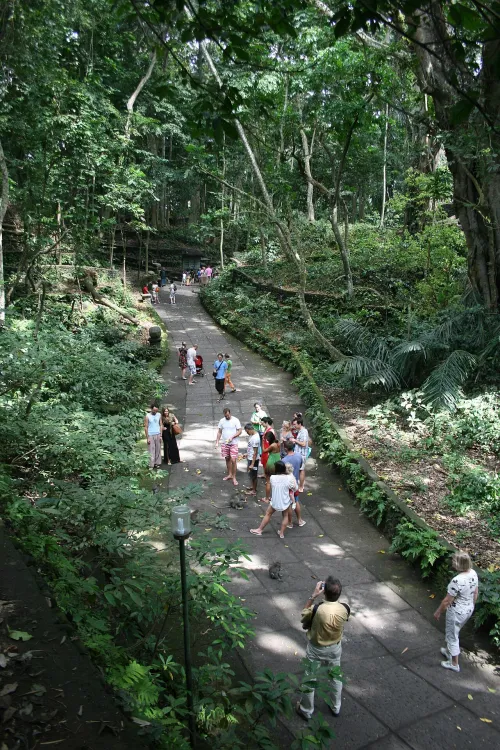
Head north toward the Ubud Art Market
Selamat datang, welcome to Ubud. I’m Alex, and our first story belongs to sacred temples and very bold residents.
Try this tour with Alex

This Ubud Route at a Glance

Seven stops lead from the Sacred Monkey Forest through Ubud Art Market, Saraswati Temple, Ubud Palace, Puri Lukisan Museum and Blanco Renaissance Museum to the Campuhan Ridge Walk. The route covers 4.3 km with 1 h 2 min of pure walking; with the visits that are worth going inside, plan about five hours.

The market, the palace and the ridge are free; the forest, the temple and both museums charge entry. Route, map and GPS navigation run free in your browser, and an optional AI Tour Guide can tell the stories as you walk.

Open free GPS & optional AI Tour Guide
View of Ubud

The Route

Walking Map of Ubud, from Forest to Ridge

7 stops 4.3 km 1 h 2 min walking
Tap to load interactive map

The 7 stops along this route

  1. Sacred Monkey Forest in Ubud, stop 1 on the self-guided walking tour
    1Sacred Monkey Forest
  2. 2Ubud Art Market
  3. Saraswati Temple in Ubud, stop 3 on the self-guided walking tour
    3Saraswati Temple
  4. Ubud Palace, stop 4 on the self-guided walking tour
    4Ubud Palace
  5. Puri Lukisan Museum in Ubud, stop 5 on the self-guided walking tour
    5Puri Lukisan Museum
  6. Blanco Renaissance Museum in Ubud, stop 6 on the self-guided walking tour
    6Blanco Renaissance Museum
  7. Campuhan Ridge Walk in Ubud, stop 7 on the self-guided walking tour
    7Campuhan Ridge Walk
  8. That's the full route.

    Walk it with an AI Tour Guide talking you through every one of these streets.

    Start free in your browser
    You made it

Seven Stops on Your Ubud Walking Tour

  1. 1

    Sacred Monkey Forest

    Sacred Monkey Forest in Ubud, stop 1 on the self-guided walking tour

    The walk begins in the village of Padangtegal, in a sanctuary known locally as Mandala Suci Wenara Wana. It covers roughly 12.5 hectares of forest with at least 186 different tree species, and it is home to around 1,260 long-tailed macaques. Look closely and you will see every age at once: big adult males, mothers, youngsters and tiny infants clinging on.

    The monkeys are not one big troop. Six groups hold their own areas of the forest, each named after its territory: the Temple group, the New Forest group, the Central Point group, the Eastern group, the Michelin group and the Cemetery group. Keep that in mind as you walk; the monkeys around you change as you cross from one group's patch to the next.

    This is also a sacred place, not just a nature park. Three temples stand inside: Pura Dalem Agung Padangtegal, Pura Beji and Pura Prajapati. The sanctuary is run by the people of Padangtegal themselves, villagers who work here directly, and its management sees its job as protecting the holiness of the site while welcoming visitors from Indonesia and abroad. Dress and behave as you would at any temple.

    Is the entry worth it? If you want macaques up close and forest temples in one place, yes. You will not have it to yourself: more than 120,000 visitors come each month. Families are welcome, and the rule for strollers, keep them guarded from the monkeys, is a good one for anything you carry.

    From here comes the longest leg of the route: 1,820 m, about 27 minutes, out of the forest and into the center of Ubud.
    Local name
    Mandala Wisata Wenara Wana
    Hours
    Daily: 09:00–18:00
    Price
    130,000 IDR adults, 100,000 IDR children
  2. 2

    Ubud Art Market

    Ubud Art Market is really two markets sharing one address. In the dark early hours the traditional market does its trade; by the time the art and souvenir stalls are open at full strength, that side is already winding down. Most visitors only ever see the second market.

    If the traditional market is what you want, the early start is not optional, and it makes a good reason for a separate dawn outing. Passing through in mid-morning on this route, treat the stalls as a stroll rather than a destination. There is no gate and no ticket.

    Budget your browsing time, because the paid part of the route starts again at the temple. Saraswati Temple is just 310 m away, about 5 minutes on foot, and the palace is only a few hundred meters beyond that.

    Hours
    Daily 08:00–18:00 (traditional morning market from approx. 04:00/06:00, art and souvenir stalls approx. 08:00–18:00)
    Price
    Free (entry)
  3. 3

    Saraswati Temple

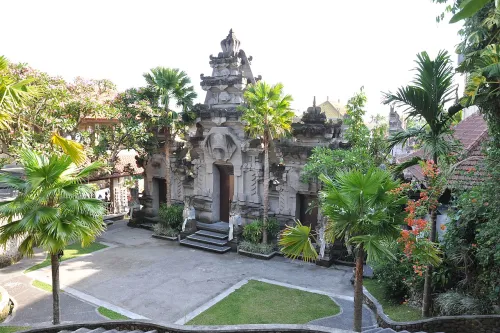
    Saraswati Temple in Ubud, stop 3 on the self-guided walking tour

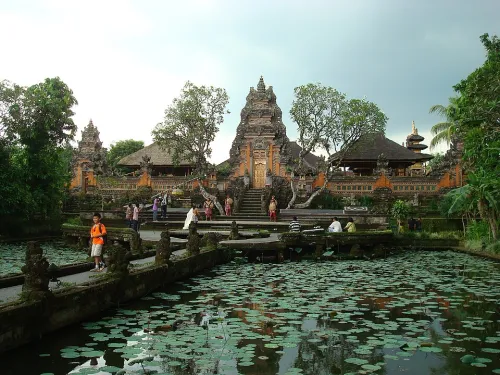
    Officially this is Pura Taman Kemuda Saraswati, and some call it the Ubud Water Palace. It is a Balinese Hindu temple dedicated to Sarasvati, goddess of learning, literature and art, a fitting patron on a route that ends with two art museums. What draws most people is the lotus pond and water garden that form the outer area of the temple. Frangipani trees line the edges of the pond, and a straight, bridge-like walkway leads across, decorated with sculptures of Hindu mythological figures carved from paras, a volcanic tuff.

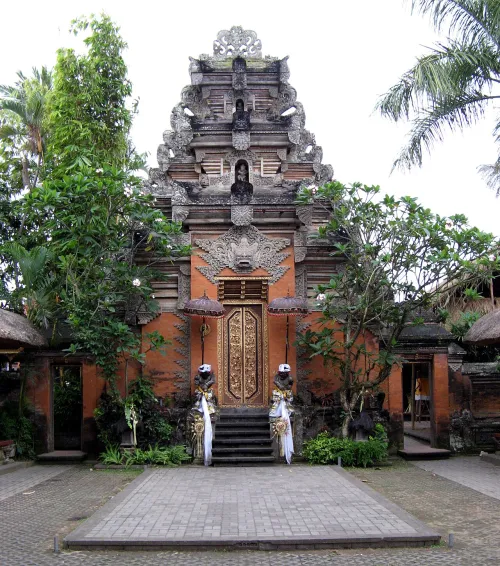
    Three red-brick gates, called kori agung, lead to the inner sanctum. The central one is the largest, flanked by two tall plumeria trees. Walk straight in and you hit a wall: an aling-aling, a device in Balinese architecture meant to confuse evil spirits, which cannot turn corners. This one is unusual, because the wall is actually the back of a 3 m statue of the demonic figure Jero Gede Mecaling. In the most sacred corner, the kaja-kangin or north-east side, stands a padmasana shrine whose base is carved with the cosmic turtle and several nagas, standing for bhur, the world of demons.

    The temple was designed by I Gusti Nyoman Lempad, a renowned Balinese sculptor and undagi, an architect of ritual objects such as cremation towers and wooden sarcophagi. Lempad had left the royal court of Blahbatuh after a serious quarrel that roused the king's anger. In Ubud the Sukawati royal family took him on, and he built palaces and temples here and in nearby villages. Prince Cokorda Gede Agung Sukawati commissioned this temple; work began in 1951 and was completed in 1952, and many of the statues along the walkway are Lempad's own work.

    The entry is worth it for anyone interested in how a Balinese temple is built and decorated; the pond alone is a fine place to sit for a while. Next, it is 340 m, about 5 minutes, to the palace of the same royal family that commissioned the temple.

    Local name
    Pura Taman Saraswati
    Hours
    Sat–Thu 08:00–19:30, Fri 08:00–21:30
    Price
    65,000 IDR adult, 50,000 IDR child (international); 40,000 IDR adult, 30,000 IDR child (domestic)
  4. 4

    Ubud Palace

    Ubud Palace, stop 4 on the self-guided walking tour

    Ubud Palace, officially Puri Saren Agung, was the official residence of Ubud's royal family, the patrons behind the temple you just left. It is free to visit, so even a short look around is worth it.

    The story of this place goes back far beyond the palace. Balinese tradition tells of Rsi Markandya, a holy man who received a divine revelation to bury five precious metals on a mountain slope, where the Mother Temple of Besakih now stands. With his followers he was drawn to a spot in the island's central foothills that seemed to radiate light and energy: Campuhan, at a confluence of the Wos River, where he built the temple Pura Gunung Lebah. You will reach Campuhan at the end of this walk.

    Rsi Markandya is credited with much more: further temples across Bali, a shared irrigation system for the rice terraces that farmers still use, and the idea of the banjar, the village council for community and religious matters. In short, he is seen as the founder of Agama Tirtha, the religion of holy water. Since its settlement in the 8th century, Campuhan has been revered for its spiritual power, and even the name Ubud comes from ubad, meaning medicine, after the healing plants that grew here. Pilgrims have long come to the river confluence to meditate, bathe and collect holy water for ceremonies.

    The royal line has roots elsewhere. When the Majapahit Empire of Java fell apart in the 15th century, many nobles fled to Bali, and the new kingdom of Gelgel on the east coast gave them refuge. They brought an artistic legacy and the caste system with them. From the palace it is 330 m, about 5 minutes, to the museum that shows where that artistic legacy led.

    Local name
    Istana Ubud
    Hours
    Daily 07:00–18:00
    Price
    Free
  5. 5

    Puri Lukisan Museum

    Puri Lukisan Museum in Ubud, stop 5 on the self-guided walking tour

    Puri Lukisan, officially the Puri Lukisan Ratna Wartha Museum, specializes in traditional and modern Balinese painting and wood carving from the 1930s onwards. Its collection covers several schools of Balinese art: Sanur, Batuan, Ubud, Young Artist and Keliki. If you have never thought of Balinese painting as having distinct regional styles, this is the place where that becomes visible.

    The museum is spread over four buildings. The northern Pitamaha Gallery shows pre-war modern traditional painting and the collection of I Gusti Nyoman Lempad, the same man who designed Saraswati Temple. The western Ida Bagus Made Gallery houses the estate collection of that painter, the eastern Wayang Gallery is devoted to Wayang painting, and the southern Founders Gallery tells the museum's history and hosts temporary exhibitions and new acquisitions.

    Two artists in the collection are worth looking out for. Ida Bagus Nyana, a woodcarver and dancer, made elongated, fluid figures without excess detail that look almost as if pulled from taffy; his Goddess Pertiwi, Mother Earth, with spidery legs and a coiled serpent, feels like a dream. His son Ida Bagus Tilem carved in the same spirit. Ida Bagus Gelgel grew up in Kamasan, far from Western influence, yet moved beyond the Wayang conventions, and in 1937 one of his paintings won a silver medal at the International Colonial Art Exhibition in Paris.

    His painting The Priest Dharmaswami, made in 1935 with natural dyes on paper, tells of a priest who rescued a monkey, a snake and a tiger from a well. When a prince later arrested him on false charges, the animals came to help him, and the painting shows them bringing gifts in thanks. After the morning in the Monkey Forest, it is hard not to smile at that. If you only visit one museum on this route, this is the one for an overview. Then it is 960 m, about 13 minutes, to the Blanco museum.

    Hours
    Daily 09:00–18:00
    Price
    95,000 IDR adult, free under 15
  6. 6

    Blanco Renaissance Museum

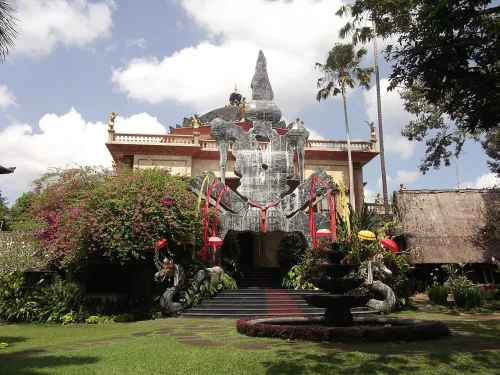
    Blanco Renaissance Museum in Ubud, stop 6 on the self-guided walking tour

    Where Puri Lukisan surveys a whole tradition, the Blanco Renaissance Museum is the world of one man. Antonio Blanco loved art, language and literature from the age of five, spoke five languages, Indonesian, French, Spanish, Tagalog and Balinese, and as a painter devoted himself to the curves of the female body. He settled in Bali in 1952.

    The King of Ubud gave him a plot of land in Campuhan, and Blanco first made it his home and painting studio. It was his dream to have his own museum one day. The museum was established here in 1998, but Blanco died on 10 December 1999, before it was officially opened on 15 September 2001, which would have been his birthday.

    Today the grounds hold a studio, a gallery, a shop, a library, a café, an amphitheater and the Blanco family temple. The studio where Antonio painted is now used by his son Mario, whose work is for sale, while his father's originals form the permanent collection. On the gallery wall you can read the words "A thing of beauty is a joy forever", a fair summary of what the Blanco family set out to show.

    Is it worth the entry? Yes, if you enjoy seeing how an artist lived and worked as much as the paintings themselves. You are already in Campuhan here, and the last leg to the ridge is 570 m, about 9 minutes.

    Hours
    Daily 09:00–17:00
    Price
    100,000 IDR adult, 70,000 IDR child
  7. 7

    Campuhan Ridge Walk

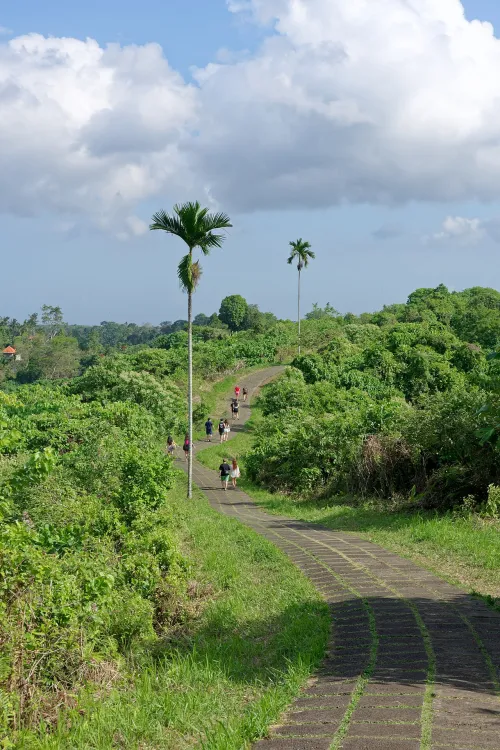
    Campuhan Ridge Walk in Ubud, stop 7 on the self-guided walking tour

    The route ends where the palace story began, in Campuhan, the area that Balinese have revered for its spiritual power since the 8th century and where Antonio Blanco received his land from the king. From here a paved path of about 2 kilometers follows a narrow ridge between two river valleys, with palm trees and rice paddies on both sides.

    The path is free, and how far along it you go is up to you. After a full day in temples and galleries, it is simply a place to walk and look out over the green on either side.

    One honest note: the ridge is at its best in the early morning, when mist rises from the valleys. On this route you arrive later in the day, so if the mist is what you want, come back for a separate early walk, perhaps combined with the traditional market in town.

    Hours
    Open 24/7
    Price
    Free
Walking tour route map of Ubud Route loaded
Sacred Monkey ForestSaraswati TempleUbud PalacePuri Lukisan Museum+3
All 7 stops are already on the map.
You just press start.
AI Tour Guide

You know the way now. Walk it with a guide in your ear.

Press start wherever you are, even hundreds of kilometres from Ubud, and the guide begins telling its stories right away. In the city, pick any of the 7 stops to start from: it leads you there, then talks with you the whole route, asking, listening, remembering, and shaping the tour around your answers.

7stops 4.3km 1 h 2 minwalking 13languages
▶Start the tour free

Free to start · Runs in your browser · No app, no download

Shorter Ways to Walk Ubud

Not everyone has five hours or wants every ticket. These three cuts keep the walking short and the stops close together.

Town center in a morning

Stops: 2, 3, 4, 5

For a first look at Ubud's core without the long forest leg. Market, temple, palace and museum sit close together: 15 minutes of walking in total. Entry is charged at Saraswati Temple and Puri Lukisan Museum; market and palace are free.

Monkeys, market and the royal quarter

Stops: 1, 2, 3, 4

For families and anyone who mainly wants the macaques plus a taste of the town. Walking time is 37 minutes, most of it the 27 minute leg out of the forest. Entry is charged at the Sacred Monkey Forest and Saraswati Temple.

Art and the ridge

Stops: 4, 5, 6, 7

For art lovers who want to finish outdoors. From the palace it is 27 minutes of walking to the ridge. Both museums charge entry; palace and ridge are free.

How Long This Ubud Tour Takes with Visits

The whole route takes 1 h 2 min of pure walking over 4.3 km, but the time is unevenly spread. The first leg from the forest into town is the longest at 27 minutes; after that market, temple, palace and Puri Lukisan follow each other at five minute intervals, and the last two legs to the Blanco museum and the ridge take 13 and 9 minutes.

Realistically, give the forest about an hour, the temple half an hour, Puri Lukisan an hour and the Blanco museum a little less; market and palace are short stops. That adds up to about five hours before you set foot on the 2 km ridge path itself. The town center variant fits into about two and a half hours with both entries, the forest variant into about three, and the art and ridge variant into about three if you walk part of the path.

Before You Set Off in Ubud

  • Start and finish: The recommended start is the Sacred Monkey Forest, and the route ends at the Campuhan Ridge Walk. You can join at any stop, but the order here keeps the long leg at the beginning and the open ridge for last.
  • Time of day: Start in the morning so the museums get the time they deserve. Two things reward an even earlier hour: the traditional side of the art market and the mist over the ridge, so consider an extra dawn visit for either.
  • Entry: The Sacred Monkey Forest, Saraswati Temple, Puri Lukisan Museum and Blanco Renaissance Museum charge entry; you pay at each site. Ubud Art Market, Ubud Palace and the ridge path are free.
  • Carrying things: In the forest, keep whatever you carry close, and if you bring a stroller, guard it from the monkeys.
Walking tour route map of Ubud
AI Tour Guide

Your guide is ready whenever you start walking.

Press start and a voice AI Tour Guide takes it from here: leading the route through Ubud, telling the stories, and turning your walk into a real back-and-forth conversation. No app or download is needed; it runs in your browser.

7stops 4.3km 1 h 2 minwalking 13languages
▶Start the tour free

Free to start · Runs in your browser · No app, no download

What the AI Tour Guide Adds Between Forest and Ridge

This route is full of names that open into longer stories: a prince who commissions a temple, an architect who fled a king, a painter who received land from the royal family. The AI Tour Guide walks with you as a conversation, picks up on what grabs you and goes further, for instance into what the Wayang painting tradition actually depicts, or how a banjar works in a village today. You can interrupt it at any moment. You start with 100 free credits; after that you choose between this tour all-inclusive for €19.99 with no time limit, or €5 per hour.

A Real Conversation A voice AI Tour Guide greets you, leads the whole route, and tells the stories and facts as you walk, asking what you want to see and keeping a real conversation going. Not a recording you press play on.
Map Navigation Follow the route on the map and walk at your own pace. You choose where to start and when to move to the next stop.
Ask Anything Curious about a building you pass? Ask your AI Tour Guide on the spot and the conversation carries on.
13 Languages Switch language anytime. No separate tour needed.
Start free in your browser

Common Questions Before You Walk Ubud

Is the Sacred Monkey Forest suitable for small children?

Yes, visitors of all ages are welcome, and there is a nursery room for families. Strollers are allowed, but keep them guarded from the monkeys the whole time.

If I only have time for one museum, which should it be?

Pick Puri Lukisan Museum if you want an overview of Balinese painting and wood carving across several schools. Pick the Blanco Renaissance Museum if you are drawn to one artist's personal world, with his house, studio and family temple on the same grounds.

Can I buy art at the Blanco Renaissance Museum?

Mario Blanco's work is for sale, and lithographs and books about Don Antonio Blanco are sold in the studio. His father's original paintings belong to the permanent collection and are not for sale.

Do I have to walk the full Campuhan Ridge path?

No. The paved path runs about 2 km along the ridge and is free, so how far you go is up to you. If the views are what you came for, an early morning walk gives you the rising mist.

Is the tour really free?

Yes. The whole tour is free: the route, the interactive map and the navigation cost you nothing. Only the voice AI Tour Guide is optional and paid: you test it with 100 free credits, then you pay either €5 per hour or €19.99 for this whole tour, with no time limit. Admission to 4 of the 7 stops is not included: Sacred Monkey Forest, Saraswati Temple, Puri Lukisan Museum and Blanco Renaissance Museum charge their own entry fees.

Do I need to download an app?

No. Everything runs in your phone browser. Open the route and start walking, no download and no sign-up required.

Do I need to book the walking tour in advance?

No booking needed. This self-guided tour is available anytime. Open the route in your browser and start walking. The AI Tour Guide works instantly, no app, no reservation required.

What languages is the AI Tour Guide available in?

The AI Tour Guide speaks 13 languages, so you take the tour in your own language and can switch at any time.

Can I skip stops or change the route?

Yes. Skip any stop, spend extra time at places you like, or start the route from any point. It is your walk, you set the pace.
Image credits
▶ Start free in your browser Runs in your browser, no app, no download