Free Walking Tour Ho Chi Minh City: Palace to Market

Nine stops through old Saigon, from the gates a tank crashed through in 1975 to the bell tower of Ben Thanh Market, all on foot in 4.2 km.

9 Stops 4.2 km ~58 min walking
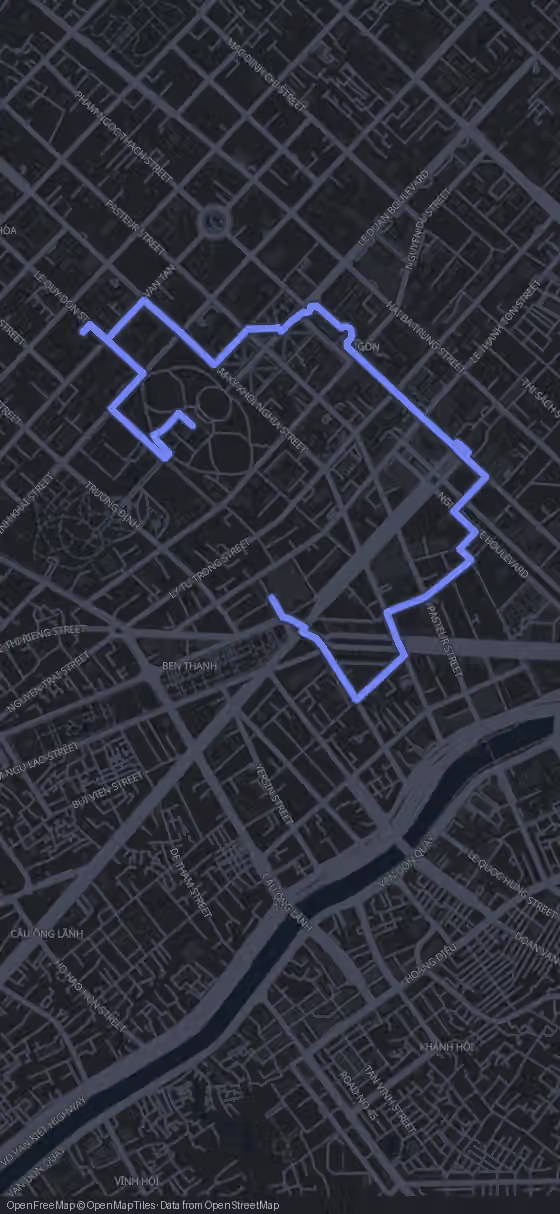
Route map for the Ho Chi Minh City walking tour
Stop 1 of 9
860 m·11 min
Independence Palace
Head north-west toward the War Remnants Museum
Welcome to Ho Chi Minh City. I'm Alex, and one palace keeps the final morning of the Vietnam War frozen in place.
Try this tour with Alex

This Route at a Glance

Nine stops over 4.2 km, from Independence Palace to Ben Thanh Market. Walking takes 58 minutes; with the interiors worth your time, plan about six and a half hours.

Admission is charged at the palace, the War Remnants Museum and the Ho Chi Minh City Museum of Fine Arts; the rest is free to see. The route, map and GPS navigation in your browser are free, and the AI Tour Guide is optional.

Open free GPS & optional AI Tour Guide
This short shows highlights of the route. All 9 stops follow below.

The Route

Walking Map of Ho Chi Minh City from Palace to Market

9 stops 4.2 km 58 min walking
Tap to load interactive map

The 9 stops along this route

  1. Independence Palace in Ho Chi Minh City, stop 1 on the self-guided walking tour
    1Independence Palace
  2. War Remnants Museum in Ho Chi Minh City, stop 2 on the self-guided walking tour
    2War Remnants Museum
  3. Notre-Dame Cathedral Basilica in Ho Chi Minh City, stop 3 on the self-guided walking tour
    3Notre-Dame Cathedral Basilica
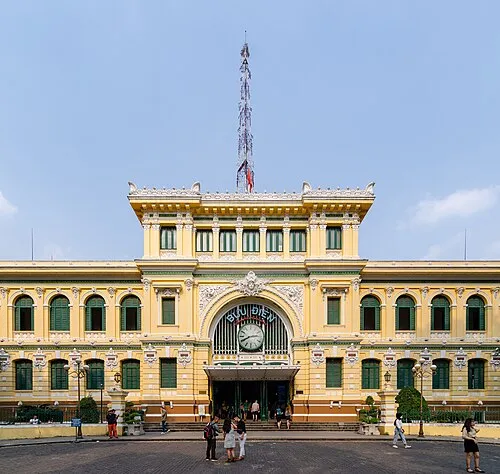
  4. Saigon Central Post Office in Ho Chi Minh City, stop 4 on the self-guided walking tour
    4Saigon Central Post Office
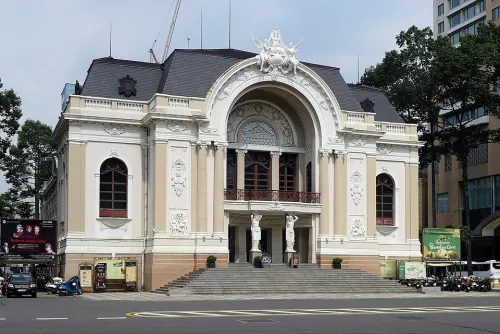
  5. Saigon Opera House in Ho Chi Minh City, stop 5 on the self-guided walking tour
    5Saigon Opera House
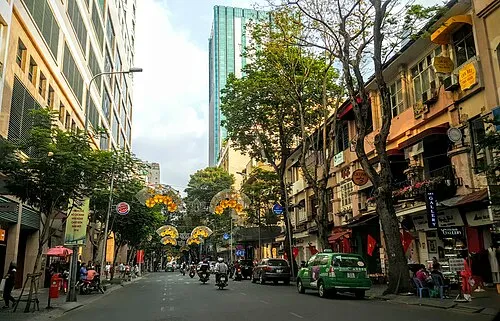
  6. Dong Khoi Street in Ho Chi Minh City, stop 6 on the self-guided walking tour
    6Dong Khoi Street
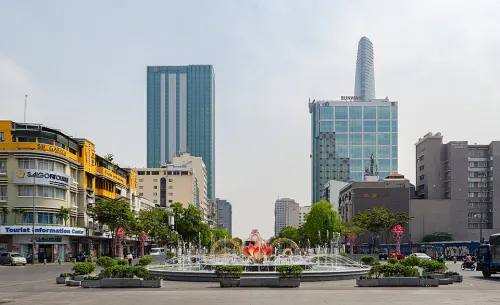
  7. Nguyen Hue Walking Street in Ho Chi Minh City, stop 7 on the self-guided walking tour
    7Nguyen Hue Walking Street
  8. Ho Chi Minh City Museum of Fine Arts, stop 8 on the self-guided walking tour
    8Ho Chi Minh City Museum of Fine Arts
  9. Ben Thanh Market in Ho Chi Minh City, stop 9 on the self-guided walking tour
    9Ben Thanh Market
  10. That's the full route.

    Walk it with an AI Tour Guide talking you through every one of these streets.

    Start free in your browser
    You made it

Ho Chi Minh City Walking Tour: Nine Stops Through Old Saigon

  1. 1

    Independence Palace

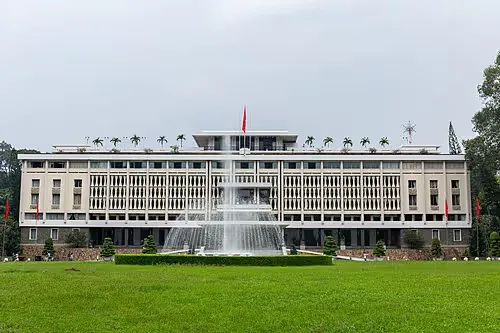
    Independence Palace in Ho Chi Minh City, stop 1 on the self-guided walking tour

    Begin at the gates where the Vietnam War ended. On 30 April 1975 a tank of the Liberation Army of South Vietnam crashed through them, and the Fall of Saigon was sealed on the lawn in front of you. The building behind, officially also called Reunification Hall, was the home and workplace of the president of the Republic of Vietnam. Today it is a museum and also a hall the state still uses for official events.

    The palace you see is the second on this spot. The first was badly damaged when two dissident pilots of South Vietnam's own air force bombed it, and in 1962 President Ngô Đình Diệm ordered a replacement. Work began on 1 July 1962 while his family moved to Gia Long Palace, now the Museum of Ho Chi Minh City. Diệm never moved in: in November 1963 he and his brother and chief adviser, Ngô Đình Nhu, were killed after a coup led by General Dương Văn Minh. General Nguyễn Văn Thiệu, then head of a military junta, opened the finished hall on 31 October 1966.

    Look at it as the work of one Vietnamese architect. Ngô Viết Thụ had won the Grand Prix de Rome in 1955, the highest honour of the Beaux-Arts school in Paris, and here he designed the seat of power for a Vietnamese head of state. After reunification the building kept serving as a government office until 1976, when those functions moved to Hanoi.

    Going inside is worth it for anyone curious about how South Vietnam was governed and how the war ended; allow about an hour and a quarter. It makes an easy first stop of the day.

    From the palace it is 880 m, about 12 minutes on foot, to the War Remnants Museum, which tells the same war from a very different angle.
    Local name
    Dinh Độc Lập
    Hours
    Daily 07:00–18:00
    Price
    80,000 VND standard combo (Palace + Exhibition), 40,000 VND palace only
  2. 2

    War Remnants Museum

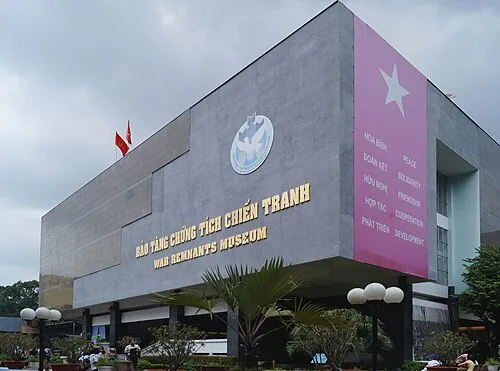
    War Remnants Museum in Ho Chi Minh City, stop 2 on the self-guided walking tour

    This is the war as remembered by the side that won it, and the museum does not soften its subject. Exhibits cover the First Indochina War and the Vietnam War, arranged in themed rooms across several buildings around a walled yard at 28 Võ Văn Tần Street.

    Its names trace postwar politics. It opened on 4 September 1975 as the Exhibition House for US and Puppet Crimes, in the former United States Information Agency building, continuing a tradition of exhibitions that exposed first French and then American war crimes. In 1990 it became the Exhibition House for Crimes of War and Aggression, dropping “U.S.” and “Puppet”. In 1995, a year after the US embargo ended and as diplomatic relations were normalised, “war crimes” and “aggression” went as well, leaving the War Remnants Museum.

    In the yard stand a Bell UH-1 “Huey” helicopter, a Northrop F-5A fighter, an M48 Patton tank, a Douglas A-1 Skyraider, a Cessna A-37 Dragonfly and a BLU-82 “Daisy Cutter” bomb. Look closely at the aircraft: several with “U.S. Air Force” markings actually belonged to the South Vietnamese Air Force and were relabelled for display. In one corner lie pieces of unexploded ordnance, their charges or fuses removed.

    Inside, one building reproduces the “tiger cages” in which the South Vietnamese government held political prisoners. It is heavy going and worth it for anyone who wants to understand how Vietnam remembers the war; give it an hour and a half. The museum charges admission.

    Next comes the longest leg of the walk: 1030 m, about 14 minutes, to the Notre-Dame Cathedral Basilica, where colonial Saigon begins.

    Local name
    Bảo tàng Chứng tích chiến tranh
    Hours
    Daily 07:30–17:30
    Price
    40,000 VND general admission, 20,000 VND reduced
  3. 3

    Notre-Dame Cathedral Basilica

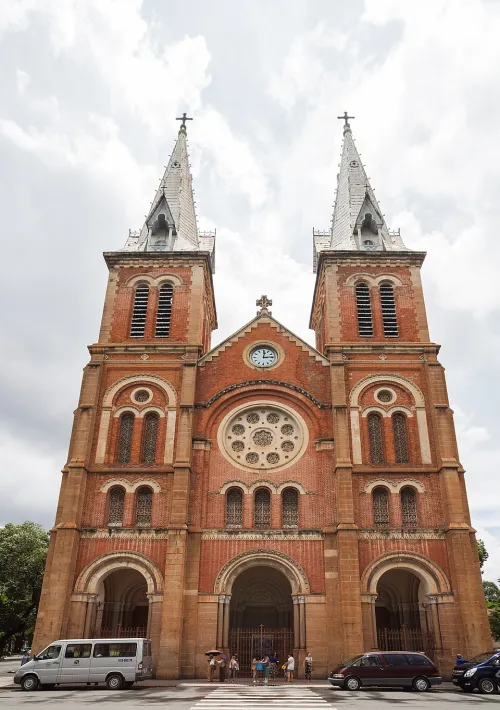
    Notre-Dame Cathedral Basilica in Ho Chi Minh City, stop 3 on the self-guided walking tour

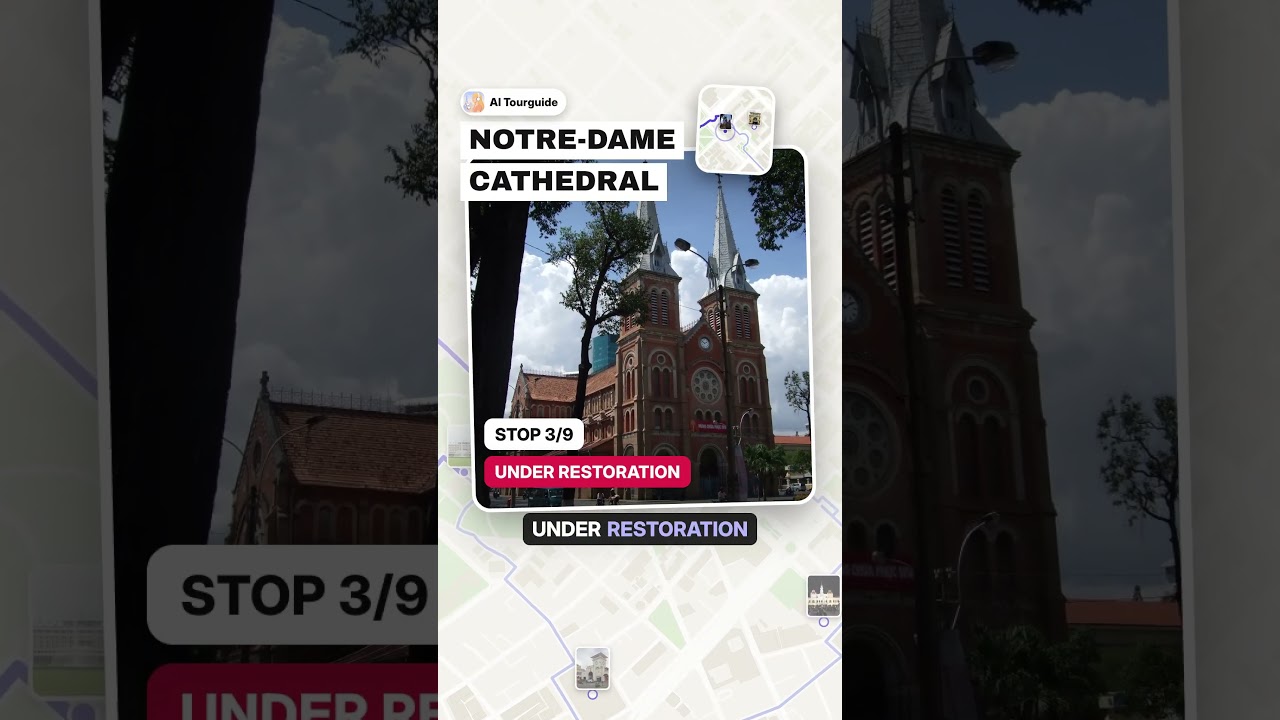
    Two bell towers, 58 metres high, announce the Notre-Dame Cathedral Basilica, built by the French between 1877 and 1880. Look at the brick of the outer walls: it came from Toulouse, and every building material was shipped from France. In the forecourt stands the statue of Our Lady of Peace, installed in 1959; only since then has the church been called Notre-Dame. Its official name is the Cathedral Basilica of Our Lady of the Immaculate Conception.

    The French first called it simply the Church of Saigon, and it had predecessors. After the conquest of Cochinchina the first church stood on today's Ngô Đức Kế Street and soon proved too small. On 28 March 1863 Bishop Lefevre laid the first stone of a wooden church on the bank of the Charner canal, finished two years later. When termites damaged it, services moved into a reception room of the French Governor's Palace until the present cathedral was ready.

    Even the site was debated. Three plots were considered: today's corner of Lê Duẩn Boulevard and Hai Bà Trưng Street, the bank of the Kinh Lớn canal, and the spot where the cathedral now stands. J. Bourard won the construction contract and supervised the work. Keep that canal in mind: later on this walk you stroll along the boulevard that replaced it.

    A visit costs nothing, and the façade and forecourt alone make the stop worthwhile even on a tight schedule. The Saigon Central Post Office is right next door, 80 m and about a minute away.

    Local name
    Nhà thờ Đức Bà Sài Gòn
    Price
    Free
  4. 4

    Saigon Central Post Office

    Saigon Central Post Office in Ho Chi Minh City, stop 4 on the self-guided walking tour

    Beside the cathedral, the Saigon Central Post Office still works as a post office, and walking in is free. The French built it between 1886 and 1891 to a design by Marie-Alfred Foulhoux, an eclectic Western building trimmed with Eastern decoration.

    Its story begins with conquest. Right after taking Gia Định, the French hurried to set up communications, and the Saigon post office opened on 13 January 1863 with Admiral Bonard presiding. At first it served only the administration; ordinary residents could use it from 1 January 1864. That same year the first stamp was issued, which the people of Saigon nicknamed “con cò”, the stork.

    The building in front of you is the larger second version, opened in 1891. The network grew fast around it: on 22 March 1888 a 2,000 km telegraph line linked Saigon with Quy Nhơn, Đà Nẵng, Huế, Vinh and Hanoi, in 1889 a telegraph link to Bangkok followed for traders, and on 1 July 1894 Saigon began using telephones.

    Go in for a few minutes even if you have nothing to post; the hall is the point of the visit. From here it is 570 m, about 8 minutes, to the Saigon Opera House.

    Local name
    Bưu điện trung tâm Sài Gòn
    Hours
    Mon–Sat: 07:30–18:00 | Sun: 08:00–17:00
    Price
    Free
  5. 5

    Saigon Opera House

    Saigon Opera House in Ho Chi Minh City, stop 5 on the self-guided walking tour

    The Saigon Opera House was completed in 1900 as the Opéra de Saïgon, its façade shaped like the Petit Palais, built the same year in France. Architect Félix Olivier gave it its character, while Ernest Guichard and Eugène Ferret supervised construction. All inscriptions, décor and furnishings were drawn by a French artist and sent from France.

    Look at the reliefs on the front. Critics found the original decoration too ornate, and some of it was removed in 1943; the city restored a portion in 1998 for Saigon's 300th anniversary, when the façade was renovated. The theatre once held 1,800 people on a main floor and two levels above it; today it seats 500.

    For two decades it was not a theatre at all. From 1956 it housed South Vietnam's National Assembly, from 1967 its Lower House and Senate, and in 1975 the People's Congress of Deputies of the Republic of South Vietnam. Only in 1976 did performances return. French theatre in Saigon is older than the building: in 1863 the colonists invited a company to play for the French legion in the admiral's villa on the Clock Square, today the corner of Nguyễn Du and Đồng Khởi streets.

    You can admire the exterior at any hour. The interior opens only during performances, so if you want to see it, buy a show ticket at the HBSO box office. Dong Khoi Street is just 60 m away, about a minute's walk.

    Local name
    Nhà hát Sài Gòn
    Hours
    Exterior viewable at any time; interior only during performances (HBSO box office Mon–Fri 08:30–16:30, Sat–Sun 09:00–12:00)
    Price
    Free (exterior); performance tickets vary
  6. 6

    Dong Khoi Street

    Dong Khoi Street in Ho Chi Minh City, stop 6 on the self-guided walking tour

    Dong Khoi Street has been Saigon's smartest shopping address since French times, lined with luxury shops and hotels. It runs one way from opposite the cathedral down to the riverside at Bạch Đằng, and the road itself is older than the French arrival.

    Its names read like a history lesson. The French first gave it the number 16, then on 1 February 1865 named it rue Catinat, after Marshal Nicolas de Catinat, who served Louis XIV, and after the warship Catinat that reached Đà Nẵng in 1856 and attacked Saigon in 1859. In 1897 the section behind the cathedral was cut off and given other names.

    In colonial days rue Catinat was considered the face of all Saigon. Government offices stood here alongside the city's first upmarket restaurants, hotels and shops. In 1955 the Saigon government renamed it Tự Do, and in 1975 the authorities of the Republic of South Vietnam gave it today's name, Đồng Khởi: three names for one street, each from a different regime.

    Walk a stretch of it at your own pace; looking costs nothing and the street is open around the clock. Nguyen Hue Walking Street lies 400 m away, about 5 minutes on foot.

    Local name
    Đường Đồng Khởi
    Hours
    Open 24/7
    Price
    Free
  7. 7

    Nguyen Hue Walking Street

    Nguyen Hue Walking Street in Ho Chi Minh City, stop 7 on the self-guided walking tour

    Nguyen Hue Walking Street was water before it was a street. Here ran the Kinh Lớn, the Grand Canal, linking the old Citadel of Saigon to the Saigon River, and in the first decades of French rule the central market stood on its bank. In 1865 its two quays were named Quai Charner and Quai Rigault de Genouilly.

    The canal smelled so foul that residents soon asked for it to be filled in. Even so, it took eighteen years of discussion before the work was done in 1886 and 1887, creating boulevard Charner. From 1926 mayor Rouelle had it laid out as two wide avenues split by a thin strip of grass, and in 1955 the South Vietnamese government renamed it after Nguyễn Huệ.

    The pedestrian square is recent: the city decided in October 2014 to turn the central lanes over to walkers, and the project was finished on 29 April 2015. The boulevard runs from Lê Thánh Tôn Street, facing Ho Chi Minh City Hall, down to the river at Tôn Đức Thắng Boulevard. On weekend evenings the whole boulevard is closed to vehicles, and at lunar new year it turns into the Nguyen Hue Flower Street.

    It is free and open around the clock; look up toward City Hall at one end and down to the river at the other. From here it is 730 m, about 10 minutes, to the Ho Chi Minh City Museum of Fine Arts.

    Local name
    Đường Nguyễn Huệ
    Hours
    Open 24/7 (pedestrian-only restrictions on weekend evenings)
    Price
    Free
  8. 8

    Ho Chi Minh City Museum of Fine Arts

    Ho Chi Minh City Museum of Fine Arts, stop 8 on the self-guided walking tour

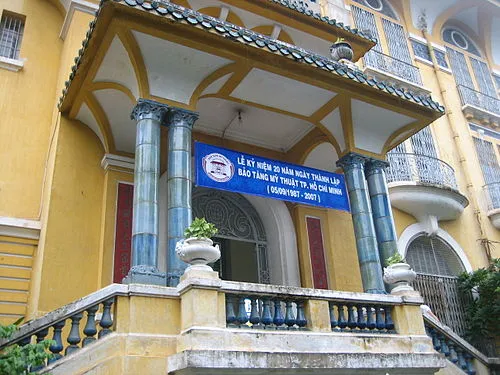
    The Ho Chi Minh City Museum of Fine Arts is as much about its building as its collection. A French architect named Rivera designed it in 1929, and it was finished in 1934, blending Chinese and French architecture in one grand house at 97 Phó Đức Chính.

    The house belonged to Hui Bon Hoa, in Vietnamese Huỳnh Văn Hoà, one of old Saigon's richest and best-known merchants. He also owned the Majestic Hotel, Từ Dũ Hospital, Saigon General Hospital and Phụng Sơn Pagoda, among other landmarks of the city.

    The city made the house a museum in 1987, but it took several years to gather enough works to open the doors. Today its three floors hold paintings, sculpture and antiquities, among them Nguyễn Gia Trí's lacquer painting “Spring Garden of North, Central and South”.

    Go in if Vietnamese art or colonial interiors interest you; 45 minutes is enough for a first look. The museum charges admission. The final leg is 440 m, about 6 minutes, to Ben Thanh Market.

    Local name
    Bảo tàng Mỹ thuật Thành phố Hồ Chí Minh
    Hours
    Daily 08:00–17:00
    Price
    30,000 VND per person
  9. 9

    Ben Thanh Market

    Ben Thanh Market in Ho Chi Minh City, stop 9 on the self-guided walking tour

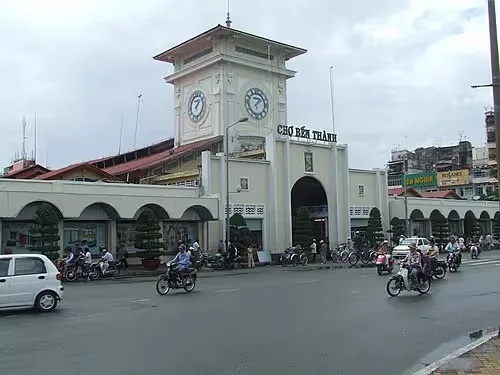
    Ben Thanh Market, with its bell tower facing the square, is one of the earliest surviving structures in the city and one of its symbols. The French firm Brossard & Mopin built it, and its French Indochinese design stands out among the modern buildings around it.

    The market is older than its hall. It began near the Saigon River, once called the Bến Nghé, beside the Citadel of Saigon, as a floating market where canals let boats load and unload goods. In 1912 it moved here, next to the Mỹ Tho railway station, today's Saigon bus station.

    Inside, 13,056 m² hold nearly 1,500 booths and more than 6,000 small businesses, selling everything from everyday goods to luxury items to over 10,000 visitors a day. The main entrance is on the south side at Lê Lợi Boulevard and Quách Thị Trang Square; others open onto Lê Thánh Tôn, Phan Bội Châu and Phan Châu Trinh.

    Entry is free. During the day the market stalls trade, and in the evening the night market takes over. Your walk ends here, and if you want to return to the Independence Palace, the GPS navigation in your browser leads you back.

    Local name
    Chợ Bến Thành
    Hours
    Daily 07:00–22:00 (fresh food/breakfast from 04:00; core market stalls active until 18:00)
    Price
    Free
Walking tour route map of Ho Chi Minh City Route loaded
Independence PalaceWar Remnants MuseumNotre-Dame Cathedral BasilicaSaigon Central Post Office+5
All 9 stops are already on the map.
You just press start.
AI Tour Guide

Now Walk Saigon's Streets with a Guide in Your Ear

Press start wherever you are, even hundreds of kilometres from Ho Chi Minh City, and the guide begins telling its stories right away. In the city, pick any of the 9 stops to start from: it leads you there, then talks with you the whole route, asking, listening, remembering, and shaping the tour around your answers.

9stops 4.2km 58 minwalking 13languages
▶Start the tour free

Free to start · Runs in your browser · No app, no download

Shorter Ways to Walk Saigon's Centre

The full walk fills most of a day. These shorter versions keep the same order and pick the part that suits your interest or the hour.

War and reunification morning

Stops: 1, 2, 3

For history readers with a morning to spare: the palace, the War Remnants Museum and on to the cathedral. 1,910 m and 26 minutes of walking. The palace and the museum charge admission; at the palace you can add the exhibition with a combined ticket.

Colonial centre

Stops: 3, 4, 5, 6, 7, 8, 9

For architecture lovers or anyone arriving after lunch: cathedral, post office, opera house, the two great streets, the merchant's mansion and the market. 2,280 m and 31 minutes of walking; only the Museum of Fine Arts charges admission.

Evening stroll

Stops: 5, 6, 7, 8, 9

For a walk after the museums close: the opera façade, Dong Khoi Street, Nguyen Hue Walking Street, past the Fine Arts mansion and into Ben Thanh's night market. 1,630 m and 22 minutes of walking, no admission; best on a weekend evening, when Nguyen Hue is free of traffic.

How Long the Ho Chi Minh City Tour Takes, Museums Included

The walking itself takes 58 minutes. The real time goes into the stops: about an hour and a quarter in the Independence Palace, an hour and a half in the War Remnants Museum, 45 minutes each in the Museum of Fine Arts and Ben Thanh Market, and shorter stays at the cathedral, the post office, the opera façade and the two streets. That comes to about six and a half hours: leave the palace gates at 08:00 and you reach the market at around 14:30.

The war and reunification morning takes about three hours and ten minutes with both interiors. The colonial centre needs about three hours and twenty minutes including the museum and the market. The evening stroll fits into about two hours.

Before You Set Off in District 1

  • Start: The Independence Palace. You can join at any stop, but this order is the recommended one.
  • End: Ben Thanh Market. The route runs one way; the GPS navigation in your browser leads you back to the start if you want.
  • When to go: Start in the morning so the museums and the post office fit comfortably into your day.
  • Admission: The palace (with an optional combo ticket for the exhibition), the War Remnants Museum and the Museum of Fine Arts charge admission; everything else is free.
Walking tour route map of Ho Chi Minh City
AI Tour Guide

Your Guide Is Waiting at the Palace Gates

Press start and a voice AI Tour Guide takes it from here: leading the route through Ho Chi Minh City, telling the stories, and turning your walk into a real back-and-forth conversation. No app or download is needed; it runs in your browser.

9stops 4.2km 58 minwalking 13languages
▶Start the tour free

Free to start · Runs in your browser · No app, no download

What the AI Tour Guide Adds Between Palace and Market

On this walk the end of a war and the French colonial city lie a few hundred metres apart, and the AI Tour Guide links them in conversation. It greets you at the palace gates, tells the stories of each place, asks what you want more of and remembers it, so a war-history reader hears different detail on the old rue Catinat than someone who came for the façades. Ask it how the Ngô family lived in Gia Long Palace, or what the National Assembly debated inside the opera house, and cut in whenever you like. You start with 100 free credits; after that, this tour costs €19.99 all-inclusive with no time limit, or €5 per hour.

A Real Conversation A voice AI Tour Guide greets you, leads the whole route, and tells the stories and facts as you walk, asking what you want to see and keeping a real conversation going. Not a recording you press play on.
Map Navigation Follow the route on the map and walk at your own pace. You choose where to start and when to move to the next stop.
Ask Anything Curious about a building you pass? Ask your AI Tour Guide on the spot and the conversation carries on.
13 Languages Switch language anytime. No separate tour needed.
Start free in your browser

Common Questions About Walking Ho Chi Minh City

Do people still call the city Saigon?

Yes, the old name is everywhere. The post office, the opera house and the cathedral all carry it, and the central ward where the cathedral stands is officially called Saigon ward.

Can I reach the route by metro?

Yes. Metro Line 1 runs beneath Nguyen Hue Walking Street, and Opera House station has several exits onto the boulevard, handy if you want to join halfway.

Is the War Remnants Museum suitable for children?

Its subject is war crimes and their victims, shown without softening. The yard with aircraft and tanks is the easier part; with young children you may prefer to visit only the palace and continue straight to the cathedral.

Where can I walk next after Ho Chi Minh City?

Siem Reap is the closest at 422 km, followed by Hội An and Bangkok. For the other end of the country, Hanoi has its own walking tour.

Is the tour really free?

Yes. The whole tour is free: the route, the interactive map and the navigation cost you nothing. Only the voice AI Tour Guide is optional and paid: you test it with 100 free credits, then you pay either €5 per hour or €19.99 for this whole tour, with no time limit. Admission to 3 of the 9 stops is not included: Independence Palace, War Remnants Museum and Ho Chi Minh City Museum of Fine Arts charge their own entry fees.

Do I need to download an app?

No. Everything runs in your phone browser. Open the route and start walking, no download and no sign-up required.

Do I need to book the walking tour in advance?

No booking needed. This self-guided tour is available anytime. Open the route in your browser and start walking. The AI Tour Guide works instantly, no app, no reservation required.

What languages is the AI Tour Guide available in?

The AI Tour Guide speaks 13 languages, so you take the tour in your own language and can switch at any time.

Can I skip stops or change the route?

Yes. Skip any stop, spend extra time at places you like, or start the route from any point. It is your walk, you set the pace.
Image credits
▶ Start free in your browser Runs in your browser, no app, no download