Free Walking Tour Hội An:Five Stops in the Old Town
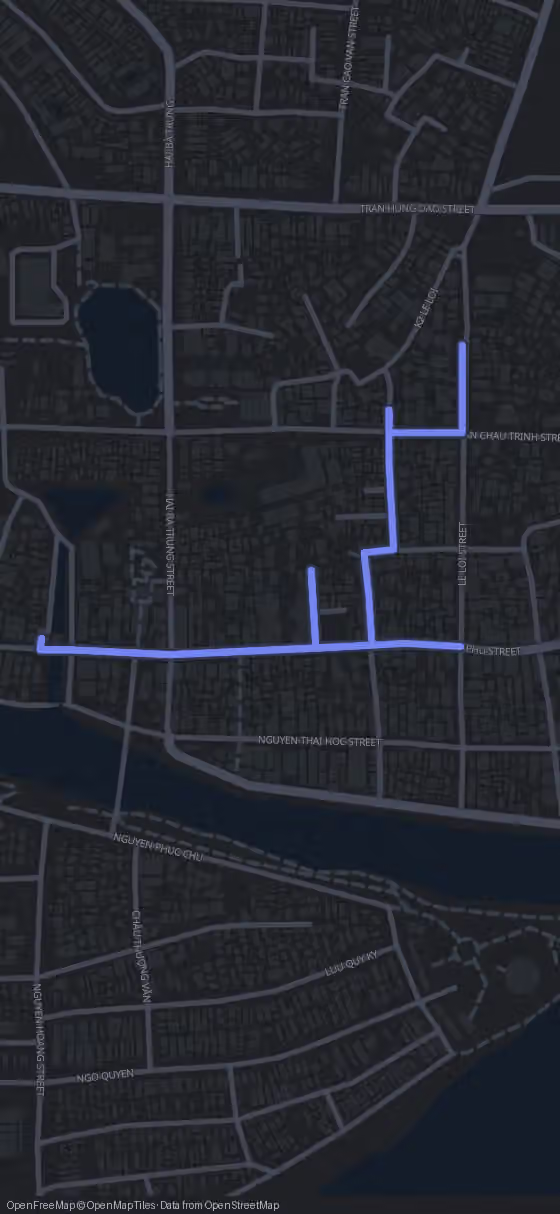
Under a kilometre, five stops and four centuries of trade: a Fujian assembly hall, a Japanese bridge with a temple on top, and a merchant house that is still a home.
The streets and the outside of the bridge are free; the Old Town ticket covers the interiors, and the museum is currently closed. The GPS route in your browser costs nothing, and the AI Tour Guide is optional.
Your walk begins at the Hoi An Museum, also known as the Museum of History and Culture of Hội An, at 10B Trần Hưng Đạo. It is currently closed, so treat it as your starting point and a moment to get your bearings rather than a visit.
The museum opened on 10 November 1989 and covers about 800 square metres. Its collection holds hundreds of objects, both original artefacts and photographic records, that follow the Old Town from its earliest days to the present. Once it reopens, it is the place to see the whole story of the town gathered in one building before you walk through the real thing.
From here it is only 120 m, about 2 minutes on foot, to Phuc Kian Assembly Hall, where that story becomes something you can step into.
Phuc Kian Assembly Hall was built in 1697 by Chinese immigrants from Fujian province. Halls like this one were where a community met, worshipped and looked after its own, and in Hội An they stand side by side with Vietnamese townhouses, a reminder of how many trading peoples shared these streets.
The first thing you notice is the ornate gate. Take a moment in front of it before going through, because the detail rewards a close look. Inside, the hall holds a shrine to Thien Hau, the goddess of the sea, a fitting protector for families whose fortunes depended on ships arriving safely in port.
In the central courtyard stands a fountain shaped like a dragon, made from broken porcelain. Step close and you can make out the individual shards that form its scales. Porcelain will come back on this walk, so keep the image in mind.
Going inside is worth it for anyone with the Old Town ticket, which covers entry; the hall opens early, making it the easiest interior to fit into an early start. Half an hour is enough to see the gate, shrine and courtyard without rushing.
Next comes the longest leg of the route: 420 m, about 6 minutes, to the Japanese Covered Bridge.
Hours
Daily 07:00–18:00
Price
Included in Old Town ticket (120,000 VND / ~4.80 USD international, 80,000 VND domestic)
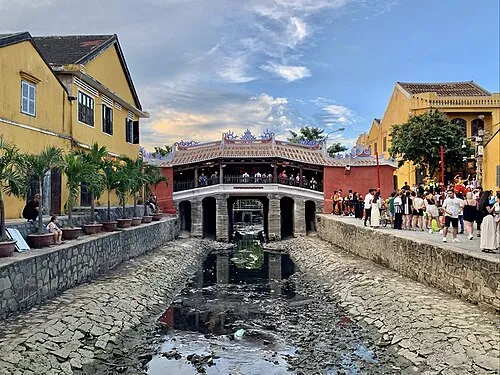
The Japanese Covered Bridge, Chùa Cầu in Vietnamese, literally the Buddhist Temple Bridge, is a footbridge with a small temple built onto it. It is 18 m long and 3 m wide. Look at how it is put together: the two ends rest on brick bridgeheads with two spans each, while the middle section has five spans on brick pillars standing in the water. Above it all, the wooden frame carries three separate but connected roofs, one for each part of the bridge.
Its story goes back to the Japanese merchants who settled in the port then called Faifo in the 16th century and built their own quarter. In 1593 a group of them began a covered bridge across a neighbourhood canal, finishing it in 1595 and linking their side with the Chinese quarter opposite. In 1653 Japanese residents added the temple on top, according to legend to calm Namazu, the monster believed to cause earthquakes. That is why a monkey and a dog keep watch here: in Japanese folklore, the monkey god and the dog god are the two who control Namazu.
The temple sits at the north end, with its entrance in the middle of the bridge facing the water. Notice the porcelain bowls capping the ends of the roof tiles, the same material you just saw turned into a dragon in the Fujian courtyard. Chinese characters appear all over the bridge and temple, including the name Lai Viễn Kiều above the temple entrance. Lord Nguyễn Phúc Chu gave the bridge that name on a visit in 1719; it means a bridge to welcome guests from afar.
When the Japanese merchants and the Dutch East Indies Company left Hội An in the 17th century, the bridge and its neighbourhood stayed largely as they were, though repairs and renovations have continued ever since. The temple was historically an altar to Trấn Vũ, honoured with a festival on the 20th day of the 7th lunar month.
Viewing the bridge from outside is free at any hour. Crossing it and seeing the shrine are part of the Old Town ticket, and worth it if you want to see the monkey, the dog and the decor up close; the shrine keeps a morning and an afternoon window. From the bridge, Tan Ky Old House is 250 m away, about 3 minutes on foot.
Local name
Chùa Cầu
Hours
Exterior always accessible; bridge interior/shrine open daily 9:00–11:00, 15:00–22:00
Price
Free exterior viewing; interior/crossing included in Old Town ticket (120,000 VND / ~4.80 USD international, 80,000 VND domestic)
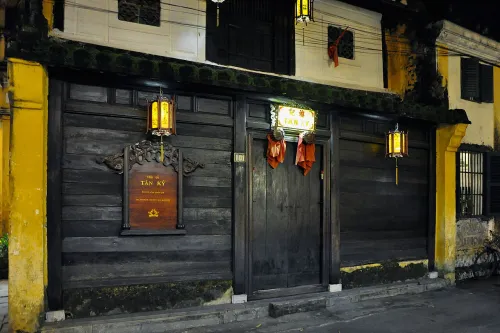
Tan Ky Old House was built more than 200 years ago by a Vietnamese merchant, and it shows how the town's trading cultures mixed even inside a single home. The two-storey house blends Japanese, Chinese and Vietnamese architectural styles, so after the Chinese hall and the Japanese bridge you see the influences you have just met combined under one roof.
What makes this house special is that it has never become a museum in the usual sense: the same family has lived here for seven generations. Look at the wooden columns and you will find marks left by flood water, a quiet record of what life beside the river has meant for the people who live here.
Going inside is included in the Old Town ticket and worth it for anyone curious about how merchant families actually lived, rather than how they worshipped. If you start in the afternoon, keep an eye on the time so you arrive while the house is still open. Around 25 minutes is a comfortable visit.
From the house it is just 150 m, about 2 minutes, into the Ancient Town, where the route opens up into the wider streets of the old port.
Hours
Daily 08:00–17:30
Price
Included in Old Town ticket (120,000 VND / ~4.80 USD international, 80,000 VND domestic)
The Ancient Town, Phố cổ Hội An, is where the route ends and where you can keep wandering as long as you like. Most of the houses around you date from the 17th to the 19th centuries and line narrow streets, with religious buildings tucked in between. Chinese assembly halls and temples stand beside traditional Vietnamese townhouses and houses built in French style, all within a few minutes of each other.
Hội An lies on the lower Thu Bồn River, and its position made it a busy international port where Japanese, Chinese and Western trading ships met during the 17th and 18th centuries. Even earlier, traces of a Champa trading port were found here, and the town is often mentioned in connection with the maritime silk road.
In the 19th century the waterways became harder to use, and the port slowly declined while Da Nang, then being built up by the French, took over its role. That decline turned out to be a kind of luck: Hội An was not destroyed in the two wars and escaped the rapid urban growth of the late 20th century. From the 1980s onwards scholars and travellers began to take notice, and today the town is a well-preserved example of a traditional Southeast Asian trading port.
What you see is only part of it. Everyday life here still carries old customs, beliefs, folk art and festivals, which is why Hội An is often described as a living museum of architecture and urban life. The public streets are always open, and your Old Town ticket still has two heritage sites left beyond the three on this walk. When you are done, the GPS navigation can lead you back to the start.
Local name
Phố cổ Hội An
Hours
Pedestrian zone / service hours daily 07:30–21:30; public streets always accessible
All 5 stops are already on the map. You just press start.
AI Tour Guide
You've read the route. Now walk it with someone telling the story beside you.
Press start wherever you are, even hundreds of kilometres from Hội An, and the guide begins telling its stories right away. In the city, pick any of the 5 stops to start from: it leads you there, then talks with you the whole route, asking, listening, remembering, and shaping the tour around your answers.
Free to start · Runs in your browser · No app, no download
Three Ways to Walk Hội An's Old Quarter
The route is short enough to walk in full, but your ticket and your timing decide how much you go inside.
The full route
Stops: 1, 2, 3, 4, 5
For first visits: 0.9 km and 13 minutes of walking from the museum's front to the Ancient Town, with three interiors on the Old Town ticket.
Ticket interiors only
Stops: 2, 3, 4
For anyone who has bought the Old Town ticket and wants its value: 670 m and 9 minutes of walking between the assembly hall, the bridge and the merchant house. With visits, plan for just under an hour and a half.
No ticket, just the bridge and the streets
Stops: 3, 5
For a quick look without paying entry: 400 m and 5 minutes of walking. You see the bridge from outside for free and continue into the public streets, which are always open.
How Long This Hội An Tour Takes With Visits
The walking itself takes 13 minutes. What fills the time are the interiors: allow about 30 minutes in Phuc Kian Assembly Hall, 20 minutes at the bridge and 25 minutes in Tan Ky Old House, plus a few minutes outside the museum. That brings you into the Ancient Town after roughly 93 minutes, and how long you stay there is up to you.
A sample morning: start at the museum at 9:00, reach Phuc Kian Assembly Hall at 9:07, the Japanese Covered Bridge at 9:43, Tan Ky Old House at 10:06 and the Ancient Town at 10:33. An afternoon start at 15:00 works with the same rhythm.
Before You Set Off in Hội An
Start and finish: The recommended start is the Hoi An Museum, and you finish in the Ancient Town. You can join at any stop; on request the GPS navigation leads you from the last stop back to the start.
Best time: Start in the morning or in the mid-afternoon: the bridge's shrine closes over midday, so arriving in that gap means seeing it only from outside.
Costs: The route is free. The Old Town ticket is cheaper for domestic visitors than for international ones and covers five heritage sites, three of them on this walk.
Pedestrian zone: The public streets of the Ancient Town are always accessible, whatever the service hours of the pedestrian zone.
AI Tour Guide
Your guide is ready whenever you are.
Press start and a voice AI Tour Guide takes it from here: leading the route through Hội An, telling the stories, and turning your walk into a real back-and-forth conversation. No app or download is needed; it runs in your browser.
Free to start · Runs in your browser · No app, no download
What the AI Tour Guide Adds in Hội An
On a route this compact, the stories are the real distance. The AI Tour Guide walks it with you as a conversation: it greets you, tells the history of each place, asks what caught your eye and remembers it, so if the Japanese merchants of Faifo interest you more than temple decor, the talk follows that thread. You can interrupt anytime, for example to ask what daily trade between the Japanese and Chinese quarters might have looked like, or how the Fujian community organised itself around its hall. You start with 100 free credits; after that you choose between this tour all-inclusive for €19.99 with no time limit, or credits at €5 per hour.
A Real Conversation
A voice AI Tour Guide greets you, leads the whole route, and tells the stories and facts as you walk, asking what you want to see and keeping a real conversation going. Not a recording you press play on.
Map Navigation
Follow the route on the map and walk at your own pace. You choose where to start and when to move to the next stop.
Ask Anything
Curious about a building you pass? Ask your AI Tour Guide on the spot and the conversation carries on.
13 Languages
Switch language anytime. No separate tour needed.
Yes. The whole tour is free: the route, the interactive map and the navigation cost you nothing. Only the voice AI Tour Guide is optional and paid: you test it with 100 free credits, then you pay either €5 per hour or €19.99 for this whole tour, with no time limit. Admission to 4 of the 5 stops is not included: Phuc Kian Assembly Hall, Japanese Covered Bridge, Tan Ky Old House and Ancient Town charge their own entry fees.
Do I need to download an app?
No. Everything runs in your phone browser. Open the route and start walking, no download and no sign-up required.
Do I need to book the walking tour in advance?
No booking needed. This self-guided tour is available anytime. Open the route in your browser and start walking. The AI Tour Guide works instantly, no app, no reservation required.
What languages is the AI Tour Guide available in?
The AI Tour Guide speaks 13 languages, so you take the tour in your own language and can switch at any time.
Can I skip stops or change the route?
Yes. Skip any stop, spend extra time at places you like, or start the route from any point. It is your walk, you set the pace.