Free Walking Tour Valletta: Bastion to Bastion

From the harbour view at Upper Barrakka to the star fort that held out in 1565: eight stops on 2.5 km through the city the Knights built.

8 Stops 2.5 km ~36 min walking
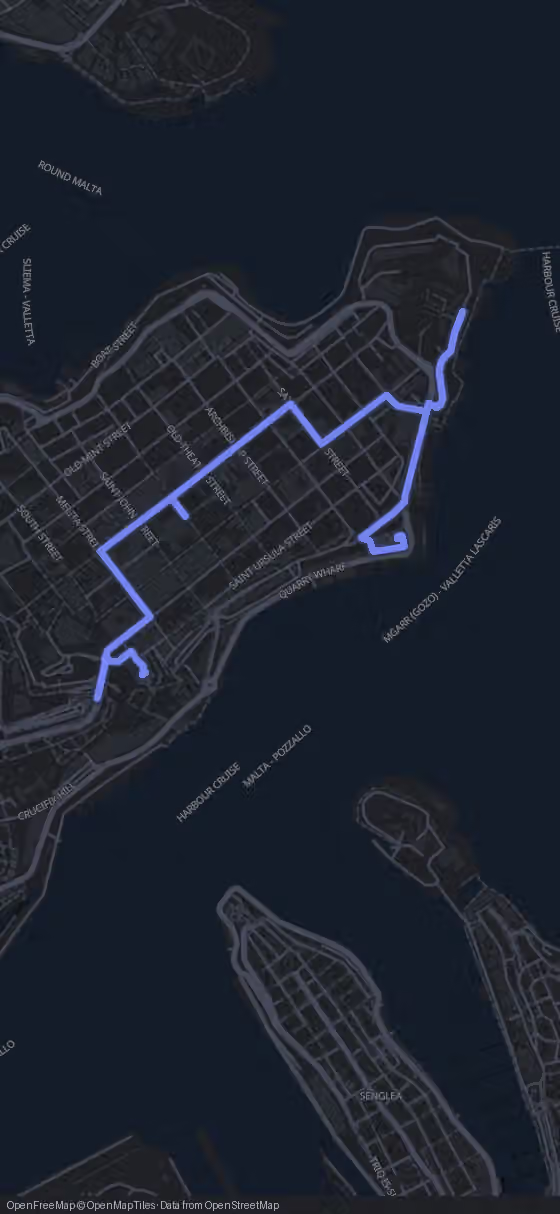
Route map for the Valletta walking tour
Stop 1 of 8
210 m·3 min
Upper Barrakka Gardens
Head south-west toward the Lascaris War Rooms
Hello, welcome to Valletta. I'm Alex, and beneath the city's gardens lies a command center cut deep into limestone.
Try this tour with Alex

The Route at a Glance

Eight stops lead from the Upper Barrakka Gardens past the Lascaris War Rooms, the National Museum of Archaeology, St. John's Co-Cathedral, the Grandmaster's Palace, Casa Rocca Piccola and Fort St. Elmo to the Lower Barrakka Gardens: 2.5 km, 36 minutes of pure walking, around four hours with two or three interiors.

The Upper Barrakka is free, the Lower Barrakka is currently closed, and the six buildings in between charge admission. Route, map and GPS navigation run free in your browser; the AI Tour Guide is optional.

Open free GPS & optional AI Tour Guide
View of Valletta

The Route

Walking Map of Valletta: Eight Stops on 2.5 km

8 stops 2.5 km 36 min walking
Tap to load interactive map

The 8 stops along this route

  1. Upper Barrakka Gardens in Valletta, stop 1 on the self-guided walking tour
    1Upper Barrakka Gardens
  2. Lascaris War Rooms in Valletta, stop 2 on the self-guided walking tour
    2Lascaris War Rooms
  3. National Museum of Archaeology in Valletta, stop 3 on the self-guided walking tour
    3National Museum of Archaeology
  4. St. John's Co-Cathedral in Valletta, stop 4 on the self-guided walking tour
    4St. John's Co-Cathedral
  5. Grandmaster's Palace in Valletta, stop 5 on the self-guided walking tour
    5Grandmaster's Palace
  6. Casa Rocca Piccola in Valletta, stop 6 on the self-guided walking tour
    6Casa Rocca Piccola
  7. Fort St. Elmo in Valletta, stop 7 on the self-guided walking tour
    7Fort St. Elmo
  8. Lower Barrakka Gardens in Valletta, stop 8 on the self-guided walking tour
    8Lower Barrakka Gardens
  9. That's the full route.

    Walk it with an AI Tour Guide talking you through every one of these streets.

    Start free in your browser
    You made it

Your Valletta Walking Tour Through the Knights' City, Stop by Stop

  1. 1

    Upper Barrakka Gardens

    Upper Barrakka Gardens in Valletta, stop 1 on the self-guided walking tour

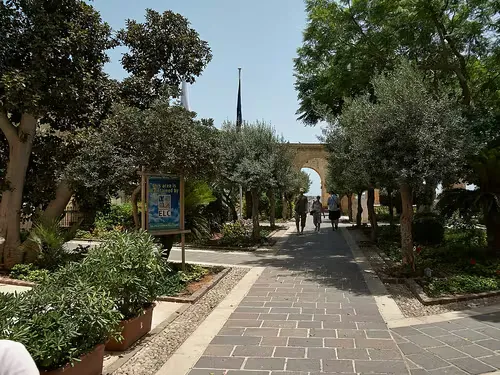
    You are standing on the St. Peter and St. Paul Bastion, the highest point of Valletta's fortifications, and the whole Grand Harbour lies at your feet. Across the water are the Three Cities, Vittoriosa, Senglea and Cospicua, the Knights' first towns on Malta, with the great shipyard and Fort St. Angelo. Floriana and the Valletta Waterfront complete the picture. Entry to the gardens is free.

    The bastion itself is a product of victory. After the Ottoman siege of 1565 the Knights laid the foundation stone of a new capital a year later and began the walls; this bastion was finished in 1570. Around 1660 the knights of the Italian langue turned the spot into a private garden, because their lodgings were nearby.

    Look at the double arcade around the garden. It was built in 1661 to plans by the Italian knight Fra Flaminio Balbiani and was once roofed. In 1775, after a revolt of the Maltese clergy against Grand Master Francisco Ximenes de Texada was crushed, Ximenes had the roof torn off as punishment. The British opened the garden to the public in 1824.

    Between the arches you'll find plaques to Albert Einstein, Guglielmo Marconi and the 1989 summit in Malta between George Bush and Mikhail Gorbachev, plus monuments to Gerald Strickland and Winston Churchill. In front of the inner arcade stands Les Gavroches, a bronze of three street children.

    Your next stop is literally beneath you: the Lascaris War Rooms were dug into the rock under these gardens. It's 210 metres, about 3 minutes, to the entrance.
    Hours
    Daily 7:00–22:00
    Price
    Free
  2. 2

    Lascaris War Rooms

    Lascaris War Rooms in Valletta, stop 2 on the self-guided walking tour

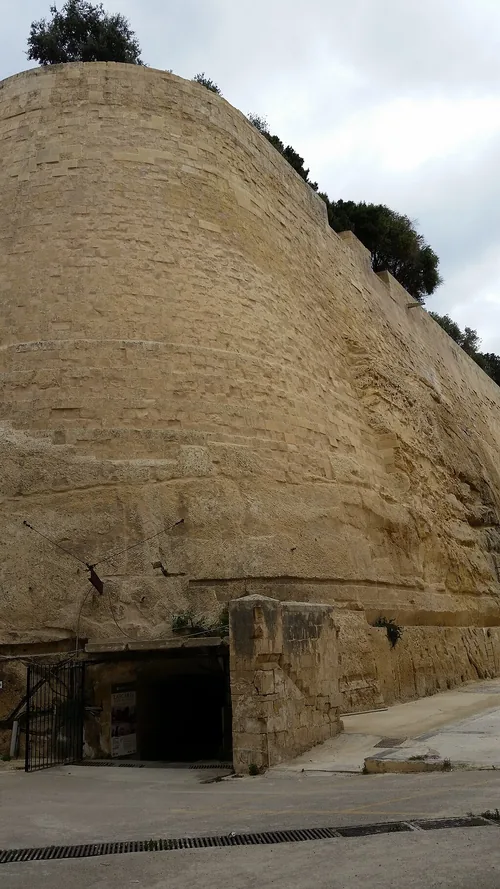
    From the outside there is little to see, and that was the point. Inside the rock lies the secret headquarters from which Malta was defended in the Second World War. The British began work in 1940, during the siege of Malta, widening tunnels under the Upper Barrakka Gardens and the Saluting Battery that had served as slave quarters in the time of the Knights. The complex was finished in early 1943.

    The name comes from the nearby Lascaris Battery, named in turn after Grand Master Giovanni Paolo Lascaris, who once had a garden on that spot. Underground, each fighting service had its own operations room. The fleet was directed from the Navy Plotting Room, air defence from the Anti-Aircraft Guns Operations Room, and the Coast Defence Room planned for an amphibious invasion. The headquarters spoke directly to radar stations across the islands, used Type X cipher machines, and the Filter Room collected reports from places such as the naval station at the Auberge de Castille.

    In 1943 Lascaris became the advance Allied headquarters: Eisenhower, Cunningham, Montgomery and Tedder directed the invasion of Sicily, Operation Husky, from here. Around 1000 people worked in the rooms during the war, 240 of them soldiers. Afterwards the Royal Navy ran its Mediterranean Fleet from Lascaris, which played a part in the Suez Crisis of 1956 and went on full alert in 1962, when a Soviet missile strike on Malta was feared. NATO used the rooms later.

    Admission is charged, and it's worth it if wartime history grabs you; if not, the story you just read covers the essentials. Then walk 420 metres, about 6 minutes, back into the Knights' city to the National Museum of Archaeology.

    Hours
    Mon–Sat 9:30–17:30 (last admission 17:00), closed Sundays
    Price
    20 EUR adults (16+), 19 EUR seniors, 7 EUR children (5-15)
  3. 3

    National Museum of Archaeology

    National Museum of Archaeology in Valletta, stop 3 on the self-guided walking tour

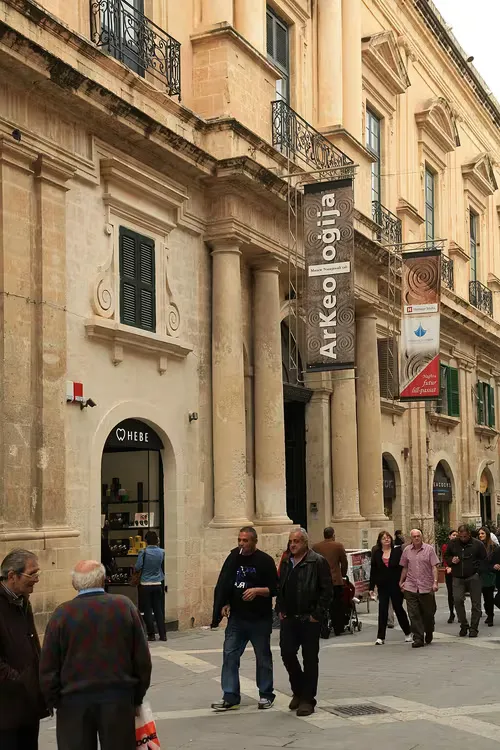
    The museum lives in the Auberge de Provence, a Baroque building on Republic Street built for the Order of St. John in 1571 to designs by Girolamo Cassar, the Maltese architect behind most of early Valletta. Look at the ground floor of the façade: in the early 17th century it was rebuilt to fit shops into it.

    On the first floor is the Gran Salon, the most ornate room in the building. Here the knights of Provence discussed business, ate and held banquets, seated at long tables in order of seniority. When Napoleon expelled the Knights in 1798, the auberge was leased to the Malta Union Club. On 12 August 1955 it was assigned to the National Museum, opened in 1958 by Agatha Barbara, then Minister of Education. Its first curator was Captain Charles G. Zammit, son of the archaeologist Sir Themistocles Zammit.

    Fine art once hung here too, but it moved out in 1974, and the museum became purely archaeological. Since a refurbishment in 1998 the finds sit in climate-controlled cases. The ground floor traces life on the islands from the Għar Dalam phase around 5200 BC, the earliest settlement, to the Tarxien phase around 2500 BC; there are also Phoenician pieces and a notable coin collection.

    Admission is charged. Go in if Malta's prehistory interests you, or simply to see the Gran Salon. From here it's 200 metres, about 3 minutes, to another Cassar building: St. John's Co-Cathedral.

    Hours
    Daily 9:00–17:00, last admission 16:30 (Saturdays June–Aug extended to 19:30); closed Tuesdays only Jan 6 – end of Feb
    Price
    5 EUR adults
  4. 4

    St. John's Co-Cathedral

    St. John's Co-Cathedral in Valletta, stop 4 on the self-guided walking tour

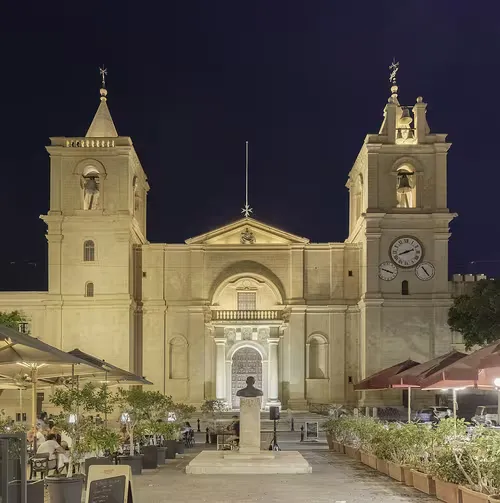
    The plain façade gives little away, and that's part of the story. Grand Master Jean de la Cassière commissioned the church in 1572, after the Great Siege, as the Conventual Church of the Order, dedicated to Saint John the Baptist. Girolamo Cassar designed it and it went up in the 1570s. Once finished it replaced St. Lawrence's Church in Birgu, across the harbour you saw from the Upper Barrakka, as the Order's main church.

    A story has it that Cassar travelled to Rhodes to bring back the plan of a church that had been turned into a mosque, as a model. Even so, he changed the design and is counted as its sole architect. The oratory and sacristy followed between 1598 and 1604, under Grand Masters Martin Garzez and Alof de Wignacourt.

    For its first century the inside was modest. Then in the 1660s Grand Master Raphael Cotoner wanted a church to rival those of Rome and handed the job to the Calabrian painter Mattia Preti, who transformed the entire interior in the Baroque style. Today it counts as one of the finest high Baroque interiors in Europe.

    If you only pay for one interior on this walk and love art, make it this one; admission is charged. Afterwards it's just 190 metres, about 2 minutes, along Republic Street to the Grandmaster's Palace, whose Palace Armoury you'll pass on the way.

    Hours
    Mon–Sat 9:00–16:45 (last entry 16:00), closed Sundays and public holidays
    Price
    15 EUR adults, 12 EUR seniors, 12 EUR students
  5. 5

    Grandmaster's Palace

    Grandmaster's Palace in Valletta, stop 5 on the self-guided walking tour

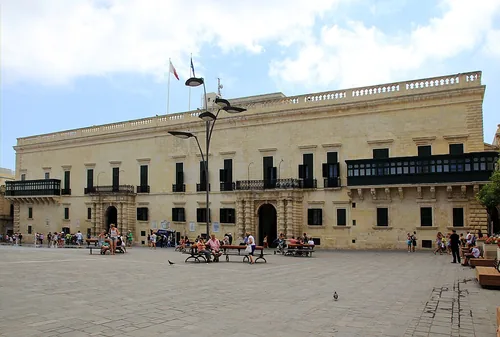
    This palace fills an entire city block and is the largest in Valletta. Its façade faces the Main Guard across St. George's Square on Republic Street, and the building is bounded by Archbishop Street, Old Theatre Street and Merchants Street. It was built between the 16th and 18th centuries for the Grand Masters of the Knights Hospitaller, who ruled Malta from 1530 to 1798.

    Every ruler of Malta renamed it. The Knights called it the Magisterial Palace; after Napoleon drove them out it became the National Palace; from 1800 the British made it the Governor's Palace and a royal residence, used by British sovereigns for major events on the island. From 1921 to 2015 it housed Malta's Parliament, and today it holds the Office of the President.

    A detail worth knowing: the palace was never meant to be here. When Valletta was founded in 1566, the plan was to build it on high ground in the south of the city, near where the Auberge de Castille later rose. That's why today's South Street was first called Strada del Palazzo.

    After a major restoration the State Rooms and the Palace Armoury reopened to the public in 2024; admission is charged. Worth it for anyone curious about how the Knights and later the British governed. Then it's 190 metres, about 3 minutes, to a palace that is still a family home.

    Hours
    Daily 9:00–17:00, last admission 16:30
    Price
    12 EUR adults (18+), 10 EUR youth (12-17) and seniors (60+), 8 EUR children (6-11), free under 6
  6. 6

    Casa Rocca Piccola

    Casa Rocca Piccola in Valletta, stop 6 on the self-guided walking tour

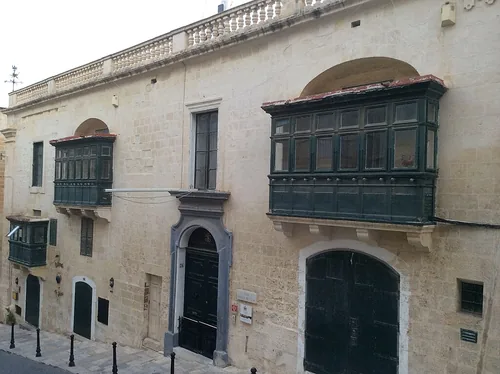
    This 16th-century palace is still the home of the noble de Piro family. It was built in 1580 by Admiral Don Pietro la Rocca, at a time when the Knights wanted a capital to rival Paris and Venice. Maps of the day call it la casa con giardino, the house with the garden, a rarity because Valletta's houses were normally not allowed gardens.

    The house was split into two smaller houses in the late 18th century and altered again in 1918. Before the Second World War an air raid shelter was dug beneath it, the second in Malta. Inside are more than fifty rooms: two libraries, two dining rooms, many drawing rooms and a chapel, with the grand rooms as long interconnected enfilades on the first floor and the kitchens and stables once on the ground floor.

    The family archive, the Archivium de Piro, holds contracts, wills, bills and court cases from the late 16th century to today and has been used by researchers at the University of Malta and the University of Oxford. The house also keeps Malta's largest private collection of antique costumes, formal and everyday wear from the 18th to the 20th century.

    Visits run as guided tours and admission is charged. Go in if you like lived-in houses more than museums, or want to see the family shelter. The palace also has a small B&B and La Giara restaurant. From here it's the longest leg so far: 600 metres, about 8 minutes, out to the tip of the peninsula and Fort St. Elmo.

    Hours
    Daily 10:00–16:00 (last admission), guided tours on the hour 10:00–16:00, closed Sundays (except by appointment)
    Price
    12 EUR adults, 8 EUR students, free for children 0-13
  7. 7

    Fort St. Elmo

    Fort St. Elmo in Valletta, stop 7 on the self-guided walking tour

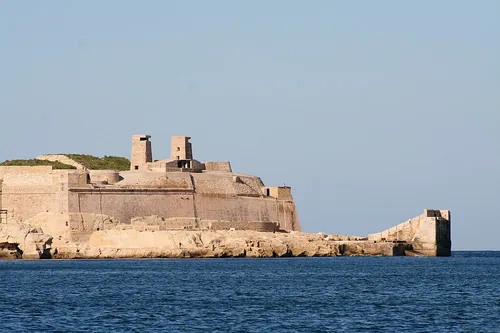
    You're at the seaward end of the Sciberras Peninsula, which divides Marsamxett Harbour from the Grand Harbour. This star fort guards the entrances to both, together with Fort Tigné and Fort Ricasoli. People kept watch here long before Valletta existed: a militia post by 1417, then in 1488 an Aragonese watchtower dedicated to Erasmus of Formia, better known as Saint Elmo.

    The Order reinforced the tower in 1533. In 1551 an Ottoman fleet sailed into Marsamxett Harbour unopposed, and the shock led to action: in 1552 the tower was pulled down and the Spanish engineer Pietro Pardo began a star fort with a cavalier, a covertway and a tenaille. A ravelin was thrown up only months before the next attack.

    That attack came in 1565 with far greater force. St. Elmo saw some of the fiercest fighting of the Great Siege, pounded by Turkish cannon on Mount Sciberras, the high ground where Valletta now stands, and from batteries where Fort Tigné is today. Its garrison of around 150 knights, 600 soldiers, most of them Spanish, and 60 armed galley slaves was resupplied by boat from Birgu and Senglea. During the bombardment a misfiring cannon struck its own parapet; the shards killed the gunner and mortally wounded Dragut, the corsair admiral and one of the Ottomans' ablest commanders. The fort held for 28 days and fell on 23 June 1565.

    Admission is charged, and for siege history this is the place to go in. The last leg is 710 metres, about 11 minutes, along the harbour side of the city to the Lower Barrakka Gardens.

    Local name
    Fort Saint Elmo
    Hours
    Daily 9:00–18:00, last admission 17:30 (Sundays with In Guardia Parade: opens 12:00 instead of 9:00)
    Price
    10 EUR adults, 7.50 EUR seniors/students/youths, 5.50 EUR children (6-11)
  8. 8

    Lower Barrakka Gardens

    Lower Barrakka Gardens in Valletta, stop 8 on the self-guided walking tour

    The Lower Barrakka Gardens are currently closed, so your walk ends at their gates. They sit on the lower part of St. Christopher's Bastion, about 600 metres from the Upper Barrakka where you started, and look out over the entrance to the Grand Harbour that Fort St. Elmo once guarded.

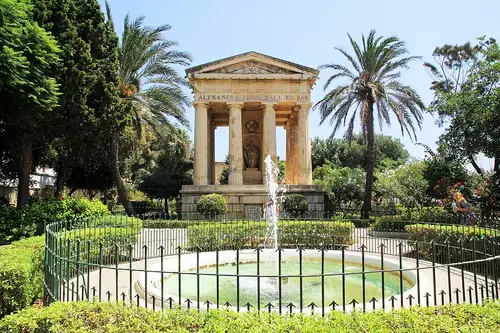
    Their origin is unusual. French troops laid them out while the Maltese population besieged them in Valletta from 1798 to 1800, probably to grow vegetables for the cut-off garrison. In 1810 a monument in the form of a neoclassical temple was raised here in memory of Alexander Ball, and further memorials recall the second great siege of Malta in the Second World War.

    Inside are also plaques to the Hungarian Revolution of 1956, the Prague Spring, Giuseppe Garibaldi and the 50th anniversary of the European Union. As one of the few green spaces in the city, the garden is protected as a historic monument. If you'd like to head back, the GPS navigation can guide you to the Upper Barrakka Gardens.

    Status
    Currently closed
Walking tour route map of Valletta Route loaded
Upper Barrakka GardensLascaris War RoomsNational Museum of ArchaeologySt. John's Co-Cathedral+4
All 8 stops are already on the map.
You just press start.
AI Tour Guide

You've read the route. Now walk it with a guide in your ear.

Press start wherever you are, even hundreds of kilometres from Valletta, and the guide begins telling its stories right away. In the city, pick any of the 8 stops to start from: it leads you there, then talks with you the whole route, asking, listening, remembering, and shaping the tour around your answers.

8stops 2.5km 36 minwalking 13languages
▶Start the tour free

Free to start · Runs in your browser · No app, no download

Three Ways to Walk Valletta

The stops sit close together, so the question is less where to walk and more which doors to go through. Pick by interest.

Outside only, the whole city in about an hour

Stops: 1, 2, 3, 4, 5, 6, 7, 8

For a first look or a short visit. You walk the full 36 minutes and read every building from the street, with time to linger in the free Upper Barrakka Gardens. No admission at all.

Knights, Baroque and palaces

Stops: 1, 3, 4, 5

For art and architecture lovers. From the Upper Barrakka to the Grandmaster's Palace is 14 minutes of walking, passing the Lascaris War Rooms on the way. Admission at the National Museum of Archaeology, St. John's Co-Cathedral and the Grandmaster's Palace.

Sieges and the Second World War

Stops: 1, 2, 6, 7, 8

For military history fans. You walk the full line in 36 minutes, since the route passes the other stops anyway, but go inside only the Lascaris War Rooms, Casa Rocca Piccola with its family air raid shelter and Fort St. Elmo. Three admissions.

How Long This Valletta Tour Takes With Museums and Breaks

The pure walking time is 36 minutes over 2.5 km. Most legs are only two or three minutes; the two longer ones come at the end, 8 minutes from Casa Rocca Piccola to Fort St. Elmo and 11 minutes from there to the Lower Barrakka Gardens.

What stretches the day are the interiors. Six of the eight stops are buildings you can enter, and doing all of them in one go fills a full day. Realistic for most people: around four hours with two or three interiors and a coffee break. The outside-only walk takes about an hour, the Knights and Baroque variant about three hours, the sieges and war variant about four.

Before You Start Your Walk in Valletta

  • Start: The Upper Barrakka Gardens are the recommended start, with the whole harbour laid out in front of you. You can join the route at any stop.
  • End: The route finishes at the Lower Barrakka Gardens, which are currently closed, so the walk ends outside their gates. The GPS navigation can lead you back to the start if you like.
  • Time of day: Start in the morning if you want to go inside several buildings, since they keep daytime hours. Check the current hours of the interiors you care about before you set out.
  • Admission: The Upper Barrakka Gardens are free. The Lascaris War Rooms, the National Museum of Archaeology, St. John's Co-Cathedral, the Grandmaster's Palace, Casa Rocca Piccola and Fort St. Elmo all charge admission.
  • Cash: Carry some cash: pastizzerias and smaller traditional places often don't take cards.

Food and Breaks Between the Bastions

Valletta eats best on its side streets. Old Bakery Street and St Lucia Street hold the local kitchens, pastizzi are the snack of choice, and many restaurants close between lunch and dinner, so lunch is often the better value. Plan your sit-down meal for lunch or a proper evening slot, not the late afternoon.

Old Bakery Street (Triq il-Forn)The most reliable cluster of local restaurants and traditional bakeries in the city. Same dishes as on Republic Street, noticeably lower prices. Frytto here fries arancini to order, and 67 Kapitali pours Maltese craft beer. (Runs parallel to Republic Street)
Crystal BakeryPastizzi and ħobż biż-żejt, bread with tomato paste, tuna, capers and olives. No seating, so take it with you and eat with a view at the Upper Barrakka. (Old Bakery Street)
Piadina CaffePiadine, salads and soups, handy before or after the cathedral. Seating is very limited, so think of it as a quick bite. (Just around the corner from St. John's Co-Cathedral)
Caffe CordinaRunning since 1837, with its 19th-century interior and frescoed ceilings intact. Pricier than an ordinary café, but you are paying for the room, so sit inside. (Republic Street)
Is-Suq tal-Belt (Valletta Food Market)A food hall with several stalls under one roof. The Everest serves Nepalese momos; grab a drink from the bar and find a seat. Good for groups who can't agree. (Merchants Street)
GranoA traditional tuna ftira, and street tables whose chairs all face the harbour.

Tourist Traps to Avoid in Valletta's Old Town

  • Eating on Republic Street: The main street has the highest prices for the plainest food: a pizza here costs clearly more than the same one on Old Bakery Street, and more again than takeaway from a Maltese bakery. Caffe Cordina is the honest exception.
  • Coperto and service charge: Many restaurants add a per-person cover charge, legal but usually in small print. Some menus also leave out a discretionary service charge that appears on the bill. Read the bill line by line; you can ask for a discretionary charge to be removed if the service didn't earn it.
  • ATMs with currency conversion: Small standalone ATMs in tourist areas sometimes offer to charge you in your home currency at a poor rate. Always choose to be charged in euros.
  • Petitions and taxis: If someone pushes an official-looking petition at you, keep walking; real Maltese charities don't usually collect on the street. The white taxis at City Gate are not metered, so agree the price before you get in or use Bolt.
Walking tour route map of Valletta
AI Tour Guide

Your guide is ready when you reach the first bastion.

Press start and a voice AI Tour Guide takes it from here: leading the route through Valletta, telling the stories, and turning your walk into a real back-and-forth conversation. No app or download is needed; it runs in your browser.

8stops 2.5km 36 minwalking 13languages
▶Start the tour free

Free to start · Runs in your browser · No app, no download

What the AI Tour Guide Adds in Valletta

On this route the AI Tour Guide meets you at the Upper Barrakka, tells the stories of each place as you walk, asks whether the Knights or the war years pull you in more, remembers your answer and leans the conversation that way. You can interrupt any time, for instance to ask what a Type X machine actually did or who Alexander Ball was. You start with 100 free credits; after that you choose between this tour all-inclusive for €19.99 with no time limit, or credits at €5 per hour.

A Real Conversation A voice AI Tour Guide greets you, leads the whole route, and tells the stories and facts as you walk, asking what you want to see and keeping a real conversation going. Not a recording you press play on.
Map Navigation Follow the route on the map and walk at your own pace. You choose where to start and when to move to the next stop.
Ask Anything Curious about a building you pass? Ask your AI Tour Guide on the spot and the conversation carries on.
13 Languages Switch language anytime. No separate tour needed.
Start free in your browser

Common Questions About Walking Valletta

Can I go into the Lower Barrakka Gardens at the end?

Not at the moment: the gardens are currently closed, so the walk ends outside. For the harbour view, take your time at the Upper Barrakka Gardens at the start.

If I only have time for one interior, which should it be?

Go by interest. For Baroque art, St. John's Co-Cathedral. For the Second World War, the Lascaris War Rooms. For the Great Siege of 1565, Fort St. Elmo. For a sense of how a Maltese noble family lives, Casa Rocca Piccola.

Is Valletta easy for vegetarians?

Maltese cooking leans heavily on meat and fish, but there are options: ftira without tuna, bigilla with bread, kapunata. Soul Food and Eeet Well on Merchants Street, Nenu's vegetarian ftira, Falafel Street and the vegan bakery Theobroma all work well.

Are there similar walking tours nearby?

Yes, across the water in Sicily: Syracuse, Catania, Noto, Ragusa and Agrigento each have their own free route.

Is the tour really free?

Yes. The whole tour is free: the route, the interactive map and the navigation cost you nothing. Only the voice AI Tour Guide is optional and paid: you test it with 100 free credits, then you pay either €5 per hour or €19.99 for this whole tour, with no time limit. Admission to 6 of the 8 stops is not included: Lascaris War Rooms, National Museum of Archaeology, St. John's Co-Cathedral, Grandmaster's Palace, Casa Rocca Piccola and Fort St. Elmo charge their own entry fees.

Do I need to download an app?

No. Everything runs in your phone browser. Open the route and start walking, no download and no sign-up required.

Do I need to book the walking tour in advance?

No booking needed. This self-guided tour is available anytime. Open the route in your browser and start walking. The AI Tour Guide works instantly, no app, no reservation required.

What languages is the AI Tour Guide available in?

The AI Tour Guide speaks 13 languages, so you take the tour in your own language and can switch at any time.

Can I skip stops or change the route?

Yes. Skip any stop, spend extra time at places you like, or start the route from any point. It is your walk, you set the pace.
Image credits
▶ Start free in your browser Runs in your browser, no app, no download