Free Walking Tour Ragusa: Baroque Rivals and a Bridge

One earthquake, two rival parishes: walk from San Giovanni's copper dome via Ponte Nuovo to Gagliardi's San Giorgio and the oldest of Ragusa's main gardens.

6 Stops 7.6 km ~1 h 50 min walking
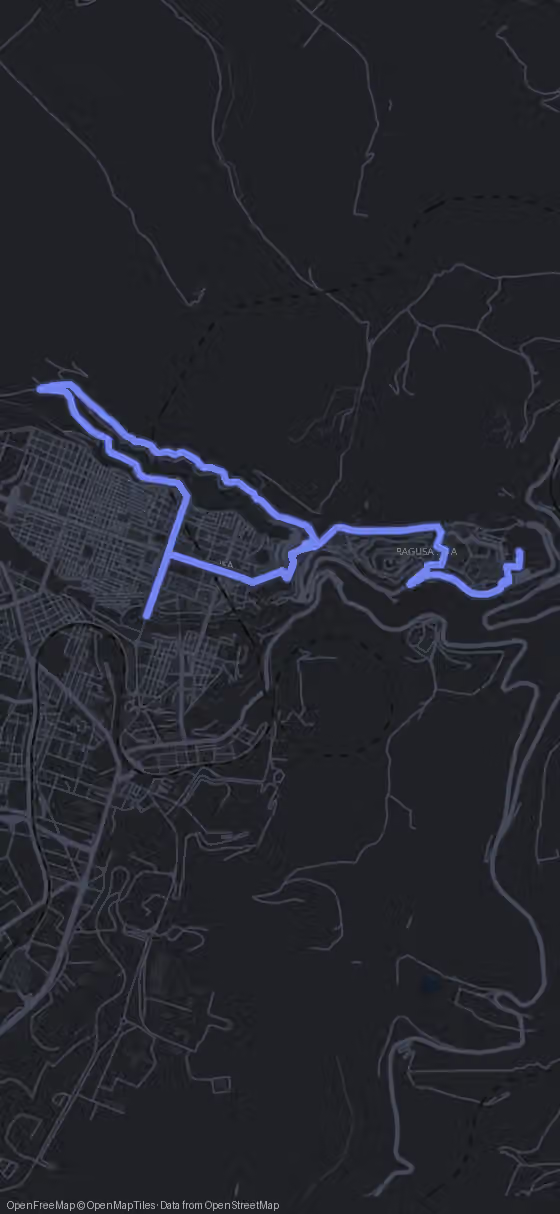
Route map for the Ragusa walking tour
Stop 1 of 6
770 m·10 min
Cathedral of San Giovanni Battista
Head north-west toward the Stairway of Santa Maria delle Scale
Ciao, welcome to Ragusa. I'm Alex, and one earthquake forced this city to rebuild itself in two very different ways.
Try this tour with Alex

What This Ragusa Walk Covers

Six stops over 7.6 km, 1 h 50 min of pure walking. You start at the Cathedral of San Giovanni Battista, pass the Stairway of Santa Maria delle Scale and Ponte Nuovo, then continue to the Church of San Giuseppe, the Duomo di San Giorgio and the Giardino Ibleo. With time inside the churches, plan close to four hours.

Every stop is free to enter. Route, map and GPS navigation are free in your browser; the AI Tour Guide is optional and tells the stories as you go.

Open free GPS & optional AI Tour Guide
View of Ragusa

The Route

Walking Map of Ragusa, Cathedral to Garden

6 stops 7.6 km 1 h 50 min walking
Tap to load interactive map

The 6 stops along this route

  1. Cathedral of San Giovanni Battista in Ragusa, stop 1 on the self-guided walking tour
    1Cathedral of San Giovanni Battista
  2. Stairway of Santa Maria delle Scale in Ragusa, stop 2 on the self-guided walking tour
    2Stairway of Santa Maria delle Scale
  3. Ponte Nuovo in Ragusa, stop 3 on the self-guided walking tour
    3Ponte Nuovo
  4. Church of San Giuseppe in Ragusa, stop 4 on the self-guided walking tour
    4Church of San Giuseppe
  5. Duomo di San Giorgio in Ragusa, stop 5 on the self-guided walking tour
    5Duomo di San Giorgio
  6. Giardino Ibleo in Ragusa, stop 6 on the self-guided walking tour
    6Giardino Ibleo
  7. That's the full route.

    Walk it with an AI Tour Guide talking you through every one of these streets.

    Start free in your browser
    You made it

Your Ragusa Walking Tour Through Six Stops

  1. 1

    Cathedral of San Giovanni Battista

    Cathedral of San Giovanni Battista in Ragusa, stop 1 on the self-guided walking tour

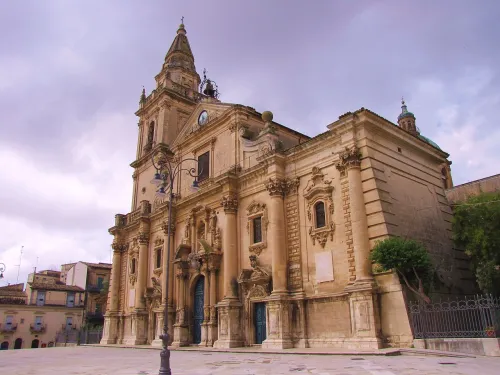
    Begin under the copper-clad dome of the Cathedral of San Giovanni Battista, which shares the title of Ragusa's main church with San Giorgio. Before you go in, give the front a minute. The rusticated pilasters and the monumental main portal are details typical of the Baroque around Acireale and Catania, and the portal closely resembles the marble one of Acireale's cathedral. That is no coincidence: two master builders from Acireale, Giuseppe Recupero and Giovanni Arcidiacono, may have had a hand in the design.

    The church you see is not in its original place. Before the earthquake of 1693, San Giovanni stood in the western part of old Ragusa, under the walls of the medieval castle; the little church of Santa Agnese was built on its ruins towards the end of the 18th century. After the quake, the parish moved to the heart of the new town, in the district called Patro. The first stone was laid on 15 April 1694, and only four months later, on 16 August, the church opened with a solemn ceremony attended by all the notables of the county. A building finished that fast had to be small, and it soon was too small for a quarter that kept growing.

    Here the real story of this walk begins. The people of San Giovanni, the sangiovannari, rebuilt their church first, and that stung the sangiorgiani, who clung to the oldest part of town around San Giorgio. The two factions had always been at odds, and the earthquake had turned the old order of the town upside down. You will meet the other side of this rivalry in Ibla.

    San Giovanni became an independent parish in 1714, and in 1718 work began on a far larger church on the same site. It was consecrated on 30 May 1778 in a ceremony led by Giovanni Battista Alagona, bishop of Syracuse. The dome followed in 1783; its copper covering was only added in the 20th century. Entry is free, so step inside before you set off.

    The first leg is a long one: 2220 m, about 29 minutes, to the Stairway of Santa Maria delle Scale.
    Hours
    Daily: 07:45–12:30, 15:00–20:00
    Price
    Free
  2. 2

    Stairway of Santa Maria delle Scale

    Stairway of Santa Maria delle Scale in Ragusa, stop 2 on the self-guided walking tour

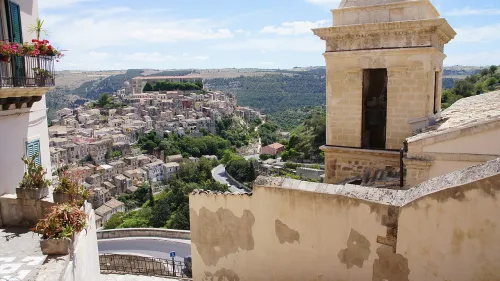
    The Stairway of Santa Maria delle Scale is not a building you enter but a public lane you walk. There is no gate and no ticket, nobody checks you or hurries you along, and it costs nothing. In a town where so much of the story is told inside churches, this is a sight that simply belongs to whoever passes through.

    Take it at your own pace and use it as a breather after the long opening leg from the cathedral. Ahead lies the longest stretch of the walk in minutes: 2140 m, about 34 minutes, to Ponte Nuovo.

    Hours
    Daily: 10:00–12:30, 15:30–18:30
    Price
    Free
  3. 3

    Ponte Nuovo

    Ponte Nuovo in Ragusa, stop 3 on the self-guided walking tour

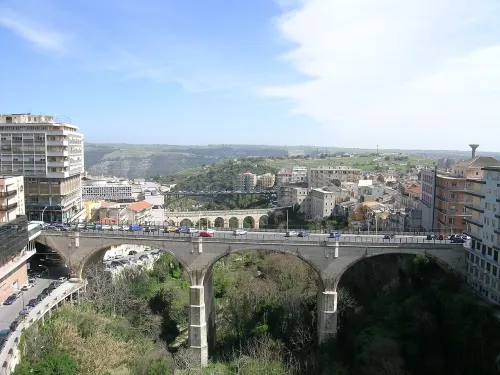
    Ponte Nuovo goes by several names: officially it is the Ponte F. Pennavaria, and older locals may still call it the Ponte del Littorio, a name from the Fascist era in which it was built. It was the second bridge across the Santa Domenica valley, and it became the main artery between the historic centre and the town's southern expansion.

    The story starts with a traffic problem. In 1932 the older Ponte dei Cappuccini could no longer cope with the traffic of the day, so the town council held a design competition for a second crossing. It was won by Aurelio Aureli, an engineer from Rome, while the money was found by Filippo Pennavaria, an undersecretary in the government, whose name the bridge still carries.

    Look at how it is built. Four shallow, segmental arches carry the deck; the structure is reinforced concrete, faced with hard local limestone, the pietra viva, so it blends with the stone of the old town. At its highest point it stands forty metres above the valley, it runs for about 132 metres and is about ten metres wide, with a two-metre pavement on each side.

    The bridge has always carried heavy car traffic, so keep to the pavement while you look over the parapet into the valley. From here it is 1980 m, about 30 minutes, to the Church of San Giuseppe in Ragusa Ibla.

    Hours
    Freely accessible, no fixed opening hours
    Price
    0 EUR
  4. 4

    Church of San Giuseppe

    Church of San Giuseppe in Ragusa, stop 4 on the self-guided walking tour

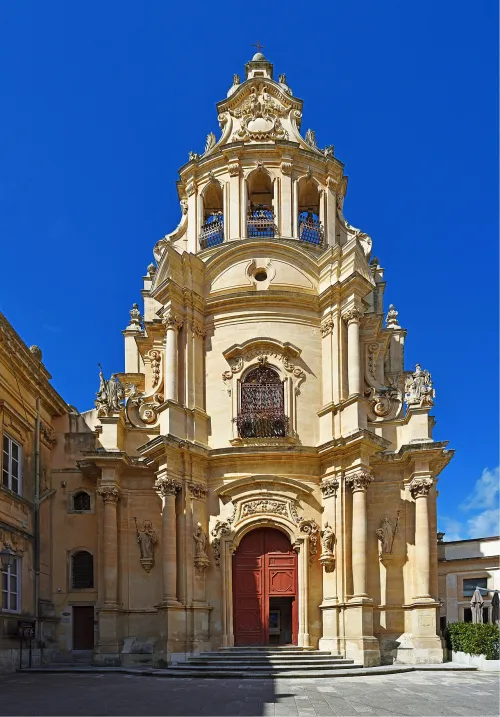
    You are now in Ragusa Ibla, on Piazza Pola, once called the Piazza Maggiore. The Church of San Giuseppe is attributed to Rosario Gagliardi and, together with San Giorgio, counts among the jewels of Sicilian Baroque. Look at the convex front, divided into three tiers. On the lowest, four columns and two Corinthian half pillars frame a round-arched portal topped by fine sculpture, and four statues stand guard: Saint Gertrude, Saint Augustine, Saint Gregory and Saint Scholastica.

    Those saints point to the church's partner, the Benedictine convent of San Benedetto. It was founded thanks to a gift from Don Carlo Giavanti, baron of Buscello and a native of Noto, who followed the last wishes of his wife, the Ragusa noblewoman Violante Castilletti, and turned the palace they lived in into a convent. How old the church itself is remains disputed: local scholars argue over whether a small church already existed from 1543 and only gained importance through the union with the convent after the donation of 1590.

    The earthquake of 1693 destroyed church and convent almost entirely, and the church now stands on the remains of San Tommaso, which the quake also flattened. Rebuilding began in 1701 and continued until 1705, with more work between 1723 and 1737. In 1756 the church took over the buildings of San Tommaso, which had moved elsewhere, and in the years up to 1760 a Rococo design replaced the Baroque one. That is why San Giuseppe looks in parts like San Giorgio and in others like the nearby Madonna del Carmine. Entry is free.

    The next leg is short: 490 m, about 7 minutes, to the Duomo di San Giorgio. On the way you pass the Palazzo della Cancelleria, the Casa Museo Appiano and the Museum of the Treasury of San Giorgio.

    Hours
    Daily: 09:00–13:00, 16:00–20:00
    Price
    Free
  5. 5

    Duomo di San Giorgio

    Duomo di San Giorgio in Ragusa, stop 5 on the self-guided walking tour

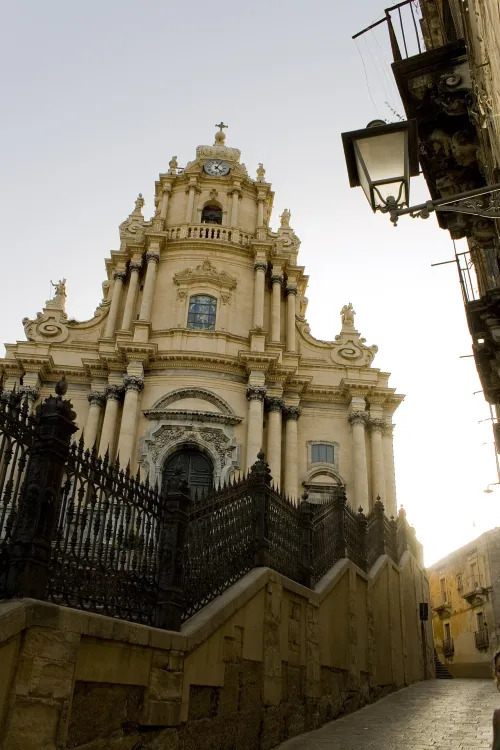
    Here is the other side of the rivalry. The Duomo di San Giorgio, also known as the Insigne Collegiata di San Giorgio, is the mother church of Ragusa, dedicated to the town's patron saint and one of its most important monuments. Stand in the square and look closely: the church is turned slightly to the left of the piazza in front of it. Rosario Gagliardi, an architect from Noto and one of the leading figures of the Baroque rebuilding, planned it that way so that the future dome would be visible behind the towering bell-tower facade, a hallmark of his churches. This building is often considered his finest work.

    Before 1693 San Giorgio stood at the eastern edge of town, near today's Giardino Ibleo. The earthquake left only part of the front, some chapels and part of the main chapel standing, so a large hall was built next to the old nave to hold services. In the second quarter of the 18th century the parish decided to move to the site of San Nicola, a church that had served the Greek rite until the 16th century before passing to the Latin rite and becoming a sacramental church of San Giorgio.

    The sangiorgiani had insisted on rebuilding in the old core, and they had to watch their rivals at San Giovanni finish first. Gagliardi received the commission in 1738. A plaque on the right side records the laying of the first stone on 28 June 1739, while a puzzling inscription on the opposite side notes that work could only really start in 1744. The facade was completed on 5 October 1775, when the bells were raised into the tower. Entry is free, and if you go into only one church on this walk, make it this one.

    From here it is 740 m, about 11 minutes, to the Giardino Ibleo, where the remains of the old San Giorgio still stand.

    Hours
    Daily: 09:30–13:00, 15:30–19:00
    Price
    Free
  6. 6

    Giardino Ibleo

    Giardino Ibleo in Ragusa, stop 6 on the self-guided walking tour

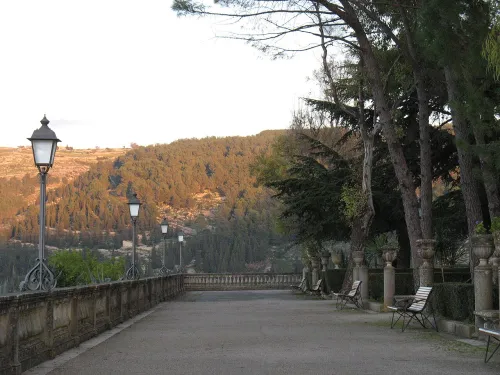
    The walk ends in the Giardino Ibleo, the oldest of Ragusa's four main gardens, set at about 385 metres above sea level on a spur of rock over the valley of the Irminio. It mixes plants and architecture: medieval remains, monumental churches and, close by, the archaeological excavations of Ragusa Ibla. The entrance is lined with carved benches, columns crowned with stone vases in different shapes and an elegant limestone balcony; long ago, a palm-lined avenue led in instead.

    Look for the 15th-century portal in Spanish Gothic style: it is the only surviving piece of the old San Giorgio, the church you just saw rebuilt elsewhere. Until the early 1800s this was an unbuilt enclosure, and an 1837 map by S. Puglisi shows the ruins of San Giorgio alongside the convents of San Domenico and the Capuchins.

    The garden was first laid out in 1858 by three noble patrons, Carmelo Arezzo di Trifiletti, Emanuele La Rocca Impillizzeri and Giuseppe Maggiore; a plaque on the wall of the Capuchin convent records the founding. The original core grew around the Viale delle Colonnine. In 1884 a public subscription, encouraged by verses from the poet Paolo Arrabito, bought the old cathedral's garden to enlarge the park. In 1907 the surveyor Giuseppe Pinelli designed the fence and moved the entrance, and in the 1930s the garden reached its present size, taking in the land of San Giacomo and the Spadaro property and adding the Boschetto della Rimembranza and the war memorial.

    Three churches stand within the garden. San Giacomo Apostolo dates from the 14th century and was rebuilt after 1693. The Capuchin church, also called Sant'Agata ai Giardini Iblei, was restored in 2015 and 2016 and holds the triptych by Pietro Novelli. San Domenico, also known as San Vincenzo Ferreri, comes with its convent and the Auditorium. The garden is free, so take your time here and let the walk wind down.

    Price
    Free
Walking tour route map of Ragusa Route loaded
Cathedral of San Giovanni BattistaStairway of Santa Maria delle ScalePonte NuovoChurch of San Giuseppe+2
All 6 stops are already on the map.
You just press start.
AI Tour Guide

You have read the route. Now walk it with a guide talking alongside you.

Press start wherever you are, even hundreds of kilometres from Ragusa, and the guide begins telling its stories right away. In the city, pick any of the 6 stops to start from: it leads you there, then talks with you the whole route, asking, listening, remembering, and shaping the tour around your answers.

6stops 7.6km 1 h 50 minwalking 13languages
▶Start the tour free

Free to start · Runs in your browser · No app, no download

Shorter Ways Through Ragusa

Not every day has room for the full walk. These cuts keep the route's order and stay free throughout, since none of the stops charges admission.

Ibla only

Stops: 4, 5, 6

For a short visit or tired legs: San Giuseppe, San Giorgio and the garden, with just 18 minutes of walking between them. With time inside, around an hour and a half. All three are free.

The upper town and the bridge

Stops: 1, 2, 3

For those who want the San Giovanni side of the rivalry and the engineering of Ponte Nuovo: 1 h 3 min of walking, a little under two hours with a look inside the cathedral. No admission anywhere.

From the bridge into Ibla

Stops: 3, 4, 5, 6

Skip the two long opening legs and begin at Ponte Nuovo: 48 minutes of walking to the garden, a little over two hours with the churches. Everything on this version is free.

How Long the Ragusa Tour Takes, With and Without Interiors

Pure walking adds up to 1 h 50 min over 7.6 km, but it is unevenly spread. The first three legs carry most of it (29, 34 and 30 minutes); once you reach Ibla, the gaps shrink to 7 and 11 minutes, so the end of the walk is dense with sights.

Add time inside the Cathedral of San Giovanni Battista, San Giuseppe and San Giorgio, a pause at the bridge and a proper stroll through the garden, and close to four hours is realistic. The Ibla-only version fits into about an hour and a half, the upper town into a little under two hours, and starting at Ponte Nuovo takes a little over two.

Before You Set Off in Ragusa

  • Start: The Cathedral of San Giovanni Battista is the recommended start, because the story of the two parishes begins there. You can join at any stop, though.
  • Finish: The walk ends in the Giardino Ibleo, a good place to sit down after the last leg.
  • Time of day: The churches close for a break in the middle of the day, so plan your morning or afternoon around the interiors you care most about.
  • Admission: None of the six stops charges admission: the three churches, the cathedral, the bridge and the garden are all free.
Walking tour route map of Ragusa
AI Tour Guide

Your guide for Ragusa is ready when you are.

Press start and a voice AI Tour Guide takes it from here: leading the route through Ragusa, telling the stories, and turning your walk into a real back-and-forth conversation. No app or download is needed; it runs in your browser.

6stops 7.6km 1 h 50 minwalking 13languages
▶Start the tour free

Free to start · Runs in your browser · No app, no download

What the AI Tour Guide Adds Between the Two Parishes

The long legs between the upper town and Ibla are where the AI Tour Guide earns its place: it turns half an hour of walking into a conversation about the people behind these churches, asks what interests you and follows up on it. You might ask what became of Filippo Pennavaria after the bridge took his name, or what the Pietro Novelli triptych in the Capuchin church shows. You start with 100 free credits; after that you choose this tour all-inclusive for €19.99 with no time limit, or €5 per hour.

A Real Conversation A voice AI Tour Guide greets you, leads the whole route, and tells the stories and facts as you walk, asking what you want to see and keeping a real conversation going. Not a recording you press play on.
Map Navigation Follow the route on the map and walk at your own pace. You choose where to start and when to move to the next stop.
Ask Anything Curious about a building you pass? Ask your AI Tour Guide on the spot and the conversation carries on.
13 Languages Switch language anytime. No separate tour needed.
Start free in your browser

Common Questions About Walking Ragusa

Can I combine Ragusa with Noto or Syracuse?

Yes, both are close: Noto is about 30 km away and Syracuse about 52 km. If you only have half a day in Ragusa, the Ibla-only version leaves room for a second town.

Is there parking near the route?

Ponte Nuovo has a strip of herringbone parking along its east side, next to the two one-way traffic lanes. That puts you right at the bridge if you prefer to start the walk there.

If I only have time to go inside one church, which should it be?

The Duomo di San Giorgio. It is the work that best shows Rosario Gagliardi's idea of a bell-tower facade with the dome rising behind it, and it is free to enter.

Is the tour really free?

Yes. The whole tour is free: the route, the interactive map and the navigation cost you nothing. Only the voice AI Tour Guide is optional and paid: you test it with 100 free credits, then you pay either €5 per hour or €19.99 for this whole tour, with no time limit.

Do I need to download an app?

No. Everything runs in your phone browser. Open the route and start walking, no download and no sign-up required.

Do I need to book the walking tour in advance?

No booking needed. This self-guided tour is available anytime. Open the route in your browser and start walking. The AI Tour Guide works instantly, no app, no reservation required.

What languages is the AI Tour Guide available in?

The AI Tour Guide speaks 13 languages, so you take the tour in your own language and can switch at any time.

Can I skip stops or change the route?

Yes. Skip any stop, spend extra time at places you like, or start the route from any point. It is your walk, you set the pace.
Image credits
▶ Start free in your browser Runs in your browser, no app, no download