Free Walking Tour Catania: Elephant to Fish Market

From the Liotru on the Piazza del Duomo to the old fish market: Roman baths under the cathedral, a nuns' dome over the city, a castle that once stood above the sea.

11 Stops 4.9 km ~1 h 7 min walking
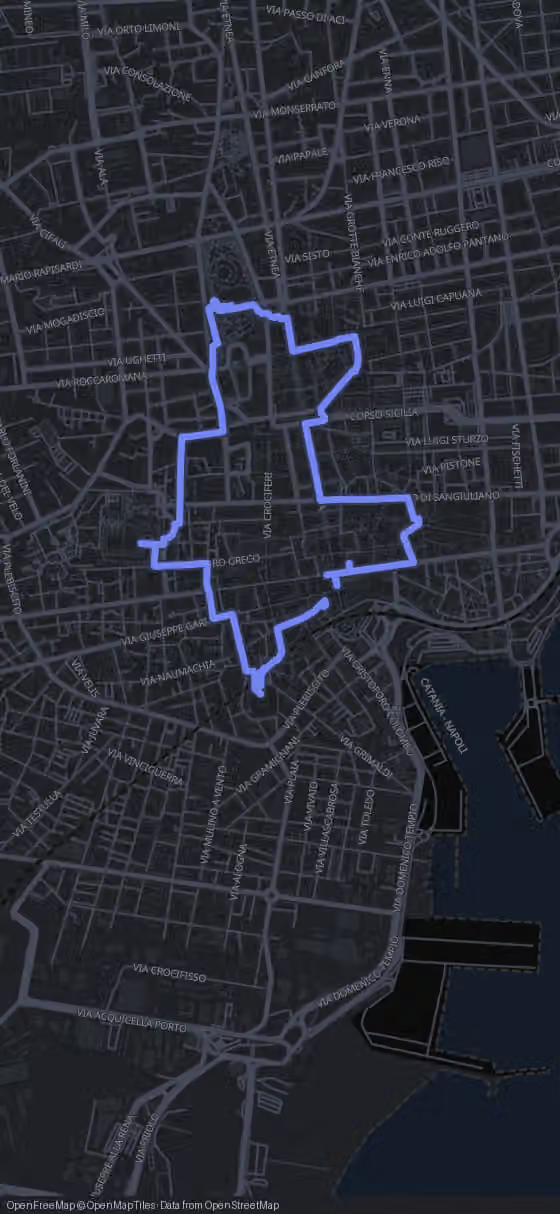
Route map for the Catania walking tour
Stop 1 of 11
30 m·1 min
Piazza del Duomo and Elephant Fountain
Head south-east toward the Terme Achilliane
Welcome to Catania. I'm Alex, and our first story begins with a volcano that rewrote the city's shoreline.
Try this tour with Alex

Catania on Foot: the Route at a Glance

Eleven stops, from the Piazza del Duomo and Elephant Fountain to La Pescheria: 4.9 km and 1 h 7 min of pure walking. With the interiors worth paying for, plan about five hours.

Squares, streets, markets, the garden and both churches on the cathedral square are free. Tickets are needed for the Terme Achilliane, the Benedictine Monastery of San Nicolò l'Arena and the terrace of the Badia di Sant'Agata. Route, map and GPS navigation run free in your browser; the AI Tour Guide is optional.

Open free GPS & optional AI Tour Guide
This short shows highlights of the route. All 11 stops follow below.

The Route

Walking Map of Catania: Eleven Stops from Duomo to Pescheria

11 stops 4.9 km 1 h 7 min walking
Tap to load interactive map

The 11 stops along this route

  1. Piazza del Duomo and Elephant Fountain in Catania, stop 1 on the self-guided walking tour
    1Piazza del Duomo and Elephant Fountain
  2. Terme Achilliane in Catania, stop 2 on the self-guided walking tour
    2Terme Achilliane
  3. Badia di Sant'Agata in Catania, stop 3 on the self-guided walking tour
    3Badia di Sant'Agata
  4. Cathedral of Saint Agatha in Catania, stop 4 on the self-guided walking tour
    4Cathedral of Saint Agatha
  5. Teatro Massimo Bellini in Catania, stop 5 on the self-guided walking tour
    5Teatro Massimo Bellini
  6. Via Etnea in Catania, stop 6 on the self-guided walking tour
    6Via Etnea
  7. Fera 'o Luni in Catania, stop 7 on the self-guided walking tour
    7Fera 'o Luni
  8. Villa Bellini in Catania, stop 8 on the self-guided walking tour
    8Villa Bellini
  9. Benedictine Monastery of San Nicolò l'Arena in Catania, stop 9 on the self-guided walking tour
    9Benedictine Monastery of San Nicolò l'Arena
  10. Castello Ursino in Catania, stop 10 on the self-guided walking tour
    10Castello Ursino
  11. La Pescheria in Catania, stop 11 on the self-guided walking tour
    11La Pescheria
  12. That's the full route.

    Walk it with an AI Tour Guide talking you through every one of these streets.

    Start free in your browser
    You made it

Your Catania Walking Tour, from the Liotru to the Fish Market

  1. 1

    Piazza del Duomo and Elephant Fountain

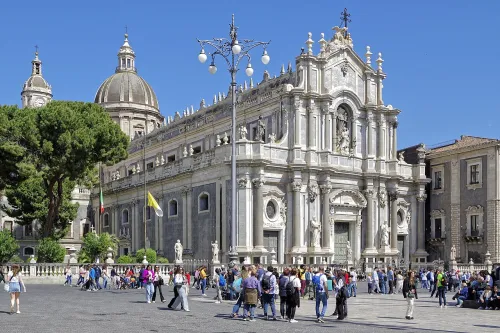
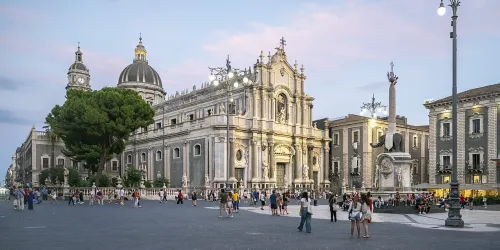
    Piazza del Duomo and Elephant Fountain in Catania, stop 1 on the self-guided walking tour

    Start with the elephant. The fountain in the middle of the square is officially the Fontana dell'Elefante, but in Catania everyone calls the animal Liotru, and the piazza feels like his. There are no gates and no tickets, so you can stand here at any hour of day or night.

    Treat the square as the city's stage before you treat it as a photo. The fireworks of the February festa end over this piazza, May Day crowds fill it, and the cathedral takes up one whole side of it.

    Almost everything around you is younger than 1693, when an earthquake razed Catania. The rebuilding of the whole centre started right here, from the cathedral, one of the few buildings that had not been completely destroyed.

    Then look at the paving with some suspicion: Roman baths lie under this square, and they are your next stop, only 70 m away. Catania stacks its centuries, and the stack starts under your shoes.
    Hours
    Open 24/7
    Price
    Free
  2. 2

    Terme Achilliane

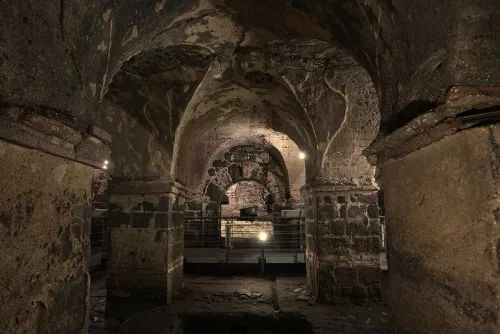
    Terme Achilliane in Catania, stop 2 on the self-guided walking tour

    To the right of the cathedral façade a ramp leads down, and a barrel-vaulted corridor squeezed between the cathedral's foundations takes you into what survives of the Terme Achilliane: a small part of a late Roman bath complex, today entirely underground beneath the Piazza del Duomo.

    Nobody is quite sure when they were built. The 4th century is the likeliest answer, partly because a group of capitals from that period was reused inside the cathedral and may come from here; the archaeologist Roger Wilson has argued for the 3rd century. The name comes from a marble inscription of the first half of the 5th century, broken into six main fragments that turned up at different times.

    That inscription also records something very human: around 434 the baths were made smaller to save on the firewood needed to heat them. Centuries later Bishop Ansgerio picked this ground for the cathedral and its Benedictine convent, and the earthquakes of 1169 and 1693 buried what was left. Some pieces ended up in the museum of the Prince of Biscari.

    The visit is compact and the ticket is cheap, so it is worth it if you want to stand in the oldest layer of the walk rather than read about it. Mind the hours, which vary from day to day. Back at street level, the Badia di Sant'Agata is 120 m on.

    Hours
    Mon, Wed, Fri, Sat 10:00–15:00, Tue, Thu 15:00–20:00, Sun by reservation
    Price
    5 EUR full, 3 EUR reduced
  3. 3

    Badia di Sant'Agata

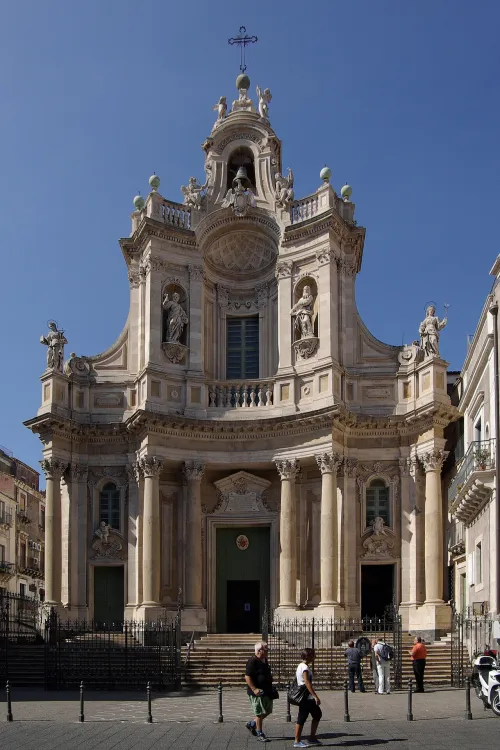
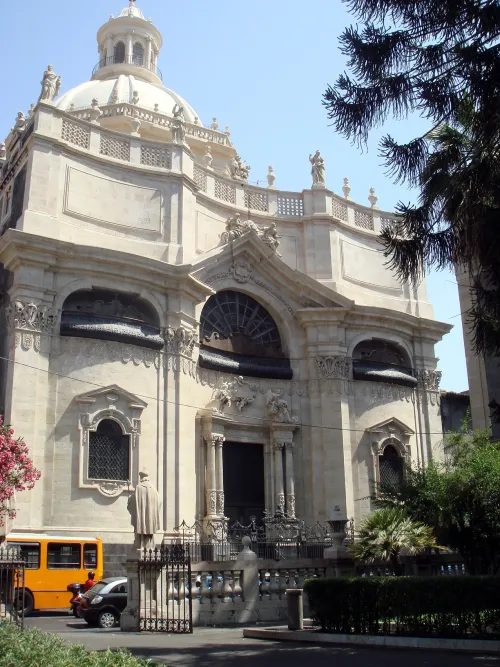
    Badia di Sant'Agata in Catania, stop 3 on the self-guided walking tour

    Across Via Vittorio Emanuele from the cathedral's left transept rises the Baroque front of the Badia di Sant'Agata, the church of a convent of cloistered Benedictine nuns. Look up at the metal grills and the balconies of carved stone fretwork: they let the nuns watch street life and the many religious processions without being seen.

    The convent was founded in 1620 with money from Erasmo Cicala. The 1693 earthquake razed it and is said to have killed 15 of the 28 nuns. The survivors stayed, sheltering in the ruins behind a fence, while rebuilding crawled until Giuseppe Moncada left 4,000 scudi in 1720. Work began in 1736 under Giovanni Battista Vaccarini, a name you will meet again on this walk. The façade was done by 1742 and kept the 17th-century portal by Giovanni Maria Amato, which had survived the quake; the octagonal dome followed only in 1768, and the church was consecrated in 1796.

    The church is free. Inside, the nave is an elongated octagon of white marble floors and yellow Castronovo marble, chosen by the architect Nicolò Daniele. The stucco statues of the side altars, Saint Benedict, the Immaculate Conception, Saint Joseph and Saint Euplio, were finished in 1782; the Saint Agatha over the main altar echoes Ercole Ferrata's Sant'Agnese in Rome. Behind that altar, find the metal grill of the balcony from which the nuns followed mass.

    The paid circuit ticket takes you up to the terrace and the dome, whose base opens views over the city and up to Mount Etna. If you want one view of Catania with the volcano behind it, this is the ticket to buy. Afterwards, the cathedral is only 40 m away.

    Hours
    Mon–Sun 09:30–20:30
    Price
    Free church entry; 7 EUR circuit ticket for terrace and dome
  4. 4

    Cathedral of Saint Agatha

    Cathedral of Saint Agatha in Catania, stop 4 on the self-guided walking tour

    Now go inside the building whose foundations you just walked beneath. The Cathedral of Saint Agatha was first built between 1078 and 1093, on the ruins of the Roman baths, by order of Roger I of Sicily, who had taken the city from the Islamic emirate of Sicily. Back then it looked like a fortress: a fortified church.

    Earthquakes and Etna kept knocking it down. In 1169 a quake left little standing but the apse area, and a fire did more damage; in 1693 it was mostly in ruins again. Look for what the Normans left: part of the transept, the two towers and the three semicircular apses, built of big lava stones, most of them taken from imperial Roman buildings.

    The front is Vaccarini's work from 1711, his Baroque answer to the 1693 disaster: three levels with granite Corinthian columns that may come from the city's Roman theatre, Saint Agatha above the entrance, Saint Euplius to the right and Saint Birillus to the left. Take a minute at the wooden main door: its 32 carved panels tell the life and martyrdom of Saint Agatha among papal arms and Christian symbols. The dome came in 1802.

    The bell tower was rebuilt after 1693 and given a 7.5 t bell, the third largest in Italy after those of St. Peter's and Milan Cathedral. The cathedral has been the seat of the archbishops of Catania since 1859.

    Entry is free, and the morning is the easiest time to go in. From the square, the Teatro Massimo Bellini is 320 m, about four minutes.

    Local name
    Cattedrale di Sant'Agata
    Hours
    Mon–Sat 07:15–12:30, 16:00–19:00, Sun 07:45–12:30, 16:00–19:00
    Price
    Free
  5. 5

    Teatro Massimo Bellini

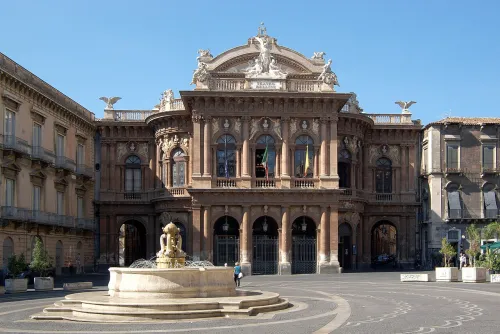
    Teatro Massimo Bellini in Catania, stop 5 on the self-guided walking tour

    The opera house on Piazza Vincenzo Bellini is currently closed, so this is a stop for the façade and the story. It carries the name of Vincenzo Bellini, the composer born in Catania, and it opened on 31 May 1890 with his masterwork Norma. The hall seats 1,200.

    That opening night took almost two centuries to arrive. Talk of a public theatre began after the 1693 earthquake; a foundation stone was laid only in 1812, and Salvatore Zahra Buda drew a grand Teatro Nuovaluce for this very spot, in front of the monastery of Santa Maria di Nuovaluce. Money ran out. A smaller provisional municipal theatre opened in 1822 instead (it was destroyed in the Second World War), while the half-built Nuovaluce served mainly as a summer hall until it was sold in 1865 to finance a new theatre.

    In 1870 the theatre architect Carlo Sada was asked to find a site. Locations came and went, one was chosen and then dropped, and in the end the original square won again. Funding trouble returned, the city took the project over and decided on a pure opera house, and from then on building went quickly: seven years to completion.

    Stand back far enough to take in the whole front, then walk on to Via Etnea, 510 m and seven minutes away.

    Local name
    Teatro Massimo Vincenzo Bellini
    Status
    Currently closed
  6. 6

    Via Etnea

    Via Etnea in Catania, stop 6 on the self-guided walking tour

    Via Etnea is the main street of historic Catania: dead straight, about 3 km long, running from the Piazza del Duomo to the Tondo Gioeni. Its name tells you where it points, towards Etna. It is free and open at any hour, a street to walk with your eyes up.

    It exists because of the 1693 earthquake, which killed about two thirds of the city's people. The Duke of Camastra, sent by the viceroy to oversee the rebuilding, laid out the new streets on a right-angled grid starting from the cathedral: one street towards the volcano and one crossing it. The first was named Via Duca di Uzeda after the viceroy of the day, later Via Stesicorea, and finally Via Etnea. It was only about 700 m long then and ended at today's Piazza Stesicoro, at a city gate called Porta di Aci. The cross street, first Via Lanza and then the Corso, is today's Via Vittorio Emanuele, where you met the Badia.

    The palazzi along both streets went up in Sicilian Baroque, designed by Vaccarini and Francesco Battaglia. Churches lined the new street from the start: after the cathedral came the Basilica della Collegiata, the Chiesa dei Minoriti, San Biagio, the Santissimo Sacramento al Borgo and Sant'Agata al Borgo. Among the civic buildings, from the cathedral end, watch for the Palazzo degli Elefanti, the town hall, then the Palazzo dell'Università and the Palazzo San Giuliano.

    From here the market of Fera 'o Luni is 530 m, about seven minutes.

    Hours
    Open 24/7
    Price
    Free
  7. 7

    Fera 'o Luni

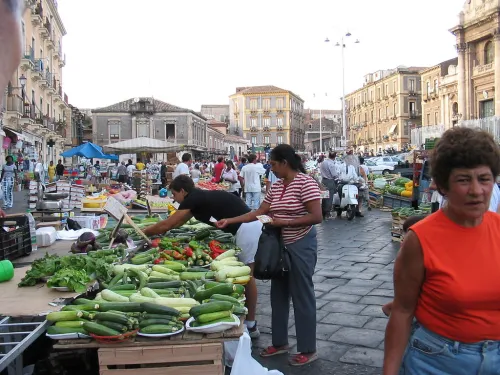
    Fera 'o Luni in Catania, stop 7 on the self-guided walking tour

    The market on Piazza Carlo Alberto is, together with the Pescheria, the oldest in Catania, and locals know it as Fera 'o Luni. Come for the life of the place rather than for monuments: this is a working market, not a showpiece.

    Nobody agrees on the name. It may simply mean Monday fair, with the local dialect wearing the Sicilian dû down through dô and rô to a bare 'ô. Or it goes back to the Foro Lunaris, where a medieval market was held in front of the church of the Elemosina. A third theory points to Luno, one of the quarters of ancient Catania, named after a temple to the Assyro-Babylonian god Luno or the Roman goddess Luna.

    Trading in this part of town is old. Antiquarians placed a Roman forum or horreum in what is now the Cortile San Pantaleone, before small houses swallowed the structures; all that remains visible is a scrap of wall in opus reticulatum. Maps of the 16th century already name other market squares around the city.

    Entry is free, but timing matters: come in the morning to see the stalls in full swing. Villa Bellini comes next, 760 m and eleven minutes away.

    Local name
    Mercato di piazza Carlo Alberto
    Hours
    Mon–Fri 07:00–14:00, Sat 07:00–19:00, Sun closed
    Price
    Free
  8. 8

    Villa Bellini

    Villa Bellini in Catania, stop 8 on the self-guided walking tour

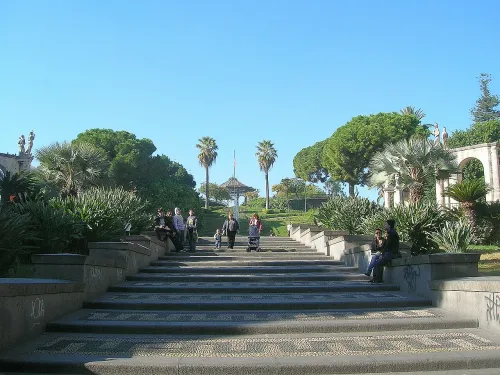
    After the market, a garden. Catania calls the Giardino Bellini simply 'a Villa: one of the city's two oldest gardens and one of its four main parks. Entry is free.

    Its core goes back to the 18th century and to Prince Ignazio Paternò Castello di Biscari, the same prince whose museum once held pieces of the Terme Achilliane. He wanted a garden in the fashion of his time: hedges shaped into labyrinths, statues along the paths, fountains of every kind, jets and little cascades. People called it the Labirinto. Pietro Paolo Arcidiacono was its first gardener, Giuseppe Squillaci came later.

    After the prince died on 1 December 1786, his heirs let it decline. It was offered for sale from 1820, and only on 29 September 1854 did the city buy it from his descendant Anna Moncada Paternò Castello. Turning a private labyrinth into a public promenade dragged on: neighbouring vegetable plots had to be bought, the experts in charge fell out, and work only got going in April 1863 under the architect Ignazio Landolina, finishing in 1875.

    Take your pause here before the longest leg of the walk: 1,160 m, about 17 minutes, to the Benedictine monastery.

    Local name
    Giardino Bellini
    Hours
    Daily 07:00–22:00 (summer, May–Oct) / 07:00–20:00 (winter, Nov–Apr)
    Price
    Free
  9. 9

    Benedictine Monastery of San Nicolò l'Arena

    Benedictine Monastery of San Nicolò l'Arena in Catania, stop 9 on the self-guided walking tour

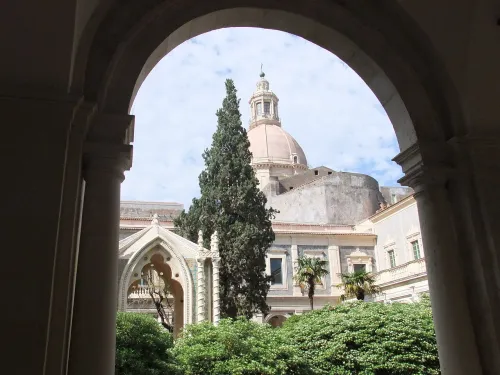
    The former Benedictine monastery of San Nicolò l'Arena lies in the west of the old town and has belonged to the UNESCO World Heritage site of the Late Baroque Towns of the Val di Noto since 2002. It is considered the largest monastery complex in Sicily, with the island's largest church, and parts of the University of Catania work inside it today.

    The monks started out on the slopes of Etna. Near today's Nicolosi, 700 m above sea level, a hospice is recorded in 1156 and a priory called San Nicolò l'Arena in 1359, dedicated to Saint Nicholas. L'Arena comes from rena rossa, a sandy red rock baked by lava flows. After the Sicilian Benedictines joined the congregation of Montecassino in 1506, the community moved down to Catania, driven by brigands, eruptions, earthquakes and the harsher climate of the Little Ice Age.

    Building began in 1558 around a marble-decorated cloister, planned with the Roman architect Giulio Lasso, best known for the Quattro Canti in Palermo. The cellars covered Roman houses, whose mosaic floors and frescoes are exposed again today. And in 1669, when Etna's lava flowed around Catania into the sea, it stopped only at the monastery's west and north façades.

    Is it worth going in? For anyone curious about Catania beyond its main street, yes: Roman floors, a 16th-century cloister and the place where the lava halted, all in one complex. Tickets are paid, with reductions available, including for students. Allow about an hour. Castello Ursino is 860 m, eleven minutes, from here.

    Local name
    Monastero di San Nicolò l'Arena
    Hours
    Daily 10:00–17:00
    Price
    10 EUR full, 7.50 EUR reduced, 6 EUR students
  10. 10

    Castello Ursino

    Castello Ursino in Catania, stop 10 on the self-guided walking tour

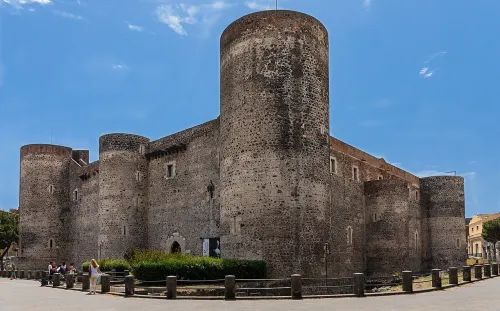
    Castello Ursino is currently closed, so you see it from outside, and the outside tells the story. The name means Bear Castle. Emperor Frederick II, King of Sicily, had it built between 1239 and 1250, after ordering in 1220 that all non-royal castles on the island be destroyed. It was meant to show royal power and defend the capital, and it was thought impregnable.

    When it went up it stood on a cliff looking out to sea. Eruptions and earthquakes have since pushed the shore away, and today it stands a kilometre inland among streets and shops; in the 17th century Etna's lava even filled its moat. It is also one of the few buildings in Catania that survived 1693.

    Its great political moment came in 1295, during the Sicilian Vespers, when the Sicilian Parliament met here and declared James II of Aragon deposed in favour of Frederick III. Robert of Anjou took it the next year, then the Aragonese got it back. Frederick III lived here, as did Peter II, Louis, Frederick IV and Maria, and here in 1392 Maria was kidnapped by Guglielmo Raimondo III Moncada to stop her marriage to Gian Galeazzo Visconti. Martin I held court here too. Once the capital moved and gunpowder weapons arrived, the castle became a prison; the city bought it in 1932 and restored it.

    The castle houses the civic museum that keeps the inscription naming the Terme Achilliane, out of reach while it is closed. The last leg, 500 m and six minutes, leads to La Pescheria.

    Status
    Currently closed
  11. 11

    La Pescheria

    La Pescheria in Catania, stop 11 on the self-guided walking tour

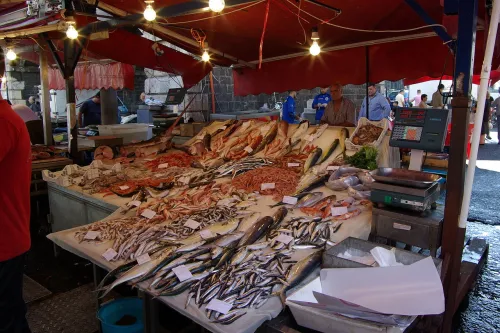
    La Pescheria, Piscarìa in Sicilian, is Catania's old fish market. Since at least the early 19th century its stalls have stood in a tunnel cut in the 16th century beneath the Palazzo del Seminario dei Chierici and the walls of Charles V, facing the Archi della Marina.

    Those arches once stood in the water of a small fishing harbour. The harbour was later filled in and turned into public green: the Giardino Pacini, Piazza Alonzo di Benedetto and Piazza Pardo. The fishmongers still work beside where the boats once lay.

    Come for the atmosphere of walking between the stalls. Entry is free, and it is a morning place. Your walk ends here, and the GPS navigation can take you back to the Liotru on the Piazza del Duomo.

    Hours
    Mon–Sat 07:00–14:00, Sun closed
    Price
    Free
Walking tour route map of Catania Route loaded
Piazza del Duomo and Elephant FountainTerme AchillianeBadia di Sant'AgataCathedral of Saint Agatha+7
All 11 stops are already on the map.
You just press start.
AI Tour Guide

You've read the Catania route. Now walk it with a guide in your ear.

Press start wherever you are, even hundreds of kilometres from Catania, and the guide begins telling its stories right away. In the city, pick any of the 11 stops to start from: it leads you there, then talks with you the whole route, asking, listening, remembering, and shaping the tour around your answers.

11stops 4.9km 1 h 7 minwalking 13languages
▶Start the tour free

Free to start · Runs in your browser · No app, no download

Shorter Ways Through Catania

Not everyone has five hours; these cuts keep the route in its recommended order and simply stop earlier.

The cathedral quarter and Via Etnea

Stops: 1, 2, 3, 4, 5, 6

For a first morning or a short stay: Roman baths, the Badia, the cathedral, the opera house and the main street. Only 15 minutes of walking in total. Paid extras are the Terme Achilliane and, if you want the view, the Badia terrace.

Centre, market and garden

Stops: 1, 2, 3, 4, 5, 6, 7, 8

Adds Fera 'o Luni and a pause in Villa Bellini, both free. 33 minutes of walking. Best on a weekday or Saturday morning, while the market is trading; the same two tickets as the short version apply.

The whole walk

Stops: 1, 2, 3, 4, 5, 6, 7, 8, 9, 10, 11

For a full day in Catania: everything from the elephant to the fish market, 1 h 7 min of walking. Add the monastery ticket to the two above; the opera house and the castle are seen from outside.

How Long the Catania Tour Takes, With and Without the Monastery

The walking itself is the small part: 1 h 7 min spread over ten short legs, the longest being the 17 minutes from Villa Bellini to the monastery. The time goes into what you enter: count about 25 minutes underground in the Terme Achilliane, 40 at the Badia with its terrace, 20 in the cathedral, and an hour in the monastery, plus shorter halts outside the theatre and the castle and time in the market and the garden.

A 10:00 start fits well: you are in the cathedral before midday, at Fera 'o Luni around 12:15 and at the monastery around 13:30. You reach La Pescheria just before 15:00, too late for its morning trade. If the fish market matters to you, go there first thing in the morning and start the route afterwards; you can join at any stop.

The cathedral quarter with Via Etnea takes about two hours with its interiors. Continuing through the market to Villa Bellini makes it a little over three hours.

Before You Set Off in Catania

  • Start and finish: The recommended start is the Piazza del Duomo and Elephant Fountain, though you can begin at any stop. The walk ends at La Pescheria, and the GPS navigation can lead you back to the start if you like.
  • Best day and time: Start in the morning, when both markets are trading.
  • Costs: Everything outdoors is free, and so are the cathedral and the Badia church. You only pay for three visits: the Terme Achilliane, the Badia terrace and the monastery.
Walking tour route map of Catania
AI Tour Guide

Your guide is ready when you reach the elephant.

Press start and a voice AI Tour Guide takes it from here: leading the route through Catania, telling the stories, and turning your walk into a real back-and-forth conversation. No app or download is needed; it runs in your browser.

11stops 4.9km 1 h 7 minwalking 13languages
▶Start the tour free

Free to start · Runs in your browser · No app, no download

What the AI Tour Guide Adds in Catania

On a walk where the same names keep returning, Vaccarini, Saint Agatha, the earthquake of 1693, the AI Tour Guide ties them together as you go. It greets you at the Liotru, tells the stories at every stop, asks what caught your eye and remembers it, so the monastery or the castle gets told the way that interests you. Bring up what this walk only touches, like who Saint Agatha was or what Bellini wrote besides Norma, and interrupt it whenever you like. You start with 100 free credits; after that you choose between this tour all-inclusive for 19.99 EUR with no time limit, or credits at 5 EUR per hour.

A Real Conversation A voice AI Tour Guide greets you, leads the whole route, and tells the stories and facts as you walk, asking what you want to see and keeping a real conversation going. Not a recording you press play on.
Map Navigation Follow the route on the map and walk at your own pace. You choose where to start and when to move to the next stop.
Ask Anything Curious about a building you pass? Ask your AI Tour Guide on the spot and the conversation carries on.
13 Languages Switch language anytime. No separate tour needed.
Start free in your browser

Common Questions About Walking Catania

Is the Catania walk worth doing on a Sunday?

Partly. Both markets are closed and the Terme Achilliane open by reservation only, but the cathedral, the Badia, Villa Bellini and the monastery all welcome visitors on Sundays, so the streets and churches still carry the walk.

Can I do the walk in the afternoon?

Partly. The cathedral quarter and Via Etnea work well in the afternoon, but the markets are morning places and the monastery does not stay open late, so the whole route is better started in the morning.

If I only pay for one ticket, which should it be?

For the view of the city with Etna behind it, the Badia terrace. For the most history under one roof, the monastery. The Terme Achilliane are small and best for those who want to stand in Roman Catania.

Which towns pair well with a day in Catania?

Taormina is 43 km away and Syracuse 52 km. For more Baroque streets, Noto at 68 km and Ragusa at 71 km each have their own walking route.

Is the tour really free?

Yes. The whole tour is free: the route, the interactive map and the navigation cost you nothing. Only the voice AI Tour Guide is optional and paid: you test it with 100 free credits, then you pay either €5 per hour or €19.99 for this whole tour, with no time limit. Admission to 2 of the 11 stops is not included: Terme Achilliane and Benedictine Monastery of San Nicolò l'Arena charge their own entry fees.

Do I need to download an app?

No. Everything runs in your phone browser. Open the route and start walking, no download and no sign-up required.

Do I need to book the walking tour in advance?

No booking needed. This self-guided tour is available anytime. Open the route in your browser and start walking. The AI Tour Guide works instantly, no app, no reservation required.

What languages is the AI Tour Guide available in?

The AI Tour Guide speaks 13 languages, so you take the tour in your own language and can switch at any time.

Can I skip stops or change the route?

Yes. Skip any stop, spend extra time at places you like, or start the route from any point. It is your walk, you set the pace.
Image credits
▶ Start free in your browser Runs in your browser, no app, no download