Free Walking Tour Cannes: Croisette to the Old Town

From the palm-lined Croisette past the festival palace and the yachts of the old port, up the Suquet hill where Cannes began, ending at a 1930s market hall.

7 Stops 3.5 km ~52 min walking
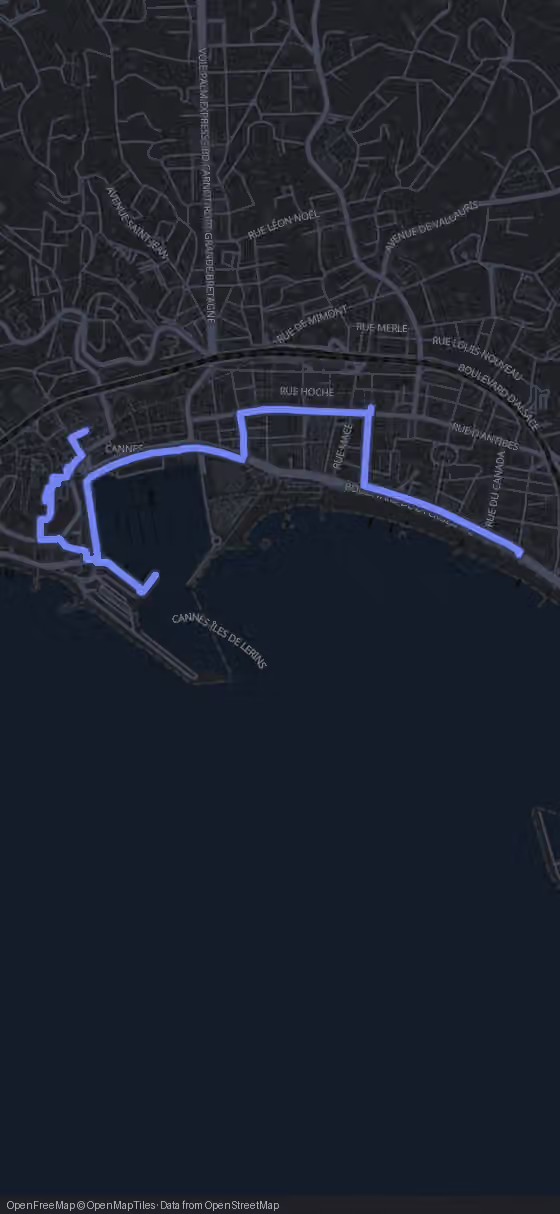
Route map for the Cannes walking tour
Stop 1 of 7
780 m·10 min
La Croisette
Head north-west toward Rue d'Antibes
Welcome to Cannes. I'm Alex, and our first story begins with the film stars who left their mark without stepping onto the red carpet.
Try this tour with Alex

What This Cannes Walk Covers

Seven stops over 3.5 km: La Croisette, Rue d'Antibes, the Palais des Festivals et des Congrès, the Vieux-Port de Cannes, the Musée de la Castre, Le Suquet and Marché Forville. Pure walking time is 52 minutes; with unhurried stops, plan about two and a half hours.

No stop charges admission, and the Musée de la Castre is currently closed, so you see it from outside. Route, map and GPS navigation are free in your browser; the AI Tour Guide is optional.

Open free GPS & optional AI Tour Guide
This short shows highlights of the route. All 7 stops follow below.

The Route

Walking Map of Cannes from the Croisette to the Suquet

7 stops 3.5 km 52 min walking
Tap to load interactive map

The 7 stops along this route

  1. La Croisette in Cannes, stop 1 on the self-guided walking tour
    1La Croisette
  2. Rue d'Antibes in Cannes, stop 2 on the self-guided walking tour
    2Rue d'Antibes
  3. Palais des Festivals et des Congrès in Cannes, stop 3 on the self-guided walking tour
    3Palais des Festivals et des Congrès
  4. Vieux-Port de Cannes, stop 4 on the self-guided walking tour
    4Vieux-Port de Cannes
  5. Musée de la Castre in Cannes, stop 5 on the self-guided walking tour
    5Musée de la Castre
  6. Le Suquet in Cannes, stop 6 on the self-guided walking tour
    6Le Suquet
  7. Marché Forville in Cannes, stop 7 on the self-guided walking tour
    7Marché Forville
  8. That's the full route.

    Walk it with an AI Tour Guide talking you through every one of these streets.

    Start free in your browser
    You made it

Your Cannes Walking Tour, Stop by Stop, from Seafront to Hilltop

  1. 1

    La Croisette

    La Croisette in Cannes, stop 1 on the self-guided walking tour

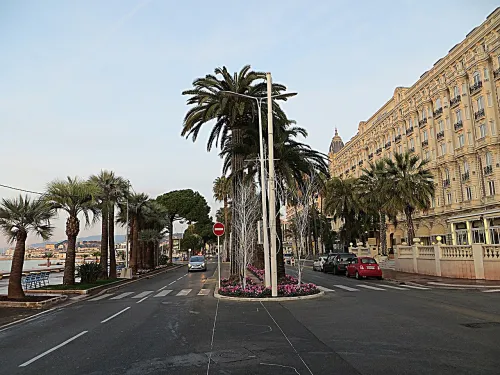
    Start on the water side. La Croisette is a wide boulevard lined with palms, with no entrance gate, no ticket and no closing time, so it is yours at any hour. This is the promenade that frames Cannes in every festival photo, and the best way to take it in is simply to walk a stretch of it with the bay beside you.

    The most advertised way to enjoy it is also the most expensive: the private beach decks along the sand rent sunbeds by the day. From late June onward reservations are essential, and in July and August turning up and getting one is close to impossible. Unless a sunbed is your entire day in Cannes, keep your sandals on and keep walking.

    Take the heat seriously here, because there is nothing to hide behind. The boulevard is fully exposed, and summer afternoons get hot. Before 10:00 or after 18:00 is the honest walking window, and the evening end of it is underrated: once the sun drops, the promenade turns genuinely comfortable.

    The Croisette has carried the film festival almost from the start. In 1949 the town opened its first festival palace, the Palais Croisette, right on this promenade. That building no longer exists; a Hilton hotel and the Palais Stéphanie stand in its place. At the opposite end from the old port lies Port Pierre-Canto, Cannes' second marina, opened in 1965 with about 530 berths.

    From here, turn inland: Rue d'Antibes is 780 m away, about 11 minutes on foot, and on the way you pass La Malmaison.
    Local name
    Boulevard de la Croisette
    Hours
    Open 24/7
    Price
    Free
  2. 2

    Rue d'Antibes

    Rue d'Antibes in Cannes, stop 2 on the self-guided walking tour

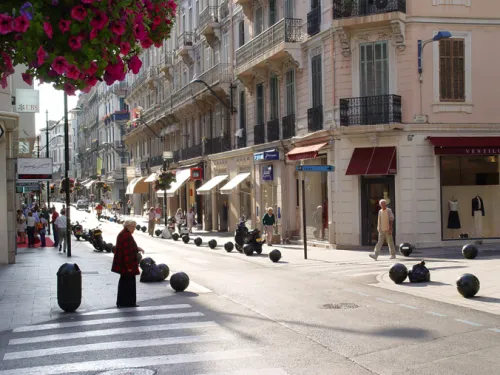
    One block back from the sea, Rue d'Antibes runs parallel to the Croisette and is, together with it, the liveliest street in town: a long line of shops and agencies. It is not pedestrianised, so keep an eye on the traffic while you window-shop. The name points the way: the street leads towards Antibes.

    It is older than it looks. Rue d'Antibes is the part of the old royal road no. 97 from Toulon to Antibes that lies east of the Suquet hill, laid out in its current course around 1830 under King Louis-Philippe. Cannes only began to spread east of its old hill in the second half of the nineteenth century, and the town council gave the street its name in November 1852. Until 1861 not a single house stood beyond today's Rue des États-Unis, and the first houses had only two floors.

    The modern street arrived piece by piece: pavements in 1872, paving from 1875, and a tram line laid in 1899 and 1900 that ran until 1933. By 1914 there were 119 buildings along it, and today the street is recorded in the inventory of Cannes' seaside heritage.

    Two façades are worth a look up. At no. 11 stands the Crédit Lyonnais building: the bank was here before 1883, bought the whole plot in 1913 and had the present building put up in 1929 by architect Félix Biasini. At no. 21 was the shop of L. Rouff, a luxury lingerie house founded in Paris in March 1925.

    If shopping is not your thing, give it ten minutes and enjoy the architecture above the shop windows. Then head back towards the sea: the Palais des Festivals et des Congrès is 600 m away, about 8 minutes.

    Hours
    Open 24/7
    Price
    Free
  3. 3

    Palais des Festivals et des Congrès

    Palais des Festivals et des Congrès in Cannes, stop 3 on the self-guided walking tour

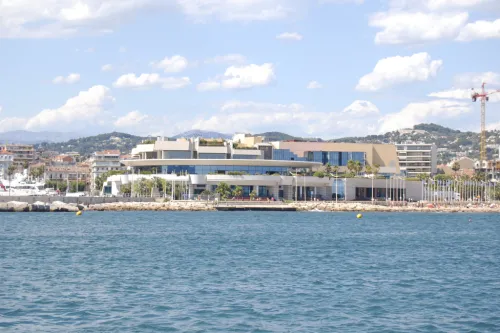
    This is the building the whole world associates with Cannes: the Palais des Festivals et des Congrès, home of the International Film Festival and of events all year round, with up to 35,000 m² of event space. Walking around the outside is free and possible at any hour, which is how most visitors experience it.

    Its story starts with a casino nobody was allowed to build. From 1899 eight casino projects were drawn up, and every one failed against the opposition of Grand Duke Michael Alexandrovich, who worried about public morals. In the end the council granted the concession to Henri Ruhl, director of the Hôtel Scribe in Paris. The casino, designed by Camille Mari, opened on 28 January 1907, with the grand duke himself in attendance. It was enlarged in 1919 and modernised in 1930 by the Nice architect Roger Séassal.

    For lack of anywhere better, the very first festival took place in that old casino, from 20 September to 5 October 1946, before the first palace went up on the Croisette. Success brought more: the film festival grew, tourism boomed and trade fairs such as MIPTV arrived from 1965. In 1979 the town decided to build a new palace near the old port, and in 1982 the present building opened, designed by Sir Hubert Bennett of London and François Druet of Biot. It replaced the old casino, gained 10,000 m² in 1999 with the Espace Riviera, and has been a listed monument since 2001.

    Film fans should give it time; everyone else will enjoy a short loop around it. Its jetty, the Jetée Albert-Édouard, marks the edge of the old port, your next stop, about 1000 m and 13 minutes away along the water.

    Hours
    Open 24/7
    Price
    Free
  4. 4

    Vieux-Port de Cannes

    Vieux-Port de Cannes, stop 4 on the self-guided walking tour

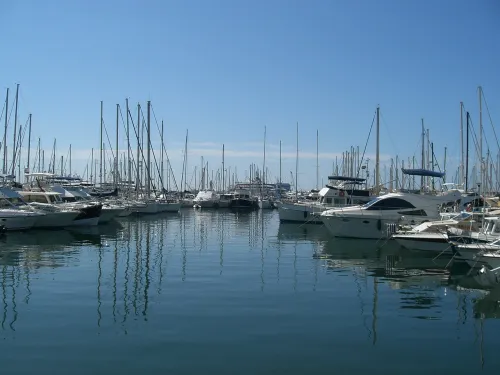
    The Vieux-Port de Cannes is a working marina with more than 700 berths plus 100 places for superyachts up to 140 metres long. It spreads over 23 hectares, 15 of them water, between the Quai Saint-Pierre, the foot of the Suquet, the Pantiero promenade, the town hall and the Palais jetty. Restaurants, cafés and shops line the quays, and strolling them is half the point.

    Look past the yachts for the small wooden boats called pointus. They are what remains of the port's original life as a fishing harbour and fishermen's village, and they still moor here among vessels many times their size.

    Sailors have used this bay since antiquity, when the settlement was known as Aegitna and the Roman Via Julia Augusta ran nearby. The oldest part of the harbour is the Quai Saint-Pierre at the foot of the Suquet hill. It was built between 1838 and 1841 on the Saint-Pierre rocks to shelter the port, after Lord Brougham interceded with King Louis-Philippe. The harbour has been enlarged again and again since.

    Linger as long as you like, then start climbing: the Musée de la Castre sits at the top of the hill, 720 m and about 12 minutes away. Up there, the castle looks out over the town, the port, the bay and the Lérins Islands.

    Hours
    Open 24/7
    Price
    Free
  5. 5

    Musée de la Castre

    Musée de la Castre in Cannes, stop 5 on the self-guided walking tour

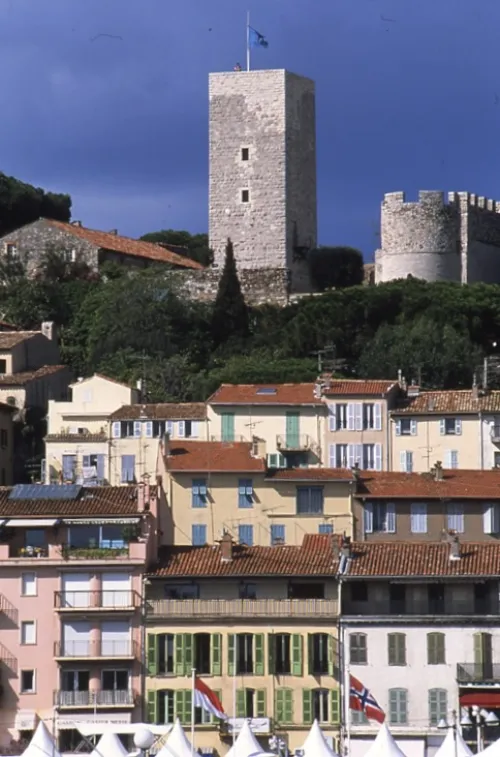
    The Musée de la Castre, now called the Musée des Explorations du monde, is currently closed, so this is a visit from outside. It is worth the climb anyway: the museum occupies the medieval castle of the monks of Lérins on Place de la Castre at the very top of the Suquet, one of the few buildings left in Cannes from the Middle Ages.

    The monks, settled in their abbey on the island of Saint-Honorat since the fifth century, began building here in the eleventh century. Their castle has a square plan like a fortress with a keep, with living quarters and a chapel inside the defensive wall and a square tower in the middle of the courtyard, tall enough for keeping watch. The abbots of Lérins were lords of much of the region, and this castle displayed their power along the coast.

    Its later life was rough. Damaged from the late sixteenth century, it was partly demolished in the eighteenth on the orders of the bishop of Grasse. During the Revolution it was sold as national property to the Hibert family, who lived in it until 1878, when it was let to a ceramics workshop, the Faïencerie d'art du Mont-Chevalier. In 1919 the town bought the buildings for its museum, whose collections range from the Himalayas and the Arctic to pre-Columbian America, Oceania and Mediterranean antiquity.

    The tower and the Sainte-Anne chapel, together with the church of Notre-Dame-de-l'Espérance, have been listed historic monuments since 1937. A garden of Mediterranean plants with tall umbrella pines lies at the entrance. From here it is only 210 m, about 4 minutes, into the lanes of Le Suquet.

    Status
    Currently closed
  6. 6

    Le Suquet

    Le Suquet in Cannes, stop 6 on the self-guided walking tour

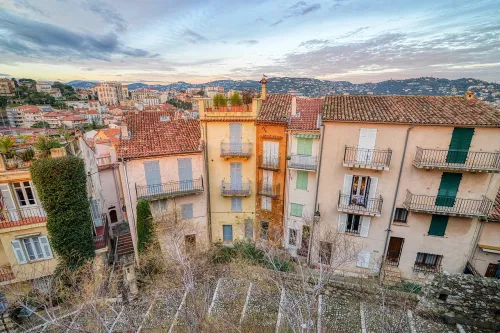
    Le Suquet, sometimes called Mont-Chevalier, is the oldest quarter of Cannes and its old town, set on a hill at the west end of the bay above the old port. Its name means a small mound, and the town itself takes its name from this spot: the hill rises to 66 metres, and the Ligurian word Canoa meant height or peak.

    Ligurian tribes were the first to settle here, building a hill fort that watched over both the bay and the land behind. In the Middle Ages the counts of Provence relied on strongholds like the Castellum Marcellini on this summit. In 960 Count William I, the Liberator, gave what was then a modest fort to Rodoard of the house of Grasse as a reward for his loyalty.

    Around 1030 Rodoard's eldest son, Guillaume-Gruette, entered religious life and gave part of his lands to the abbey of Lérins. That deed of gift is also the founding act of the territory that became Cannes. It mentions a castle on the hill at the heart of a growing settlement, and a port that was in reality just a beach, recorded as De Portu Canue. Around 1080 Abbot Aldebert II began the great tower of the Suquet to protect the site from corsairs and Saracens, and in 1131 the count of Provence confirmed the gift, sealed by the pope himself.

    Take your time wandering the hill; this is where the town's story begins. When you are ready, head down to Marché Forville, just 180 m and 3 minutes away, past Aux Bons Enfants.

    Hours
    Open 24/7
    Price
    Free
  7. 7

    Marché Forville

    Marché Forville in Cannes, stop 7 on the self-guided walking tour

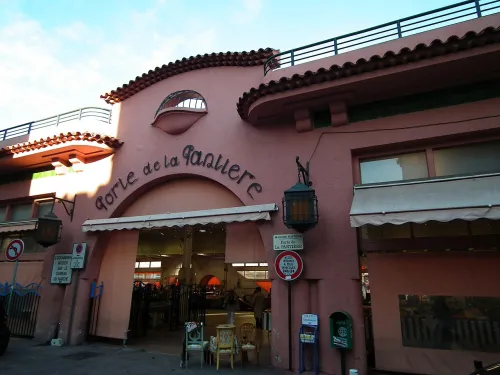
    Your walk ends where Cannes shops for food: Marché Forville, a covered market hall at 6 Rue du Marché-Forville with around fifty traders. It is a morning market, and on some days the hall hosts a brocante instead. Arrive before late morning to see it at its busiest.

    The hall you see dates from 1929, when architect Henri Bret of Draguignan won a competition to replace the wooden market of 1884. Building took three years, and the market opened in 1932. It covers 3,000 m² and carries the label Patrimoine du XXe siècle, after the regional heritage commission recognised it in November 2000.

    Notice the contrast between outside and in. The reinforced concrete structure hides behind theatrical Provençal façades with balconies, fake dovecotes, pergolas, rows of génoise eaves and ochre render. Inside it is purely practical: two rows of concrete pillars hold up the flat roof, daylight falls from high windows onto white walls, and the floor is laid in stoneware tiles so it is easy to clean.

    Even if you buy nothing, a slow lap through the stalls is a fitting finish after the hill: the old town above you, the market at your feet.

    Hours
    Sep–Jun: Tue–Sun 07:00–13:00, Mon 08:00–16:00 (Brocante); Jul–Aug: Daily 07:00–13:00
    Price
    Free
Walking tour route map of Cannes Route loaded
La CroisetteRue d'AntibesPalais des Festivals et des CongrèsVieux-Port de Cannes+3
All 7 stops are already on the map.
You just press start.
AI Tour Guide

You know the route now. Walk it with a guide in your ear.

Press start wherever you are, even hundreds of kilometres from Cannes, and the guide begins telling its stories right away. In the city, pick any of the 7 stops to start from: it leads you there, then talks with you the whole route, asking, listening, remembering, and shaping the tour around your answers.

7stops 3.5km 52 minwalking 13languages
▶Start the tour free

Free to start · Runs in your browser · No app, no download

Shorter Cannes Walks: Seafront or Old Town

Short on time? The route splits neatly at the old port into a seafront half and an old town half. Everything on both is free.

Seafront and festival

Stops: 1, 2, 3, 4

For anyone who wants the Cannes of the film festival: the Croisette, the shopping street, the Palais and the yachts of the old port. Walking time is 32 minutes. All four stops are open at any hour, so this half also works as an evening walk once the heat drops.

Old port, old town and market

Stops: 4, 5, 6, 7

For history lovers and food shoppers: from the fishing boats of the old port up to the medieval castle of the Lérins monks and down to the Forville market. Walking time is 19 minutes. Do it in the morning, when the market is in full swing.

How Long Does This Cannes Walk Take?

The 3.5 km take 52 minutes of pure walking. Since nothing on the route has a paid interior and the museum is closed, your time goes into looking, strolling the port and exploring the lanes of the Suquet, which adds up to about two and a half hours at an easy pace.

The order runs from the newer seafront town to the old hill, which is also the order in which Cannes grew backwards in time: nineteenth century boulevards first, the medieval core last. Starting around 9:00 puts you at Marché Forville before noon. The seafront half alone takes a little over an hour with stops, the old town half about an hour.

Before You Set Off in Cannes

  • Start and finish: The recommended start is La Croisette, the finish is Marché Forville at the foot of the Suquet. You can join at any stop; the order shown is simply the one that flows best.
  • Best time of day: Go in the morning. The seafront is shadeless, and the walk ends at a market that is a morning affair.
  • Which day: Any day works for the streets and the port. For the food market, avoid Mondays from September to June, when the hall hosts a brocante instead.
  • Cost: The walk costs nothing: every stop is free to see, and route, map and GPS navigation are free in your browser.
Walking tour route map of Cannes
AI Tour Guide

Your guide is ready when you reach the Croisette.

Press start and a voice AI Tour Guide takes it from here: leading the route through Cannes, telling the stories, and turning your walk into a real back-and-forth conversation. No app or download is needed; it runs in your browser.

7stops 3.5km 52 minwalking 13languages
▶Start the tour free

Free to start · Runs in your browser · No app, no download

What the AI Tour Guide Adds Between Port and Hill

On this route the AI Tour Guide walks the whole way with you as a conversation: it greets you on the Croisette, tells the stories of the casino, the monks and the market, asks what you came to Cannes for and remembers it, so a film fan hears more about the festival and a history lover more about the Lérins abbots. Ask it what the old town lanes were like before the boulevards, or which films made the festival famous, and it takes the thread from there; interrupt it whenever you like. You start with 100 free credits; after that it is €19.99 for this tour with no time limit, or €5 per hour.

A Real Conversation A voice AI Tour Guide greets you, leads the whole route, and tells the stories and facts as you walk, asking what you want to see and keeping a real conversation going. Not a recording you press play on.
Map Navigation Follow the route on the map and walk at your own pace. You choose where to start and when to move to the next stop.
Ask Anything Curious about a building you pass? Ask your AI Tour Guide on the spot and the conversation carries on.
13 Languages Switch language anytime. No separate tour needed.
Start free in your browser

Common Questions About Walking Cannes

Is there a free beach along the Croisette?

Yes. Plage Gazagnaire, mid-promenade, is a free public stretch of sand, so you can swim or sit by the water without renting a sunbed on a private deck.

Can I walk the route in the evening?

Partly. La Croisette, Rue d'Antibes, the outside of the Palais des Festivals and the old port are open at all hours, and the promenade is pleasant once the sun drops. The Forville market is a morning affair, so keep the old town half for another morning.

When is the best time to visit Marché Forville?

In the morning, when the stalls are at their busiest. On some days the hall is given over to a brocante instead of the food market.

Which towns nearby make a good second walk?

Antibes is 10 km away and is the town Rue d'Antibes is named after. Perfume town Grasse is 14 km inland, and Nice is 26 km along the coast.

Is the tour really free?

Yes. The whole tour is free: the route, the interactive map and the navigation cost you nothing. Only the voice AI Tour Guide is optional and paid: you test it with 100 free credits, then you pay either €5 per hour or €19.99 for this whole tour, with no time limit.

Do I need to download an app?

No. Everything runs in your phone browser. Open the route and start walking, no download and no sign-up required.

Do I need to book the walking tour in advance?

No booking needed. This self-guided tour is available anytime. Open the route in your browser and start walking. The AI Tour Guide works instantly, no app, no reservation required.

What languages is the AI Tour Guide available in?

The AI Tour Guide speaks 13 languages, so you take the tour in your own language and can switch at any time.

Can I skip stops or change the route?

Yes. Skip any stop, spend extra time at places you like, or start the route from any point. It is your walk, you set the pace.
Image credits
▶ Start free in your browser Runs in your browser, no app, no download