



Église Notre-Dame de l'Assomption
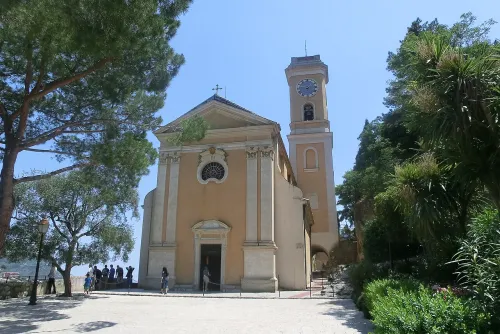
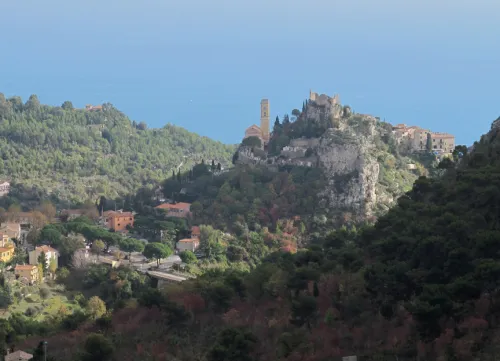
Begin with the building that announces Èze from afar: the light ochre façade of the Église Notre-Dame de l'Assomption. From outside it is calmly neoclassical, with a round œil-de-bœuf window, paired Corinthian pilasters and a square bell tower in two levels. Look up at the clock: its blue face is the colour of the Virgin Mary, to whom the church is dedicated.
The church you see replaced an older one that was falling into ruin. Duke Charles-Emmanuel III of Savoy had the Italian architect Antoine Spinelli rebuild it between 1764 and 1778, and the paperwork tells a nice story: when Spinelli was paid on 7 December 1778, the building was almost, but not quite, finished. The village prior, Charles-François Fighiera, pushed hard for it. In 1777 the bishop of Nice blessed two new bells named Marie-Madeleine and Laurence, and a year later Fighiera gave the church relics of Saint Germain. The bell tower followed in the 19th century; lightning has struck it several times, which is why its original cupola is gone.
Step inside and the mood changes completely: behind the sober front opens a single baroque nave, richly decorated and lined with side chapels. Among the listed furnishings are two framed paintings, a Pietà and a Nativity, plus three pairs of candlesticks. Look out for the Egyptian cross too, a hint at much older roots: it recalls the belief that the Phoenicians once raised a temple to Isis on this rock. The church has been a listed historic monument since 1984.
Entry is free, so even ten minutes inside are worth it, especially if you like the contrast between a classical shell and a baroque heart. From here it is 190 metres, about 4 minutes, to the Point de Vue d'Èze.