Free Walking Tour Nice: Seafront, Old Town, Castle Hill

From the Promenade des Anglais up to Castle Hill and back down to Place Masséna: eight stops, 5.8 km, and the story of how Nice grew from a fortified rock.
8 Stops 5.8 km ~1 h 25 min walking
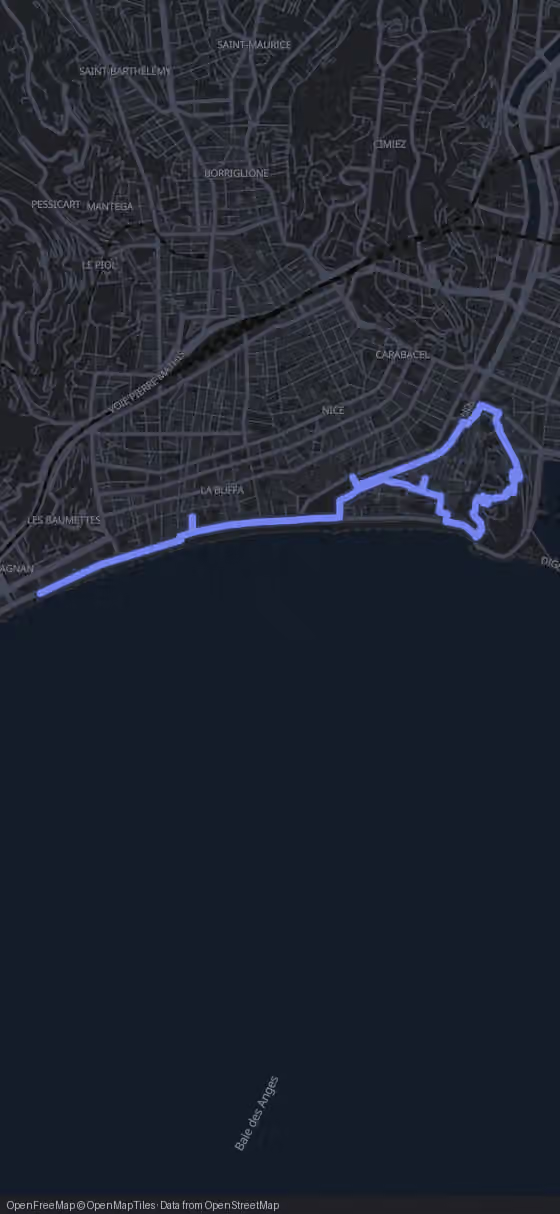
Route map for the Nice walking tour
Stop 1 of 8
150 m·2 min
Promenade des Anglais
Head south-east off the promenade toward Villa Masséna
Bonjour, welcome to Nice. I’m Alex, and this famous seafront began as an act of winter relief.
Try this tour with Alex

Your Route at a Glance

Eight stops on a 5.8 km line: from the Promenade des Anglais past Villa Masséna into the old town to Cathédrale Sainte-Réparate and Cours Saleya, up Castle Hill, then Place Garibaldi, Promenade du Paillon and Place Masséna. Pure walking time is 1 h 25 min; with visits, plan about four and a half hours.

Everything is free except Villa Masséna, which charges admission. Route, map and GPS navigation run free in your browser; the AI Tour Guide is optional.

Open free GPS & optional AI Tour Guide
This short shows highlights of the route. All 8 stops follow below.

The Route

Walking Map of Nice: Eight Stops from Sea to Square

8 stops 5.8 km 1 h 25 min walking
Tap to load interactive map

The 8 stops along this route

  1. Promenade des Anglais in Nice, stop 1 on the self-guided walking tour
    1Promenade des Anglais
  2. Villa Masséna in Nice, stop 2 on the self-guided walking tour
    2Villa Masséna
  3. Cathédrale Sainte-Réparate in Nice, stop 3 on the self-guided walking tour
    3Cathédrale Sainte-Réparate
  4. Cours Saleya in Nice, stop 4 on the self-guided walking tour
    4Cours Saleya
  5. Castle Hill in Nice, stop 5 on the self-guided walking tour
    5Castle Hill
  6. Place Garibaldi in Nice, stop 6 on the self-guided walking tour
    6Place Garibaldi
  7. Promenade du Paillon in Nice, stop 7 on the self-guided walking tour
    7Promenade du Paillon
  8. Place Masséna in Nice, stop 8 on the self-guided walking tour
    8Place Masséna
  9. That's the full route.

    Walk it with an AI Tour Guide talking you through every one of these streets.

    Start free in your browser
    You made it

Stop by Stop: Your Nice Walking Tour from La Prom to Place Masséna

  1. 1

    Promenade des Anglais

    Promenade des Anglais in Nice, stop 1 on the self-guided walking tour

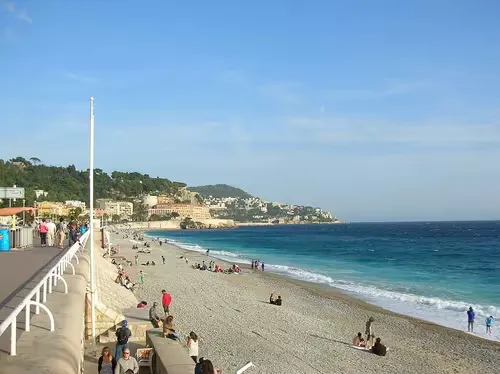
    You start on La Prom, as locals simply call it: a seafront walkway that runs about 7 km along the Mediterranean, from the airport to the Quai des États-Unis. Watch who uses it: cyclists, skaters on blades and boards, families pushing strollers, especially on a Sunday. The blue chairs facing the water are part of the scene, so sit down for a moment and take it in.

    The walkway has a very English origin. From the second half of the 18th century, English aristocrats came to spend the winter here. In 1820 a harsh winter further north brought a wave of beggars to Nice, and some of the English suggested putting them to work building a path along the sea. The Reverend Lewis Way and members of Holy Trinity, the Anglican church in Nice, paid for it. The city liked the idea so much that it greatly widened the project.

    In the local dialect the Niçois called it the Camin deis Anglés, the English Way. Only after Nice was annexed by France in 1860 did it become La Promenade des Anglais. Today it also belongs to cycling history: the Tour de France held a team time trial here in 2013, started here in 2020, and in 2024, because of the Paris Olympics, finished on the Promenade instead of the Champs-Élysées.

    The Promenade also carries a painful memory. On 14 July 2016 a truck was deliberately driven into crowds celebrating Bastille Day here; many people still pause for a moment when they pass.

    From here it is 1070 m, about 15 minutes along the seafront, to Villa Masséna, a winter residence built for exactly the kind of wealthy visitor this promenade attracted.
    Hours
    Open 24/7, every day of the year (public seafront promenade, no gate or ticketing)
    Price
    Free
  2. 2

    Villa Masséna

    Villa Masséna in Nice, stop 2 on the self-guided walking tour

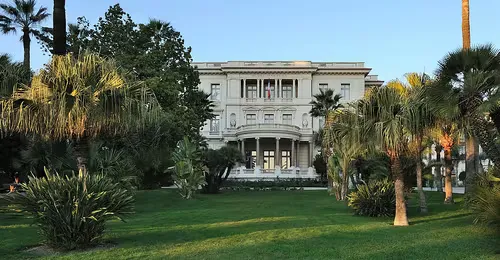
    The white villa on the Promenade, right next to the Hotel Negresco, was built between 1898 and 1902 as a winter home. Its architect was the Dane Hans-Georg Tersling, who designed several grand buildings on the Côte d'Azur during the Belle Époque. Look at the style: neoclassical, the fashion of the day, with a strong Italian accent. Around it lies a large park laid out on the English model but planted with Mediterranean species.

    The name leads straight to Napoleon. The villa was commissioned by Victor Masséna, Prince of Essling, grandson of André Masséna, one of Napoleon's marshals. His son sold it to the city in 1919 for roughly what he would otherwise have owed to keep the park closed to the public under French inheritance law. Two years later, in 1921, it opened as a museum.

    Inside, the lavish ground floor and the furnished salons by Tersling and Aaron Messiah are in Empire style. Two floors show painting, sculpture, decorative arts, jewellery and furniture from the Belle Époque, along with the art and regional history of the Riviera. Two objects draw most visitors: a death mask of Napoleon made by the surgeon Dr Arnold, and a mother-of-pearl diadem that belonged to Joséphine de Beauharnais, his first wife.

    Is it worth going in? If you like Napoleon, Belle Époque interiors or want to understand how the Riviera's winter society lived, yes, give it about an hour. Admission is charged; until 2014 it was free for everyone, and since then visitors from outside the region pay. If you only want the outside, the façade and the setting are worth a few minutes on their own.

    Next comes the longest leg: 1670 m, about 23 minutes, to Cathédrale Sainte-Réparate in the heart of the old town.

    Local name
    Musée Masséna
    Hours
    Closed Tuesdays. Summer (2 May–31 Oct): daily 10:00–18:00. Winter (1 Nov–30 Apr): daily 11:00–18:00.
    Price
    10 EUR full price, 8 EUR reduced (groups of 10+)
  3. 3

    Cathédrale Sainte-Réparate

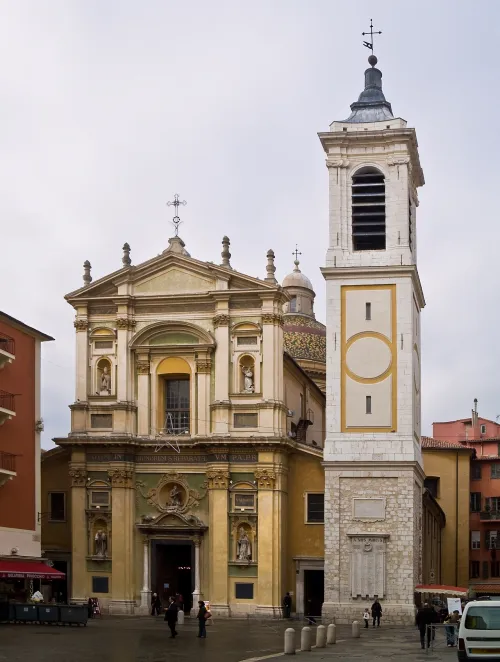
    Cathédrale Sainte-Réparate in Nice, stop 3 on the self-guided walking tour

    You are now in front of the cathedral of Nice and seat of its diocese, dedicated to the Assumption of the Virgin and to Saint Reparata. The building you see was commissioned in 1649, when Bishop Didier Palletis judged the old church too small for the city and called in the architect Jean-André Guibert. Work began in 1650, the cathedral was consecrated in 1699, and builders kept adding structures and decoration until 1949. The prominent bell tower beside it went up between 1731 and 1757.

    The story starts higher up. The first cathedral of Nice, St Mary of the Castle, stood on the hill you will climb later and was consecrated in 1049. In 1060 relics of Saint Reparata arrived, and by 1075 a chapel in her name stood at the foot of the castle. It became a priory of the Abbey of Saint-Pons in the 12th century and a parish church in 1246, and was extended between 1455 and 1468 as the town grew.

    In 1590 the bishops moved their seat here, in a ceremony led by Bishop Luigi Pallavicini in the presence of Charles Emmanuel I, Duke of Savoy. The church has been a national monument since 1906.

    Entry is free, so step in for a few minutes, quietly if a service is on. From here it is only 310 m, about 4 minutes, through the lanes of the Old Town to Cours Saleya.

    Hours
    Daily 7:30–19:00, closed at midday for services; closes earlier at 17:00 in winter.
    Price
    Free
  4. 4

    Cours Saleya

    Cours Saleya in Nice, stop 4 on the self-guided walking tour

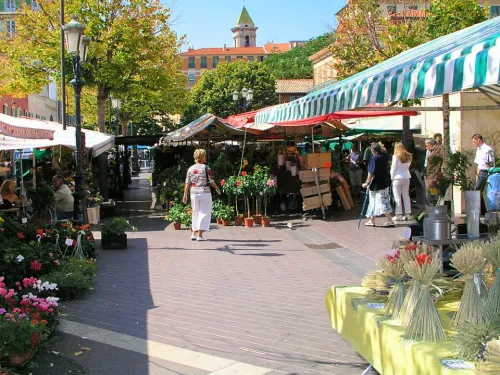
    Cours Saleya is the main pedestrian street of the old town, running parallel to the Quai des États-Unis. Depending on the day you find the flower and food markets, a flea market, and in high season a crafts market in the evening. Walk its length and look at the long block on the sea side: these are the buildings of the Terrasse, built in the first half of the 18th century along the shore and open to the public, which gave the Cours its final line.

    Old texts call this space the Marina. From 1714 people called it the palco, Italian for stage, because this was where you came to be seen. It was levelled almost entirely in 1748, shops spread along it, and around 1750 merchants and owners formed an association to defend their interests. In 1766 rows of elms replaced the mulberry trees planted a century earlier, on condition that they did not hide the balustrade of the terrace.

    By the late 18th century strolling had become the favourite pastime of a wealthy, idle crowd. The Cours and its terraces were the centre of Nice's social life, with cafés and luxury shops, and the many foreign residents raved about the views from the top of the Terraces. At the eastern end, on Place Charles-Félix, a monument was raised in 1827 in honour of King Charles-Félix. Opposite, on the north side, look up at the private gardens and terraces on the first floor overlooking the Cours.

    Browsing is free; the markets are about atmosphere, flowers and local produce. From here it is 790 m, about 15 minutes, to Castle Hill. Your legs can take you up, or use the lift, the Ascenseur du Château opposite Castel Plage, which is free; skip the little tourist train, which only gives you a short stop at the top.

    Hours
    Square always accessible; flower market Tue–Sun 6:00–17:30, food market Tue–Sun 6:00–13:30; flea market Mon 7:00–18:00; in high season evening crafts market Tue–Sun ~18:00–00:30
    Price
    Free to enter/browse (public square)
  5. 5

    Castle Hill

    Castle Hill in Nice, stop 5 on the self-guided walking tour

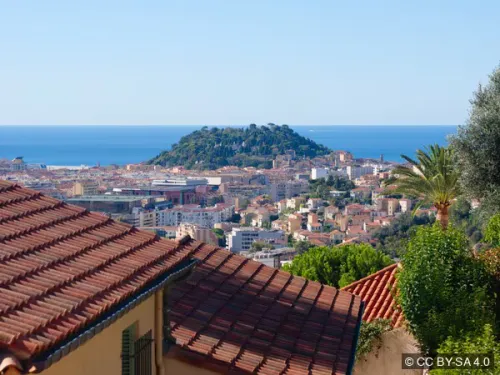
    Castle Hill, the Colline du Château, is a limestone rock rising to 93 metres, and this is where Nice began. Its top has two plateaus: the southern one carried the castle for seven centuries, the slightly lower northern one held the first suburbs and later the citadel. In the 11th century there was already a fortified settlement up here with a cathedral and houses, and until the 13th century the whole town of Nice stayed confined to this hill.

    The castle stood from the 11th to the 18th century and was counted among the strongest fortifications on this stretch of the Mediterranean. After Nice gave itself to Savoy in 1388, the castle and its walls were reworked in 1440. It survived several sieges, notably in 1543 and 1691, until French troops took it in 1705; a year later Louis XIV had it destroyed. For older Niçois, though, the hill is linked less to the fortress than to the heroine Catherine Ségurane, even if her feats seem to have happened at a town gate, the Porte Pairolière.

    Today it is a park, popular with locals and visitors alike, with a waterfall and viewpoints all round. Photographers come for the view down over the old town, the Baie des Anges and the Promenade des Anglais, the line you walked this morning. Every day around noon a cannon shot rings out, in fact a firework charge, to mark midday.

    The park is free and there is no time limit, so take your time and walk between the viewpoints. Then head down 970 m, about 14 minutes, to Place Garibaldi.

    Local name
    Colline du Château
    Hours
    Summer (1 Apr–31 Oct): daily 8:30–20:00. Winter (1 Nov–31 Mar): daily 8:30–18:00.
    Price
    Free
    Website
    nice.fr ↗
  6. 6

    Place Garibaldi

    Place Garibaldi in Nice, stop 6 on the self-guided walking tour

    Place Garibaldi is a large rectangle, about 123 by 92 metres, on the northern edge of the old town in the port district. Every building around it has arcades, and under them you find shops, cafés and restaurants. In the Niçard dialect it was once called plassa Vitour, in Italian piazza Vittorio.

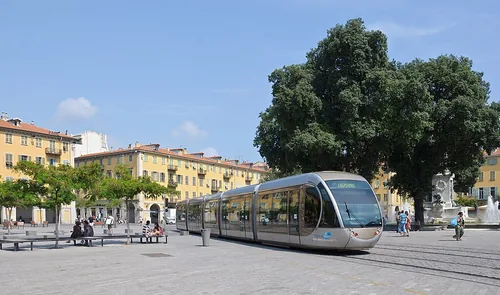
    Look at the ground: grey gneiss slabs in the centre, basalt paving round the edges. Four holm oaks and some albizias give shade. In the middle stands the monument to Garibaldi in a square basin 17 metres across. In November 2007 it had to be moved 18 metres south to make room for the tram. Watch the tram pass: it crosses the square without overhead wires, a choice made to protect the look of the place.

    Since the renovation of 2007 and 2008 the restaurant terraces spread out onto the square, but they must follow strict rules on colour and furniture, which is why everything looks so tidy. On the corner with Boulevard Jean-Jaurès is the Café de Turin, founded in 1908 and known for seafood.

    Everything here is free, and late afternoon is a good moment to sit down for a drink. From here it is 1020 m, about 14 minutes, to the Promenade du Paillon.

    Hours
    Open 24/7 (public square)
    Price
    Free
  7. 7

    Promenade du Paillon

    Promenade du Paillon in Nice, stop 7 on the self-guided walking tour

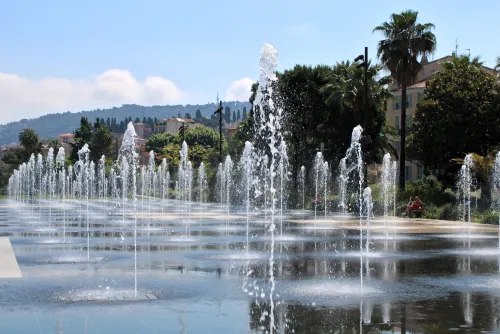
    You are walking on top of a river. The Promenade du Paillon is a green corridor 1.2 km long that follows the covered River Paillon, linking the Promenade des Anglais with the Théâtre National. It was designed by the landscape architect Michel Péna and passes the Théâtre de Verdure and the Jardin Albert-Ier.

    Covering the river began in 1868, and the new ground filled up over the next century: the municipal casino, an esplanade in 1931, an exhibition hall in 1954, the Acropolis congress centre in the 1980s, a bus station and car park in 1973, then MAMAC in 1990 and the Tête Carrée in 2002. Work on the green corridor began in 2010 with the demolition of the bus station and its hanging gardens, and cost forty million euros.

    The park opened on 26 October 2013 and was an instant hit, above all its play areas. So much so that within a week three children were hurt on a wooden play structure and the city had to revisit safety with the manufacturer. Property prices nearby were soon said to have risen by 20 percent. In 2020 the mayor presented plans to extend it further.

    There is a neat link to the start of the walk: the pebbles poured onto the beaches along La Prom come from the Paillon. Entry is free. Place Masséna is just 40 m away, about a minute.

    Hours
    Daily 7:00–21:00
    Price
    Free
    Website
    nice.fr ↗
  8. 8

    Place Masséna

    Place Masséna in Nice, stop 8 on the self-guided walking tour

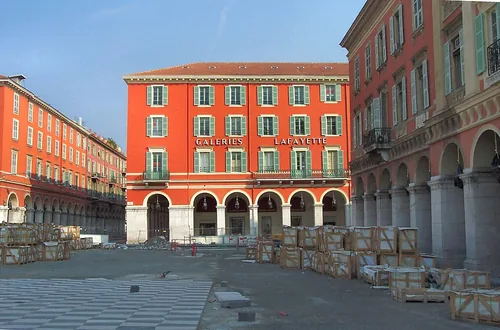
    You finish on Place Masséna, the central square of Nice, placed between the old town and Avenue Jean-Médecin and close to the Promenade des Anglais. It was built step by step from the 1820s and 1830s, modelled on Piazza Vittorio Veneto in Turin, at a time when Nice belonged to the House of Savoy. Look at the uniform façades and the geometry of the square: that unity was the point.

    It was planned as part of a general scheme to beautify the town by the Consiglio d'Ornato, the city's planning council, and is considered one of its finest achievements. The square has been reworked several times over almost two centuries, yet locals defend it fiercely as a jewel of their heritage.

    The name brings you full circle to Villa Masséna: Marshal André Masséna was born in Nice and stayed attached to his roots. Today the square is a hub for transport and for events of every kind, cultural, social and political, and above all for the carnival, when visitors meet Niçois culture head on.

    The square is free and open at all hours, so stay as long as you like. If you want to get back to the start, the GPS navigation leads you to the Promenade des Anglais on request.

    Hours
    Open 24/7 (public square)
    Price
    Free
Walking tour route map of Nice Route loaded
Promenade des AnglaisVilla MassénaCathédrale Sainte-RéparateCours Saleya+4
All 8 stops are already on the map.
You just press start.
AI Tour Guide

You know the route now. Walk it with a guide in your ear.

Press start wherever you are, even hundreds of kilometres from Nice, and the guide begins telling its stories right away. In the city, pick any of the 8 stops to start from: it leads you there, then talks with you the whole route, asking, listening, remembering, and shaping the tour around your answers.

8stops 5.8km 1 h 25 minwalking 13languages
▶Start the tour free

Free to start · Runs in your browser · No app, no download

Shorter Ways to Walk It

Short on time or legs? These three cuts keep the route's logic and only drop what you can live without.

Seafront, museum and old town

Stops: 1, 2, 3, 4

For a morning with Belle Époque interiors and Napoleon relics. About 42 minutes of walking; Villa Masséna is the only stop with admission, the rest is free.

Old town and the castle rock

Stops: 3, 4, 5, 6

For anyone who wants the oldest layers of Nice and the views. About 33 minutes of walking, and every stop is free.

From the hill to the squares

Stops: 5, 6, 7, 8

For an afternoon that starts with the panorama and ends among cafés and fountains. About 29 minutes of walking, all free.

How Long Does This Nice Tour Take on Foot?

The full line covers 5.8 km with 1 h 25 min of pure walking. The longest leg is Villa Masséna to Cathédrale Sainte-Réparate at 1670 m; the shortest is the 40 m hop from Promenade du Paillon to Place Masséna.

Realistically, give the whole tour about four and a half hours: roughly an hour inside Villa Masséna, three quarters of an hour on Castle Hill, and shorter pauses everywhere else. Skip the museum interior and about three and a half hours is enough.

The variants take less: seafront, museum and old town about two and a half hours with the museum visit; old town and castle rock about two hours; hill to the squares a little under two hours.

Before You Set Off from the Promenade

  • Start: The Promenade des Anglais is the recommended start, but you can join at any stop; the order here is the one that flows best.
  • Finish: You end on Place Masséna. If you want to return to the start, the GPS navigation leads you back on request.
  • Time of day: Start in the morning if you want to see the Cours Saleya markets in full swing and still have light for the views from Castle Hill.
  • Admission: Only Villa Masséna charges admission. The Promenade, the cathedral, the squares, the Paillon gardens and the Castle Hill park are free.
  • Water: Bring a reusable bottle and fill it up, or buy water in a shop. Skip the mobile vendors selling cheap bottles: some have been seen refilling them from park fountains.

Food and Breaks Along the Route: Socca, Bistros, Aperitivo

The old town is where you eat well on this route, ideally in the side lanes rather than on the main axes. Socca at a counter, a bistro lunch, and an aperitivo on Place Garibaldi cover the day.

Chez René SoccaAn institution for socca, the chickpea pancake, served hot with plenty of pepper. Queue at the counter and share an assortment; with two people, one grabs a table while the other queues. Much cheaper than ordering the same dishes at a sit-down place on Cours Saleya. (Old Town, 2 rue Miralheti)
La MerendaA small bistro for Niçoise cooking. In summer, reserve online two or three weeks ahead. Seating is on small stools, and cards are accepted, but not Amex. (Old Town, 4 Rue Raoul Bosio)
Le PanierBlind tasting menus in a small old town alley. Go at lunch: same kitchen, same room, a shorter and cheaper menu than in the evening. (Old Town, 5 Rue Barillerie)
Aperitivo on Place GaribaldiLocals call it the best happy hour in town: pull up a chair at one of the cafés under the arcades and watch the square. (Place Garibaldi)

Tourist Traps to Avoid in Nice, from Bracelets to Blue Chairs

  • Seafront restaurants with hawkers: Many places here pull you in from the street and charge mainly for the view; picture menus and a menu touristique are warning signs. A few are decent, such as La Chapa, Nice Sunset and Plage Beau Rivage. Otherwise follow locals into the side lanes, where menus come only in French. (Quai des États-Unis and Promenade des Anglais)
  • Bracelets and string tricks: Someone ties a friendship bracelet on your wrist or a string round your finger as a magic trick, then demands money. While your arm is tied up, an accomplice goes for your pockets. Keep walking and don't hold out your hand.
  • Clipboard petitions and broken cameras: A collector with a clipboard asks for a signature and then a cash donation; legitimate charities in France rarely collect on the street. Equally, someone may ask you to take their photo, drop the camera and demand money for repairs. Both are distractions for pickpocketing.
  • Pickpockets at the markets and on trams: The crowded Cours Saleya markets and trams and buses from the airport are where pickpockets work. Keep bags closed in front of you, and never leave belongings unattended on the beach. (Cours Saleya)
  • Pebbles and blue chairs: Every year around 15,000 cubic metres of pebbles from the River Paillon are poured onto the beaches to slow erosion. Pocketing them can earn you a fine, and the blue chairs belong on the Promenade, not on the beach or in your suitcase. (Promenade des Anglais)
Walking tour route map of Nice
AI Tour Guide

Your guide is ready when you are, right from La Prom.

Press start and a voice AI Tour Guide takes it from here: leading the route through Nice, telling the stories, and turning your walk into a real back-and-forth conversation. No app or download is needed; it runs in your browser.

8stops 5.8km 1 h 25 minwalking 13languages
▶Start the tour free

Free to start · Runs in your browser · No app, no download

What the AI Tour Guide Adds on This Route

On this walk the AI Tour Guide leads the way as a conversation: it greets you on La Prom, tells the stories of each place as you arrive, asks what you care about and remembers it. If Napoleon at Villa Masséna grabs you, it can follow Marshal Masséna's career further; if the castle sieges interest you more, it goes deeper into Catherine Ségurane's legend. You can interrupt any time, and the route stays the same. You start with 100 free credits; after that, choose this tour all-inclusive for €19.99 with no time limit, or €5 per hour.

A Real Conversation A voice AI Tour Guide greets you, leads the whole route, and tells the stories and facts as you walk, asking what you want to see and keeping a real conversation going. Not a recording you press play on.
Map Navigation Follow the route on the map and walk at your own pace. You choose where to start and when to move to the next stop.
Ask Anything Curious about a building you pass? Ask your AI Tour Guide on the spot and the conversation carries on.
13 Languages Switch language anytime. No separate tour needed.
Start free in your browser

Common Questions About Walking Nice

Is there a museum pass that covers Villa Masséna?

Yes. The Pass Musées de Nice runs for four days and covers the city museums, including Villa Masséna, the Matisse museum, MAMAC and Palais Lascaris. It pays off from the second museum. The Chagall museum is a national museum and not included.

Do students or children pay at Villa Masséna?

Under-18s and students get into the city museums free with proof, so bring your student card. Jobseekers and visitors with disabilities plus one companion are also on the free list.

Is the walk good with children?

Yes. The Promenade du Paillon has popular play areas, Castle Hill is a park with a waterfall, and the noon cannon is fun to hear. Plan a stroller-friendly pace on La Prom, where families come especially on Sundays.

Where can I go from Nice for a day trip?

Close by are Villefranche-sur-Mer, Èze and Monaco; further along the coast, Antibes and Menton have their own walking routes.

Is the tour really free?

Yes. The whole tour is free: the route, the interactive map and the navigation cost you nothing. Only the voice AI Tour Guide is optional and paid: you test it with 100 free credits, then you pay either €5 per hour or €19.99 for this whole tour, with no time limit. Admission to one of the 8 stops is not included: Villa Masséna charges its own entry fee.

Do I need to download an app?

No. Everything runs in your phone browser. Open the route and start walking, no download and no sign-up required.

Do I need to book the walking tour in advance?

No booking needed. This self-guided tour is available anytime. Open the route in your browser and start walking. The AI Tour Guide works instantly, no app, no reservation required.

What languages is the AI Tour Guide available in?

The AI Tour Guide speaks 13 languages, so you take the tour in your own language and can switch at any time.

Can I skip stops or change the route?

Yes. Skip any stop, spend extra time at places you like, or start the route from any point. It is your walk, you set the pace.
Image credits
▶ Start free in your browser Runs in your browser, no app, no download