Free Walking Tour Cape Town: Waterfront to the Castle

Eight stops from the V&A Waterfront through the painted streets of the Bo-Kaap to the Castle of Good Hope, at your own pace and with free GPS navigation.

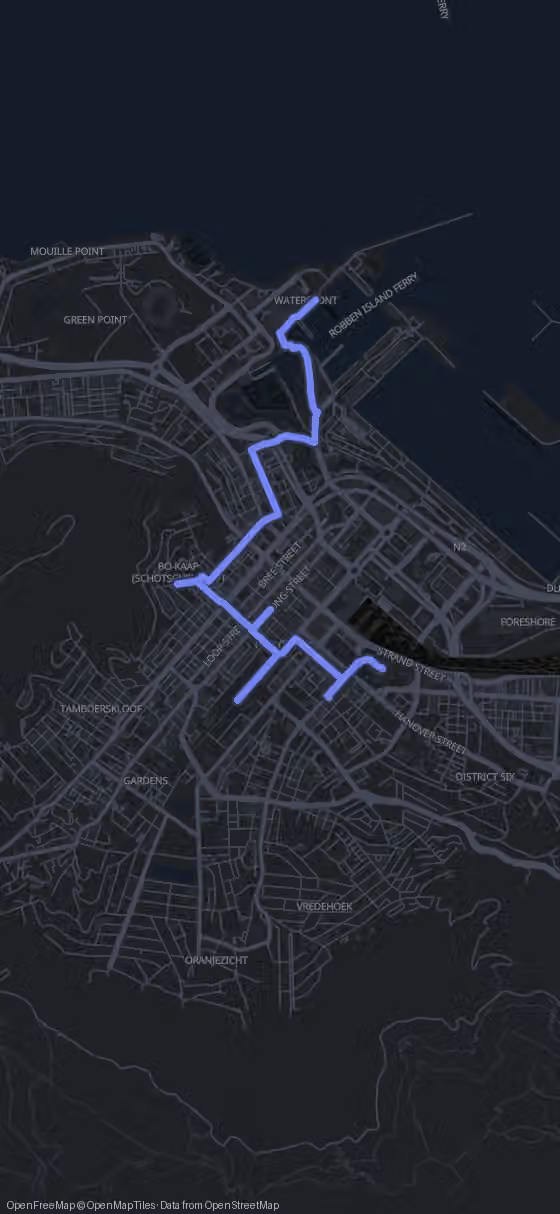
8 Stops 6.5 km ~1 h 34 min walking
Route map for the Cape Town walking tour
Stop 1 of 8
3.05 km·38 min
V&A Waterfront
Head south-west toward Bo-Kaap
Welcome to Cape Town. I’m Alex, and one of this city’s brightest streets carries a story of freedom.
Try this tour with Alex

What this walk covers

Eight stops run in one line through the city, from the V&A Waterfront past the Bo-Kaap, Company's Garden and City Hall to the Castle of Good Hope. The route ends across town, not where it started.

There is no meeting point and no group to keep up with. The GPS route is free, and the live AI Tour Guide is an optional upgrade that walks the route with you if you want it.

Open free GPS & optional AI Tour Guide
This short shows highlights of the route. All 8 stops follow below.

The Route

Walking Map of Cape Town, from the Harbour to the Castle

8 stops 6.5 km 1 h 34 min walking
Tap to load interactive map

The 8 stops along this route

  1. V&A Waterfront in Cape Town, stop 1 on the self-guided walking tour
    1V&A Waterfront
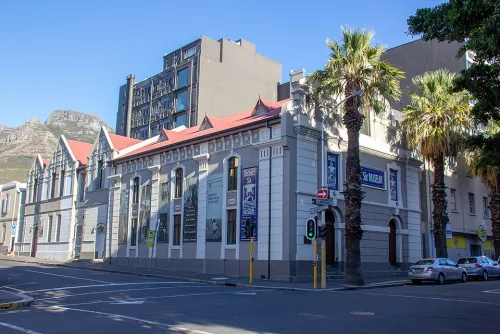
  2. Bo-Kaap in Cape Town, stop 2 on the self-guided walking tour
    2Bo-Kaap
  3. Greenmarket Square in Cape Town, stop 3 on the self-guided walking tour
    3Greenmarket Square
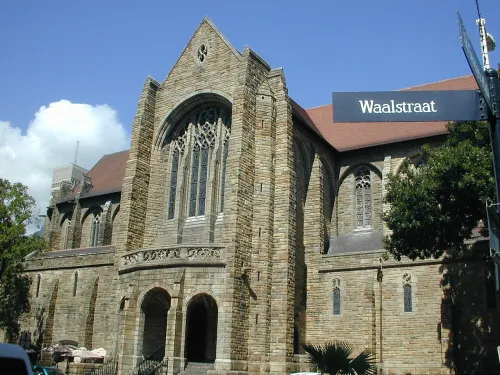
  4. St George's Cathedral in Cape Town, stop 4 on the self-guided walking tour
    4St George's Cathedral
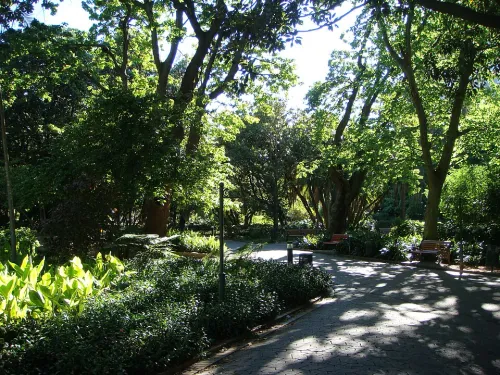
  5. Company's Garden in Cape Town, stop 5 on the self-guided walking tour
    5Company's Garden
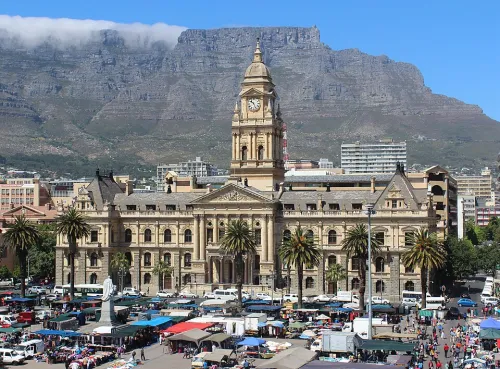
  6. City Hall in Cape Town, stop 6 on the self-guided walking tour
    6City Hall
  7. District Six Museum in Cape Town, stop 7 on the self-guided walking tour
    7District Six Museum
  8. Castle of Good Hope in Cape Town, stop 8 on the self-guided walking tour
    8Castle of Good Hope
  9. That's the full route.

    Walk it with an AI Tour Guide talking you through every one of these streets.

    Start free in your browser
    You made it

Your Cape Town Walking Tour Stop by Stop: Eight Places, Three Centuries

  1. 1

    V&A Waterfront

    V&A Waterfront in Cape Town, stop 1 on the self-guided walking tour

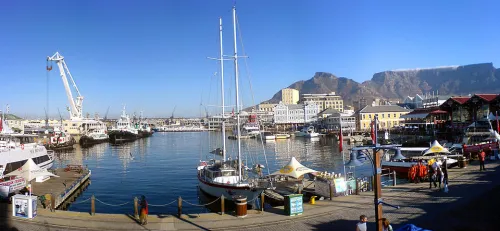
    Look up from the quays and Table Mountain fills the background: this is where Cape Town began. The V&A Waterfront stands on the oldest working harbour in the Southern Hemisphere, and today its 123 hectares mix a marina, hotels, apartments, offices and a big shopping mall. By visitor numbers it is the most popular sight in the city, and the quays are open to stroll at any hour.

    The story starts in 1654, two years after Jan van Riebeeck landed in this sheltered bay. He built a small jetty because his job was to run a refreshment station: fresh water and vegetables for Dutch East India Company ships on the long haul to Java and Batavia. Everything else on this walk, from the garden to the fort, grew out of that one purpose.

    The bay was not always kind. In June 1858 winter storms wrecked more than 30 ships, and Lloyd's of London refused to insure vessels wintering in Table Bay. On 17 September 1860 Prince Alfred, Queen Victoria's second son, tipped the first load of stone for a breakwater, starting the harbour that finally made the bay safe all year. His name and his mother's live on in the Victoria & Alfred of the Waterfront and in the Alfred Mall.

    Take twenty minutes here, not longer: the shops will still be here in the evening. Then head inland on the longest leg of the day, 3120 m and about 47 minutes to Bo-Kaap. You pass the Zeitz MOCAA on the way out of the harbour, worth a note for another day.

    Hours
    Open 24/7 (Retail & Shopping: Daily 09:00–21:00)
    Price
    Free
  2. 2

    Bo-Kaap

    Bo-Kaap in Cape Town, stop 2 on the self-guided walking tour

    The colours hit you first: rows of bright houses along cobbled streets on the slopes of Signal Hill. The name means "above the Cape" in Afrikaans, and the area was once called the Malay Quarter. According to the South African Heritage Resources Agency it holds the largest concentration of pre-1850 architecture in the country and is the oldest surviving residential neighbourhood in Cape Town.

    It started with a landlord. In 1760 Jan de Waal bought land at the foot of Signal Hill and from 1763 built small rental houses, huurhuisjes, which he leased to his slaves. One of the first three is 71 Wale Street, now the Bokaap Museum. Skilled Muslim craftsmen from Southeast Asia, the Mardijkers, settled here, followed by enslaved people from Malaysia, Indonesia and parts of Africa, which is where the name Malay comes from.

    Faith shaped the streets. The Auwal Mosque in Dorp Street dates from 1794, the Nurul Islam Mosque from 1844, and the Tana Baru Cemetery was opened in 1804 for Muslim families. Between 1790 and 1825 houses in Cape Dutch and Cape Georgian style went up for tradesmen and artisans, and after emancipation in 1834 developers added rows of narrow, deep huurhuisjes for freed slaves. Later the area became racially segregated under apartheid; more than half of today's residents identify as Muslim.

    This is a lived-in neighbourhood, so wander slowly and keep your camera polite. When you are ready, walk 830 m, about 11 minutes, down into the old town to Greenmarket Square.

    Hours
    Open 24/7
    Price
    Free
  3. 3

    Greenmarket Square

    Greenmarket Square in Cape Town, stop 3 on the self-guided walking tour

    You are standing on the oldest civic stage in town. The patch in front of the door of the Old Town House counts as the historical centre of Cape Town, and Burg Street runs straight through the square. Look for the hand pump near the middle: it once brought clean water up from an underground river that flows beneath the city.

    The square grew naturally in the years after 1652, as farmers sold produce from the Company's Garden and nearby farms here. Other trade followed quickly, including the sale of slaves. A fountain supplied drinking water, and in 1696 a burgher watch house was built to keep order, turning the market into the town's administrative and social centre. By the 1730s the thatched cottages around it were being replaced by flat-roofed houses of one and more storeys.

    Over the centuries the square served as a slave market, a vegetable market and even a car park. Under apartheid it became a regular focus of political protest, partly because parliament was so close and partly because of who traded and shopped here. Today it hosts a flea market selling African crafts and curios.

    The Old Town House now holds the Michaelis Collection of art if you want a look inside. Otherwise browse the stalls, then walk 390 m, about 5 minutes, to St George's Cathedral.

    Hours
    Open 24/7 (Market: Daily approx. 09:00–18:00, main trading Mon–Sat)
    Price
    Free
  4. 4

    St George's Cathedral

    St George's Cathedral in Cape Town, stop 4 on the self-guided walking tour

    The stone church in front of you is the Anglican cathedral of Cape Town, seat of the Archbishop and mother church of the Anglican Church of Southern Africa. Sir Herbert Baker designed it, and the first foundation stones were laid in 1901 on the site of an older church that it replaced.

    That first church has a story of its own. In 1827 the Bishop of Calcutta, visiting what was then a distant outpost of his diocese, raised the idea of an Anglican church; until then services were held in the Castle and later in the Groote Kerk. The colonial government gave a plot at the lower end of the Company's Garden, on the corner of Government Avenue and Wale Street, and Governor Sir Lowry Cole laid the foundation stone on St George's Day, 23 April 1830. The design copied St Pancras' Church in London, the contractor lost heavily on the job, and the church opened on 21 December 1834 with room for 1,000 people.

    In 1847 Robert Gray became the first Bishop of Cape Town and placed his throne in this modest parish church, which made it a cathedral overnight. He dreamed of a grander building but died in 1872 before it happened; Baker's cathedral came a generation later.

    Entry is free, and visitors are welcome. Step back out and walk 470 m, about 7 minutes, into the Company's Garden.

    Hours
    Mon–Thu 08:30–16:00, Fri 08:30–15:00 (office/visiting hours; daily services, Sun from 07:00)
    Price
    Free
  5. 5

    Company's Garden

    Company's Garden in Cape Town, stop 5 on the self-guided walking tour

    Shade, old trees and lawns in the middle of the business district: this is the oldest garden in South Africa and a national heritage site. It is still watered from the Molteno Dam, fed by springs on the lower slopes of Table Mountain.

    The garden is the reason the harbour mattered. On 29 April 1652 the master gardener Hendrik Boom prepared the first ground for sowing, and the settlers kept daily records of every seed until they had a calendar for planting and harvest. They grew salad herbs, peas, beans, radish, beet, spinach, wheat, cabbage, asparagus and turnips, and traded copper and tobacco with the Khoisan for cattle and sheep. By 1653 the settlement fed itself all year, and by 1658 nearly every garden plant of Europe and India grew here.

    Before 1680 this was a vegetable plot. Then Simon van der Stel redesigned it for beauty, and travellers of many nations wrote that nowhere else could you find such a variety of trees, shrubs, vegetables and flowers in one place. The botanist Hendrik Bernard Oldenland built a herbarium here that was shipped to the Netherlands after his sudden death.

    Entry is free. Give it half an hour on a bench, then walk 850 m, about 11 minutes, to City Hall on the Grand Parade.

    Hours
    Daily 07:00–19:00 (Sep–Mar), Daily 07:00–18:00 (Apr–Aug)
    Price
    Free
  6. 6

    City Hall

    City Hall in Cape Town, stop 6 on the self-guided walking tour

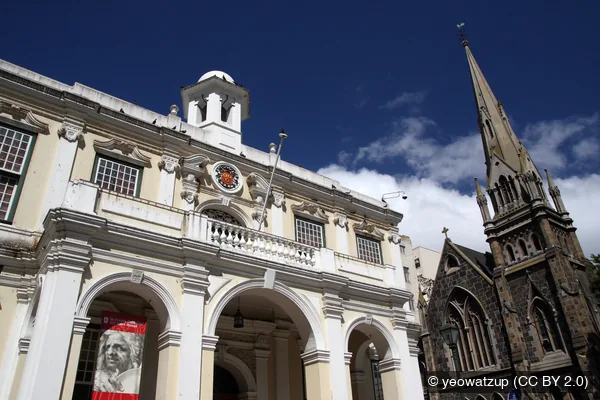
    The honey-coloured facade on the Grand Parade is built of oolitic limestone shipped from Bath in England. Cape Town City Hall is an Edwardian building from 1905, and until then the city had no city hall of its own. The idea came up in 1887 as a tribute for Queen Victoria's Golden Jubilee; a competition followed in 1893, won by the architects Harry Austin Reid and Frederick George Green, and much of the material and fittings came from Europe.

    Listen on the hour. The tower's turret clock strikes the hours and chimes the Westminster quarters, its four faces are iron frames filled with opal, and the bells were cast by John Taylor and Co of Loughborough.

    Inside stands the organ built by Norman and Beard, specified by Sir George Martin, organist of St Paul's Cathedral in London. It is made of mahogany, teak and pine and has 3165 pipes, from 10 metres down to 19 millimetres. Martin called it an artistic and mechanical triumph.

    You can take in the exterior and the Grand Parade at any time. The exhibition inside is free but not open every day, so plan your day around it if the building interests you. From here it is only 340 m, about 5 minutes, to the District Six Museum.

    Hours
    Exhibition: Tue–Fri 10:00–16:00, Mon/Sat/Sun closed; Exterior / Grand Parade: open 24/7
    Price
    Free
  7. 7

    District Six Museum

    District Six Museum in Cape Town, stop 7 on the self-guided walking tour

    You enter an old Methodist church, and the floor is the exhibit: a huge map of District Six covered in handwritten notes by former residents marking where their homes once stood. In the 1970s the apartheid government forcibly removed about 60,000 people of many backgrounds from this inner-city neighbourhood. The foundation was set up in 1989 and the museum opened in 1994 as their memorial.

    Around the map you find old street signs, family stories, historical declarations and displays on the demolition. One of the people who grew up here was the jazz musician Abdullah Ibrahim, once known as Dollar Brand. The museum is not only about the past: it runs programmes on housing, planning, music, literature and art with today's community, and in 2003 it received a Prince Claus Award from the Netherlands.

    If you go inside only one place today, make it this one. Allow an hour for a self-guided visit; there is an admission fee.

    Afterwards walk 530 m, about 7 minutes, to the Castle of Good Hope, back to the very beginning of the colony.

    Hours
    Mon–Sat 09:00–16:00, Sun closed
    Price
    65 ZAR adults (self-guided), 80 ZAR adults (guided)
  8. 8

    Castle of Good Hope

    Castle of Good Hope in Cape Town, stop 8 on the self-guided walking tour

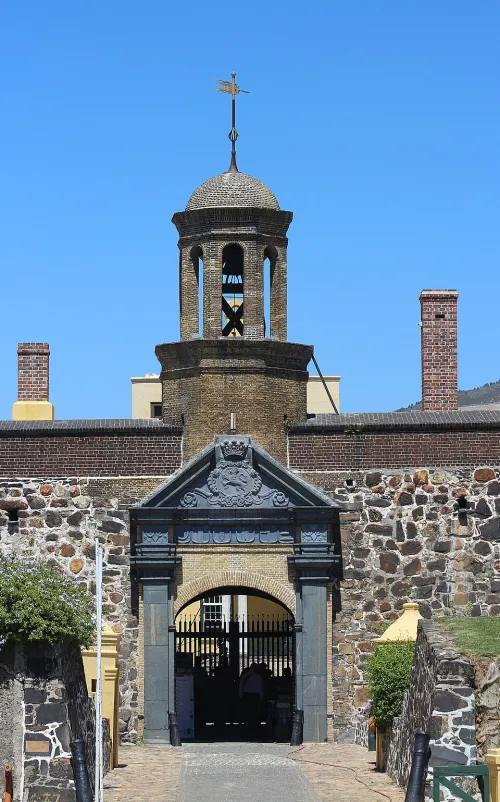
    Five bastions behind a canal: the Castle of Good Hope is a pentagonal fort built by the Dutch East India Company between 1666 and 1679 and the oldest existing building in South Africa. It once stood on the shore of Table Bay; land reclamation on the Foreshore has since left it inland. Declared a historical monument in 1936 and restored in the 1980s, it is regarded as the best-preserved VOC fort anywhere.

    It replaced Jan van Riebeeck's first fort of clay and timber from 1652. In 1664, with rumours of war between Britain and the Netherlands, his successor Zacharias Wagenaer was ordered to build a stone fortress, and the first stone was laid on 2 January 1666. The work kept stalling because the Company did not want to spend the money, and much of it was done by enslaved people: fearing a revolt by local groups, the VOC brought up to 60,000 enslaved people from Madagascar, Mozambique, the Dutch Indies and India to the Cape.

    Walk the walls and read the bastion names. On 26 April 1679 they were named after the titles of William III of Orange-Nassau: Leerdam in the west, then clockwise Buuren, Katzenellenbogen, Nassau and Oranje.

    The Castle charges admission, and it is worth going in. It is a fitting end: the harbour you started at, the garden and the fort were all built for the same refreshment station, and here the walk closes the circle of that story.

    Hours
    Daily 09:00–16:00; Closed Christmas Day and Workers' Day
    Price
    50 ZAR adults, 25 ZAR children (5–17) / pensioners, 8 ZAR school groups
Walking tour route map of Cape Town Route loaded
V&A WaterfrontBo-KaapGreenmarket SquareSt George's Cathedral+4
All 8 stops are already on the map.
You just press start.
AI Tour Guide

You know the route now. Walk it with a guide in your ear.

Press start wherever you are, even hundreds of kilometres from Cape Town, and the guide begins telling its stories right away. In the city, pick any of the 8 stops to start from: it leads you there, then talks with you the whole route, asking, listening, remembering, and shaping the tour around your answers.

8stops 6.5km 1 h 34 minwalking 13languages
▶Start the tour free

Free to start · Runs in your browser · No app, no download

Shorter ways to walk the route

Not everyone has a full day. These three versions keep the order of the route and simply start or stop at a different place.

Historic centre only

Stops: 2, 3, 4, 5, 6, 7, 8

For anyone staying in the city centre who wants the history without the long harbour approach. You start in Bo-Kaap and walk 3.4 km, about 46 minutes on foot, to the Castle. You pay admission at the District Six Museum and the Castle.

Free from end to end

Stops: 1, 2, 3, 4, 5, 6

For a tight budget: from the Waterfront to City Hall, 5.7 km and about 81 minutes of walking, without a single ticket. On the days it is open, the exhibition in City Hall is free as well.

Compact city core

Stops: 3, 4, 5, 6

For a short morning or a gap between other plans: Greenmarket Square, the cathedral, the garden and City Hall lie 1.7 km apart in total, about 23 minutes on foot, and all four are free.

How Long This Cape Town Tour Takes, With and Without the Museums

On foot alone the full route takes 1 h 34 min over 6.5 km, and almost half of that is the first leg from the Waterfront up to Bo-Kaap. After that the stops sit close together, rarely more than ten minutes apart, so the city centre feels like one long, easy stroll.

Realistically you need about six hours: roughly an hour each for the District Six Museum and the Castle, half an hour in the Company's Garden and around twenty minutes at each of the other stops. Leave the Waterfront at 09:00 and you reach the District Six Museum shortly after 12:30 and the Castle around 13:45, with plenty of time for both visits.

The centre-only version fits into about four hours with both visits inside, the free version into about three and a half hours, and the compact core into roughly an hour and a half.

Before you set off from the Waterfront

  • Start and finish: The recommended start is the V&A Waterfront and the walk ends at the Castle of Good Hope, so it is a one-way route. You can join at any stop; the order shown is simply the one that flows best.
  • Best days: A weekday works best if you want to see inside every stop, since not every door on the route is open every day.
  • Start time: Set off around 09:00, which leaves plenty of time for the District Six Museum and the Castle later in the day.
  • Entry costs: Budget for two admission fees if you go inside both the District Six Museum and the Castle. Everything else on the walk is free.
  • Navigation: Open the free GPS route in your browser and it leads you from stop to stop, including the longer first stretch into Bo-Kaap.
Walking tour route map of Cape Town
AI Tour Guide

Your guide is waiting at the Waterfront whenever you are.

Press start and a voice AI Tour Guide takes it from here: leading the route through Cape Town, telling the stories, and turning your walk into a real back-and-forth conversation. No app or download is needed; it runs in your browser.

8stops 6.5km 1 h 34 minwalking 13languages
▶Start the tour free

Free to start · Runs in your browser · No app, no download

What the AI Tour Guide adds on this route

Between the harbour and the Castle this walk crosses the VOC's refreshment station, the slave trade, Cape Malay faith and the forced removals of apartheid. The AI Tour Guide leads you through it as a conversation: it greets you at the Waterfront, tells the stories as you arrive, asks what grabs you and remembers it, so by District Six it knows whether you care more about the families, the music or the politics. You can interrupt any time to ask, say, how the Mardijkers came to the Cape or what happened to the people who left District Six. You start with 100 free credits; after that you choose this tour all-inclusive for €19.99 with no time limit, or credits at €5 per hour.

A Real Conversation A voice AI Tour Guide greets you, leads the whole route, and tells the stories and facts as you walk, asking what you want to see and keeping a real conversation going. Not a recording you press play on.
Map Navigation Follow the route on the map and walk at your own pace. You choose where to start and when to move to the next stop.
Ask Anything Curious about a building you pass? Ask your AI Tour Guide on the spot and the conversation carries on.
13 Languages Switch language anytime. No separate tour needed.
Start free in your browser

Common Questions about Walking Cape Town

Can I take a guided visit at the District Six Museum?

Yes. Besides the self-guided visit there is a guided visit that costs a little more, which is worth it if you want the stories behind the floor map told in person.

Is the Castle cheaper for children and older visitors?

Yes. Children and pensioners pay a reduced price, and school groups pay less as well.

What if the museums are closed on the day I'm in Cape Town?

Then walk the free outdoor parts, from the Waterfront through Bo-Kaap, Greenmarket Square and the Company's Garden, and add the Castle if it is open. The District Six Museum and the City Hall exhibition are not open every day, so check before you plan around them.

Is Bo-Kaap an open-air museum?

No, it is a living residential neighbourhood where families have stayed for generations, so treat the colourful houses as people's homes. The Bokaap Museum in the old house at 71 Wale Street is the place to look inside.

Is there always something going on at Greenmarket Square?

During the day the traders have their stalls up and the square is at its liveliest. The square itself is open at all hours, so you can pass through even after the market has packed up.

Is the tour really free?

Yes. The whole tour is free: the route, the interactive map and the navigation cost you nothing. Only the voice AI Tour Guide is optional and paid: you test it with 100 free credits, then you pay either €5 per hour or €19.99 for this whole tour, with no time limit. Admission to 2 of the 8 stops is not included: District Six Museum and Castle of Good Hope charge their own entry fees.

Do I need to download an app?

No. Everything runs in your phone browser. Open the route and start walking, no download and no sign-up required.

Do I need to book the walking tour in advance?

No booking needed. This self-guided tour is available anytime. Open the route in your browser and start walking. The AI Tour Guide works instantly, no app, no reservation required.

What languages is the AI Tour Guide available in?

The AI Tour Guide speaks 13 languages, so you take the tour in your own language and can switch at any time.

Can I skip stops or change the route?

Yes. Skip any stop, spend extra time at places you like, or start the route from any point. It is your walk, you set the pace.
Image credits
▶ Start free in your browser Runs in your browser, no app, no download