Free Walking Tour Mar del Plata: Casino, Hill and Cape

From Bustillo's seafront casino up to the villas of Stella Maris, out to Cabo Corrientes and back to the beach that turned Mar del Plata into a resort.

8 Stops 7.7 km ~1 h 47 min walking
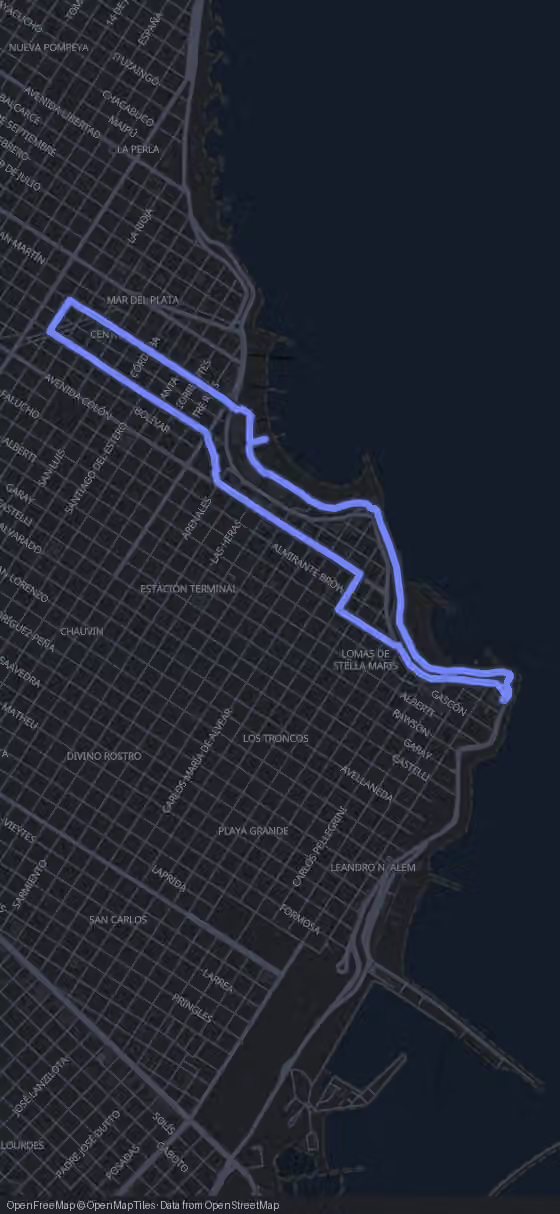
Route map for the Mar del Plata walking tour
Stop 1 of 8
1 km·13 min
Casino Central
Head inland to the north-west toward the Catedral de los Santos Pedro y Cecilia
Hola, welcome to Mar del Plata. I'm Alex, and on one hill here, a piece of city infrastructure dresses like an English keep.
Try this tour with Alex

The Route at a Glance

Eight stops over 7.7 km, starting at Casino Central, climbing to the Stella Maris hill and finishing on Playa Bristol. Pure walking time is 1 h 47 min; with both paid interiors, plan on about four hours.

Most of it costs nothing. Only Villa Ortiz Basualdo (Museo Castagnino) and Torre Tanque charge admission. The GPS route in your browser is free, and the AI Tour Guide is optional.

Open free GPS & optional AI Tour Guide
View of Mar del Plata

The Route

Walking Map of Mar del Plata: Casino, Stella Maris and the Cape

8 stops 7.7 km 1 h 47 min walking
Tap to load interactive map

The 8 stops along this route

  1. Casino Central in Mar del Plata, stop 1 on the self-guided walking tour
    1Casino Central
  2. Catedral de los Santos Pedro y Cecilia in Mar del Plata, stop 2 on the self-guided walking tour
    2Catedral de los Santos Pedro y Cecilia
  3. 3Plaza San Martín
  4. Villa Ortiz Basualdo (Museo Castagnino) in Mar del Plata, stop 4 on the self-guided walking tour
    4Villa Ortiz Basualdo (Museo Castagnino)
  5. Torre Tanque in Mar del Plata, stop 5 on the self-guided walking tour
    5Torre Tanque
  6. Mirador Cabo Corrientes in Mar del Plata, stop 6 on the self-guided walking tour
    6Mirador Cabo Corrientes
  7. Hotel Provincial in Mar del Plata, stop 7 on the self-guided walking tour
    7Hotel Provincial
  8. Playa Bristol in Mar del Plata, stop 8 on the self-guided walking tour
    8Playa Bristol
  9. That's the full route.

    Walk it with an AI Tour Guide talking you through every one of these streets.

    Start free in your browser
    You made it

Your Mar del Plata Walking Tour, Eight Stops and Their Stories

  1. 1

    Casino Central

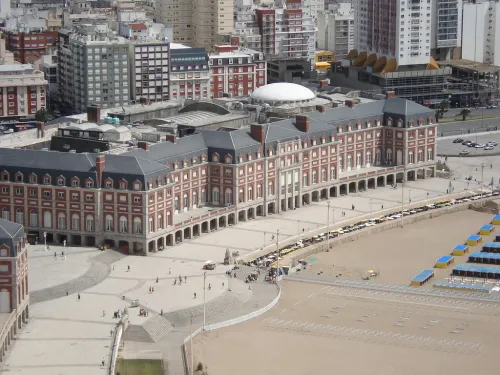
    Casino Central in Mar del Plata, stop 1 on the self-guided walking tour

    Start with the building itself before you think about going in. Casino Central is one of a matched pair designed by Alejandro Bustillo, its twin being the Hotel Provincial across the square. Both took their cue from the Hôtel du Palais on the seafront of Biarritz in France: an eclectic style with clear echoes of French Neoclassicism, walls clad in brick and quartzite, and a slate mansard roof on top. Between the two lies Plaza Guillermo Brown, which opens to the sea and is guarded by two sea lion statues carved by José Fioravanti, the photo every visitor takes.

    The project moved fast. Buenos Aires Province governor Manuel Fresco broke ground on 15 July 1938, and the casino opened on 22 December 1939. Bustillo also laid out the Rambla Casino, the esplanade in front, and the central square, both built between 1938 and 1941 for the casino and the hotel still to come. The interiors were handed to Jean-Michel Frank, the French designer who happened to be in Argentina at the time, working together with the local design house Casa Comte.

    After a provincial refurbishment in December 2007, the grand canopied entrance moved from Avenida Patricio Peralta Ramos to the seafront esplanade, so today you walk in facing the ocean. Inside are a main room looking out over the Atlantic, rooms with 140 gaming tables for blackjack, baccarat, craps and roulette, and 630 slot machines. It counts among the largest casinos in Argentina: in summer around 12,000 players come through per evening, and on January weekends as many as 18,000 a day.

    Is it worth going in? If you are 18 or over, yes, briefly: admission is free, you need a valid ID, and a look at the main room shows you the scale Bustillo was working with. If you are travelling with children, the façade and the sea lions are the visit.

    From here the route turns away from the sea for a while. It is 1,000 m and about 14 minutes to the cathedral, the church the first wealthy summer guests paid for.
    Local name
    Casino de Mar del Plata
    Hours
    Slots: Sun–Thu 11:00–04:00, Fri–Sat 11:00–05:00; Table games: Sun–Thu 11:00–03:00, Fri–Sat 11:00–04:00 (extended during summer season)
    Price
    Free admission (18+ only, valid ID/DNI required)
  2. 2

    Catedral de los Santos Pedro y Cecilia

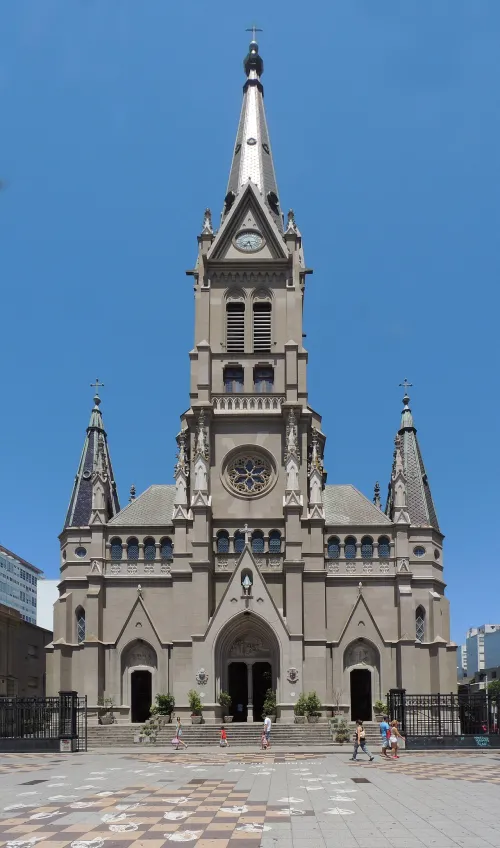
    Catedral de los Santos Pedro y Cecilia in Mar del Plata, stop 2 on the self-guided walking tour

    The cathedral announces itself from a distance: a 60 m bell tower rising over a façade framed by two smaller towers, all in neo-Gothic dress. In the tower sits a rose window three metres across, and behind the louvres hang five bells cast in 1929 by the Paccard foundry in France, the heaviest weighing 3075 kg.

    The church exists because of the beach. When bathing holidays took off in Mar del Plata at the end of the 19th century, some very wealthy guests donated money for a proper church to replace the small chapel of Saint Cecilia. With help from the local authorities, the foundation stone was laid on 18 January 1893. The first Mass was celebrated in 1897 inside a building that was still unfinished, and Monsignor Terrero blessed the completed part on 12 February 1905. A large donation in 1913 paid for the sacristy, the rectory and the baptistery; the crypt under the high altar followed in 1920.

    Its titles came in stages: Pope Pius XI made it a minor basilica in 1924, and when Pius XII created the diocese of Mar del Plata in 1957, it became the cathedral. That is why it is dedicated to two saints at once, Peter and Cecilia, the old chapel's patron kept alongside.

    Go in; admission is free. The nave runs 67 m long and 20 m wide, with ribbed vaults 20 m overhead. Look at the windows in two layers: the lower stained glass was made in Argentina, while most of the clerestory windows high up came from Metz in France. The high altar, designed by the architect Pedro Benoit and made in France, carries a carved wooden neo-Gothic retable with the Virgin of Luján, patron of Argentina, and saints including Jane Frances de Chantal gathered around the crucified Christ. Twenty minutes is enough for most visitors.

    Plaza San Martín is close: 390 m, about five minutes on foot.

    Local name
    Catedral de Mar del Plata
    Hours
    Mon–Sat 07:30–19:00, Sun 08:00–13:00 and 17:00–20:00 (Crypt: Mon–Fri 10:00–12:00)
    Price
    Free admission
  3. 3

    Plaza San Martín

    Plaza San Martín is the city's municipal main square, open, unfenced and free at any hour. There is nothing to buy a ticket for here, which is exactly why it makes a good pause.

    Treat it as the hinge of the walk. So far you have seen the city dressed for visitors, the casino and the church its summer guests paid for. Fittingly, the art museum you are heading to began life in the city's municipal building, where Mar del Plata opened its first fine arts museum in 1938.

    Take stock before you move on: the next leg is the longest of the route, 2,270 m and about 33 minutes out to the villa on the Stella Maris hill. If your timing is for the museum, this is where you check the clock.

    Hours
    Open 24/7
    Price
    Free (public square)
  4. 4

    Villa Ortiz Basualdo (Museo Castagnino)

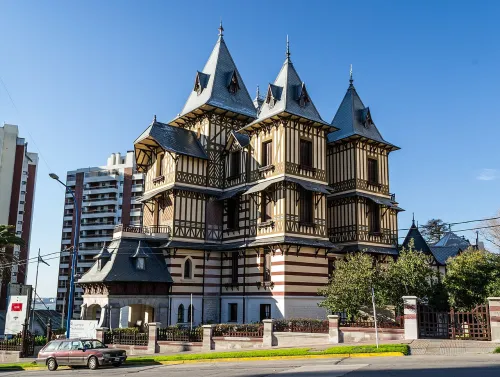
    Villa Ortiz Basualdo (Museo Castagnino) in Mar del Plata, stop 4 on the self-guided walking tour

    You are now on the Stella Maris hill, once a lookout over the sea and later the address of choice for summer residences. The Villa Ortiz Basualdo shares the slope with Villa Normandy and Villa Blaquier, and since January 2021 the ensemble has been protected as a National Historic Monument.

    The Ortiz Basualdo family of Buenos Aires commissioned the house in 1909. Its architects, Luis Dubois and Pablo Pater, worked in the then brand-new art nouveau style that was fashionable for exclusive houses in France and Argentina alike. Look closely at the half-timbering: it is not wood at all, but was painted on later to give the stone house an Anglo-Norman look. The structure is mostly stone, finished with a zinc roof.

    Since 1980 the villa has housed the Museo Municipal de Arte Juan Carlos Castagnino. The museum had been founded in 1938 and spent its first decades in the municipal building, collecting modern art and above all the work of Castagnino, a realist painter and muralist. The official version says the family donated the property to the city, which let the museum move in and reopen on 9 July 1980; family members today say it was expropriated by Peronist governments. Either way, the furniture the family bought in 1909 and during a remodelling in 1918 came with the house.

    That mix is the reason to go in: a period interior with its original furnishings and a collection built around one Argentine painter. Art and interior lovers should give it about 35 minutes.

    The water tower is just 380 m away, a six-minute walk; do not linger here too long if you want to see it from inside.

    Hours
    Wed–Mon 14:00–19:00, Tue closed
    Price
    4600 ARS general, 3400 ARS residents, retirees, students
  5. 5

    Torre Tanque

    Torre Tanque in Mar del Plata, stop 5 on the self-guided walking tour

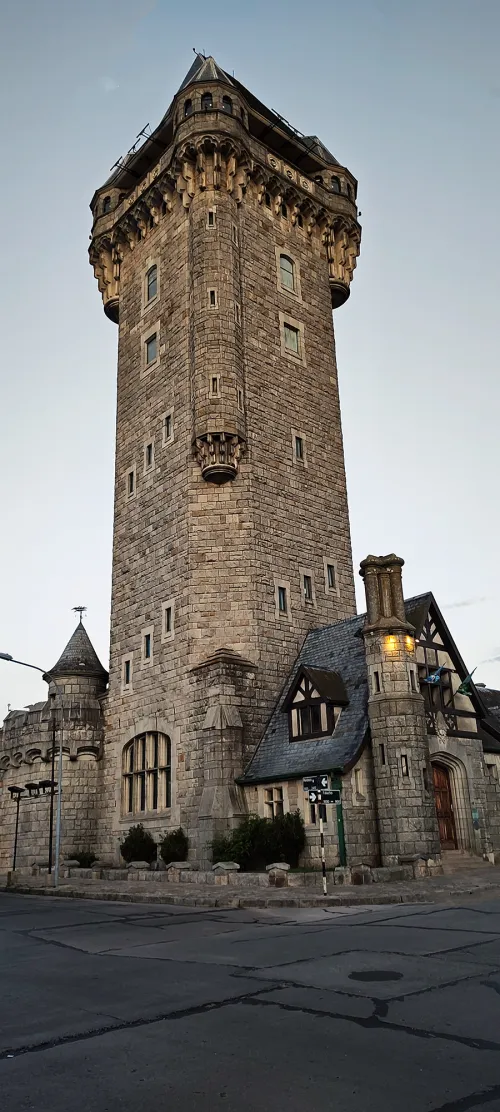
    At 40.75 m, standing on a hill already 40 m above sea level, the Torre Tanque is hard to miss. It looks like a Tudor manor that grew a tower, which is the point: it is a working water tower, still supplying drinking water to downtown Mar del Plata, dressed up to fit the neighbourhood.

    Its story starts with the summer houses. When Argentina's upper class made Mar del Plata its resort at the end of the 19th century, many built on the Stella Maris hills, where fresh water came from windmills. In 1911 the entrepreneur Miguel Lanus put up a concrete water tower holding 2,000 litres for 14 surrounding blocks. As Stella Maris grew more exclusive, that plain tower looked out of place, and the national water agency, Obras Sanitarias de la Nación, decided on a larger reservoir that would also look the part.

    Architect Cornelio Lange won the tender, and work began on 1 September 1939. To make room for the reservoir, 6 m below ground, 5,753 m³ of stone and 7,363 m³ of earth were dug out of the hill. The quartzite that came out, known in Argentina as Piedra Mar del Plata, went back onto the outside as cladding, a signature of the local building style. The cistern holds 13,000,000 litres and the elevated tank another 500,000. It was first filled on 30 January 1943, with President Ramón Castillo at the opening ceremony. Today the municipal water company OSSE runs it, and it has been a National Historic Monument since 2013.

    Going inside costs admission. It is worth it if engineering and local building history interest you.

    From here it is downhill to the coast: 1,150 m and about 15 minutes to the Cabo Corrientes lookout.

    Hours
    Mon–Fri 08:00–15:00, Sat–Sun closed
    Price
    4309.08 ARS general, 2154.54 ARS students, retirees, and residents; free on Wednesdays (non-holidays), and free for children under 12 and persons with CUD
  6. 6

    Mirador Cabo Corrientes

    Mirador Cabo Corrientes in Mar del Plata, stop 6 on the self-guided walking tour

    The route meets the sea again at the Cabo Corrientes lookout, on the public promenade where the Paseo Jesús de Galíndez runs along Avenida Patricio Peralta Ramos. It is exactly what it promises: open around the clock, no fee, no fence, the cape right in front of you.

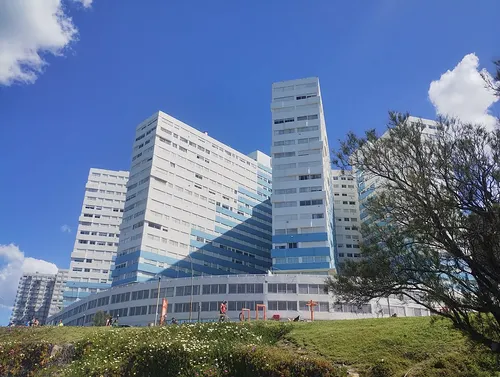
    Behind the lookout stands the building everyone photographs, four separate blocks pushed out toward the water. Locals call it Cuatro Dedos, four fingers, and the nickname does the rest. Here is the catch: the Cuatro Dedos is private housing, with no public visits of any kind, so admire it from the promenade.

    There is nothing to climb and nothing to book; the promenade is the stop. Give it ten minutes with the cape and the open water.

    Then comes the second long leg of the day: 2,380 m and about 32 minutes back to Bustillo's other building, the Hotel Provincial.

    Hours
    Exterior viewing freely accessible 24/7 along public coastal promenade
    Price
    Free (viewpoint, no admission)
  7. 7

    Hotel Provincial

    Hotel Provincial in Mar del Plata, stop 7 on the self-guided walking tour

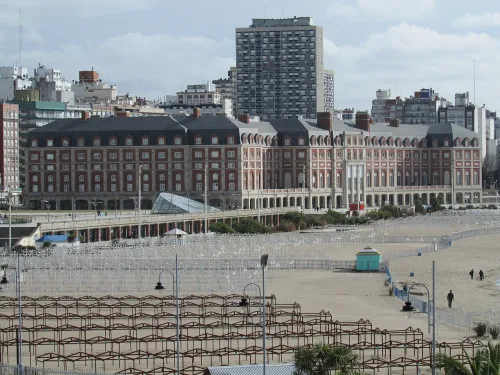
    You are now looking at the twin of the casino you started at. Bustillo designed both in 1937 in his Neoclassical manner with strong French inspiration, adapted, in his own words, to the local environment. The casino and the esplanade went up quickly; President Ramón Castillo opened the Rambla in December 1941. The hotel, planned with 500 rooms, took much longer. The structure was finished in 1948, and the Hotel Provincial opened on 18 February 1950, for a long time the largest hotel in Argentina. Its neighbour held a record of its own: Casino Central was the largest casino in the world by floor space until the Trump Taj Mahal opened in Atlantic City in 1990.

    Inside, the lobby had murals by César Bustillo, the architect's son, and decoration planned by the same Jean-Michel Frank and Casa Comte team as the casino. The hotel hosted many editions of the Mar del Plata Film Festival and the 2010 Ibero-American Summit, and guests included Gina Lollobrigida and Paul Newman.

    The glamour did not last without interruption. Operation of the publicly owned hotel was privatised in 1984 and handed to Empresa Hotelera Americana; after years of losses the operator pulled out at the end of 1998, and the province closed the doors. The building stood empty for a decade until NH Hotels of Madrid made an offer in April 2008. A US$30 million refurbishment directed by local architect Alejandro Novakovsky followed, and the hotel reopened on 8 February 2009 with 469 rooms, 12 suites and a convention centre across 77,500 m².

    Today it is a working NH hotel with no tourist visits; guided tours are suspended. Enjoy it from the Rambla Casino, where the façade and its twin line up best.

    The beach is right there: 170 m, about two minutes.

    Hours
    Exterior view accessible 24/7 from Rambla Casino; interior operating as NH hotel (reception 24/7 for guests, no public tourist visits)
    Price
    No admission (working NH hotel; guided visits suspended)
  8. 8

    Playa Bristol

    Playa Bristol in Mar del Plata, stop 8 on the self-guided walking tour

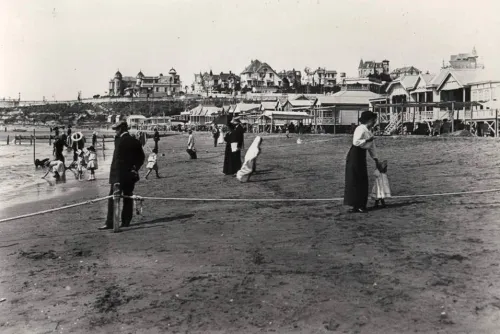
    Playa Bristol is where the resort began, and it takes its name from a hotel that no longer exists. In the mid-19th century there was a small port here, and the rancher Patricio Peralta Ramos, whose name the coastal avenue carries, founded the first settlement by the sea. The railway arrived in 1886 and brought the first holidaymakers.

    The early hotels were simple until the Bristol Hotel opened in 1888: three storeys, three blocks long, built for wealthy families who came to bathe in the sea. Many leading citizens of Buenos Aires took the overnight train for the opening. Wooden promenades and the first residences followed, and when Mar del Plata became a city in 1907 the resort was already called the Biarritz of Argentina, the same model Bustillo had in mind for the casino behind you. In 1913 a French-style rambla opened, with Belgian ceramic paving, balustrades and Greco-Roman statues. Through the late 1920s rich families built chalets near the hotel and lived here from November until Easter.

    Then the beach changed hands. Locals began using their own section, the Playa Popular, and some of the wealthy moved on to Playa Chica and Playa Grande south of the city. Mar del Plata became a destination for Peronist social tourism, no longer only for the rich. The French rambla was demolished in the 1940s, and the Bristol Hotel is gone too.

    The beach also holds a darker memory. On the afternoon of 10 October 1946, more than eight hundred false killer whales stranded on the shores of Mar del Plata, most of them here. They came in tight groups and made no attempt to return to the water. Some people stabbed or shot them or cut off their fins, until a police guard was posted to stop it. As the bodies decomposed they were towed 3 km out to sea; the waves brought some back, and two skeletons were dissected.

    Free and open at any hour, it is the place to end the walk: shoes off, a quarter of an hour on the sand, and the whole story of the city's seaside life around you.

    Hours
    Open 24/7
    Price
    Free
Walking tour route map of Mar del Plata Route loaded
Casino CentralCatedral de los Santos Pedro y CeciliaVilla Ortiz Basualdo (Museo Castagnino)Torre Tanque+4
All 8 stops are already on the map.
You just press start.
AI Tour Guide

You've read the route. Now walk it with a guide in your ear.

Press start wherever you are, even hundreds of kilometres from Mar del Plata, and the guide begins telling its stories right away. In the city, pick any of the 8 stops to start from: it leads you there, then talks with you the whole route, asking, listening, remembering, and shaping the tour around your answers.

8stops 7.7km 1 h 47 minwalking 13languages
▶Start the tour free

Free to start · Runs in your browser · No app, no download

Shorter Ways to Walk Mar del Plata

Not everyone has an afternoon for the full loop. These three cuts follow the recommended order and stay on the same legs, so the walking times add up exactly.

Casino and city centre

Stops: 1, 2, 3

For a short first look or a grey morning: the twin of Bustillo's seafront ensemble, the cathedral and the main square. 1,390 m and 19 minutes of walking, no admission anywhere, though the casino floor is only for adults.

From the sea up to Stella Maris

Stops: 1, 2, 3, 4, 5

For art and architecture lovers who want the hill but not the long coastal return. 4,040 m and 58 minutes of walking; the museum and the water tower are ticketed, so pick a weekday other than Tuesday.

Hill, cape and beach

Stops: 4, 5, 6, 7, 8

For anyone staying near Stella Maris or arriving in the early afternoon: museum, tower, the cape lookout, the grand hotel and the beach. 4,080 m and 55 minutes of walking, with the museum and tower as the only paid stops.

How Long This Mar del Plata Tour Takes with the Museum and the Tower

The 7.7 km take 1 h 47 min of pure walking, but two legs carry most of it: 33 minutes from Plaza San Martín up to the villa, and 32 minutes from the Cabo Corrientes lookout back to the Hotel Provincial. Everything else is short hops.

A start at Casino Central around 12:15 works out like this: cathedral at 12:44, Plaza San Martín at 13:14, the villa at 13:57, about 35 minutes in the museum, Torre Tanque at 14:41, the lookout at 15:11, the Hotel Provincial at 15:53 and Playa Bristol at 16:05. With a quarter of an hour on the sand you finish around 16:20, roughly four hours in all.

The variants shrink accordingly: casino and city centre take about 70 minutes with visits, the walk up to Stella Maris about 2 h 40 min, and the hill, cape and beach section about 2 h 20 min.

Before You Set Off from the Casino

  • Start and finish: The recommended start is Casino Central, the finish is Playa Bristol. You can join at any stop; the order here is simply the one that flows best.
  • Best days: Choose your day with care. The museum and the water tower are not open every day, and you want both on the same walk.
  • Time of day: Start shortly after midday so you reach the villa as the museum opens and still catch the tower before it closes.
  • Costs: Only the museum and the Torre Tanque charge admission. The casino, cathedral, square, lookout, hotel exterior and beach are free.
Walking tour route map of Mar del Plata
AI Tour Guide

Your guide is ready when you reach the casino.

Press start and a voice AI Tour Guide takes it from here: leading the route through Mar del Plata, telling the stories, and turning your walk into a real back-and-forth conversation. No app or download is needed; it runs in your browser.

8stops 7.7km 1 h 47 minwalking 13languages
▶Start the tour free

Free to start · Runs in your browser · No app, no download

What the AI Tour Guide Adds Between Casino and Cape

On a route where the same names keep coming back, Bustillo, Peralta Ramos, President Castillo, the AI Tour Guide ties the threads together as you walk. It greets you at the casino, tells the stories at each place, asks what you care about, architecture, art or the city's social history, and leans the conversation that way. You can interrupt any time, for instance to hear more about Juan Carlos Castagnino as a muralist or what Peronist social tourism meant for the families who came to Playa Bristol. The route itself stays as it is; the GPS navigation leads you from stop to stop.

A Real Conversation A voice AI Tour Guide greets you, leads the whole route, and tells the stories and facts as you walk, asking what you want to see and keeping a real conversation going. Not a recording you press play on.
Map Navigation Follow the route on the map and walk at your own pace. You choose where to start and when to move to the next stop.
Ask Anything Curious about a building you pass? Ask your AI Tour Guide on the spot and the conversation carries on.
13 Languages Switch language anytime. No separate tour needed.
Start free in your browser

Common Questions About This Walk

Are there discounts at the museum and the water tower?

Yes. At Villa Ortiz Basualdo residents, retirees and students pay a reduced price. At Torre Tanque students, retirees and residents get a reduced ticket as well, and children and holders of a CUD go in free.

Can I do the walk in the morning instead?

The free stops, yes, and the cathedral crypt and the water tower suit a morning visit. The museum, though, is an afternoon visit, so a morning walk means seeing the villa from outside.

How do I get back to the casino from Playa Bristol?

The GPS navigation in your browser can lead you from the last stop back to the start if you want it to.

Is the tour really free?

Yes. The whole tour is free: the route, the interactive map and the navigation cost you nothing. Only the voice AI Tour Guide is optional and paid: you test it with 100 free credits, then you pay either €5 per hour or €19.99 for this whole tour, with no time limit. Admission to 2 of the 8 stops is not included: Villa Ortiz Basualdo (Museo Castagnino) and Torre Tanque charge their own entry fees.

Do I need to download an app?

No. Everything runs in your phone browser. Open the route and start walking, no download and no sign-up required.

Do I need to book the walking tour in advance?

No booking needed. This self-guided tour is available anytime. Open the route in your browser and start walking. The AI Tour Guide works instantly, no app, no reservation required.

What languages is the AI Tour Guide available in?

The AI Tour Guide speaks 13 languages, so you take the tour in your own language and can switch at any time.

Can I skip stops or change the route?

Yes. Skip any stop, spend extra time at places you like, or start the route from any point. It is your walk, you set the pace.
Image credits
▶ Start free in your browser Runs in your browser, no app, no download