Free Walking Tour Montevideo: Ciudad Vieja and the Port

Thirteen stops on 3.3 km: Artigas in his crypt, a city gate rebuilt stone by stone, asado under Liverpool iron and a tango first played in a pastry shop.

13 Stops 3.3 km ~45 min walking
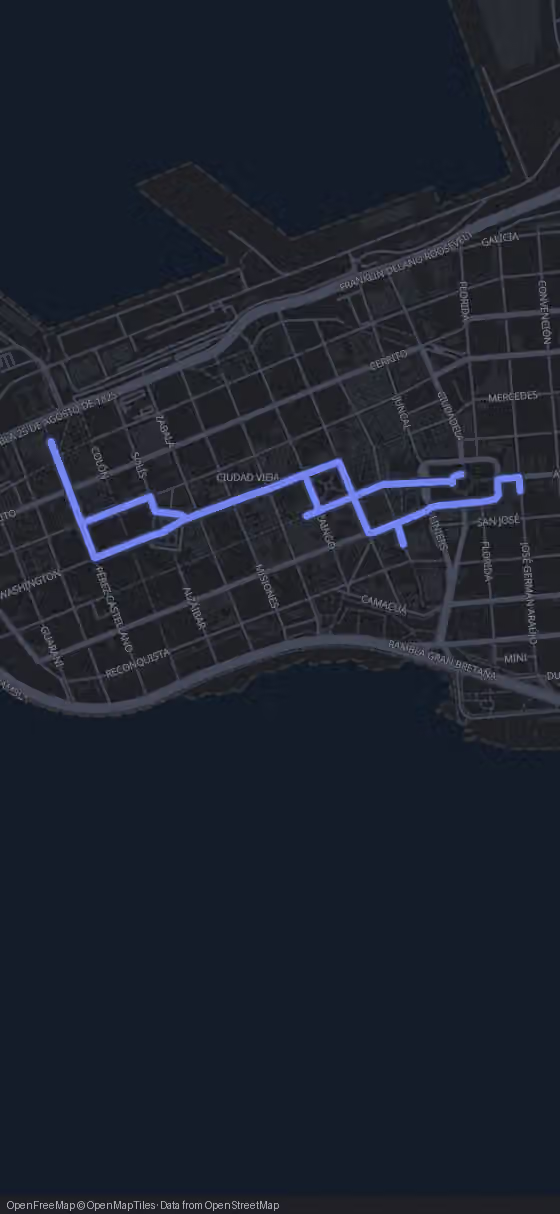
Route map for the Montevideo walking tour
Stop 1 of 13
40 m·1 min
Plaza Independencia
Head west across the plaza toward the Mausoleo de Artigas
Hola, welcome to Montevideo. I'm Alex, and this city preserved a doorway long after the fortress around it vanished.
Try this tour with Alex

Your Route Through Montevideo at a Glance

This walk links 13 stops, from Plaza Independencia through the Ciudad Vieja to the port and back to Palacio Salvo. It covers 3.3 km with 45 minutes of pure walking; with lunch and the best interiors, plan a full day.

The squares, the Mausoleo de Artigas, the Catedral Metropolitana and several museums are free. Museo Torres García, Museo de Arte Precolombino e Indígena, the Teatro Solís tour and the Palacio Salvo tower charge entry. The GPS route in your browser is free; the AI Tour Guide is optional.

Open free GPS & optional AI Tour Guide
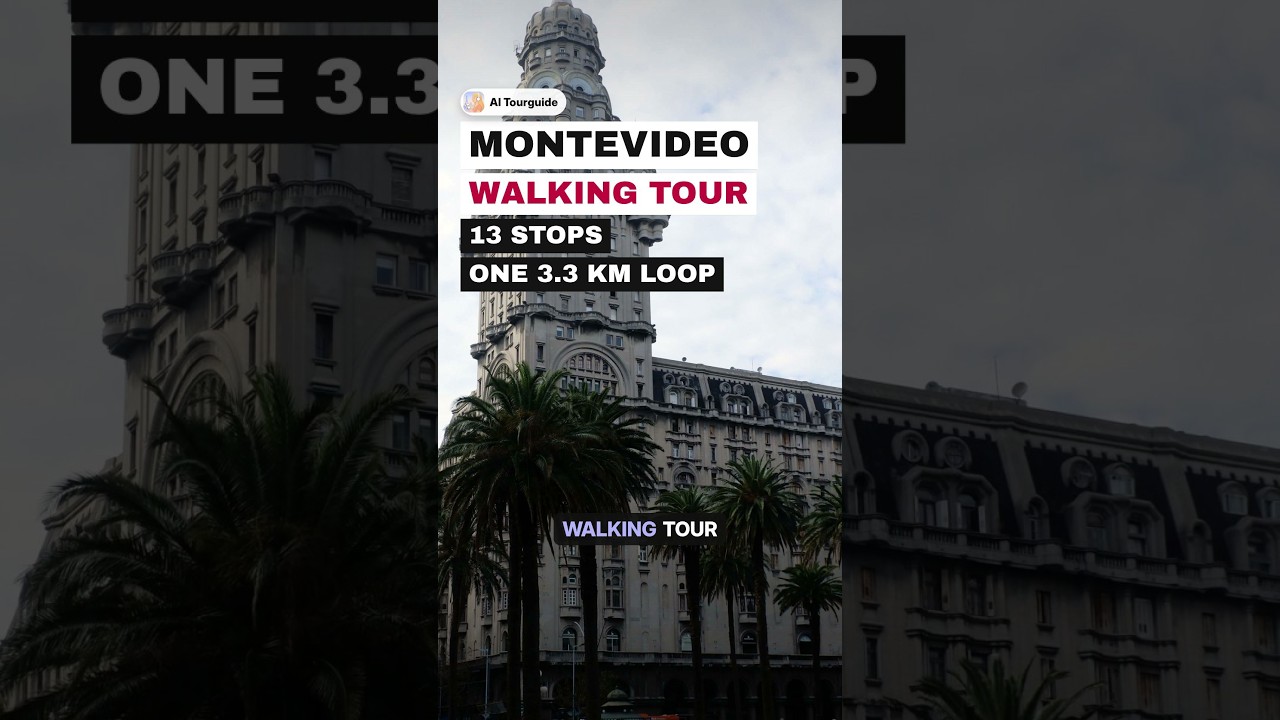
This short shows highlights of the route. All 13 stops follow below.

The Route

Walking Map of Montevideo, from Plaza Independencia to the Port

13 stops 3.3 km 45 min walking
Tap to load interactive map

The 13 stops along this route

  1. Plaza Independencia in Montevideo, stop 1 on the self-guided walking tour
    1Plaza Independencia
  2. Mausoleo de Artigas in Montevideo, stop 2 on the self-guided walking tour
    2Mausoleo de Artigas
  3. Puerta de la Ciudadela in Montevideo, stop 3 on the self-guided walking tour
    3Puerta de la Ciudadela
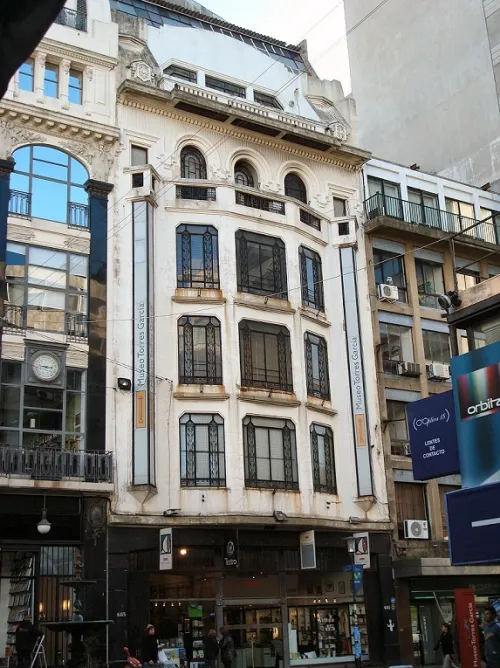
  4. Museo Torres García in Montevideo, stop 4 on the self-guided walking tour
    4Museo Torres García
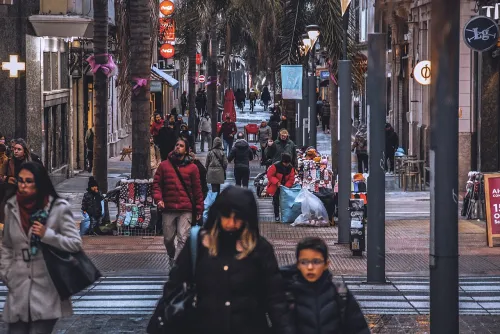
  5. Peatonal Sarandí in Montevideo, stop 5 on the self-guided walking tour
    5Peatonal Sarandí
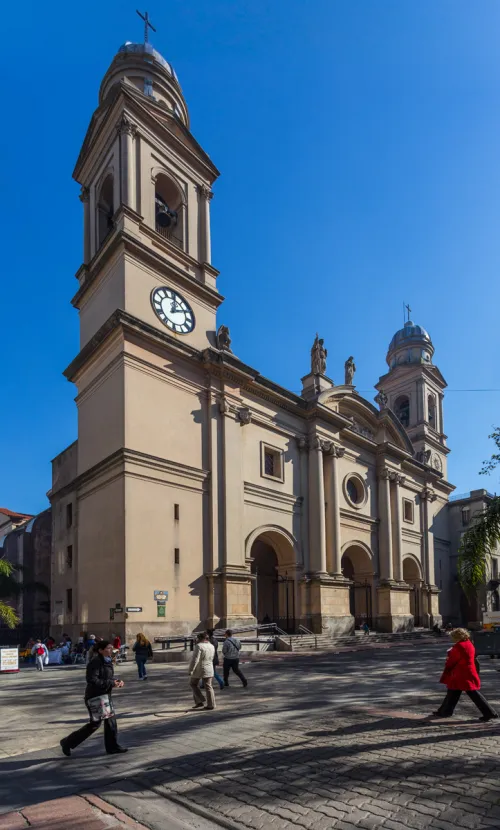
  6. Catedral Metropolitana in Montevideo, stop 6 on the self-guided walking tour
    6Catedral Metropolitana
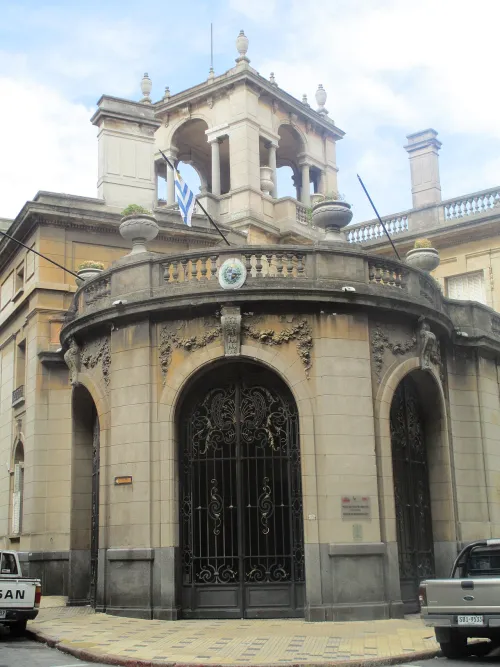
  7. Palacio Taranco in Montevideo, stop 7 on the self-guided walking tour
    7Palacio Taranco
  8. Museo de Arte Precolombino e Indígena in Montevideo, stop 8 on the self-guided walking tour
    8Museo de Arte Precolombino e Indígena
  9. Mercado del Puerto in Montevideo, stop 9 on the self-guided walking tour
    9Mercado del Puerto
  10. Plaza Zabala in Montevideo, stop 10 on the self-guided walking tour
    10Plaza Zabala
  11. Cabildo de Montevideo, stop 11 on the self-guided walking tour
    11Cabildo de Montevideo
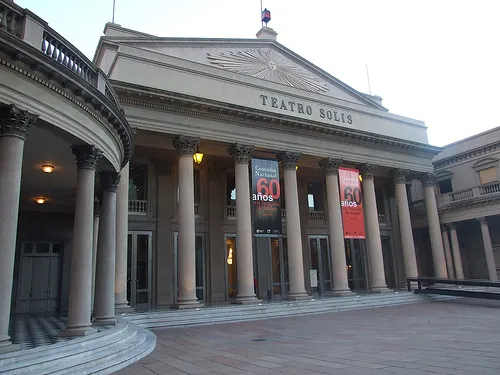
  12. Teatro Solís in Montevideo, stop 12 on the self-guided walking tour
    12Teatro Solís
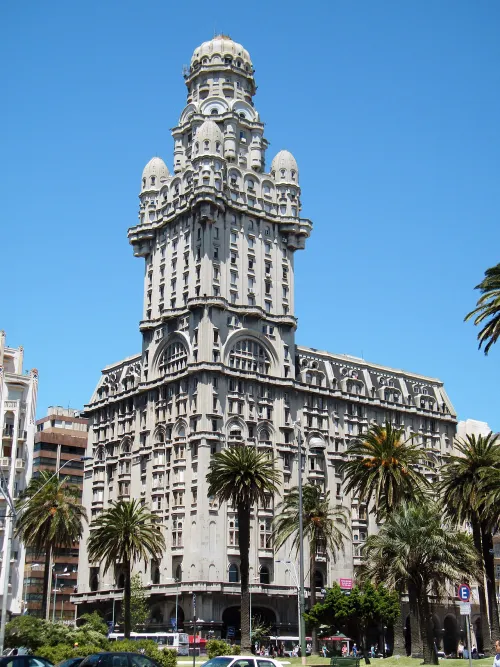
  13. Palacio Salvo in Montevideo, stop 13 on the self-guided walking tour
    13Palacio Salvo
  14. That's the full route.

    Walk it with an AI Tour Guide talking you through every one of these streets.

    Start free in your browser
    You made it

Your Montevideo Walking Tour Through the Ciudad Vieja, Stop by Stop

  1. 1

    Plaza Independencia

    Plaza Independencia in Montevideo, stop 1 on the self-guided walking tour

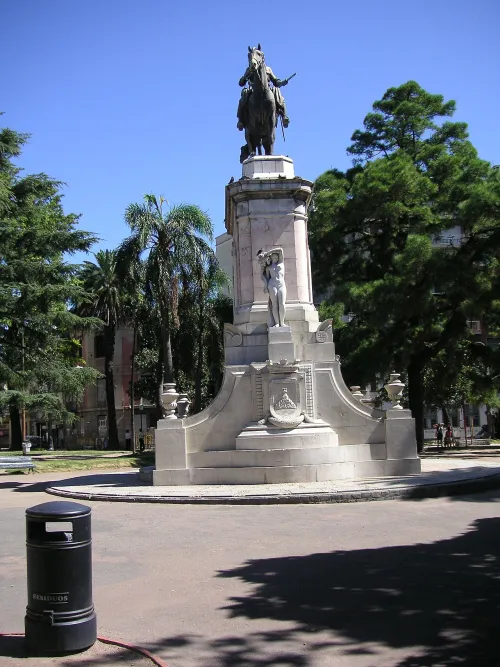
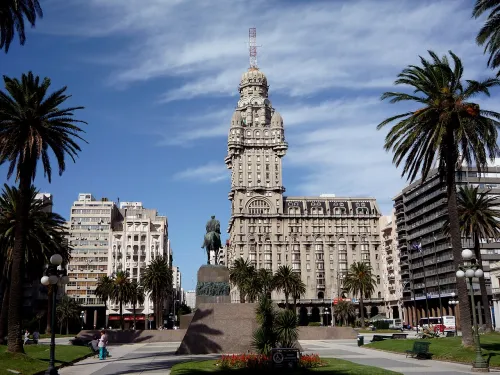
    You start in the middle of Montevideo's main square, right where the old fortified city ends and the modern one begins. Around you stand buildings this walk comes back to: the tower of Palacio Salvo and the Teatro Solís, along with the Estévez Palace and the Executive Tower. The square has long been the stage for big political demonstrations and official ceremonies, so if you find a crowd or a parade here, you are seeing it used exactly as intended.

    The ground under your feet once held the Citadel of Montevideo. After independence the colonial walls came down, the city spilled outward, and in 1837 the Ciudad Nueva, the New City, was planned. Architect Carlo Zucchi drew this square, reportedly with the Rue de Rivoli in Paris in mind. In the 19th century the Estévez Palace, then the seat of government, gave the square its national weight.

    For decades the square itself stayed largely bare. Only at the start of the 20th century did French landscape architect Carlos Thays lay out four French-style parterres with fountains and plant his trademark palms. They are symbolic: they stand for the Thirty-Three Orientals, the leaders of the 1825 expedition that began Uruguay's fight for independence.

    In the centre rises General José Gervasio Artigas on horseback, a 17-metre bronze on a granite base by sculptor Angelo Zanelli, unveiled in 1923 under President Baltasar Brum. Walk 40 metres to the foot of the monument: the national hero himself rests directly underneath.
    Hours
    Open 24/7
    Price
    Free
  2. 2

    Mausoleo de Artigas

    Mausoleo de Artigas in Montevideo, stop 2 on the self-guided walking tour

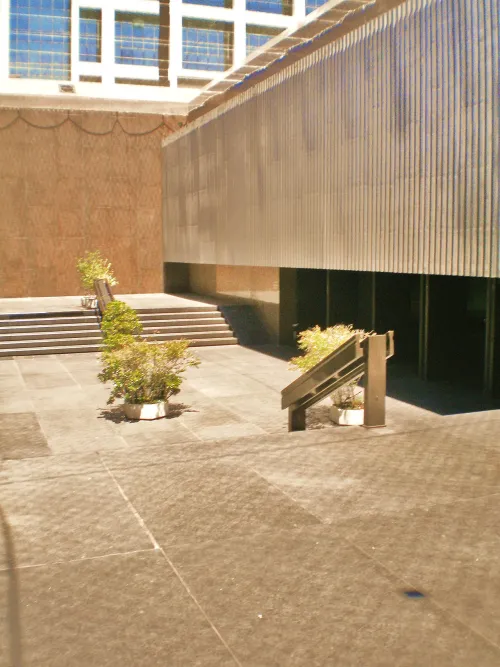
    Under the equestrian statue lies the Mausoleo de Artigas, the resting place of Uruguay's founding hero. A permanent guard from the Regimiento de Blandengues de Artigas watches over the remains, so expect uniformed soldiers and keep your voice low.

    The wish to honour Artigas here is much older than the crypt. Under President Máximo Santos a law approved a monument to the man by then seen unanimously as the founder of the nation. This square was chosen because it linked the old and the new city, and on 25 August 1884, the anniversary of the Declaration of Independence, the foundation stone was laid. Sculptor Federico Soneira won the design competition the following year, but his monument was never built.

    Twenty years passed before the idea returned. During the first government of José Batlle y Ordóñez two laws moved it forward: one shifted the monument to Joaquín Suárez from in front of the Estévez Palace to a small square on Avenida Agraciada, the other funded the new monument and a fresh competition.

    The crypt itself has a darker origin. The civic-military dictatorship approved it on 27 September 1974 and built it between 1974 and 1977. Until then the remains of Artigas, who died in exile in Paraguay in 1850, had rested in the National Pantheon of the Central Cemetery.

    Entry is free and the mausoleum sits right on your path, so it costs you little time. From here it is 70 metres to the Puerta de la Ciudadela.

    Local name
    Mausoleo de José Gervasio Artigas
    Hours
    From 1 Sep 2026: Mon–Fri 09:00–13:00 and 14:30–18:00; Sat, Sun and holidays 09:00–18:00
    Price
    Free
    Website
    gub.uy ↗
  3. 3

    Puerta de la Ciudadela

    Puerta de la Ciudadela in Montevideo, stop 3 on the self-guided walking tour

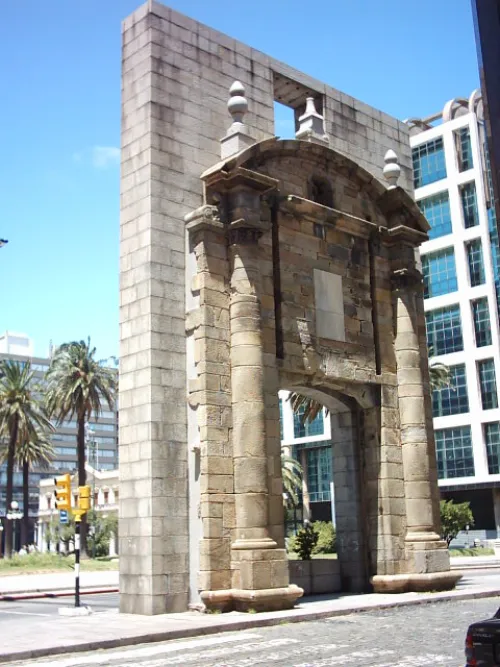
    This stone gateway is the last piece of the Citadel, the great fortress the Spanish built in the 18th century to defend walled Montevideo from the land side, on the ground that is now Plaza Independencia. It marks the start of the Ciudad Vieja and has become one of the city's best-known symbols.

    Its survival is a story of wandering. In 1877, as Montevideo grew beyond its walls, the last fortifications of the old town were torn down together with the Citadel, and the gate was dismantled stone by stone. It moved between several sites and finally served as the back gate of the former School of Arts and Trades on Calle Gonzalo Ramírez, today the Universidad del Trabajo del Uruguay.

    In 1959 it came home, rebuilt piece by piece and aligned with the axis of Peatonal Sarandí, just a few metres from its original spot. Walk round to the back: a buttress-like structure had to be built to give the free-standing portal solid support. Weathering forced another restoration in 2009.

    Pass through the arch and you are in the old town. The Museo Torres García is only 50 metres along the pedestrian street.

    Hours
    Open 24/7
    Price
    Free
  4. 4

    Museo Torres García

    Museo Torres García in Montevideo, stop 4 on the self-guided walking tour

    Joaquín Torres García was a teacher, writer and painter, and the founder of Constructive Universalism. His museum fills a five-storey art deco building at Sarandí 683, on the site of Casa Broqua & Scholberg, one of the great bazaars of Montevideo's golden age.

    The museum has moved almost as much as the city gate. After the artist's death in 1949, his widow Manolita Piña led family and friends in creating it. It opened on 28 July 1955 on Avenida 18 de Julio, moved in 1967 to the basement of the Ateneo de Montevideo, home of the Taller Torres García, and stayed closed from 1975 through the years of the dictatorship. In 1986 the family set up the Fundación Torres García, and an agreement between the Generalitat of Catalonia and the Uruguayan state paid for this building, in use since 1990. His eldest daughter, Olimpia Torres Piña, led the foundation until her death in 2007.

    The exhibitions spread over three floors. You follow the transformations of his work, shaped by his travels and personal life, alongside pieces by artists from his workshop and circle such as José Gurvich and his son Augusto Torres. The archive holds letters, thousands of pages, sketches, hand-drawn books and unpublished manuscripts, and the museum runs art workshops.

    If modern or Latin American art interests you, this is the interior to choose this morning, and it charges entry. Then walk 280 metres, about 4 minutes, further along Peatonal Sarandí.

    Local name
    Museo Joaquín Torres García
    Hours
    Mon–Sun 10:00–18:00
    Price
    UYU 400 visitors / UYU 200 residents in Uruguay (with CI)
  5. 5

    Peatonal Sarandí

    Peatonal Sarandí in Montevideo, stop 5 on the self-guided walking tour

    Peatonal Sarandí is the main lane of the historic centre: 850 metres of pedestrian street from the Citadel gate to Peatonal Pérez Castellano. The last four blocks down to the Rambla carry traffic again, and beyond them the long southern breakwater of the port continues the line under the name Escollera Sarandí. Trams ran here until the mid-20th century; the street became pedestrian in 1992 and was redesigned in 2005. Its name recalls the Battle of Sarandí of 1825.

    In colonial times this was the spine of the city. It ran from the main gate across the plaza mayor, today Plaza Constitución, past the cathedral and the Cabildo, the seat of government.

    On 25 August 1897, President Juan Idiarte Borda was leading a procession along this street, from an independence anniversary service in the cathedral towards the Estévez Palace, when he was shot dead. It remains Uruguay's only presidential assassination.

    Look down as you walk: since April 2010 the Paseo de los Soles has set 60 cm tiles into the paving, each with a 16-rayed sun with a face, like the one on the Uruguayan flag, and the name of a figure from Uruguayan culture or a famous visitor. Look up for the Edificio Pablo Ferrando next to the Museo Torres García, the Plaza Fuerte Hotel and the Club Uruguay, plus galleries and shops. The Catedral Metropolitana is 60 metres on.

    Hours
    Open 24/7
    Price
    Free
  6. 6

    Catedral Metropolitana

    Catedral Metropolitana in Montevideo, stop 6 on the self-guided walking tour

    The mother church of Uruguay's Catholics stands on Plaza de la Constitución, better known as Plaza Matriz, at the corner of Sarandí and Ituzaingó. It is dedicated to the Immaculate Conception and has been a National Historic Monument since 1975. The Cabildo across the square comes later on the walk, on your way back to the centre.

    Work began in 1790 as a parish church, and it was consecrated on 21 October 1804 although still unfinished. Pope Pius IX made it a minor basilica in 1870, it became a cathedral eight years later, and with the founding of the archdiocese in 1897 it became the metropolitan cathedral. Until the early decades of the 20th century it was the tallest building in the city, until new building rules let others rise past it.

    Read the neoclassical facade from bottom to top: three portals in the form of a triumphal arch, then three small windows and a broken round pediment. The two bell towers at the sides also hold the facade steady. Inside, the vaulted central nave rises about 16 metres, and a dome on a windowed drum crowns the crossing.

    Entry is free, and it is worth going in for the marble, the baptismal font from 1753 and the two baroque pulpits on the eastern pillars of the nave. From here it is 510 metres, about 7 minutes, to Palacio Taranco.

    Local name
    Catedral de Montevideo
    Hours
    Mon–Sat 09:00–18:00, Sun 10:00–12:30
    Price
    Free
  7. 7

    Palacio Taranco

    Palacio Taranco in Montevideo, stop 7 on the self-guided walking tour

    This French palace faces Plaza Zabala and has housed the Museo de Artes Decorativas since 1972. The block once held the Casa de Comedias, Montevideo's first theatre, and later the Teatro San Felipe. The square in front gets its own visit later, after the port.

    The brothers José, Félix and Hermenegildo Ortiz de Taranco arrived in Uruguay at the end of the 19th century, bought the plot with the ruins of the theatre and in 1907 commissioned the French architects Charles Louis Girault, who designed the Petit Palais in Paris, and Jules León Chifflot. John Adams's firm, also behind the British Hospital, built it. The architects sent 72 handwritten plans and 29 watercolours with instructions for the decoration.

    The house had to fit an unusual family. José and Hermenegildo never married, while Félix wed Elisa García de Zúñiga and had seven children, and the three brothers, very close, always lived together. They exchanged many letters with the architects asking for changes. The Paris firm Casa Krieger sent designs for ornaments and furniture; the brothers kept many and rejected others, which you can trace in the original watercolours on display. The rest of the art and furniture they bought on trips to Europe.

    The family lived here until Félix died in 1940, and in 1943 the state bought the palace with its furniture. It is free and well worth going in if you like grand interiors. Then walk 190 metres through the streets of the Ciudad Vieja to the Museo de Arte Precolombino e Indígena.

    Hours
    Tue–Sat 11:00–18:00, Sun–Mon closed
    Price
    Free
  8. 8

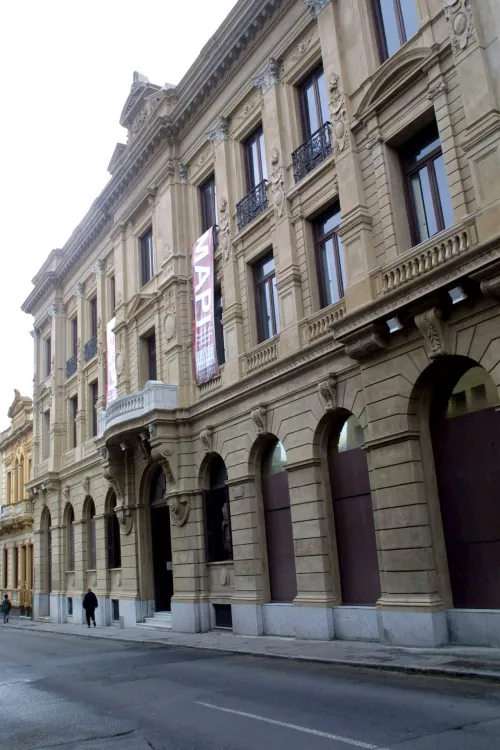
    Museo de Arte Precolombino e Indígena

    Museo de Arte Precolombino e Indígena in Montevideo, stop 8 on the self-guided walking tour

    The MAPI opened in 2004 through an agreement between the city of Montevideo and the collector Matteo Goretti, who brought in a large part of his collection. Since then it has grown to more than seven thousand objects through donations from private owners and public institutions, including the Faculty of Architecture and the National Library.

    Two collections connect with what you have already seen. The Augusto Torres and Elsa Andrada collection, objects from Indigenous peoples of North America, comes from the son of Joaquín Torres García. The Dr. Arturo Lezama collection holds objects and human remains from the Bañadero archaeological site in Salto, recovered in 1975. The museum also looks after Claudio Rama Vitale's collection of around nine hundred Latin American masks.

    The building has its own odd story. Dr. Emilio Reus built it between 1883 and 1888 as a hydrotherapy clinic, but it never opened as one. Instead it housed the Ministry of Development and then the Ministry of National Defence until 1985. A year later it was declared a National Historic Monument as an example of eclectic, strongly Italian-influenced architecture.

    The museum charges entry, and if you have time for only one museum on the port side, choose this one for the masks. The Mercado del Puerto is 250 metres on, about 3 minutes.

    Hours
    Mon–Sat 10:30–18:00 (entry until 17:30), Sun closed
    Price
    UYU 250 general, UYU 200 university students, UYU 100 high school students & Uruguayan pensioners; free for children under 12; free Mondays 10:30-14:00 (until 18:00 for Uruguayans)
  9. 9

    Mercado del Puerto

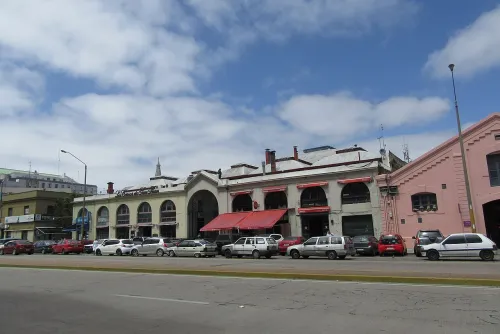
    Mercado del Puerto in Montevideo, stop 9 on the self-guided walking tour

    Under a great iron roof, the old port market no longer sells produce: it is filled with restaurants serving traditional Uruguayan food, above all asado grilled over open-fire parrillas, plus souvenir shops. Live tango and displays of Uruguayan traditions also belong to the scene here.

    The market was the project of the Spanish merchant Pedro Sáenz de Zumarán, whose company wanted one of the largest markets in South America. British engineers designed it, and its ironwork was made in Liverpool. President Lorenzo Batlle y Grau and his ministers opened it on 10 October 1868, as a wholesale market for fruit and vegetables that supplied both the port and the town.

    Look up at the centre of the hall. A round iron fountain once stood here; in 1897 it gave way to the four-faced clock, also shipped from Liverpool, that still marks the heart of the building. After ups and downs in the 20th century, the stalls turned into restaurants from the 1970s, and in 1976 the market became a National Historic Monument.

    Walking in is free. On this route it is the natural place for a long lunch. Afterwards, Plaza Zabala is 520 metres away, about 8 minutes.

    Hours
    Mon–Sat 09:00–17:00, Sun 10:00–17:00 (individual restaurants open until 22:00, outdoor terraces/bars until 00:00)
    Price
    Free
  10. 10

    Plaza Zabala

    Plaza Zabala in Montevideo, stop 10 on the self-guided walking tour

    Plaza Zabala breaks the Ciudad Vieja's tidy grid: it sits at an angle, because it follows the outline of the Fuerte Grande, the first building raised here when the city was founded. The French landscape architect Édouard-François André designed it in the spirit of Belle Époque gardens, and it is the only square in Montevideo that still keeps its iron railings. It has been a National Historic Monument since 1975.

    The fort later gave way to the colonial Casa de Gobierno. In late 1878, under the dictatorship of Colonel Lorenzo Latorre, the government house was demolished to make room for a public square, yet the site lay empty for 12 years. The square finally opened on 31 December 1890.

    It is named after Bruno Mauricio de Zabala, the Spanish soldier who founded Montevideo. His equestrian statue, by Spanish sculptor Lorenzo Coullaut Valera with Basque architect Pedro Muguruza Otaño, was unveiled on 27 December 1931. Even the street around the square honours him: Circunvalación Durango is named after his home town of Durango in Biscay.

    Stand in the centre and turn slowly: on three of the four sides you can see the water of the Río de la Plata or the bay. On the north side are Palacio Taranco and the house of Sáenz Zumarán, the same name as the market's founder, now a bank. From here it is 560 metres, about 8 minutes, to the Cabildo, passing the Museo Histórico Nacional on the way.

    Hours
    Open 24/7
    Price
    Free
  11. 11

    Cabildo de Montevideo

    Cabildo de Montevideo, stop 11 on the self-guided walking tour

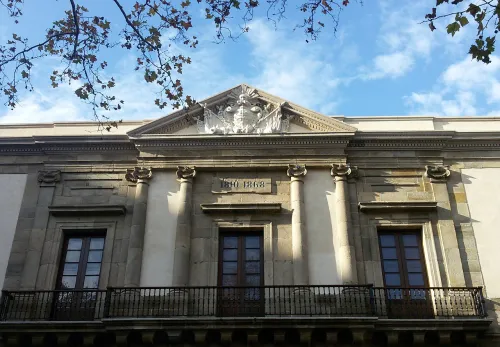
    Back on Plaza Matriz, opposite the Catedral Metropolitana, stands the old seat of colonial government. Work began in 1804 under master builder Tomás Toribio, and in colonial times it held both the Cabildo and the royal jails. On 18 July 1830, Uruguay's first Constitution was sworn in one of its rooms.

    The council had earlier, humbler homes: first the house of Captain Pedro Gronardo, then from 1737 a building on this same corner of today's Juan Carlos Gómez and Sarandí. As trade made Montevideo richer in the late 18th century, that shaky building no longer fitted, and the present one went up in its place, facing the plaza mayor and the church as the Laws of the Indies prescribed. It combined administration, courts and cells.

    Building it took from 1804 until 1869, through the British invasions, the Revolución Oriental and independence. When Toribio died in 1810, his son José took over. After 1830 it hosted the General Assembly while still serving as a prison until the late 19th century; when the Palacio Legislativo opened in 1925, the chambers moved out and the Foreign Ministry moved in.

    Today it is the Museo Histórico Cabildo de Montevideo, free to enter, and an after-lunch visit fits easily. The Teatro Solís is 270 metres away, about 3 minutes.

    Hours
    Mon–Fri 11:00–17:45, Sat & non-working holidays 11:00–17:00, Sun closed
    Price
    Free
  12. 12

    Teatro Solís

    Teatro Solís in Montevideo, stop 12 on the self-guided walking tour

    Uruguay's most important theatre opened in 1856, right next to Plaza Independencia. Its architect was Carlo Zucchi, the same man who laid out the square where you started. It takes its name from Juan Díaz de Solís, the first European explorer to land in what is now Uruguay.

    The idea goes back to 1833, when a group of influential citizens set out to build a new theatre. In 1840 they won government approval, and the board under Juan Francisco Giró met for the first time on 16 June. They imagined a cultural centre for the young Eastern State of Uruguay, a place of harmony and prosperity. It was also, quite openly, a place for the elite to be seen and to show off social and political standing.

    On 14 September 1878, Tomás Giribaldi's La Parisina, considered the first Uruguayan national opera, premiered here. A major reconstruction began in 1998 and ended with the reopening in August 2004; look for the two columns designed by Philippe Starck. The acoustics were entrusted to Jerome Falala of the French studio Avel Acoustique.

    Guided tours of the theatre charge entry, so check the tour times before you arrive. If you would rather see a performance, tickets are sold at the box office. Palacio Salvo is 470 metres on, about 7 minutes.

    Hours
    Guided tours: Wed–Fri 16:00; Sat–Sun 15:00 & 16:00 (Box office daily 15:00–19:00)
    Price
    Guided tours: UYU 400 foreigners / UYU 200 nationals; free on Wednesdays
  13. 13

    Palacio Salvo

    Palacio Salvo in Montevideo, stop 13 on the self-guided walking tour

    You finish where you began, at the corner of Avenida 18 de Julio and Plaza Independencia, under the tower you have seen all day. The brothers Ángel, José and Lorenzo Salvo, who bought the plot for 650,000 pesos, completed it in 1928. It has 27 storeys and stands 101 metres tall, 105 metres with the beacon on top. For a short time it was the tallest building in Latin America, and at its completion the tallest reinforced concrete structure in the world. It has been a National Historic Monument since 1996.

    The architect, Mario Palanti, was an Italian immigrant living in Buenos Aires, and he used a similar design for the Palacio Barolo there; if you continue to Buenos Aires, look out for its twin. The style mixes Renaissance references, Gothic echoes and Neoclassical touches into a silhouette that became an emblem of the city's prosperous early 20th century.

    Before the tower, this corner held the pastry shop La Giralda, where Gerardo Matos Rodríguez first played La Cumparsita in 1917, the tango that is now a cultural symbol of Uruguay. The Tango Museum inside tells the story of the song and of Uruguayan tango. The basement, now a car park, once held a theatre where Joséphine Baker, the Lecuona Cuban Boys and Jorge Negrete performed. Planned as a hotel, the building ended up as offices and homes, with 370 residential units.

    To see it from inside, take the paid 30-minute tour with the observation deck. If you finish the walk late in the day, you may need to come back another day for it.

    Hours
    Mon–Fri: 10:00–18:00 | Sat: 10:00–14:00 | Sun: 12:00–16:00
    Price
    UYU 600 for the guided tour (about 45 min, incl. terrace and viewpoint); children 6 to 12 UYU 300, under 6 free
Walking tour route map of Montevideo Route loaded
Plaza IndependenciaMausoleo de ArtigasPuerta de la CiudadelaMuseo Torres García+9
All 13 stops are already on the map.
You just press start.
AI Tour Guide

You know the route now. Walk it with a guide in your ear.

Press start wherever you are, even hundreds of kilometres from Montevideo, and the guide begins telling its stories right away. In the city, pick any of the 13 stops to start from: it leads you there, then talks with you the whole route, asking, listening, remembering, and shaping the tour around your answers.

13stops 3.3km 45 minwalking 13languages
▶Start the tour free

Free to start · Runs in your browser · No app, no download

Shorter Ways to Walk the Ciudad Vieja

You can join the route at any stop, so it splits naturally into three pieces that also work on their own.

Plaza Independencia to the cathedral

Stops: 1, 2, 3, 4, 5, 6

For a first morning or a short layover: the square, Artigas, the old gate, one art museum and the main pedestrian street. Walking time is about 8 minutes in total. Only the Museo Torres García charges entry; the mausoleum and the cathedral are free.

Museums and lunch by the port

Stops: 7, 8, 9, 10

For anyone who likes interiors and a long lunch. Walking time is about 13 minutes. Palacio Taranco is free, the Museo de Arte Precolombino e Indígena charges entry, and the Mercado del Puerto costs nothing until you order.

Afternoon back to the square

Stops: 10, 11, 12, 13

For an afternoon of history and views. Walking time is about 18 minutes. The Cabildo is free; the Teatro Solís tour and the Palacio Salvo tower charge entry, so time your arrival around the theatre's tour slot.

How Long Does This Montevideo Tour Take with Lunch and Museums?

The 3.3 km take 45 minutes of pure walking, and most legs are short. The first four stops sit within about 160 metres of each other; the longest stretches, from the Mercado del Puerto to Plaza Zabala and on to the Cabildo, take 8 minutes each.

If you only look from outside, about two hours is enough. With the interiors that repay the time, it becomes a full day. A weekday plan: start at 10:00 on Plaza Independencia, reach the Museo Torres García around 10:35, Palacio Taranco just before noon, the Museo de Arte Precolombino e Indígena around 12:40 and the Mercado del Puerto for lunch around 13:25. Leave at about 14:40, and after Plaza Zabala and the Cabildo you reach the Teatro Solís in time for its afternoon tour. Palacio Salvo is 7 minutes on.

Each of the shorter variants fills a morning or an afternoon: the first about 90 minutes with the art museum, the port section about three hours with lunch, the last about two hours including the theatre tour.

Before You Set Off in Montevideo

  • Start: Plaza Independencia is the recommended start, but you can join at any stop and the GPS route leads you on from there.
  • Finish: Palacio Salvo, on the edge of Plaza Independencia, so you end where you began.
  • Best day and time: Pick a day when the museums on the route are open. Start around 10:00 so you reach Palacio Taranco before noon.
  • Costs: The walk and most stops are free. Bring Uruguayan pesos for the Museo Torres García, the Museo de Arte Precolombino e Indígena, the Teatro Solís tour and the Palacio Salvo tower, plus lunch at the Mercado del Puerto.
Walking tour route map of Montevideo
AI Tour Guide

Your guide is waiting at Plaza Independencia whenever you are.

Press start and a voice AI Tour Guide takes it from here: leading the route through Montevideo, telling the stories, and turning your walk into a real back-and-forth conversation. No app or download is needed; it runs in your browser.

13stops 3.3km 45 minwalking 13languages
▶Start the tour free

Free to start · Runs in your browser · No app, no download

What the AI Tour Guide Adds in Montevideo

The stories on this route are written for reading; the AI Tour Guide turns them into a conversation as you walk. It greets you on Plaza Independencia, tells each place's story, asks what caught your eye and remembers it, so a soldier's crypt or a forgotten bazaar gets more time if that is what you care about. Ask it who Artigas really was and why a dictatorship wanted him under the square, or what Constructive Universalism means in front of a Torres García canvas, and interrupt whenever you like. You start with 100 free credits; after that, choose this tour all-inclusive for €19.99 with no time limit, or €5 per hour.

A Real Conversation A voice AI Tour Guide greets you, leads the whole route, and tells the stories and facts as you walk, asking what you want to see and keeping a real conversation going. Not a recording you press play on.
Map Navigation Follow the route on the map and walk at your own pace. You choose where to start and when to move to the next stop.
Ask Anything Curious about a building you pass? Ask your AI Tour Guide on the spot and the conversation carries on.
13 Languages Switch language anytime. No separate tour needed.
Start free in your browser

Common Questions About Walking Montevideo

What happens at the Mercado del Puerto on New Year's Eve?

At midday on 31 December the market area turns into a large street party with a traditional water and cider fight. Locals and visitors join in, so expect to get wet.

Are there reduced entry prices for residents or students?

Yes. The Museo Torres García and the Teatro Solís tours are cheaper for Uruguayan residents and nationals, and the Museo de Arte Precolombino e Indígena offers reductions for students and Uruguayan pensioners.

Which day is best for the walk?

A weekday, when the museums along the route are open. On other days the squares, the mausoleum, the market and the views from outside still work, so the walk keeps much of its appeal.

Where can I walk next after Montevideo?

For another day in Uruguay, try the walks in Colonia del Sacramento or Punta del Este.

Is the tour really free?

Yes. The whole tour is free: the route, the interactive map and the navigation cost you nothing. Only the voice AI Tour Guide is optional and paid: you test it with 100 free credits, then you pay either €5 per hour or €19.99 for this whole tour, with no time limit. Admission to 3 of the 13 stops is not included: Museo Torres García, Museo de Arte Precolombino e Indígena and Palacio Salvo charge their own entry fees.

Do I need to download an app?

No. Everything runs in your phone browser. Open the route and start walking, no download and no sign-up required.

Do I need to book the walking tour in advance?

No booking needed. This self-guided tour is available anytime. Open the route in your browser and start walking. The AI Tour Guide works instantly, no app, no reservation required.

What languages is the AI Tour Guide available in?

The AI Tour Guide speaks 13 languages, so you take the tour in your own language and can switch at any time.

Can I skip stops or change the route?

Yes. Skip any stop, spend extra time at places you like, or start the route from any point. It is your walk, you set the pace.
Image credits
▶ Start free in your browser Runs in your browser, no app, no download