

Teatro Greco
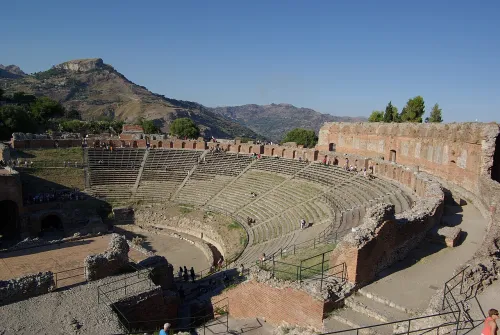
Start where Taormina looks its grandest. The Teatro Greco is the second-largest ancient theatre in Sicily, after the one in Syracuse, and its name tells only half the story. Greeks built a first theatre here in the 3rd century BC to stage plays. In the 2nd century BC a Roman building rose over it, and in the 2nd century AD the Romans turned it into an arena and enlarged the auditorium considerably. From then on the shows were gladiator fights and animal hunts, not tragedies.
Because it was built on the older Greek theatre, it is set into the hillside, while Roman theatres usually stood free. Some rows of the cavea were cut straight into the rock and already seated about 5,400 people; the lowest row measures 62 m across, the highest 147 m. The whole complex is 120 m long, 50 m wide and 20 m high, divided into stage, orchestra and cavea.
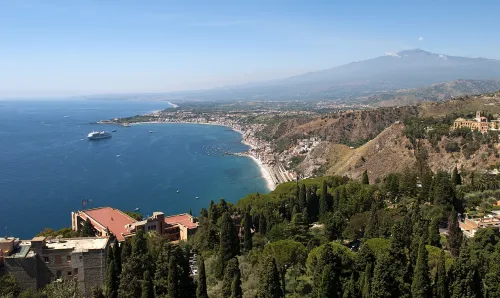
Now face the stage building. The Romans built it of brick, with a two-storey show front towards the audience: niches where statues once stood, and columns set in front. After the empire fell the theatre decayed and suffered in wars; in the 19th century the stage building was partly reconstructed, and the marble columns you see were put up between 1835 and 1840. Then look through the opening, about ten metres wide: it frames Etna and the bay of Giardini-Naxos. Goethe stood here too.
Beside the theatre, the Antiquarium is a small archaeological museum. Most finds went to museums in Naples, Messina and Syracuse, but look for a marble base whose inscription records that Tauromenion won a horse-racing title at the ancient Olympic Games. The theatre charges admission, and it is worth it for anyone; give it about an hour. Then it is 360 m, about 4 minutes, to Palazzo Corvaja.