Free Walking Tour Palermo: Normans, Markets, Mummies

Gold mosaics in the Palatine Chapel, street food at the Capo, the Capuchin friars' catacombs: one free walk through Norman, Spanish and baroque Palermo.

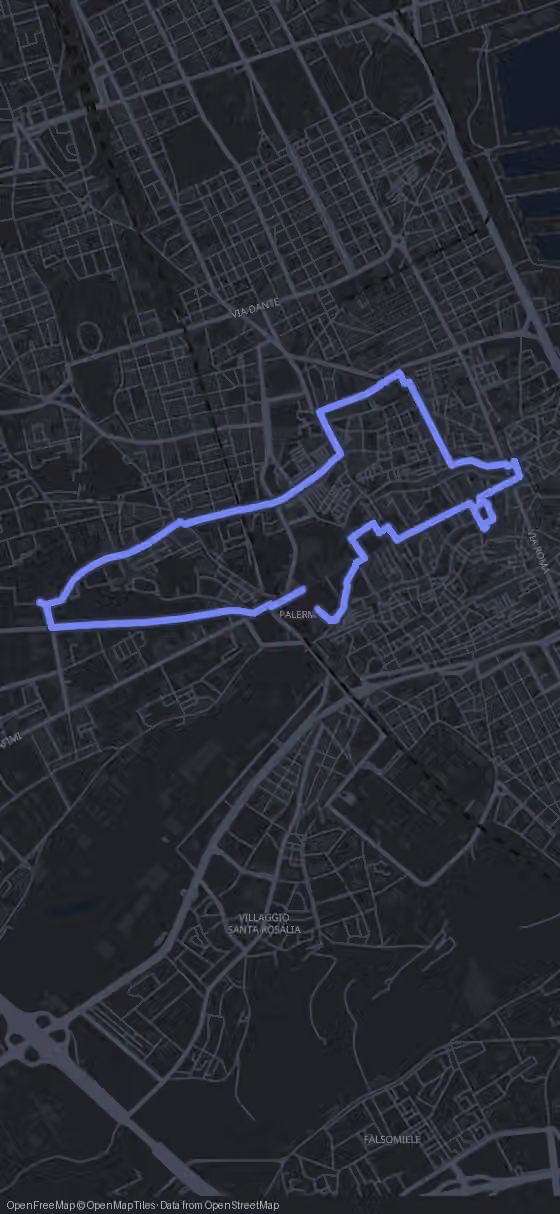
12 Stops 6.2 km ~1 h 25 min walking
Route map for the Palermo walking tour
Stop 1 of 12
40 m·1 min
Norman Palace
Head south from the ticket courtyard to the Palatine Chapel
Ciao, welcome to Palermo. I'm Alex, and one royal chapel here brings three medieval cultures together in a single room.
Try this tour with Alex

This Palermo Route at a Glance

Twelve stops lead from the Norman Palace through the old centre and out to Porta Nuova, which stands right beside the palace. The loop covers 6.2 km with 1 h 25 min of pure walking; with lunch and the interiors worth paying for, plan about six hours.

The squares, the fountain, both markets and the nave of Palermo Cathedral are free. The palace with its chapel, the two small churches on Piazza Bellini, the Teatro Massimo and the Capuchin Catacombs charge admission. Route, map and GPS navigation are free in your browser; the AI Tour Guide is optional.

Open free GPS & optional AI Tour Guide
View of Palermo

The Route

Walking Map of Palermo, from the Palace to the City Gate

12 stops 6.2 km 1 h 25 min walking
Tap to load interactive map

The 12 stops along this route

  1. Norman Palace in Palermo, stop 1 on the self-guided walking tour
    1Norman Palace
  2. Palatine Chapel in Palermo, stop 2 on the self-guided walking tour
    2Palatine Chapel
  3. Palermo Cathedral, stop 3 on the self-guided walking tour
    3Palermo Cathedral
  4. Quattro Canti in Palermo, stop 4 on the self-guided walking tour
    4Quattro Canti
  5. San Cataldo Church in Palermo, stop 5 on the self-guided walking tour
    5San Cataldo Church
  6. Church of the Martorana in Palermo, stop 6 on the self-guided walking tour
    6Church of the Martorana
  7. Fontana Pretoria in Palermo, stop 7 on the self-guided walking tour
    7Fontana Pretoria
  8. Vucciria Market in Palermo, stop 8 on the self-guided walking tour
    8Vucciria Market
  9. Teatro Massimo in Palermo, stop 9 on the self-guided walking tour
    9Teatro Massimo
  10. Capo Market in Palermo, stop 10 on the self-guided walking tour
    10Capo Market
  11. Capuchin Catacombs in Palermo, stop 11 on the self-guided walking tour
    11Capuchin Catacombs
  12. Porta Nuova in Palermo, stop 12 on the self-guided walking tour
    12Porta Nuova
  13. That's the full route.

    Walk it with an AI Tour Guide talking you through every one of these streets.

    Start free in your browser
    You made it

The Palermo Walking Tour, Stop by Stop from Palace to Porta Nuova

  1. 1

    Norman Palace

    Norman Palace in Palermo, stop 1 on the self-guided walking tour

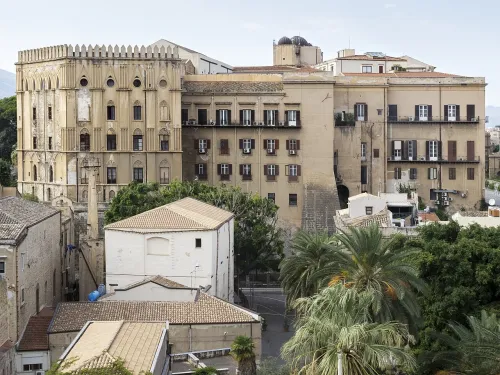
    Start where Palermo's rulers have sat for most of the city's history. The Norman Palace stands on the highest point of the old town, and the ground beneath it is older than any king: in 1984, digs under the Duke of Montalto Halls uncovered a Punic structure. Under Arab rule the first nucleus of the building rose here between two rivers, the Kemonia and the Papireto, built with the defensive features of a fortress, and it remained in use in Byzantine times.

    After the Norman conquest in 1072, the new masters built a castle that was both royal residence and seat of government. Four towers marked its core, and inside were workshops and textile laboratories, the tiraz, where the court's luxury fabrics were made. Roger II was crowned the first Norman king of Sicily in 1130, and his successors William I, nicknamed "the Mean", and William II, "the Good", ruled a court where Latin, Greek and Arab cultures met. Roger's grandson Frederick II kept the palace at the centre of power and of culture, supporting the poets of the Sicilian School. It is counted as the oldest royal residence in Europe.

    The Angevins and Aragonese let it decline; Spanish viceroys revived it in the late 16th century. Since 1946 the Sicilian Regional Assembly has met here, so this is still a working seat of government as well as a monument.

    Go in: one ticket covers the royal rooms, the gardens and the Palatine Chapel, and the chapel alone justifies it. Buy the official ticket and add the official audio or video guide rather than paying many times more for a group tour; you see the same rooms. The chapel is 40 metres away, a minute's walk inside the same complex.
    Hours
    Mon–Sat 08:30–16:30 (last admission), Sun & Holidays 08:30–12:30 (last admission)
    Price
    19 EUR full, 17 EUR reduced
  2. 2

    Palatine Chapel

    Palatine Chapel in Palermo, stop 2 on the self-guided walking tour

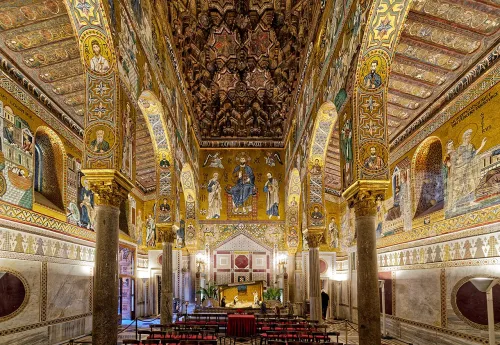
    Roger II commissioned this royal chapel in 1132, building it over an older chapel from around 1080 that survives as the crypt. It took eight years to build, and the mosaics were only partly finished by 1143. Dedicated to Saint Peter, it mixes three worlds in one room: a Byzantine plan with three apses, Norman builders, and a Fatimid ceiling.

    Look up first. The nave is covered by a muqarnas ceiling, the honeycomb vaulting of the Islamic world, and the rectangular form of the chapel shows the same Fatimid influence. Six pointed arches, three on each side of the nave, rest on classical columns reused from older buildings. The oldest mosaics are probably those of the ceiling, the drum and the dome.

    Then turn to the transept, where Byzantine artists of the 1140s worked. On the north wall you see Saint John in the desert and a landscape with the Lamb of God; below stand five Greek fathers of the church, among them Basil, Gregory the Theologian and John Chrysostom, the three the Orthodox church honours as the Three Hierarchs. Notice the elongated figures and flowing robes, and how the colour and light shift as you move; every scene sits in an ornamental frame, much like an icon.

    Since 2015 the chapel has been part of the UNESCO site "Arab-Norman Palermo and the Cathedral Churches of Cefalù and Monreale", which is a good reason to add Cefalù to your Sicily plans. If you pay for only one interior on this walk, make it this one. From the palace it is 590 metres, about 8 minutes, to the cathedral.

    Local name
    Cappella Palatina
    Hours
    Mon–Sat 08:30–16:30 (last admission), Sun & Holidays 08:30–12:30 (last admission)
    Price
    19 EUR full, 17 EUR reduced
  3. 3

    Palermo Cathedral

    Palermo Cathedral, stop 3 on the self-guided walking tour

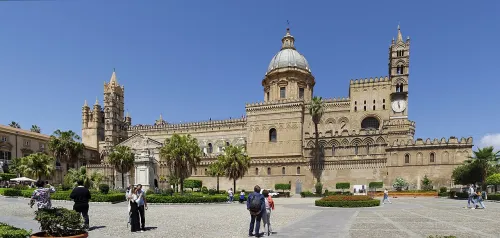
    What you see is eight centuries of building in one block. Walter Ophamil, the Norman archbishop of Palermo and minister to King William II, raised the church in 1185 on the site of an earlier Byzantine basilica, said to have been founded by Pope Gregory I and turned into a mosque after the Arab conquest in the 9th century. Ophamil himself lies in a sarcophagus in the crypt.

    Walk around it before you go in. The main entrance today is the wide south porch in Gothic-Catalan style, with three arches, built around 1465 and opening onto the square. On the western side, on Via Matteo Bonello, the façade keeps its 14th and 15th century look: a Gothic portal between two towers, with a 15th century Madonna in the niche above. Two pointed arches span the street and connect the façade to the bell tower, which belongs to the Archbishops' Palace, now the Museo Diocesano, crowned by small belfries and arcades.

    The neoclassical look comes from works between 1781 and 1801 under Ferdinando Fuga and Giuseppe Venanzio Marvuglia. Fuga added the great dome and the smaller domes over the aisles; in the process the great altarpiece by Gagini, with its statues, friezes and reliefs, was taken apart and its sculptures scattered around the church.

    The nave is free, so step inside even if you are short on time; the ticket desks at the entrance sell only the treasury, the crypt and the rooftops. The rooftop terraces are worth paying for separately if you want the view. From here you follow Via Vittorio Emanuele for 600 metres, about 8 minutes, passing RISO, the regional museum of contemporary art, on the way to Quattro Canti.

    Hours
    Mon–Sat 07:00–19:00, Sun 08:00–13:00, 16:00–19:00
    Price
    Free (church); optional monumental area tickets 1.00-15.00 EUR
  4. 4

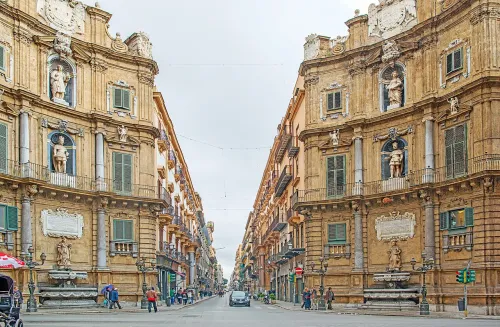
    Quattro Canti

    Quattro Canti in Palermo, stop 4 on the self-guided walking tour

    You are standing on the crossing that organises the whole old city. The street you just walked, the Cassaro, today Corso Vittorio Emanuele, has been Palermo's main street since Arab rule in the 9th century, running from the Norman Palace. In the 17th century it was extended and widened all the way to the sea, and in 1608 the Spanish viceroy Maqueda cut a second great street across it at a right angle: Via Maqueda.

    The two streets split the old town into four quarters: Albergheria, the Capo (Seralcadio), Loggia and Kalsa. Their meeting point became an octagonal square, begun in 1608 and finished in 1620. Its official name is Piazza Vigliena, after the viceroy who had it built; locals also call it the Teatro del Sole, because throughout the day the sun falls on one of the corner façades.

    The Florentine architect Giulio Lasso put a palace on each corner, with curved façades in three tiers. Read them from bottom to top: fountains at street level stand for the four seasons; above them, the Spanish kings Charles V, Philip II, Philip III and Philip IV; at the top, the patron saints of the four quarters, Agatha, Cristina, Ninfa and Oliva. Turn slowly on the spot to take in all four corners.

    It is free and always open. San Cataldo is 140 metres away, a two minute walk.

    Hours
    Open 24/7
    Price
    Free
  5. 5

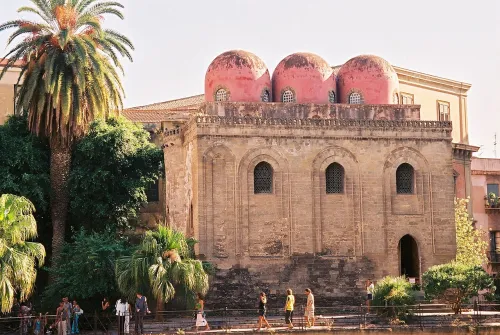
    San Cataldo Church

    San Cataldo Church in Palermo, stop 5 on the self-guided walking tour

    The three red domes in a row are the giveaway: this small church near Piazza Bellini is one of the images Palermo uses for its Norman era, because East and West meet so plainly in its forms. It was founded by Maio of Bari while he was the king's grand admiral, between 1154 and 1160.

    Maio did not enjoy it for long. He was murdered in 1160 and his property sold; the chapel built in his houses is identified as San Cataldo because his young daughter Matilda, who died in 1161, was buried here. The inscription recording her burial is still on an inside wall near the entrance, so look for it as you go in. Maio's roots in Apulia may explain both the dedication to Saint Cataldo, a bishop of Taranto, and the row of three domes, a building type from his home region.

    Later the Benedictines of Monreale looked after the church until 1787. Then it was swallowed by a neoclassical building and even served as a post office, until Giuseppe Patricolo restored it in 1882 to its original severe form. Inside it is bare stone, and that is the point.

    Admission is charged but the visit is short, so it suits anyone curious about how the Normans built. The Martorana is 50 metres away, practically next door.

    Hours
    Daily 10:00–13:30, 14:00–18:00 (Mar–Oct); Daily 09:00–13:30, 14:00–17:00 (Nov–Feb)
    Price
    2.50 EUR full, 1.50 EUR reduced
  6. 6

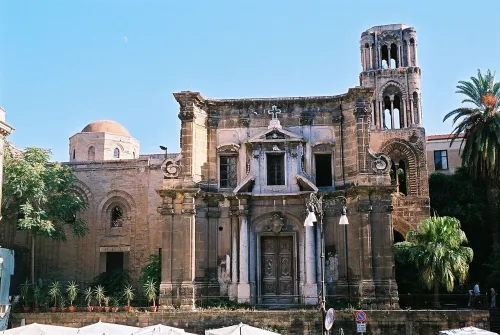
    Church of the Martorana

    Church of the Martorana in Palermo, stop 6 on the self-guided walking tour

    Officially this is Santa Maria dell'Ammiraglio, the church of the admiral, but everyone calls it the Martorana. It overlooks Piazza Bellini beside San Cataldo and faces the baroque church of Santa Caterina, and it is part of the same UNESCO site as the Palatine Chapel since 2015.

    It is still a living church with an unusual community. It serves as the parish of San Nicolò dei Greci and co-cathedral of the Eparchy of Piana degli Albanesi: the Arbëreshë, descendants of Albanians who fled Ottoman persecution to southern Italy and Sicily from the 15th century, celebrate the Byzantine rite here in Greek and Albanian. They belong to the Catholic Church but keep the traditions of the East, visible in their icons, their liturgy and their language. If a service is under way when you arrive, wait quietly at the back.

    Over the centuries many tastes were added, so the styles overlap. Before you go in, look at two of the entrance columns: they carry Arabic inscriptions in Kufic script, one quoting a verse of the Quran and the other a basmala. Inside, a Christian inscription in Arabic, painted on wood, is set into the mosaics of the dome.

    Admission is charged, with a separate ticket that adds the wider complex. Fontana Pretoria is 130 metres away, two minutes on foot.

    Hours
    Daily 10:00–18:00 (winter) / 18:30 (summer); Divine Liturgy Mon–Sat 09:00, Sun 11:00
    Price
    4 EUR full (church), 6 EUR full (church & complex); 3 EUR / 5 EUR reduced
  7. 7

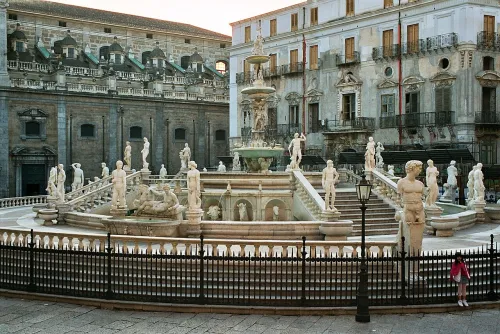
    Fontana Pretoria

    Fontana Pretoria in Palermo, stop 7 on the self-guided walking tour

    This fountain was never meant for Palermo. The Florentine sculptor Francesco Camilliani, a student of Baccio Bandinelli, made it in the 16th century for the garden of Don Luigi de Toledo in Florence, a garden without a palace, laid out on land pried from the nuns of San Domenico al Maglio. It had 48 statues and was framed by an arbour of 90 wooden columns designed by Bartolomeo Ammannati. Giorgio Vasari called it unparalleled in Florence and maybe in Italy.

    Then Luigi ran into deep debt. Brother of a former viceroy of Sicily and about to move to Naples, he sold the fountain to the city of Palermo in 1573. It was taken apart into 644 pieces and arrived on 26 May 1574; houses were demolished to make room, and the city Senate bought the building opposite and moved the city hall into it, the Palazzo Pretorio, which gave fountain and square their name.

    Not everything made the journey. Some statues broke in transit, others probably stayed with Luigi; two figures thought to be from the fountain are in the Bargello in Florence, and others went to Naples and later to a garden in Cáceres in Spain. As you circle the basins, look for the gaps in the crowd of marble figures.

    It is free and open at all hours, one block south of Quattro Canti beside Santa Caterina. The Vucciria is 320 metres on, about 4 minutes.

    Hours
    Open 24/7
    Price
    Free
  8. 8

    Vucciria Market

    Vucciria Market in Palermo, stop 8 on the self-guided walking tour

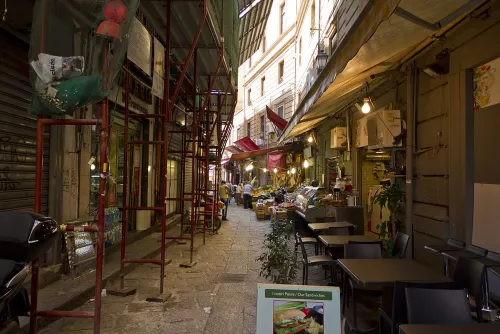
    The Vucciria is the oldest of Palermo's historic markets, in the Castellammare quarter, running through narrow lanes from Piazza Caracciolo near Via Roma down towards the old harbour of La Cala. Its name goes back to the sixteen years of Charles I of Anjou: the French word boucherie, butcher's shop, from the slaughterhouse that supplied the meat. Fish, fruit and vegetables came later, and a butcher in local dialect is still a vuccèri.

    In Palermo the word also came to mean confusion, the chaos of voices when the traders' calls drown each other out. The lanes are tight, the goods are piled close, and getting through can be a squeeze; that closeness to sellers, food and other shoppers is exactly the attraction. Cook stalls grill stigghiola and fry panelle in front of you.

    Look out for the Genio del Garraffo in his aedicula on Piazza Garraffello, a marble figure from 1483 of the city's guardian spirit, deeply rooted in popular belief. His restoration is part of a turnaround: until around 2010 the palaces here were visibly decaying, and since then residents have come to value the quarter again.

    Be honest with yourself about timing. By day locals consider the Vucciria very touristy, so walk through, look, and save your appetite for the Capo; the Vucciria comes into its own in the evening as a place to go out. From here it is 920 metres, about 13 minutes, to the Teatro Massimo.

    Hours
    Daily morning and afternoon (market stalls); street area open 24/7
    Price
    Free
  9. 9

    Teatro Massimo

    Teatro Massimo in Palermo, stop 9 on the self-guided walking tour

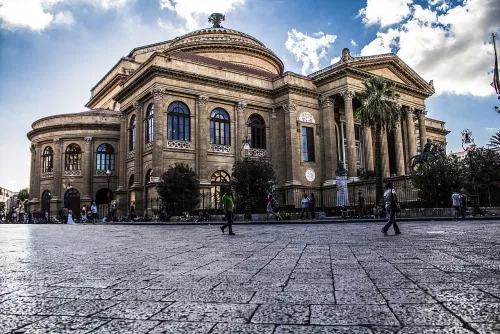
    The opera house on Piazza Verdi is the largest in Italy, and when it opened, with 7,730 square metres, only the Palais Garnier in Paris and the court opera in Vienna in all of Europe were bigger. It is dedicated to King Victor Emanuel II and famous for its acoustics.

    It was built to make a statement. After the unification of Italy in 1861, Palermo, then the second city of southern Italy after Naples, wanted a theatre worthy of its rank, and in 1864, prompted by mayor Antonio Starrabba di Rudinì, the council announced an international competition. Giovan Battista Filippo Basile designed it and oversaw the works; when he died in 1891, his son Ernesto Basile took over.

    The construction firm of Giovanni Rutelli and Alberto Machì built it from the foundations to the attic, and Rutelli was responsible for all the external decoration. He designed a steam-powered tower crane to lift the huge stone blocks and columns into place, a family of stone workers in Palermo going back generations.

    You get inside on a guided tour, which charges admission and suits anyone who wants to see the hall and the public rooms. Even from the square the columned front is worth a few minutes. The Capo Market is 380 metres away, about 5 minutes.

    Hours
    Daily 09:30–19:00 (last tour 18:20)
    Price
    14 EUR full, 7 EUR reduced (under 26)
  10. 10

    Capo Market

    Capo Market in Palermo, stop 10 on the self-guided walking tour

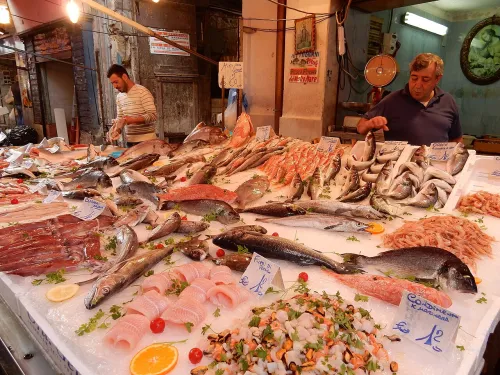
    Five minutes from the opera house you are back in market territory, in the quarter that gave the Capo its name. The stalls run along Via Porta Carini and Via Beati Paoli, and of the two markets on this walk this is the more traditional one: a working food market where Palermitans shop, first and foremost, with the scene coming second.

    Make this your lunch stop. Arancina, sfincione, pane con panelle and pani ca meusa are the city's standing street food circuit, and you eat them right there between the stalls; finish with a cannolo or a granita.

    From late October the stalls pile up frutta di Martorana, marzipan shaped like fruit and named after the church you saw on Piazza Bellini. On 2 November, the feast of the dead, Sicilian children traditionally receive sugar figures and marzipan fruit.

    Eat properly here: the next leg is the longest of the day, 1,730 metres or about 25 minutes, out to the Capuchin Catacombs.

    Hours
    Mon–Sat 07:00–20:00, Sun 07:00–13:00 (market stalls); street area open 24/7
    Price
    Free
  11. 11

    Capuchin Catacombs

    Capuchin Catacombs in Palermo, stop 11 on the self-guided walking tour

    This is the strangest stop on the route and, for many, the one they talk about afterwards. In the 16th century Palermo's Capuchin monastery ran out of space in its cemetery, and the friars began to dig crypts beneath it. In 1599 they mummified one of their own, Brother Silvestro of Gubbio, and placed him down here.

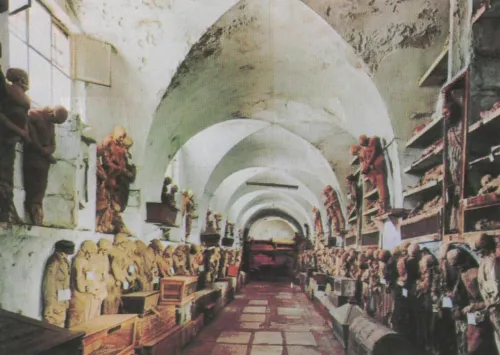
    The bodies were dried on racks of ceramic pipes and sometimes washed with vinegar later; some were embalmed, others sealed in glass cases. Friars kept their everyday habits, sometimes with the ropes they had worn in penance. At first only friars were laid here, but over the centuries it became a status symbol. Leading citizens wrote in their wills which clothes they wanted to be preserved in, some even asking to have them changed at intervals. Priests wear their vestments, everyone else the fashion of their day.

    Walk the corridors and notice the order: clergy, professionals, women and children each have their own sections, so the social ranks of the living continue among the dead. Relatives came to pray and keep their dead presentable, and paid for the privilege. As long as donations arrived, a body kept its place; if they stopped, it was moved to a shelf until payments resumed.

    Brother Riccardo, in 1871, was the last friar buried here; the catacombs officially closed in 1880, yet the last burials date from the 1920s and 1930s. Admission is charged and half an hour is enough. Porta Nuova is 1,310 metres away, about 17 minutes.

    Local name
    Catacombe dei Cappuccini
    Hours
    Daily 09:00–17:30 (last admission 17:10)
    Price
    5 EUR full, 3 EUR reduced
  12. 12

    Porta Nuova

    Porta Nuova in Palermo, stop 12 on the self-guided walking tour

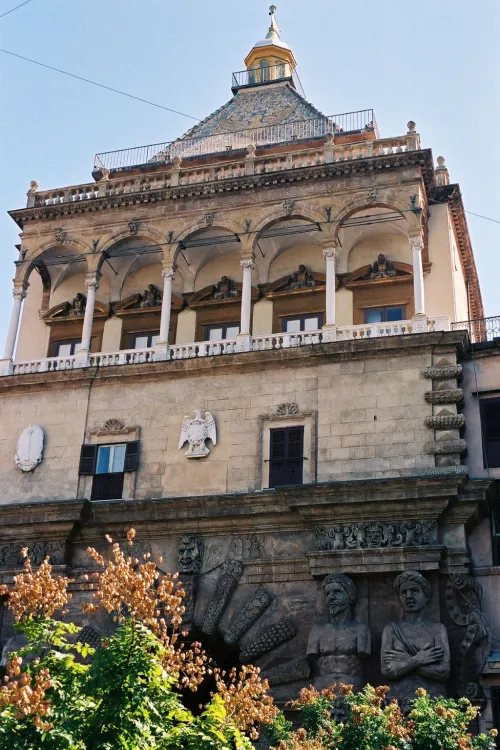
    You end beside the Norman Palace, at the gate that for centuries was the main way into Palermo by land. Inside it begins the Cassaro, the street you followed this morning; outside runs Corso Calatafimi, the road to Monreale, the obvious next trip for anyone who loved the Palatine Chapel.

    A first opening here, the Porta dell'Aquila, dates from 1460. On 13 September 1535 the emperor Charles V rode through it, coming from Monreale after his conquest of Tunis. The monumental gate you see was commissioned in 1583 by the viceroy Marcantonio Colonna to celebrate the victory over the Turks and the emperor's triumphs, a stone memory of that entry. Look at the rusticated base: four captive Moors carry the structure like columns.

    The Senate wanted it called Porta Austriaca, some records say Porta Imperiale, but the people of Palermo kept calling it Porta Nuova, the new gate, and the name stuck.

    On 20 December 1667 lightning set off gunpowder stored inside, and the gate was almost entirely destroyed. Gaspare Guercio rebuilt it in 1669 and crowned it with a pyramid roof covered in coloured majolica tiles showing eagles with spread wings. It is free and always there; take a last look at the tiled roof, and you are a few steps from where the walk began.

    Hours
    Open 24/7
    Price
    Free
Walking tour route map of Palermo Route loaded
Norman PalacePalatine ChapelPalermo CathedralQuattro Canti+8
All 12 stops are already on the map.
You just press start.
AI Tour Guide

You know the route now. Walk it with a guide in your ear.

Press start wherever you are, even hundreds of kilometres from Palermo, and the guide begins telling its stories right away. In the city, pick any of the 12 stops to start from: it leads you there, then talks with you the whole route, asking, listening, remembering, and shaping the tour around your answers.

12stops 6.2km 1 h 25 minwalking 13languages
▶Start the tour free

Free to start · Runs in your browser · No app, no download

Shorter Ways to Walk Palermo

Not everyone has a full day. These two cuts follow the recommended order and keep the walking legs exactly as on the full route.

Norman Palermo in a morning

Stops: 1, 2, 3, 4, 5, 6, 7

For anyone who came for the Arab-Norman monuments. From the Norman Palace and the Palatine Chapel past the cathedral to Quattro Canti, the two churches on Piazza Bellini and Fontana Pretoria: 22 minutes of walking in total. The palace ticket covers the chapel, San Cataldo and the Martorana charge their own admission, the cathedral nave, the crossroads and the fountain are free. With the interiors, allow around two and a half hours.

Baroque centre, markets and opera

Stops: 4, 5, 6, 7, 8, 9, 10

For food lovers and anyone who has already seen the palace. From Quattro Canti through Piazza Bellini, past the fountain into the Vucciria, on to the Teatro Massimo and lunch at the Capo: 27 minutes of walking. Only the two Piazza Bellini churches and the opera house tour cost money; skip them and the whole stretch is free. With lunch and the theatre tour, about two and a half hours.

How Long This Palermo Tour Takes, With and Without the Interiors

The pure walking time is 1 h 25 min, and most of it falls in the second half: the legs in the old centre are short, often a minute or two, while the stretch from the Capo Market out to the Capuchin Catacombs takes 25 minutes and the way back to Porta Nuova another 17.

With the palace and chapel (give them well over an hour), the cathedral nave, the two churches on Piazza Bellini, a Teatro Massimo tour, a proper lunch at the Capo and half an hour among the catacombs, the full route fills about six hours. If you stay outside everywhere except the free cathedral nave and still stop for lunch, it takes about three hours.

Before You Set Off in Palermo

  • Start and finish: The recommended start is the Norman Palace, but you can join the route at any stop. It ends at Porta Nuova, right beside the palace, so you finish practically where you began; the GPS navigation can also lead you back to the start.
  • Time of day: Start in the morning: the palace and chapel come first, the markets fall around midday and the Capo Market makes the natural lunch stop before the long walk to the catacombs.
  • Tickets: Admission is charged at the Norman Palace with the Palatine Chapel (one ticket), San Cataldo Church, the Church of the Martorana, the Teatro Massimo tour and the Capuchin Catacombs. Palermo Cathedral's nave, Quattro Canti, Fontana Pretoria, both markets and Porta Nuova are free.
  • Getting around: Walk. The old centre is compact and too narrow for sightseeing buses, which mostly circle the outside. If your legs give up on the way to the catacombs, a city AMAT bus is the cheap fallback; stamp your ticket as you board, because inspectors fine unvalidated tickets on the spot.
  • Cash: Bring cash for the market stalls and withdraw it from bank machines such as UniCredit or Intesa rather than the ATMs inside shops.

Street Food and Breaks Along the Route

Palermo's street food is the reason many people come, and on this route lunch belongs at a market stall, not at a tablecloth. Eat standing between the stands, and save the sit-down trattoria for the evening.

Street food lunch at the CapoPane con panelle, pani ca meusa, arancina and sfincione cost little and fill you up; a whole street food lunch comes in at a fraction of a restaurant meal with wine. This is what Palermo is known for, not a budget compromise. (Capo Market)
Granita with briocheThe classic Palermo breakfast, or a mid-morning break: granita with a brioche at an ordinary bar away from the tourist squares, or a cornetto with a cappuccino like the locals.

Tourist Traps to Avoid in Palermo's Old Centre

  • Restaurants on the main tourist drag: Places along Via Vittorio Emanuele charge more for less. Walk away from any kitchen that serves pasta all afternoon or lunch well before one o'clock, and from any menu offering pasta with chicken, which Palermo simply does not eat. (Via Vittorio Emanuele, on the way from Palermo Cathedral to Quattro Canti)
  • Carriages, Ape tuk-tuks and hop-on buses: Horse carriages and Ape rides rarely post their prices, so the fare depends on who is asking, and the horses are often poorly treated. The hop-on bus mostly drives around the old centre rather than through it. Everything on this route is within walking distance.
  • The broken card reader in taxis: Some drivers claim their card machine does not work to get cash. Card payment is mandatory; say you will take another taxi, and the machine usually starts working again.

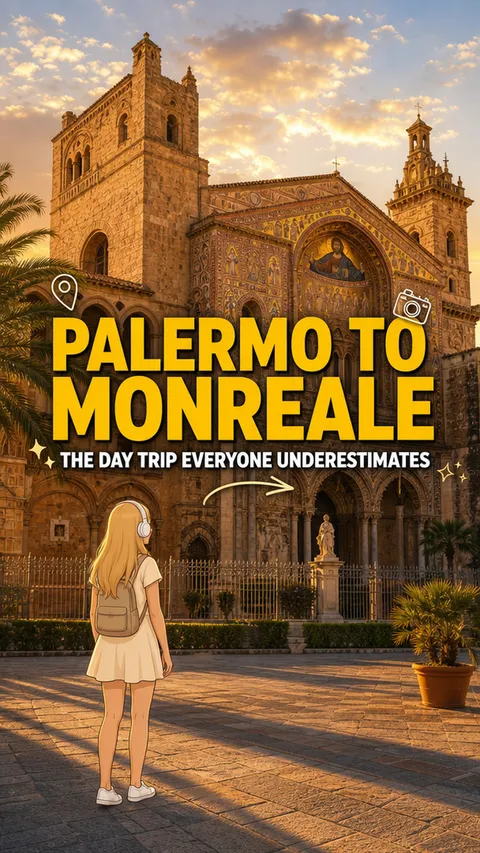
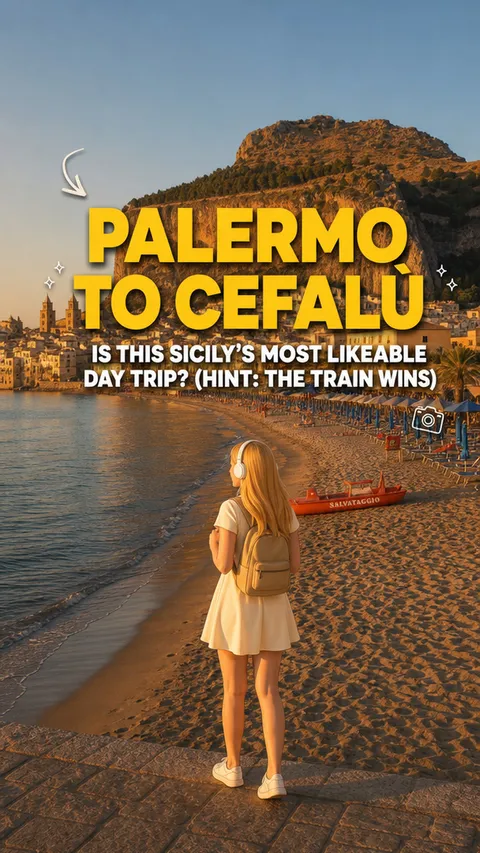
Day Trips from Palermo: Monreale, Cefalù and Further Afield

Out in the morning, back by night. Every route here fits in one full day.

Walking tour route map of Palermo
AI Tour Guide

Your guide is ready whenever you reach the Norman Palace.

Press start and a voice AI Tour Guide takes it from here: leading the route through Palermo, telling the stories, and turning your walk into a real back-and-forth conversation. No app or download is needed; it runs in your browser.

12stops 6.2km 1 h 25 minwalking 13languages
▶Start the tour free

Free to start · Runs in your browser · No app, no download

What the AI Tour Guide Adds Between Palace and Catacombs

The AI Tour Guide walks this route with you as a conversation: it greets you at the palace, tells the stories of each place, asks what you make of the mosaics or the market noise, remembers what grabbed you and shapes the next stops around it. You can cut in anytime, for instance to ask what the poets of Frederick II's court actually wrote about, or how the stallholders at the Capo decide what goes on the grill. You start with 100 free credits; after that you choose between this tour all-inclusive for €19.99 with no time limit, or €5 per hour.

A Real Conversation A voice AI Tour Guide greets you, leads the whole route, and tells the stories and facts as you walk, asking what you want to see and keeping a real conversation going. Not a recording you press play on.
Map Navigation Follow the route on the map and walk at your own pace. You choose where to start and when to move to the next stop.
Ask Anything Curious about a building you pass? Ask your AI Tour Guide on the spot and the conversation carries on.
13 Languages Switch language anytime. No separate tour needed.
Start free in your browser

Common Questions About Walking Palermo

Should I rent a car for a few days in Palermo?

Not for the city. Unofficial parking attendants ask for a tip even on free spaces, and the restricted traffic zones bring fines. Walk and use the bus; keep a car for touring the rest of the island.

Are the Capuchin Catacombs too much for some visitors?

They are a genuinely macabre place: hundreds of preserved bodies, many fully dressed, on display along the corridors. Most adults find it fascinating rather than frightening, but if you travel with children or are squeamish about the dead, decide before you walk the 25 minutes out there.

Is an evening at the Teatro Massimo better than the guided tour?

If your dates fall in the opera and ballet season, which runs from October to June, seats in the upper tiers cost roughly what the guided tour does, and you get the hall and its acoustics in use. Outside the season, the tour is the way in.

Is the tour really free?

Yes. The whole tour is free: the route, the interactive map and the navigation cost you nothing. Only the voice AI Tour Guide is optional and paid: you test it with 100 free credits, then you pay either €5 per hour or €19.99 for this whole tour, with no time limit. Admission to 6 of the 12 stops is not included: Norman Palace, Palatine Chapel, San Cataldo Church, Church of the Martorana, Teatro Massimo and Capuchin Catacombs charge their own entry fees.

Do I need to download an app?

No. Everything runs in your phone browser. Open the route and start walking, no download and no sign-up required.

Do I need to book the walking tour in advance?

No booking needed. This self-guided tour is available anytime. Open the route in your browser and start walking. The AI Tour Guide works instantly, no app, no reservation required.

What languages is the AI Tour Guide available in?

The AI Tour Guide speaks 13 languages, so you take the tour in your own language and can switch at any time.

Can I skip stops or change the route?

Yes. Skip any stop, spend extra time at places you like, or start the route from any point. It is your walk, you set the pace.
Image credits
▶ Start free in your browser Runs in your browser, no app, no download