Free Walking Tour Copenhagen: Castles, Harbour, Mermaid

From Tivoli's gates to the parliament on Slotsholmen: Christian IV's tower, two royal palaces, a star-shaped citadel and the canal where Andersen lived.

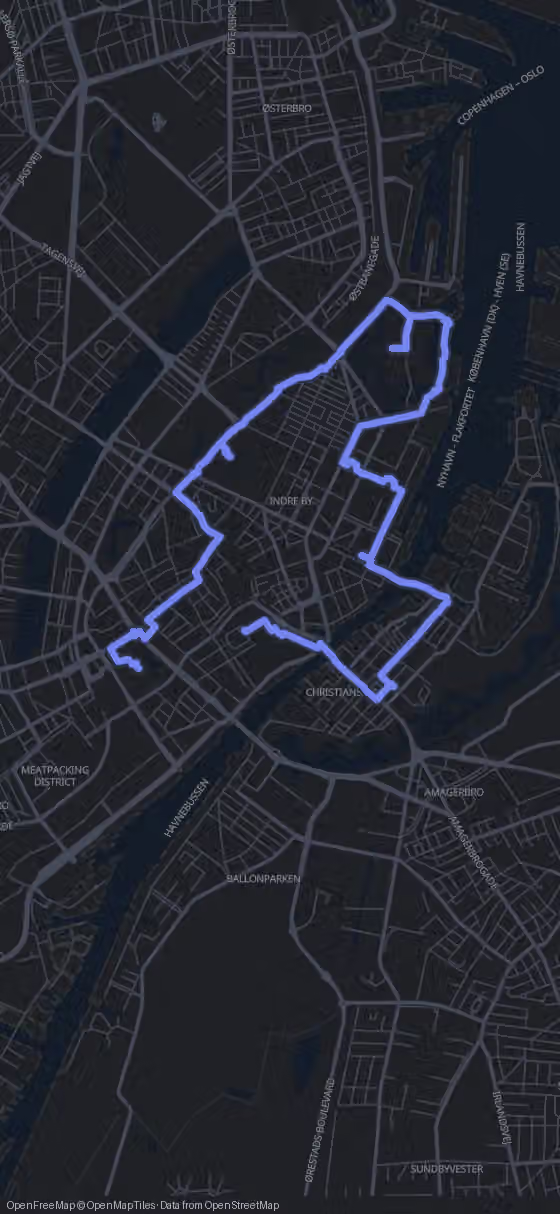
13 Stops 10.1 km ~2 h 18 min walking
Route map for the Copenhagen walking tour
Stop 1 of 13
640 m·8 min
Tivoli Gardens
Head north toward Copenhagen City Hall
Velkommen to Copenhagen. I'm Alex, and this city has a habit of keeping old ideas very much alive.
Try this tour with Alex

What This Copenhagen Walk Covers

Thirteen stops lead from Tivoli Gardens past the royal palaces and the harbour to Christiansborg Palace: 10.1 km and 2 h 18 min of pure walking. Outside only, plan about four and a half hours; with the best interiors and lunch it fills more than one sightseeing day.

The streets, Kastellet, the harbour front and Nyhavn cost nothing; you pay to go into the Round Tower, Rosenborg Castle, Amalienborg Palace and Christiansborg Palace. Route, map and GPS navigation are free in your browser, and the optional AI Tour Guide leads the walk as a conversation.

Open free GPS & optional AI Tour Guide
This short shows highlights of the route. All 13 stops follow below.

The Route

Walking Map of Copenhagen: Tivoli to Slotsholmen in 13 Stops

13 stops 10.1 km 2 h 18 min walking
Tap to load interactive map

The 13 stops along this route

  1. Tivoli Gardens in Copenhagen, stop 1 on the self-guided walking tour
    1Tivoli Gardens
  2. Copenhagen City Hall, stop 2 on the self-guided walking tour
    2Copenhagen City Hall
  3. Round Tower in Copenhagen, stop 3 on the self-guided walking tour
    3Round Tower
  4. Rosenborg Castle in Copenhagen, stop 4 on the self-guided walking tour
    4Rosenborg Castle
  5. Kastellet in Copenhagen, stop 5 on the self-guided walking tour
    5Kastellet
  6. The Little Mermaid in Copenhagen, stop 6 on the self-guided walking tour
    6The Little Mermaid
  7. Gefion Fountain in Copenhagen, stop 7 on the self-guided walking tour
    7Gefion Fountain
  8. Marble Church in Copenhagen, stop 8 on the self-guided walking tour
    8Marble Church
  9. Amalienborg Palace in Copenhagen, stop 9 on the self-guided walking tour
    9Amalienborg Palace
  10. Nyhavn in Copenhagen, stop 10 on the self-guided walking tour
    10Nyhavn
  11. Church of Our Saviour in Copenhagen, stop 11 on the self-guided walking tour
    11Church of Our Saviour
  12. Borsen in Copenhagen, stop 12 on the self-guided walking tour
    12Borsen
  13. Christiansborg Palace in Copenhagen, stop 13 on the self-guided walking tour
    13Christiansborg Palace
  14. That's the full route.

    Walk it with an AI Tour Guide talking you through every one of these streets.

    Start free in your browser
    You made it

Stop by Stop: Your Copenhagen Walking Tour Through Kings, Citadel and Harbour

  1. 1

    Tivoli Gardens

    Tivoli Gardens in Copenhagen, stop 1 on the self-guided walking tour

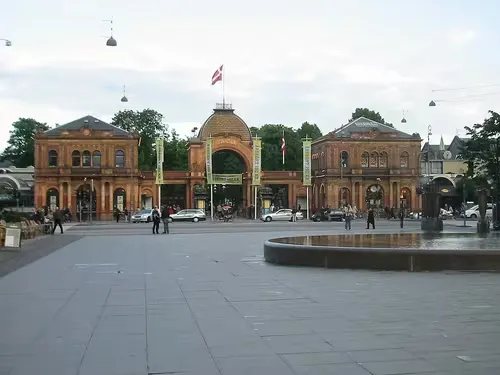
    The walk begins at the gates of Tivoli Gardens, right beside the Central rail station. Tivoli opened on 15 August 1843, which makes it the second-oldest amusement park still running anywhere, beaten only by Dyrehavsbakken in nearby Klampenborg. With 4.25 million visitors in 2024 it is the most visited amusement park in Scandinavia.

    Its founder, Georg Carstensen, won a five-year charter from King Christian VIII with a disarmingly honest pitch: when people are amusing themselves, they do not think about politics. The king let him use about 15 acres of the fortified glacis outside the West Gate, Vesterport, for an annual rent, and until the 1850s Tivoli lay outside the city, reachable only through that gate. Its first name, Tivoli & Vauxhall, borrowed from famous pleasure gardens in Paris and London.

    From the start there were buildings in an imagined Oriental style, a theatre, bandstands, cafés, flower gardens and early rides such as a merry-go-round. After dark coloured lamps lit the paths, and on some evenings fireworks were reflected in the lake, which is a remnant of the old city moat. Hans Christian Lumbye led the music here from 1843 to 1872.

    Tivoli charges entry, and it deserves its own unhurried visit rather than a squeezed-in hour, so on this walk take in the entrance and the story, and come back when you can give it time. City Hall is 620 m away, about 9 minutes on foot.
    Price
    DKK 180 adult; DKK 90 child; combined ticket DKK 469
  2. 2

    Copenhagen City Hall

    Copenhagen City Hall, stop 2 on the self-guided walking tour

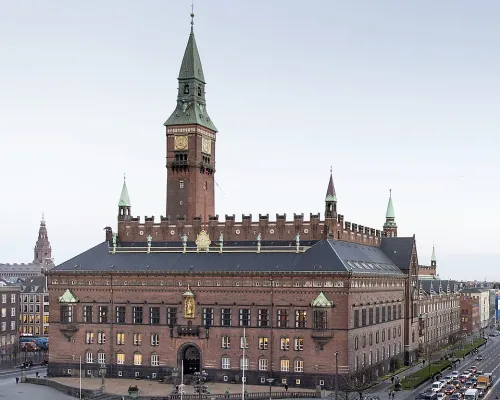
    On City Hall Square stands Copenhagen City Hall, home of the city council and the Lord Mayor's office. Architect Martin Nyrop designed it in a National Romantic style drawing on the Renaissance, and it was built between 1892 and 1905.

    It is the city's sixth town hall. All its predecessors stood around Gammeltorv and Nytorv, roughly 500 m northeast, where the medieval market town traded. Gammeltorv is the city's oldest square, yet almost nothing is known about the first town hall there. The third one, which Christian IV had rebuilt as a small Renaissance house with curved gables and a slender octagonal tower, burned in the great fire of 1728; its Baroque successor fell to the next great fire in 1795.

    War and a shortage of building materials delayed the fifth city hall until 1815. Christian Frederik Hansen designed it in Neoclassical style on Nytorv, and it still stands, today serving as the Copenhagen Court House. So one of the old city halls is still in use, just not for the city council.

    The lobby is free and worth a quick look. The paid guided tour suits you if architecture and civic history are your thing. From here it is 900 m, about 12 minutes, to the Round Tower.

    Local name
    Københavns Rådhus
    Hours
    Mon–Fri: 09:00–16:00 | Sat: 09:30–13:00 | Sun: Closed
    Price
    Town hall lobby freely accessible; guided town hall tour 80 DKK
    Website
    kk.dk ↗
  3. 3

    Round Tower

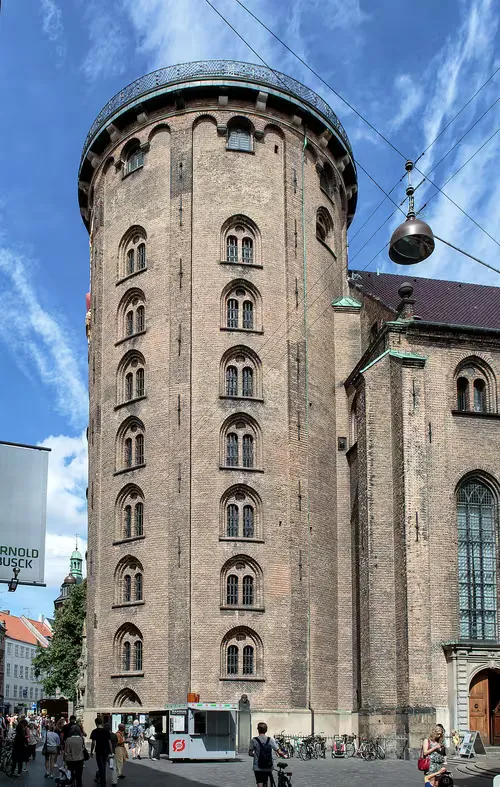
    Round Tower in Copenhagen, stop 3 on the self-guided walking tour

    The Round Tower was built for science. Christian IV opened it as an astronomical observatory in 1637, only five years after Leiden got the first of Europe's national observatories. At the time countries were competing for colonies, and accurate star readings meant accurate navigation across the oceans.

    The idea came from Christian Longomontanus, who became the king's astronomer after Tycho Brahe fell out of favour and left Denmark. In 1625 he proposed a tower to replace Brahe's demolished observatory Stjerneborg, first on the hill Solbjerget, today Valby Bakke. Because the university also needed a students' church and a library, the three plans merged into one grand building, the Trinitatis Complex, on land the king had bought in 1622 next to the Regensen dormitories. Hans van Steenwinckel the Younger is generally credited with the design, though he did not live to see the tower completed.

    What makes the visit memorable is the way up: a broad helical corridor that winds 7.5 turns to a platform 34.8 m above the ground, with views over Copenhagen. The complex also holds the Trinitatis Church and the rooms that housed the first university library.

    The ticket is modest, which makes this the easy family yes on the route. Allow about half an hour, then walk 920 m, around 12 minutes, to Rosenborg Castle.

    Local name
    Rundetårn
    Hours
    Summer (Apr–Sep): daily 10:00–20:00. Winter (Oct–March): Mon–Tue 10:00–21:00, Wed–Sun 10:00–18:00
    Price
    60 DKK adults, 40 DKK students, under 18 free
  4. 4

    Rosenborg Castle

    Rosenborg Castle in Copenhagen, stop 4 on the self-guided walking tour

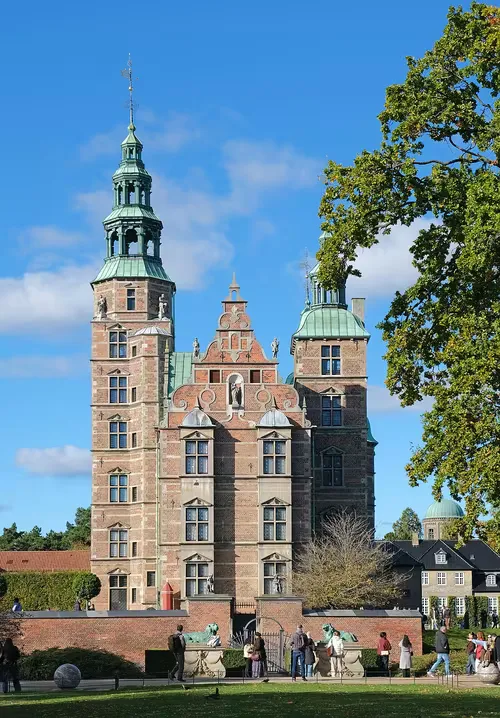
    Rosenborg Castle started as a country summer house that Christian IV built in 1606, then kept enlarging until it reached its present form in 1624. Its Dutch Renaissance style was typical of Danish building at the time, and Bertel Lange and Hans van Steenwinckel the Younger, the architect linked to the Round Tower, are associated with its planning.

    Danish kings lived here until about 1710. After Frederik IV the court returned only twice, both times in an emergency: when Christiansborg Palace burned in 1794 and during the British attack on Copenhagen in 1801.

    The highlight inside is the Long Hall, completed in 1624 as a ballroom and later used for receptions and banquets; only in the second half of the 19th century did it become known as the Knight's Hall. Christian V hung twelve tapestries of his victories in the Scanian War, and the early 18th-century stucco ceiling shows the Danish coat of arms framed by the Orders of the Elephant and of Dannebrog. Look for the coronation chair of the absolutist kings, the queens' throne with three silver lions in front of it, and a large collection of mostly 17th-century silver furniture.

    The castle houses the Royal Collections, spanning Danish royal culture from Christian IV to the 19th century, and it is the strongest interior on the route if you like royal objects up close; plan about an hour. Tickets are a little cheaper online than at the ticket office.

    Next comes the longest leg of the walk: 2010 m, about 28 minutes, to Kastellet.

    Local name
    Rosenborg Slot
    Hours
    Mostly daily 10:00–17:00; 2.11–23.12 Mon closed, Tue–Sun 10:00–16:00
    Price
    140 DKK online / 150 DKK at the ticket office
  5. 5

    Kastellet

    Kastellet in Copenhagen, stop 5 on the self-guided walking tour

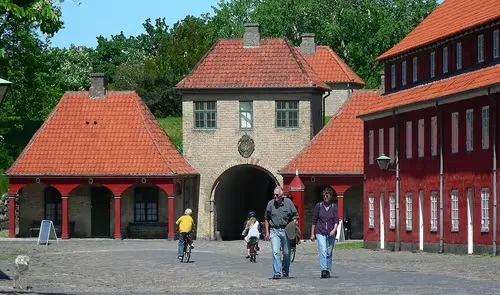
    Kastellet, the Citadel, is a pentagon of ramparts with a bastion at each corner and one of the best preserved fortresses in Northern Europe. It used to connect to the ring of bastioned ramparts around Copenhagen, of which only the ramparts of Christianshavn survive. Inside the grounds stand the Citadel Church and a windmill, and the place is still a military site as well as a public park.

    Christian IV started it in 1626 with St. Anne's Redoubt, an outpost on the coast north of the city that guarded the harbour entrance together with a blockhouse north of Christianshavn. His bigger plan was to push the city's fortifications north to meet the redoubt, which was completed only in the mid-1640s, just after Frederick III took the throne.

    After the Swedish siege of Copenhagen, which ended in 1660, the Dutch engineer Henrik Rüse was brought in to rebuild and extend the works. Officially it became Citadellet Frederikshavn, but everyone calls it Kastellet. It defended the city in the Battle of Copenhagen in 1807, and the painter Christen Købke, a figure of the Danish Golden Age, grew up here and painted the area many times. On 9 April 1940 German troops landing at the nearby harbour took it without resistance.

    Entry is free. A quarter of an hour is enough for a loop through the grounds before you walk 590 m, about 8 minutes, to the Little Mermaid.

    Hours
    Winter half-year 06:00–20:00, summer half-year 06:00–22:00
    Price
    Free
  6. 6

    The Little Mermaid

    The Little Mermaid in Copenhagen, stop 6 on the self-guided walking tour

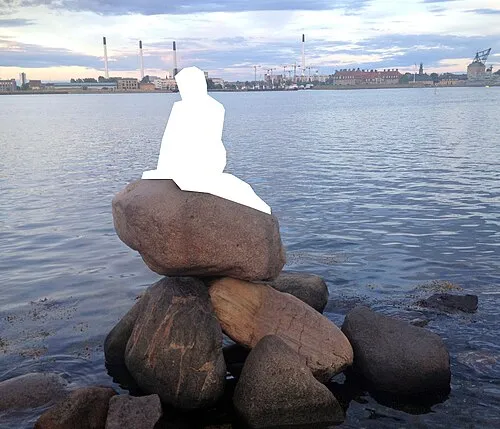
    On a rock by the water at the Langelinie promenade sits the Little Mermaid, a bronze by Edvard Eriksen showing a mermaid becoming human. She is only 1.25 m tall and weighs 175 kg, so expect something small and quiet rather than a monument; that modesty is part of her charm, and she has been a Copenhagen icon since her unveiling on 23 August 1913.

    The statue goes back to Hans Christian Andersen's fairy tale of 1837 and to a night at the ballet. Carl Jacobsen, son of the Carlsberg founder, saw a ballet of the story at the Royal Theatre and in 1909 commissioned the statue, asking the ballerina Ellen Price to model. She refused to pose nude, so Eriksen modelled the figure entirely on his wife, Eline. The popular story that the face is Price's is not true.

    For the Expo 2010 in Shanghai the city sent her to the Danish Pavilion, the first official move since she was installed. While she was away, an authorised copy sat on a rock in the lake at Tivoli Gardens, where this walk began. She has also become a frequent target of vandals and activists, and officials have considered moving her a few metres out into the harbour; as of September 2022 she still sat on dry land.

    The statue is free to see at any hour. From here it is 460 m, about 6 minutes, to the Gefion Fountain, another gift that Copenhagen owes to Carlsberg.

    Local name
    Den lille Havfrue
    Hours
    Open 24/7
    Price
    Free
  7. 7

    Gefion Fountain

    Gefion Fountain in Copenhagen, stop 7 on the self-guided walking tour

    The Gefion Fountain shows the Norse goddess Gefjon driving four oxen that pull a plough, all at large scale on the harbour front, next to Kastellet and just south of Langelinie. The Carlsberg Foundation gave it to the city for the brewery's 50th anniversary. It was first meant for the main square outside City Hall, but the city chose this spot near the Øresund instead.

    Danish artist Anders Bundgaard sculpted the naturalistic figures from 1897 on, the basins and decoration were finished in 1908, and the water first ran on 14 July 1908. Later the fountain fell out of use for years; a renovation began in 1999 and it was inaugurated again in September 2004.

    The scene tells how Zealand, the island Copenhagen stands on, was created. In the Ynglinga saga the Swedish king Gylfi promised Gefjon as much land as she could plough in one night. She turned her four sons into oxen, and the land they tore loose was thrown into the sea to become Zealand. The hole left behind filled with water, and Snorri Sturluson identified it as Lake Mälaren, west of Stockholm. Look at the straining oxen and you see the whole legend in one moment.

    The fountain is free and always accessible. Walk 860 m, about 12 minutes, to the Marble Church.

    Hours
    Open 24/7
    Price
    Free
  8. 8

    Marble Church

    Marble Church in Copenhagen, stop 8 on the self-guided walking tour

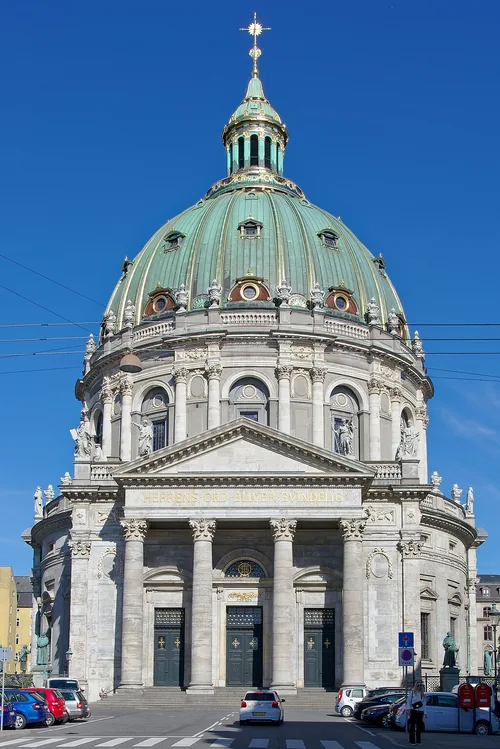
    Officially it is Frederik's Church, but everyone calls it the Marble Church. It is the focal point of Frederiksstaden, the district built to mark 300 years since the first coronation of a king from the House of Oldenburg. Its dome spans 31 m, the largest church dome in Scandinavia, and rests on twelve columns, with gold window frames and statues on the outer walls.

    Nicolai Eigtved drew the plans around 1740, and his first idea was far grander, with a taller dome 45 m across resting on the outer walls. King Frederick V laid the foundation stone on 31 October 1749, but budget cuts slowed the work and Eigtved died in 1754. From 1756 the French architect Nicolas-Henri Jardin carried on with a more classical marble design, until Johann Friedrich Struensee abandoned the plans in 1770.

    The unfinished church then stood as a ruin for nearly 150 years, while architects such as C. F. Harsdorff kept proposing ways to complete it. Step inside to see the colourful fresco in the dome, most likely inspired by St. Peter's in Rome.

    The church is free. The dome can only be visited on a paid guided tour for at most 15 people, so come a little early to get a place. Amalienborg lies due east, 400 m or about 6 minutes away.

    Local name
    Marmorkirken
    Hours
    Mon–Thu 10:00–17:00, Fri 12:00–17:00, Sat 10:00–17:00, Sun 13:00–17:00. Dome tours Tue–Sun 13:30, max 15 people
    Price
    Church free; dome climb 50 DKK adults, children 0-12 free
  9. 9

    Amalienborg Palace

    Amalienborg Palace in Copenhagen, stop 9 on the self-guided walking tour

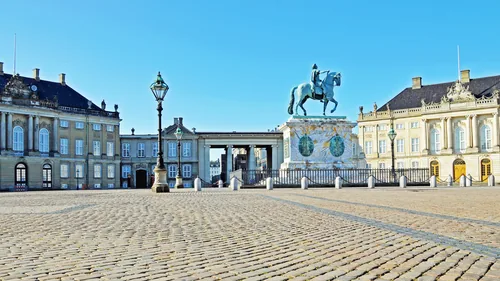
    Amalienborg is the official residence of the Danish monarch, today King Frederik X and Queen Mary. Four identical classical palaces with Rococo interiors stand around an octagonal courtyard, with a large equestrian statue of Frederick V at its centre.

    The four palaces were built for noble families. Only after Christiansborg Palace burned in 1794 did the royal family buy them and move in, and various monarchs have lived here ever since.

    The site has a darker prehistory. An earlier palace here, Sophie Amalienborg, was built from 1669 to 1673 for Queen Sophie Amalie. In 1689 her son Christian V celebrated his 44th birthday there with a German opera, perhaps the first opera performance in Denmark. At the repeat performance a few days later a stage decoration caught fire, the theatre and palace burned to the ground and about 180 people died.

    The museum charges entry. Go in if you want to see how the royal family lives; otherwise the courtyard alone is worth the stop. From here it is 620 m, about 8 minutes, to Nyhavn, passing the Amaliehaven park on the way.

    Hours
    Outside summer: Tue–Sun 10:00–16:00, Mon closed. 28.3-1.11: daily 10:00–16:00 (also Mon)
    Price
    125 DKK adults (museum), 80 DKK students, under 18 free
  10. 10

    Nyhavn

    Nyhavn in Copenhagen, stop 10 on the self-guided walking tour

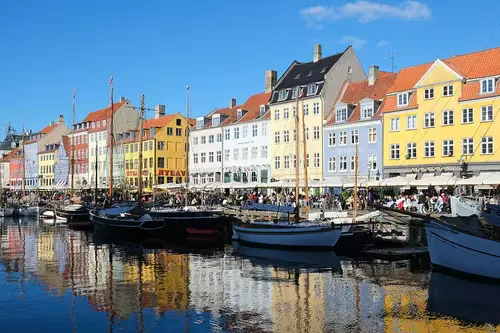
    Nyhavn, the New Harbour, runs from Kongens Nytorv to the Inner Harbour, lined with brightly coloured townhouses from the 17th and early 18th centuries and full of historic wooden ships. Christian V had it dug between 1670 and 1675 by Danish soldiers and Swedish prisoners of war, as a gateway from the sea to the old city, where ships unloaded cargo and fishermen their catch.

    For a long time it was notorious for beer, sailors and prostitution. Hans Christian Andersen lived here for 18 years: from 1845 to 1864 at No. 67, where a plaque recalls him, and from 1871 to 1875 at No. 18. The oldest house, No. 9, dates from 1681. The first bridge, a temporary wooden footbridge, opened in 1874 and was replaced by today's bridge in 1912.

    When ships grew larger and freight moved to land after the Second World War, the harbour emptied. In the mid-1960s the Nyhavn Society set out to revive it, in 1977 it reopened as a harbour for veteran ships, and in 1980 the quay, by then a car park, became pedestrian. Since then it works like a town square for locals and visitors alike.

    Nyhavn costs nothing and is open around the clock. Take your photos and keep your money for a meal a few streets away. Then walk 1390 m, about 19 minutes, over to Christianshavn and the Church of Our Saviour.

    Hours
    Open 24/7
    Price
    Free
  11. 11

    Church of Our Saviour

    Church of Our Saviour in Copenhagen, stop 11 on the self-guided walking tour

    When Christian IV planned Christianshavn in 1617 as an independent merchant town on Amager, it needed a church. A temporary one opened in 1639, but work on the Church of Our Saviour, designed by Lambert van Haven, began only in 1682. It was inaugurated in 1695 with a makeshift altar and a tower without a spire.

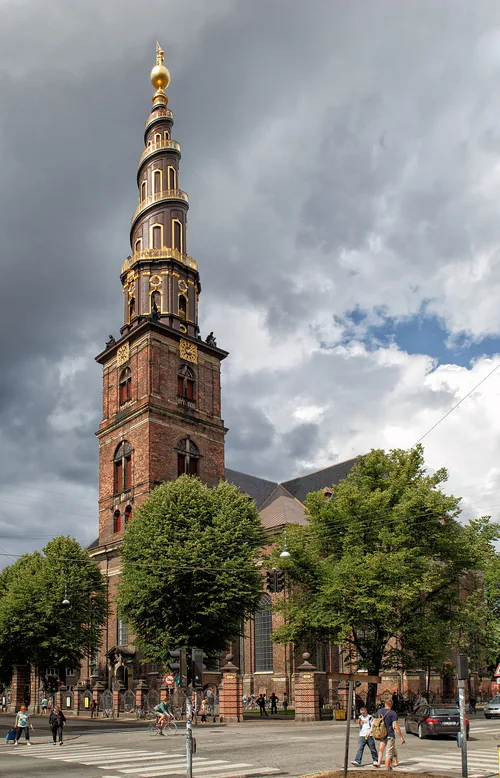
    The spire waited until Frederik V. Lauritz de Thurah replaced van Haven's design with his own, approved in 1749, and three years later the king climbed the finished tower at a ceremony on 28 August 1752. Its spiral winds anticlockwise, which spawned a lasting legend that the architect jumped to his death on realising it turned the wrong way. It is not true: Thurah died in his bed seven years later, and nothing suggests he was unhappy with his work.

    From outside, notice the Dutch Baroque brickwork: red and yellow bricks on a granite base, laid in a random pattern, unlike the orderly brick patterns of Christian IV's buildings. The carillon plays melodies every hour from 8 in the morning until midnight.

    The church is free; the tower climb, which winds around the outside of the spire to the top with wide views over central Copenhagen, is paid. Rain or wind can close it at short notice, so check the sky before you queue. From here it is 870 m, about 13 minutes, to Borsen.

    Local name
    Vor Frelsers Kirke
    Hours
    Tower daily 09:00–20:00 (last admission 30 min before closing). Tower closed all January and 24-25.12; weather-related closures (rain/wind) possible
    Price
    Church free; tower climb 70 DKK adults
  12. 12

    Borsen

    Borsen in Copenhagen, stop 12 on the self-guided walking tour

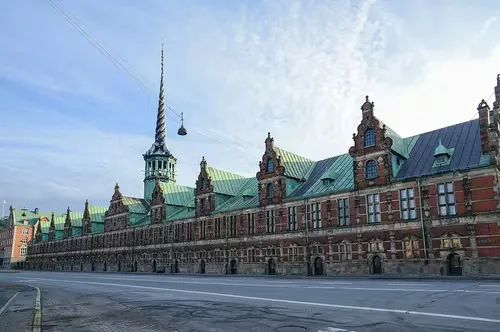
    Borsen, the old bourse, was built under Christian IV between 1619 and 1640 as a commodity exchange and later served as the stock exchange. It is counted among the leading examples of Dutch Renaissance architecture in Denmark and is a protected building.

    Its famous feature was a 56 m spire shaped like the tails of four dragons twisted together. On 16 April 2024 a fire destroyed the building and brought the spire down. Borsen is currently closed for restoration, so you see it only from outside, and what you see is a monument in repair after one of the city's most painful recent losses.

    Christiansborg Palace stands right next to it, 430 m or about 6 minutes on foot.

    Local name
    Børsen
    Price
    Free (exterior only; closed for restoration)
  13. 13

    Christiansborg Palace

    Christiansborg Palace in Copenhagen, stop 13 on the self-guided walking tour

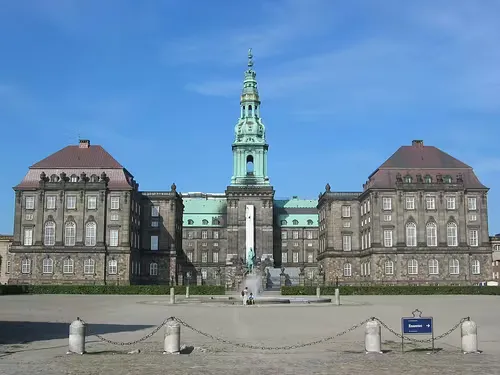
    Christiansborg Palace on the islet of Slotsholmen houses the Danish Parliament, the Prime Minister's Office and the Supreme Court, which makes it the only building in the world holding all three branches of a country's government. Danes simply call it Borgen, the castle, and the name stands for Danish politics as a whole. The monarch still uses parts of it, including the Royal Reception Rooms, the Palace Chapel and the Royal Stables.

    Castles have stood on this spot since 1167, when Bishop Absalon built the first one on a small island outside the harbour. From the early 15th century the site was the seat of central government, until 1794 the main royal residence and from 1849 the seat of parliament. Two great fires, in 1794 and 1884, left a building from three eras: the Baroque showgrounds of 1738 to 1746, the Neoclassical chapel of 1826 and the Neo-Baroque main palace, finished in 1928.

    Inside you can visit the festival halls, the ruins and the royal kitchen, and the Royal Stables are part of the complex too. Tickets are sold per area or as a combined ticket; if you only pick one area, the ruins take you back to Absalon's first castle.

    This is the end of the route. If you want to return to Tivoli Gardens, the GPS navigation in your browser can lead you back to the start.

    Local name
    Christiansborg Slot
    Hours
    Festival halls/ruins/kitchen: daily 10:00–17:00 (30.3-1.11). Marstald: daily 13:30–16:00 (summer 10:00–17:00, no horses 8.6-19.7). Castle church: Mon–Sat closed, Sun 10:00–17:00 (outside summer)
    Price
    DKK 60-150 student; DKK 85-150 adult; combined ticket DKK 225
Walking tour route map of Copenhagen Route loaded
Tivoli GardensCopenhagen City HallRound TowerRosenborg Castle+9
All 13 stops are already on the map.
You just press start.
AI Tour Guide

You know the route now. Walk it with a guide in your ear.

Press start wherever you are, even hundreds of kilometres from Copenhagen, and the guide begins telling its stories right away. In the city, pick any of the 13 stops to start from: it leads you there, then talks with you the whole route, asking, listening, remembering, and shaping the tour around your answers.

13stops 10.1km 2 h 18 minwalking 13languages
▶Start the tour free

Free to start · Runs in your browser · No app, no download

Shorter Copenhagen Walks: Three Ways to Split the Route

The full route is long, and the paid interiors cluster at both ends. These three sections each work as a half day on their own, and any two make a full day.

Christian IV's old town

Stops: 1, 2, 3, 4

For a first morning in the city and anyone drawn to the kings who built it. From Tivoli Gardens via City Hall and the Round Tower to Rosenborg Castle: 2.4 km and 33 minutes of walking. The City Hall lobby is free; the Round Tower and Rosenborg charge entry, and Rosenborg is cheaper online.

Citadel, Mermaid and the royal quarter

Stops: 5, 6, 7, 8, 9, 10

The budget section and the best one for a dry day outdoors: Kastellet, the Little Mermaid, the Gefion Fountain, the Marble Church, Amalienborg and Nyhavn, 2.9 km and 40 minutes of walking. Everything is free from outside; the Marble Church dome and the Amalienborg museum are optional paid extras.

Christianshavn and Slotsholmen

Stops: 10, 11, 12, 13

For tower climbers and anyone curious about Danish politics. From Nyhavn over to the Church of Our Saviour, then back to Borsen and Christiansborg Palace: 2.7 km and 38 minutes of walking. The tower climb and Christiansborg both charge entry.

How Long Does This Copenhagen Tour Take, With and Without the Interiors?

The 10.1 km take 2 h 18 min of pure walking. The longest leg is the 2010 m, about 28 minutes, from Rosenborg Castle to Kastellet; every other leg stays under 20 minutes. If you only look from outside and pause around ten minutes at each stop, you finish in about four and a half hours.

Add the Round Tower, an hour in Rosenborg, the Marble Church dome, the Amalienborg museum, the tower of the Church of Our Saviour, Christiansborg and a lunch break, and you reach about eight and a half hours. That is too much for a single day, so split it: Tivoli Gardens to Nyhavn on day one, with 1 h 41 min of walking, and Nyhavn to Christiansborg Palace on day two, with 38 minutes.

The one fixed appointment on the route is the Marble Church dome tour. From Rosenborg Castle to the Marble Church you walk 54 minutes; with a quarter of an hour at Kastellet and ten minutes each at the Little Mermaid and the Gefion Fountain, leave Rosenborg by 11:55 and you arrive at 13:24.

Before You Start Your Copenhagen Walk

  • Start and finish: The recommended start is Tivoli Gardens, right next to the Central rail station, and the walk ends at Christiansborg Palace on Slotsholmen. You can join at any stop; on request the GPS navigation leads you from the last stop back to the start.
  • Best days: Pick a weekday if you want to go inside: that is when the interiors along the route are most reliably open and the dome tour runs.
  • Time of day: Start around 09:30, so the City Hall lobby and Rosenborg are open when you get there, and that pace brings you to the Marble Church in time for the dome tour.
  • Entry costs: Several interiors charge entry: the Round Tower, Rosenborg (cheaper online), the Marble Church dome, the Amalienborg museum, the Church of Our Saviour tower and Christiansborg. Tivoli comes on top if you go in.

Food and Breaks Along the Route: Hotdogs, Smørrebrød, Coffee

Copenhagen eats hotdogs and smørrebrød, and both deserve a place in your day. Smørrebrød is a lunch dish: most of the good places serve it only at midday, so plan your sit-down break then and keep hotdogs for the quick stops.

Tivoli hotdogFood in Tivoli is fine but priced high; the hotdog is the fun exception if you go in. (Inside Tivoli Gardens)
Restaurant FodkoldCheap hotdogs and a small Carlsberg, right by City Hall. (City Hall Square)
Den Økologiske PølsemandOrganic roasted pork sausage; the sauces make it, from pickled mayo to honey mustard, plus ketchup and onions. (By the Round Tower)
Domhusets SmørrebrødThe budget smørrebrød lunch at Kattesundet 18, off Strøget, priced by the piece. Try the Stjerneskud with egg, shrimp and caviar.
Schønnemann or Restaurant KronborgSchønnemann has served smørrebrød since 1877, lunch only and usually fully booked, so reserve. If it is full, Kronborg off Strøget sits in a 17th-century building, has an old-school Danish feel, keeps a cannonball from the English bombardment and stays open late.
JudieThe one Nyhavn table worth sitting down at: well-regarded smørrebrød on an old boat, lunch only. (Nyhavn)
Apollo BarTucked away from the harbour strip, a local alternative for coffee, cocktails and small bites. (Side street off Nyhavn)
Aamanns ReplikTraditional smørrebrød with wide harbour views. (At the Royal Playhouse)
Broens GadekokkenOutdoor food court of container stalls, an easy lunch with plenty of choice. (Across the harbour from Nyhavn)

Tourist Traps to Avoid in Copenhagen While You Walk

  • Nyhavn waterfront restaurants: Prices run well above comparable places five minutes away, and the food rarely justifies it. The quick test: on the water, English menu outside, steep prices for main dishes? Then it is priced for tourists. Photograph the canal and eat elsewhere, for example at Aamanns 1921 in Niels Juels Gade. (Nyhavn)
  • Card and cup games on Strøget: Guess the card or the cup with the ball: these street games can take 500 kroner from you in moments. Walk past.
  • Fake police officers: Some travellers report men posing as police, asking for ID on the pretext of a drug check and then for a bribe. Real Danish police never ask for money, so always ask to see their ID.
Walking tour route map of Copenhagen
AI Tour Guide

Your guide is ready at Tivoli whenever you are.

Press start and a voice AI Tour Guide takes it from here: leading the route through Copenhagen, telling the stories, and turning your walk into a real back-and-forth conversation. No app or download is needed; it runs in your browser.

13stops 10.1km 2 h 18 minwalking 13languages
▶Start the tour free

Free to start · Runs in your browser · No app, no download

What the AI Tour Guide Adds Between Rosenborg and the Harbour

On this route one king keeps reappearing: Christian IV built the Round Tower, Rosenborg, the first Kastellet, Christianshavn and Borsen. The AI Tour Guide picks up threads like that and follows the ones you care about, whether that is royal intrigue, fortress building or Andersen's Copenhagen, and it takes up the questions you bring along, such as how Andersen's mermaid story really ends or what the Danish signs along the quay say. It greets you at Tivoli, tells the stories as you walk, asks what you think and remembers it for later stops. Route, map and GPS navigation stay free; for the guide you start with 100 free credits, then choose this tour all-inclusive for €19.99 with no time limit, or €5 per hour.

A Real Conversation A voice AI Tour Guide greets you, leads the whole route, and tells the stories and facts as you walk, asking what you want to see and keeping a real conversation going. Not a recording you press play on.
Map Navigation Follow the route on the map and walk at your own pace. You choose where to start and when to move to the next stop.
Ask Anything Curious about a building you pass? Ask your AI Tour Guide on the spot and the conversation carries on.
13 Languages Switch language anytime. No separate tour needed.
Start free in your browser

Common Questions About Walking Copenhagen

Which tower is better: the Round Tower or the Church of Our Saviour?

For a sure thing, the Round Tower: you walk up inside and it is cheaper. The Church of Our Saviour is the bigger thrill, climbing around the outside of the spire, but it closes in rain or wind.

Do children pay entry on this route?

Children and teens go free at the Round Tower and the Amalienborg museum, younger children go free on the Marble Church dome tour, and Tivoli has a reduced child ticket. For child prices at Rosenborg and Christiansborg, ask at the ticket desk.

If I can only do one palace interior, which should it be?

Rosenborg Castle if you want royal treasures up close, with the coronation chair and the silver lions. Christiansborg Palace if politics and the medieval ruins interest you more. Amalienborg is the choice if you want to see how today's royal family lives.

Where can I take a similar walk after Copenhagen?

If your trip continues south, there are self-guided routes in Stralsund, 155 km away, and Rostock, 179 km away.

Is the tour really free?

Yes. The whole tour is free: the route, the interactive map and the navigation cost you nothing. Only the voice AI Tour Guide is optional and paid: you test it with 100 free credits, then you pay either €5 per hour or €19.99 for this whole tour, with no time limit. Admission to 5 of the 13 stops is not included: Tivoli Gardens, Round Tower, Rosenborg Castle, Amalienborg Palace and Christiansborg Palace charge their own entry fees.

Do I need to download an app?

No. Everything runs in your phone browser. Open the route and start walking, no download and no sign-up required.

Do I need to book the walking tour in advance?

No booking needed. This self-guided tour is available anytime. Open the route in your browser and start walking. The AI Tour Guide works instantly, no app, no reservation required.

What languages is the AI Tour Guide available in?

The AI Tour Guide speaks 13 languages, so you take the tour in your own language and can switch at any time.

Can I skip stops or change the route?

Yes. Skip any stop, spend extra time at places you like, or start the route from any point. It is your walk, you set the pace.
Image credits
▶ Start free in your browser Runs in your browser, no app, no download