Free Walking Tour Rostock: Gates, Gables and Brick Gothic

Seven stops through Rostock's old town: Hanseatic gables, two city gates and the brick churches of St. Mary's and St. Peter's, with a free GPS route to follow.

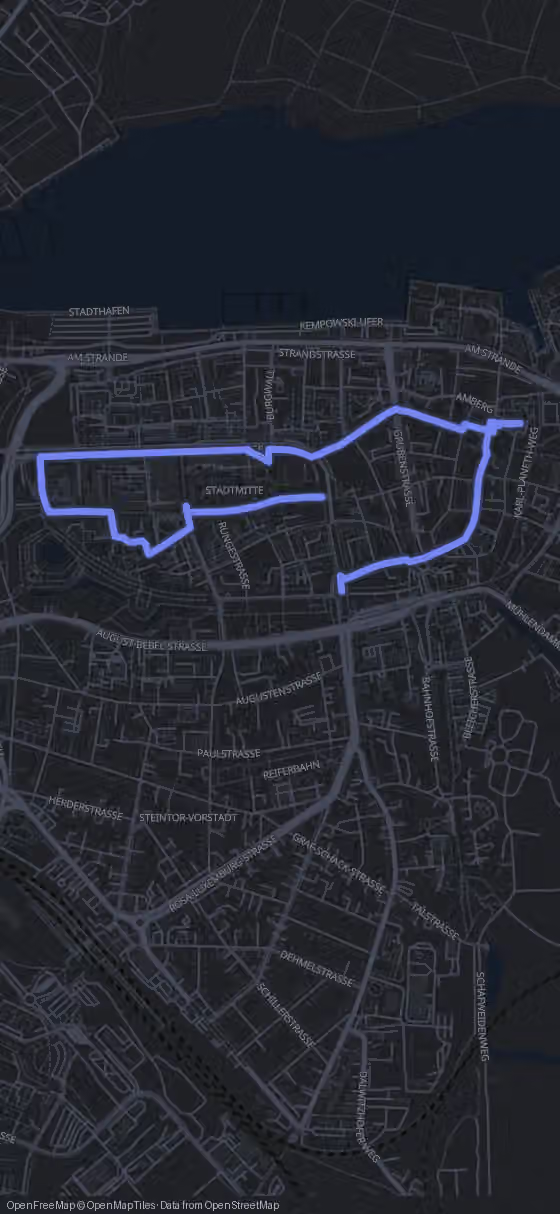
7 Stops 3.2 km ~44 min walking
Route map for the Rostock walking tour
Stop 1 of 7
370 m·5 min
Neuer Markt
Head west from the Neuer Markt into Kröpeliner Straße
Moin, welcome to Rostock. I'm Alex, and the elegant town hall ahead conceals a much older skyline.
Try this tour with Alex

The Route at a Glance

Seven stops, 3.2 km and 44 minutes of pure walking: from Neuer Markt along Kröpeliner Straße to the Cultural History Museum (Kloster zum Heiligen Kreuz) and the Kröpeliner Tor, then back through the old town via St. Mary's Church and St. Peter's Church to the Steintor. With the interiors that repay a visit, plan on about four hours.

The squares, the street, the Steintor, the museum and the nave of St. Peter's are free; the Kröpeliner Tor, St. Mary's and the St. Peter's tower charge admission. The GPS route in your browser costs nothing, and the AI Tour Guide is optional.

Open free GPS & optional AI Tour Guide
View of Rostock

The Route

Walking Map of Rostock's Old Town Route

7 stops 3.2 km 44 min walking
Tap to load interactive map

The 7 stops along this route

  1. Neuer Markt in Rostock, stop 1 on the self-guided walking tour
    1Neuer Markt
  2. Kröpeliner Straße in Rostock, stop 2 on the self-guided walking tour
    2Kröpeliner Straße
  3. Cultural History Museum (Kloster zum Heiligen Kreuz) in Rostock, stop 3 on the self-guided walking tour
    3Cultural History Museum (Kloster zum Heiligen Kreuz)
  4. Kröpeliner Tor in Rostock, stop 4 on the self-guided walking tour
    4Kröpeliner Tor
  5. St. Mary's Church in Rostock, stop 5 on the self-guided walking tour
    5St. Mary's Church
  6. St. Peter's Church in Rostock, stop 6 on the self-guided walking tour
    6St. Peter's Church
  7. Steintor in Rostock, stop 7 on the self-guided walking tour
    7Steintor
  8. That's the full route.

    Walk it with an AI Tour Guide talking you through every one of these streets.

    Start free in your browser
    You made it

Your Rostock Walking Tour, Gate to Gate

  1. 1

    Neuer Markt

    Neuer Markt in Rostock, stop 1 on the self-guided walking tour

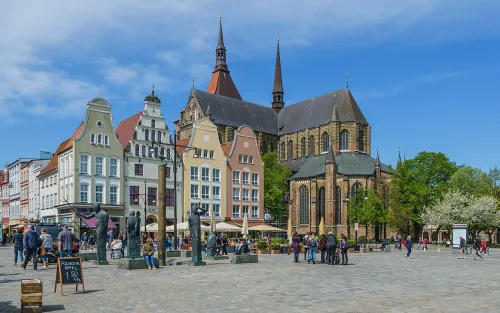
    You start where medieval Rostock did its business. Neuer Markt is almost square, roughly 90 by 80 metres, and on its east side stands the town hall, whose beginnings go back to the 13th century. The town hall and the two gabled houses just south of it came through the war without bomb damage, so that corner gives you the clearest picture of how the whole square once looked.

    Rostock grew out of three separate towns, the Old, Middle and New Town, and each had its own market, its own town hall and a parish church nearby. This was the market of the Middle Town, and it quickly became the economic heart of the whole city. Its town hall became the town hall for all of Rostock, and nearby St. Mary's became the main parish church. The leading families moved here and built splendid gabled houses on every side, later remodelled in baroque, classicist and historicist style from the 18th into the early 20th century.

    Look at the other sides and you see what the British air raids of late April 1942 did. The south side was destroyed completely, and the main post office went up there after the war. On the north side only three of the original ten houses survived, and those were pulled down in 1959. Today there is a lawn where they stood, and whether to rebuild the north side is still being debated.

    Count the streets that run into the square: Kröpeliner Straße, Lange Straße, Glatte Aal, Große Wasserstraße and Steinstraße. Most of them belonged to the proverbial seven landmarks of Rostock, a list of seven streets that people once rattled off by heart. Keep Steinstraße in mind, because the walk ends where it begins. From here it is 370 metres, about five minutes, into Kröpeliner Straße.
    Hours
    Open 24 hours
    Price
    0 EUR
  2. 2

    Kröpeliner Straße

    Kröpeliner Straße in Rostock, stop 2 on the self-guided walking tour

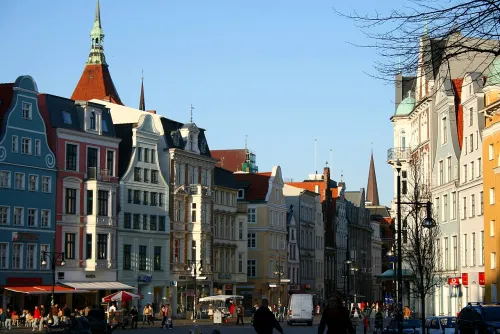
    Kröpeliner Straße is Rostock's main shopping street, running 650 metres from Neuer Markt to the Kröpeliner Tor. Walk it slowly and look up: the gabled houses, many restored close to their original form, have elaborate, colourful façades. Forty buildings along it are listed monuments, covering Brick Gothic and Renaissance from the Hanseatic era, baroque, classicism, historicism and even postmodern architecture.

    Halfway along, the street opens into Universitätsplatz with the main building of the university and the Brunnen der Lebensfreude, the Fountain of the Joy of Life. This is the liveliest spot on the street and a good place to pause. Also worth a glance is the building that now houses the city library.

    The street has changed character more than once. Trams used to run here until 1961, when the line moved to Lange Straße, and in 1968 Kröpeliner Straße became a pedestrian zone, one of the first in the GDR. The name is younger than you might think: only since 1945 has the whole stretch carried one name, and at first that name was Stalinstraße. It became Kröpeliner Straße after de-Stalinisation.

    Today around 5,000 people pass through every hour, drawn by more than 250 shops. The house numbers start at the southeast corner and run up to 99. From the street it is just 230 metres, about three minutes, to the Cultural History Museum.

    Hours
    Open 24 hours
    Price
    0 EUR
  3. 3

    Cultural History Museum (Kloster zum Heiligen Kreuz)

    Cultural History Museum (Kloster zum Heiligen Kreuz) in Rostock, stop 3 on the self-guided walking tour

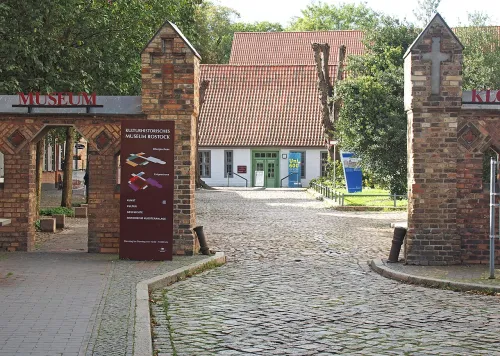
    The Cultural History Museum is one of the largest and most important museums in Mecklenburg-Vorpommern, and its story is a journey through Rostock itself. It began with citizens who met in the town's art society in 1841 to collect the city's art and display it in a museum. A building in Steinstraße was bought in 1858, the museum was founded in 1859, and the growing collections were first shown to the public in 1885 at the Lindenhof.

    That soon became too small. In 1901 the city bought the building of the Societät and converted it, and on 4 October 1903 the Art and Antiquities Museum officially opened. In 1936 it was reorganised as the municipal museum and took in the ethnological collection as well.

    Then came the dark years. In 1937 the Nazi campaign against so-called degenerate art seized fifteen paintings from the collection, including works by Ernst Barlach, Lovis Corinth, Otto Dix, Erich Heckel and Emil Nolde. Eight of them were destroyed. During the war the holdings were moved to vaults, village churches, manor houses and castles, and the collections suffered heavy losses. The museum reopened on 1 May 1946 in the restored building at the Steintor, but when that building was given over to a maritime museum, the collections were housed for a time in the Kröpeliner Tor.

    The idea of moving the museum into the Kloster zum Heiligen Kreuz goes back to 1920, when the convent was dissolved. Entry is free, so even with little time it is worth stepping in if Rostock's history interests you. The next stop is 440 metres away, about six minutes: the very gate that once sheltered these collections.

    Hours
    Mon: Closed | Tue–Sun: 10:00–18:00
    Price
    0 EUR
  4. 4

    Kröpeliner Tor

    Kröpeliner Tor in Rostock, stop 4 on the self-guided walking tour

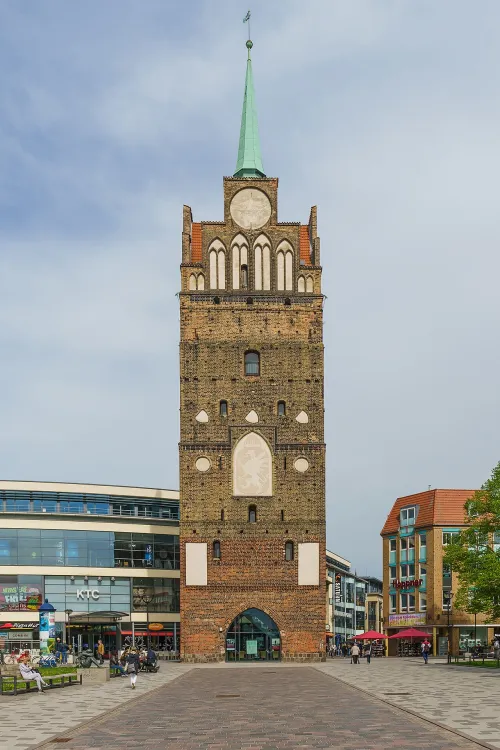
    The Kröpeliner Tor closes off the western end of Kröpeliner Straße. Built around 1270 in Gothic style, it was the westernmost of the four great gates in Rostock's fortifications, and at times the city had as many as 22 gates. Even then it was among the most massive. Whether it was named after the small town of Kröpelin, which the road leads towards, or after a patrician family of the same name is still disputed.

    Look closely at the brickwork. The gate originally had only two storeys, and you can still see where they end by the different colour of the stones. Around 1400 the citizens decided to add five more storeys, bringing it to its present 54 metres. It stood on the road to Lübeck and Wismar, and its height was meant to show arriving merchants how big and important this Hanseatic city was. On the field side, the side facing away from the town, a griffin was set into the large pointed arch during a restoration in 1905.

    Its history did not stop there. A wooden gate stood here as early as 1255, and the stone gate followed after the three original towns officially united in 1265; it is first recorded in 1280. In 1847 a neo-Gothic annex was added, turning the gate into a showpiece. The British raids of April 1942 left the gate almost untouched while much around it was destroyed, yet the undamaged annex was removed in 1945 for aesthetic reasons, and a surviving stretch of town wall was torn down for traffic plans that were never built. Trams ran through the gate until 1960, and it was restored again in the late 1960s.

    Going inside costs admission. It suits anyone who wants to experience the gate from within; if you are short on time, the outside tells most of its story. From here the route turns back into the old town, 600 metres and about eight minutes to St. Mary's Church.

    Hours
    Feb–Oct: daily 10:00–18:00; Nov–Jan: daily 10:00–17:00; closed on public holidays
    Price
    Adults 3 EUR | Reduced 2 EUR | Family 8 EUR | Under 6 free
  5. 5

    St. Mary's Church

    St. Mary's Church in Rostock, stop 5 on the self-guided walking tour

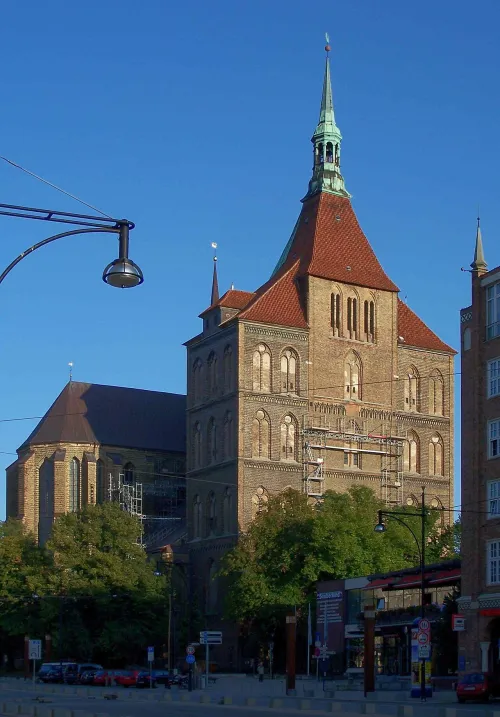
    St. Mary's Church on Ziegenmarkt is the biggest of Rostock's three town churches; the others are St. Peter's and St. Nicholas, and a fourth, St. James', was heavily damaged in the Second World War and later demolished. A church on this site is first mentioned in 1232. The present building dates from the 13th century and was enlarged at the end of the 14th century into today's triple-nave, cross-shaped basilica in Brick Gothic, the style of the Hanseatic ports. The huge tower with its baroque lantern on top was not completed until the end of the 18th century.

    St. Mary's became the main parish church in 1265, and since the Reformation in 1531 it has belonged to the Lutheran church. That turning point is visible inside: the Renaissance pulpit made by Rudolf Stockmann in 1574 was the first piece of decoration installed after the Reformation. It shows scenes from the Passion, and a baroque sounding board from 1723 crowns it. Notice where it stands, right in the middle of the church. The acoustics here were poor, so the pulpit was placed to bring the preacher close to the congregation.

    The high altar from 1721 is mainly painted wood and tells its story in three pictures, from bottom to top: the Last Supper, the Resurrection and the Outpouring of the Holy Spirit.

    Then turn to the south transept. The window there, 26 metres high, shows the Last Judgement and is one of the largest single stained glass windows in Europe. A Tyrolean stained glass workshop finished it in 1904; it survived the war damaged and was thoroughly restored by 2008 and fitted with protective glazing. The ticket is worth it for the pulpit and this window alone, and visitors under 18 go in free. Next comes a longer leg, 770 metres and about eleven minutes, to St. Peter's Church.

    Local name
    Marienkirche Rostock
    Hours
    May–Oct: Mon–Sat 10:00–17:00, Sun/holiday 11:00–16:00 | Nov–Apr: Mon–Sat 10:00–16:00, Sun/holiday 11:00–15:00
    Price
    Adults 4 EUR | Reduced 3 EUR | Under 18 free | Annual ticket 15 EUR
  6. 6

    St. Peter's Church

    St. Peter's Church in Rostock, stop 6 on the self-guided walking tour

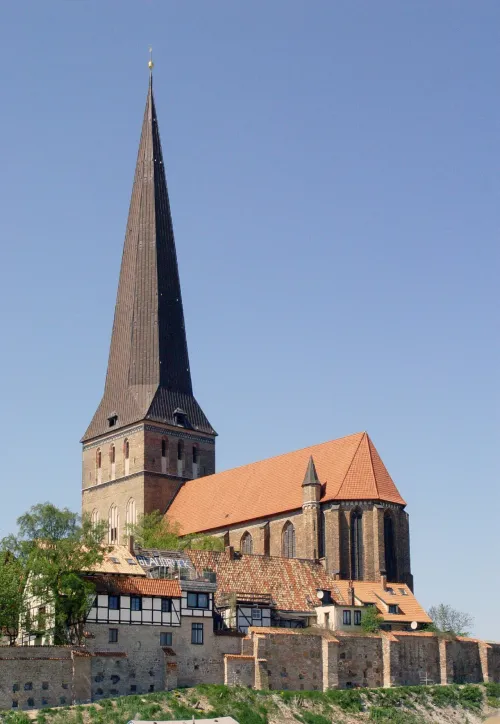
    St. Peter's Church is the oldest of Rostock's three town churches, built in the middle of the 13th century; a church on this site is first mentioned in 1252. Like St. Mary's it is a triple-nave basilica in Brick Gothic. Walk along the outside and look at the north and south façades: round-arched arcades alternate four times over, each with a large rectangular window.

    The tower has had a turbulent life. The original reached 127 metres until lightning destroyed it in 1543. After a storm damaged it again, it was rebuilt in 1578 as a polygonal spire 117 metres high, and for centuries it served as a landmark for the whole area. The church itself decayed after the Reformation, when a Lutheran congregation used it, and was renovated in 1902. Forty years later, in 1942, heavy bombing damaged it again and the spire collapsed.

    Rebuilding took decades. Inside, the church now has a flat timber ceiling at 24 metres, and in 1994 a 17-metre glass window was installed in the choir. The same year the new copper spire was finished, paid for by public donations, and St. Peter's became a visible landmark again.

    The church is free to enter. The observation platform at 45 metres has its own ticket and rewards you with views over the city and out to the Baltic Sea, so on a clear day it is the one extra worth paying for on this route. From here it is 780 metres, about eleven minutes, to the last stop, the Steintor.

    Local name
    Petrikirche
    Hours
    May–Sep daily 10:00–18:00 | Oct–Apr daily 10:00–16:00; closed Good Friday, 24.12, 31.12
    Price
    Church free | Tower (observation deck): Adults 5 EUR | Reduced 3 EUR
  7. 7

    Steintor

    Steintor in Rostock, stop 7 on the self-guided walking tour

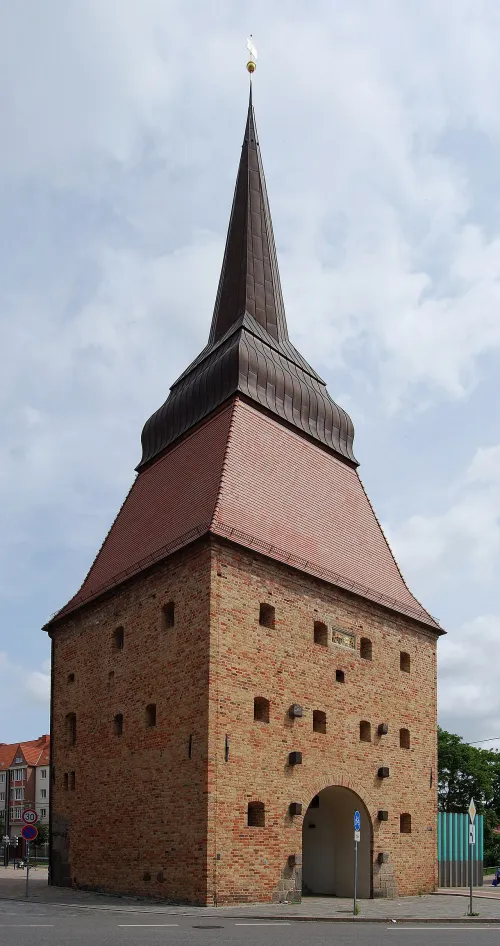
    The Steintor you see today is a Renaissance gate built between 1574 and 1577 on the south side of Rostock's fortifications. Together with the Kröpeliner Tor, the Petritor and the Mühlentor it was one of the city's four main gates. The first Steintor went up in 1279 and soon replaced the Kuhtor as the main entrance to the city. Then as now, the paved Steinstraße, which gave the gate its name, ran straight from here to Neuer Markt with its town hall and St. Mary's.

    The original gate did not last 300 years, and the reason is a power struggle. In 1565 Rostock clashed with the dukes in Schwerin, partly over a beer tax in the dukes' favour. When the city refused to swear the formal oath of allegiance to Duke Johann Albrecht I, he rode in through the Steintor with 500 horsemen. In 1566 he had the gate, its outer gate, part of the town wall and a defensive tower razed, and used the stones to build a fortress of his own in what is now the Rosengarten.

    The conflict ended only with the First Rostock Hereditary Treaty of 21 September 1573, which bound the city to its rulers for centuries and recognised them as supreme judges. The citizens then bought from the duke the right to tear down his fortress and did so the following spring. The costly rebuilding of the wall and of the Steintor in the style of the Dutch Renaissance followed, and unusually for the period, the builders responsible can be traced by name.

    This is where the walk ends. Steinstraße takes you straight back to Neuer Markt, closing the circle through medieval Rostock, and the GPS navigation in your browser can guide you there if you like.

    Hours
    Open 24 hours
    Price
    0 EUR
Walking tour route map of Rostock Route loaded
Neuer MarktKröpeliner StraßeCultural History Museum (Kloster zum Heiligen Kreuz)Kröpeliner Tor+3
All 7 stops are already on the map.
You just press start.
AI Tour Guide

Now walk the streets of Rostock with a guide in your ear

Press start wherever you are, even hundreds of kilometres from Rostock, and the guide begins telling its stories right away. In the city, pick any of the 7 stops to start from: it leads you there, then talks with you the whole route, asking, listening, remembering, and shaping the tour around your answers.

7stops 3.2km 44 minwalking 13languages
▶Start the tour free

Free to start · Runs in your browser · No app, no download

Shorter Ways Through Rostock

Not every day has room for all seven stops and four interiors. These three versions keep the route's logic and change only what you take in.

Shopping street and the western gate

Stops: 1, 2, 3, 4

For a first look or a short visit: from Neuer Markt down Kröpeliner Straße to the museum and the Kröpeliner Tor. Only 14 minutes of walking; the museum is free and the gate is the one ticketed stop. With the museum and a look inside the gate, allow about an hour and a half.

Gates and churches

Stops: 4, 5, 6, 7

For anyone who loves medieval architecture: start at the Kröpeliner Tor and walk via St. Mary's and St. Peter's to the Steintor, 30 minutes on foot. St. Mary's and the Kröpeliner Tor charge admission, and the St. Peter's tower platform is an optional extra ticket. Allow a little over two hours.

The full route without tickets

Stops: 1, 2, 3, 4, 5, 6, 7

For a tight budget: all seven stops and the full 44 minutes of walking, but you go inside only where it is free, the museum and the nave of St. Peter's, and admire the Kröpeliner Tor and St. Mary's from outside. Allow about two and a half hours.

How Long Does This Rostock Old Town Walk Take?

The walking itself takes 44 minutes. The route first runs out to the western edge of the old town along Kröpeliner Straße, then swings back through the centre to the churches and ends at the southern gate, so you never retrace a street for long.

With the museum, St. Mary's, the inside of the Kröpeliner Tor and the St. Peter's tower platform, about four hours is realistic. If you only go into St. Mary's and look at the rest from outside, two hours is enough. The shorter versions take between an hour and a half and two and a half hours, depending on which interiors you choose.

Before You Set Off in Rostock

  • Start: Neuer Markt is the recommended start, but you can join the route at any stop.
  • Finish: The walk ends at the Steintor. Steinstraße leads straight back to Neuer Markt, and the GPS navigation in your browser can guide you back to the start if you like.
  • Tickets: The Kröpeliner Tor, St. Mary's Church and the observation platform of St. Peter's charge admission. Neuer Markt, Kröpeliner Straße, the Steintor, the Cultural History Museum and the nave of St. Peter's are free.
  • Time of day: Walk during the day so the churches and the museum are open, and check their opening hours before you set off.
Walking tour route map of Rostock
AI Tour Guide

Your Rostock guide is ready when you are

Press start and a voice AI Tour Guide takes it from here: leading the route through Rostock, telling the stories, and turning your walk into a real back-and-forth conversation. No app or download is needed; it runs in your browser.

7stops 3.2km 44 minwalking 13languages
▶Start the tour free

Free to start · Runs in your browser · No app, no download

What the AI Tour Guide Adds in Rostock

On this route the AI Tour Guide turns Rostock's Hanseatic past into a conversation. It greets you at Neuer Markt, tells the stories of each place as you arrive, asks what caught your eye and remembers whether you lean towards churches, war history or merchant life. Ask it what being a Hanseatic city actually meant for Rostock's trade, or how the families in the gabled houses lived, and it picks up the thread. You can interrupt at any moment; the route stays the same.

A Real Conversation A voice AI Tour Guide greets you, leads the whole route, and tells the stories and facts as you walk, asking what you want to see and keeping a real conversation going. Not a recording you press play on.
Map Navigation Follow the route on the map and walk at your own pace. You choose where to start and when to move to the next stop.
Ask Anything Curious about a building you pass? Ask your AI Tour Guide on the spot and the conversation carries on.
13 Languages Switch language anytime. No separate tour needed.
Start free in your browser

Common Questions About Walking Rostock

Is the St. Peter's tower platform worth the extra ticket?

If the weather is clear, yes. The platform sits at 45 metres and looks out over the city and the Baltic Sea. The church itself is free, so you can decide on the spot.

Do children pay at St. Mary's Church?

No, visitors under 18 go in free. Adults buy a ticket at the entrance.

How do I get back to the start from the Steintor?

Follow Steinstraße, the old paved street that runs from the gate directly to Neuer Markt. The GPS navigation in your browser can also lead you back.

Where can I walk a similar route near Rostock?

Stralsund, 67 km away, and Greifswald, 82 km away, each have their own free walking route.

Is the tour really free?

Yes. The whole tour is free: the route, the interactive map and the navigation cost you nothing. Only the voice AI Tour Guide is optional and paid: you test it with 100 free credits, then you pay either €5 per hour or €19.99 for this whole tour, with no time limit. Admission to 2 of the 7 stops is not included: Kröpeliner Tor and St. Mary's Church charge their own entry fees.

Do I need to download an app?

No. Everything runs in your phone browser. Open the route and start walking, no download and no sign-up required.

Do I need to book the walking tour in advance?

No booking needed. This self-guided tour is available anytime. Open the route in your browser and start walking. The AI Tour Guide works instantly, no app, no reservation required.

What languages is the AI Tour Guide available in?

The AI Tour Guide speaks 13 languages, so you take the tour in your own language and can switch at any time.

Can I skip stops or change the route?

Yes. Skip any stop, spend extra time at places you like, or start the route from any point. It is your walk, you set the pace.
Image credits
▶ Start free in your browser Runs in your browser, no app, no download