

Marktplatz
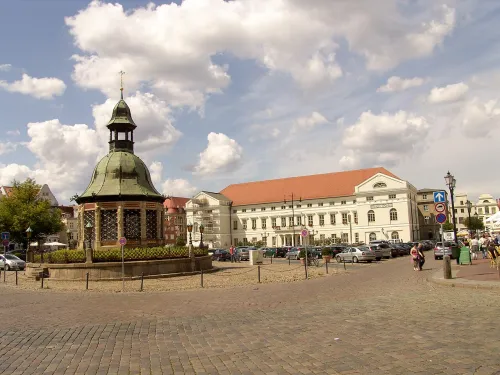
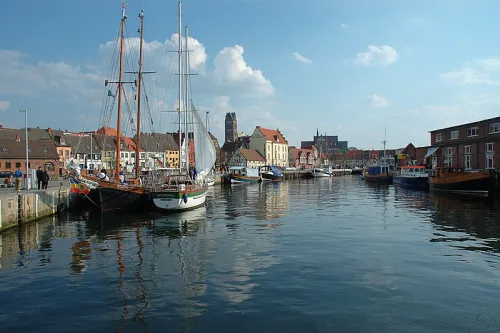
You are standing on roughly a hectare of almost square cobbled space, the centre of Wismar's old town. In the Middle Ages Wismar was an important member of the Hanseatic League, and the sheer size of this square shows how much the town mattered. Since 2002 the old town, together with the Old Harbour, has been on the UNESCO World Heritage List. The pavilion that dominates the square is the Wasserkunst, a waterworks building begun around 1579 and finished in 1602, and still one of the town's landmarks.
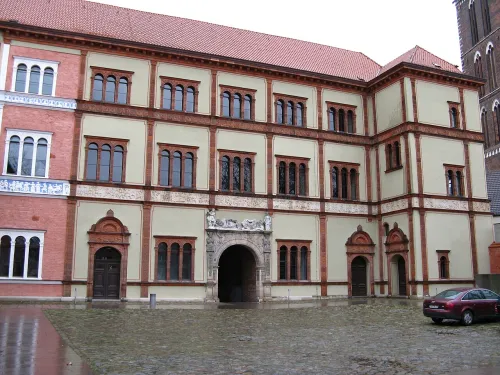
Turn to the houses. The patrician house Alter Schwede dates from about 1380 and is the oldest building on the square. The town hall has a history of its own: the first one burned down in 1351, the second went up in the later 14th century, and the third, the one you see, followed in 1819. In 2018 two houses on the south side burned almost completely, a reminder that these facades need constant care.
Look down for a memorial plaque. It recalls the execution of mayor Johann Bantzkow and councillor Hinrik van Haren. They commanded a fleet that suffered a crushing defeat in the Øresund in 1427 and were sentenced to death after unrest among the craftsmen.
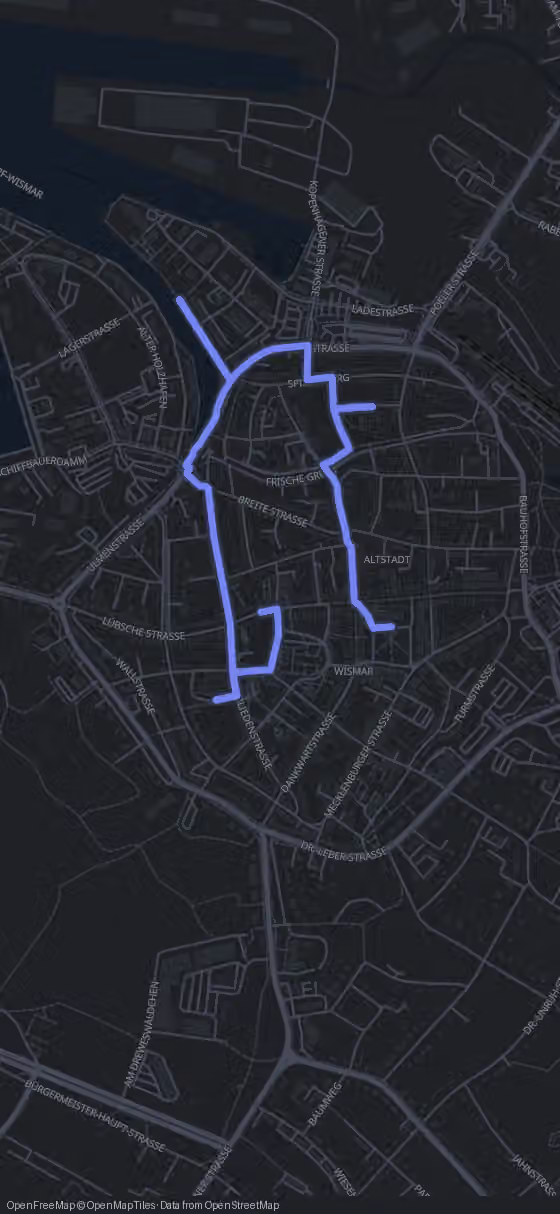
The street names read like a map of medieval trade. Lübsche Straße leads to Lübeck, Krämerstraße is named after merchants and Großschmiedestraße after blacksmiths, while Dankwartstraße remembers the smith Tangmar, who worked here around 1250. Between the market and Hegede, at numbers 8 and 9, the passage Salzfässchen takes its name from a former market booth shaped like a salt barrel. Until about 1995 cars parked here between concrete blocks; after repaving in the 1990s and in 2006/08 the square hosts the weekly market again.
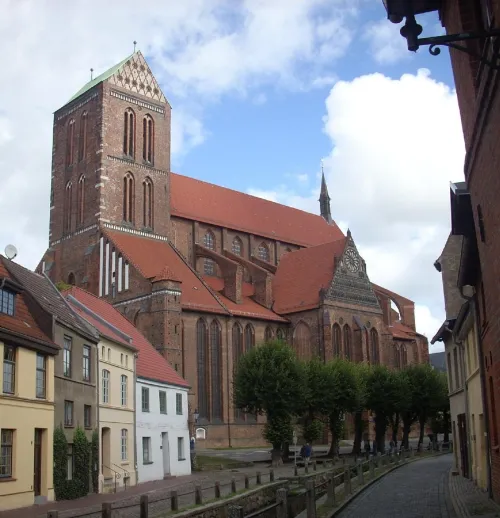
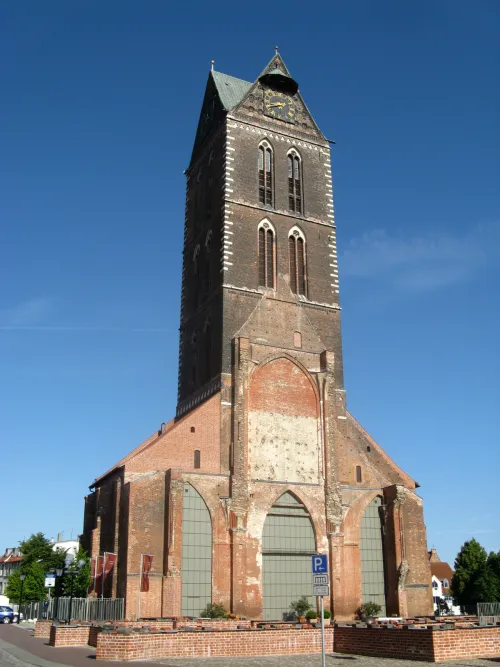
From here it is 640 m and about 8 minutes to St. Nicholas' Church, the first of the three great churches.