

Stralsund Town Hall
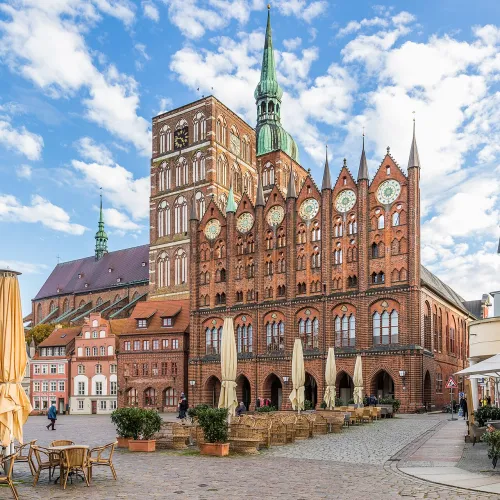
You start in front of Stralsund's landmark, counted among the most important secular buildings of the whole Baltic region. The ornate show facade facing the Old Market was added in 1444. Look up at it and imagine it as it once was: richly decorated with figures and with the coats of arms of the princes Stralsund had defeated in 1316, among them Erich of Lüneburg and Guntzel of Wittenberg. A merchant town putting its beaten enemies on its front wall tells you a lot about its confidence.
The story starts earlier. Stralsund received town rights in 1234, and a first building on this spot was begun around 1230. The Brick Gothic hall you see grew from the early 14th century, and constant extensions until the 19th century left a mix of styles. At first it was a place of trade: a hall for expensive cloth from what is now Belgium and a merchants' store. By 1340 council chambers and a great hall had been added to the north and south.
Below your feet lies the Ratskeller, built as a single storeroom of 1400 square metres and described as the largest connected cellar in Northern Europe. Merchants and councillors slid their goods down chutes from the Old Market; later traders stored cloth and wine there, some of it from Mâcon in France. The earliest entries in the town book, dated between 1271 and 1278, partly concern renting out this very cellar. Its ribbed vaults copy the Kampischer Hof in Stralsund, a style the Cistercian monks had brought to the north.
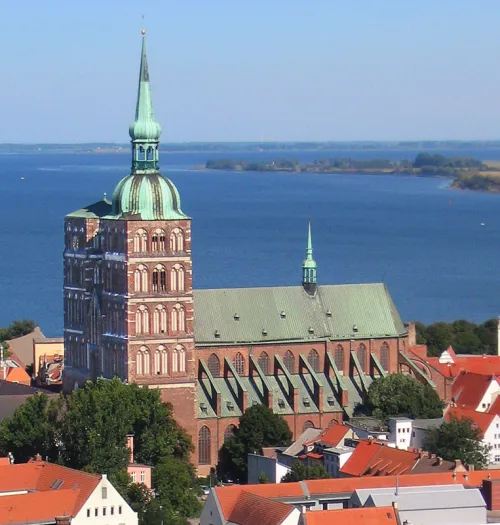
The interior is closed to visitors, so this is a facade stop; take your time with the front and the square. St. Nicholas' Church is just 160 m away, a two minute walk, and the two buildings were planned side by side from the beginning.