Free Walking Tour Greifswald:Old Town to Eldena Abbey
From the granite Market Square past Caspar David Friedrich's birthplace to the river, the old wooden drawbridge at Wieck and the abbey ruin he painted.
Squares, harbour, bridge, ruin and the cathedral itself are free; the two museums, the cathedral tower and the university tour charge admission. Route, map and GPS navigation run free in your browser; the AI Tour Guide is optional.
Your Greifswald Walking Tour, Stop by Stop from Painter's House to Abbey Ruin
1
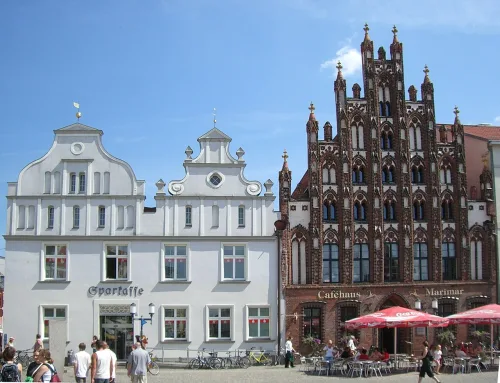
Market Square
Greifswald begins on stone. The Market Square is paved in Lusatian granite, gabled houses close off its sides, and the Town Hall stands in the middle of the square rather than at its edge, dividing it into Markt and Fischmarkt. The ground plan you are standing on is the one the medieval town laid out, and it has survived.
Nothing here needs a ticket and nothing keeps hours: the square is public around the clock, which makes it the natural reference point for everything that follows. Take one slow lap, look up at the gables and get your bearings.
You will be back here later for the Town Hall, once you've seen the painter's birthplace, the university and the cathedral. After that the walk leaves the old town for the river and does not return. For now, head up Lange Straße to the Caspar David Friedrich Centre, 300 m and about 4 minutes away.
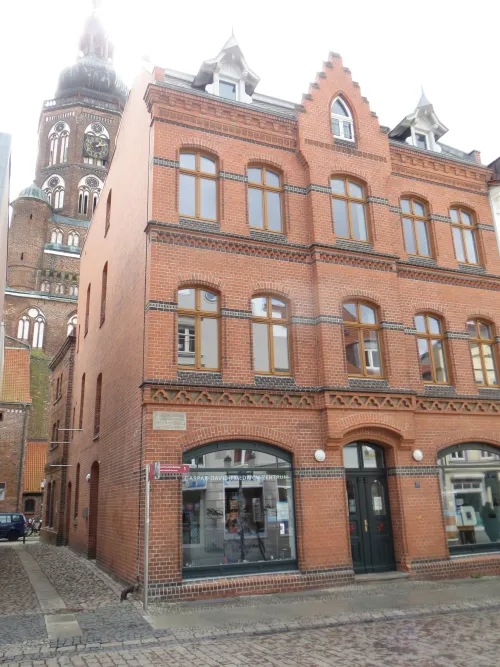
At Lange Straße 57 stands the house where Caspar David Friedrich was born, today a museum and memorial. Greifswald doesn't keep a quiet corner for this painter, it is organised around him, and your walk proves it: his birthplace here, his paintings in the Pomeranian State Museum, the cathedral he and his brother remodelled, and at the very end the abbey ruin his canvases made famous.
If the painter is why you came, it is worth paying admission to go in. Plan around an hour, and expect a museum about the man and his origins rather than a gallery of his major works; those you'll find later in the State Museum.
The catch is timing. Make sure the centre is open before you set off from the Market Square; if it isn't yet, go to St. Nikolai Cathedral first and come back.
If the Pomeranian State Museum is on your list as well, decide here: ask at the desk about a combined ticket before you pay.
From here it is 360 m, about 5 minutes, to the University of Greifswald. On the way you pass the Greifswald Observatory, a lesser-known spot worth a glance.
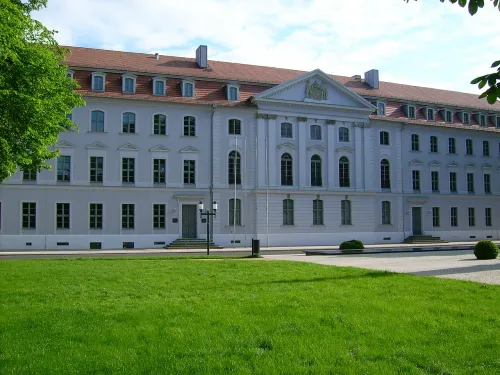
The University of Greifswald was founded on 17 October 1456, with the approval of both the Holy Roman Empire and the Pope. The driving force was the town's lord mayor, Heinrich Rubenow, who became its first rector, backed by Duke Wartislaw IX of Pomerania and Bishop Henning Iven. The founding ceremony took place in St. Nikolai Cathedral, your next stop.
Rubenow seized a chance. A decree had restricted teaching at the University of Rostock, founded in 1419, and several professors left for Greifswald to carry on their work. The new university started with the four classic faculties of theology, philosophy, medicine and law, and in the late Middle Ages it was one of the most important centres of learning in the Duchy of Pomerania. Through the Hanse it had ties with universities across northern Europe from its earliest years.
Only Heidelberg, Leipzig and Rostock are older in Germany, which makes Greifswald the fourth oldest university in the country. Until recently it bore the name Ernst-Moritz-Arndt University. Today it has around 10,179 students, about two thirds of them from outside Mecklenburg-Vorpommern, with international students from 90 countries.
The campus can be seen from outside at any time and for free. If you want to see inside, there is a paid guided tour of the Aula and the Karzer; worth it if university history interests you more than a second museum. From here it's 380 m, about 5 minutes, to the cathedral where it all began.
Local name
Universität Greifswald
Hours
Exterior campus viewable 24/7; guided tour of Aula & Karzer daily 15:00 (Apr–Oct)
Price
Guided tour of Aula & Karzer 5 EUR; campus exterior free
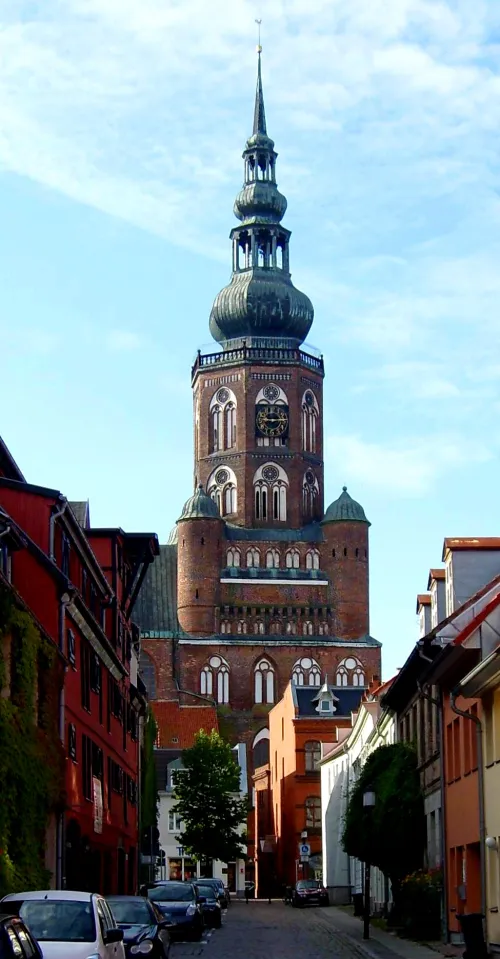
St. Nikolai is dedicated to Saint Nicholas, patron of seafarers and merchants, which suits a Hanseatic town. It is a Brick Gothic church and was the main church and bishop's seat of the Pomeranian Evangelical Church. A church of St. Nicholas is first mentioned in 1263, and the oldest surviving parts date from the last third of the 13th century. It began as a single-nave choir, later absorbed into a hall church; it had its first organ as early as 1362, and a new choir with a straight east wall was begun in 1385 and finished in 1395.
When the university was founded here in 1456, Bishop Henning Iven raised St. Nikolai to a collegiate church. The new status brought money, and that same year work began on raising the tower. The octagonal upper section went up between 1480 and 1500, and with a Gothic spire of about 60 metres added early in the 16th century, the tower reached 120 metres.
Storms took the spire twice. In 1515 the top collapsed and was not replaced until 1609. On 13 February 1650 it fell again, this time destroying the roof; several vaults of the nave and south aisle caved in, and a few days later the east wall followed. All the furnishings were lost, and the town council immediately called for donations to rebuild. Much later, Caspar David Friedrich and his brother had a hand in remodelling the interior.
Entry to the church is free, while going up the tower costs extra. Then it's back to the square: 240 m, about 3 minutes, to the Town Hall.
Local name
Greifswalder Dom
Hours
May–Oct: Mon–Sat 10:00–18:00, Sun ca. 11:30–16:00; Nov–Apr: Mon–Sat 10:00–16:00, Sun ca. 11:30–15:00
Price
Church free; tower climb 4 EUR adults, 2 EUR children, 8 EUR family
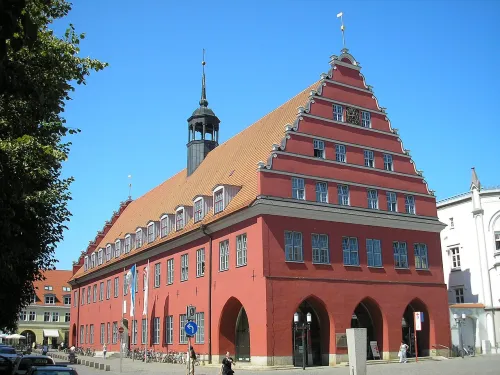
Greifswald received market rights in 1241, is mentioned as an oppidum in 1248 and was granted Lübeck town law in 1250. In the middle of the new market rose the Town Hall, whose foundations probably date from around 1250. A merchants' house is recorded here in 1349, and the name Radhus, town hall, first appears in 1551.
In the great town fire of 1713 the building burned out; it was restored by 1738 and altered several times after. What you see is a long, plastered red brick building with 16 window bays. The gently curved baroque gables have carried their strong cornices since 1724. The gable ends once had open Gothic halls with three arched gateways, closed off over time, the last of them in 1997. On the steep roof sits an open baroque turret, from which the bell rings once an hour during the day.
Look for the bronze door, 3.15 by 2.00 metres, made in 1966 by the sculptor Jo Jastram. Its relief carries a fragment of Bertolt Brecht's Kinderhymne and commemorates the surrender of Greifswald to the Red Army without a fight on 29 April 1945.
The Town Hall is the seat of the municipal administration and is not open for regular tourist visits, so the baroque ceiling stucco by Balthasar Braun from 1748 and the painted mythological wallpapers from 1749 in the former council chamber stay out of reach. The exterior is free to see at any time. The Pomeranian State Museum is just 180 m away, about 2 minutes.
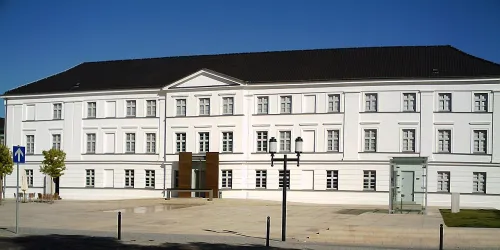
The Pomeranian State Museum tells the history, art and culture of the former province of Pomerania, with a clear focus on understanding and reconciliation with Poland. Its collection holds around 60,000 objects covering 14,000 years.
For many visitors the heart of it is the picture gallery: Caspar David Friedrich hangs here, alongside Vincent van Gogh and Frans Hals. If you came to Greifswald for Friedrich's paintings rather than his biography, this is the place to see them.
The museum is young. Greifswald and its university applied for it in 1992, the town provided historic buildings in the centre in 1993, and the foundation was set up in 1996, after reunification opened new ways of presenting Pomeranian history. Because that history crosses borders, the museum appointed an academic advisory board with Polish, Swedish and Danish members. The architect Gregor Sunder-Plassmann won the design competition; renovation and extension ran from 1998, the gallery opened in May 2000, and the complete museum on 3 June 2005.
The museum charges admission; give it an hour and a half if you go in. Afterwards the walk leaves the old town: 680 m, about 9 minutes, to the Museum Harbour on the river.
Local name
Pommersches Landesmuseum
Hours
Tue–Sun 10:00–17:00, Mon closed
Price
12 EUR full, 10 EUR reduced, 5 EUR children (6-17), under 6 free
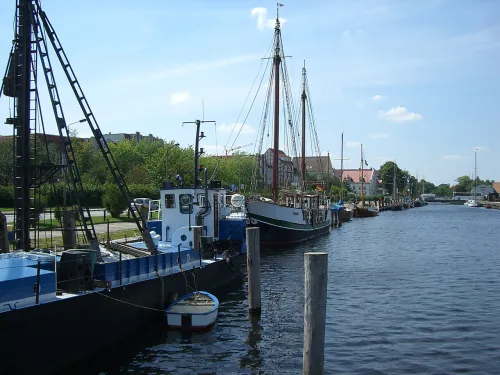
The Museum Harbour lies northeast of the old town on the river Ryck, and with more than 50 ships it is the largest museum harbour in Germany. It is free and open around the clock, so stroll the quay at your own pace and read the names on the hulls.
It grew out of a GDR working group on fishing traditions in the 1980s, where ship enthusiasts and owners of old boats gathered. Their attempts to found a museum harbour kept failing because the ruling party feared too many ships so close to the Polish border. Still, in 1988 they organised a meeting of old ships, mostly Zeesboote, the first Gaffelrigg, held every year since. After 1990 the town harbour was given up as a cargo port and moved to Ladebow, which freed the quays; links with the museum harbour in Flensburg followed, and that year's festival in Wieck became a joint 'German-German gaff jumble'. The association was officially founded on 23 February 1991.
The club also secured heritage protection for the Buchholz shipyard, the last surviving boatyard in Greifswald, which is now run as a working technical museum and self-help workshop for old ships. Among the vessels based here are the Alfred, built in 1913, the Bremerlotse from 1956, once a pilot boat on the Weser, and the yacht Ellida from 1955. The Gaffelrigg festival takes place every third weekend in July in Wieck.
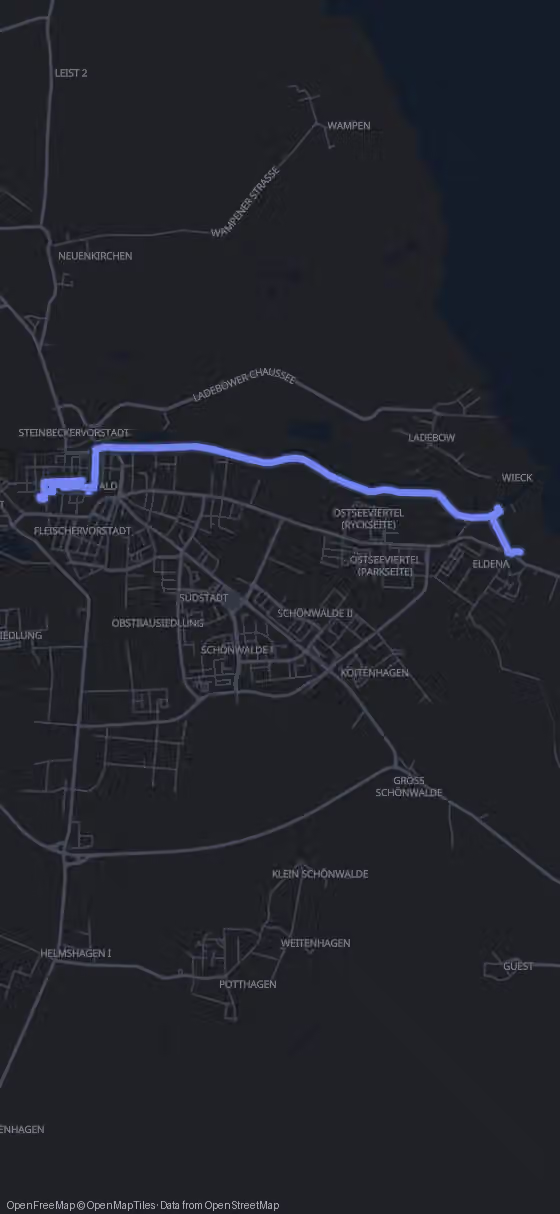
Now comes the longest leg of the walk: 4,360 m, about 58 minutes, to the Wieck Drawbridge. Towards the end you pass through Wieck Fishing Village before reaching the bridge.
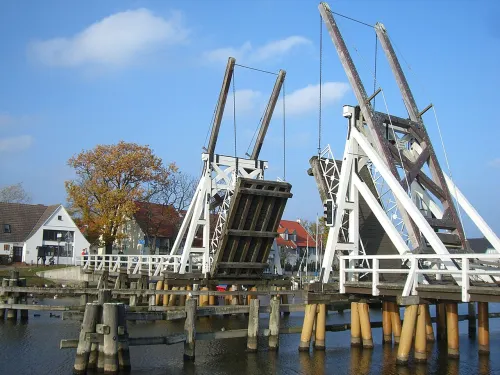
This wooden bascule bridge was built in 1887 after a Dutch model. It crosses the Ryck a few hundred metres before the river flows into the Dänische Wiek, the southern part of the Greifswalder Bodden, and links the districts of Wieck and Eldena.
People have lived at the river mouth since the abbey was founded in 1199, yet for almost seven centuries the only way across was by boat or ferry. Even today the next bridge is about five kilometres upstream, at the old town. On 20 December 1886 the Greifswald wooden shipbuilder and shipowner August Spruth was commissioned to build a bridge of his own design; his carpenters started in February 1887, and on 25 July 1887 it was inaugurated. It cost 33,850 marks.
The bridge is 55.1 metres long and 7.5 metres wide, with a 10.7 metre channel for ships. It was thoroughly overhauled in 1993 and 1994, eight months of work for 1.6 million marks, and still needs constant care: on 9 August 2004 a bolt snapped and one of the heavy lifting chains came down. As one of the oldest wooden drawbridges still in working order, it is a technical monument and the landmark of Wieck, a favourite subject for photographers and painters.
Cross it to the Eldena side; the abbey ruins are 690 m away, about 9 minutes.
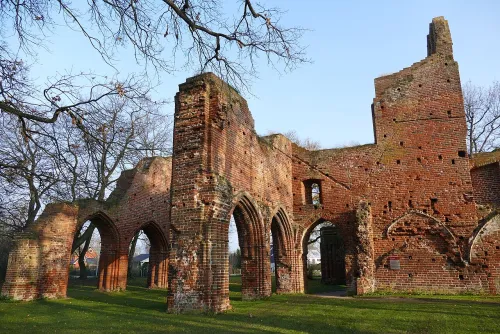
Here the walk closes the circle it opened at Friedrich's birthplace. Eldena Abbey, originally Hilda Abbey, was a Cistercian monastery, and only ruins survive. Caspar David Friedrich painted them again and again, most famously in Abbey in the Oak Forest.
The monks came by a detour. The Danish abbey of Esrum had founded a daughter house at Dargun in 1172, which was destroyed in 1198 in fighting between Denmark and Brandenburg. Jaromar I, Prince of the Rani, whose wife came from the Danish royal house, offered them a new site at the mouth of the Ryck, including profitable salt pans. In 1199 the abbey was founded, and Pope Innocent III confirmed it in 1204.
Salt made the abbey rich and influential in the Christianisation of Western Pomerania. Early in the 13th century it also gave rise to Greifswald itself, which began as the monastery's trading settlement opposite the salt pans, near where the via regia, an important trade route, crossed the river. The market town you started in was, in other words, the abbey's offshoot. After the Battle of Bornhöved in 1227 the Danes withdrew, and in 1248/49 Duke Wartislaw III of Pomerania forced the abbey to hand Greifswald over to him as a fief.
The ruins are free and open at all times, so there's no hurry at the end of the day. Walk around the remaining walls and compare what you see with the painting you may have seen in the State Museum.
All 9 stops are already on the map. You just press start.
AI Tour Guide
You just read the route. Now walk it with a guide in your ear, all the way to Eldena.
Press start wherever you are, even hundreds of kilometres from Greifswald, and the guide begins telling its stories right away. In the city, pick any of the 9 stops to start from: it leads you there, then talks with you the whole route, asking, listening, remembering, and shaping the tour around your answers.
Free to start · Runs in your browser · No app, no download
Shorter Ways to Walk Greifswald
Not every visit has room for the whole walk to Eldena; these three cuts follow the same route and keep its order.
Old town only
Stops: 1, 2, 3, 4, 5, 6
For a morning or a short stay: the six old-town stops sit close together, just 19 minutes of walking in total. Admissions apply only if you go into the Caspar David Friedrich Centre, the Pomeranian State Museum, up the cathedral tower or join the university tour.
In Caspar David Friedrich's footsteps
Stops: 2, 4, 6, 9
For anyone who came for the painter: his birthplace, the cathedral he helped remodel, his paintings in the State Museum and the ruin he made famous. Following the route from the Friedrich Centre to Eldena means 1 h 31 min of walking; you pay for the two museums, the cathedral is free.
The river walk to Eldena
Stops: 7, 8, 9
For an afternoon outdoors: from the Museum Harbour along to the Wieck Drawbridge and on to the abbey ruins, 67 minutes of walking and not a single ticket.
How Long Does This Greifswald Tour Take, With and Without Museums?
Pure walking time is 1 h 37 min over 7.2 km, but it is split very unevenly. The six old-town stops lie within 19 minutes of each other; the harbour, Wieck and Eldena take up most of the distance, with the 58 minutes from the Museum Harbour to the Wieck Drawbridge as the longest leg by far.
If you only look around and step into the cathedral, three and a half hours is realistic. Add about an hour for the Caspar David Friedrich Centre, an hour and a half for the Pomeranian State Museum and a quarter of an hour for the cathedral tower, and the walk becomes a full day of around six hours.
Pressed for time, take the old town in a morning and the river section in an afternoon or on another day; the two halves stand well on their own.
Before You Set Off in Greifswald
Start and finish: The recommended start is the Market Square, the walk ends at the Eldena Abbey Ruins. You can join at any stop, and the Museum Harbour is the natural starting point if you only want the river.
Best days: Choose your day with the Caspar David Friedrich Centre and the Pomeranian State Museum in mind, since neither is open every day.
Time of day: Leave the Market Square in the late morning so the Friedrich Centre is open when you arrive. If you want the university's tour of the Aula and Karzer, take the old town slowly and save the river for afterwards.
Costs: The walk, map and GPS navigation cost nothing; you only pay admissions where you go in. The AI Tour Guide starts with 100 free credits; after that you choose between €19.99 all-inclusive for this tour with no time limit, or €5 per hour.
AI Tour Guide
Your guide is ready when you reach the Market Square.
Press start and a voice AI Tour Guide takes it from here: leading the route through Greifswald, telling the stories, and turning your walk into a real back-and-forth conversation. No app or download is needed; it runs in your browser.
Free to start · Runs in your browser · No app, no download
What the AI Tour Guide Adds Between the Old Town and Eldena
The AI Tour Guide walks this route as a conversation: it greets you on the Market Square, tells the stories of each place, asks what you care about and shapes the rest of the walk around that, whether it's Friedrich, the Hanseatic university or the old ships. On the long stretch out to Wieck it has time for what no stop text covers, like the old boats tied up at the quay or the Hanse links that brought scholars to the young university, and you can interrupt it whenever something catches your eye.
A Real Conversation
A voice AI Tour Guide greets you, leads the whole route, and tells the stories and facts as you walk, asking what you want to see and keeping a real conversation going. Not a recording you press play on.
Map Navigation
Follow the route on the map and walk at your own pace. You choose where to start and when to move to the next stop.
Ask Anything
Curious about a building you pass? Ask your AI Tour Guide on the spot and the conversation carries on.
13 Languages
Switch language anytime. No separate tour needed.
I only have time for one museum. Which should it be?
If Caspar David Friedrich is your reason for coming, the Pomeranian State Museum is the better pick, because that's where his paintings hang, alongside van Gogh and Frans Hals. The Friedrich Centre is about the man and his birthplace, smaller and cheaper.
Is the long walk out to Wieck and Eldena worth it?
Yes, if you have the afternoon: the harbour, the wooden drawbridge and the abbey ruin explain where Greifswald came from, and all three are free and always open. If not, the old-town part works on its own.
Does the walk work in winter?
Yes. Everything outdoors is open around the clock. In the colder months some indoor stops keep shorter hours, and the university tour of the Aula and Karzer is not offered then.
Which other towns pair well with Greifswald?
Stralsund is 31 km away and makes an easy second Hanseatic town. Rostock, whose university lost the professors who helped found Greifswald's, is 82 km away, and Szczecin across the Polish border is 106 km.
Is the tour really free?
Yes. The whole tour is free: the route, the interactive map and the navigation cost you nothing. Only the voice AI Tour Guide is optional and paid: you test it with 100 free credits, then you pay either €5 per hour or €19.99 for this whole tour, with no time limit. Admission to 2 of the 9 stops is not included: Caspar David Friedrich Centre and Pomeranian State Museum charge their own entry fees.
Do I need to download an app?
No. Everything runs in your phone browser. Open the route and start walking, no download and no sign-up required.
Do I need to book the walking tour in advance?
No booking needed. This self-guided tour is available anytime. Open the route in your browser and start walking. The AI Tour Guide works instantly, no app, no reservation required.
What languages is the AI Tour Guide available in?
The AI Tour Guide speaks 13 languages, so you take the tour in your own language and can switch at any time.
Can I skip stops or change the route?
Yes. Skip any stop, spend extra time at places you like, or start the route from any point. It is your walk, you set the pace.