

Golden Gate
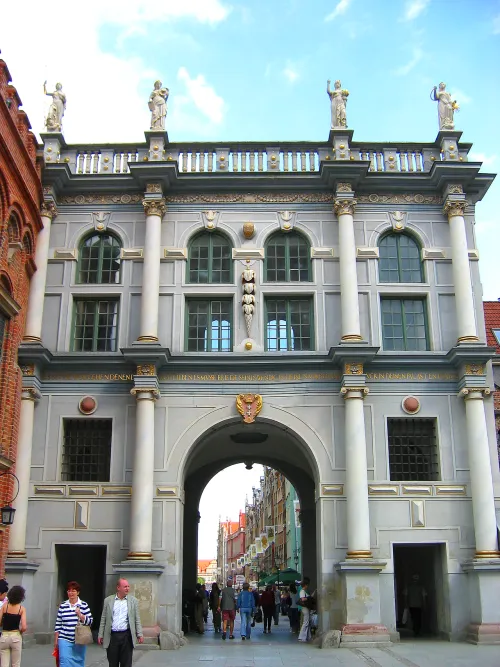
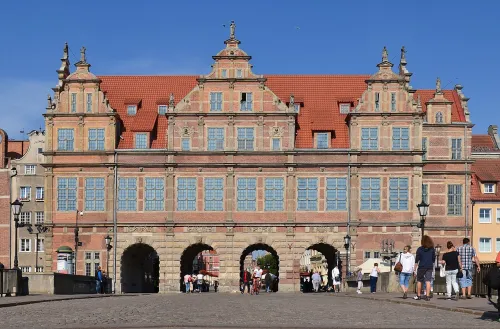
Stand under the arch and look up. The Golden Gate is shaped like a triumphal arch, framed by Ionic and composite columns and crowned on both façades by an attic with eight allegorical statues, four on each side. It was finished in 1612 to a design by Abraham van den Blocke, and it was built to impress rather than to defend. A Gothic city gate, the Long Lane Gate, stood here before and was torn down to make room for it.
The statues carry a message. On the west side stand Pax, Libertas, Fortuna and Fama: peace, freedom, fortune and fame, the things the burghers hoped for. Walk through and turn around: facing Long Lane are Concordia, Iustitia, Pietas and Prudentia, harmony, justice, piety and prudence, the civic virtues expected of them in return. Peter Ringering carved the originals in 1648 after designs by Jeremias Falck. Weather wore them away, and what you see today are reconstructions of copies made in 1878.
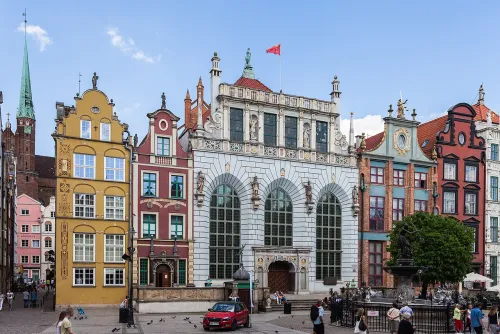
Look for the German inscription in the frieze, a line from Psalm 122: may they prosper who love you, may there be peace within your walls and good fortune in your palaces. A fitting greeting for a merchant city. The name “Golden Gate” itself is not historic; it was adopted only after the Second World War. In the 19th century the building housed the Royal School of Fine Arts, it was damaged in 1945 and rebuilt in 1957. Today the Polish architects' association looks after it, and the patrician Court of the Brotherhood of St. George stands right beside it.
The gate costs nothing and is open at any hour, so take your time with the figures. Once you pass through, you are already on the Royal Road, just 10 m further.