Free Walking Tour Szczecin: Gate, Castle and Cathedral

From a Baroque city gate along the Oder embankment to the castle of the Pomeranian dukes and a Gothic cathedral: Szczecin's story in one walk.

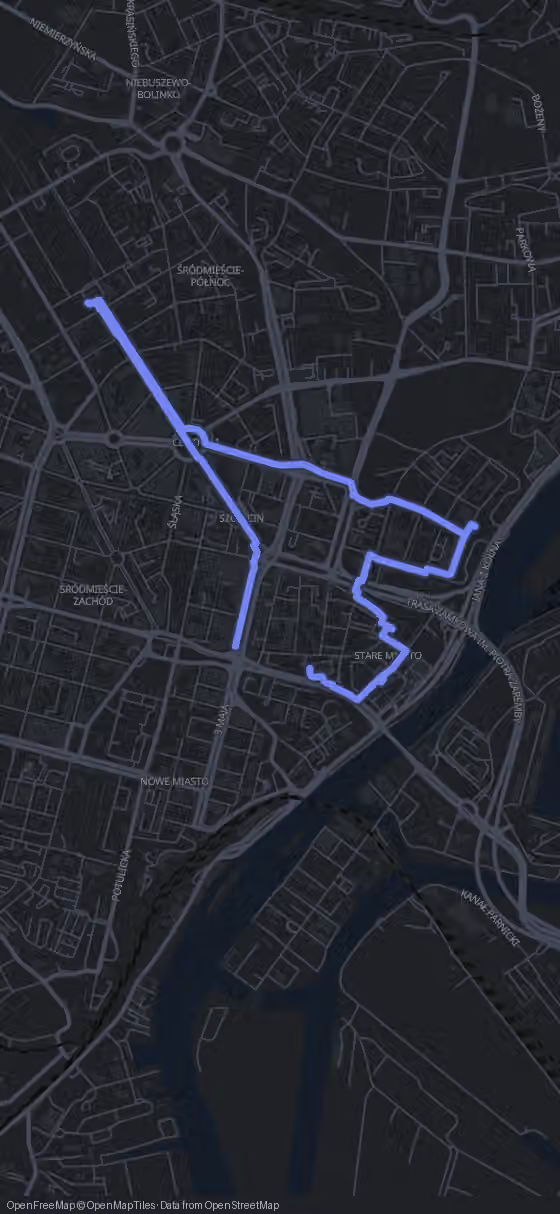
8 Stops 5.4 km ~1 h 17 min walking
Route map for the Szczecin walking tour
Stop 1 of 8
1.6 km·20 min
Port Gate
Head north-west toward the Szczecin Philharmonic
Welcome to Szczecin. I'm Alex, and this city's sharpest modern landmark rose where a wartime ruin once stood.
Try this tour with Alex

This Szczecin Route at a Glance

Eight stops from the Port Gate to the Cathedral Basilica of St James the Apostle: 5.4 km, 1 h 17 min of pure walking, about five hours with museum visits. On the way: Szczecin Philharmonic, National Museum in Szczecin, Chrobry Embankment, Dialogue Centre Upheavals, Ducal Castle of the Pomeranian Dukes and Hay Market Square.

The gate, the embankment, the square, the castle courtyards and the cathedral church are free; the museums and towers charge entry. The GPS route in your browser is free, the AI Tour Guide is optional.

Open free GPS & optional AI Tour Guide
View of Szczecin

The Route

Walking Map of Szczecin, Gate to Cathedral

8 stops 5.4 km 1 h 17 min walking
Tap to load interactive map

The 8 stops along this route

  1. Port Gate in Szczecin, stop 1 on the self-guided walking tour
    1Port Gate
  2. Szczecin Philharmonic, stop 2 on the self-guided walking tour
    2Szczecin Philharmonic
  3. National Museum in Szczecin, stop 3 on the self-guided walking tour
    3National Museum in Szczecin
  4. Chrobry Embankment in Szczecin, stop 4 on the self-guided walking tour
    4Chrobry Embankment
  5. Dialogue Centre Upheavals in Szczecin, stop 5 on the self-guided walking tour
    5Dialogue Centre Upheavals
  6. Ducal Castle of the Pomeranian Dukes in Szczecin, stop 6 on the self-guided walking tour
    6Ducal Castle of the Pomeranian Dukes
  7. Hay Market Square in Szczecin, stop 7 on the self-guided walking tour
    7Hay Market Square
  8. Cathedral Basilica of St James the Apostle in Szczecin, stop 8 on the self-guided walking tour
    8Cathedral Basilica of St James the Apostle
  9. That's the full route.

    Walk it with an AI Tour Guide talking you through every one of these streets.

    Start free in your browser
    You made it

Your Szczecin Walking Tour, Eight Stops in Order

  1. 1

    Port Gate

    Port Gate in Szczecin, stop 1 on the self-guided walking tour

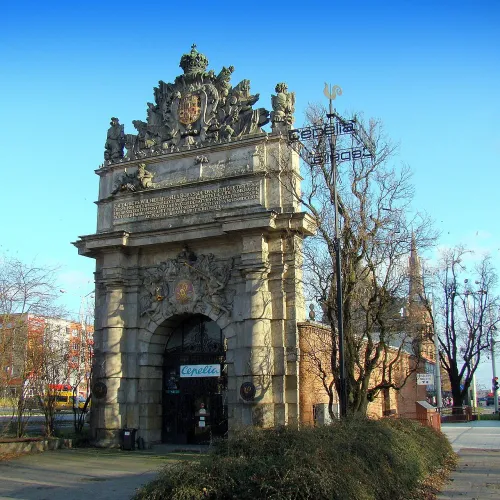
    Your walk begins at a Baroque showpiece: the Port Gate, known locally as Brama Portowa, standing where Independence Avenue, Wyszyńskiego Street and Victory Square meet. Take a moment with the façade. Its elaborate sculptures are the work of Bartholomé Damart, carved from sandstone brought from Pirna in Saxony, while the bricks behind them were made in Liège, in today's Belgium. Materials from half of Europe, assembled for one city entrance.

    The gate was ordered by King Frederick William I of Prussia in 1724 and built between 1725 and 1727 to designs by the military architect Gerhard Cornelius van Wallrawe, with masonry by Hans Jürgen Reinecke. It was not decoration alone: it sat in the fortification walls as one of the ways into the city, covered by the Royal and Passau bastions nearby.

    Its names tell their own story. It opened as the Brandenburg Gate and became the Berlin Gate in 1732, because the road leading out of it ran to Berlin. That name had belonged to another gate on Wyszyńskiego Street, which was pulled down the same year. When the walls came down in the 19th century, this gate was spared and handed over to the city.

    In 1902 the city placed the Amphitrite Fountain by Reinhold Felderhoff in front of the gate's eastern side, by then bricked up: the Greek sea goddess, nude, on a chariot pulled by two galloping horses above a wide, shallow basin. Some religious conservative women protested against her nudity. Today the gate serves as a community theatre venue, so the outside is what you get unless you come for a show.

    From here it is the longest leg of the day so far: 1640 m, about 24 minutes, to the Szczecin Philharmonic, a building that could hardly be more different.
    Local name
    Brama Portowa
    Hours
    Open 24/7
    Price
    Free
  2. 2

    Szczecin Philharmonic

    Szczecin Philharmonic, stop 2 on the self-guided walking tour

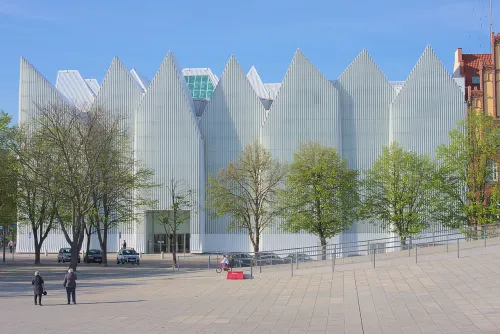
    After the Baroque gate, the Szczecin Philharmonic looks almost like a glacier set into the street. The architects Barozzi Veiga faced a real problem: the city centre is dominated by 18th and 19th century architecture, and they had to fit a large contemporary volume into it. Their answer was to cut the building into vertical sections, shift them slightly against each other and give each one a pointed gable roof. Look at the roofline and you will see how the steep gables echo the old town houses without copying them.

    Inside, five storeys hold two concert halls with 953 and 192 seats, and the main stage has room for 120 musicians and 110 singers. Construction began in April 2011 and the building was inaugurated on 14 September 2014. It stands on the site of an earlier concert hall by Franz Schwechten from 1884, whose ruin was demolished in 1962.

    The orchestra is older than its home. It was founded in 1948 and gave its first concert on 25 October that year under Felicjan Lasota. Since 1958 it has carried the name of the Polish composer Mieczysław Karłowicz. Józef Wiłkomirski enlarged the ensemble, and under Stefan Marczyk it toured Germany, Denmark, Bulgaria, Italy and the Soviet Union. Soloists such as Krystian Zimerman and Natalia Gutman have played with it. Until 2014 the orchestra performed in a hall of the city's town hall.

    Is it worth going in? The building is open to visitors, and on selected days there are guided tours, also in English, plus an exhibition on the gallery level with its own ticket. Best of all, if your schedule allows, is an evening concert. Then comes another long leg: 2000 m, about 28 minutes, to the National Museum in Szczecin above the river.

    Local name
    Filharmonia Szczecińska
    Hours
    Building: Tue–Sun 10:00–18:00 (and 1 hr before events); Ticket office: Tue–Fri 12:00–18:00, Sat 12:00–16:00; Gallery Level 4: selected Sat–Sun 12:00–16:00; Guided tours: selected Fridays at 13:00 (DE), 14:00 (EN), 15:00 (PL)
    Price
    Guided tour: 30 PLN full, 20 PLN reduced (summer tour: 20 PLN full, 10 PLN reduced); Gallery Level 4 & Art.Room exhibition: 10 PLN (free for children up to 10 and persons with disabilities); concert ticket prices vary by event
  3. 3

    National Museum in Szczecin

    National Museum in Szczecin, stop 3 on the self-guided walking tour

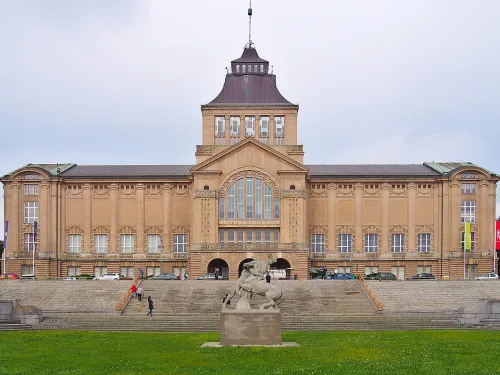
    The main building of the National Museum in Szczecin forms the visual centre of the Chrobry Embankment, and you will appreciate its role best when you look back at it from the river side in a moment. The National Museum counts as one of the most important museums in Poland, and this is its headquarters.

    Its roots go back to 1824, when the Society for Pomeranian History and Antiquities was founded. On 23 September 1826 its first collection opened to the public in the Ducal Castle, which you will reach later on this walk. Becoming capital of the new Prussian province of Pomerania in 1815 had set off rapid growth, and wealthy patrician families such as the Stoltings, the Dohrns and the Kasels shaped what was collected. A city museum followed in 1878 with a picture gallery, a print collection and antique bronzes, and in 1913 everything moved into the new city museum on the freshly built terrace.

    After 1945 the Polish City Museum grew out of these collections, and in 1970 it became the National Museum. In the 1970s it gained the history museum in the Old Town Hall and a museum of contemporary art in the former headquarters of the fortress garrison; today five branches belong to it, among them the Dialogue Centre Upheavals on this route.

    Inside you will find paintings, copies of antique sculpture, ship models and objects of cultural history and ethnography, alongside frequently changing exhibitions. If you have an hour and enjoy maritime history or art, it is worth the ticket. Afterwards you only need 20 m, about a minute, to stand on the Chrobry Embankment itself.

    Local name
    Muzeum Narodowe
    Hours
    Tue, Sun 10:00–16:00; Wed–Sat 10:00–18:00; Mon closed
    Price
    Permanent exhibitions: 20 PLN full, 12 PLN reduced; Temporary exhibitions (Wały Chrobrego 3): 15 PLN full, 8 PLN reduced; Combined (permanent + temporary): 30 PLN full, 15 PLN reduced; All branches (valid 3 days): 65 PLN full, 40 PLN reduced; Free admission to permanent exhibitions on Saturdays
  4. 4

    Chrobry Embankment

    Chrobry Embankment in Szczecin, stop 4 on the self-guided walking tour

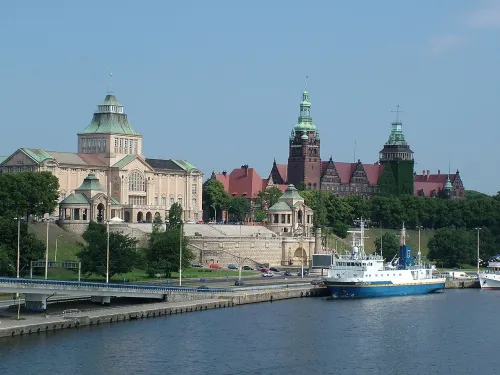
    The Chrobry Embankment, Wały Chrobrego in Polish, runs for 500 metres along the western bank of the Oder, and it is the image many people carry home from Szczecin. It was planned and built by the city architect Wilhelm Meyer-Schwartau between 1900 and 1914, on the grounds of the former Fort Leopold. The whole complex is built uniformly from sandstone blocks, which is why it reads as one piece together with the museum behind it.

    Look for the central platform with the fountain grotto below it. Carved into the stone are the name, the building dates 1902 and 1907, the coat of arms of the province of Pomerania and sculptures. The lamp posts are shaped as stylised lighthouses, a nod to the port city, and a large pavilion closes the plateau at each end. Halfway down the slope towards the river, a semicircle holds the sculpture Hercules fighting Nessus, made by Karl Ludwig Manzel in 1913. Lawns, shrubs and groups of trees soften the slope down to the water.

    The buildings along the top deserve a glance too. To the north stands the former seat of the Prussian regional government, built between 1906 and 1911 to plans by Paul Kieschke and today the seat of the West Pomeranian Voivodeship administration. To the south follow the Maritime Academy, founded in 1966 in the former Pomeranian state finance office, and the former Pomeranian state insurance institution by Emil Drews.

    The German name was Haken Terrace, after Hermann Haken, mayor from 1878 until 1907. The Polish name means Ramparts of Bolesław the Brave, after the early Polish ruler, and it reflects the conviction of the first Polish officials after 1945 that the city had been regained after centuries of German rule. From here it is 620 m, about 9 minutes, to the Dialogue Centre Upheavals, which picks up exactly that postwar story.

    Local name
    Wały Chrobrego
    Hours
    Open 24/7
    Price
    Free
  5. 5

    Dialogue Centre Upheavals

    Dialogue Centre Upheavals in Szczecin, stop 5 on the self-guided walking tour

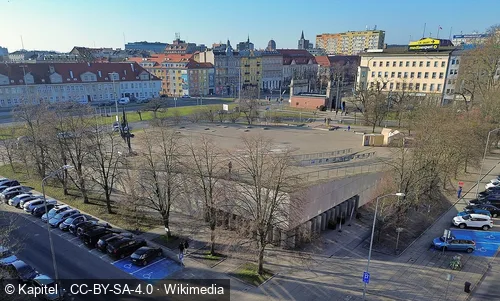
    At first you may wonder where the museum is. The Dialogue Centre Upheavals is an underground building, sunk into Solidarity Square, designed by Robert Konieczny's studio KWK Promes. Above it stands the Monument to the Victims of December 1970 by Czesław Dźwigaj. The place is chosen with intent: the square lies next to the former provincial headquarters of the communist party, where demonstrations and street fighting broke out in December 1970. Sixteen people died.

    The exhibition, a pavilion of the National Museum, traces the turning points of the region's recent history. It starts in 1945, when the Potsdam agreements placed Szczecin inside the Polish state, the German population of Western Pomerania was expelled and Polish settlers arrived in their place. It then focuses on the moments of social revolt in 1970, 1981 and 1989 that led to Poland regaining its sovereignty in 1989.

    Why does this centre exist at all? Until 1989 official history was heavily ideological and protected by censorship, so impartial research on the region could not be published. Even later, many in Szczecin felt the city's role in the revolt against communist rule was overlooked in national memory; leaving Szczecin out of the 25th anniversary celebrations of August 1980 hurt in particular. The museum set out to fill that gap, and the centre opened on 25 January 2016.

    If the 20th century interests you, or you want to understand why this city feels the way it does, plan about three quarters of an hour inside; it charges entry. Next comes a short hop of 380 m, about 6 minutes, back several centuries to the castle of the Pomeranian dukes.

    Local name
    Centrum Dialogu „Przełomy”
    Hours
    Tue–Thu, Sat 10:00–18:00; Fri, Sun 10:00–16:00; Mon closed
    Price
    Permanent exhibitions: 20 PLN full, 12 PLN reduced; Combined (permanent + temporary): 30 PLN full, 15 PLN reduced; All branches: 65 PLN full, 40 PLN reduced; Free admission to permanent exhibitions on Saturdays
  6. 6

    Ducal Castle of the Pomeranian Dukes

    Ducal Castle of the Pomeranian Dukes in Szczecin, stop 6 on the self-guided walking tour

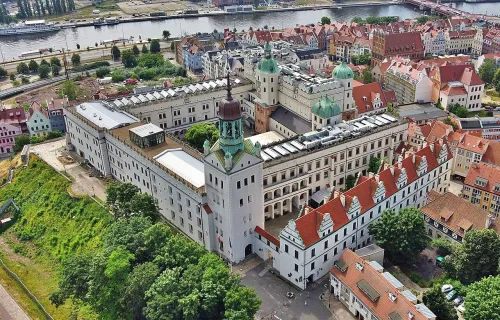
    The Ducal Castle of the Pomeranian Dukes rises on Castle Hill in the Old Town, near the Oder. What you see mixes Gothic with Pomeranian mannerism, and it was the seat of the dukes of Pomerania-Stettin, from the House of Pomerania that ruled the duchy from 1121 until 1637. Today it is one of the largest cultural centres in the West Pomeranian Voivodeship.

    The story starts with a quarrel. In 1346 Duke Barnim III, called the Great, began building his residence inside the city walls against the will of the burghers; an older Pomeranian stronghold had been levelled in 1249. Under Casimir V the complex was expanded in 1428 into a castle. In 1490 it was partly rebuilt for the wedding of Bogusław X with Anna Jagiellonka, daughter of the Polish king Casimir IV Jagiellon.

    The look of the courtyard dates largely from 1573 to 1582, when Italian stonemasons rebuilt the castle in mannerist style for Duke John Frederick, to designs by Wilhelm Zachariasz Italus. Two new wings closed the courtyard in front of the medieval southern and eastern wings, the main gate received the ducal crest and the northern wing was meant for the chapel. Look for that crest as you walk in.

    After the Peace of Westphalia in 1648 the castle housed the Swedish governor. From 1705 until 1711 the Polish queen Catherine Opalińska lived here with a small court and her daughters Anna and Marie Leszczyńska, the future Queen of France; in 1711 King Stanisław I Leszczyński joined them, fleeing Saxon and Russian troops.

    The courtyards and terraces are free and worth a stroll for anyone. The permanent exhibitions, the bell tower and the Ducal Terrace charge entry; the visitor centre helps you choose. On the 350 m, 4 minute walk to Hay Market Square you enter the Old Town and pass the Museum of the History of Szczecin.

    Local name
    Zamek Książąt Pomorskich
    Hours
    Permanent exhibitions & Ducal Terrace: Tue–Sun 10:00–17:00, Mon closed; Bell Tower: Tue–Sun 10:00–18:00, Mon closed; Castle Courtyards and terraces: daily 06:00–23:00; Visitor Center (CIKiT): daily 10:00–18:00
    Price
    Permanent exhibitions: 30 PLN full, 20 PLN reduced; Bell Tower (Wieża Dzwonów): 10 PLN full, 7 PLN reduced; Ducal Terrace (Taras Książęcy): 10 PLN full, 7 PLN reduced; Castle Courtyards: free admission
  7. 7

    Hay Market Square

    Hay Market Square in Szczecin, stop 7 on the self-guided walking tour

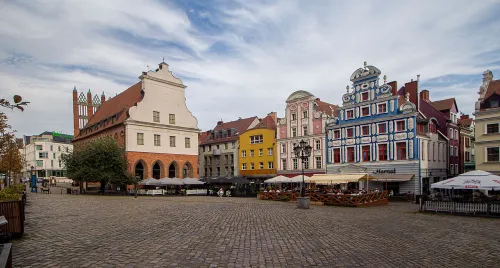
    Hay Market Square, Rynek Sienny, is one of the oldest public spaces in the city, laid out in the Middle Ages as a market place. In 1310 it was recorded in Latin as forum antiquum, the old market, and after 1325 people began calling it the Hay Market, after one of the goods traded here.

    The building to look at is the Old Town Hall on its corner. It was built in the 15th century in Gothic style, replacing an earlier wooden building, and remodelled in Baroque style in the 17th century. In 1879 the city government moved out and the rooms were rented to private businesses; today the building houses the Museum of the History of Szczecin. At the western end of the square a stock exchange opened in 1835, on the site of former lodgings for sailors.

    Much of what surrounds you is younger than it looks. Late 19th century tenements once framed the square, mostly Baroque in style and later refurbished in an eclectic manner. Bombing in the Second World War burned them down; the Old Town Hall was rebuilt, the other ruins were cleared. The houses on the north and west sides went up in the 1990s, some of them replicating the old tenements, so you are looking at a careful reconstruction of a lost townscape.

    Even the name has a twist. In 1945 this square and the neighbouring New Market were renamed Rzepicha Square, after the wife of the legendary Piast the Wheelwright, seen as founder of the Piast dynasty. Only in 1995 did both squares get their old names back. From here it is 420 m, about 7 minutes, to the cathedral.

    Local name
    Rynek Sienny
    Hours
    Open 24/7
    Price
    Free
  8. 8

    Cathedral Basilica of St James the Apostle

    Cathedral Basilica of St James the Apostle in Szczecin, stop 8 on the self-guided walking tour

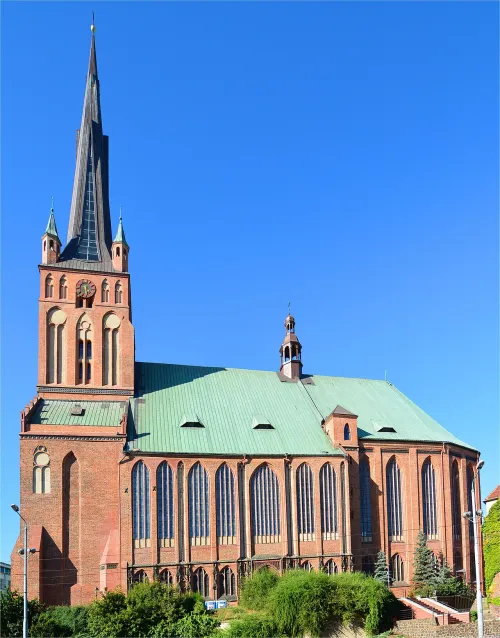
    The walk ends at the Cathedral Basilica of St James the Apostle, the seat of the Archdiocese of Szczecin-Kamień. It is counted as the second tallest church in Poland and the largest church in Western Pomerania, and its tower is one of the defining landmarks of the Old Town.

    The church was founded in 1187, built by the citizens themselves and modelled on St Mary's Church in Lübeck. Around 1220 the Pomeranian Duke Bogislaw II was buried here. Its history is a chain of collapses and rebuilds: in 1456 one of its two towers fell in a storm and destroyed part of the church, and the reconstruction, finished in 1503, turned it into a hall church with a single tower. After the Reformation it belonged to the Pomeranian Evangelical Church. In 1677, during the Scanian War, it was destroyed again and rebuilt in Baroque style between 1690 and 1693.

    In 1894 the west tower collapsed in a storm once more; the rebuild finished in 1901 with a spire of 119 metres. On the night of 16 August 1944, air raids brought that spire down, and bombs and fire destroyed the north wall, all altars and the artworks inside. After the war officials hesitated to allow a rebuild, until a heritage conservator pointed out that demolishing the remains would cost more than restoring them. Work began in 1971 and lasted three years. Look at the north wall: it was rebuilt in a modern style that deliberately does not match the rest.

    The church is free to enter and worth a quiet walk through the nave. The observation deck in the tower charges entry and gives you a view over the route you have just walked. From here, the GPS navigation can lead you back to the Port Gate if you wish.

    Local name
    Bazylika Archikatedralna św. Jakuba Apostoła
    Hours
    Observation deck: Mon–Sun 10:00–18:00 (Summer season 24.06-30.08: Mon–Fri 09:00–19:00, Sat–Sun 09:00–20:00); Church services: Sun 07:30, 09:00, 10:30, 12:00, 18:00, 21:00; Weekdays 07:00, 12:00, 18:00
    Price
    Cathedral church: Free; Observation deck (tower): 19 PLN full, 10 PLN reduced, groups >15 persons: 16 PLN full, 8 PLN reduced, children under 5: free
Walking tour route map of Szczecin Route loaded
Port GateSzczecin PhilharmonicNational Museum in SzczecinChrobry Embankment+4
All 8 stops are already on the map.
You just press start.
AI Tour Guide

You know the route now. Walk it with a guide in your ear.

Press start wherever you are, even hundreds of kilometres from Szczecin, and the guide begins telling its stories right away. In the city, pick any of the 8 stops to start from: it leads you there, then talks with you the whole route, asking, listening, remembering, and shaping the tour around your answers.

8stops 5.4km 1 h 17 minwalking 13languages
▶Start the tour free

Free to start · Runs in your browser · No app, no download

Shorter Ways to Walk Szczecin

Not every day allows the full route. These versions keep the core of the city and drop the long first legs.

Old Town in a nutshell

Stops: 6, 7, 8

For a short visit or a gap between trains: castle, market square and cathedral, only 770 m and 11 minutes of walking. Castle courtyards and the cathedral church are free; the castle exhibitions and the cathedral tower charge entry. About an hour and a half with a look into the castle and up the tower.

River and Old Town

Stops: 3, 4, 5, 6, 7, 8

For history lovers who want the museums: start at the National Museum, follow the embankment and finish at the cathedral. 1790 m and 27 minutes of walking. The National Museum, the Dialogue Centre, the castle exhibitions and the tower charge entry. Plan about three and a half hours.

Full route, outside only

Stops: 1, 2, 3, 4, 5, 6, 7, 8

For walkers on a tight budget: all eight stops, 1 h 17 min of walking, and only the free parts: the gate, the embankment, the castle courtyards, the market square and the cathedral church. About three hours in total.

How Long Does the Szczecin Walk Really Take?

The pure walking time is 1 h 17 min. More than half of it falls on the first two legs, Port Gate to Philharmonic and on to the National Museum; after that, everything from the museum to the cathedral sits within 27 minutes of walking.

With the visits that are worth the time, roughly an hour in the National Museum, three quarters of an hour in the Dialogue Centre, half an hour each at the castle and the cathedral tower, plus short looks at the other stops, you are out for about five hours. Seen from outside only, the whole route takes about three hours; the Old Town version needs about an hour and a half, the river and Old Town version about three and a half hours.

Before You Set Off in Szczecin

  • Start and finish: The recommended start is the Port Gate, the finish is the Cathedral Basilica of St James the Apostle. You can join at any stop; the GPS navigation in your browser can lead you back to the start from the cathedral.
  • Time of day: If you want to go into the museums, set off in the morning so the indoor visits fit comfortably into the day. For the outside-only version, any daylight hours work.
  • Entry fees: Tickets are needed for the National Museum, the Dialogue Centre, the castle exhibitions, the castle bell tower and Ducal Terrace, the cathedral tower, and the Philharmonic's guided tours and gallery. Everything else on the route is free.
  • Concerts: If you would like to hear the orchestra, check the Philharmonic's programme before your visit; ticket prices depend on the event.
Walking tour route map of Szczecin
AI Tour Guide

Your guide is ready at whichever stop you start.

Press start and a voice AI Tour Guide takes it from here: leading the route through Szczecin, telling the stories, and turning your walk into a real back-and-forth conversation. No app or download is needed; it runs in your browser.

8stops 5.4km 1 h 17 minwalking 13languages
▶Start the tour free

Free to start · Runs in your browser · No app, no download

What the AI Tour Guide Adds in Szczecin

Szczecin was Pomeranian, Swedish, Prussian and German before it became Polish, and the AI Tour Guide lets you follow whichever thread grabs you: what daily life at the dukes' court looked like, how the new Polish population arrived after 1945, or what the December 1970 protests meant to the families who lived through them. It greets you, tells the stories at each stop, asks what you care about and shapes the conversation around it, and you can interrupt at any time. You start with 100 free credits; after that, choose this tour all-inclusive for €19.99 with no time limit, or €5 per hour.

A Real Conversation A voice AI Tour Guide greets you, leads the whole route, and tells the stories and facts as you walk, asking what you want to see and keeping a real conversation going. Not a recording you press play on.
Map Navigation Follow the route on the map and walk at your own pace. You choose where to start and when to move to the next stop.
Ask Anything Curious about a building you pass? Ask your AI Tour Guide on the spot and the conversation carries on.
13 Languages Switch language anytime. No separate tour needed.
Start free in your browser

Common Questions About Walking Szczecin

Can I go inside the Port Gate?

The gate is used today as a community theatre venue, so you see the interior when you come for a performance. The façade and its sculptures are free to look at any time.

Does one ticket cover the National Museum and the Dialogue Centre?

Both belong to the National Museum in Szczecin. Besides separate tickets there is a combined ticket for all branches, valid for three days, which pays off if you plan to see several of them.

Is the cathedral free to enter?

Yes, the church itself is free. Only the observation deck in the tower charges entry. Masses are held daily, so keep your visit quiet during a service.

Can I visit the castle without buying a ticket?

Yes. The castle courtyards and terraces are free; you pay only for the permanent exhibitions, the bell tower and the Ducal Terrace. The visitor centre in the castle is a good first stop for information.

Is the tour really free?

Yes. The whole tour is free: the route, the interactive map and the navigation cost you nothing. Only the voice AI Tour Guide is optional and paid: you test it with 100 free credits, then you pay either €5 per hour or €19.99 for this whole tour, with no time limit. Admission to 3 of the 8 stops is not included: National Museum in Szczecin, Dialogue Centre Upheavals and Ducal Castle of the Pomeranian Dukes charge their own entry fees.

Do I need to download an app?

No. Everything runs in your phone browser. Open the route and start walking, no download and no sign-up required.

Do I need to book the walking tour in advance?

No booking needed. This self-guided tour is available anytime. Open the route in your browser and start walking. The AI Tour Guide works instantly, no app, no reservation required.

What languages is the AI Tour Guide available in?

The AI Tour Guide speaks 13 languages, so you take the tour in your own language and can switch at any time.

Can I skip stops or change the route?

Yes. Skip any stop, spend extra time at places you like, or start the route from any point. It is your walk, you set the pace.
Image credits
▶ Start free in your browser Runs in your browser, no app, no download