

Palace of Culture and Science
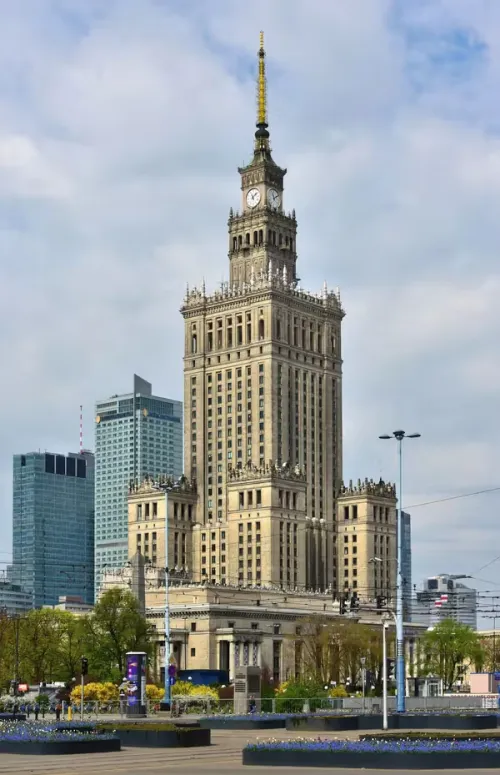
Start at Plac Defilad 1, in front of the building that still dominates central Warsaw. The Palace of Culture and Science was presented as a “gift of the Soviet nation to the Polish nation” and went up between 1952 and 1955. Until 1956 it officially carried Stalin's name. With the antenna mast that forms part of its spire it reaches 237 metres, the second tallest building in Poland by total height.
If the silhouette reminds you of Moscow, that's intended: the Soviet architect Lev Rudnev took his cue from the Moscow skyscrapers known abroad as the Seven Sisters, which in turn borrowed from American art deco towers. The result mixes socialist realism with historicism. In front of the main entrance on the Marszałkowska side stand two sculptures: Adam Mickiewicz by Stanisław Horno-Popławski and Nicolaus Copernicus by Ludwika Nitschowa.
This is no empty monument. The City Council meets inside in the Warsaw Hall, and the palace holds four theatres (Studio, Dramatyczny, Lalka and 6. piętro), the National Museum of Technology, the Museum of Evolution of the Polish Academy of Sciences, the Kinoteka cinema, Civitas University and a youth centre with a swimming pool. From 1958 the International Book Fair was held here for many years. The Congress Hall, built for 3,000 people, has been closed since 2014. Since 2007 the palace has been a listed monument.
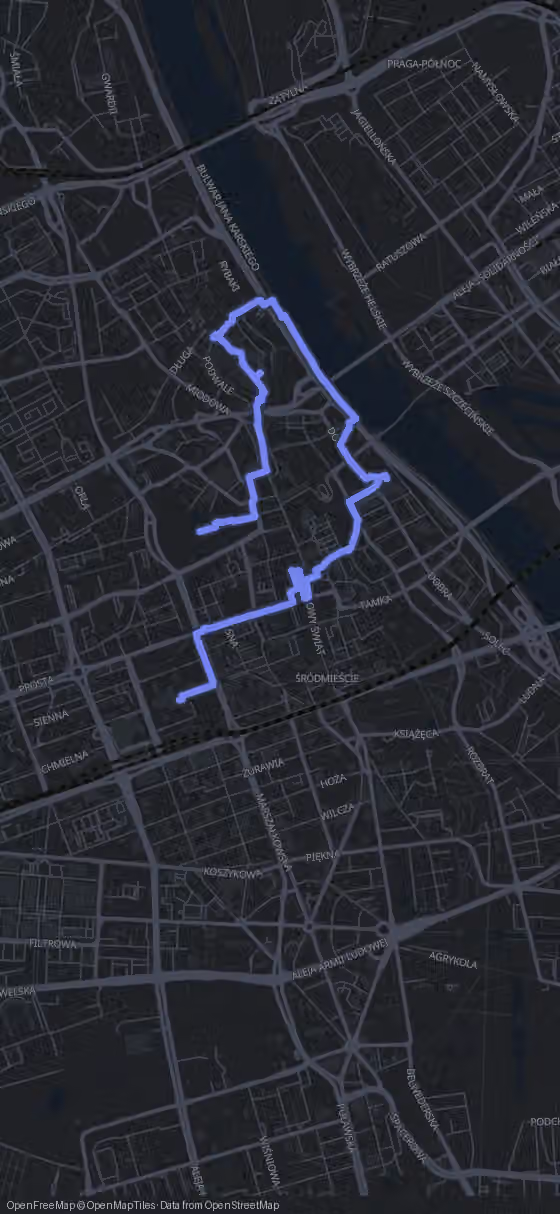
Is it worth going up? The viewing terrace charges admission and suits you if you want the city laid out before you walk it. If not, the facade and the two sculptures are enough. Holy Cross Church is 1,390 metres away, about 19 minutes on foot; on the way you pass the Museum of Modern Art.