Free Walking Tour Poznań: Goats, Island and Enigma

Catch the Town Hall goats at noon, cross to the island where the Polish state took shape, then meet the codebreakers who took on Enigma, all on foot.

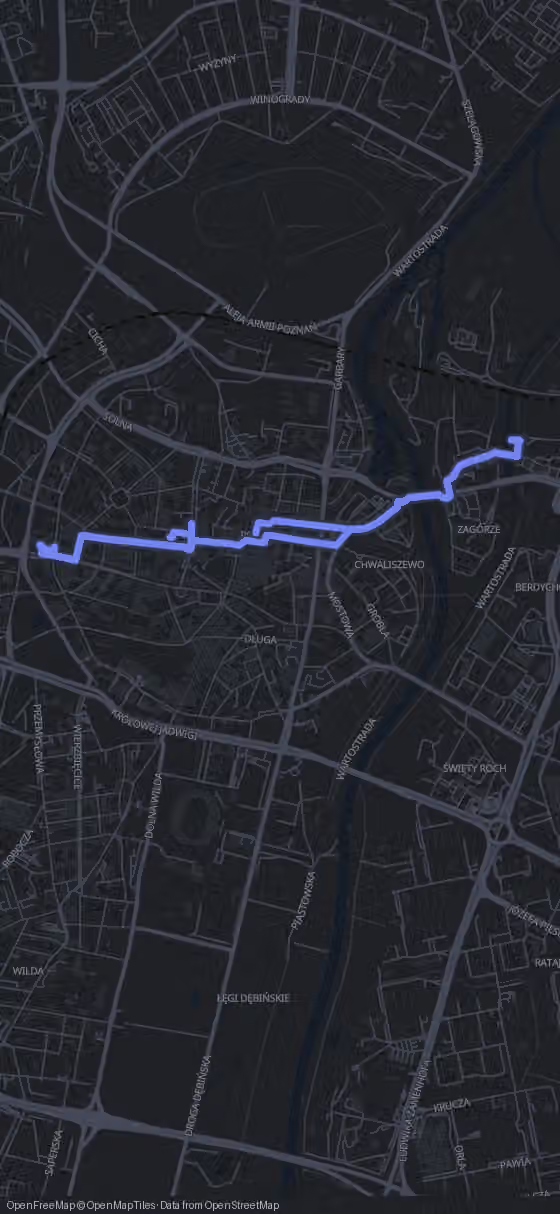
8 Stops 5.6 km ~1 h 18 min walking
Route map for the Poznań walking tour
Stop 1 of 8
10 m·1 min
Old Market Square
Head north-east across the square to the Town Hall
Welcome to Poznań. I'm Alex, and three mathematicians from this city quietly changed the course of the Second World War.
Try this tour with Alex

This Route at a Glance

Eight stops take you from the Old Market Square to Freedom Square: 5.6 km in all, 1 h 18 min of pure walking and about 3 hours with time to look around. Every museum you go into adds to that.

Free to visit: Poznań Town Hall with mechanical goats, Ostrów Tumski (Cathedral Island) and both squares. Brama Poznania, the Imperial Castle and the Enigma Cipher Breaking Museum charge entry; at the National Museum in Poznań you sort out tickets at the desk. The GPS route in your browser is free, the AI Tour Guide optional.

Open free GPS & optional AI Tour Guide
View of Poznań

The Route

Walking Map of Poznań: Old Town, Island and Imperial District

8 stops 5.6 km 1 h 18 min walking
Tap to load interactive map

The 8 stops along this route

  1. Old Market Square in Poznań, stop 1 on the self-guided walking tour
    1Old Market Square
  2. Poznań Town Hall with mechanical goats, stop 2 on the self-guided walking tour
    2Poznań Town Hall with mechanical goats
  3. Brama Poznania in Poznań, stop 3 on the self-guided walking tour
    3Brama Poznania
  4. Ostrów Tumski (Cathedral Island) in Poznań, stop 4 on the self-guided walking tour
    4Ostrów Tumski (Cathedral Island)
  5. Imperial Castle in Poznań, stop 5 on the self-guided walking tour
    5Imperial Castle
  6. Enigma Cipher Breaking Museum in Poznań, stop 6 on the self-guided walking tour
    6Enigma Cipher Breaking Museum
  7. National Museum in Poznań, stop 7 on the self-guided walking tour
    7National Museum in Poznań
  8. Freedom Square in Poznań, stop 8 on the self-guided walking tour
    8Freedom Square
  9. That's the full route.

    Walk it with an AI Tour Guide talking you through every one of these streets.

    Start free in your browser
    You made it

Poznań on Foot, Stop by Stop, from Goats to Codebreakers

  1. 1

    Old Market Square

    Old Market Square in Poznań, stop 1 on the self-guided walking tour

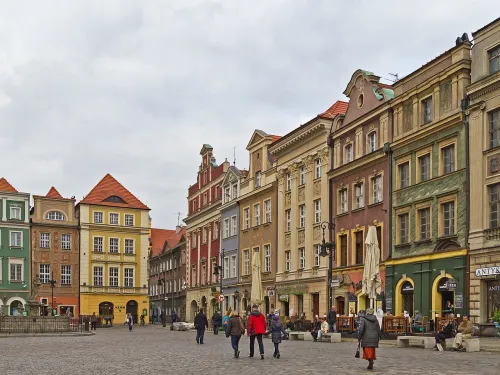
    You are standing in the centre and the oldest part of Poznań's Old Town. Each side of the square runs about 140 metres, which makes it the third-largest market square in Poland; Wrocław has one of the two bigger ones. In the middle sits a block of buildings led by the Old Town Hall, and around it rise tall rows of former tenement houses, the kamienice.

    The town itself is younger than you might think. The first settlement lay on the river island of Ostrów Tumski, at least from the 9th century, while this part of the city on the left bank of the Warta received its charter in 1253. The square was laid out around then, with each side cut into 16 equal plots, and work on the Royal Castle at the western edge of the walls had started a few years earlier.

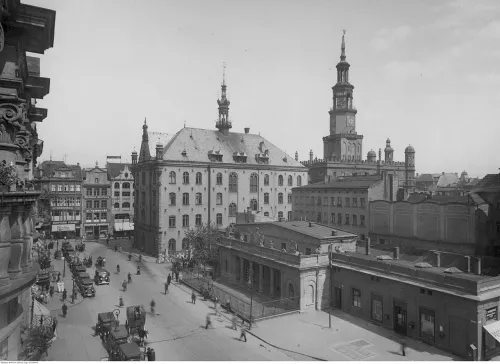
    After a fire in 1536 left heavy damage, the Italian builder Giovanni Battista di Quadro reshaped the Town Hall and several other buildings in Renaissance style from 1550. Most of what you see around you, though, was rebuilt after the Battle of Poznań in 1945 badly damaged the square.

    Look at the central block. The row of small 16th-century merchants' houses, the domki budnicze, got its multicoloured paint between 1953 and 1961, and its arcade holds souvenir stalls. On house number 17, find the coat of arms of the merchants' guild that gave the houses their name: a herring and three palms. Next to them, facing south, stands the former town chancellery.

    The Town Hall stands at the northeast corner of this central group, 10 metres away, a minute's walk.
    Local name
    Stary Rynek
    Hours
    Open 24/7
    Price
    Free
  2. 2

    Poznań Town Hall with mechanical goats

    Poznań Town Hall with mechanical goats, stop 2 on the self-guided walking tour

    Turn to the front of the Town Hall and look up above the clock. Every day at noon, two mechanical goats emerge there and butt heads, and the crowd that gathers for them is part of the show: this is one of the city's main attractions, and it is worth planning your start around it.

    The first town hall went up in the late 13th century, soon after the city was founded in 1253. What you see now is largely the work of Giovanni Battista di Quadro, who rebuilt it from 1550 to 1560 in Mannerist style. Take a moment for the ornate loggia on the façade, the detail that sets this building apart from the merchants' houses beside it.

    Until 1939 this was the seat of local government. Today the building is the Museum of Poznań, a branch of the National Museum, and the Town Hall is free to visit. If the goats have whetted your appetite for the city's own story, step inside; if you are short on time, the façade and the noon show are the essentials.

    From here the route leaves the Old Town and heads east toward the river and the Śródka district: 1590 metres, about 22 minutes, to Brama Poznania, the gateway to the island where Poznań began.

    Local name
    Ratusz
    Hours
    Daily: 12:00–20:00 (goats appear at noon)
    Price
    Free
  3. 3

    Brama Poznania

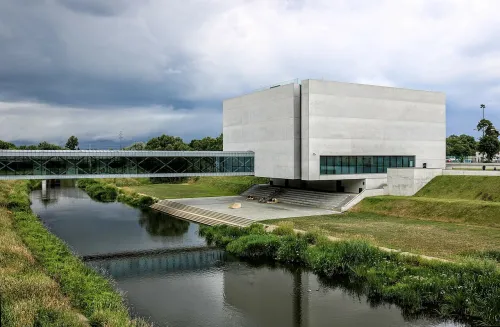
    Brama Poznania in Poznań, stop 3 on the self-guided walking tour

    Brama Poznania, also known as Porta Posnania, is an interactive heritage centre devoted to Ostrów Tumski, the oldest district of the city, and to the part it played when the Polish state was taking shape. It opened on 1 May 2014, and visiting it before you set foot on the island gives you the story you will be walking through.

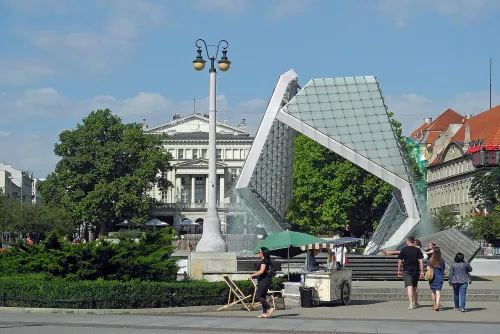
    Notice how the complex is built. A minimalist concrete cube stands on the Śródka side, entered through a zigzag; across the river Cybina stands the 19th-century Cathedral Lock, now home to the Śluza Gallery, and a glass footbridge joins the two. Around them lie an amphitheatre over the Cybina and a small park with plane trees and concrete benches.

    The centre grew out of a programme to revive Śródka and became part of the Royal-Imperial Route, a trail through the city's history. An international competition in 2009 drew 26 designs; architects Arkadiusz Emerla and Maciej Wojda of Ad Artis Architects won. The Belgian firm Tempora, specialists in narrative exhibitions, designed the displays, supervised by archaeologist Professor Hanna Kóčka-Krenz, who discovered the palace of Mieszko I, the first ruler of Poland.

    Entry is ticketed, and it pays off for first-time visitors, families and anyone who likes history told through screens and models rather than glass cases. The centre belongs to the same city heritage institution as the Enigma museum later on the route, and it sells a combined ticket; ask at the desk what it covers.

    Ostrów Tumski is 380 metres away, about 5 minutes on foot.

    Hours
    Tue–Fri: 9:00–18:00 | Sat–Sun: 10:00–19:00 | Mon: closed
    Price
    PLN 35 adult; PLN 29 reduced; PLN 75 family; group PLN 25; combined ticket PLN 49 / PLN 36
  4. 4

    Ostrów Tumski (Cathedral Island)

    Ostrów Tumski (Cathedral Island) in Poznań, stop 4 on the self-guided walking tour

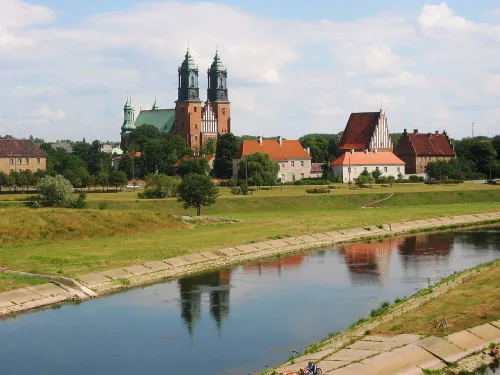
    Ostrów Tumski, Cathedral Island, sits between two branches of the Warta. Its centre is taken up by Poznań Cathedral and other church buildings, and although it officially belongs to the former New Town district, this is the oldest part of the city. Once it was one of several neighbouring islands near where the Warta and the Cybina meet.

    The first known fortified settlement, a gród, stood here in the 8th or 9th century. By the 10th century the island had become one of the main political centres of the Piast lands, the heart of the early Polish state, and its rulers kept a palace here.

    Archaeologists working in 1999 found where that palace stood: on the site of today's Church of the Virgin Mary, west of the cathedral. It was joined to a chapel believed to be the first Christian church in Poland, probably used by Dobrawa, the wife of Mieszko I, and her Bohemian attendants. Mieszko himself was baptised in 966. With that conversion came Poland's first missionary bishop, Jordan, who is thought to have made Poznań his seat, and the first cathedral was built in this period.

    Walking the island is free, and since 2008 it has been one of Poland's official national Historic Monuments. Visits to the church interiors are not possible during mass, so give a service its space and come back after it.

    Now comes the longest leg of the day: 2450 metres, about 35 minutes, back across the river to the Imperial District. Along the way you pass the Croissant Museum.

    Hours
    Summer (1.3-15.11): weekdays 9:00–16:00, Sun 14:00–18:00 | winter (16.11-end Feb): weekdays 9:00–16:00. No access during mass/service.
    Price
    Free
  5. 5

    Imperial Castle

    Imperial Castle in Poznań, stop 5 on the self-guided walking tour

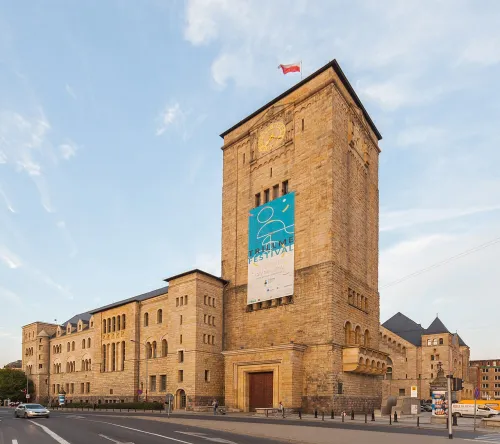
    The bulky Neo-Romanesque building in front of you was finished in 1910 by the architect Franz Schwechten for Wilhelm II, German Emperor, who added plenty of his own ideas. He chose the style on purpose: to him it was the most Germanic and recalled the glory of the Holy Roman Empire.

    Despite its name, it is a palace, not a castle. Even the adjective is disputed. Germans called it royal, because Wilhelm built it as King of Prussia for his provincial residence; Poles say imperial, because in Poznań the word royal belongs to the Royal Castle of the medieval Polish kings.

    Its location tells the story of the city under Prussian rule. Prussia annexed Poznań in the Second Partition of Poland in 1793. When part of the old fortress ring was taken down, the new land became a Germanic city core, the Imperial District, planned by Josef Stübben. Around the palace rose the Prussian Settlement Commission (now Collegium Maius), the Royal Academy (today the university's Aula and Collegium Minus), the City Theatre (now the opera house) and the Protestant Church of St Paul, today the Catholic Church of the Holiest Saviour.

    Since then the building has served German offices until 1918 and again in the Second World War, and Polish ones from 1918 to 1939 and since 1945. Going inside costs a fee; you choose between a ticket with a printed plan and a pricier one with an audio guide. Worth it if the Prussian chapter interests you; otherwise the exterior and the district around it tell much of the story.

    The Enigma Cipher Breaking Museum is just 100 metres away, a minute's walk.

    Local name
    Zamek Cesarski
    Hours
    Daily: 12:00–20:00
    Price
    10 zł normal / 7 zł reduced (with plan/brochure); 20 zł normal / 15 zł reduced (with audio guide)
  6. 6

    Enigma Cipher Breaking Museum

    Enigma Cipher Breaking Museum in Poznań, stop 6 on the self-guided walking tour

    The Enigma Cipher Centre, Centrum Szyfrów Enigma, is an interactive multimedia exhibition about the Enigma cipher machine and three Polish cryptologists: Marian Rejewski, Henryk Zygalski and Jerzy Różycki, who played a key role in the early breaking of its codes. It opened in September 2021 as a joint project of the city and Adam Mickiewicz University; the original idea came from radio journalist Szymon Mazur.

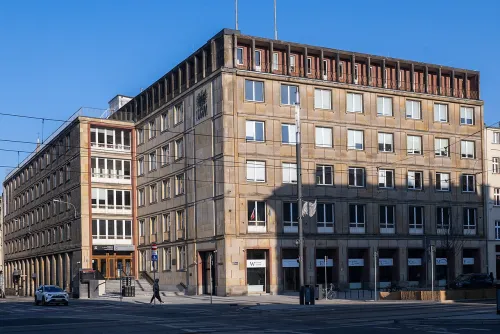
    The site is the point. From 1843 to 1847 the headquarters of the German Empire's 5th Army Corps was built here. After the First World War the Wielkopolska 14th Infantry Division moved in, and some rooms went to the Poznań branch of the Polish Army's Cipher Bureau, where those three men worked.

    In the Second World War the German army used the building, and it was badly damaged. In 1948 the decision fell not to rebuild it but to put up a new building for the regional authorities of the Polish United Workers' Party, which stayed until 1990. The university's history department then moved in, until it left for the Morasko campus in 2015.

    Entry is ticketed, and this is the interior on the route most worth your time if you like the Second World War, technology or puzzles. Allow a good hour and a half to try the interactive stations properly.

    The National Museum in Poznań lies 900 metres on, about 12 minutes on foot.

    Local name
    Centrum Szyfrów Enigma
    Hours
    Tue–Fri: 9:00–18:00 | Sat–Sun: 10:00–19:00 | Mon: closed
    Price
    35 PLN, reduced 29 PLN, family 75 PLN
  7. 7

    National Museum in Poznań

    National Museum in Poznań, stop 7 on the self-guided walking tour

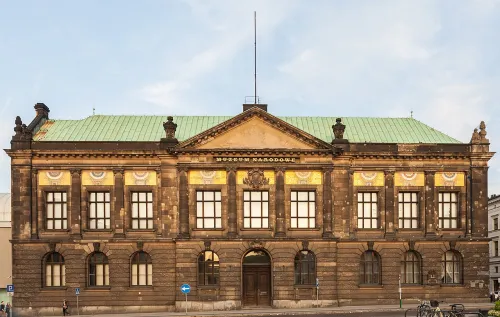
    The National Museum in Poznań is one of the largest museums in Poland. It holds a rich collection of Polish painting from the 16th century onward and foreign painting from Italy, Spain, the Netherlands and Germany, plus coins and a gallery of applied arts. In 2006 its collection counted 309,569 objects.

    Its names follow Poznań's history. Founded in 1857 as the Museum of Polish and Slavic Antiquities, it became the Provincial Museum of Posen in 1894 and the Kaiser-Friedrich-Museum in 1902. The main building, by Carl Hinckeldyen, dates from 1904.

    The Second World War hit hard: the building was damaged, German forces looted the collection, and the natural history and ethnographic collections were destroyed. After the war the Polish government brought many of the stolen works back. A new north wing, designed by Marian Trzaska around the turn of the 1960s and 1970s and fitted out in the 1990s by Witold Gyurkovich, opened in 2001.

    Inside, seven galleries cover antiquity, the Middle Ages, Polish art from the 16th to 18th centuries, Polish art from the partitions to the end of the Second World War, European painting, modern art, and posters and graphic design. You will find the ticket desk inside. For art lovers this deserves a full visit; with limited time, pick one or two galleries rather than rushing through all seven.

    Freedom Square is only 180 metres away, about 3 minutes on foot.

    Local name
    Muzeum Narodowe
  8. 8

    Freedom Square

    Freedom Square in Poznań, stop 8 on the self-guided walking tour

    Plac Wolności, Freedom Square, lies west of the medieval town, a long rectangle of 85 by 205 metres. Locals sometimes call it Plajta. This is where the route ends, and where the Prussian city story you followed from the Imperial Castle began.

    Before it was a square, this was a hill called Musza Góra, after the Muszyński family, who owned the land from the 16th century. After the Second Partition the Prussian authorities pulled down the medieval fortifications, absorbed the old suburbs and laid out a new Upper Town. Its centrepiece was a square big enough for a full infantry regiment to line up. The city bought the land in 1798 from the nobleman Dobrzycki for 2500 thalers, levelled the hill and named the square Wilhelmsplatz after Frederick William III.

    A fire in 1803 sped up the changes: the old Jewish cemetery on its northern edge was cleared, and trees were planted to turn the square into a park. After the uprising and the arrival of French troops in 1806 it was renamed after Napoleon; when the Duchy of Warsaw fell, the German name returned.

    Around the middle of the 19th century the eastern part stayed a park while the western part became a formal square with two monuments. The older one, the Löwendenkmal, was the first Prussian monument in the city: a lion with four soldiers, marking victory in the Prussian-Austrian war of 1866.

    The square is free and open, a good place to sit and let the walk settle. If you want to return to the Old Market Square, the GPS navigation in your browser will lead you back.

    Local name
    Plac Wolności
    Hours
    Open 24/7
    Price
    Free
Walking tour route map of Poznań Route loaded
Old Market SquarePoznań Town Hall with mechanical goatsBrama PoznaniaOstrów Tumski (Cathedral Island)+4
All 8 stops are already on the map.
You just press start.
AI Tour Guide

You've read the route. Now walk Poznań with a guide in your ear.

Press start wherever you are, even hundreds of kilometres from Poznań, and the guide begins telling its stories right away. In the city, pick any of the 8 stops to start from: it leads you there, then talks with you the whole route, asking, listening, remembering, and shaping the tour around your answers.

8stops 5.6km 1 h 18 minwalking 13languages
▶Start the tour free

Free to start · Runs in your browser · No app, no download

Shorter Ways to Walk Poznań

The route splits neatly into two halves: the medieval core with the island, and the Prussian-era district with its museums. Each works on its own.

Old Town and Cathedral Island

Stops: 1, 2, 3, 4

For a first visit or a morning with the goats at its heart. About 2 km and 28 minutes of walking, ending on Ostrów Tumski. Only Brama Poznania charges entry; the squares, the Town Hall and the island are free.

Imperial District and Codebreakers

Stops: 5, 6, 7, 8

For history and art fans, or a rainy afternoon. About 1.2 km and 16 minutes of walking. The Imperial Castle, the Enigma Cipher Breaking Museum and the National Museum in Poznań are ticketed; Freedom Square is free.

How Long Does This Poznań Tour Take with Museums?

The pure walking time is 1 h 18 min. Most of it falls on two longer legs, out to Brama Poznania and back from the island to the Imperial Castle; everything else lies a few minutes apart, so the rhythm is long walk, cluster of sights, long walk, cluster of sights.

If you go inside Brama Poznania and the Enigma Cipher Breaking Museum, the two interiors that add most to the story you are walking, plan about 6 hours. Add the National Museum in Poznań and it becomes a full day. The Old Town and island half takes about 1.5 hours from the outside, around 3 hours with Brama Poznania; the Imperial District half takes about 4 hours with Enigma and the National Museum.

Before You Set Off in Poznań

  • Start: The Old Market Square is the recommended start, but you can join at any stop and follow the order from there.
  • Finish: Freedom Square. The GPS navigation in your browser can lead you back to the Old Market Square if you want.
  • Best time to set off: Shortly before noon, so you are standing in front of the Town Hall when the goats come out.
  • Tickets: Brama Poznania, the Imperial Castle and the Enigma Cipher Breaking Museum charge entry; the National Museum in Poznań has its own desk. The squares, the Town Hall and Ostrów Tumski are free.
Walking tour route map of Poznań
AI Tour Guide

Your Poznań guide is ready when you are.

Press start and a voice AI Tour Guide takes it from here: leading the route through Poznań, telling the stories, and turning your walk into a real back-and-forth conversation. No app or download is needed; it runs in your browser.

8stops 5.6km 1 h 18 minwalking 13languages
▶Start the tour free

Free to start · Runs in your browser · No app, no download

What the AI Tour Guide Adds on This Route

This walk jumps from Piast dukes to a Prussian emperor to Polish cryptologists, and the AI Tour Guide keeps that thread together as a conversation. It greets you on the Old Market Square, tells the stories as you walk, asks whether medieval Poland or the twentieth century pulls you more, remembers your answer and shifts the emphasis. You can interrupt any time, for instance to ask what became of Rejewski, Zygalski and Różycki after 1939 or which gallery of the National Museum suits an hour. The route, map and GPS stay free; the guide starts with 100 free credits, after that you choose this tour all-inclusive for €19.99 with no time limit, or €5 per hour.

A Real Conversation A voice AI Tour Guide greets you, leads the whole route, and tells the stories and facts as you walk, asking what you want to see and keeping a real conversation going. Not a recording you press play on.
Map Navigation Follow the route on the map and walk at your own pace. You choose where to start and when to move to the next stop.
Ask Anything Curious about a building you pass? Ask your AI Tour Guide on the spot and the conversation carries on.
13 Languages Switch language anytime. No separate tour needed.
Start free in your browser

Common Questions about Walking Poznań

If I only have time for one museum, which should it be?

For the Second World War and codebreaking, the Enigma Cipher Breaking Museum. For the beginnings of Poland and context for the island, Brama Poznania. For painting, from Polish art to Italian, Spanish and Dutch masters, the National Museum in Poznań.

Where can I sit down for a coffee or a meal on the route?

On the Old Market Square. Many of the former tenement houses around it are now restaurants, cafés and pubs, often with tables out on the square.

I'm arriving in the afternoon. Will I miss the goats?

The goats only come out once a day, at noon. Walk the route as planned and come back to the Town Hall at noon on another day, or start the next day with the Old Town half.

Which other cities make a good next stop from Poznań?

Gniezno is 47 km away, Toruń 131 km and Wrocław 144 km; each has its own walking tour. Berlin is 240 km away.

Is the tour really free?

Yes. The whole tour is free: the route, the interactive map and the navigation cost you nothing. Only the voice AI Tour Guide is optional and paid: you test it with 100 free credits, then you pay either €5 per hour or €19.99 for this whole tour, with no time limit.

Do I need to download an app?

No. Everything runs in your phone browser. Open the route and start walking, no download and no sign-up required.

Do I need to book the walking tour in advance?

No booking needed. This self-guided tour is available anytime. Open the route in your browser and start walking. The AI Tour Guide works instantly, no app, no reservation required.

What languages is the AI Tour Guide available in?

The AI Tour Guide speaks 13 languages, so you take the tour in your own language and can switch at any time.

Can I skip stops or change the route?

Yes. Skip any stop, spend extra time at places you like, or start the route from any point. It is your walk, you set the pace.
Image credits
▶ Start free in your browser Runs in your browser, no app, no download