Free Walking Tour Gniezno: Poland's First Capital

From early medieval Poland to the cathedral where kings were crowned: a short 2.1 km walk past a quiet lake, royal chalices and a rebuilt market square.

5 Stops 2.1 km ~29 min walking
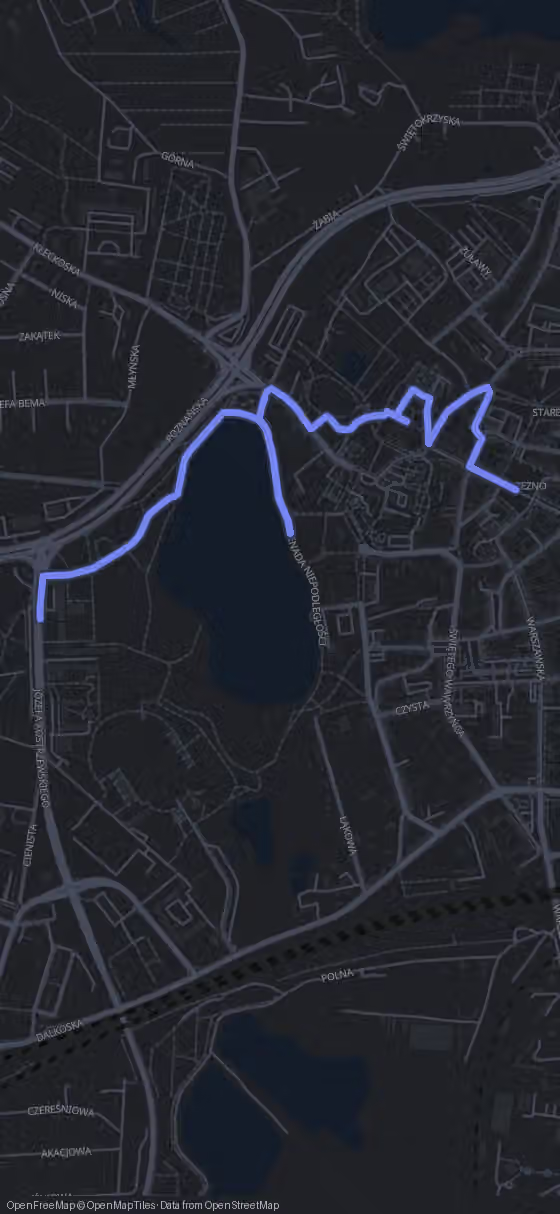
Route map for the Gniezno walking tour
Stop 1 of 5
860 m·11 min
Museum of the Origins of the Polish State
Head north-east toward Lake Jelonek
Welcome to Gniezno. I'm Alex, and this compact city once placed crowns on Poland's first kings.
Try this tour with Alex

Gniezno on Foot: What to Expect

Five stops, 2.1 km and 29 minutes of pure walking: from the Museum of the Origins of the Polish State past Lake Jelonek to Gniezno Cathedral, the Archdiocese of Gniezno Museum and the Old Market Square. With the interiors, plan just under four hours.

The lake, the square and the cathedral interior are free; the two museums and the cathedral's doors, crypts and tower terrace charge admission. The GPS route runs free in your browser; the AI Tour Guide is optional.

Open free GPS & optional AI Tour Guide
This short shows highlights of the route. All 5 stops follow below.

The Route

Walking Map of Gniezno: Museum, Lake, Cathedral, Rynek

5 stops 2.1 km 29 min walking
Tap to load interactive map

The 5 stops along this route

  1. Museum of the Origins of the Polish State in Gniezno, stop 1 on the self-guided walking tour
    1Museum of the Origins of the Polish State
  2. Lake Jelonek in Gniezno, stop 2 on the self-guided walking tour
    2Lake Jelonek
  3. Gniezno Cathedral, stop 3 on the self-guided walking tour
    3Gniezno Cathedral
  4. Archdiocese of Gniezno Museum, stop 4 on the self-guided walking tour
    4Archdiocese of Gniezno Museum
  5. Old Market Square in Gniezno, stop 5 on the self-guided walking tour
    5Old Market Square
  6. That's the full route.

    Walk it with an AI Tour Guide talking you through every one of these streets.

    Start free in your browser
    You made it

Your Gniezno Walking Tour from the Origins Museum to the Rynek

  1. 1

    Museum of the Origins of the Polish State

    Museum of the Origins of the Polish State in Gniezno, stop 1 on the self-guided walking tour

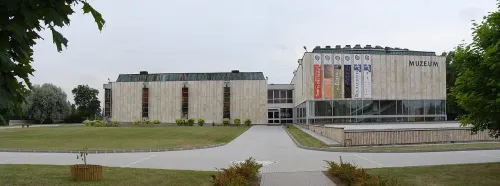
    Start where Polish history starts. The Museum of the Origins of the Polish State, Muzeum Początków Państwa Polskiego in Polish, is an archaeological museum devoted to the early medieval state and to Gniezno as its first capital. More than 17,000 objects make up the collection, and it is the only museum in Poland with permanent exhibitions on medieval Polish culture and art.

    The museum grew out of the excavations that began in 1948, which had a very public goal: to find scientific proof of where the Polish state began. It was founded in 1956 as a branch of the Archaeological Museum in Poznań, expanded for the millennium celebrations of 1966 and became independent in 1973, when work began on the modern building at ulica Józefa Kostrzewskiego 1. The permanent exhibition opened in March 1983, and with it the museum took its present name.

    That 1983 show was the first in Poland to use multimedia technology, and the current exhibition, opened on 12 April 2012, deliberately echoes its title. The 2012 overhaul, funded with EU money, brought the museum up to international standards, and every information panel is now in Polish and English, which makes it an easy visit for foreign travellers.

    Is it worth going in? If you want the cathedral and the treasury to make sense, yes: an hour here gives you the cast of characters you will meet again on the hill. Admission is paid. From here it is 860 m, about 11 minutes, to Lake Jelonek.
    Local name
    Muzeum Początków Państwa Polskiego
    Hours
    May–Sep: daily 09:00–18:00; Oct–Apr: daily 09:00–16:00 (ticket desk closes 15 min before closing)
    Price
    20 PLN full, 16 PLN reduced, family (2+2) 60 PLN, group (>10) 15 PLN/person; Sundays free admission
  2. 2

    Lake Jelonek

    Lake Jelonek in Gniezno, stop 2 on the self-guided walking tour

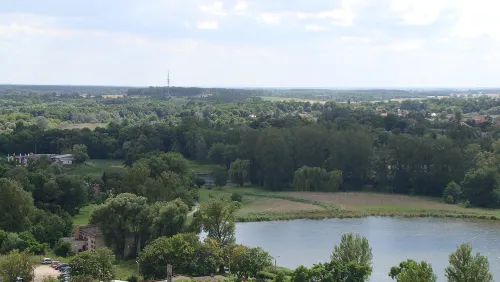
    Lake Jelonek is a small town lake that locals usually call Lake Wenecja, Venice Lake. It covers about 15 hectares and is remarkably shallow: on average just 1.2 m deep, 2.4 m at its deepest point. The Struga Gnieźnieńska, a stream that feeds the Wełna river, flows right through it.

    Its history is quieter than the rest of the walk, but it has one: the archbishops' castle once stood on the shore of this lake. Nothing here costs anything and it is open at any hour, so treat it as a breather between the museum and the cathedral.

    From the lake it is 620 m, about 9 minutes, to Gniezno Cathedral. The route takes you right past the famous Gniezno Doors as you arrive.

    Hours
    24/7
    Price
    Free
  3. 3

    Gniezno Cathedral

    Gniezno Cathedral, stop 3 on the self-guided walking tour

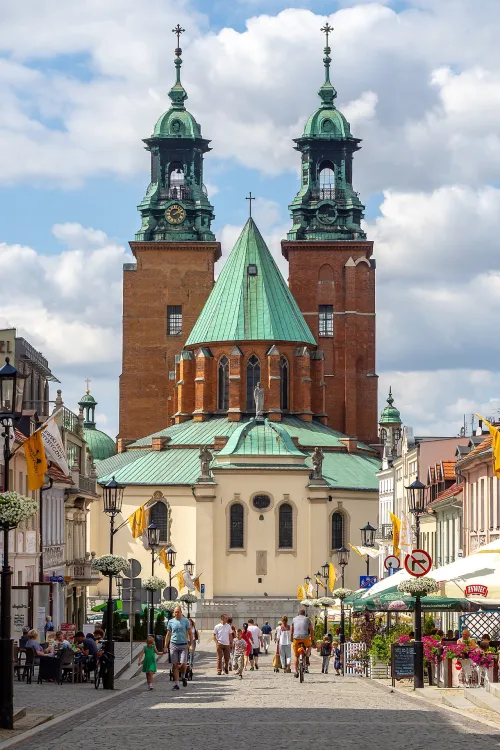
    Gniezno Cathedral, Archikatedra gnieźnieńska, is the heart of this tour. The Brick Gothic basilica was the coronation church of several Polish kings and for nearly 1000 years the seat of the country's highest church officials. Despite a long and often violent history it has survived largely intact, which makes it one of the oldest and most precious sacred buildings in Poland; since 16 September 1994 it has been a national Historical Monument.

    The site is older than the walls you see. At the end of the ninth century a simple rectangular oratory stood here. Duke Mieszko I replaced it with a cruciform church, and in 977 his wife, Duchess Dąbrówka, was buried in it. His son Bolesław the Brave, later Poland's first king, rebuilt it and raised it to a cathedral. In 999 the funeral of St Adalbert of Prague took place here, and in March 1000 Emperor Otto III came to pray at his tomb and called the Congress of Gniezno, where he and Bolesław discussed a joint realm of Germany, France, Rome, England and the Slavic states.

    Two treasures tell Adalbert's story. The two-winged bronze doors from around 1175 show scenes of his martyrdom, and inside stands his silver coffin, made of pure silver by Peter von der Rennen in 1662. It replaced an earlier one donated in 1623 by King Sigismund III Vasa himself, which the Swedes looted in 1655.

    Entering the cathedral is free. The doors, the crypts and the tower terrace each have their own ticket; if you only choose one, take the doors, since they are the reason the cathedral is famous. The Archdiocese of Gniezno Museum is just 80 m away, a one-minute walk.

    Local name
    Archikatedra gnieźnieńska
    Hours
    May 1 – Oct 31: Mon–Sat 09:00–17:00, Sun closed for sightseeing; Nov 1 – Apr 30: Mon–Sat 09:00–16:00, Sun closed for sightseeing
    Price
    Free for cathedral interior; optional tickets: Gniezno Doors 16 PLN (14 PLN reduced), Crypts 14 PLN (12 PLN reduced), Tower terrace 12 PLN (10 PLN reduced), Combined all-inclusive ticket 48 PLN (42 PLN reduced)
  4. 4

    Archdiocese of Gniezno Museum

    Archdiocese of Gniezno Museum, stop 4 on the self-guided walking tour

    Right next to the cathedral, at ulica Kolegiaty 2, the Archdiocese of Gniezno Museum looks after the cathedral treasury. Together with the treasuries of Wawel and Jasna Góra, it holds the most valuable and unique Romanesque and Gothic church art in Poland. Archbishop Józef Glemp founded the museum in 1989, and it opened on 22 May 1991; its first director, curator and the man who assembled the collection was Bolesław Dzierwa.

    Look for the chalices. St Adalbert's chalice is a tenth-century agate cup in a gold setting added around the turn of the 12th and 13th centuries. The first Dąbrówka chalice dates from about 1170; the second, from about 1190, was a gift from Duke Mieszko III the Old and came from Trzemeszno. On the paten of the royal chalice is one of the oldest Latin leonine verses in Poland, from the 12th century: Life feeds death, sweetness drinks vinegar, not a man but a worm defeats the armed man.

    Beyond the treasury you find church sculpture, among it a 14th-century wooden relief of the Dormition from Liszkowo and a Lamentation from Gościeszyn of around 1420, plus Polish coffin portraits, liturgical textiles, medals, coins and mementos of the last primates of Poland. Many pieces were brought here from other churches, such as the collegiate churches of Kruszwica and Trzemeszno.

    For anyone drawn to medieval craftsmanship this is the most rewarding 45 minutes of the day, and well worth the ticket. Then it is 540 m, about 8 minutes, to the Old Market Square, a stretch that follows the Royal Trail.

    Local name
    Muzeum Archidiecezjalne
    Hours
    May 1 – Oct 31: Mon–Sat 09:00–17:00, Sun closed; Nov 1 – Apr 30: Mon–Sat 09:00–16:00, Sun closed
    Price
    18 PLN full, 16 PLN reduced, family 52 PLN; combined pass with Cathedral attractions 48 PLN full, 42 PLN reduced
  5. 5

    Old Market Square

    Old Market Square in Gniezno, stop 5 on the self-guided walking tour

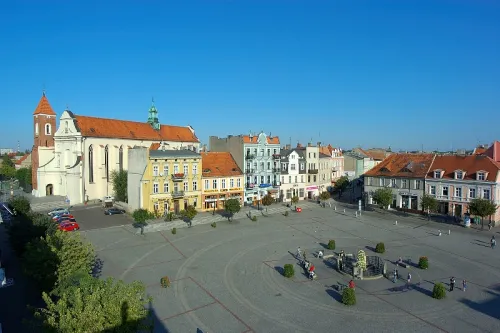
    The Old Market Square, the Rynek, sits on Maiden's Hill, one of the seven hills of Gniezno. In the Middle Ages it belonged to one of the settlements outside the stronghold, and by the late Middle Ages it was enclosed by walls.

    What you see today is the result of a disaster. In 1819 a fire destroyed most of Gniezno, and only two buildings on the square survived; both were thoroughly restored in 1980. The rebuilding plan of 1819 drew a new axis from the cathedral to the Protestant church, today's ulica Chrobrego, and straightened the crooked streets into roughly rectangular blocks. Residents protested, but the authorities pushed it through: the square was lowered, and the old foundations, the moat and what was left of the walls were cleared away.

    Look down at the cobbles. Lines of red brick trace the outlines of the buildings that stood here before the fire. Around you the houses come from different periods, some with cornices, balconies and friezes. Ulica Tumska leads off towards the cathedral, lined with early 19th-century houses decorated with floral and classical friezes, and ulica Chrobrego begins as a pedestrian street of early 20th-century townhouses.

    Most of the square is closed to cars, and the fountain in the middle dates from the end of 2014. The old town also has two churches, Holy Trinity and the Franciscan church, if you still have time. This is where the walk ends, a fitting place to sit down and look back at the hill you came from.

    Local name
    Rynek
    Hours
    24/7
    Price
    Free
Walking tour route map of Gniezno Route loaded
Museum of the Origins of the Polish StateLake JelonekGniezno CathedralArchdiocese of Gniezno Museum+1
All 5 stops are already on the map.
You just press start.
AI Tour Guide

You know the route now. Walk it with a guide in your ear.

Press start wherever you are, even hundreds of kilometres from Gniezno, and the guide begins telling its stories right away. In the city, pick any of the 5 stops to start from: it leads you there, then talks with you the whole route, asking, listening, remembering, and shaping the tour around your answers.

5stops 2.1km 29 minwalking 13languages
▶Start the tour free

Free to start · Runs in your browser · No app, no download

Shorter Ways to Walk Gniezno

Not everyone wants two museums in one morning. These versions keep the cathedral at the centre and fit a tighter schedule or a Sunday.

Cathedral Hill and the old town

Stops: 2, 3, 4, 5

For visitors who care most about the cathedral and its treasures. Start at the lake and skip the archaeology museum: 18 minutes of walking. You pay for the Archdiocese of Gniezno Museum and any cathedral extras you choose; the combined pass is the simplest way to cover both.

The free route

Stops: 2, 3, 5

For a tight budget or a short stopover. Lake, cathedral interior and market square cost nothing. You walk past the Archdiocese of Gniezno Museum on the way to the square, so the walking time stays at 18 minutes. Only the doors, crypts or tower terrace would cost extra.

Sunday walk

Stops: 1, 2, 3, 5

For a Sunday visit. The Museum of the Origins of the Polish State is free that day, while the cathedral is closed for sightseeing and the Archdiocese Museum is closed, so you see both from outside. The full 29 minutes of walking stays the same.

How Long Does This Gniezno Tour Take with the Museums?

The walking itself takes 29 minutes over 2.1 km, and the longest leg is the first one, 860 m from the museum to the lake. The cathedral and the Archdiocese of Gniezno Museum are only 80 m apart, so the middle of the tour is all about looking, not walking.

With an hour in the Museum of the Origins of the Polish State, an hour in the cathedral including the doors or crypts, 45 minutes in the Archdiocese Museum and short breaks at the lake and on the square, you need just under four hours. Start at 10:00 and you reach the Rynek before 14:00.

The Cathedral Hill version takes a little under three hours, the free route about an hour and a half, and the Sunday walk a little over two hours.

Before You Set Off in Gniezno

  • Start and finish: The recommended start is the Museum of the Origins of the Polish State; the walk ends on the Old Market Square. You can join at any stop, the order here is simply the one that flows best.
  • Best day: Plan your visit carefully, since the cathedral and the Archdiocese Museum are not open for sightseeing every day of the week.
  • Opening hours: Start in the morning so you have enough time for all three interiors before they close.
  • Costs: The Origins museum, the cathedral's doors, crypts and tower terrace, and the Archdiocese Museum each charge entry, with reduced tickets available. A combined pass covers the cathedral attractions and the Archdiocese Museum.
  • Guide: Route, map and GPS navigation are free. The AI Tour Guide is optional: 100 free credits to start, then either this tour all-inclusive for €19.99 with no time limit, or €5 per hour.
Walking tour route map of Gniezno
AI Tour Guide

Your guide is ready when you reach the first museum.

Press start and a voice AI Tour Guide takes it from here: leading the route through Gniezno, telling the stories, and turning your walk into a real back-and-forth conversation. No app or download is needed; it runs in your browser.

5stops 2.1km 29 minwalking 13languages
▶Start the tour free

Free to start · Runs in your browser · No app, no download

What the AI Tour Guide Adds in Gniezno

On this route the history piles up fast: Mieszko I, Dąbrówka, Adalbert, Otto III, all within a few hundred metres. The AI Tour Guide greets you at the museum and tells these stories as you walk, asks what catches your interest and follows it. Curious why Adalbert came to Gniezno in the first place, or what became of the plans made at the Congress of Gniezno? Just interrupt and the conversation goes there, while the GPS route keeps leading you from stop to stop.

A Real Conversation A voice AI Tour Guide greets you, leads the whole route, and tells the stories and facts as you walk, asking what you want to see and keeping a real conversation going. Not a recording you press play on.
Map Navigation Follow the route on the map and walk at your own pace. You choose where to start and when to move to the next stop.
Ask Anything Curious about a building you pass? Ask your AI Tour Guide on the spot and the conversation carries on.
13 Languages Switch language anytime. No separate tour needed.
Start free in your browser

Common Questions About Visiting Gniezno

Is Gniezno a good day trip from Poznań?

Yes. Gniezno is 47 km from Poznań, and the whole walk with its museums fits into a morning or an early afternoon. Avoid Sunday if the cathedral interior matters to you.

Are the exhibitions in English?

In the Museum of the Origins of the Polish State, yes: since the 2012 renovation the information panels are in Polish and English throughout.

Is the cathedral open for sightseeing every day?

No. On days when it is closed to visitors, you can still admire the Brick Gothic exterior and spend more time in the Origins museum.

What is the Old Market Square like in winter?

In winter a tall Christmas tree goes up next to the fountain, and since 2008 there has been an ice rink on the square.

Where else is worth visiting after Gniezno?

If you enjoy medieval brick architecture, Toruń is 86 km away and has its own walking route.

Is the tour really free?

Yes. The whole tour is free: the route, the interactive map and the navigation cost you nothing. Only the voice AI Tour Guide is optional and paid: you test it with 100 free credits, then you pay either €5 per hour or €19.99 for this whole tour, with no time limit. Admission to 2 of the 5 stops is not included: Museum of the Origins of the Polish State and Archdiocese of Gniezno Museum charge their own entry fees.

Do I need to download an app?

No. Everything runs in your phone browser. Open the route and start walking, no download and no sign-up required.

Do I need to book the walking tour in advance?

No booking needed. This self-guided tour is available anytime. Open the route in your browser and start walking. The AI Tour Guide works instantly, no app, no reservation required.

What languages is the AI Tour Guide available in?

The AI Tour Guide speaks 13 languages, so you take the tour in your own language and can switch at any time.

Can I skip stops or change the route?

Yes. Skip any stop, spend extra time at places you like, or start the route from any point. It is your walk, you set the pace.
Image credits
▶ Start free in your browser Runs in your browser, no app, no download