Free Walking Tour Wrocław: Rynek to Centennial Hall

From the Gothic town hall and the dwarfs at knee height to Cathedral Island, where a lamplighter still lights the gas lamps every evening.

9 Stops 6.2 km ~1 h 24 min walking
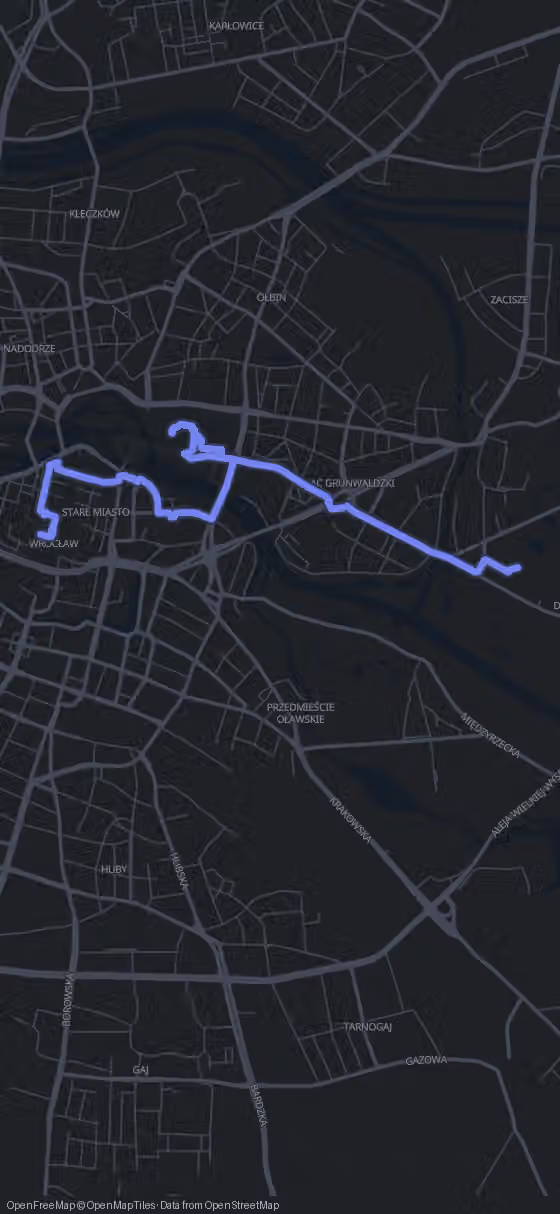
Route map for the Wrocław walking tour
Stop 1 of 9
170 m·2 min
Wrocław Market Square
Head east toward the Old Town Hall
Welcome to Wrocław. I'm Alex, and the tiny bronze residents underfoot began with a very serious act of political mischief.
Try this tour with Alex

This Wrocław Route at a Glance

Nine stops lead from Wrocław Market Square and the Old Town Hall past the Wrocław Dwarfs, Wrocław University and Hala Targowa to the Panorama of the Battle of Racławice, the Cathedral of St. John the Baptist, Ostrów Tumski and Centennial Hall: 6.2 km, 1 h 24 min of pure walking, about five and a half hours with the best interiors.

The squares, dwarfs, market hall and island are free; the university, the Panorama, the cathedral tower and chapels and the Centennial Hall exhibition charge admission. Route and GPS navigation are free in your browser; the AI Tour Guide is optional.

Open free GPS & optional AI Tour Guide
View of Wrocław

The Route

Walking Map of Wrocław: Old Town, Islands and Centennial Hall

9 stops 6.2 km 1 h 24 min walking
Tap to load interactive map

The 9 stops along this route

  1. Wrocław Market Square, stop 1 on the self-guided walking tour
    1Wrocław Market Square
  2. Old Town Hall in Wrocław, stop 2 on the self-guided walking tour
    2Old Town Hall
  3. Wrocław Dwarfs, stop 3 on the self-guided walking tour
    3Wrocław Dwarfs
  4. Wrocław University, stop 4 on the self-guided walking tour
    4Wrocław University
  5. Hala Targowa in Wrocław, stop 5 on the self-guided walking tour
    5Hala Targowa
  6. Panorama of the Battle of Racławice in Wrocław, stop 6 on the self-guided walking tour
    6Panorama of the Battle of Racławice
  7. Cathedral of St. John the Baptist in Wrocław, stop 7 on the self-guided walking tour
    7Cathedral of St. John the Baptist
  8. Ostrów Tumski in Wrocław, stop 8 on the self-guided walking tour
    8Ostrów Tumski
  9. Centennial Hall in Wrocław, stop 9 on the self-guided walking tour
    9Centennial Hall
  10. That's the full route.

    Walk it with an AI Tour Guide talking you through every one of these streets.

    Start free in your browser
    You made it

Your Wrocław Walking Tour, Nine Stops in Order

  1. 1

    Wrocław Market Square

    Wrocław Market Square, stop 1 on the self-guided walking tour

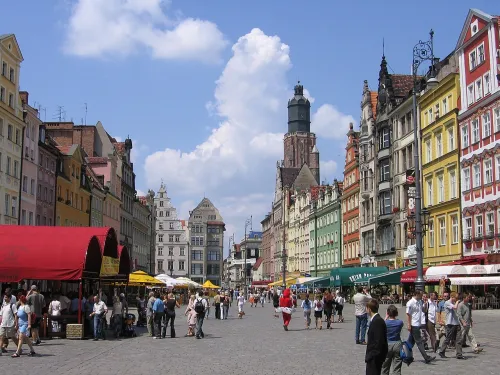
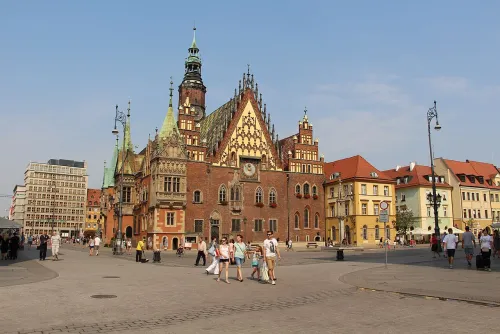
    Start where Wrocław has traded since the Middle Ages. The Rynek, known in German as the Großer Ring, is one of the largest old town market squares in Europe and today the heart of the pedestrian zone. Ten streets run into it, two at every corner: Świdnicka and Oławska at the south-east, Wita Stwosza and Kuźnicza at the north-east, Odrzańska and św. Mikołaja at the north-west, while Salt Square opens diagonally from the south-west corner.

    Look at the middle of the square and you'll notice the central block doesn't sit straight: it's turned about 7 degrees clockwise. Inside it stand the Old Town Hall, the New Town Hall and a cluster of tenement houses, threaded by narrow lanes such as Przejście Garncarskie, Przejście Żelaźnicze and Sukiennice. Wander through one of them and you are inside the block rather than circling it.

    Historians count more than the open space as the Rynek: the facades on all four sides, Salt Square and the square around St. Elizabeth's Church belong to the same layout. For centuries the Old Town Hall housed both the city government and the court. That only changed in the first half of the 19th century, when the New Town Hall was built; the mayor's office is still there and the City Council meets inside.

    All of this is free and open at any hour. From here it's 170 m, about 2 minutes, to the front of the Old Town Hall in the central block.
    Local name
    Rynek
    Hours
    Open 24/7
    Price
    Free
  2. 2

    Old Town Hall

    Old Town Hall in Wrocław, stop 2 on the self-guided walking tour

    This Gothic town hall is one of the city's main landmarks, and its walls hold some 250 years of building. The city's largely German population commissioned it, and German architects, stonemasons and councils kept adding to it from the end of the 13th century to the middle of the 16th.

    Nobody knows exactly when work began. Between 1299 and 1301 a single-storey building went up with cellars and a tower known as the consistory; the Burghers' Hall and the lower floors of the tower may survive from that time. Back then this was a house of trade more than of government. Between 1328 and 1333 an upper storey added the Council room and the Aldermen's room, and later in the 14th century the Court room followed.

    The real boom came with Wrocław's prosperity in the 15th and 16th centuries, above all in the four decades after 1470. The Burghers' Hall was given the vaults it still has, the Great Hall took shape on the upper floor, and the Treasury and Little Treasury were added. As you walk around the building, read its irregular outline as the record of a city that kept needing more rooms.

    Admiring the exterior costs nothing. Inside, the Great Hall hosts concerts, the building houses a museum of burgher life, and beneath it lies Świdnicka Cellar, billed as the oldest restaurant in Europe. If civic history is your thing, the museum is the way to see these rooms; ask about tickets at the entrance. From here it's 230 m, about 3 minutes, to the dwarfs.

    Local name
    Ratusz
    Hours
    Open 24/7
    Price
    Free
  3. 3

    Wrocław Dwarfs

    Wrocław Dwarfs, stop 3 on the self-guided walking tour

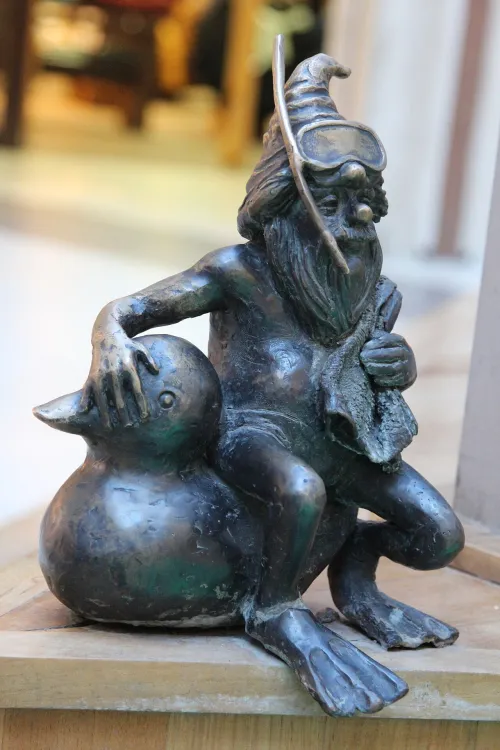
    Now look down. Little figurines no taller than 30 cm have been appearing in Wrocław's streets since 2005: more than 800 by 2024 and an estimated 1,040 in 2026. Plenty of visitors walk the city with a map just to hunt them down, so don't be surprised to see people crouching by a wall with a camera.

    Their story is older and more political than they look. In 2001 a dwarf monument was placed on Świdnicka Street to honour the Orange Alternative, a Polish anti-communist movement that used the dwarf as its symbol. In 2003 the mayor kept the idea going with a tiny plaque at knee height for the Dwarves' Museum, on the wall of the historic tenement called Jaś between the Market Square and St. Elizabeth's Church.

    The first five figures arrived in August 2005, designed by Tomasz Moczek, a graduate of the Academy of Fine Arts in Wrocław: the Fencer near the university, the Butcher in the Stare Jatki arcade, two Sisyphuses on Świdnicka Street and the Oder Washer near Piasek Bridge, whose name nods to the outlying district of Pracze Odrzańskie.

    Later dwarfs carry messages too. In 2008 the Deaf-Mute and the Blind joined the others on Świdnicka Street for the Wrocław Without Barriers campaign, and days later Marzenka, based on the logo of the Mam marzenie charity, appeared at the Hematology and Pediatric Oncology Clinic. The dwarfs are free and always out, and every September the city holds a Dwarves' Festival. Keep counting on the 410 m, about 5 minutes, to Wrocław University, where the Fencer is waiting.

    Local name
    Wrocławskie krasnale
    Hours
    Open 24/7
    Price
    Free
  4. 4

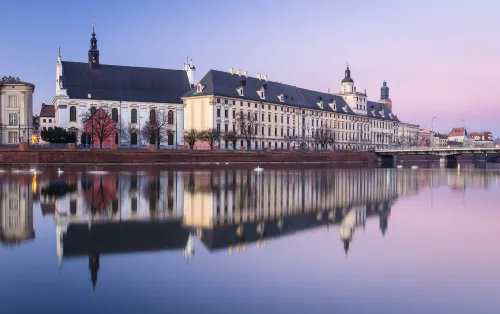
    Wrocław University

    Wrocław University, stop 4 on the self-guided walking tour

    Wrocław University began in 1702 as the Academia Leopoldina, founded by Emperor Leopold I, who ruled Silesia as King of Bohemia; the region had belonged to the Bohemian crown since the 14th century. In 1811, under Prussian rule, it merged with the Viadrina University, moved here from Frankfurt an der Oder, and in 1945 it became a Polish university.

    That layered history is the key to the place. The university sees itself as heir both to the Habsburg and Prussian German schools of the city and to the Jan Kazimierz University in Lviv, founded in 1661. It is the oldest university in Wrocław, with around 23,500 students across 12 faculties in the sciences and humanities.

    Before you go on, look for the Fencer nearby, one of the original five dwarfs. Going inside the university costs admission, which you pay on site. It's worth it if you're curious how one institution carried Habsburg, Prussian and Polish identities; if you'd rather save time and money for the Panorama, the outside is enough.

    Then it's 600 m, about 8 minutes, to Hala Targowa; on the way you pass the Mathematical Tower.

    Local name
    Uniwersytet Wrocławski
  5. 5

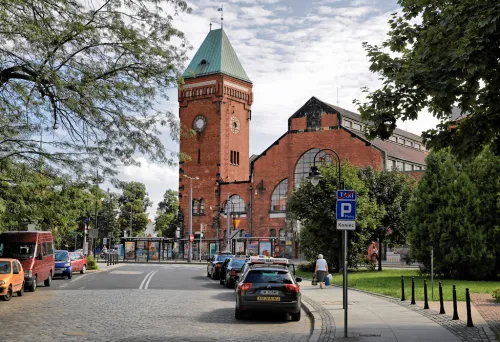
    Hala Targowa

    Hala Targowa in Wrocław, stop 5 on the self-guided walking tour

    Hala Targowa, officially Market Hall No. I and once Markthalle Nummer 1, was designed by Richard Plüddemann and Heinrich Küster. Building began in autumn 1906 and the hall opened on 5 October 1908. It stands on Piaskowa Street close to Sand Island, Piasek Bridge and the oldest districts of the city, and it counts as a valuable monument of engineering.

    The city built it to bring order to trade in the centre, which had spread across places like the New Market. Four halls were planned in 1890 and 1891, but only two went up. Its almost identical twin, Market Hall No. II on Kolejowa Street by the same designers, was badly damaged in 1945 and demolished in 1973, so this is the one that survived.

    The site has a past of its own. A 14th-century court of the bishops of Lubusz stood here, rebuilt early in the 16th century as the Sand Arsenal; the city owned the plot from 1511. When demolition started on 1 October 1905, workers dug up stone cannonballs, which were later set into the north facade as a reminder. Look for them before you go in.

    The structure is the other story. The hall was first planned with steel roof trusses, but after comparing costs the city switched to reinforced concrete, built by the Wrocław firm Lolat-Eisenbeton. Walking through is free. From here it's 490 m, about 7 minutes, to the Panorama of the Battle of Racławice.

    Hours
    Mon–Sat 8:00–18:30, Sun closed
    Price
    Free
  6. 6

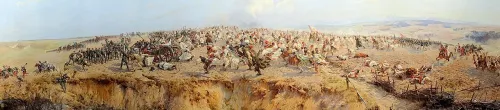
    Panorama of the Battle of Racławice

    Panorama of the Battle of Racławice in Wrocław, stop 6 on the self-guided walking tour

    Here a painting 15 m high and 114 m long wraps all the way around you, with you standing at the centre. A special perspective, lighting and artificial terrain blur the line between canvas and ground, so new scenes open up at every angle as you turn. It is one of only a few surviving examples of a 19th-century form of mass entertainment, and the oldest in Poland.

    The subject is the Battle of Racławice on 4 April 1794, during the Kościuszko Uprising. Tadeusz Kościuszko led regular troops and peasant volunteers armed with scythes against the Russian army under General Alexander Tormasov, and won. The uprising itself failed to save Polish independence, which is exactly why the memory of this victory mattered so much to a nation without a state.

    The idea came from the painter Jan Styka in Lviv, who brought in the battle painter Wojciech Kossak, helped by artists including Teodor Axentowicz and Włodzimierz Tetmajer. It was meant for the 100th anniversary of the battle and the General National Exhibition of 1894. The canvas was woven to order in Brussels, the iron frame of the rotunda, designed by Ludwik Ramułt, came from Vienna, and the rotunda in Stryjski Park was ready in July 1893. The painters finished in nine months, and the opening on 5 June 1894 drew crowds; on average 75,000 people a year came to see it.

    Admission is charged, and if you only pay for one interior today, make it this one. It's 1060 m, about 14 minutes, to the Cathedral of St. John the Baptist.

    Local name
    Panorama Racławicka
    Hours
    Winter (1.11-31.3): Mon closed, Tue–Fri 9:30–16:00, Sat 9:30–17:00, Sun 9:30–16:00. Summer (1.4-31.10): daily 8:30–19:00
    Price
    zł 50
    Website
    mnwr.pl ↗
  7. 7

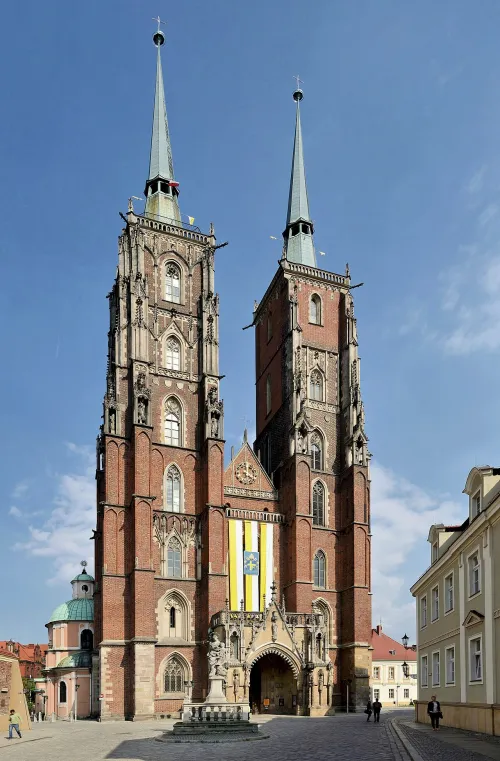
    Cathedral of St. John the Baptist

    Cathedral of St. John the Baptist in Wrocław, stop 7 on the self-guided walking tour

    The Cathedral of St. John the Baptist is the seat of the Archdiocese of Wrocław: a Gothic church with neo-Gothic additions, and the fourth church on this spot. Together with the Old Town it is designated a Historic Monument of Poland.

    The first church here went up in the mid-10th century under the Bohemian Přemyslids, a fieldstone building about 25 m long. After the diocese was founded in 1000 under the Piast duke Bolesław I the Brave, a larger basilica with three naves, a crypt and towers replaced it, only to be destroyed, probably by Duke Bretislaus of Bohemia around 1039. A Romanesque church followed under Duke Casimir I and was enlarged in 1158 by Bishop Walter of Malonne.

    After the first Mongol invasion of Poland the church was rebuilt in Brick Gothic, and when work on the choir started in 1244 it became the first brick building in the city. Bishop Nanker added the nave and the bases of the western towers by 1341. Fire destroyed the roof on 19 June 1540, and another on 9 June 1759 burned the towers, roof, sacristy and choir; repairs dragged on for about 150 years. Karl Lüdecke rebuilt the interior and west side in neo-Gothic style in the 1870s, and Hugo Hartung worked on the damaged towers early in the 20th century.

    For a visit, you can buy a ticket for the tower's viewing platform, one for the baroque chapels and main altar, or a combined ticket. The tower depends on the weather, and neither is open during services. The platform is the choice if you want the city from above; the chapels suit art lovers. From here it's 390 m, about 5 minutes, to Ostrów Tumski.

    Local name
    Archikatedra św. Jana Chrzciciela
    Hours
    Viewing platform/chapels: Mon–Sat 10:00–17:00, Sun 14:00–16:00 (not during services, tower weather-dependent)
    Price
    Tower with viewing platform 32 zł normal / 27 zł reduced; baroque chapels + main altar 27 zł / 22 zł; both combined 42 zł / 32 zł. Children under 6 tower free.
  8. 8

    Ostrów Tumski

    Ostrów Tumski in Wrocław, stop 8 on the self-guided walking tour

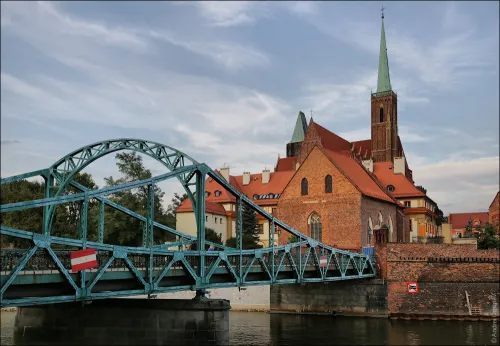
    Ostrów Tumski, Cathedral Island, is the oldest part of Wrocław. It really was an island between branches of the Oder; ostrów is Old Polish for island. It's also one of the few places left in Europe where a lamplighter lights the gas street lamps by hand every evening.

    Excavations show that people first settled the western part, between the churches of St. Martin and the Holy Cross. In the 10th century a wooden church of St. Martin stood here inside defensive walls along the river, with around 1,500 inhabitants on the island. Benedictine monks probably built St. Martin's chapel, the first building in solid material, early in the 11th century. Churches multiplied because the Congress of Gniezno in 1000 decided to create a bishopric in Wrocław.

    In 1163 Bolesław I the Tall, back from exile, took the settlement and made the island his capital, replacing wooden defences with brick and building a Romanesque residence. In 1315 the island was sold to the church, and outside secular law it became a refuge for people on the run from Wrocław's courts. Its status showed in an odd rule: men were not allowed to wear any headgear, even on Tumski Bridge and even if they were royalty. Nicolaus Copernicus served here as a canon of the Holy Cross chapter from 1503 until 1538.

    The island is free and open at any hour. Next comes the longest leg: 2840 m, about 39 minutes, to Centennial Hall. If your legs are done, the island is a good place to end, ideally as the lamps come on.

    Hours
    Open 24/7
    Price
    Free
  9. 9

    Centennial Hall

    Centennial Hall in Wrocław, stop 9 on the self-guided walking tour

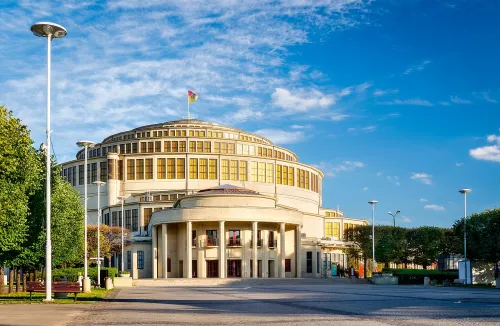
    Centennial Hall, once called People's Hall, was built by the architect Max Berg between 1911 and 1913 as a multipurpose space for exhibitions, concerts, theatre, opera and sport. It still hosts sporting events, business summits and concerts. As an early landmark of reinforced concrete architecture it was made a Historic Monument of Poland on 20 April 2005, together with the Four Domes Pavilion, the Pergola and the Iglica, and became a UNESCO World Heritage Site in 2006.

    The name goes back to 1813. On 10 March that year, in what was then Breslau, King Frederick William III of Prussia issued his proclamation To My People, calling Prussians to rise against Napoleon, and created the Iron Cross. In October Napoleon was beaten at the Battle of Leipzig, and the hall opened for that battle's 100th anniversary. The city had waited in vain for state money and paid the enormous costs itself.

    Hans Poelzig laid out the grounds, opened on 20 May 1913 in the presence of Crown Prince William. Look for the large pond with fountains framed by a concrete pergola in a half ellipse, with a Japanese garden beyond it to the north. The celebrations had a twist: Gerhart Hauptmann wrote a festival play for the occasion, but Max Reinhardt's staging was stopped by national conservatives who found it too antimilitaristic.

    The Visitor Centre's multimedia exhibition charges admission, and a combined ticket adds the hall's interior. For anyone interested in architecture, go inside to see what Berg did with concrete. This is the end of the route.

    Local name
    Hala Stulecia
    Hours
    Visitor Centre Tue–Sun 10:00–18:00 (April–October), 10:00–17:00 (November–March); closed Mondays
    Price
    Visitor Centre multimedia exhibition 25 PLN (reduced 20 PLN, family 45 PLN); exhibition plus Centennial Hall interior 30 PLN (reduced 25 PLN, family 55 PLN)
Walking tour route map of Wrocław Route loaded
Wrocław Market SquareOld Town HallWrocław DwarfsWrocław University+5
All 9 stops are already on the map.
You just press start.
AI Tour Guide

You've read the route. Now walk it with a guide in your ear.

Press start wherever you are, even hundreds of kilometres from Wrocław, and the guide begins telling its stories right away. In the city, pick any of the 9 stops to start from: it leads you there, then talks with you the whole route, asking, listening, remembering, and shaping the tour around your answers.

9stops 6.2km 1 h 24 minwalking 13languages
▶Start the tour free

Free to start · Runs in your browser · No app, no download

Shorter Ways to Walk Wrocław

Short on time or energy? Each of these cuts keeps the recommended order and simply drops part of the route.

Old Town core

Stops: 1, 2, 3, 4, 5

For a first look at the centre: about 1.4 km and 18 minutes of walking from the Rynek to the market hall. Only Wrocław University charges admission, so this works on a tight budget too.

Old Town and Cathedral Island

Stops: 1, 2, 3, 4, 5, 6, 7, 8

Everything except the long final leg: about 3.4 km and 44 minutes of walking. Admission applies at the university, the Panorama and the cathedral tower and chapels; you end on the island instead of out at Centennial Hall.

Panorama to the river at dusk

Stops: 5, 6, 7, 8

For an afternoon start: about 1.9 km and 26 minutes of walking from Hala Targowa via the Panorama and the cathedral, timed so you reach Ostrów Tumski as the gas lamps are lit. The Panorama and the cathedral tower and chapels charge admission.

How Long Does This Wrocław Tour Take on Foot?

The pure walking time is 1 h 24 min for 6.2 km. The Old Town stops sit close together, the river stops follow in short legs, and nearly half of the walking comes at the end: 39 minutes from Ostrów Tumski out to Centennial Hall.

With time to look around the free stops and to go inside where it pays off, the Panorama, the cathedral tower and Centennial Hall, plan about five and a half hours. Leave out every paid interior and the walk takes roughly two and a half hours.

The Old Town core takes about two hours including the university. Old Town and Cathedral Island run to a little over four hours with the Panorama and the tower. The afternoon cut from Hala Targowa to the island needs about two and a half hours with both paid visits.

Before You Set Off in Wrocław

  • Start: Wrocław Market Square is the recommended start, but you can join at any stop and follow the order from there.
  • Finish: Centennial Hall, after the longest leg of 2840 m from Ostrów Tumski. If you'd rather finish near the centre, end on the island.
  • Time of day: Start in the morning if you want the paid interiors. The cathedral tower depends on the weather and doesn't open during services; the island is at its most atmospheric in the evening.
  • Admission: Free: the Market Square, the Old Town Hall from outside, the dwarfs, Hala Targowa and Ostrów Tumski. Paid: Wrocław University, the Panorama, the cathedral tower and chapels, and the Centennial Hall exhibition and interior.
  • Navigation: Open the free GPS route in your browser; it guides you from stop to stop.
Walking tour route map of Wrocław
AI Tour Guide

Your guide is ready when you are, at any stop.

Press start and a voice AI Tour Guide takes it from here: leading the route through Wrocław, telling the stories, and turning your walk into a real back-and-forth conversation. No app or download is needed; it runs in your browser.

9stops 6.2km 1 h 24 minwalking 13languages
▶Start the tour free

Free to start · Runs in your browser · No app, no download

What the AI Tour Guide Adds in Wrocław

This walk keeps changing hands between Bohemian, Piast, Habsburg, Prussian and Polish Wrocław, and the AI Tour Guide lets you follow whichever thread grabs you, perhaps how the Panorama travelled from Lviv to this city or what 1945 meant for old Breslau. It greets you, tells the stories of each place, asks what you're curious about, remembers it and shapes the next stop around it; you can interrupt whenever you like. You start with 100 free credits; after that, choose this tour all-inclusive for €19.99 with no time limit, or credits at €5 per hour.

A Real Conversation A voice AI Tour Guide greets you, leads the whole route, and tells the stories and facts as you walk, asking what you want to see and keeping a real conversation going. Not a recording you press play on.
Map Navigation Follow the route on the map and walk at your own pace. You choose where to start and when to move to the next stop.
Ask Anything Curious about a building you pass? Ask your AI Tour Guide on the spot and the conversation carries on.
13 Languages Switch language anytime. No separate tour needed.
Start free in your browser

Common Questions About Walking Wrocław

If I only pay for one interior in Wrocław, which should it be?

The Panorama of the Battle of Racławice. You can enjoy the town hall, the dwarfs and the island for free, but nothing else on the route puts you inside a painting. If you'd rather have a view over the city, pick the cathedral tower.

Can I walk this route in the evening?

Partly. The Market Square, the Old Town Hall from outside, the dwarfs and Ostrów Tumski are free and open around the clock. Plan the market hall and the paid interiors for daytime.

Can small children go up the cathedral tower?

Yes, children under six go up the tower free of charge. Older children and adults need a ticket, and there is a combined ticket with the baroque chapels.

Where can I take another walking tour after Wrocław?

Nearby options with their own free GPS routes include Görlitz and Poznań, each about 140 km away, or Krakow a little further.

Is the tour really free?

Yes. The whole tour is free: the route, the interactive map and the navigation cost you nothing. Only the voice AI Tour Guide is optional and paid: you test it with 100 free credits, then you pay either €5 per hour or €19.99 for this whole tour, with no time limit. Admission to 3 of the 9 stops is not included: Wrocław University, Panorama of the Battle of Racławice and Centennial Hall charge their own entry fees.

Do I need to download an app?

No. Everything runs in your phone browser. Open the route and start walking, no download and no sign-up required.

Do I need to book the walking tour in advance?

No booking needed. This self-guided tour is available anytime. Open the route in your browser and start walking. The AI Tour Guide works instantly, no app, no reservation required.

What languages is the AI Tour Guide available in?

The AI Tour Guide speaks 13 languages, so you take the tour in your own language and can switch at any time.

Can I skip stops or change the route?

Yes. Skip any stop, spend extra time at places you like, or start the route from any point. It is your walk, you set the pace.
Image credits
▶ Start free in your browser Runs in your browser, no app, no download