

Plaza de Armas
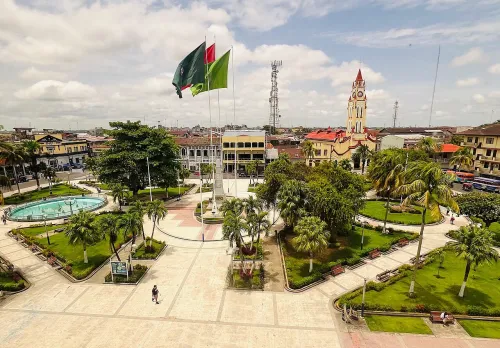
Iquitos grew outward from this square. The Plaza de Armas has been the city's main public space since it was laid out in 1764, and it still fills exactly one city block. Official ceremonies happen here, the national anthem is sung here, and the flags of Peru and of the Loreto region are raised here; on any ordinary day it is simply the place where locals and visitors cross paths.
In the middle stands a squat, four-sided obelisk that narrows towards its tip, set on a stone platform next to three flagpoles. Walk all the way around it. Its four faces carry long lists of names: the men from Loreto who died in the War of the Pacific. The base is decorated with inlaid metal images of the war's heroes. Keep that war in mind, because it returns at the riverfront.
On the east side, a round fountain runs shows of coordinated water jets that climb to about ten metres, lit in colours with lilac dominating. Benches are scattered at the corners and inside the square, close to the obelisk.
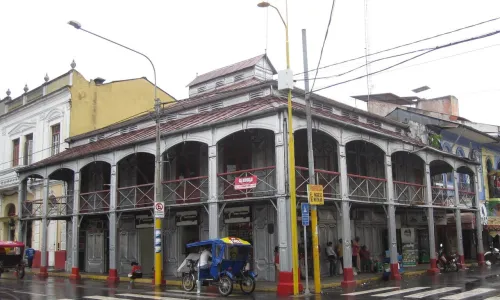
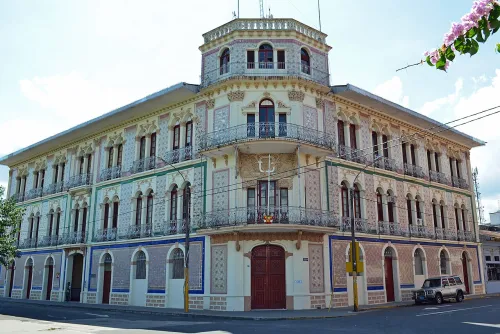
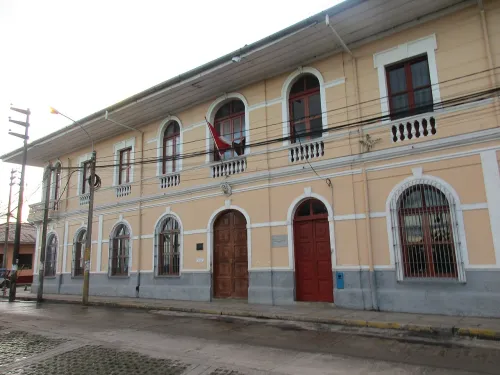
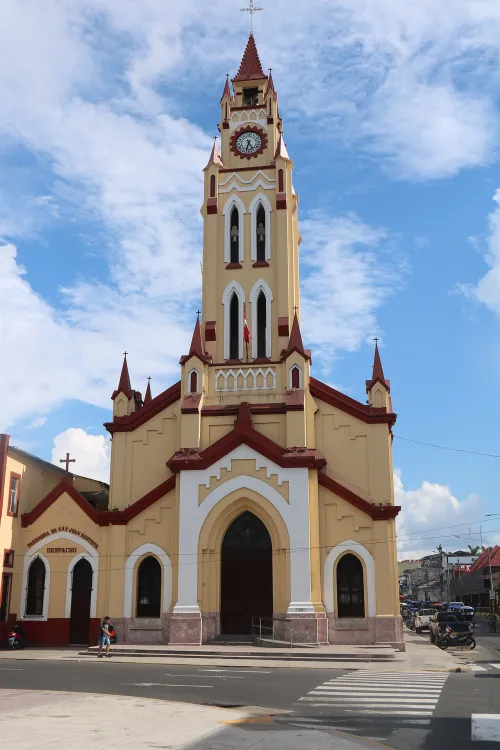
Look around the edges and the first chapters of the walk are already in view: the Casa de Fierro on the east side, the Catedral de Iquitos, which locals also call the Iglesia Matriz, at the southwest corner, and nearby the former houses of the Pinasco and Fitzcarrald families. The iron house is only 80 m away, a one-minute walk.