Free Walking Tour Puno: Old Center to Condor Lookout

A stone arch, the sanctuary of Puno's patron Virgin, a condor high above the city and a cathedral carved in basalt, all on one loop through the old center.

7 Stops 3.1 km ~49 min walking
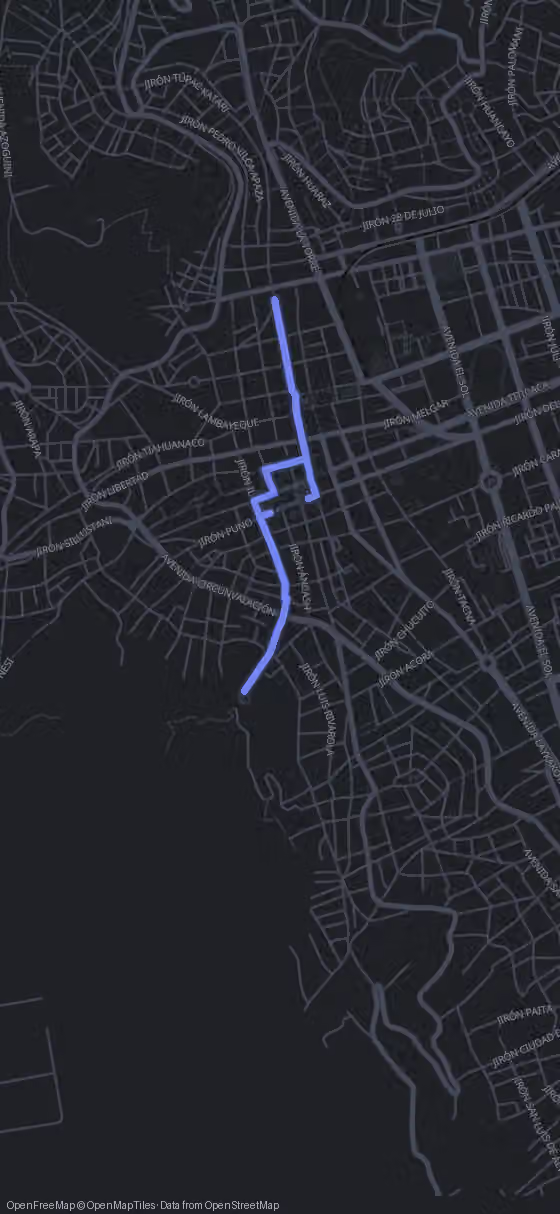
Route map for the Puno walking tour
Stop 1 of 7
730 m·9 min
Plaza de Armas de Puno
Head north up the slope toward the Arco Deústua
Welcome to Puno. I'm Alex, and one small church here holds the image that draws an entire city into the streets each February.
Try this tour with Alex

Puno on Foot: What This Loop Covers

Seven stops on 3.1 km, from the Plaza de Armas de Puno through the old center, up to the Mirador de Kuntur Wasi and back down to the Catedral de Puno on the same square. Pure walking time is 49 min; with the visits that pay off, plan about three hours.

Everything is free except the Museo Carlos Dreyer, which charges entry. Route, map and GPS navigation in your browser cost nothing; the AI Tour Guide is optional.

Open free GPS & optional AI Tour Guide
View of Puno

The Route

Walking Map of Puno: Plaza, Sanctuary and Condor Lookout

7 stops 3.1 km 49 min walking
Tap to load interactive map

The 7 stops along this route

  1. Plaza de Armas de Puno, stop 1 on the self-guided walking tour
    1Plaza de Armas de Puno
  2. Arco Deústua in Puno, stop 2 on the self-guided walking tour
    2Arco Deústua
  3. Iglesia de San Juan Bautista in Puno, stop 3 on the self-guided walking tour
    3Iglesia de San Juan Bautista
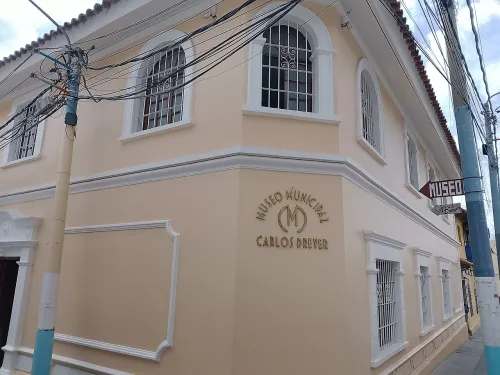
  4. Museo Carlos Dreyer in Puno, stop 4 on the self-guided walking tour
    4Museo Carlos Dreyer
  5. Balcón del Conde de Lemos in Puno, stop 5 on the self-guided walking tour
    5Balcón del Conde de Lemos
  6. Mirador de Kuntur Wasi in Puno, stop 6 on the self-guided walking tour
    6Mirador de Kuntur Wasi
  7. Catedral de Puno, stop 7 on the self-guided walking tour
    7Catedral de Puno
  8. That's the full route.

    Walk it with an AI Tour Guide talking you through every one of these streets.

    Start free in your browser
    You made it

Your Puno Walking Tour from Arch to Cathedral

  1. 1

    Plaza de Armas de Puno

    Plaza de Armas de Puno, stop 1 on the self-guided walking tour

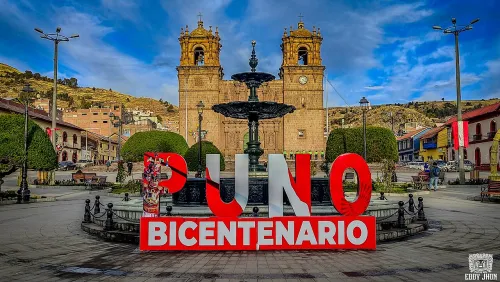
    Start on the Plaza de Armas and give it a minute before the route pulls you away. This is Puno's central public square, open around the clock, and it holds the whole circle together: the route runs out through the old center, climbs to a lookout over the city and then comes back down to the cathedral, which stands right here on this square. In a sense you are beginning at the end.

    Use the plaza for one practical thing before you leave: check today's opening times for the museum and the cathedral. Their doors are not open all day, and knowing that now decides whether you visit the cathedral first or last. The square itself never closes, which makes it your natural fallback whenever a door somewhere turns out to be shut.

    When you are ready, leave the square along Jr. Independencia. The first leg is 740 m, about 11 min, to a stone arch standing in the middle of the street.
    Hours
    24/7
    Price
    Free
  2. 2

    Arco Deústua

    Arco Deústua in Puno, stop 2 on the self-guided walking tour

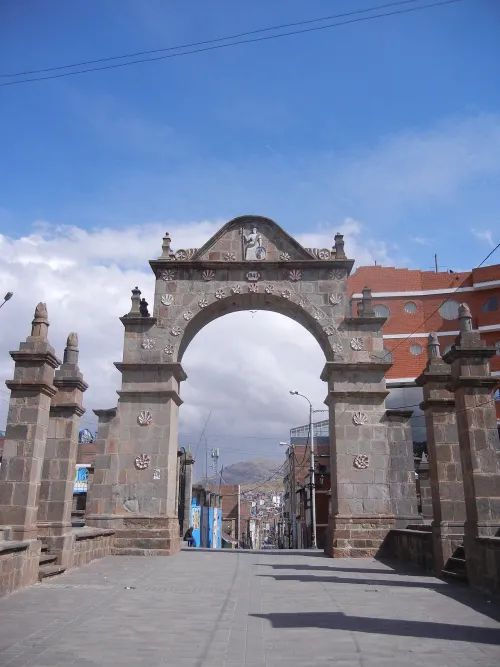
    Coming along Jr. Independencia, watch your left: the stone arch stands free in the street, with no gate, no ticket and no opening hours. It went up in 1847, and you simply walk up to it.

    This is a short stop, and it deserves the short version. The arch is a marker more than a monument to study, the point where the route leaves the civic center behind and turns toward the church that holds Puno's most venerated image. Walk through it, glance back once, then carry on onto Jr. Lima. The sanctuary is 370 m away, about 5 min.

    Hours
    24/7
    Price
    Free
  3. 3

    Iglesia de San Juan Bautista

    Iglesia de San Juan Bautista in Puno, stop 3 on the self-guided walking tour

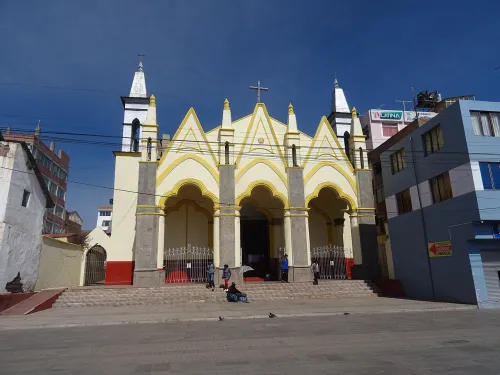
    This church is the reason Puno celebrates the Virgen de la Candelaria. Her image has been kept here since 1700, and since 7 February 1988 the church carries the title of Sanctuary of the Virgen de la Candelaria, granted by Jesús Mateo Calderón Barrueto, then bishop of Puno. The parish itself is much older: it was founded in 1562 on the orders of the bishop of La Paz, split off from the parish of Paucarcolla, and the viceroy of Peru was informed the same year.

    The story that made the Virgin Puno's patron dates from 1781. The town was under siege by the revolutionary army of Túpac Amaru, and after battles through March, April and May its fall seemed only a matter of time. The townspeople carried the image out in procession to ask for protection. That same night the rebels pulled back and left. People took it as a miracle, and the Candelaria rose to the most important saint of the region, enthroned for good on the high altar of this church.

    From the start, San Juan Bautista was also a place of refuge and prayer for indigenous people, the abused, the poor and the marginalized. The building you see is not the colonial one: on 5 March 1886 a fire brought the old church down. Reconstruction committees worked for 25 years, and in 1911 the church reopened with the new architecture that still stands today.

    Going inside is free and worth a few quiet minutes for anyone curious about the Candelaria, since the image on the high altar is the heart of the place. Services take priority, so move softly if a Mass is on. From here it is 420 m, about 6 min, to the museum.

    Hours
    Daily approx. 06:00–17:00 (subject to liturgical services)
    Price
    Free
  4. 4

    Museo Carlos Dreyer

    Museo Carlos Dreyer in Puno, stop 4 on the self-guided walking tour

    The museum sits in the former house of Carlos Dreyer, a German collector and artist who settled in Puno, at the corner of Jr. Deustua and Jr. Conde de Lemos. The building was declared part of Peru's national cultural heritage on 23 July 1980, and inside it holds around 1,800 pieces covering pre-Inca, Inca, colonial and republican times.

    The collection is arranged in rooms you can take one by one. The Inca room shows pre-Columbian objects; the lithic gallery is devoted to the Pukara culture; the regional archaeology room covers the kingdoms of the altiplano. The room called Death in the Altiplano displays finds from Sillustani. Then the tone changes: the picture gallery shows Dreyer's own collection and the indigenist movement in art, followed by a colonial room, a religious room and a room about Dreyer himself.

    This is the only stop on the loop that charges entry, and the one that explains the region best. If you plan to see Sillustani or simply want context for the altiplano, give it about an hour. If you are short on time or money, it is the stop to skip. Either way, the next stop is just 30 m away, about 1 min, on the same corner.

    Hours
    Mon–Fri 09:00–18:00, Sat 09:00–16:00, Sun and holidays closed
    Price
    S/ 15 foreigners (S/ 10 foreign students); S/ 10 Peruvian nationals (S/ 5 Peruvian students); S/ 5 Puno local adults (S/ 2 local students, S/ 1 children)
  5. 5

    Balcón del Conde de Lemos

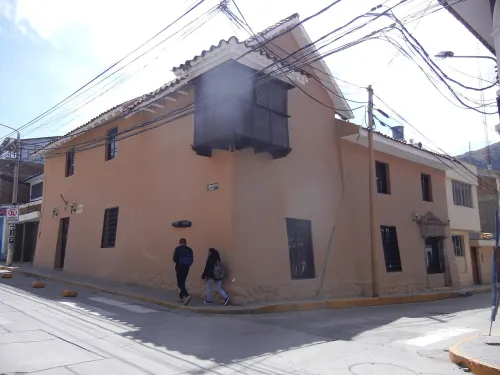
    Balcón del Conde de Lemos in Puno, stop 5 on the self-guided walking tour

    You barely leave the museum before the next stop: the corner of Jr. Deustua and Jr. Conde de Lemos. On it stands a 17th-century colonial house with a wooden balcony over the street, and that balcony is the whole visit.

    Know what the building is before you look for a door: it houses the regional culture authority, with offices and administration and no interior visits for tourists. The facade and the historic wooden balcony are free to see from the street at any hour. Take a good look, then get ready for the one real effort of the day.

    The longest leg of the loop starts here: 800 m, about 15 min, along Jr. Ilave and then uphill to the lookout over the city.

    Hours
    Exterior viewable 24/7
    Price
    Free
  6. 6

    Mirador de Kuntur Wasi

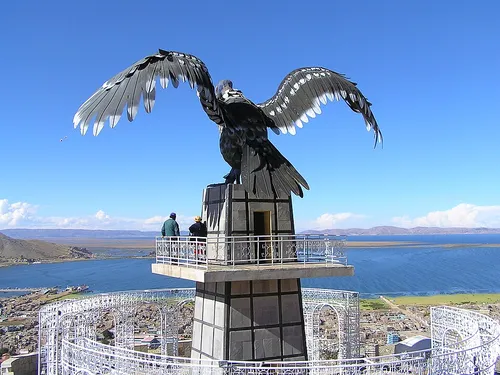
    Mirador de Kuntur Wasi in Puno, stop 6 on the self-guided walking tour

    At the top there is no gate and no ticket booth; the platform is public and never closes. What marks it is a condor at monumental scale, and the city spreads out beneath the platform. The sculpture plus the height you just gained: that is the reward for the climb, so take your time up here.

    One rule for this stop has nothing to do with tickets: come in daylight. The platform has no closing hour of its own, but the safety advice for this stretch is clear, so do not save the lookout for after dark. If your day started late, switch to the daylight-first order and come up here before the old center.

    From the condor the route heads back down: 710 m, about 11 min, to the cathedral on the Plaza de Armas.

    Hours
    24/7
    Price
    Free
  7. 7

    Catedral de Puno

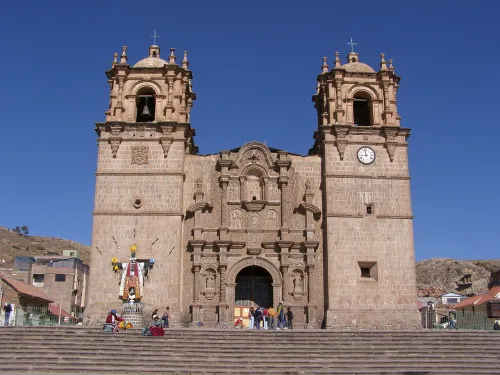
    Catedral de Puno, stop 7 on the self-guided walking tour

    Back on the Plaza de Armas, stand in front of the facade before you go in. The Basilica Cathedral of San Carlos Borromeo is built in a mestizo style that mixes Spanish baroque with Andean influences, and the center of the facade shows it in stone: human figures, native flowers and sirens playing charangos, carved by local craftsmen in hard basalt. The two massive towers rise 30 m and are decorated only on their top level.

    Look at the doors, too. A date on the central door records the facade as finished in 1757, and a year on the side door puts the completion of the church at 1794. Construction is said to have taken around 80 years; it may have started in 1709, or as early as 1669, right after the founding of Puno as a mining town. The initiative is credited to the miner Miguel de San Román, while the work was carried out by the indigenous builder Simón de Asto.

    The church became the cathedral of the newly created diocese of Puno in 1861. A fire in 1930 destroyed much of the wooden interior, including the high altar. In 1965 Pope Paul VI gave it the title of minor basilica, and in 1972 it was declared a national cultural asset of Peru.

    Entry is free. Inside, expect something plain: a single nave on a cross-shaped plan with a dome over the crossing, 15 m high and 10 m wide, and a marble high altar by Emilio Hart Terre that replaced the one lost in the fire. The facade is the main event, so even if the doors are closed when you arrive, the visit works. And since you are standing on the plaza where you began, the loop is complete.

    Hours
    Mon–Fri 08:00–12:00, 15:00–18:00; Sat 08:00–13:00, 15:00–19:00; Sun 08:00–12:00, 15:00–19:00
    Price
    Free
Walking tour route map of Puno Route loaded
Plaza de Armas de PunoArco DeústuaIglesia de San Juan BautistaMuseo Carlos Dreyer+3
All 7 stops are already on the map.
You just press start.
AI Tour Guide

You know the route now. Walk it with a guide talking beside you.

Press start wherever you are, even hundreds of kilometres from Puno, and the guide begins telling its stories right away. In the city, pick any of the 7 stops to start from: it leads you there, then talks with you the whole route, asking, listening, remembering, and shaping the tour around your answers.

7stops 3.1km 49 minwalking 13languages
▶Start the tour free

Free to start · Runs in your browser · No app, no download

Shorter and Smarter Ways to Walk Puno

The full loop suits most days, but three versions fit a late start, tired legs or a tight budget.

Daylight first

Stops: 6, 7, 1, 2, 3, 4, 5

For a late start: go to the lookout while it is still light, walk down to the cathedral, cross the square and do the old center afterwards. The legs add up to 34 min of walking. Only the museum charges entry.

Old center without the climb

Stops: 7, 1, 2, 3, 4, 5

For anyone who wants history rather than height: see the cathedral first, since it stands on the plaza, then follow the streets to the balcony. That is 23 min of walking, and the museum is the only ticket.

No tickets at all

Stops: 1, 2, 3, 5, 6, 7

For a zero budget: pass the museum door and keep going. You still walk the full 49 min because the museum lies on the way, and every remaining stop is free.

How Long This Puno Tour Takes, Museum Included

The walking itself takes 49 min. What stretches the loop is what you do at the stops: an hour in the museum, a slow look inside both churches and time at the top of the lookout bring the full route to roughly three hours.

Skip the museum and you are done in about two hours. The version without the climb, museum included, takes a little over two hours; the daylight-first order takes as long as the full loop, it only changes the sequence.

Before You Set Out in Puno

  • Start: The Plaza de Armas de Puno is the recommended start, but you can join the route at any stop.
  • Finish: The loop ends at the Catedral de Puno, which stands on the plaza where you began.
  • Time of day: Walk in daylight, mainly for the lookout. Check today's opening times for the museum and the cathedral before you leave the square, since neither is open all day.
  • Entry: The Museo Carlos Dreyer charges entry; both churches, the lookout, the arch, the balcony and the plaza are free.
Walking tour route map of Puno
AI Tour Guide

Your guide is ready whenever you reach the plaza.

Press start and a voice AI Tour Guide takes it from here: leading the route through Puno, telling the stories, and turning your walk into a real back-and-forth conversation. No app or download is needed; it runs in your browser.

7stops 3.1km 49 minwalking 13languages
▶Start the tour free

Free to start · Runs in your browser · No app, no download

What the AI Tour Guide Adds in Puno

On this loop the AI Tour Guide turns history into a conversation: it greets you on the plaza, tells the stories at each stop, asks what caught your eye and remembers it. If the siege of 1781 grabs you, it can go deeper into Túpac Amaru's rebellion; if the Sillustani finds in the museum stay with you, it can tell you more about who was buried there and why. You can interrupt it any time, and the route stays the same.

A Real Conversation A voice AI Tour Guide greets you, leads the whole route, and tells the stories and facts as you walk, asking what you want to see and keeping a real conversation going. Not a recording you press play on.
Map Navigation Follow the route on the map and walk at your own pace. You choose where to start and when to move to the next stop.
Ask Anything Curious about a building you pass? Ask your AI Tour Guide on the spot and the conversation carries on.
13 Languages Switch language anytime. No separate tour needed.
Start free in your browser

Common Questions About Walking Puno

Are there reduced tickets at the Museo Carlos Dreyer?

Yes. Students pay less than full-price adults, and Peruvian nationals and Puno residents have their own lower rates. Bring your student card.

Can I visit the churches during Mass?

The Iglesia de San Juan Bautista follows its liturgical schedule, so services take priority over visits. If a Mass is on, stay at the back, keep quiet, or come back once it is over.

Which cities nearby have a walking tour of their own?

The closest are Copacabana and Arequipa; La Paz and Cusco also work as next stops on a longer trip.

Is the tour really free?

Yes. The whole tour is free: the route, the interactive map and the navigation cost you nothing. Only the voice AI Tour Guide is optional and paid: you test it with 100 free credits, then you pay either €5 per hour or €19.99 for this whole tour, with no time limit. Admission to one of the 7 stops is not included: Museo Carlos Dreyer charges its own entry fee.

Do I need to download an app?

No. Everything runs in your phone browser. Open the route and start walking, no download and no sign-up required.

Do I need to book the walking tour in advance?

No booking needed. This self-guided tour is available anytime. Open the route in your browser and start walking. The AI Tour Guide works instantly, no app, no reservation required.

What languages is the AI Tour Guide available in?

The AI Tour Guide speaks 13 languages, so you take the tour in your own language and can switch at any time.

Can I skip stops or change the route?

Yes. Skip any stop, spend extra time at places you like, or start the route from any point. It is your walk, you set the pace.
Image credits
▶ Start free in your browser Runs in your browser, no app, no download