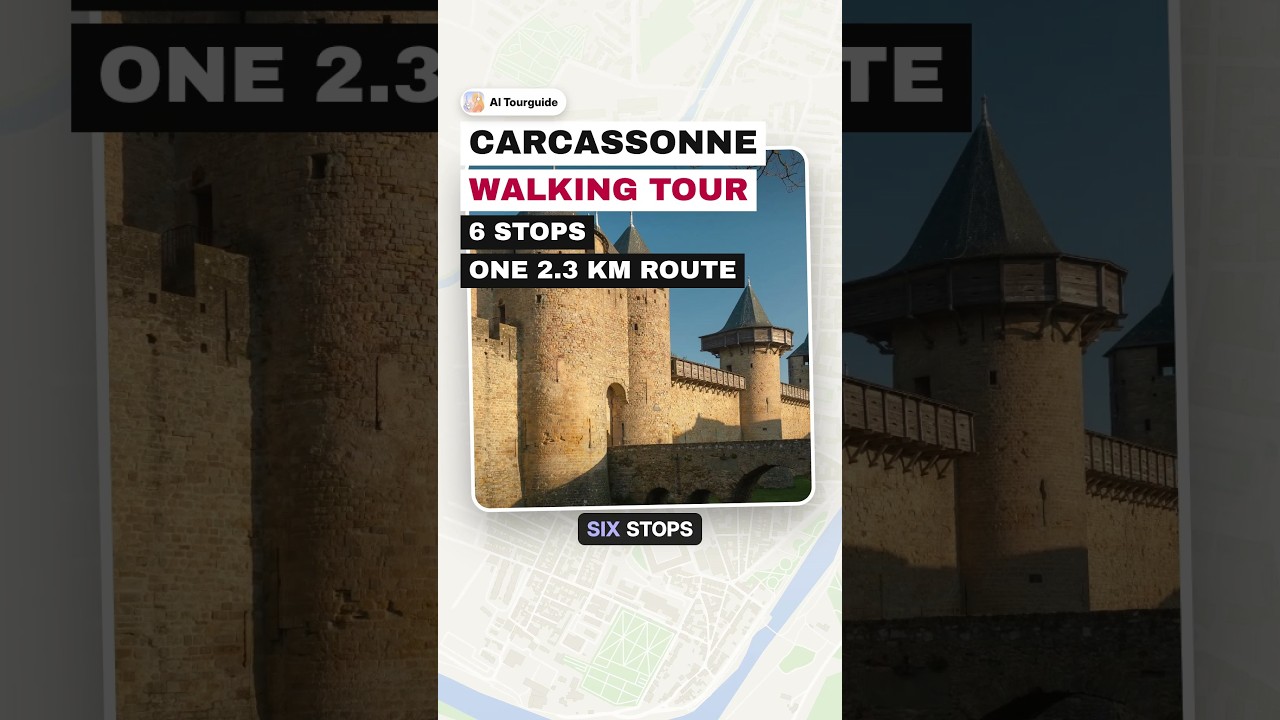
Free Walking Tour Carcassonne: Bastide to Cité

Cross from the lower town over a medieval bridge into the walled Cité: six stops, 2.3 km, and only one ticket worth weighing up.

6 Stops 2.3 km ~36 min walking
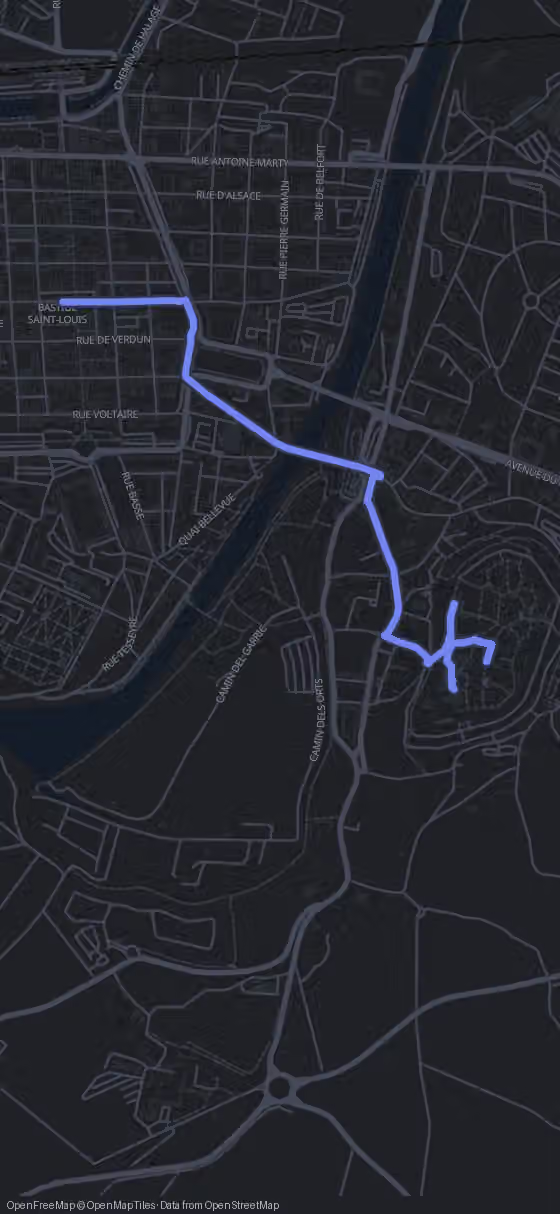
Route map for the Carcassonne walking tour
Stop 1 of 6
630 m·8 min
Place Carnot
Head east toward the Pont Vieux
Welcome to Carcassonne. I'm Alex, and our first story begins with a fortress counted in towers and kilometres of walls.
Try this tour with Alex

This Carcassonne Route at a Glance

Six stops lead from Place Carnot in the lower town over the Pont Vieux and up through the Porte Narbonnaise to the Château Comtal, the Basilica Saints Nazarius and the Porte d'Aude. It is 2.3 km and 36 minutes of pure walking; with the castle and the basilica, plan about three hours.

Only the castle charges admission; everything else is free. Route, map and GPS navigation run free in your browser, and the optional AI Tour Guide leads the walk as a conversation.

Open free GPS & optional AI Tour Guide
This short shows highlights of the route. All 6 stops follow below.

The Route

Walking Map of Carcassonne, from Place Carnot to the Porte d'Aude

6 stops 2.3 km 36 min walking
Tap to load interactive map

The 6 stops along this route

  1. Place Carnot in Carcassonne, stop 1 on the self-guided walking tour
    1Place Carnot
  2. Pont Vieux in Carcassonne, stop 2 on the self-guided walking tour
    2Pont Vieux
  3. Porte Narbonnaise in Carcassonne, stop 3 on the self-guided walking tour
    3Porte Narbonnaise
  4. Château Comtal in Carcassonne, stop 4 on the self-guided walking tour
    4Château Comtal
  5. Basilica Saints Nazarius in Carcassonne, stop 5 on the self-guided walking tour
    5Basilica Saints Nazarius
  6. Porte d'Aude in Carcassonne, stop 6 on the self-guided walking tour
    6Porte d'Aude
  7. That's the full route.

    Walk it with an AI Tour Guide talking you through every one of these streets.

    Start free in your browser
    You made it

Your Carcassonne Walking Tour Stop by Stop: Lower Town, Bridge and Cité

  1. 1

    Place Carnot

    Place Carnot in Carcassonne, stop 1 on the self-guided walking tour

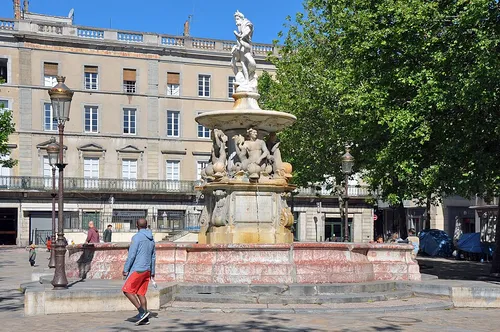
    Start in the town without walls, on purpose. Place Carnot is the open central square of the Bastide Saint-Louis, the lower town where Carcassonne actually lives. The covered market halls and the local bars are a few streets away, and the walled Cité you came for waits on its hill across the river. You will reach it on foot, and the walk shows you how the two towns belong together.

    This grid of streets exists because of an exile. After the crusade against the Albigensians, the people of Carcassonne came back after seven years away, and the king had the old settlement around the ramparts torn down, the Aude diverted and the marshes drained. Louis IX then allowed the inhabitants to build a new town down here, on the far side of the river from the fortress that had once been their home.

    The square is also the city's stage, and the calendar decides what you find on it. In July the free shows of the Festival OFF take over the Bastide's squares in the evenings. In October a wine festival fills this one with the appellations of the Aude. From early December it turns into a Christmas village with an ice rink.

    From here it is 800 m and 11 minutes to the river. On the way you pass the Musée des Beaux-Arts de Carcassonne, then the houses open up and the Pont Vieux lies ahead with the Cité behind it.
    Hours
    Open 24/7
    Price
    Free
  2. 2

    Pont Vieux

    Pont Vieux in Carcassonne, stop 2 on the self-guided walking tour

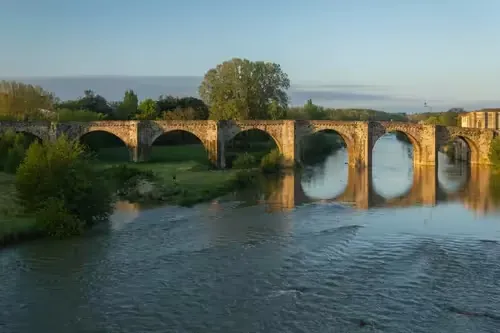
    Stop in the middle of the Pont Vieux and look both ways. Ahead, the Cité sits on its hill; behind you lies the lower town you just crossed. Downstream you can make out the next crossings, because Carcassonne lines up three bridges over the Aude in a row: the Pont Vieux, the Pont Neuf and the Pont de l'Avenir.

    The story of a bridge here starts with a deal. The oldest document dates from 1184: Roger Trencavel allowed the townspeople to build a new bridge, provided they paid for it themselves. In his will of 1194 he kept only the principle of his toll and cut it to a yearly payment of two measures of wheat. That bridge was probably wooden and took about ten years to build, though the historian Jacques-Alphonse Mahul argued that the deed referred to another crossing, the Pont du Moulin du Roi on an old arm of the river. Either way, the Albigensian Crusade most likely destroyed it.

    The stone bridge under your feet belongs to the new lower town. Early in the 14th century the king allowed the inhabitants to build it in stone and fund the work with tolls on passage and paving. It was under construction in 1315 and probably finished around 1320; a deed of 1353 shows it complete. A royal letter of 1318 granted Limoux the same arrangement, which is why the Pont Neuf there looks related. Originally a stone arch split this bridge in two and marked the border between lower town and upper town.

    The bridge did not come through unchanged. Two arches collapsed in 1456, and the restoration of 1820 reworked it and somewhat disfigured it. It has been a listed historic monument since 1926. Now comes the longest leg of the walk: 930 m and 16 minutes uphill to the Porte Narbonnaise.

    Hours
    Open 24/7
    Price
    Free
  3. 3

    Porte Narbonnaise

    Porte Narbonnaise in Carcassonne, stop 3 on the self-guided walking tour

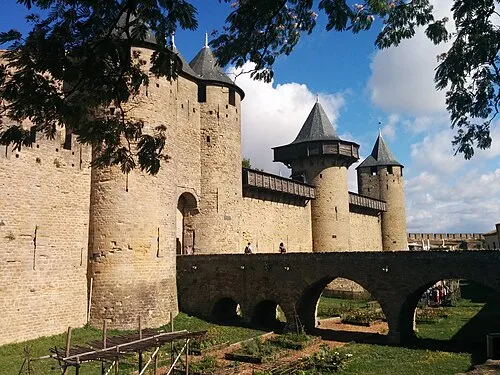
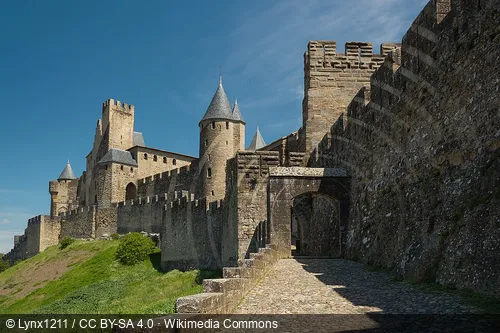
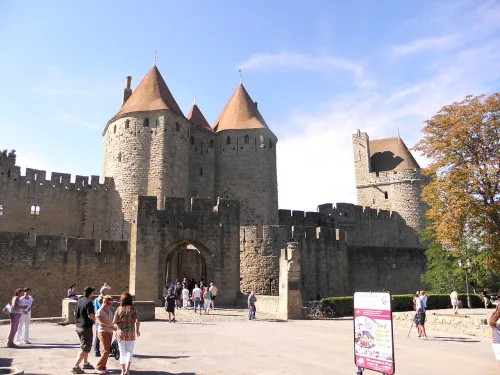
    At the Porte Narbonnaise you are at the main entrance of the walled Cité, a UNESCO-listed fortress. Look up and around before you walk in: fifty-two towers punctuate a double ring of walls that wraps the whole hilltop. What you see today owes much to the 19th century, when Viollet-le-Duc restored the fortress and gave the towers their pointed slate roofs.

    The double ring is the key to understanding the place. Between the outer and inner walls runs a strip about a kilometre long called the lices. You can follow it around the full defensive circuit, away from the shops and crowds of the main street, and see how an attacker who broke through the first wall would find himself trapped in front of the second. If you have twenty minutes to spare, walk a stretch of the lices before going further in.

    From the gate, the route crosses the Cité de Carcassonne itself: 230 m and 3 minutes through the lanes to the Château Comtal, the castle inside the fortress.

    Hours
    Always open
    Price
    Free
  4. 4

    Château Comtal

    Château Comtal in Carcassonne, stop 4 on the self-guided walking tour

    The Château Comtal is the only stop on this route with a ticket counter, and the one most visitors misunderstand. The adult ticket buys the castle interior and the wall-walk, the rampart circuit of the Cité. It does not buy the Cité: the lanes and gates you just walked through stay free either way. Decide on that basis, not on the poster at the gate.

    On a first visit, with one interior in the day's budget, this is the one to spend it on. The wall-walk shows you the fortification from above: the two rings of walls, the lices running between them and the Aude you crossed at the Pont Vieux. From up there the morning's walk suddenly makes sense as one picture, lower town, bridge and hill.

    Timing matters more than anything else here. The ticket office stops selling a while before the castle itself closes, so arriving late in the afternoon can cost you the visit.

    Back outside, the basilica is 210 m and 3 minutes away.

    Hours
    2 May – 30 Sep 2026 daily 10:00–18:30 | 1 Oct – 31 Dec 2026 daily 9:30–17:00. Ticket office closes 45 min (Apr–Sep) resp. 30 min (Oct–March) before closing.
    Price
    EUR 13 adult
  5. 5

    Basilica Saints Nazarius

    Basilica Saints Nazarius in Carcassonne, stop 5 on the self-guided walking tour

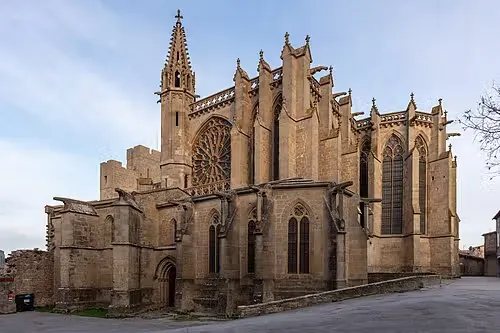
    The Basilica Saints Nazarius is built of sandstone on the plan of a Latin cross, 59 m long inside, with a 16 m wide nave and a 36 m transept. Walk around to the north wall for the main entrance: a Romanesque portal of five receding arches over two doors. The west wall is a fortress façade, as was common for medieval churches in the Languedoc.

    Inside, the building splits into two moods. The Romanesque nave, the oldest part, is dim. Then the Gothic transept and choir open up with much larger windows and far more light. Look for the central stained-glass window of the choir: it dates from 1280 and is one of the oldest in the south of France. The crypt looks ancient too, but it belongs to the later construction.

    The history goes back further than the stones. A first church is thought to have stood here in the 6th century, under the Visigothic ruler Theodoric the Great. On 12 June 1096 Pope Urban II came to the town and blessed the building materials for a new cathedral, completed in the first half of the 12th century on the site of a Carolingian cathedral of which nothing remains. Around the end of the 13th century, under Philip III and Philip IV and the bishops Pierre de Rochefort and Pierre Rodier, it was rebuilt in the Gothic style.

    It stayed the cathedral of Carcassonne until 1803, when the title passed to the Cathédrale Saint-Michel. It became a historic monument in 1840, was renovated by Viollet-le-Duc along with the rest of the Cité and was raised to a minor basilica in 1898. Entry is free, so go in whatever your interests; twenty minutes is enough for the nave, the choir window and the portal. The last stop is just 160 m and 2 minutes on.

    Local name
    Basilique Saint-Nazaire-et-Saint-Celse de Carcassonne
    Hours
    Mon–Sat: 09:00–18:30 | Sun: 9:00–10:45, 12:30–18:30
    Price
    Free
  6. 6

    Porte d'Aude

    Porte d'Aude in Carcassonne, stop 6 on the self-guided walking tour

    The Porte d'Aude is the western gateway of the Cité, and it ends the route with a wide view: vineyards stretching toward the Pyrenees, a landscape that has hardly changed since the fortress guarded the border between France and Aragon.

    The gate was also a lifeline. The steep cobbled path that runs down from here passes the Church of Saint-Gimer and was the way medieval defenders went down to the Aude for water during sieges. Standing here, you can see why a fortress on a hill needed this exit as much as its walls.

    If you head back to the lower town, this path is the defenders' route in reverse of the morning: from the Cité down toward the river you crossed at the start.

    Hours
    Open 24/7
    Price
    Free
Walking tour route map of Carcassonne Route loaded
Place CarnotPont VieuxPorte NarbonnaiseChâteau Comtal+2
All 6 stops are already on the map.
You just press start.
AI Tour Guide

You know the way up to the Cité. Now walk it with a guide in your ear.

Press start wherever you are, even hundreds of kilometres from Carcassonne, and the guide begins telling its stories right away. In the city, pick any of the 6 stops to start from: it leads you there, then talks with you the whole route, asking, listening, remembering, and shaping the tour around your answers.

6stops 2.3km 36 minwalking 13languages
▶Start the tour free

Free to start · Runs in your browser · No app, no download

Shorter Ways Through Carcassonne

The full route links both towns. If time, budget or energy is short, these cuts still make sense on their own.

The Cité only

Stops: 3, 4, 5, 6

For when you are already up at the walls or have only a morning. From the Porte Narbonnaise to the Porte d'Aude it is 600 m and 8 minutes of walking; the only ticket is the castle. With the interior and wall-walk, allow about two hours.

Outside the walls of the castle, free all the way

Stops: 1, 2, 3, 4, 5, 6

For a tight budget: walk the whole route but look at the Château Comtal from its gate instead of buying a ticket, and use the time for the lices instead. Walking stays at 36 minutes, the cost at zero, and about an hour and three quarters is enough.

Lower town and old bridge

Stops: 1, 2

For an evening after a day in the Cité: Place Carnot and the Pont Vieux, 800 m and 11 minutes apart, both free, with the walled town lit up across the river. Half an hour covers it.

How Long This Carcassonne Tour Takes, With and Without the Castle

Most of the 36 minutes of pure walking comes at the start: 11 minutes to the bridge, then 16 minutes uphill to the Cité. Once inside the walls, the last four stops sit three minutes or less apart, so the morning slows down exactly where there is most to see.

A realistic example: leave Place Carnot at 9:00, pause about ten minutes each at the square, the bridge and the gate, and you reach the Château Comtal at 10:00. Give the castle about 75 minutes, step into the basilica at 11:18 for twenty minutes and you stand at the Porte d'Aude around 11:40. On a Sunday the basilica takes a break late in the morning, so start later and reach it once it has reopened.

The Cité-only variant takes about two hours with the castle, the free full route about an hour and three quarters, the evening loop in the lower town half an hour.

Before You Set Off from Place Carnot

  • Start and finish: Place Carnot is the recommended start, but you can join at any stop. The route ends at the Porte d'Aude, the western gate of the Cité, so you finish high up with the view rather than back in the lower town.
  • Best time: Any day works: the squares, bridge and gates are always open and the castle opens daily. The basilica is open every day too, but on Sundays it closes for a break late in the morning.
  • Costs: Budget for a ticket if you want the castle interior and wall-walk. The rest of the route, the basilica included, costs nothing.
Walking tour route map of Carcassonne
AI Tour Guide

Your guide is waiting at Place Carnot when you are ready.

Press start and a voice AI Tour Guide takes it from here: leading the route through Carcassonne, telling the stories, and turning your walk into a real back-and-forth conversation. No app or download is needed; it runs in your browser.

6stops 2.3km 36 minwalking 13languages
▶Start the tour free

Free to start · Runs in your browser · No app, no download

What the AI Tour Guide Adds Between the Two Towns

This route tells one story across two towns: the people who were pushed off the hill, rebuilt down by the river and paid for their own bridge. The AI Tour Guide greets you at Place Carnot, carries that thread up to the walls, asks whether sieges, builders or restorers interest you most and remembers your answer at every stop. Want to know what daily life behind the double walls was like, or how the Cité looked before its restoration? Just interrupt and ask, and the conversation goes there. You start with 100 free credits; after that, take this tour all-inclusive for €19.99 with no time limit, or pay €5 per hour.

A Real Conversation A voice AI Tour Guide greets you, leads the whole route, and tells the stories and facts as you walk, asking what you want to see and keeping a real conversation going. Not a recording you press play on.
Map Navigation Follow the route on the map and walk at your own pace. You choose where to start and when to move to the next stop.
Ask Anything Curious about a building you pass? Ask your AI Tour Guide on the spot and the conversation carries on.
13 Languages Switch language anytime. No separate tour needed.
Start free in your browser

Common Questions About Walking Carcassonne

Do I need the castle ticket to enter the Cité?

No. The lanes, the gates and the basilica are free with or without it. The ticket covers only the castle interior and the wall-walk along the ramparts.

Why do the Cité's towers have pointed slate roofs?

They come from the 19th century restoration by Viollet-le-Duc. Purists still argue about whether they fit a fortress of the south.

Should I see the Cité or the lower town in the evening?

Locals keep the Cité for the morning and the Bastide for the afternoon and evening, once the day-trippers have left the hill.

What makes a good day trip from Carcassonne?

Toulouse is 86 km away and pairs well for a second city walk; Collioure, 96 km away, takes you to the coast. For a cross-border trip, Girona lies 141 km away.

Is the tour really free?

Yes. The whole tour is free: the route, the interactive map and the navigation cost you nothing. Only the voice AI Tour Guide is optional and paid: you test it with 100 free credits, then you pay either €5 per hour or €19.99 for this whole tour, with no time limit. Admission to one of the 6 stops is not included: Château Comtal charges its own entry fee.

Do I need to download an app?

No. Everything runs in your phone browser. Open the route and start walking, no download and no sign-up required.

Do I need to book the walking tour in advance?

No booking needed. This self-guided tour is available anytime. Open the route in your browser and start walking. The AI Tour Guide works instantly, no app, no reservation required.

What languages is the AI Tour Guide available in?

The AI Tour Guide speaks 13 languages, so you take the tour in your own language and can switch at any time.

Can I skip stops or change the route?

Yes. Skip any stop, spend extra time at places you like, or start the route from any point. It is your walk, you set the pace.
Image credits
▶ Start free in your browser Runs in your browser, no app, no download