

Upper Square
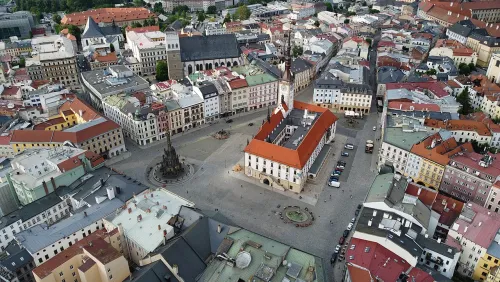
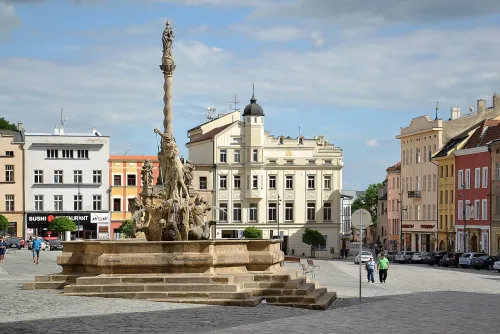
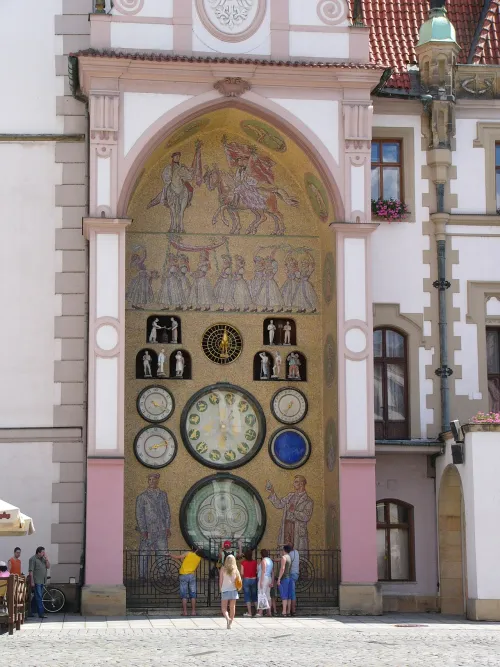
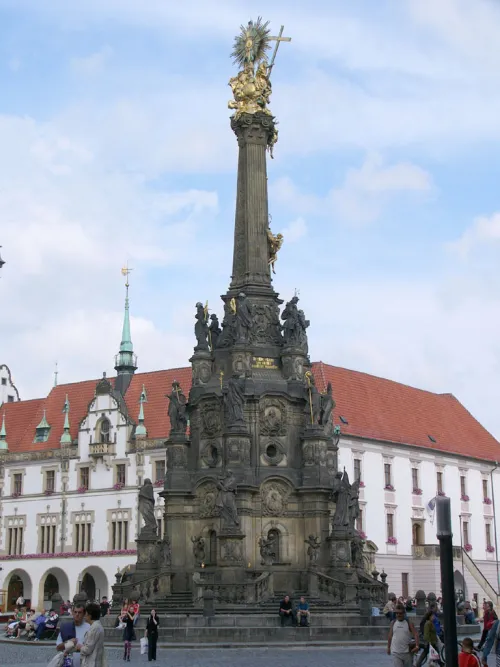
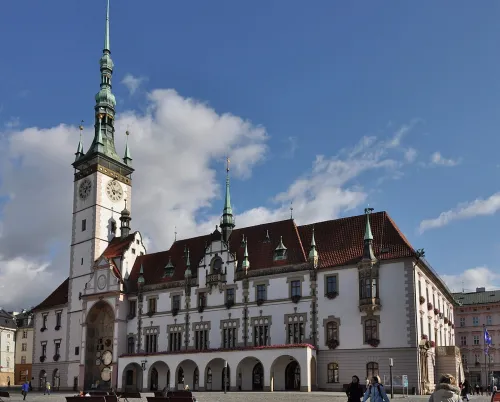
You start on the Upper Square, the place Olomouc treats as the centre of the whole city. It covers almost two hectares, and its eye-catcher is the Renaissance town hall with the astronomical clock; the Holy Trinity Column rises here too. You'll come back to all three at the end, so for now take in the frame around them: the city theatre in Empire style, built into the western front of the square in the first half of the 19th century, and the Baroque fountains of Caesar and Hercules.
None of this was a given. The square was created in the early 13th century by draining a marsh. In 1261 King Přemysl Otakar II allowed the town to build a market hall, and on that spot the town hall later rose. Through the Middle Ages wealthy burghers and nobles built their houses around it, and the square grew in importance with every one of them.
The 19th and 20th centuries kept changing its face. A row of lime trees once lined the northern side, and from 1899 a tram line ran across the square from the main station. When the tracks were moved off the square in 1954, the trees went too and were never replanted. The names changed even faster: Masaryk Square in the First Republic and right after the Second World War, Stalin Square between 1955 and 1960, then Peace Square until 1990.
The last renovation, between 1998 and 2001, brought new paving, benches and lighting, plus the new Arion fountain. Part of the public met it with doubts, while experts mostly welcomed it. Today the square hosts Christmas markets and the European Heritage Days. From its southeastern corner it opens into the Lower Square, only 270 m and 4 minutes away.