Free Walking Tour Brno: Petrov, Špilberk, Tugendhat

Ten stops from the cathedral on Petrov to Mendel's abbey, Špilberk's citadel, Mies van der Rohe's villa and a market trading since 1190.

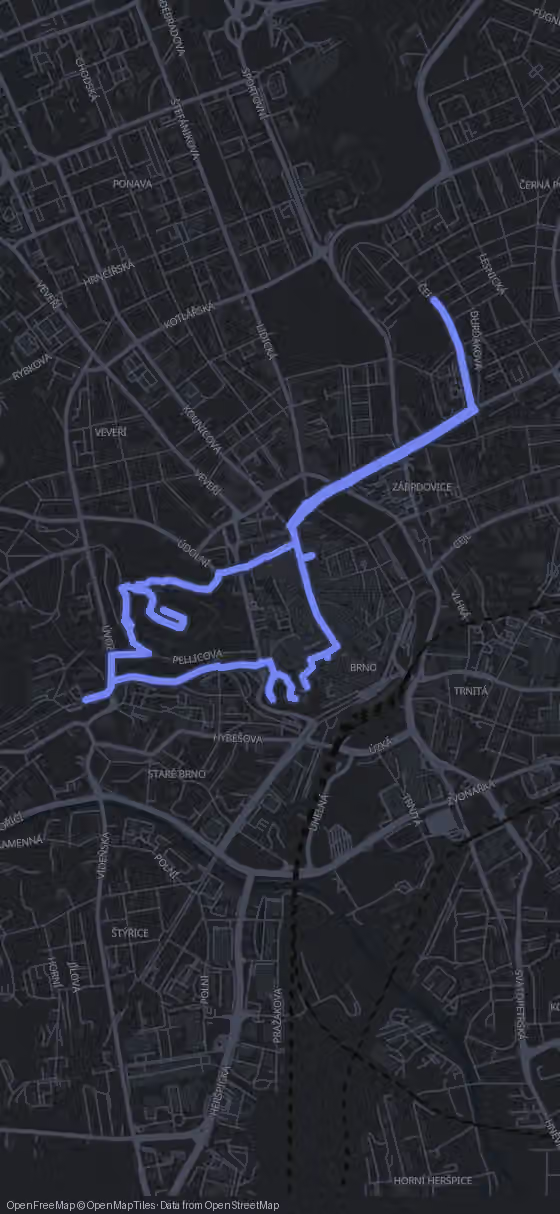
10 Stops 8.4 km ~2 h 1 min walking
Route map for the Brno walking tour
Stop 1 of 10
300 m·4 min
Cathedral of SS Peter and Paul
Head west and downhill toward Denis Gardens
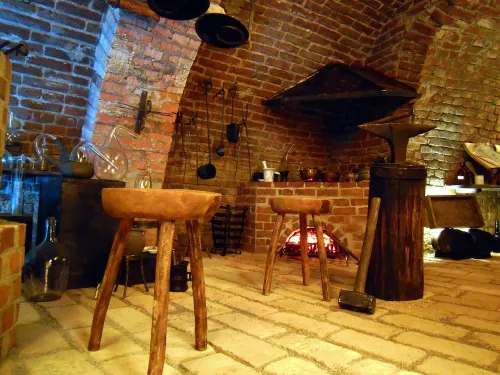
Ahoj, welcome to Brno. I'm Alex, and a monk's quiet garden here changed how the world understands inheritance.
Try this tour with Alex

What This Walk Through Brno Covers

Ten stops lead you from the Cathedral of SS Peter and Paul on Petrov hill to the Moravian Museum. The route is 8.4 km with 2 h 1 min of pure walking; with two or three interiors it fills most of a day.

The cathedral nave, Denis Gardens, the grounds of Špilberk Castle, the Church of St. James, Freedom Square and Zelný trh cost nothing. The Mendel Museum, Villa Tugendhat and the Labyrinth under the Vegetable Market charge entry, as does the museum. Route, map and GPS navigation are free in your browser; the AI Tour Guide is optional.

Open free GPS & optional AI Tour Guide
This short shows highlights of the route. All 10 stops follow below.

The Route

Walking Map of Brno, Petrov Hill to the Vegetable Market

10 stops 8.4 km 2 h 1 min walking
Tap to load interactive map

The 10 stops along this route

  1. Cathedral of SS Peter and Paul in Brno, stop 1 on the self-guided walking tour
    1Cathedral of SS Peter and Paul
  2. Denis Gardens in Brno, stop 2 on the self-guided walking tour
    2Denis Gardens
  3. Mendel Museum in Brno, stop 3 on the self-guided walking tour
    3Mendel Museum
  4. Špilberk Castle in Brno, stop 4 on the self-guided walking tour
    4Špilberk Castle
  5. Villa Tugendhat in Brno, stop 5 on the self-guided walking tour
    5Villa Tugendhat
  6. Church of St. James in Brno, stop 6 on the self-guided walking tour
    6Church of St. James
  7. Freedom Square in Brno, stop 7 on the self-guided walking tour
    7Freedom Square
  8. Labyrinth under the Vegetable Market in Brno, stop 8 on the self-guided walking tour
    8Labyrinth under the Vegetable Market
  9. Zelný trh in Brno, stop 9 on the self-guided walking tour
    9Zelný trh
  10. Moravian Museum in Brno, stop 10 on the self-guided walking tour
    10Moravian Museum
  11. That's the full route.

    Walk it with an AI Tour Guide talking you through every one of these streets.

    Start free in your browser
    You made it

Your Brno Walking Tour, From Cathedral to Museum

  1. 1

    Cathedral of SS Peter and Paul

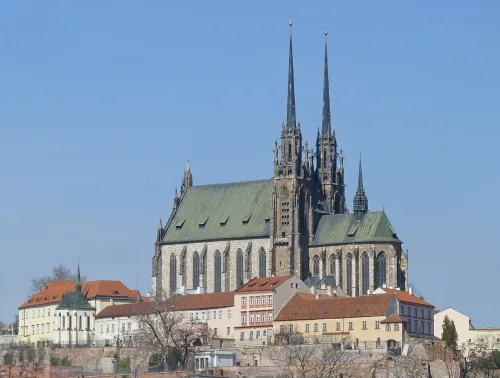
    Cathedral of SS Peter and Paul in Brno, stop 1 on the self-guided walking tour

    Start on Petrov hill, under two tall spires that rise 84 metres over the old town. Look closely and you see several centuries at once: the outer shell is Gothic and mostly 14th century, the interior largely Baroque, and the towers are far younger than they look. The architect August Kirstein designed them in Gothic Revival style, and they went up between 1901 and 1909.

    The hill has carried a church for much longer. Around 1140, under Margrave Conrad II, a Romanesque chapel stood here, with a crypt built probably for an important local dignitary or as a court chapel. That crypt still exists: it lies under the paving at the entrance, so you walk over it as you go in. A larger church dedicated to St. Peter followed in the 1230s, only to be damaged in the great fire that swept Brno in 1306. Both Peter and Paul appear as patrons from 1378.

    After the Hussite Wars the church was rebuilt in the second quarter of the 15th century, gaining a presbytery, the chapel of the Virgin Mary and the cross-shaped plan of a classic Gothic church. From 1296 it was the seat of the Royal Capital Chapter; today it is the seat of the Diocese of Brno and a national cultural monument.

    The nave is free, so a short look inside costs you only time. The tower and treasury need a ticket, which makes sense if you want to go up one of Kirstein's towers.

    From the cathedral it is just 300 m and 4 minutes to Denis Gardens, laid out on the slope of the same hill.
    Local name
    Katedrála svatého Petra a Pavla
    Hours
    Cathedral: Mon–Thu & Sat 08:15–18:15, Fri 10:30–18:30, Sun 07:00–18:15; towers: May–Sep Mon–Sat 10:00–18:15, Sun 12:00–18:15 (Oct–Apr 11:00/12:00–16:45)
    Price
    Nave free; tower & treasury: 60 CZK full, 40 CZK reduced
  2. 2

    Denis Gardens

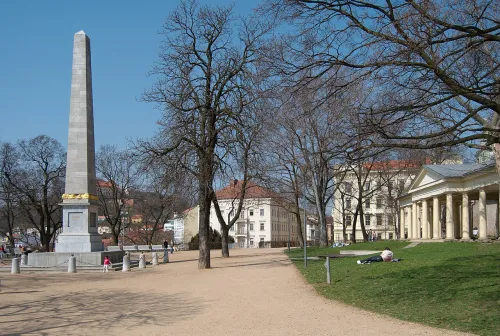
    Denis Gardens in Brno, stop 2 on the self-guided walking tour

    The terraces on the slope of Petrov, between a surviving stretch of the old city walls and Husova street, are more than a pleasant green pause. This was the first public park in Moravia and in the Czech lands founded by a public administration. Serpentine paths wind through it and link it with the streets Nádražní and Bašty, and the Governor's Garden is part of it.

    Work began after 1805 on a rocky knoll called Puhlík, at the urging of the Moravian governor Count Prokop Lažanský; the Scottish nobleman and landscape architect Lord James Ogilvy Findlater is said to have helped with the design. The decisive changes came between 1814 and 1818 under governor Count Antonín Bedřich Mitrovský, who had the old eighth bastion reshaped.

    Look for the obelisk on four gilded lions. It was unveiled on 4 October 1818 to celebrate the Austrian victory over Napoleon, and its inscription praises Emperor Francis I as liberator; the designer was Alois Pichl. The park was founded on that same day, the emperor's name day, and named Františkov after him. Close by stands a late Classicist colonnade from around 1850 with a fountain.

    In 1919 the park was renamed in honour of the French historian Ernest Denis, who had helped bring about Czechoslovakia. It has been a protected monument since 1964. Entry is free at any hour.

    From here the walk to the Mendel Museum is 1110 m and 15 minutes; on the way you pass Super Panda Circus.

    Local name
    Denisovy sady
    Hours
    Freely accessible, no opening hours
    Price
    Free
  3. 3

    Mendel Museum

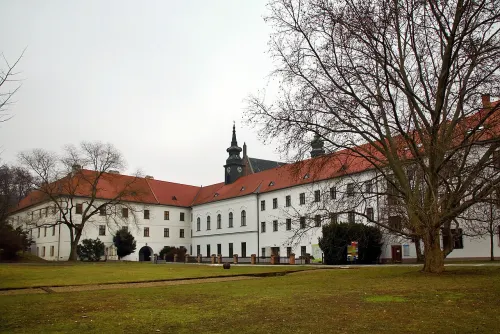
    Mendel Museum in Brno, stop 3 on the self-guided walking tour

    You are now in Old Brno, at the Augustinian Abbey where Gregor Johann Mendel worked as abbot. The museum tells the story of genetics and of Mendel's life and work in the very rooms where it happened. It opened in 2002 and has been part of Masaryk University since 2007; between 1965 and 2001 the same rooms housed the Mendelianum of the Moravian Museum, which moved to the Bishop's Court in 2012. There is also a lecture hall and a café in the building.

    Mendel's fame came late. Only when his work was rediscovered around 1900 did Brno become a magnet for naturalists. His family and the researchers William Bateson and Hugo Iltis gathered what he had left behind; a committee founded on Iltis's initiative in 1906 unveiled a Mendel monument in 1910, and the square was renamed from Klášterní to Gregor Mendel Square that same year.

    For his 100th birthday in 1922 a memorial plaque was placed where his experimental garden had been, and the abbots set up a first memorial museum in the abbey. Iltis, who owned part of the estate himself, sold it in 1932 to a German society for science and art and ran the collection, until his opposition to the Nazis cost him the post. In 1938 he emigrated, taking with him the part of the collection he still considered his own.

    The museum charges admission. If you have any interest in science or in how one patient monk changed biology, go in; if not, the abbey from outside is enough.

    The walk up to Špilberk Castle is 1420 m and takes 24 minutes.

    Local name
    Mendelovo muzeum Masarykovy univerzity
    Hours
    Apr–Sep Tue–Sun 09:00–18:00; Oct–Mar Tue–Sun 10:00–17:00; Mon closed
    Price
    130 CZK full, 100 CZK reduced
  4. 4

    Špilberk Castle

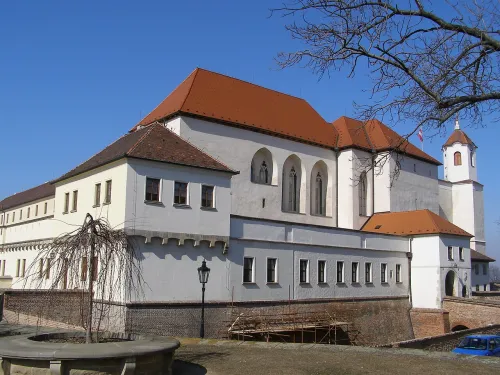
    Špilberk Castle in Brno, stop 4 on the self-guided walking tour

    Špilberk sits on its own hilltop above the city. Construction began in the first half of the 13th century under the Přemyslid kings and was completed by King Ottokar II of Bohemia. It started as a major royal castle, became the seat of the Moravian margraves in the mid-14th century, and was slowly turned into a huge Baroque citadel.

    The town of Brno bought the castle in 1560 and made it a municipal fortress. Its bastions helped the city hold off Swedish raids during the Thirty Years' War, and that success led to even heavier fortification. At the same time Špilberk served as a prison, later considered the harshest in the Austrian Empire, and finally as barracks.

    The list of prisoners reads like a history lesson. After the Battle of White Mountain in 1620, the leading Moravian rebels against the Habsburgs were held here for years; later came Protestants, revolutionaries of 1848 and 1849, and ordinary thieves. Franz Freiherr von der Trenck, one of the most controversial figures of his time, died here on 4 October 1749. Jean-Baptiste Drouet, the postmaster who had arrested King Louis XVI, was held here, as were fifteen Hungarian Jacobins led by the writer Ferenc Kazinczy. Stendhal's hero Fabrice del Dongo keeps referring to this prison in The Charterhouse of Parma.

    The castle grounds are free. The casemates have their own ticket and are the place to go if the prison stories grip you; the museum, exhibitions and tower are covered by a separate one.

    Now comes the longest leg: 2970 m and 42 minutes to Villa Tugendhat, whose great window looks back at this very castle.

    Hours
    Castle grounds daily 06:00–22:00; museum/exhibitions/tower daily 10:00–18:00; casemates daily 09:00–21:00 (ticket office daily 09:00–18:00)
    Price
    Castle grounds free; casemates: 190 CZK full, 115 CZK reduced; museum: 170 CZK full, 100 CZK reduced
  5. 5

    Villa Tugendhat

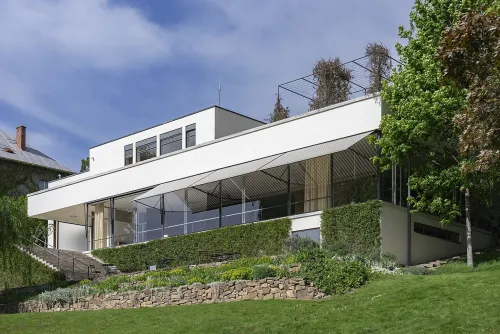
    Villa Tugendhat in Brno, stop 5 on the self-guided walking tour

    From the street this villa looks modest, which is part of the point. Ludwig Mies van der Rohe and Lilly Reich designed it, and it was built between 1928 and 1930 for Fritz and Greta Tugendhat of the wealthy Jewish Czech Tugendhat family. Made of reinforced concrete, it quickly became an icon of modernism and one of Europe's pioneering prototypes of modern architecture; since 2001 it has been on the UNESCO World Heritage List.

    The villa stands free on a slope facing south-west. You enter from the street on the top floor, with the entrance hall and the rooms for the parents, children and nanny; the floor beneath holds the main living area, the conservatory, the terrace, the kitchen and the servants' rooms. The chauffeur's flat and garages have their own entrance.

    Mies used an iron frame that let him do without load-bearing walls, so the living area is one open space full of light. Its glass wall is divided into large windows framing a panoramic view of Špilberk Castle, and two of them can be lowered completely into the floor, like a car window. Mies and Reich specified every piece of furniture; the Tugendhat chair and the Brno chair are still made today. There were no paintings or ornaments, yet the room is anything but bare, thanks to an onyx wall and rare tropical woods.

    You can see the villa on a basic or an extended circuit, both paid. If you care about architecture or design, this is the interior on the route to pay for.

    Back into the old town it is 1780 m and 25 minutes to the Church of St. James.

    Local name
    Vila Tugendhat
    Hours
    Mon: Closed | Tue–Sun: 10:00–18:00
    Price
    450 CZK full, 270 CZK reduced (Základní okruh); 500 CZK full (Rozšířený okruh)
  6. 6

    Church of St. James

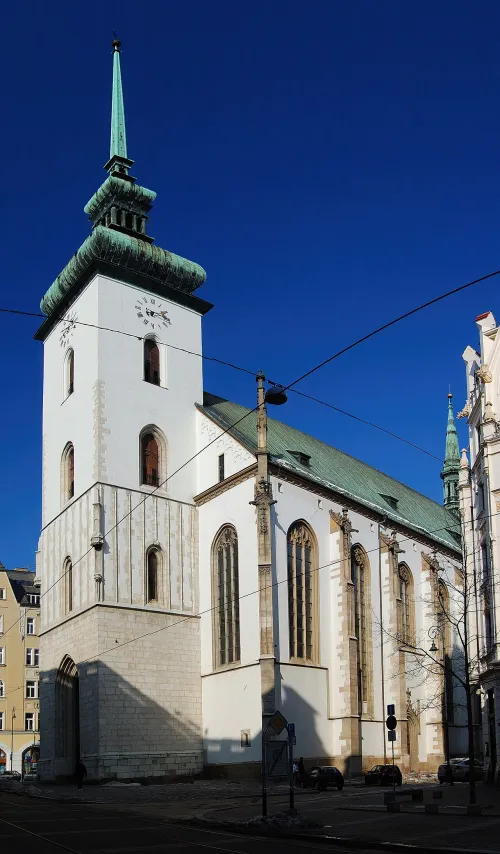
    Church of St. James in Brno, stop 6 on the self-guided walking tour

    St. James is a late Gothic hall church with three naves and a big tower at its western end, which also holds the main entrance. It counts among the largest well-preserved Gothic churches in the Czech Republic and has been a national monument since 1995.

    Its story begins early in the 13th century, when a church was founded here for the German inhabitants of this part of town. On the vault of the presbytery you can spot the painted coat of arms of the abbess of the Cistercian convent at Oslavany with the date 1220, recalling the consecration of a smaller Romanesque church that once stood here for Flemish and German settlers. Nothing of that church survives.

    The building you see grew from 1446, when work on the choir began; the presbytery with its inner polygon is the oldest part. In the late 1450s the builder was probably a master called Hans of Brno. Between 1368 and 1405 a ring of chapels rose around the church and its cemetery, paid for partly by gifts and bequests from Brno's citizens, while the Oslavany convent carried most of the building costs. Beneath the church lies an ossuary that is also open to the public.

    Entry to the nave is free, and so are the roof truss and tower, so there is every reason to go in. From here Freedom Square is only 170 m and 2 minutes away.

    Local name
    Kostel svatého Jakuba Staršího
    Hours
    Nave: daily 09:30–22:00; roof truss & tower: daily 10:00–20:00
    Price
    Free
  7. 7

    Freedom Square

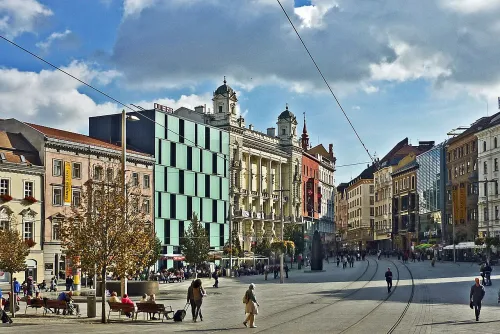
    Freedom Square in Brno, stop 7 on the self-guided walking tour

    Náměstí Svobody is the centre of the city. It formed in the 13th century where three trade routes crossed, which explains its rough triangle; seven streets still open onto it. Masarykova leads to the main station, and Rašínova runs north towards the churches of St. James and St. Thomas.

    In the Middle Ages it was the Forum Inferius, the Lower Market, and rich burghers and nobles built their houses around it. In 1679 a plague column was raised and soon dominated the square. The church of St. Nicholas was torn down in 1869, and its last remains disappeared after an air raid in 1945. Around 1900 the square was largely rebuilt, with many houses replaced in neo-Renaissance style.

    The latest makeover came in 2006: new paving, a restored plague column, fresh trees and a bronze fountain with verses by the poet Jan Skácel. Look at the paving for the marked outline of the vanished St. Nicholas church. The square is free and open at all times.

    Walk on 410 m and 6 minutes to the Labyrinth under the Vegetable Market.

    Local name
    Náměstí Svobody
    Hours
    Freely accessible, no opening hours
    Price
    Free
  8. 8

    Labyrinth under the Vegetable Market

    Labyrinth under the Vegetable Market in Brno, stop 8 on the self-guided walking tour

    Under the old market lies a network of corridors, passages, tunnels, crypts and cellars on several levels, dug bit by bit from the Middle Ages into the 20th century. The rooms sit between 6 and 8 metres below ground. They were explored in 2011, together with the Mintmaster's Cellar on Dominikánské náměstí.

    Today the cellars hold exhibitions on the history of Brno and its people: trade, wine growing, alchemy, storage and lighting. They are also used for presentations, receptions and concerts, so the space feels lived in rather than abandoned.

    Entry is paid, and the labyrinth suits you if you like seeing a city from underneath and want everyday history rather than palaces.

    When you come out, the market itself is just 60 m and a minute away.

    Local name
    Podzemí pod Zelným trhem
    Hours
    Tue–Sun 09:00–18:00 (last admission 17:30), Mon closed
    Price
    200 CZK full, 100 CZK reduced
  9. 9

    Zelný trh

    Zelný trh in Brno, stop 9 on the self-guided walking tour

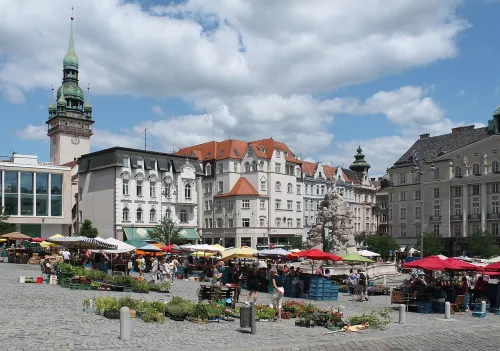
    Zelný trh, the Vegetable or Cabbage Market, has been in use since 1190, earlier than the city itself was founded. It began as a general market and later specialised in fruit and vegetables. From 1255 it was called forum superius, the upper market, and by 1340 Krautmarkt, Zelný trh. It has run in one place for 850 years and was never interrupted, not even under communism, when all other private trade was banned. That makes it the largest market in Brno and the oldest continuously operating vegetable and plant market in Central Europe.

    Stalls sell vegetables, fruit, smoked meat and rabbit, flowers, seeds and seedlings, bread, Moravian kolach, spices, nuts, eggs, cheese and traditional herbs, and there are small restaurants and street food stands too.

    In the middle stands the Parnassus Fountain, built between 1690 and 1695 to a design by Johann Bernhard Fischer von Erlach and made by Tobias Kracker and Anton Riga. On its six-pointed star base rises a rocky cliff topped by a statue of Europa; in the cave sits Heracles, flanked by figures for Babylonia, Persia and Greece. On the square you also find the Reduta Theatre of 1608, the oldest theatre building in Central Europe.

    The palace that houses the Moravian Museum is on this square, 190 m and 3 minutes away.

    Hours
    Freely accessible, no opening hours
    Price
    Free
  10. 10

    Moravian Museum

    Moravian Museum in Brno, stop 10 on the self-guided walking tour

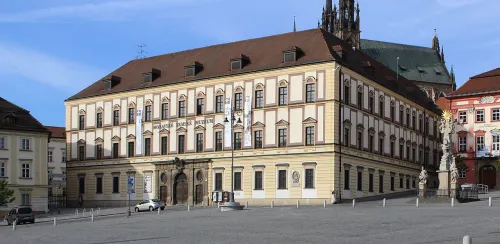
    The walk ends at Dietrichstein Palace, built between 1613 and 1616 for Cardinal Franz von Dietrichstein and reworked in late Baroque style around 1700 into one of Brno's largest Baroque buildings. Inside is the Moravian Museum, the second-largest and second-oldest museum in the country, with several million objects across science and culture. Emperor Francis II founded it by decree in July 1817.

    The museum's best story is about courage. When the Nazis invaded Czechoslovakia, the Jewish Petschek family fled to the United States and tried to post their treasure, Beethoven's original score for the fourth movement of String Quartet No. 13. The Gestapo intercepted it and asked an expert from this museum to check it. He recognised Beethoven's hand at once and told the Nazis it was a fake, so the museum could keep it safe. It stayed here for more than 80 years until the museum decided in August 2022 to return it to the Petschek heirs.

    You can buy a ticket for the permanent exhibitions or for the entire building. Worth it if you still have energy for a big collection; if the day has been long, the palace courtyard and the story are a fitting end.

    Local name
    Moravské zemské muzeum
    Hours
    Wed–Fri 09:00–17:00, Sat 10:00–17:00, Sun 13:00–17:00, Mon & Tue closed (ticket office closes 30 min before closing)
    Price
    170 CZK full, 110 CZK reduced (permanent exhibitions); 220 CZK full, 130 CZK reduced (entire building)
    Website
    mzm.cz ↗
Walking tour route map of Brno Route loaded
Cathedral of SS Peter and PaulDenis GardensMendel MuseumŠpilberk Castle+6
All 10 stops are already on the map.
You just press start.
AI Tour Guide

You know the route now. Walk it with a guide who talks with you.

Press start wherever you are, even hundreds of kilometres from Brno, and the guide begins telling its stories right away. In the city, pick any of the 10 stops to start from: it leads you there, then talks with you the whole route, asking, listening, remembering, and shaping the tour around your answers.

10stops 8.4km 2 h 1 minwalking 13languages
▶Start the tour free

Free to start · Runs in your browser · No app, no download

Shorter Ways to Walk Brno

The full route asks for a whole day. If you have less time or one clear interest, these cuts follow the same order and keep the walking short.

Petrov, Mendel and the castle

Stops: 1, 2, 3, 4

For a morning with history and science: cathedral, park, Mendel's abbey and Špilberk. That is 2830 m and 43 minutes of walking. You pay only for the Mendel Museum and, if you want them, the cathedral tower and the castle's casemates or museum.

The old town in an hour or two

Stops: 6, 7, 8, 9, 10

For a short visit or an afternoon: St. James, Freedom Square, the labyrinth, the market and the Moravian Museum lie close together, 830 m and 12 minutes of walking in all. Entry applies to the labyrinth and the museum; the church and the squares are free.

Modernism, then the centre

Stops: 5, 6, 7, 8, 9, 10

For architecture lovers: begin at Villa Tugendhat and walk back into town, 2610 m and 37 minutes of walking. Paid interiors are the villa, the labyrinth and the Moravian Museum, so plan the villa visit first and leave enough of the afternoon for the rest.

How Long This Brno Tour Takes, With and Without Interiors

The order starts high on Petrov, comes down through Denis Gardens to Old Brno and the abbey, then rises to Špilberk. The longest leg follows: 2970 m and 42 minutes out to Villa Tugendhat, before the route turns back into the compact old town, where the last five stops sit within a few minutes of each other.

The pure walking time is 2 h 1 min. Add about an hour each for two or three interiors, plus short looks at the free places, and you are at six or seven hours. Going into every paid interior in one day is too much for most people; choose the two or three that match your interest and come back for the rest.

Before You Set Off in Brno

  • Start and finish: The recommended start is the Cathedral of SS Peter and Paul, the walk ends at the Moravian Museum. You can join at any stop, and the GPS navigation in your browser can lead you from the last stop back to the start.
  • Best days: Pick your day with care: the Mendel Museum, Villa Tugendhat, the labyrinth and the Moravian Museum are not open every day.
  • Time of day: Start in the morning if you want a paid interior on the hill and another in the old town; the centre's museums close earlier than the squares and the church.
  • Entry costs: If you went into everything at full price (cathedral tower and treasury, Mendel Museum, Špilberk's casemates and museum, the villa's basic circuit, the labyrinth and the Moravian Museum's permanent exhibitions), the tickets would add up quickly. Most visitors pick a few and spend far less.
Walking tour route map of Brno
AI Tour Guide

Your guide is ready at whichever stop you start

Press start and a voice AI Tour Guide takes it from here: leading the route through Brno, telling the stories, and turning your walk into a real back-and-forth conversation. No app or download is needed; it runs in your browser.

10stops 8.4km 2 h 1 minwalking 13languages
▶Start the tour free

Free to start · Runs in your browser · No app, no download

What the AI Tour Guide Adds Between Petrov and Tugendhat

On a route that jumps from a Romanesque crypt to a 1930 villa, the AI Tour Guide leads you as a conversation: it greets you, tells the stories of each place, asks what you care about and remembers it, so a Mendel fan hears more science and an architecture fan more about Mies. You can interrupt any time, for example to ask how Mendel actually ran his experiments in the abbey garden or what happened to the Tugendhat family after they left Brno. You start with 100 free credits; after that you choose this tour all-inclusive for €19.99 with no time limit, or credits at €5 per hour.

A Real Conversation A voice AI Tour Guide greets you, leads the whole route, and tells the stories and facts as you walk, asking what you want to see and keeping a real conversation going. Not a recording you press play on.
Map Navigation Follow the route on the map and walk at your own pace. You choose where to start and when to move to the next stop.
Ask Anything Curious about a building you pass? Ask your AI Tour Guide on the spot and the conversation carries on.
13 Languages Switch language anytime. No separate tour needed.
Start free in your browser

Common Questions About Walking Brno

Which stops can I still visit in the evening?

The Špilberk Castle grounds and the Church of St. James stay open into the evening; if you want the casemates, buy your ticket earlier in the day. Freedom Square, Zelný trh and Denis Gardens are always accessible.

What do locals call these places?

The cathedral is simply "Petrov", Freedom Square is "Svoboďák" and Špilberk is "Špilas". Many people still call Denis Gardens by its old name Františkov, or the Terraces under Petrov.

Is there a good day trip from Brno?

Mikulov is 43 km away and Olomouc 65 km. If you are travelling on, Vienna is 111 km and Bratislava 123 km from Brno, and Prague 187 km.

How do Zelný trh and Freedom Square differ?

Both are medieval markets. Freedom Square was the Lower Market, Forum Inferius, and is today the city's main square; Zelný trh was the upper one, forum superius, and still sells fruit, vegetables and flowers.

Is the tour really free?

Yes. The whole tour is free: the route, the interactive map and the navigation cost you nothing. Only the voice AI Tour Guide is optional and paid: you test it with 100 free credits, then you pay either €5 per hour or €19.99 for this whole tour, with no time limit. Admission to 4 of the 10 stops is not included: Mendel Museum, Villa Tugendhat, Labyrinth under the Vegetable Market and Moravian Museum charge their own entry fees.

Do I need to download an app?

No. Everything runs in your phone browser. Open the route and start walking, no download and no sign-up required.

Do I need to book the walking tour in advance?

No booking needed. This self-guided tour is available anytime. Open the route in your browser and start walking. The AI Tour Guide works instantly, no app, no reservation required.

What languages is the AI Tour Guide available in?

The AI Tour Guide speaks 13 languages, so you take the tour in your own language and can switch at any time.

Can I skip stops or change the route?

Yes. Skip any stop, spend extra time at places you like, or start the route from any point. It is your walk, you set the pace.
Image credits
▶ Start free in your browser Runs in your browser, no app, no download