Free Walking Tour Lecce: Baroque Churches, Roman Ruins

From the cathedral courtyard of Piazza del Duomo to Charles V's triumphal gate: 1.9 km through Baroque Lecce and its Roman theatre and amphitheatre.

7 Stops 1.9 km ~26 min walking
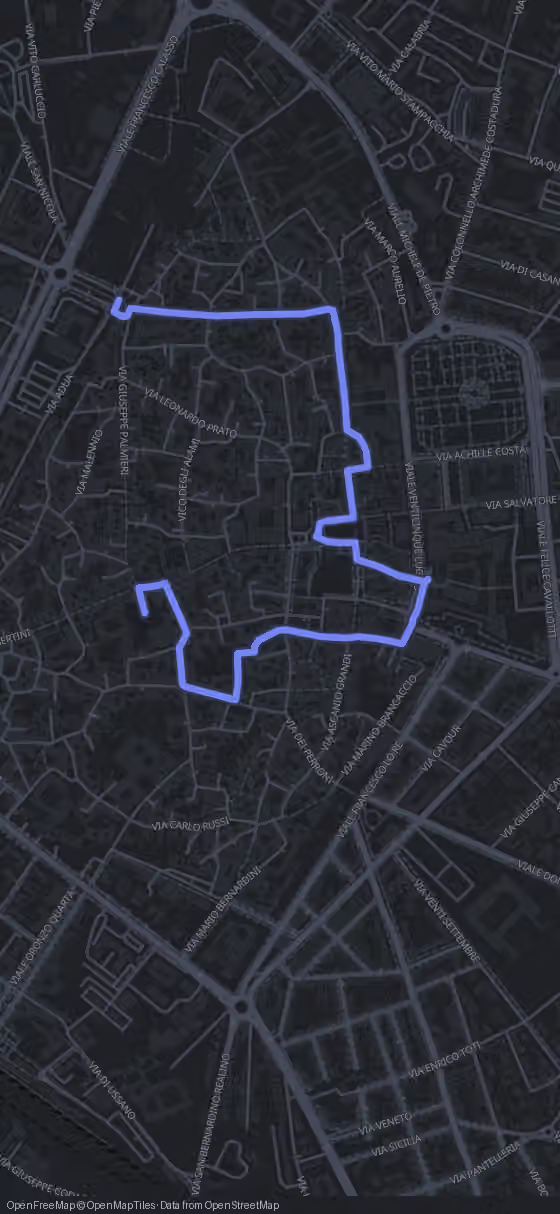
Route map for the Lecce walking tour
Stop 1 of 7
420 m·5 min
Piazza del Duomo
Head south-east toward the Roman Theatre
Buongiorno, welcome to Lecce. I’m Alex, and this golden city owes its wildest details to a stone soft enough to carve like butter.
Try this tour with Alex

This Lecce Route at a Glance

Seven stops lead you 1.9 km from Piazza del Duomo to Porta Napoli, through the Baroque core and past two Roman stages. Pure walking time is 26 min; with the interiors that matter, plan around three hours.

Piazza Sant'Oronzo, the Roman Amphitheatre and the gate are free. Castello Carlo V is visited by paid guided tour, Basilica di Santa Croce sits on a combined ticket and the Roman Theatre charges admission. The GPS route is free; the AI Tour Guide is optional.

Open free GPS & optional AI Tour Guide
View of Lecce

The Route

Walking Map of Lecce's Seven Stops

7 stops 1.9 km 26 min walking
Tap to load interactive map

The 7 stops along this route

  1. Piazza del Duomo in Lecce, stop 1 on the self-guided walking tour
    1Piazza del Duomo
  2. Roman Theatre in Lecce, stop 2 on the self-guided walking tour
    2Roman Theatre
  3. Castello Carlo V in Lecce, stop 3 on the self-guided walking tour
    3Castello Carlo V
  4. Piazza Sant'Oronzo in Lecce, stop 4 on the self-guided walking tour
    4Piazza Sant'Oronzo
  5. Roman Amphitheatre in Lecce, stop 5 on the self-guided walking tour
    5Roman Amphitheatre
  6. Basilica di Santa Croce in Lecce, stop 6 on the self-guided walking tour
    6Basilica di Santa Croce
  7. Porta Napoli in Lecce, stop 7 on the self-guided walking tour
    7Porta Napoli
  8. That's the full route.

    Walk it with an AI Tour Guide talking you through every one of these streets.

    Start free in your browser
    You made it

Lecce Walking Tour Stop by Stop, from the Duomo to Porta Napoli

  1. 1

    Piazza del Duomo

    Piazza del Duomo in Lecce, stop 1 on the self-guided walking tour

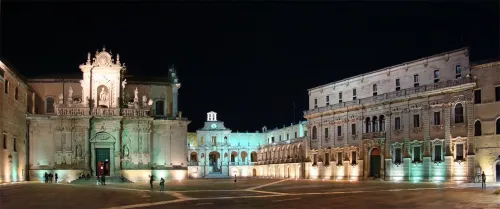
    Walk in and the square closes around you like a stage set. That is no accident: Piazza del Duomo was once the Corte del Vescovado, the inner courtyard of a 13th-century bishop's citadel with a wall of its own, its north end shut by a bronze gate. All around you stand the pieces of that complex: the cathedral of Santa Maria Assunta with its bell tower, the bishop's palace and the seminary. To this day the square belongs to the Diocese of Lecce, not to the city.

    The look you see dates from 1659, when Bishop Luigi Pappacoda asked the Lecce architect Giuseppe Zimbalo, nicknamed 'lo Zingarello', to rebuild the cathedral in Lecce Baroque. Zimbalo kept the Romanesque floor plan, and Pappacoda consecrated the new church himself in 1670. The surrounding buildings were reworked in the same style, and the cathedral received a 'false' facade, a showpiece front turned toward the square for effect.

    A century later Bishop Alfonso Sozy Carafa brought in the architect Emanuele Manieri. He knocked down the old entrance walls and put up twin palaces with propylaea, gateway structures that carried the hinges of new gates and set up your arrival like a theatre entrance. Manieri also gave the seminary its heavy, sober front, a deliberate calm next to the cathedral. The gates stayed until the late 19th century; only when they were removed did the old courtyard take the name Piazza del Duomo.

    The cathedral and bell tower are on the same combined ticket as Basilica di Santa Croce, so if you plan to see the basilica inside, it makes sense to look in here as well. From the square it is 420 m, about 6 min, to the Roman Theatre.
    Hours
    Freely accessible, no opening hours (open square)
    Price
    Free
  2. 2

    Roman Theatre

    Roman Theatre in Lecce, stop 2 on the self-guided walking tour

    Nobody went looking for this theatre. It turned up by chance in 1929, during work in the gardens of two historic palaces, Palazzo D'Arpe and Palazzo Romano. Its exact date is uncertain, but it is assigned to the age of Augustus and is closely tied to the amphitheatre you will meet in Piazza Sant'Oronzo.

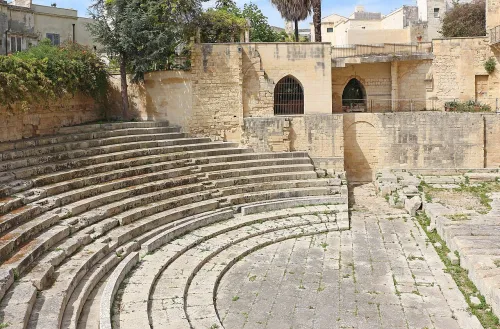
    Look at the curved seating, the cavea: it was carved into a bank of rock and then faced with squared blocks, with an outer diameter of 40 m and an inner one of 19 m. Narrow aisles split it into six wedges of twelve tiers each, many of them restored. The orchestra, where the chorus moved, is paved with white limestone slabs; in front of it three broad curved tiers took movable seats for local notables, behind a low wall called the balteus. The stage is 30 m wide. More than 5,000 people are thought to have watched tragedies and comedies here.

    Fragments of the clay decoration of the balteus go back to Augustus, while the marble statues that once adorned the theatre are attributed to the age of the Antonine emperors. All the finds are kept in the adjoining museum of the same name, and performances still bring the theatre to life today.

    Admission is charged, and you find out the price at the entrance. If you love Roman architecture, going in to see the statues and the details up close is worth it; if your time is short, the view from outside shows you the shape of the place. Next comes Castello Carlo V, 410 m and about 6 min away.

    Local name
    Teatro romano di Lecce
  3. 3

    Castello Carlo V

    Castello Carlo V in Lecce, stop 3 on the self-guided walking tour

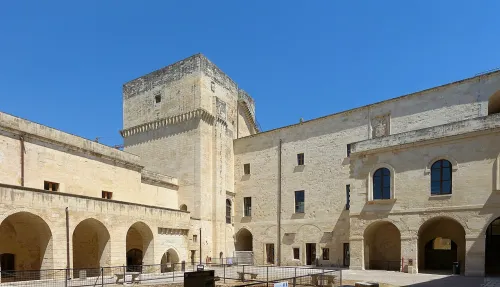
    In 1539 Emperor Charles V ordered Lecce's medieval stronghold torn down and replaced with a modern fortress built on the latest principles of military architecture. The job went to Gian Giacomo dell'Acaja, chief engineer of the Kingdom of Naples, and the outer fortress was finished in 1549. Keep his name in mind; it comes back at the end of the walk.

    Making room for such massive walls had a price. A Celestine monastery and its church of the Holy Cross were demolished and rebuilt on Via Umberto I, and you will see the Celestines' coats of arms again on the side portals of Basilica di Santa Croce. An elegant older palace, on the other hand, was absorbed into the core of the castle: traces of it survive in the keep, in a tower in the courtyard and in the Torre Mozza.

    The castle had several gates. In 1872 the moat around it was filled in and the drawbridges removed. Today you enter only through the Porta Reale; the Porta Falsa at the back was the stronger of the two, built to resist attacks from the nearby Adriatic coast.

    It was never only a fortress: in the 18th century one of its halls served as a theatre. From 1870 the army used it as barracks and a military district office, until 1979, and on 30 April 1983 the military handed it to the city, which now uses it for its culture department and cultural events. You can only go inside on a paid guided tour. That is worth it if fortifications and their many lives interest you; otherwise the walls tell the story from outside. Piazza Sant'Oronzo is just 180 m, 2 min, away.

    Local name
    Castello di Lecce
    Hours
    Mon: Closed | Tue–Sun: 10:00–20:00
    Price
    10 EUR adults (guided tour only)
  4. 4

    Piazza Sant'Oronzo

    Piazza Sant'Oronzo in Lecce, stop 4 on the self-guided walking tour

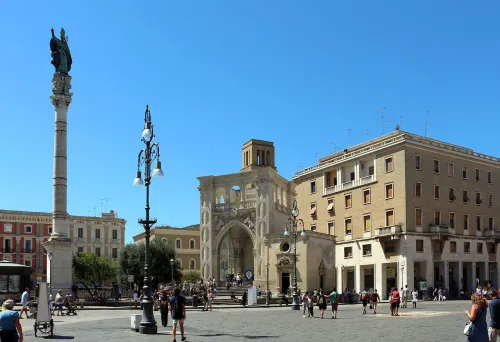
    This is the main square of Lecce's old town, named after Saint Oronzo, the city's first bishop. It sits midway along the town's old axis, which runs from Porta Rudiae along Via Libertini and Corso Vittorio Emanuele II, crosses the square and continues down Via Trinchese to Piazza Mazzini. People pass through all day, and historic shops sit next to modern stores.

    Look at the centre, where the main pieces stand close together but deliberately out of line. A Roman column carries the statue of Sant'Oronzo, the patron saint. Beside it stands the Sedile, also called Palazzo del Seggio: squat but lavish, mixing Gothic and Renaissance, built in 1592 to replace an older building of the same kind, and once used for military purposes too. Next to it is the plain little church of San Marco, which Venetian merchants asked for and which grew out of an older place of worship.

    Then look down. On the wide pavement a mosaic shows the city's coat of arms: the she-wolf under a holm oak tree.

    The square has always changed with the city's politics and fortunes, sometimes quickly and only for a while, which is why its buildings feel so mixed. Everything here is free and open. The Roman Amphitheatre is part of the same square, 90 m and a minute's walk away.

    Hours
    Freely accessible, no opening hours (open square)
    Price
    Free
  5. 5

    Roman Amphitheatre

    Roman Amphitheatre in Lecce, stop 5 on the self-guided walking tour

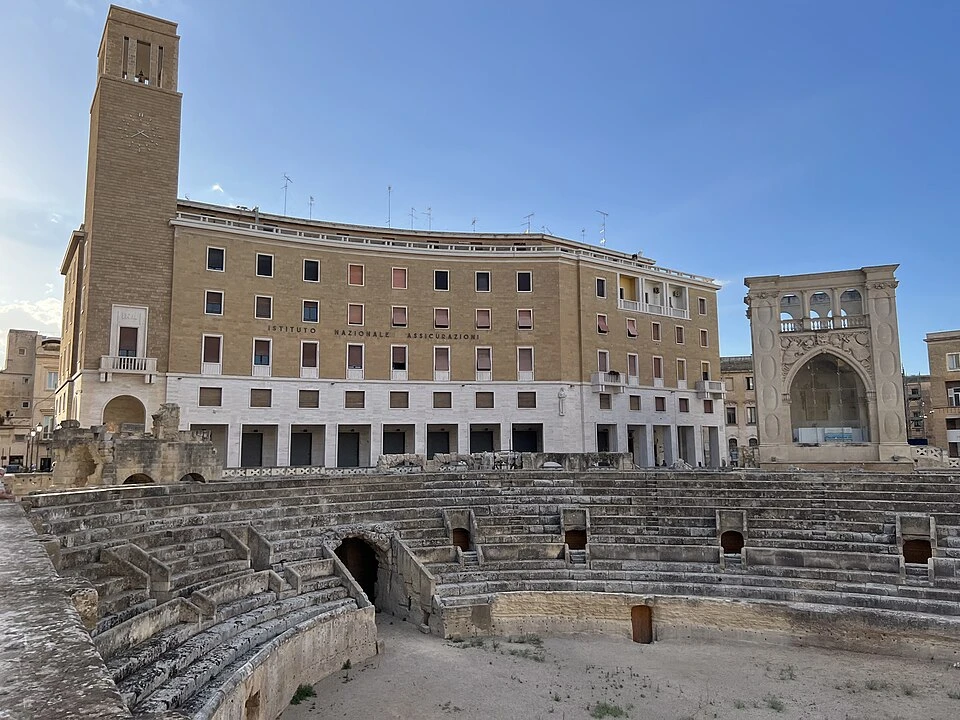
    What you see is only about a third of it. The rest of the Roman Amphitheatre still lies hidden under Piazza Sant'Oronzo, beneath several buildings and the church of Santa Maria della Grazia. Together with the theatre you saw earlier, it is the clearest sign of how important Lupiae, Roman Lecce, became in the first and second centuries AD.

    The story told about both buildings goes back to Augustus. Before he became emperor, in the turbulent time after the murder of Julius Caesar, he passed through Lupiae and was taken in. To repay that hospitality, he is said to have paid for two great venues: this amphitheatre and the theatre. Scholars still debate the date, though, which ranges from Augustus to the age of Trajan and Hadrian.

    It reappeared in the early 1900s, while the Banca d'Italia building was going up. Excavations started almost at once, driven by the Salento archaeologist Cosimo De Giorgi, and went on until 1940.

    Picture its full size: 102 by 83 m outside, an arena of 53 by 34 m and room for around 25,000 spectators, five times the theatre. It was partly cut into the rock and partly built on arches of squared stone. You can make out part of the elliptical arena with the lower rows of seats, and two ring corridors: one runs under the seating, the other, outer one is a portico with the sturdy piers that once carried the upper order, a gallery of arches like the Colosseum or the Arena di Verona.

    It is free and open at any hour, so you can come back after dark too. Basilica di Santa Croce is 190 m, 2 min, away.

    Local name
    Anfiteatro romano di Lecce
    Hours
    Open 24/7
    Price
    0
  6. 6

    Basilica di Santa Croce

    Basilica di Santa Croce in Lecce, stop 6 on the self-guided walking tour

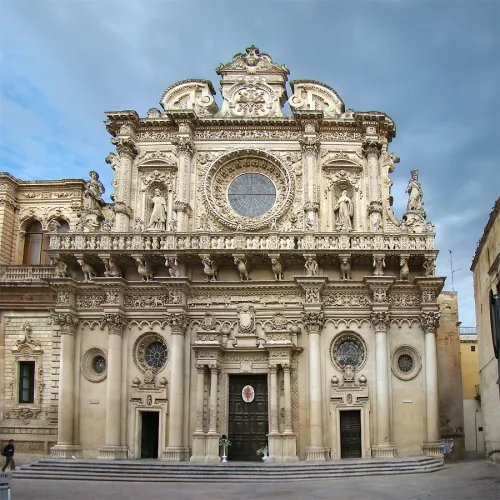
    Stop in front of the facade and give it time. Six smooth columns carry a band crowded with animals, grotesque figures and plants, and above it opens a great rose window. The main portal is framed by a pair of Corinthian columns and bears the arms of Philip III of Spain, Maria d'Enghien and Walter VI of Brienne; the side portals carry the arms of the Celestines, the monks you heard about at the castle.

    Much of the carving tells a story. The atlantes holding up the balcony stand for the Turkish prisoners taken by the Christian League at the naval battle of Lepanto in 1571. The animals under the balustrade represent the Christian powers that fought there: the dragon of the Boncompagni, family of Pope Gregory XIII, the griffin of the Republic of Genoa, and Hercules for the Grand Duke of Tuscany.

    Walter VI of Brienne founded a monastery here in the 14th century. Work on a new church began in 1549, partly using houses of Jews who had been expelled from Lecce in 1510, and it dragged on for two centuries. The lower facade was done in 1582 and the dome in 1590; from 1606 Francesco Antonio Zimbalo added the portals, Cesare Penna designed the upper facade and the rose window, and Giuseppe Zimbalo, the same architect as the cathedral, decorated the upper facade. In 1905 the church became a minor basilica.

    Inside, the plan is a Latin cross. It began with a nave and four aisles, two of which became side chapels in the 18th century, and there are seventeen altars; the main one has a decorated portal with the arms of the Adorni family, whose tombs were inside the basilica. Entry is with the combined church ticket. If the facade has caught you, the interior is worth it. From here the longest leg, 600 m and about 8 min, leads to Porta Napoli.

    Hours
    Daily 09:00–21:00 (April to September), 09:00–18:00 (October to March); last admission 15 minutes before closing
    Price
    21 EUR single ticket for the cathedral and bell tower, the Basilica of Santa Croce, the churches of Santa Chiara and San Matteo, the Old Seminary and the Museum of Sacred Art (MuDAS); ages 12–17 13 EUR; family (2 adults + children 12–17) 48 EUR
  7. 7

    Porta Napoli

    Porta Napoli in Lecce, stop 7 on the self-guided walking tour

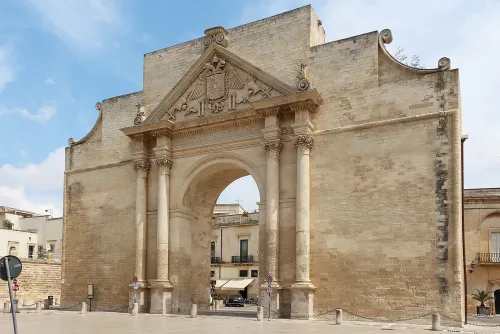
    The walk ends where Charles V began, at least in stone. Lecce's people and Ferrante Loffredo, governor of the province of Terra d'Otranto, put up this triumphal arch in 1548 to honour the emperor who had fortified the city. It stands on the site of the older Porta San Giusto, and it was probably designed by Gian Giacomo dell'Acaya, the same engineer who built the castle. Its name comes from the road that began here, the consular road to Naples.

    Look at the single round arch, flanked by two Corinthian columns on each side, which carry a triangular pediment with the Habsburg imperial arms of Charles V. Carved cannons and suits of armour fill the decoration, a deliberate echo of Roman triumphal arches. The stretches of wall that once ran on either side were removed when the city walls were rebuilt in the 19th century, which is why the gate now stands alone.

    Under the pediment runs the dedication. It hails Charles V as triumphant in the Indies, Gaul and Africa, subduer of rebel Christians and 'terror and exterminator of the Turks', and praises Loffredo for keeping the Turks and the empire's enemies away from the shores of Salento. The city and people of Lecce, it says, dedicated the arch to his greatness in 1548.

    Porta Napoli is one of the old town's surviving gates, alongside Porta San Biagio and Porta Rudiae; a fourth, Porta San Martino, was destroyed. It stands beside the little Piazzetta Arco di Trionfo, facing the obelisk of Terra d'Otranto. This is the end of the route; the GPS navigation in your browser will lead you back to Piazza del Duomo if you want.

    Hours
    Freely accessible, no opening hours (open city gate)
    Price
    Free
Walking tour route map of Lecce Route loaded
Piazza del DuomoRoman TheatreCastello Carlo VPiazza Sant'Oronzo+3
All 7 stops are already on the map.
You just press start.
AI Tour Guide

You know the route now. Walk it with a guide in your ear.

Press start wherever you are, even hundreds of kilometres from Lecce, and the guide begins telling its stories right away. In the city, pick any of the 7 stops to start from: it leads you there, then talks with you the whole route, asking, listening, remembering, and shaping the tour around your answers.

7stops 1.9km 26 minwalking 13languages
▶Start the tour free

Free to start · Runs in your browser · No app, no download

Shorter Ways to Walk Lecce

The full route suits a first visit, but Lecce's sights sit close together, so trimming it is easy.

The full route

Stops: 1, 2, 3, 4, 5, 6, 7

For a first visit with a morning to spare: all seven stops, 1.9 km and 26 min of walking. Admission applies only if you go inside the castle (guided tour), the churches (combined ticket) or the Roman Theatre.

Ending at Santa Croce

Stops: 1, 2, 3, 4, 5, 6

For anyone who wants to finish in the heart of the old town: you skip the final 600 m to the gate and walk 1,290 m in 17 min. The same three paid interiors are optional.

The compact centre

Stops: 3, 4, 5, 6

For an hour between other plans: Castello Carlo V, Piazza Sant'Oronzo, the Roman Amphitheatre and Basilica di Santa Croce lie 460 m apart in total, 5 min on foot. The amphitheatre and square are free; the castle tour and basilica ticket are your call.

How Long the Lecce Tour Takes, With and Without Interiors

Walking alone takes 26 min across 1.9 km. Most legs are short: the castle, Piazza Sant'Oronzo, the amphitheatre and Santa Croce follow each other within a couple of minutes, and the longest stretch is the final 600 m from the basilica to Porta Napoli, 8 min.

If you look at everything from outside and take time over the facades, you need about an hour and a half. Add the cathedral, the castle's guided tour and the basilica interior and the walk grows to around three hours.

Ending at Santa Croce cuts the walking to 17 min. The compact centre needs only 5 min on foot and fits into an hour without the castle tour; with it, allow longer.

Before You Set Off in Lecce

  • Start and finish: Piazza del Duomo is the recommended start, but you can join at any stop. The route ends at Porta Napoli, and the GPS navigation in your browser takes you back to the start if you want.
  • Best day and time: Pick a day when Castello Carlo V is open. Start at Piazza del Duomo around 09:30, keep the first two stops brief, and you reach the castle once it has opened for the day.
  • Budget: Walking the route costs nothing. Going inside everywhere means paying for the castle tour, the combined church ticket and the Roman Theatre.
Walking tour route map of Lecce
AI Tour Guide

Your guide is waiting at Piazza del Duomo, whenever you are.

Press start and a voice AI Tour Guide takes it from here: leading the route through Lecce, telling the stories, and turning your walk into a real back-and-forth conversation. No app or download is needed; it runs in your browser.

7stops 1.9km 26 minwalking 13languages
▶Start the tour free

Free to start · Runs in your browser · No app, no download

What the AI Tour Guide Adds in Lecce

On this route the AI Tour Guide greets you at Piazza del Duomo and tells the stories of each place as you walk, asking what catches your eye. If the Roman layers of Lupiae hook you, it keeps coming back to them; if it is the carved Baroque, it follows that thread instead, and you can interrupt whenever you like, for instance about how Lecce's builders worked their stone or what life looked like for the Celestine monks. It leaves the route as it is. You start with 100 free credits; after that, this tour costs €19.99 all-inclusive with no time limit, or €5 per hour.

A Real Conversation A voice AI Tour Guide greets you, leads the whole route, and tells the stories and facts as you walk, asking what you want to see and keeping a real conversation going. Not a recording you press play on.
Map Navigation Follow the route on the map and walk at your own pace. You choose where to start and when to move to the next stop.
Ask Anything Curious about a building you pass? Ask your AI Tour Guide on the spot and the conversation carries on.
13 Languages Switch language anytime. No separate tour needed.
Start free in your browser

Common Questions about Walking Lecce

Which sights does the combined church ticket cover?

One single ticket covers the cathedral and its bell tower, Basilica di Santa Croce, the churches of Santa Chiara and San Matteo, the Old Seminary and the Museum of Sacred Art (MuDAS). Teenagers pay less, and there is a family ticket as well.

Can I do the walk in the evening?

Yes, as an outdoor walk. Both squares and Porta Napoli are open spaces, and the Roman Amphitheatre is open around the clock and free. The interiors close earlier, so an evening walk means facades, columns and ruins rather than churches.

Which towns pair well with Lecce?

Ostuni is 65 km away, Alberobello 92 km and Matera 137 km, each with its own walking route. If you are heading up the coast, Bari is 139 km away.

Is the tour really free?

Yes. The whole tour is free: the route, the interactive map and the navigation cost you nothing. Only the voice AI Tour Guide is optional and paid: you test it with 100 free credits, then you pay either €5 per hour or €19.99 for this whole tour, with no time limit. Admission to 3 of the 7 stops is not included: Roman Theatre, Castello Carlo V and Basilica di Santa Croce charge their own entry fees.

Do I need to download an app?

No. Everything runs in your phone browser. Open the route and start walking, no download and no sign-up required.

Do I need to book the walking tour in advance?

No booking needed. This self-guided tour is available anytime. Open the route in your browser and start walking. The AI Tour Guide works instantly, no app, no reservation required.

What languages is the AI Tour Guide available in?

The AI Tour Guide speaks 13 languages, so you take the tour in your own language and can switch at any time.

Can I skip stops or change the route?

Yes. Skip any stop, spend extra time at places you like, or start the route from any point. It is your walk, you set the pace.
Image credits
▶ Start free in your browser Runs in your browser, no app, no download