Free Walking Tour Split: Gates, Squares and Cellars

Enter Diocletian's Palace through its gates, step out into the squares of later Split, then return for the emperor's cellars, his mausoleum and the Peristyle.

9 Stops 1.3 km ~17 min walking
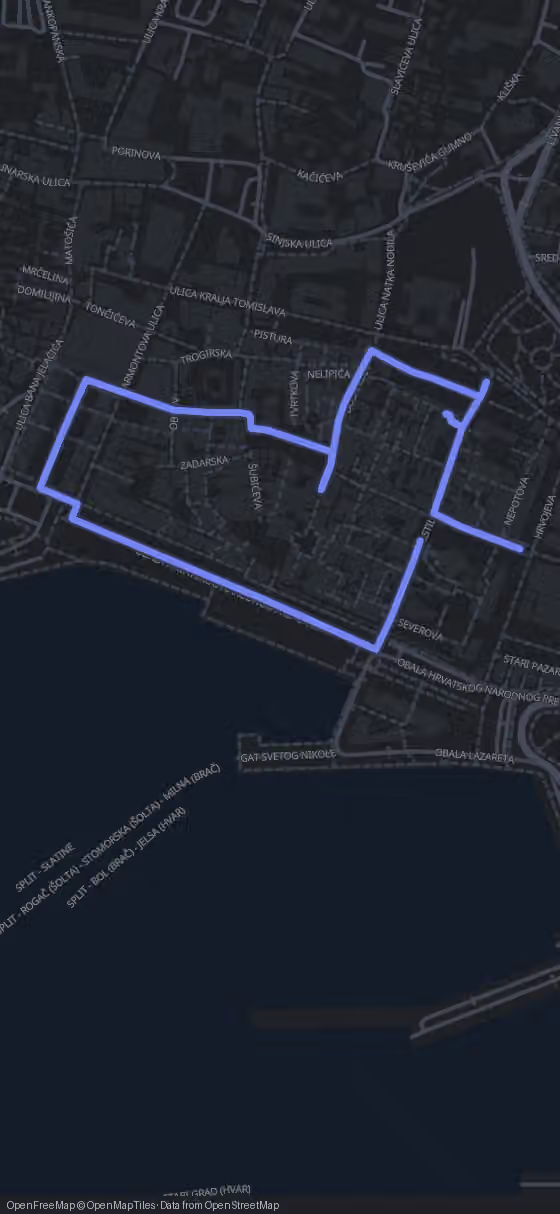
Route map for the Split walking tour
Stop 1 of 9
260 m·3 min
Silver Gate
Head north-west toward the Golden Gate
Welcome to Split. I'm Alex, and the city's cathedral began as the resting place of an emperor who persecuted Christians.
Try this tour with Alex

Split's palace walk at a glance

Nine stops lead from the Silver Gate, the palace's eastern entrance, to Peristyle Square at its heart: 1.3 km and 17 minutes of pure walking. Plan about an hour and a half if you stay outdoors, or about two and a half hours with visits inside.

The gates, the squares and the Gregory of Nin Statue are free. The Temple of Jupiter, Diocletian's Cellars and the Cathedral of Saint Domnius charge entry. The GPS route in your browser is free; the AI Tour Guide is optional.

Open free GPS & optional AI Tour Guide
View of Split

The Route

Walking Map of Split: From the Silver Gate to the Peristyle

9 stops 1.3 km 17 min walking
Tap to load interactive map

The 9 stops along this route

  1. Silver Gate in Split, stop 1 on the self-guided walking tour
    1Silver Gate
  2. Golden Gate in Split, stop 2 on the self-guided walking tour
    2Golden Gate
  3. Gregory of Nin Statue in Split, stop 3 on the self-guided walking tour
    3Gregory of Nin Statue
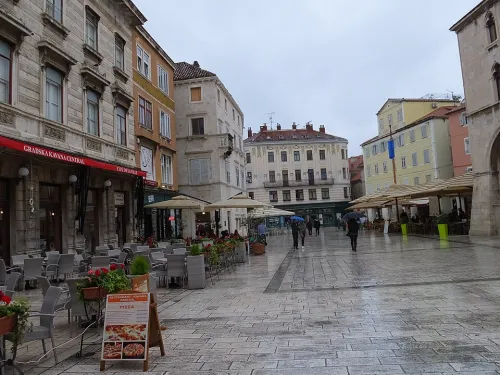
  4. People's Square in Split, stop 4 on the self-guided walking tour
    4People's Square
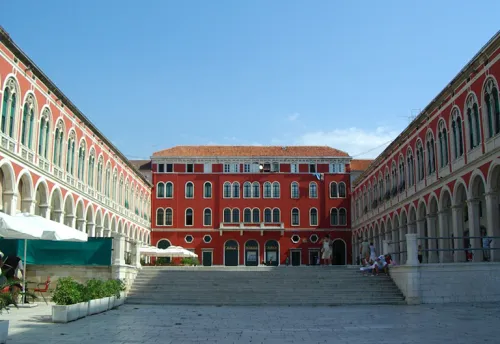
  5. Republic Square in Split, stop 5 on the self-guided walking tour
    5Republic Square
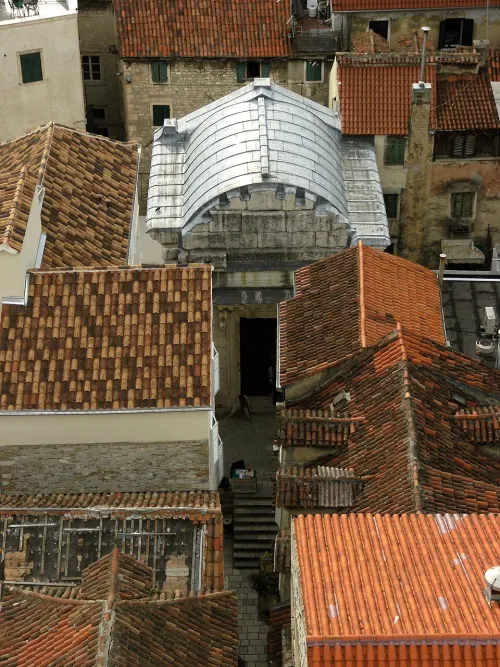
  6. Temple of Jupiter in Split, stop 6 on the self-guided walking tour
    6Temple of Jupiter
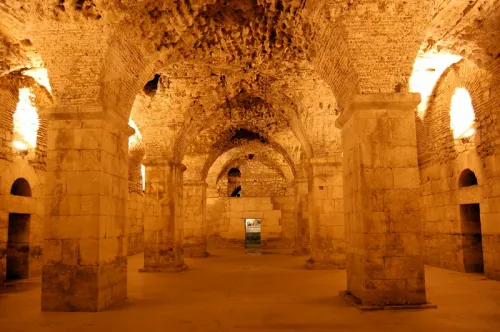
  7. Diocletian's Cellars in Split, stop 7 on the self-guided walking tour
    7Diocletian's Cellars
  8. Cathedral of Saint Domnius in Split, stop 8 on the self-guided walking tour
    8Cathedral of Saint Domnius
  9. Peristyle Square in Split, stop 9 on the self-guided walking tour
    9Peristyle Square
  10. That's the full route.

    Walk it with an AI Tour Guide talking you through every one of these streets.

    Start free in your browser
    You made it

Your Split Walking Tour Through the Palace and Beyond, Stop by Stop

  1. 1

    Silver Gate

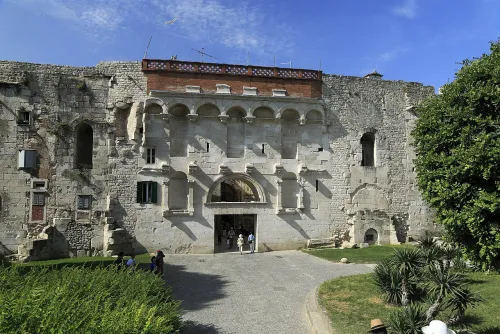
    Silver Gate in Split, stop 1 on the self-guided walking tour

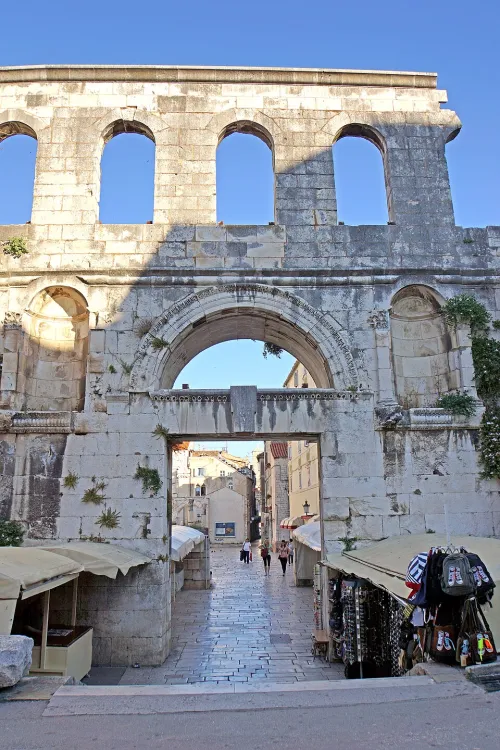
    You begin at one of the four main Roman gates into what was once Diocletian's Palace and is today Split's old town. Late Roman Split called it Porta Orientalis, the Eastern Gate, and it opened toward the Roman town of Epetia, which is Stobreč today. Its Latin name, Porta argentea, and the Croatian Srebrna vrata both translate as the Silver Gate.

    Look up at the wall above the opening. Probably around the 6th century, a small church dedicated to St. Apolinar was built up there, inside the corridor where sentries once walked. That was a time when refugees from the surrounding communities were pouring into the safety of the palace, and similar little churches appeared above the Golden, Iron and Bronze gates as well. The gate itself stayed in use through the Middle Ages.

    The wall around you has been rebuilt and stripped back more than once. In 1764 the Venetians, who ruled the city then, opened a second passage a few metres away, known as the Small Gate, and in 1820 a building that later housed the Archaeological Museum went up right beside it. The Baroque church of Dušica, built into this stretch of wall, was badly damaged by Allied bombing in the Second World War. During the extensive renovation of 1952, later additions were removed to expose the Roman fabric and the Small Gate was closed off, a clean-up that remains controversial because it changed the character of the whole area.

    Opposite the gate, next to the main town market, stands the Dominican monastery and church of St. Catherine of Alexandria, founded in the 13th century and restored after being demolished in the 17th. One more story for the road: in 2000, Pope John Paul II rode through the Silver Gate in his popemobile on his way to the Cathedral of Saint Domnius, where this walk will also bring you. From here it is 170 m, about two minutes, to the Golden Gate, passing the City Museum of Split on the way.
    Local name
    Srebrna vrata
    Hours
    Freely accessible (public gate, part of city street network)
    Price
    Free
  2. 2

    Golden Gate

    Golden Gate in Split, stop 2 on the self-guided walking tour

    This was the palace's main entrance, the northern gate, and it was built to look the part: elaborately decorated with columns and statues to mark its rank. It stood at the end of the road that ran north to Salona, Diocletian's birthplace and the capital of the Roman province of Dalmatia. When the emperor gave up the throne on 1 May 305, he probably came in through this very gate to begin his retirement.

    The name you know is relatively young. Late antique Romans called it Porta Septemtrionalis, the Northern Gate; in the Middle Ages it became Porta Romae, the Roman Gate. ‘Golden Gate’ seems to date from the Renaissance and first turns up in a Venetian travel itinerary of 1553.

    What you see is a gate that lost its finery. During the sieges of the early Middle Ages, the townspeople sealed it and used a smaller passage that was easier to defend, and over those centuries the columns and statuary disappeared. When calmer times returned, a new northern entrance, the Door of Picture, took over for good. Only in modern times was the Golden Gate reopened and repaired.

    Above the passage, in the narrow former guard corridor, sits the Church of St. Martin, one of those 6th century chapels built over the gates. Its space measures just 1.64 by 10 metres. It once had a pre-Romanesque bell tower, pulled down in the 19th century, similar to the one that still stands above the Iron Gate. The palace walls suffered too: around 1630 the Venetian governor Alvise Zorzi had eleven Roman towers on the north and east sides taken apart and shipped the stone blocks to Venice for the church of Santa Maria della Salute. The next stop is only 60 m away, about a minute's walk.

    Local name
    Zlatna vrata
    Hours
    Freely accessible (public gate, part of city street network)
    Price
    Free
  3. 3

    Gregory of Nin Statue

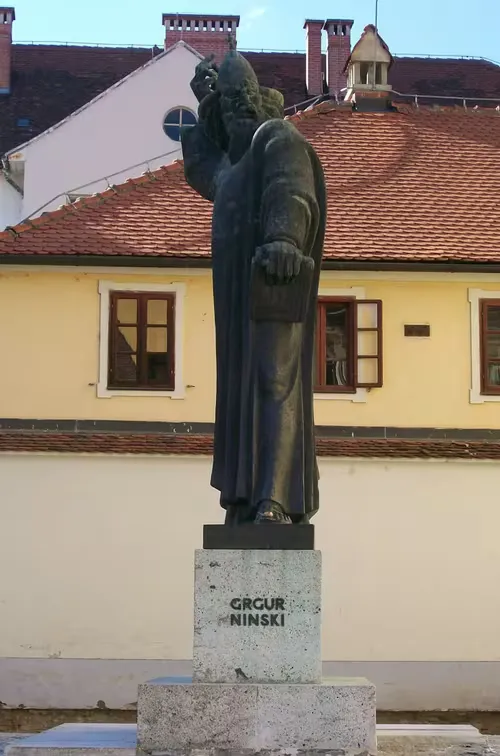
    Gregory of Nin Statue in Split, stop 3 on the self-guided walking tour

    Sixty metres from the Golden Gate, a bronze colossus by Ivan Meštrović rises above you. Grgur Ninski, as the statue is called locally, is counted among the sculptor's better monuments, and it is worth a few minutes of looking rather than a quick photo.

    Meštrović designed it to be read from one angle above all: in profile. Walk around until you see the figure side-on, and the composition falls into place. The robe is simple and stylized, with large unbroken surfaces that are deliberate rather than unfinished. Its folds run in strong vertical lines that give the statue its monumental weight, while the rounded upper parts lend the figure energy and temper, which carries the whole idea of the monument.

    Remember the name Meštrović: you'll meet his work again inside the Temple of Jupiter. From here it is 240 m, about three minutes, to People's Square, where Split first grew beyond the walls of the palace.

    Local name
    Grgur Ninski
    Hours
    Freely accessible (outdoor public statue)
    Price
    Free
  4. 4

    People's Square

    People's Square in Split, stop 4 on the self-guided walking tour

    Locals call it Pjaca, and it marks the moment Split outgrew its emperor. In the 13th century the medieval town spread west beyond the Iron Gate of Diocletian's Palace, and it needed a new centre. This square became the main civic square, while the Peristyle inside the palace kept the role of cathedral square. It is first mentioned in 1225.

    The square took shape where a small pre-Romanesque church of St. Lawrence once stood, so its first name was St. Lawrence's Square. Later it became the Square of Arms, after the town guard's building, then Piazza dei Signori, and finally People's Square. It was paved in stages and only fully paved in 1749.

    Historically, the north side held the late Gothic complex of the Rector's Palace with the communal palace and town hall, plus a municipal theatre with a prison. Next to the town hall stands the 16th century Renaissance Karepić palace, linked to it by graceful late Gothic double windows. On the east, against the palace walls, was a group of palaces with a Romanesque tower that received a clock in the 15th century, along with a Renaissance loggia for the town guard.

    Look for the late Romanesque palace of Ćubrijan Žaninić, the count of Korčula, on the other side of the Iron Gate: it has picturesque six-light windows at its corner and a statue of St. Anthony the Hermit dated 1394. The Nakić house, built in the Viennese Secession style, closes the square on the west, and on the south are the building of today's Gradska kavana, a hotel and the Pavlović palace. A stone flagpole, the štandarac, once stood before the communal loggia bearing the city's arms and the lion of St. Mark; a new one stands a little further west today. Continue 310 m, about four minutes, to Republic Square.

    Local name
    Narodni trg
    Hours
    Freely accessible (public square)
    Price
    Free
  5. 5

    Republic Square

    Republic Square in Split, stop 5 on the self-guided walking tour

    Officially Trg Republike, but everyone in Split says Prokurative. The square lies west of Diocletian's Palace and is a stage for the city's cultural life; for almost fifty years it has hosted the traditional Split festival of popular music.

    It is the work of one ambitious man. Mayor Antonio Bajamonti wanted to turn a neglected provincial town into what he called a città dell'avvenire, a city of the future, a small modern European city. His motto was Volere è potere, to want is to be able, and as soon as he took office he founded the Associazione dalmatica to carry out his plans.

    The backbone of the ensemble was a theatre built on what was then Marmont's field. The Teatro Bajamonti opened on 27 December 1859, and Bajamonti planned two wings around it, modelled on the famous Procuratie of Venice. The western wing went up between 1863 and 1867 in neo-Renaissance style, designed by the architect G. B. Meduna. Then, on 15 May 1882, the theatre burned down; it was rebuilt, but not in its original form, and later housed the Marjan cinema and a youth theatre.

    Details came piece by piece. In 1899 a balustrade of small stone columns, made back in Bajamonti's time, was set up along the south side. When the west wing was renovated in 1905, the cement masks and friezes you can look for on the facade were added. The eastern side was slowed by building permits and disputes: an Austro-Hungarian bank signed a contract for part of the land in November 1908, but quarrels kept delaying the work. Now comes the longest leg: 450 m, about six minutes, back into the palace to the Temple of Jupiter, passing the Ethnographic Museum.

    Local name
    Trg Republike
    Hours
    Freely accessible (public square)
    Price
    Free
  6. 6

    Temple of Jupiter

    Temple of Jupiter in Split, stop 6 on the self-guided walking tour

    You are now in the western, religious part of the palace, close to the Peristyle. The temple was built between 295 and 305, together with the palace itself, and dedicated to Jupiter, the supreme Roman god, whom Diocletian called his divine father. The Scottish architect Robert Adam considered it one of the most beautiful monuments in Europe.

    Before you go in, look at the sphinx guarding the entrance. It is one of twelve that Diocletian brought from Egypt. Above the doorway, reliefs show gods and heroes: Victoria, Triton, Helios, Hercules, Jupiter and Apollo. In front of the baptistery stands the Renaissance sarcophagus of Jakov Selembrije from the 16th century. Parts of the temple were never finished: Diocletian abdicated unexpectedly in 305 and arrived from Nicomedia earlier than planned, so work on the palace stopped.

    Probably in the 6th century the temple became the baptistery of St. John the Baptist, around the same time the crypt of St. Thomas was built. In the 11th century a Romanesque bell tower was raised above the vault; it was demolished around 1840, when the taste of the day demanded that ancient monuments be purified of later additions.

    Inside, the richly decorated doorways and above all the coffered barrel vault are the highlight. There are also the sarcophagi of two archbishops of Split, Ivan of Ravenna, who died around 1059, and Lovre, who died around 1099, and the large bronze St. John the Baptist by Ivan Meštrović. The temple charges entry; it is worth it if the vault and the Meštrović bronze appeal to you, and if you're short on time, the sphinx and the reliefs are on view from outside. Diocletian's Cellars are only 10 m away.

    Local name
    Jupiterov hram
  7. 7

    Diocletian's Cellars

    Diocletian's Cellars in Split, stop 7 on the self-guided walking tour

    These vaulted halls at the southern end of the palace once held up the emperor's private apartments. They rank among the best preserved ancient complexes of their kind in the world, and they cover about an eighth of the palace's entire area.

    Here is why they matter: the cellars were built as a faithful structural copy of the rooms above. The emperor's apartments are gone, but walking these halls lets you picture how his chambers were laid out in the palace's first phase. Down here the Romans also stored food and wine for the household, and the remains of a large press for wine and oil are still on display exactly where they were found. The cellars also held a nymphaeum and a marble table, a mensa, from the emperor's dining room.

    Archaeologists have been working here for about 70 years and found walls that predate the palace by two centuries; these early Imperial structures are still not fully understood. There is also a network of wells that remained in use into the Middle Ages.

    After Rome, the halls had many lives. In the early Middle Ages refugees sheltering behind the palace walls lived in part of them, and traces of that housing survive in one courtyard. Later the cellars served as water storage. The monastery and church of St. Clare stood above the eastern section, which probably partly collapsed and took the monastery with it. Over time the cellars were nearly forgotten, filled with waste from the floors above. Entry is paid, and for anyone who wants to understand the palace as a building, this is the visit to choose. The cathedral is 10 m away.

    Local name
    Podrumi Dioklecijanove palače
    Hours
    Daily 08:30–20:00; closed Apr 5; last entry 30 min before closing
    Price
    10 EUR, pupils/students/pensioners 8 EUR, family 18 EUR, under 7 free
  8. 8

    Cathedral of Saint Domnius

    Cathedral of Saint Domnius in Split, stop 8 on the self-guided walking tour

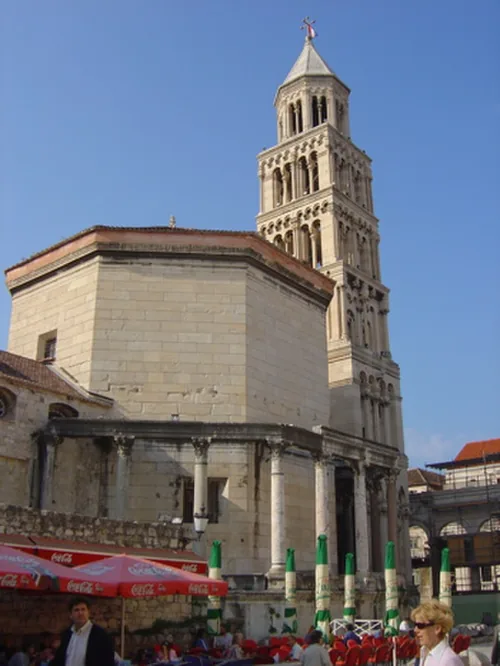
    The irony of this building is the best story on the walk. It was built in 305 as the mausoleum of Diocletian, the emperor who persecuted Christians, and today it is the Catholic cathedral of Split, the seat of the Archdiocese of Split-Makarska. Consecrated around the turn of the 7th century, it is regarded as the oldest Catholic cathedral in the world still in use in its original structure, without a near-complete later rebuilding.

    Strictly speaking, it is a complex: the church itself is dedicated to the Virgin Mary, and the bell tower, added in the 12th century, to Saint Domnius. Together they make up one of the most recognisable landmarks of Split.

    Saint Domnius, called Sveti Duje by locals, was born in Antioch and became bishop of Salona, the Roman capital of Dalmatia near today's Solin. In 304 he was beheaded at Salona with seven other Christians during Diocletian's persecutions. When Avars and Slavs destroyed Salona in the 7th century, its people fled to the islands; some later returned and settled in the abandoned palace.

    Those refugees turned the emperor's tomb into a church, destroying the pagan idols and the sarcophagus in which Diocletian had been buried. From the ruined basilicas of Salona they brought the relics of martyrs he had ordered killed: Domnius, the first bishop of Salona, and Anastasius of Aquileia, a humble worker. So the saints now rest in the building meant for their persecutor. Entry is paid, and this is the one interior to prioritise if you only have time for one. Peristyle Square, your last stop, is 10 m away.

    Local name
    Katedrala sv. Dujma
    Website
    smn.hr ↗
  9. 9

    Peristyle Square

    Peristyle Square in Split, stop 9 on the self-guided walking tour

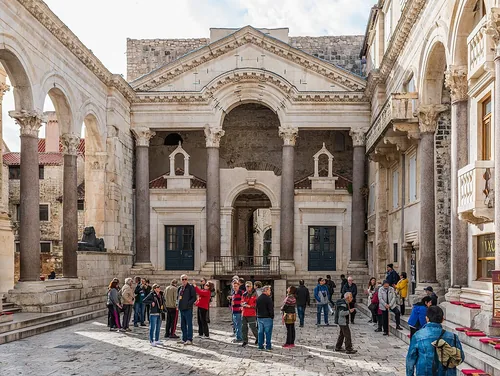
    You finish in the ceremonial heart of the palace, the square in front of the cathedral. It is one of the oldest preserved squares in Europe, and its original local name was Pločata sv. Dujma. In Roman terms a peristyle was an inner courtyard surrounded by columns; here it became a square framed on both long sides by rows of Corinthian columns linked by arches.

    Look closely at some of the columns on the south side: they came from Egypt and are cut from imperial porphyry, the same stone that Diocletian's sarcophagus in the octagonal mausoleum is believed to have been made of. The facade was flanked by two sphinxes; one of them is still here, almost perfectly preserved.

    The square sat on the palace's main north-south street, the cardo, which crossed the main east-west street, the decumanus, at its northern end. The front was divided in two: the upper part leads into the Vestibule, the lower one down into the cellars you just visited. Three statues once decorated the entrance to the Vestibule, one of Diocletian, one of Jupiter and a third whose identity is still unknown. From the protiron on the south side, the emperor addressed the people from the other part of the palace; it also separated the northern half for servants and soldiers from the southern half where he lived.

    Turn around once and you take in the palace's plan: on the west the baptistery, once the Temple of Jupiter, along with temples of Venus and Cybele; on the east Diocletian's mausoleum, today the cathedral. The square is free and a fitting place to end. If you'd like to return to the Silver Gate, the GPS navigation in your browser guides you back.

    Local name
    Peristil
    Hours
    Freely accessible (public square, ceremonial heart of Diocletian's Palace)
    Price
    Free
Walking tour route map of Split Route loaded
Silver GateGolden GateGregory of Nin StatuePeople's Square+5
All 9 stops are already on the map.
You just press start.
AI Tour Guide

You know the way now. Walk it with a guide in your ear.

Press start wherever you are, even hundreds of kilometres from Split, and the guide begins telling its stories right away. In the city, pick any of the 9 stops to start from: it leads you there, then talks with you the whole route, asking, listening, remembering, and shaping the tour around your answers.

9stops 1.3km 17 minwalking 13languages
▶Start the tour free

Free to start · Runs in your browser · No app, no download

Three Ways to Walk Split's Old Town

The full route links everything, but the palace and the later town split neatly, so you can shorten the walk to suit your time and budget.

Everything from the outside, no tickets

Stops: 1, 2, 3, 4, 5, 6, 7, 8, 9

For anyone on a tight budget or with little time: walk the whole 1.3 km in 17 minutes of walking, see the sphinx and reliefs at the Temple of Jupiter, the cathedral's exterior and the Peristyle without buying a single ticket. About an hour and a half.

Gates and town squares

Stops: 1, 2, 3, 4, 5

For those who want the story of how Split grew beyond the emperor's walls: from the Silver Gate past the Golden Gate and Meštrović's bronze to People's Square and Republic Square. 780 m and about 10 minutes of walking, all free.

The palace heart

Stops: 6, 7, 8, 9

For visitors short on time who want the Roman core: Temple of Jupiter, Diocletian's Cellars, Cathedral of Saint Domnius and Peristyle Square lie a few metres apart, about 3 minutes of walking in total. Three of the four charge entry, so this is where your time goes inside rather than on foot.

How Long Does the Split Palace Walk Take, Inside and Out?

The pure walking time is 17 minutes for 1.3 km. The longest leg, 450 m and about 6 minutes, takes you from Republic Square back into the palace to the Temple of Jupiter; after that the last four stops sit only 10 m apart.

Looking at everything from the outside, you'll need about an hour and a half. If you go into the temple, the cellars and the cathedral, allow about two and a half hours, with the cellars and the cathedral taking the largest share. The gates and squares alone fill roughly 45 minutes; the palace heart with all three interiors about an hour and a half.

Before You Set Off in Split

  • Start: The Silver Gate is the recommended start, since the route follows the palace from its eastern entrance outward and back in. You can join at any stop, though.
  • Finish: Peristyle Square, the ceremonial centre of the palace. If you want to return to the Silver Gate, the GPS navigation guides you back.
  • Tickets: The Temple of Jupiter, Diocletian's Cellars and the Cathedral of Saint Domnius charge entry; you'll find the current price at each ticket desk. Everything else on the route is free.
  • Timing: Check the opening hours of the cellars, the temple and the cathedral before you set out, so the paid visits fit into your walk.
Walking tour route map of Split
AI Tour Guide

Your guide is ready whenever you reach the palace walls.

Press start and a voice AI Tour Guide takes it from here: leading the route through Split, telling the stories, and turning your walk into a real back-and-forth conversation. No app or download is needed; it runs in your browser.

9stops 1.3km 17 minwalking 13languages
▶Start the tour free

Free to start · Runs in your browser · No app, no download

What the AI Tour Guide adds inside the palace walls

In barely more than a kilometre, Split piles up an emperor, refugees from Salona, Venetian governors and a 19th-century mayor with big dreams. The AI Tour Guide carries these layers through the walk as a conversation: it greets you, tells the stories of each place, asks what caught your eye and follows that thread. Wondering what became of the temples of Venus and Cybele beside the Peristyle, or how the Iron Gate looks today? Just ask on the spot. You start with 100 free credits; after that, this tour costs €19.99 all-inclusive with no time limit, or €5 per hour in credits.

A Real Conversation A voice AI Tour Guide greets you, leads the whole route, and tells the stories and facts as you walk, asking what you want to see and keeping a real conversation going. Not a recording you press play on.
Map Navigation Follow the route on the map and walk at your own pace. You choose where to start and when to move to the next stop.
Ask Anything Curious about a building you pass? Ask your AI Tour Guide on the spot and the conversation carries on.
13 Languages Switch language anytime. No separate tour needed.
Start free in your browser

Common Questions About Walking Split's Old Town

Can I see all four Roman gates of Diocletian's Palace on this walk?

The Silver Gate and the Golden Gate are stops, and People's Square grew up right outside the Iron Gate, so you pass it there. The Bronze Gate is not on this route.

Where can I see more work by Ivan Meštrović on the route?

Besides the Gregory of Nin Statue, his large bronze of St. John the Baptist stands inside the Temple of Jupiter, which needs a ticket.

Why does the walk end at the Peristyle rather than start there?

The route first shows you how the town spilled out of the palace and then brings you back to its Roman centre, so the oldest and grandest part comes last.

Can I combine Split with another walking tour in the region?

Yes. Mostar is about 113 km away and Dubrovnik about 166 km; both have their own self-guided routes.

Is the tour really free?

Yes. The whole tour is free: the route, the interactive map and the navigation cost you nothing. Only the voice AI Tour Guide is optional and paid: you test it with 100 free credits, then you pay either €5 per hour or €19.99 for this whole tour, with no time limit. Admission to 3 of the 9 stops is not included: Temple of Jupiter, Diocletian's Cellars and Cathedral of Saint Domnius charge their own entry fees.

Do I need to download an app?

No. Everything runs in your phone browser. Open the route and start walking, no download and no sign-up required.

Do I need to book the walking tour in advance?

No booking needed. This self-guided tour is available anytime. Open the route in your browser and start walking. The AI Tour Guide works instantly, no app, no reservation required.

What languages is the AI Tour Guide available in?

The AI Tour Guide speaks 13 languages, so you take the tour in your own language and can switch at any time.

Can I skip stops or change the route?

Yes. Skip any stop, spend extra time at places you like, or start the route from any point. It is your walk, you set the pace.
Image credits
▶ Start free in your browser Runs in your browser, no app, no download