Free Walking Tour Thun: Lake, Castle and Old Town

One loop, thirteen stops: an island street in the Aare, sidewalks a storey off the road, a Zähringen castle and the oldest surviving panorama painting in the world.

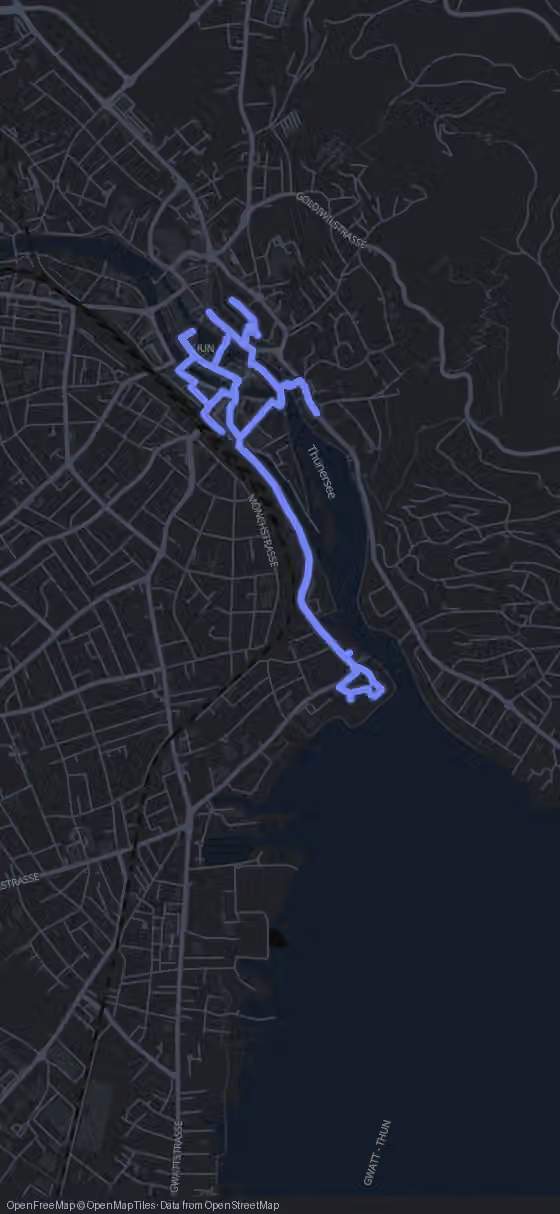
13 Stops 6.5 km ~1 h 31 min walking
Route map for the Thun walking tour
Stop 1 of 13
130 m·2 min
Bälliz Pedestrian Zone
Head south from the Bälliz toward Inseli Island Park at the tip of the island.
Welcome to Thun. I'm Alex, and one quiet rotunda here can wrap an entire 19th-century town around you.
Try this tour with Alex

The Thun Loop at a Glance

Thirteen stops on a loop that starts and ends at the Bälliz Pedestrian Zone: out to the lake, up through the old town to Thun Castle, then out to Schadau where the Aare leaves the lake. 6.5 km, 1 h 31 min of pure walking, about four and a half hours with the visits worth making.

Most stops are free, including Stadtkirche Thun and Kirche Scherzligen. Thun Castle, Kunstmuseum Thun and the Wocher Panorama charge admission. The GPS route runs free in your browser; the AI Tour Guide is optional.

Open free GPS & optional AI Tour Guide
View of Thun

The Route

Walking Map of Thun: the Whole 6.5 km Loop

13 stops 6.5 km 1 h 31 min walking
Tap to load interactive map

The 13 stops along this route

  1. Bälliz Pedestrian Zone in Thun, stop 1 on the self-guided walking tour
    1Bälliz Pedestrian Zone
  2. 2Inseli Island Park
  3. Lake Thun, stop 3 on the self-guided walking tour
    3Lake Thun
  4. Mühleplatz in Thun, stop 4 on the self-guided walking tour
    4Mühleplatz
  5. Rathausplatz in Thun, stop 5 on the self-guided walking tour
    5Rathausplatz
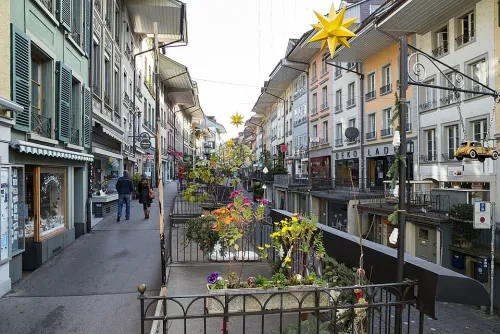
  6. Obere Hauptgasse in Thun, stop 6 on the self-guided walking tour
    6Obere Hauptgasse
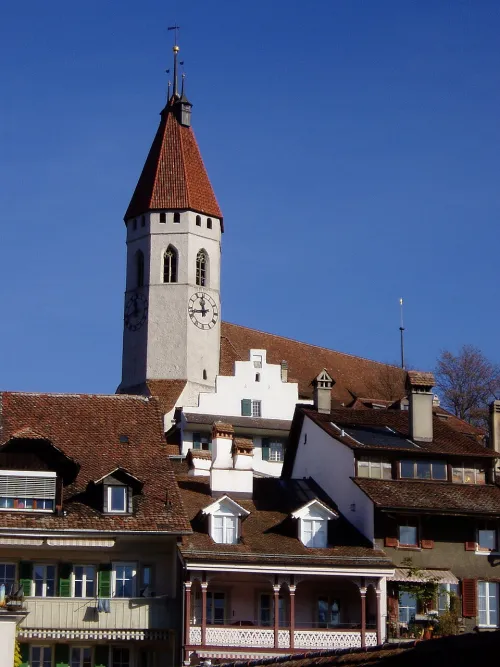
  7. Stadtkirche Thun, stop 7 on the self-guided walking tour
    7Stadtkirche Thun
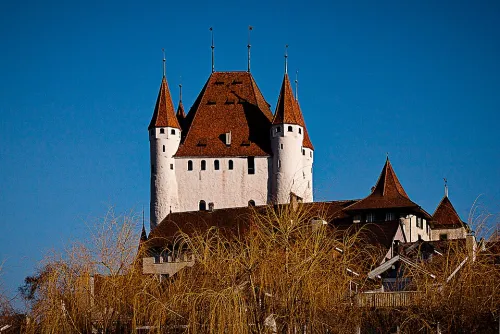
  8. Thun Castle, stop 8 on the self-guided walking tour
    8Thun Castle
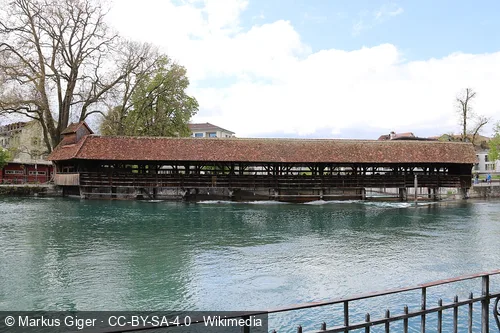
  9. Scherzligschleuse in Thun, stop 9 on the self-guided walking tour
    9Scherzligschleuse
  10. Kunstmuseum Thun, stop 10 on the self-guided walking tour
    10Kunstmuseum Thun
  11. Schadau Park and Castle in Thun, stop 11 on the self-guided walking tour
    11Schadau Park and Castle
  12. Wocher Panorama in Thun, stop 12 on the self-guided walking tour
    12Wocher Panorama
  13. Kirche Scherzligen in Thun, stop 13 on the self-guided walking tour
    13Kirche Scherzligen
  14. That's the full loop.

    Walk it with an AI Tour Guide talking you through every one of these streets.

    Start free in your browser
    You made it

Your Thun Walking Tour, from the Bälliz to Scherzligen

  1. 1

    Bälliz Pedestrian Zone

    Bälliz Pedestrian Zone in Thun, stop 1 on the self-guided walking tour

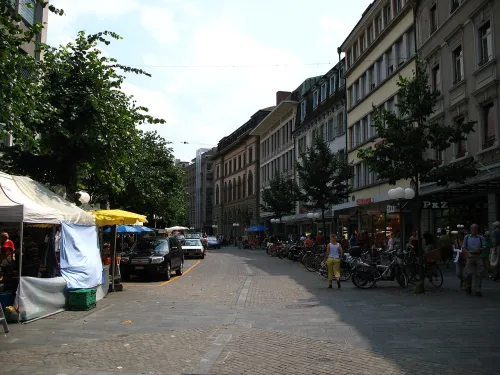
    You start on an island. The Bälliz is Thun's car-free shopping street, laid along the middle of the Aare with water running on both sides of you. Keep that picture in your head and the town sorts itself out: the river splits around this strip, the old town rises on one side, and everything on this loop is arranged around the point where you are standing.

    On paper the Bälliz is a retail street, and you will be back here when the loop closes, so the shops can wait. Use it now for what it is good at: picking up anything you need for a few hours on foot. Then save your energy for what comes next, because the park at the island's tip, the lake, the weirs and the old town all deserve more of your attention than shop windows.

    Head for the southern end of the island. Inseli Island Park is only 130 m away, two minutes on foot.

    Hours
    Freely accessible, no opening hours
  2. 2

    Inseli Island Park

    The island narrows to a green point, and this is it: Inseli is the public park at the southern tip of the Bälliz, freely open and free of charge. On an ordinary day it is a patch of lawn with water all around you. In summer it becomes one of the town's main swim spots.

    That gives you the first real decision of the day. You can swim now, while the walk is still short and there is a long stretch ahead to dry off, or you can save it for the end of the loop. The water stays warm enough for swimming from July well into September, so in high summer a towel in your bag is a good idea.

    From the island tip, the route heads for the open water. Lake Thun is 440 m away, about six minutes.

    Hours
    Freely accessible, no opening hours
    Price
    Free
  3. 3

    Lake Thun

    Lake Thun, stop 3 on the self-guided walking tour

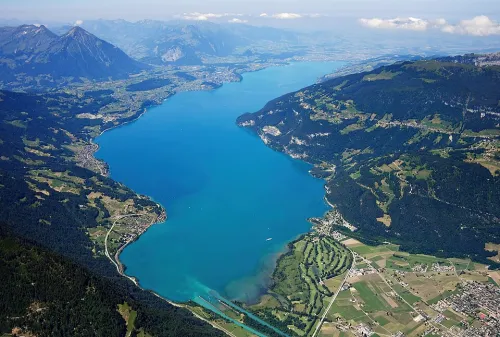
    This is the lake the town is named after, and the town sits on its northern shore. Lake Thun covers 48.3 km², which makes it the largest Swiss lake that lies entirely within a single canton. It formed after the last ice age, and for a long time it was one with Lake Brienz: together they were called the Wendelsee. Only after the 10th century did the two separate. Today Lake Brienz still feeds this one, sitting 6 m higher.

    Look toward the mountains and think about where this water comes from. The catchment reaches all the way up to the Finsteraarhorn at 4,274 m, and streams such as the Kander pour in from the Oberland. The only way out is the Aare, and its capacity is limited. After heavy rain that combination regularly floods the lakeshore, which is why the water level is managed so carefully at the weirs and the lock you will cross later on this walk.

    Two stories make the lake more than scenery. Passenger steamers have run here regularly since 1835, and today ten ships keep the towns around the shore connected. Less romantic: after the Second World War and until 1964, the Swiss government dumped unused munitions into the lake, somewhere between 3,000 and more than 9,020 tons by the various reckonings. It is all still down there.

    From the shore, the route turns back toward the river. Mühleplatz is 560 m away, about eight minutes.

    Local name
    Thunersee
    Hours
    Freely accessible, no opening hours
  4. 4

    Mühleplatz

    Mühleplatz in Thun, stop 4 on the self-guided walking tour

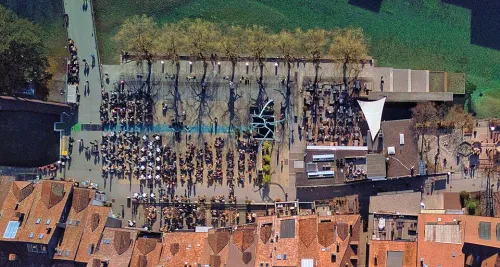
    Back from the lake, you meet the Aare again at Mühleplatz, a square that seems built for one purpose: a pause. Cafés and restaurants line the water, and the view runs out to the river weirs, where the Aare pushes through town in a fast, controlled rush.

    Controlled is the word to remember. The amount of water you see racing over the weirs is set further downstream at the Scherzligschleuse, the old lock you will cross later. After what you have just heard about the lake's floods, the noise of the weirs makes more sense: this is the town keeping the lake in check.

    This is the natural break before the climb into the old town, so take your coffee here rather than later. If you come in December, the square fills with Christmas market stalls, which makes the stop even more worthwhile.

    Rathausplatz is just 150 m away, two minutes on foot.

    Hours
    Freely accessible, no opening hours
    Price
    Free
  5. 5

    Rathausplatz

    Rathausplatz in Thun, stop 5 on the self-guided walking tour

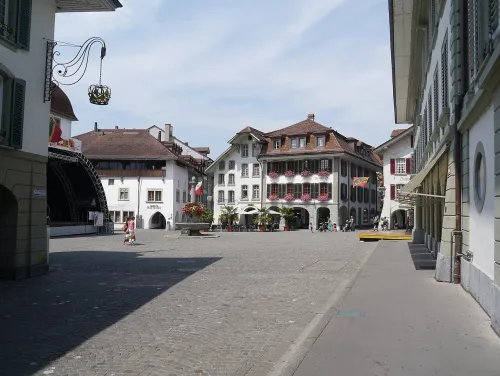
    The old town begins here, around a square held by the sixteenth-century town hall. Take a moment to look at the building that gives the square its name, then look at the square itself, because on certain mornings it changes character completely.

    On Wednesday and Saturday mornings the farmers move in, and Rathausplatz becomes the food stop of the loop: Bernese farmhouse cheeses, fruit must and fresh bread. The rule is simple. Come early, because the full range is only there in the first hours and the stalls are packed up by midday. On other days the square is quieter, and you can move straight on.

    The old town's main street starts right here. Obere Hauptgasse is 140 m away, two minutes.

    Hours
    Always open
    Price
    Free
  6. 6

    Obere Hauptgasse

    Obere Hauptgasse in Thun, stop 6 on the self-guided walking tour

    Now the strange one. On the Obere Hauptgasse, the old town's main street, the pavement runs a full storey over the road. These are the Hochtrottoirs, Thun's two-storey sidewalks, and they give you a street with two levels of pedestrians, one walking along at road height and one strolling past the upper shopfronts.

    This is the detail people take home from Thun, so give it a proper look before you get distracted by the shop windows. Notice how the upper walkway is built against the houses, how the two levels relate to each other and how the shops on both floors open onto the street.

    Take the upper level onward toward the church: it is the direction of the route and the more pleasant walk. Stadtkirche Thun is 170 m away, about four minutes.

    Hours
    Freely accessible, no opening hours
    Price
    Free
  7. 7

    Stadtkirche Thun

    Stadtkirche Thun, stop 7 on the self-guided walking tour

    You come up to the town's Protestant main church, and the first thing you see is its tower: octagonal, with a pointed, tile-covered spire. It is the oldest part of the church, dating from around 1330, and was painted with frescoes around 1430. Up in it hang five bells cast in different centuries.

    The church behind the tower is much younger. It was rebuilt in 1738 to plans by Paulus Nader. Before that, a medieval church dedicated to St Maurice stood here, with a Gothic high choir going back to the 13th century, and traces of even older buildings reach back to the 10th century. So you are standing on a spot that has been a church for about a thousand years.

    Inside, it is free and worth a quarter of an hour, especially if you like craftsmanship. The late Baroque preaching hall is decorated with stucco by Daniel Haag. Look for the Renaissance communion table from 1602 and the pulpit by Daniel Gintzi from 1661. Then find the epitaph made in 1748 by Johann August Nahl the Elder for the Schultheiss Beat Ludwig May. Music lovers should note the organ: built by Metzler in 1950, extended in 1994, with 47 stops and around 3,200 pipes.

    The castle is right above you. Thun Castle is 180 m away, three minutes.

    Hours
    Mon–Sun 09:00–19:00 (as a rule)
    Price
    0 CHF
  8. 8

    Thun Castle

    Thun Castle, stop 8 on the self-guided walking tour

    Thun Castle crowns the hill, and its massive keep with the huge roof is the image of the town. In the early Middle Ages there was only a small fort and a church up here. Duke Berthold V of Zähringen built the castle between 1180 and 1190, and the keep you see still stands from his time up to the level of the Knights' Hall, a room 14 m tall that was meant as a monument to Zähringen power. The irony: the Zähringen never lived here. They preferred Burgdorf.

    In 1218 the castle passed to the House of Kyburg, who added the upper levels. Then came the darkest story of the hill. In 1322 a dispute over who would rule the southern Kyburg lands ended with Eberhard II von Kyburg murdering his brother Hartmann II here in the castle. To protect his new lands from the Habsburgs, Eberhard sold them to Bern and promptly received them back as a fief. After a failed Kyburg raid on Solothurn in 1382 led to war and a string of Bernese victories, Bern bought Thun and Burgdorf outright in 1384.

    Under Bern the castle became the seat of local government. The huge roof dates from the 1430s, and in 1429 a late Gothic wing for offices and living quarters was added on the west side, known as the "new castle". The castle also served as a courthouse, and since at least the 17th century there was a prison under the roof of the keep. A new prison was built on the grounds in 1886; two years later, in 1888, the museum opened, and for a time the jailer also sold the tickets and guarded the exhibits. Since 2006 the castle has belonged to the town of Thun.

    The museum charges admission, and if you are going inside anywhere on this loop, make it here: the Knights' Hall alone justifies the visit, and history fans should allow about an hour. Then head back down to the water. The Scherzligschleuse is 520 m away, about eight minutes.

    Hours
    Feb–Mar: daily 13:00–16:00 | Apr–Jun: daily 10:00–17:00 | Jul–Aug: daily 09:30–17:30 | Sep–Oct: daily 10:00–17:00 | Nov–Jan: Sundays 13:00–16:00 (and daily 13:00–16:00 from Dec 25 to Jan 10)
    Price
    CHF 10 (museum castle), CHF 5 (special exhibition), CHF 15 (combi ticket castle + special exhibition); CHF 8 reduced (AHV/IV, students, trainees, military; special exhibition CHF 3, combi CHF 11), CHF 3 children (6-16 years), CHF 20 family card (2 adults + 2 children)
  9. 9

    Scherzligschleuse

    Scherzligschleuse in Thun, stop 9 on the self-guided walking tour

    Back down by the water you find the quietest curiosity on the route. The Scherzligschleuse is a covered wooden bridge from 1726, built onto the lock that regulates how much Aare leaves Lake Thun. This is the control point you saw at work from Mühleplatz: what happens here decides how the weirs in town behave.

    Walk across slowly and look at the timber construction overhead and at the gates of the lock under you. The bridge marks its 300th year in 2026. It is free, always open, and a calm counterpoint after the history packed into the castle.

    Kunstmuseum Thun is close by, 300 m away, about four minutes.

    Hours
    Freely accessible, no opening hours
  10. 10

    Kunstmuseum Thun

    Kunstmuseum Thun, stop 10 on the self-guided walking tour

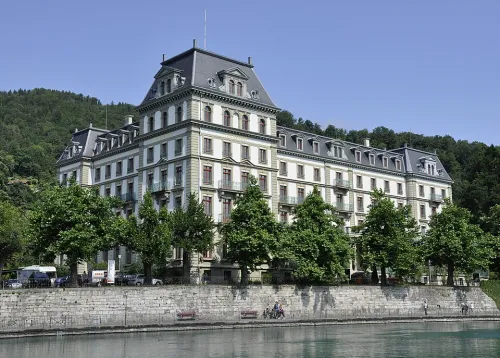
    The grand building on the Aare was once a hotel: the Grandhotel Thunerhof. Since 1949 it has housed the Kunstmuseum Thun, right in the town centre on the river. Even if you do not go in, the façade tells you something about Thun's past as a destination for well-off travellers.

    The museum grew out of the town's own art collection. In the 1940s the painter Alfred Glaus, former councillor Fritz Lehner and former town president Paul Kunz looked for a proper home for it; in summer 1948 an art commission under Lehner was formed and put Glaus in charge of organising, restoring and running the collection.

    Today the museum shows five or six changing exhibitions a year, mostly contemporary art with an eye on international and Swiss trends. It has staged a solo show of Christian Marclay and the first major retrospective of the artist sisters Claudia & Julia Müller, and it likes to set present-day works in dialogue with older art. Admission is charged. Go in if contemporary art is your thing and you have time; otherwise the loop has plenty more ahead.

    Now comes the longest leg so far: 1800 m to Schadau Park and Castle, about 24 minutes on foot.

    Hours
    Tue–Sun 10:00–17:00, Wed 10:00–19:00, Mon closed (closed between exhibitions; 24 and 31 Dec open until 16:00, 25 Dec closed, 26 Dec and 1/2 Jan open)
    Price
    CHF 10 adults, CHF 8 reduced (students, apprentices, AHV, IV, Berner Oberland Pass)

  11. 11

    Schadau Park and Castle

    Schadau Park and Castle in Thun, stop 11 on the self-guided walking tour

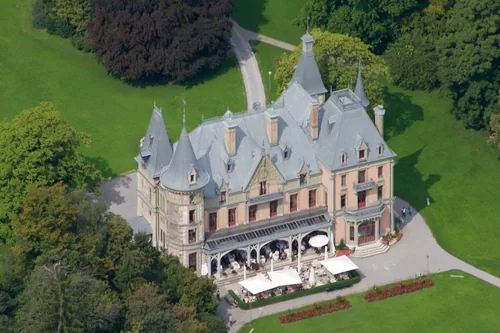
    You reach an English landscape garden at the point where the Aare flows out of Lake Thun, and in it a castle that looks as if it had been flown in from the Loire. Schadau Park is public and free, and the castle has belonged to the town of Thun since 1925.

    It is younger than it looks. Abraham Denis Alfred de Rougemont and his wife Sophie de Pourtalès had it built between 1846 and 1854. The plans came from the Neuchâtel architect James Victor Colin, trained at the École des Beaux-Arts in Paris, who combined medieval elements with French Renaissance ones: a residential tower, a great hall, a central main block and corner turrets. The Paris architect Pierre-Charles Dusillion, who had worked on the restoration of the Loire château of Azay-le-Rideau, reworked the façades, adding the contrasting colours of the different stones and the rich carving.

    Look closely at the stonework, especially the veranda with its Gothic-style tracery. The carving was done by the Dutch sculptor Joseph Hubert Verbunt, trained in Paris, and the round tower, with its vertical bands, nods to the royal châteaux of the Loire. There are also touches of English Tudor Gothic. Local references are few: mainly the coats of arms and initials of the owner. Some of the historic fittings the family bought and installed, such as Renaissance panelling and Baroque stoves, were removed and sold after the last de Rougemont died.

    The castle now houses a hotel and restaurant, and the interior can only be seen on public castle tours that include an aperitif. For most visitors the park and the façades are reason enough to come. The Wocher Panorama is just 170 m away, two minutes through the park.

    Hours
    Schadau Park: freely accessible around the clock | Schadau Castle restaurant: Mon–Sat 08:30–23:30, Sun 08:30–22:00
    Price
    Park free | Schadau Castle (hotel & restaurant) interior visit: CHF 25 (only as part of public castle tours incl. aperitif)
  12. 12

    Wocher Panorama

    Wocher Panorama in Thun, stop 12 on the self-guided walking tour

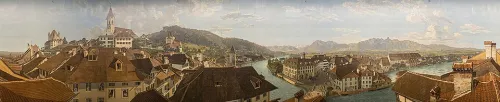
    In this round building in the Schadau park hangs the oldest surviving panorama painting in the world: a 360-degree view of Thun, about 7.5 m high and 38 m long. You stand in the middle and the whole town of 1814 surrounds you, close enough to look into living rooms, schoolrooms and lanes.

    The story starts with a trip. In 1808 the Basel artist Marquard Wocher travelled to the Unspunnen festival in Interlaken, passed through Thun and was so taken with the little town on the lake that he decided to paint it. He spent two summers here sketching, sitting on a rooftop in the middle of the old town. Back in Basel, friends lent him the money for a round building about 12.5 m across, and from 1809 to 1814 he painted the picture alone, without assistants.

    The canvas gave him trouble: he could not stretch it without folds, and its coarse texture made painting hard. Friends from the bookbinding trade found the solution, and the canvas was covered with handmade paper to give him a smooth surface. Two painter friends kept sending him sketches and reports of every new building in Thun, which is why the picture shows the town exactly as it looked in 1814.

    When the panorama opened, visitors came from all over the world despite a steep entrance fee. The guest book includes Marie-Louise of Austria, Napoleon's second wife, and the grand dukes Michael and Nicholas, the later Tsar. Since 1960 the painting has belonged to the Gottfried Keller Foundation, and since 1961 it has been on show here. Admission is charged, and it is worth every minute: plan about half an hour.

    Kirche Scherzligen is 280 m away, about four minutes.

    Hours
    Mar–Nov: Tue–Sun 11:00–17:00
    Price
    CHF 9 adults, CHF 8 reduced (students, apprentices, AHV, IV, Berner Oberland Pass)
  13. 13

    Kirche Scherzligen

    Kirche Scherzligen in Thun, stop 13 on the self-guided walking tour

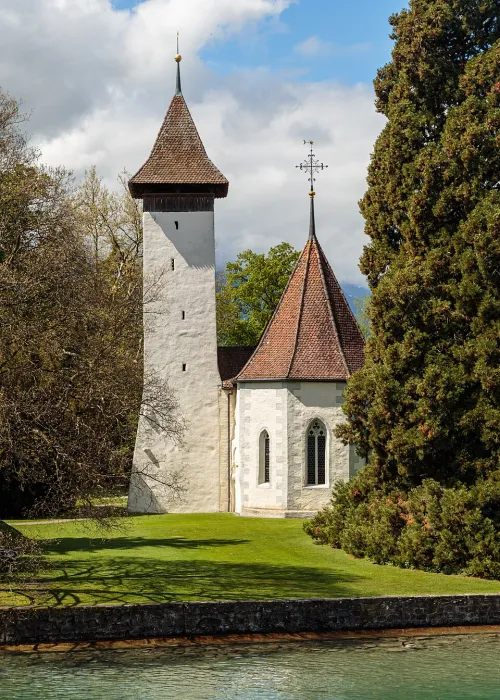
    The small church on the bank of the Aare, right where the river leaves the lake, is the oldest story on the whole loop. Look at its alignment: it does not face due east like most churches, but exactly toward the point where the sun rises on 21 June, the longest day of the year.

    The spot was probably sacred long before Christianity. Roman coins from the reign of Trajan and a coin of Magnus Maximus from the late 4th century have been found here, and the first church was built over a late antique double tomb from the 5th or 6th century. Scherzligen is one of the earliest documented places in the canton of Bern: around 761 the bishop of Strasbourg gave the church to Ettenheim Abbey. The lower two thirds of the tower date from the 9th century, and the nave with its Romanesque apse was built between the 10th and 12th centuries.

    Go inside; it is free and worth a quarter of an hour. After 1100 a screen separated the clergy from the lay people, at first 80 cm high and raised to 155 cm after 1215. Around 1400 came the wall painting of the death of Mary, and in the decades after 1440 more paintings were added on the north and south walls of the nave. A large sacrament house followed after 1453. In 1272 the church passed to the monastery of Interlaken.

    From here the loop closes. The Bälliz Pedestrian Zone is 1630 m away, about 22 minutes on foot, and the shops you skipped this morning are waiting.

    Local name
    Reformierte Kirche Scherzligen
    Hours
    Apr 1–Oct 31 Daily 10:00–18:00; Nov 1–Mar 31 Sun 11:00–16:00
    Price
    0 CHF
Walking tour route map of Thun Route loaded
Bälliz Pedestrian ZoneLake ThunMühleplatzRathausplatz+9
All 13 stops are already on the map.
You just press start.
AI Tour Guide

You know the Thun loop now. Walk it with a guide in your ear.

Press start wherever you are, even hundreds of kilometres from Thun, and the guide begins telling its stories right away. In the city, pick any of the 13 stops to start from: it leads you there, then talks with you the whole route, asking, listening, remembering, and shaping the tour around your answers.

13stops 6.5km 1 h 31 minwalking 13languages
▶Start the tour free

Free to start · Runs in your browser · No app, no download

Shorter Ways to Walk Thun

The loop splits cleanly into two halves, which works well if you only have a morning or want to spread Thun over two visits.

Lake and old town up to the castle

Stops: 1, 2, 3, 4, 5, 6, 7, 8

For a first visit with limited time: the island, the lakeshore, the market square, the raised sidewalks, the town church and the castle. 27 minutes of walking, ending at Thun Castle. Only the castle charges admission; Stadtkirche Thun is free.

From the lock to Schadau and back

Stops: 9, 10, 11, 12, 13, 1

For art lovers and anyone who has already seen the old town: the wooden lock bridge, the art museum, the Schadau park, the panorama painting and the old church at the lake outflow, then back to the Bälliz. 56 minutes of walking. Kunstmuseum Thun and the Wocher Panorama charge admission; the park and Kirche Scherzligen are free.

How Long Does This Thun Tour Take with Castle and Panorama?

Pure walking time for the full loop is 1 h 31 min over 6.5 km. The legs are short in the old town and long at the end: the 1800 m from Kunstmuseum Thun to Schadau Park and Castle take 24 minutes, and the 1630 m from Kirche Scherzligen back to the Bälliz take 22 minutes.

Plan on about four and a half hours in total: around an hour inside Thun Castle, half an hour at the Wocher Panorama, a quarter of an hour in each of the two churches, a coffee break at Mühleplatz and a few minutes at every other stop. If you add Kunstmuseum Thun, count roughly another 45 minutes. The old town half alone fits into about two hours with the castle; the Schadau half takes around two hours with the panorama.

Before You Set Off in Thun

  • Start and finish: The recommended start is the Bälliz Pedestrian Zone, and the loop brings you back there. You can join at any stop; the order on the map is the one that works most smoothly.
  • Best time: Start in the morning. On Wednesdays and Saturdays you catch the farmers' market on Rathausplatz while it is still fully stocked, and you reach the castle with plenty of the day left.
  • Admission: Thun Castle, Kunstmuseum Thun and the Wocher Panorama charge admission. The interior of Schadau Castle is only open on public castle tours. Everything else, including both churches, is free.
  • Swimming: In summer, pack a towel: Inseli Island Park is one of the town's swim spots.
Walking tour route map of Thun
AI Tour Guide

Your guide is ready when you reach the Bälliz.

Press start and a voice AI Tour Guide takes it from here: leading the route through Thun, telling the stories, and turning your walk into a real back-and-forth conversation. No app or download is needed; it runs in your browser.

13stops 6.5km 1 h 31 minwalking 13languages
▶Start the tour free

Free to start · Runs in your browser · No app, no download

What the AI Tour Guide Adds in Thun

The AI Tour Guide walks this loop with you as a conversation. It greets you at the Bälliz, tells the stories of each place, asks what you want to know more about and remembers it: if the Kyburg feud at the castle grips you, the talk at Schadau and Scherzligen leans toward power and families; if the panorama does, it follows art. You can interrupt at any moment. You start with 100 free credits; after that you choose between this tour all-inclusive for €19.99 with no time limit, or credits at €5 per hour.

A Real Conversation A voice AI Tour Guide greets you, leads the whole route, and tells the stories and facts as you walk, asking what you want to see and keeping a real conversation going. Not a recording you press play on.
Map Navigation Follow the route on the map and walk at your own pace. You choose where to start and when to move to the next stop.
Ask Anything Curious about a building you pass? Ask your AI Tour Guide on the spot and the conversation carries on.
13 Languages Switch language anytime. No separate tour needed.
Start free in your browser

Common Questions about Walking in Thun

Is the Wocher Panorama part of Kunstmuseum Thun?

Yes, the panorama belongs to Kunstmuseum Thun, but it hangs in its own building in the Schadau park, a separate stop on the loop with its own admission.

Can I add a boat trip on Lake Thun?

Yes. Passenger ships run by BLS cross the lake and serve Thun and Interlaken, and a ship canal links the lake to Thun railway station. A crossing makes an easy add-on before or after the walk.

Can I combine Thun with another town on the same day?

Thun pairs well with Bern, 25 km away, which has its own free walking route. If you are heading into the mountains instead, Wengen and Mürren both have routes too.

Do I need a ticket for the castle in advance?

Tickets for Thun Castle are sold at the castle itself. There is also a combined ticket for the museum and the special exhibition, as well as a family ticket.

Is the tour really free?

Yes. The whole tour is free: the route, the interactive map and the navigation cost you nothing. Only the voice AI Tour Guide is optional and paid: you test it with 100 free credits, then you pay either €5 per hour or €19.99 for this whole tour, with no time limit. Admission to 3 of the 13 stops is not included: Thun Castle, Kunstmuseum Thun and Wocher Panorama charge their own entry fees.

Do I need to download an app?

No. Everything runs in your phone browser. Open the route and start walking, no download and no sign-up required.

Do I need to book the walking tour in advance?

No booking needed. This self-guided tour is available anytime. Open the route in your browser and start walking. The AI Tour Guide works instantly, no app, no reservation required.

What languages is the AI Tour Guide available in?

The AI Tour Guide speaks 13 languages, so you take the tour in your own language and can switch at any time.

Can I skip stops or change the route?

Yes. Skip any stop, spend extra time at places you like, or start the route from any point. It is your walk, you set the pace.
Image credits
▶ Start free in your browser Runs in your browser, no app, no download