Free Walking Tour Bern: Clock Tower, Bears and Fountains

Start under the Zytglogge, walk out to the bears and the Rose Garden, then stand in the flat where Einstein wrote the papers that changed physics.

15 Stops 5.7 km ~1 h 21 min walking
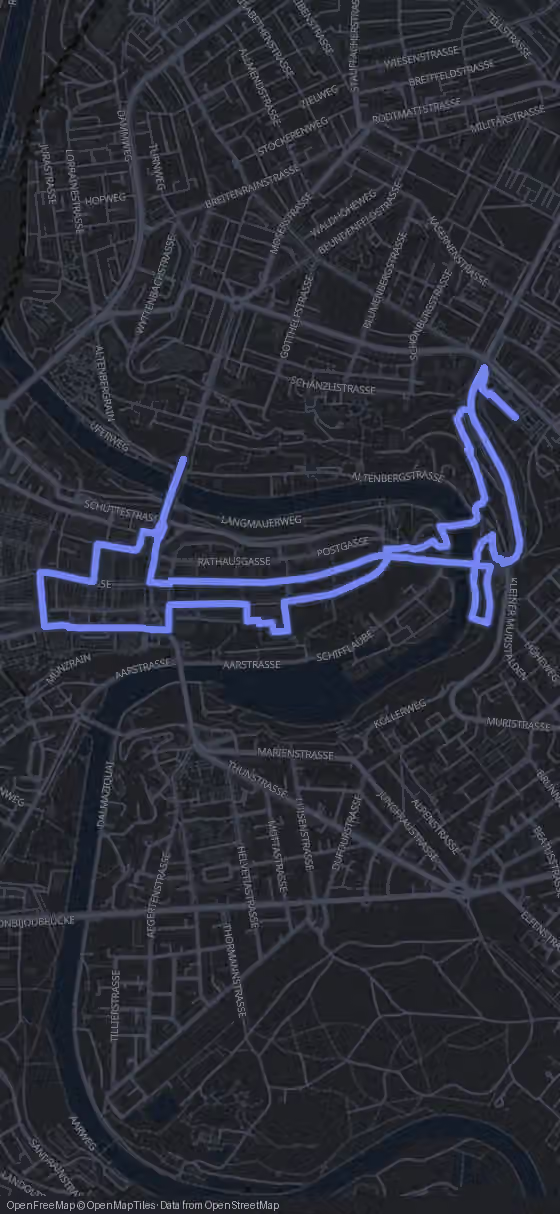
Route map for the Bern walking tour
Stop 1 of 15
110 m·1 min
Zytglogge
Head east into Kramgasse toward the Zähringen fountain
Grüezi, welcome to Bern. I'm Alex, and one quiet apartment here helped change how we understand space and time.
Try this tour with Alex

What This Bern Loop Covers

15 stops on a loop that begins and ends at the Zytglogge: out through the Old Town to the Rose Garden and the BearPark on the Aare, back via the Einstein House and on to the Kindlifresserbrunnen. 5.7 km and 1 h 21 min of pure walking; with time at each stop and one museum, plan about four hours.

Almost everything is free to see. Only the Einstein House charges admission, plus an optional guided tour inside the clock tower. The GPS route in your browser is free and leads you from stop to stop; the AI Tour Guide is optional.

Open free GPS & optional AI Tour Guide
This short shows highlights of the route. All 15 stops follow below.

The Route

Walking Map of Bern: The Old Town Loop at a Glance

15 stops 5.7 km 1 h 21 min walking
Tap to load interactive map

The 15 stops along this route

  1. Zytglogge in Bern, stop 1 on the self-guided walking tour
    1Zytglogge
  2. Zähringerbrunnen in Bern, stop 2 on the self-guided walking tour
    2Zähringerbrunnen
  3. Fountain of Justice in Bern, stop 3 on the self-guided walking tour
    3Fountain of Justice
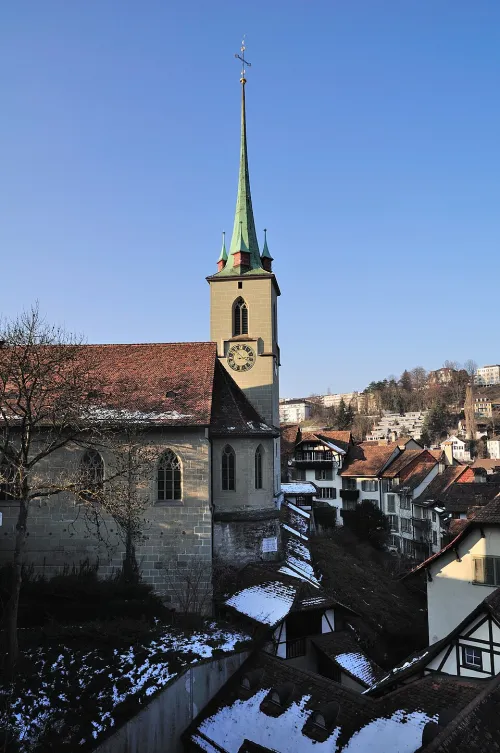
  4. Nydegg Church in Bern, stop 4 on the self-guided walking tour
    4Nydegg Church
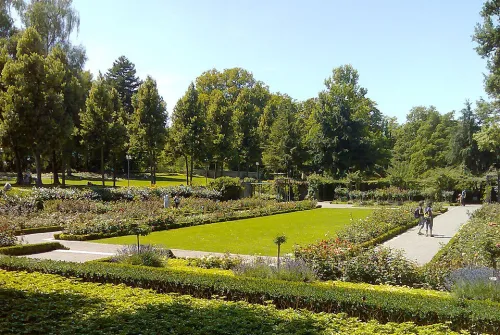
  5. Rose Garden in Bern, stop 5 on the self-guided walking tour
    5Rose Garden
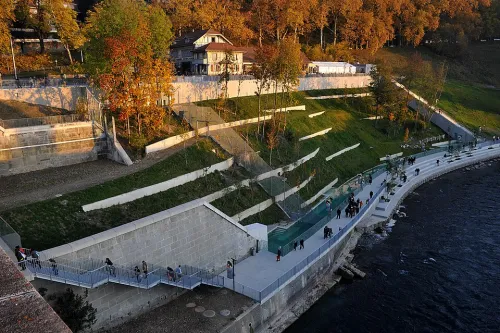
  6. BearPark in Bern, stop 6 on the self-guided walking tour
    6BearPark
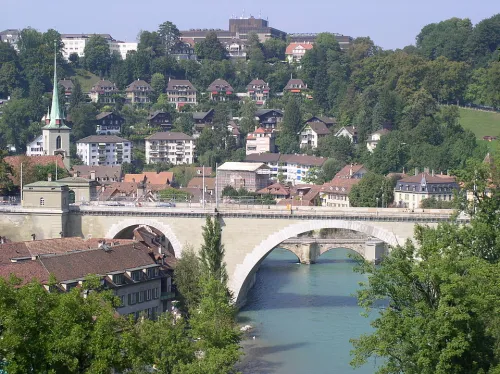
  7. Nydegg Bridge in Bern, stop 7 on the self-guided walking tour
    7Nydegg Bridge
  8. Münsterplattform in Bern, stop 8 on the self-guided walking tour
    8Münsterplattform
  9. Einstein House in Bern, stop 9 on the self-guided walking tour
    9Einstein House
  10. Bundesplatz in Bern, stop 10 on the self-guided walking tour
    10Bundesplatz
  11. Käfigturm in Bern, stop 11 on the self-guided walking tour
    11Käfigturm
  12. Französische Kirche in Bern, stop 12 on the self-guided walking tour
    12Französische Kirche
  13. Kornhaus in Bern, stop 13 on the self-guided walking tour
    13Kornhaus
  14. Kornhausbrücke in Bern, stop 14 on the self-guided walking tour
    14Kornhausbrücke
  15. Kindlifresserbrunnen in Bern, stop 15 on the self-guided walking tour
    15Kindlifresserbrunnen
  16. That's the full loop.

    Walk it with an AI Tour Guide talking you through every one of these streets.

    Start free in your browser
    You made it

Your Bern Walking Tour Through the Aare Loop, Stop by Stop

  1. 1

    Zytglogge

    Zytglogge in Bern, stop 1 on the self-guided walking tour

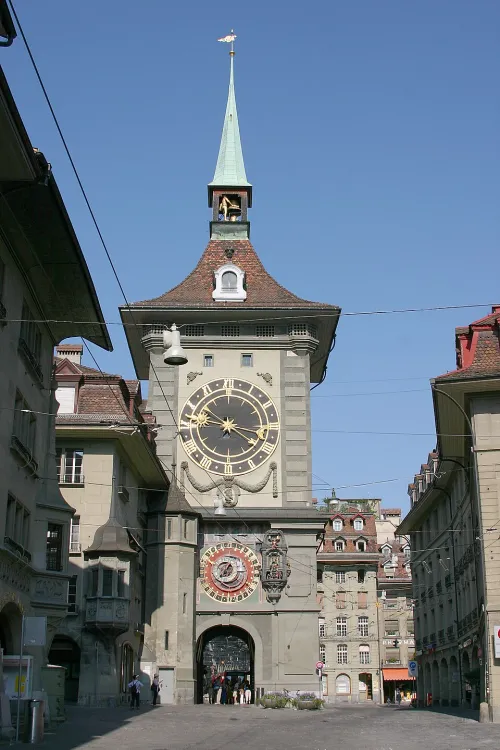
    Look up at the tower with the big clock face over the gateway. The Zytglogge is the oldest monument in Bern and one of its most recognisable symbols, and its 15th-century astronomical clock is the reason people gather here. The name is Bernese German for 'time bell': the clock and the great bell, cast in 1405, gave the tower its identity. It is a heritage site of national significance and part of the Old City of Bern, a UNESCO World Heritage Site.

    It started life around 1220 as a gate tower in Bern's western wall, built after the young city's first expansion westward. Back then it was a squat block only 16 metres tall. When the city grew again and the wall moved out to the Käfigturm, the Zytglogge became a second line of defence and was raised by 7 metres so it could still look over the houses around it.

    Once the defences moved even further west in the 1340s, the tower became a women's prison. Among the inmates were the so-called Pfaffendirnen, women convicted of relations with clergymen. The great fire of 1405 burnt the tower out completely; the structural damage was so severe that the repairs were only truly finished with the last restoration in 1983. After the fire the cells were abandoned, and early in the 15th century a clock went up above the gate, probably with a simple astronomical dial and a musical mechanism. Late in that century the tower was extended and decorated in the Burgundian fashion of the day.

    From the street the tower is free to look at, any time. Going inside means joining a paid guided tour: worth it if the clock has made you curious about how it works, while a quick visit can happily stay outside. The Zähringerbrunnen is only 110 m along the Kramgasse, a one-minute walk.
    Hours
    Open 24/7
    Price
    Free (exterior); Guided Tour CHF 18–20 (adults)
  2. 2

    Zähringerbrunnen

    Zähringerbrunnen in Bern, stop 2 on the self-guided walking tour

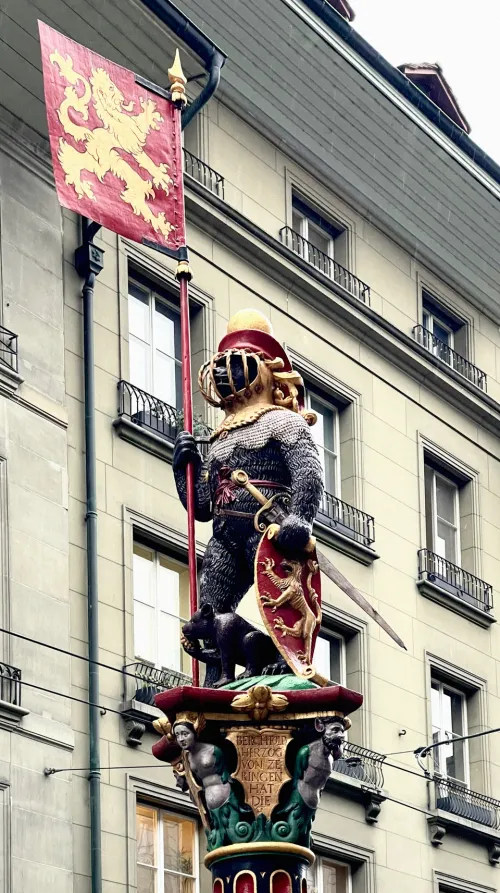
    The fountain in front of Kramgasse 63 and 66 is crowned by a bear in armour: helmet on, two swords tucked into his belt, a banner in his right paw and a shield in his left. Both show a golden lion on red, a variant of the arms carried by the Zähringer family. Now look between his legs: a bear cub is busy devouring a bunch of grapes. The figure faces east.

    Hans Hiltprand built the fountain in 1535, one of the Old Town fountains from the 16th century. For a long time it was known as the Finstergässlibrunnen or simply the bear fountain. The name it carries today only appeared in the 19th century and honours Berchtold V of Zähringen, the founder of Bern. The fountain was restored in 2014.

    Don't mix it up with the Zähringer monument, a separate statue you'll pass near the Nydegg Church later on. And the water here is the real thing: the fountain is supplied from the city's drinking water network.

    From here it is 370 m, about 5 minutes, to the Fountain of Justice in the Gerechtigkeitsgasse.

    Hours
    Always open
    Price
    Free
  3. 3

    Fountain of Justice

    Fountain of Justice in Bern, stop 3 on the self-guided walking tour

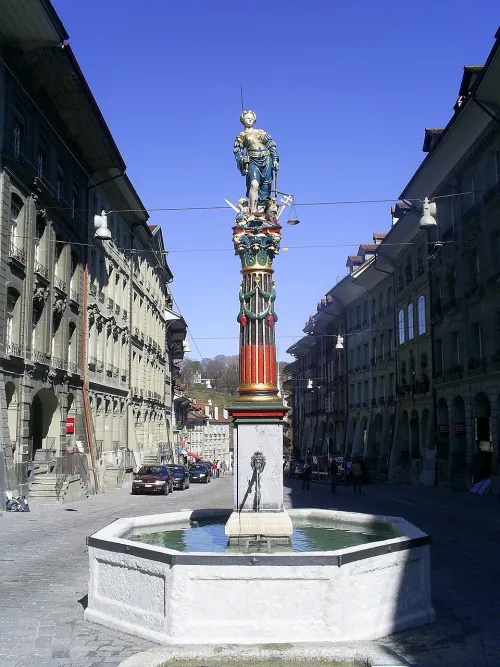
    Of all the Old Town fountains, this is the one art historians rate highest, and the only one in Bern that keeps all of its original design elements. Lady Justice stands on a slim stone pillar decorated with an acanthus frieze, poised and graceful: sword in her right hand, scales in her left, a blindfold over her eyes. She wears an antique-style costume with sandals and one bare knee, and a golden suit of armour with relief ornament over blue robes.

    Now look at her feet. Four smaller busts crowd the pedestal: a Pope, an Emperor, a Sultan and a Schultheiss, Bern's own head of government, whose golden chain of office probably once bore the Bernese arms. All four have their eyes closed in submission. Renaissance humanists saw them as the four forms of government, theocracy, monarchy, autocracy and the republic, and the message is plain: justice stands above every earthly power.

    The figure is the work of Hans Gieng, and it was copied all over Switzerland until the middle of the 17th century. What you see today is itself a copy, because vandals largely destroyed the original in 1986. The octagonal main basin is made of plain limestone slabs held by an iron ring and carries the date of one renovation, MDCCCXLV, that is 1845; two smaller basins catch the overflow. The central pedestal dates from 1949.

    Keep the name Hans Gieng in mind; he turns up again at the end of the loop. The Nydegg Church is 270 m on, a 4-minute walk.

    Local name
    Gerechtigkeitsbrunnen
    Hours
    Always open
    Price
    Free
  4. 4

    Nydegg Church

    Nydegg Church in Bern, stop 4 on the self-guided walking tour

    You've reached the eastern edge of the Old Town, the Nydegg quarter. The name comes from Bernese German for 'lower corner'. The Old Town sits on a peninsula in a loop of the Aare, and this is where the city began: in 1190 Duke Berchtold V of Zähringen built Nydegg castle here, with four corner towers, roughly where the church choir stands today. After the Zähringer line died out, the castle passed to the city, and the people of Bern tore it down in the 1260s and 1270s to build houses.

    A small church replaced the fortress in the 1340s, consecrated in 1344 and again in 1346. In 1469 the city asked the Teutonic Order to hand the chapel over so it could be rebuilt, but the Burgundian Wars got in the way. The tower followed in the 1480s, and a new nave was finished in 1504.

    After the Reformation of 1529 the church became a warehouse for barrels, timber and grain, and only served for worship again from 1566. Two years later the bell tower roof burned. By 1571 it was rebuilt, and Caspar Brükessel forged the large iron cross on the spire. The tower looks much as it did then; in 1625 four firing slits were cut to help defend the city gate, and in 1631 eight copper waterspouts were added. Look for the slits and the spouts.

    Entry to the church is free, so a short look inside fits easily. Next to it, in the Nydegghöfli, stands the Zähringer monument, which spent over a century on the Münsterplattform before moving here in 1968. Then comes the longest leg by time: 910 m and 17 minutes to the Rose Garden.

    Hours
    Daily 09:00–17:00
    Price
    Free
  5. 5

    Rose Garden

    Rose Garden in Bern, stop 5 on the self-guided walking tour

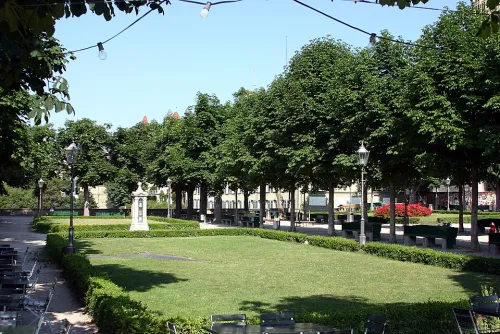
    This park northeast of the Old Town, in the Schosshalde quarter, is where locals and visitors alike come for the view back over the Old Town. Find a bench, catch your breath and take in the rooftops you've just walked through. Today 223 kinds of roses grow here, along with 200 kinds of iris and 28 of rhododendron.

    It has not always been a place for picnics. From 1765 until the Schosshalde cemetery opened in 1877, this ground was itself a cemetery. In 1913 it became a public park, and roses were bred here from 1917. The pond with the two monumental groups Europa and Neptune by Karl Hänny has been here since 1918, and the whole park was redesigned in 1956. The avenue of crosses, the Kreuzallee, is a leftover from the cemetery days; it was replanted with twelve new lime trees in 1997.

    Look out, too, for the bust of the writer Jeremias Gotthelf by Arnold Huggler from 1937. It had to make way for the summer restaurant in 1960 and now stands in front of the pavilion that houses a library of Swiss German dialect books, with a reading garden beside it.

    With a large playground and a restaurant on site, this is the natural break on the loop, especially with children. When you're ready, it is 1060 m and 14 minutes to the BearPark.

    Hours
    Always open
    Price
    Free
    Website
    bern.ch ↗
  6. 6

    BearPark

    BearPark in Bern, stop 6 on the self-guided walking tour

    Bern and its bears go back centuries, and the BearPark on the bank of the Aare is how the city carries that tradition into the present. Instead of a bare pit, the bears have 6,500 square metres of habitat designed with their welfare in mind. The historic Bear Pit right next door is still part of their territory, so keep an eye on both.

    The park came with a price tag that made headlines. The works were budgeted at 9.1 million Swiss francs; the budget was raised during construction to 9.7 and then 14.5 million, and the final bill came to 24 million francs. It became a financial scandal, but the bears got their riverside home.

    The BearPark is run together with the Dählhölzli zoo as Tierpark Bern. It is open around the clock and costs nothing, so how long you stay depends on whether the bears feel like showing themselves.

    From here you pass the old Bear Pit on your way to the Nydegg Bridge, 350 m and 5 minutes away.

    Local name
    Bärenpark Bern
    Hours
    Open 24/7
    Price
    Free
  7. 7

    Nydegg Bridge

    Nydegg Bridge in Bern, stop 7 on the self-guided walking tour

    This stone bridge links the eastern end of the Old Town with the newer parts of the city across the Aare. It is 190 metres long, and when it was built it was only the second way across the river, after the Untertorbrücke. Today it is a Swiss heritage site of national significance.

    The city appointed Karl Emanuel Müller as lead engineer on 7 July 1840. Crews worked through the winter of 1840 and 1841 building coffer dams for the pillar foundations, and despite severe floods the pillars stood above the water by May 1841. The side arches came next, then the scaffolding for the large central arch. When the keystone went in on 14 and 15 September 1843, Bern celebrated with cannon fire, speeches and a feast. On 23 November 1844 the whole city turned out to dedicate the bridge, which had cost about 1,650,000 francs.

    Its busy years did not last. In 1853 part of the new federal constitution abolished internal tolls, the toll houses on the bridge closed and the canton took it over. The Tiefenaubrücke of 1850 and the railway drew traffic away, until the city grew to the southeast in the 1920s and the Nydegg Bridge became a popular way in once more.

    Stop in the middle and look along the Aare before you go on. The Münsterplattform is 640 m away, a 9-minute walk.

    Hours
    Always open
    Price
    Free
  8. 8

    Münsterplattform

    Münsterplattform in Bern, stop 8 on the self-guided walking tour

    The Bernese call it the Pläfe: a rectangular terrace in front of the Minster, perched above the slope down to the Aare. It is about 85 metres wide, and at its southeast corner it rises 31.5 metres above the Badgasse. Sandstone balustrades frame it, two corner pavilions close it off toward the river, and the shade comes from horse chestnuts, which replaced the original lime trees in the 18th century.

    Building it took nearly two centuries. The foundation stone was laid in 1334, but the retaining walls were only finished in 1514, with the Minster's master builder Erhart Küng closely involved. At the Reformation in 1528 the fill behind the walls was still incomplete, a rubble slope 14 metres lower than today. Into that rubble went the saints' statues that iconoclasts tore out of the Minster. They were dug up in 1986 in what became known as the Bern sculpture find. Until 1531 the terrace was a cemetery, then it became a park.

    Walk to the southern balustrade and find the memorial plaque to Theobald Weinzäpfli. On 23 May 1654 the student fell from his horse over this wall and survived the drop; he lived to become pastor of Kerzers and died in 1694. And look at the lawns: one of them has a work by the Bernese artist Carlo E. Lischetti set into it, titled, fittingly, Münster-Plattform.

    It is a quiet, free spot to sit for ten minutes. The Einstein House is just 220 m away, 3 minutes on foot.

    Hours
    Always open
    Price
    Free
  9. 9

    Einstein House

    Einstein House in Bern, stop 9 on the self-guided walking tour

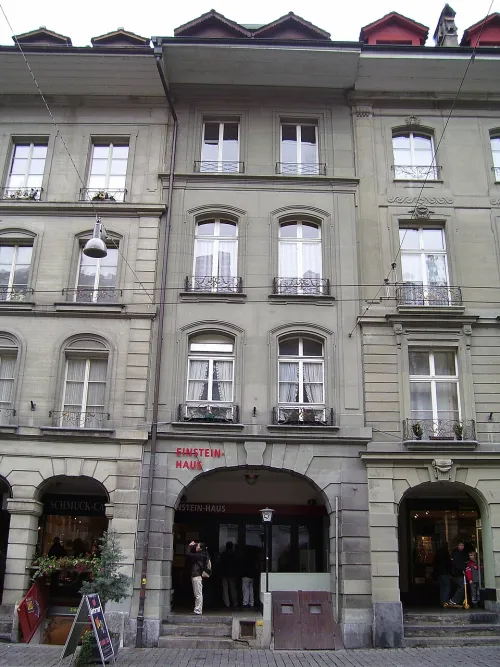
    At Kramgasse 49, a flat on the second floor was home to Albert Einstein, his wife Mileva Marić and their son Hans from 1903 to 1905. Einstein was working at the Federal Institute of Intellectual Property at the time, and in these rooms he wrote the papers of his 'miracle year', published in the Annalen der Physik. They presented his theory of relativity and helped lay the foundations of modern physics.

    The museum shows the apartment as the family lived in it, with furniture from the period, so you can picture a young patent clerk working at the table after hours. One floor up, an exhibition traces Einstein's life and work.

    It is the one paid stop on the loop. Allow about 45 minutes. If physics leaves you cold, the façade and the thought of what was written behind it may be enough; if you have any curiosity about Einstein, this is the place to spend it.

    From here it is 510 m and 7 minutes to the Bundesplatz.

    Local name
    Einsteinhaus
    Hours
    February to December: Mon–Sat 10:00–17:00
    Price
    CHF 8.– adults
  10. 10

    Bundesplatz

    Bundesplatz in Bern, stop 10 on the self-guided walking tour

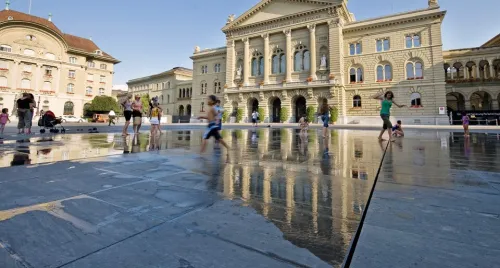
    You're standing in front of the Federal Palace, the seat of the Swiss parliament on the south side of the square at number 3. On the east side is the head office of the Swiss National Bank, on the west the Berner Kantonalbank; to the north the square opens onto the Bärenplatz. State receptions, political rallies and events all take place here.

    Look at your feet. A rectangle of natural stone, 60 by 36 metres and aligned with the geometry of the parliament building, dominates the square. Its slabs of Vals gneiss, each 60 by 100 cm and 6 cm thick, are laid in mirror symmetry so that large ornaments appear. A gently curving band of light runs through the square and visually links the Bärenplatz with the parliament.

    In the western part of the square, 26 water jets rise from the ground, one for each of the 26 cantons of the Swiss Confederation. On a warm day you'll see children running between them.

    Change may be coming on the north side: after UBS took over Credit Suisse, the parliamentary services want to rent the former Credit Suisse building at number 2 for a visitor centre. The Käfigturm is 220 m away, 3 minutes on foot.

    Hours
    Always open
    Price
    Free
  11. 11

    Käfigturm

    Käfigturm in Bern, stop 11 on the self-guided walking tour

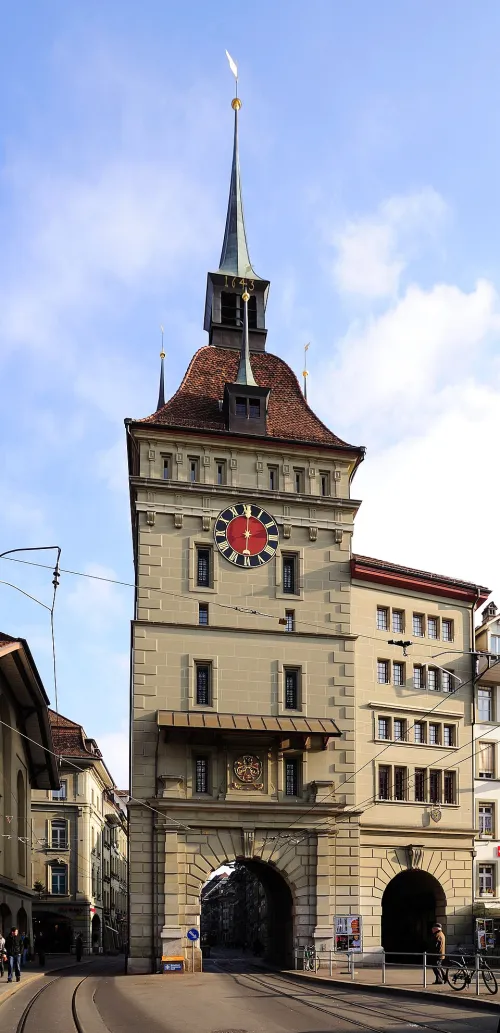
    The Baroque tower ahead stands where Bern's second city gate stood from 1256. As the city grew westward from the Zytglogge, a new wall needed a new gatehouse, and the first tower here looked much like the early Zytglogge: a hollow square, largely open at the back toward the city, with a small flat platform on top and a gate onto the bridge over the moat.

    Its name tells the next chapter. After the fire of 1405 the town prison moved here from the Zytglogge, and the tower became the nüwe kefyen, the new cage. That soon shrank to kebie, and from it came Käfigturm, the cage or jail tower. Once another tower became the women's prison, this one was known as the Mannenkefi, the men's cage. By 1433 it also served as a watch and signal tower.

    The tower you see is not the medieval one. In 1638 the council appointed a commission to replace the dilapidated building; it was torn down in 1640 and rebuilt from 1641, a little further west, since the old tower had stood about 3.8 metres to the east. One of the chief builders, Joseph Plepp, died in April 1642 before it was done.

    The tower is a cultural property of national significance and part of the UNESCO Old Town. Entry is free. The Französische Kirche is 280 m away, 4 minutes.

    Hours
    Mon: 14:00–18:00 | Tue–Fri: 10:00–18:00 | Sat: 10:00–16:00 | Sun: Closed
    Price
    Free
  12. 12

    Französische Kirche

    Französische Kirche in Bern, stop 12 on the self-guided walking tour

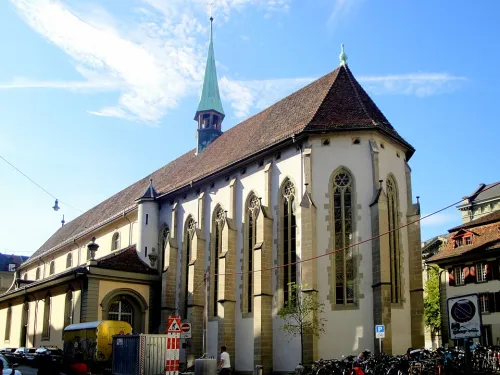
    The French Church at Zeughausgasse 8 began as a Dominican friary church. The friars, known as preachers, settled in Bern in 1269 and built it in the last two decades of the 13th century, which is why it was long called the Predigerkirche. Inside, the stone choir screen built with the church was painted in 1495 by artists from the circle of the Bernese Carnation Masters.

    After the Reformation the choir was turned into a granary in 1534 and walled off from the nave above the screen, where an organ was installed. The Baroque west front came in 1753; the choir was restored between 1909 and 1912 by Karl Indermühle, who also added a neo-Baroque sacristy. Between 1849 and 1864 that unused choir even housed the public art collections of the city and canton, the forerunner of Bern's art museum. Gone for good is Niklaus Manuel's Dance of Death, painted on the friary's south wall before 1520 and destroyed with the wall in 1660.

    The name comes from the people who worshipped here. French-language services began in 1623, and after the revocation of the Edict of Nantes in 1685 the church became a centre for Huguenot refugees. It still serves Bern's French-speaking Reformed parish, and choirs often choose it for large works, accompanied by the Goll organ of 1991 in a historic case built in 1828 by Franz Josef Remigius Bossart.

    Entry is free. The Kornhaus is only 60 m away, one minute.

    Hours
    Mon: Closed | Tue–Fri: 09:00–17:00 | Sat: 09:00–13:00 | Sun: 09:00–12:00
    Price
    Free
  13. 13

    Kornhaus

    Kornhaus in Bern, stop 13 on the self-guided walking tour

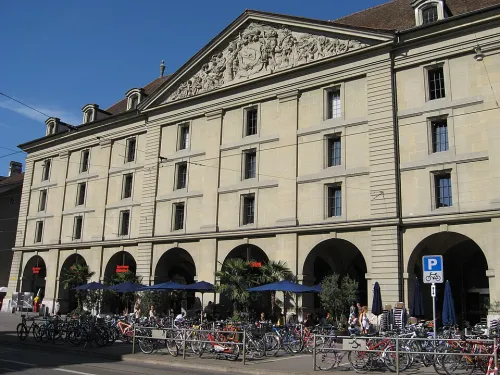
    This big sandstone building at Kornhausplatz 18 was the city granary, built between 1711 and 1715 to plans by the brothers Hans Jakob Dünz and Abraham Dünz the Younger. It belonged to the municipal grain office, founded in 1482, and stored the wine and grain with which the city paid its officials' salaries.

    In 1895 the city converted it into a trade museum, with a post office on the ground floor. The cellar became a grand festival hall, and after a competition Rudolf Münger painted it in Art Nouveau style: the coats of arms of all the districts of the canton of Bern, sayings by Otto von Greyerz, ribbons with folk songs, native flowers and animals.

    That cellar now holds the Kornhauskeller restaurant, which locals nickname the Chübu, Bernese for 'bucket'. Upstairs you'll find the main library of the Kornhausbibliotheken, the Kornhausforum for exhibitions and debates, and a café. Even if you don't eat here, a look into the painted cellar is worth it when the doors are open.

    The Kornhausbrücke starts from this same square, 290 m and 4 minutes away.

  14. 14

    Kornhausbrücke

    Kornhausbrücke in Bern, stop 14 on the self-guided walking tour

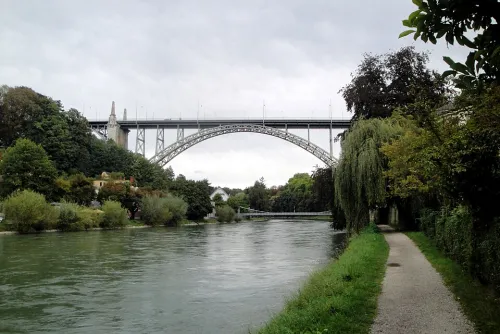
    The steel bridge named after the granary spans the whole Aare valley, connecting the Old Town with the Altenberg, Spitalacker and Breitenrain quarters to the north. It is 382 metres long and 12.6 metres wide; at the top of the main arch the roadway runs 47.76 metres above the river at low water. Look down and you'll see the much lower Altenbergsteg footbridge of 1857, just a few metres to one side.

    The town voted for it on 13 January 1895. Bernese engineers A. and H. von Bonstetten and Paul Simons designed it with the machine works Theodor Bell & Cie. in Kriens and the Gutehoffnungshütte in Oberhausen, whose engineer Reinhold Krohn was involved. Work began in September 1895 and the bridge opened on 18 June 1898. The steel truss arches carry the raised roadway: a main span of 115 metres and five smaller arches of 34 metres each.

    For the 2008 European Football Championship the bridge, part of the way from the main station to the Wankdorf stadium, was given a Dutch name, first Kornhausbrug, then Korenhuisbrug. A souvenir of it is still a favourite photo for Dutch visitors and football fans. Corrosion protection work is planned between spring and autumn until 2028, so expect scaffolding in places.

    Walk out as far as you like for the view, then head back 290 m, 4 minutes, to the Kindlifresserbrunnen on the Kornhausplatz.

    Hours
    Always open
    Price
    Free
  15. 15

    Kindlifresserbrunnen

    Kindlifresserbrunnen in Bern, stop 15 on the self-guided walking tour

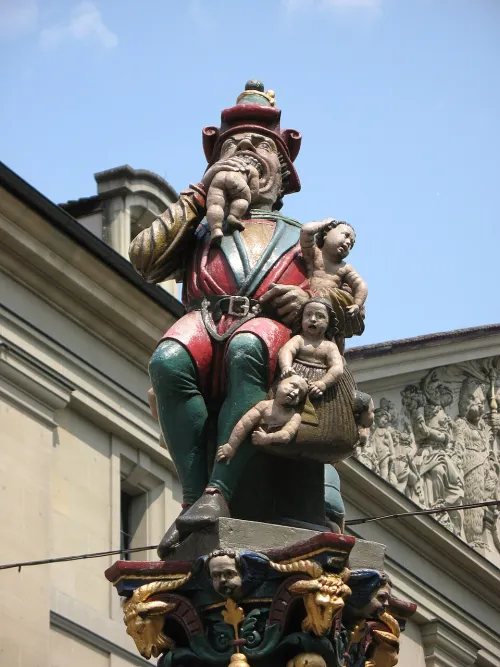
    Here is the strangest fountain in town by any measure: a seated ogre biting into a naked child, with a sack of more children at his side. Its name is Swiss German for 'child eater fountain'. It was made in 1545 and 1546 by Hans Gieng, the same sculptor who carved Lady Justice at the start of your walk, to replace a wooden fountain from the 15th century. It was first called simply the Platzbrunnen; the current name appears in 1666.

    Nobody knows for sure who the ogre is. His pointed hat looks like the hat Jews were made to wear, which has led to speculation that the figure expresses the antisemitic blood libel. Others see Krampus, the Alpine figure who punishes naughty children at Christmas, or Cronus devouring his children, though Cronus should have six and Saturn twelve, not the eight here. Some think of Cardinal Schiner, who led the Swiss into bloody defeats in northern Italy, or of a jealous older brother of Bern's founder who supposedly ate the town's children, a story no chronicle records.

    Two more readings: a carnival figure meant to scare disobedient children, or the eight children as the eight cantons of the Old Swiss Confederacy, with an enemy such as Charles the Bold, Duke of Burgundy, trying to swallow them up. Decide for yourself as you look at the painted figure.

    The Zytglogge is just 80 m away, one minute on foot, and that closes the loop.

    Hours
    Always open
    Price
    Free
Walking tour route map of Bern Route loaded
ZytgloggeZähringerbrunnenFountain of JusticeNydegg Church+11
All 15 stops are already on the map.
You just press start.
AI Tour Guide

You've read the Bern loop. Now walk it with a guide in your ear.

Press start wherever you are, even hundreds of kilometres from Bern, and the guide begins telling its stories right away. In the city, pick any of the 15 stops to start from: it leads you there, then talks with you the whole route, asking, listening, remembering, and shaping the tour around your answers.

15stops 5.7km 1 h 21 minwalking 13languages
▶Start the tour free

Free to start · Runs in your browser · No app, no download

Shorter Ways to Walk Bern's Old Town

The loop splits neatly at the Münsterplattform, so you can walk half of it today and the other half tomorrow, or pick the half that suits your group.

Lower Old Town, roses and bears

Stops: 1, 2, 3, 4, 5, 6, 7, 8

For families and anyone who wants fresh air more than museums: from the Zytglogge past three fountains and the Nydegg Church, out to the Rose Garden with its big playground, then the BearPark and back over the Nydegg Bridge. 55 minutes of walking, about 2 h 15 min with breaks, and nothing to pay. You finish 3 minutes from the Einstein House if you change your mind.

Upper Old Town: Einstein, parliament and towers

Stops: 8, 9, 10, 11, 12, 13, 14, 15

For a compact half day in the centre: from the Münsterplattform to the Einstein House, the Bundesplatz, the Käfigturm, the French church and the Kornhaus quarter. 26 minutes of walking, plus 1 minute back to the Zytglogge; around two hours with the Einstein House as the only paid entry, well under an hour and a half without it.

The full loop

Stops: 1, 2, 3, 4, 5, 6, 7, 8, 9, 10, 11, 12, 13, 14, 15

For a first visit with a free morning: all 15 stops, 1 h 21 min of walking and about four hours in total. The Einstein House is the one admission fee; the guided tour inside the Zytglogge is an extra you can add at the start.

How Long Does This Bern Tour Take With the Einstein House?

The walking itself takes 1 h 21 min. What stretches the day is the Einstein House, where 45 minutes is a comfortable visit, and the Rose Garden, where twenty minutes on the benches and among the roses feels about right. Add a few minutes at each fountain, church and tower and you land at roughly four hours.

Start at the Zytglogge at 09:00 and you reach the Einstein House around 11:15, the Französische Kirche at about 12:40 and the Zytglogge again a little after 13:00.

The lower half alone takes about 2 h 15 min with breaks; the upper half about two hours with the Einstein House, less than an hour and a half if you skip it.

Before You Set Off in Bern

  • Start and finish: The recommended start is the Zytglogge, and the loop brings you back to it. You can join at any stop; the order here is simply the one that flows best.
  • Best day: Pick a day when the Käfigturm, the Französische Kirche and the Einstein House are all open. On Saturdays, start early so you reach the French church in good time.
  • Costs: The fountains, bridges, squares, parks and the BearPark cost nothing, and so do the Nydegg Church, the Käfigturm and the Französische Kirche. You pay only for the Einstein House and, if you want it, a guided tour inside the Zytglogge.
  • Water: The Zähringerbrunnen on the Kramgasse is fed from the city's drinking water network, and its quality is checked regularly, so you can refill a bottle there early on.
Walking tour route map of Bern
AI Tour Guide

Your Bern guide starts whenever you do.

Press start and a voice AI Tour Guide takes it from here: leading the route through Bern, telling the stories, and turning your walk into a real back-and-forth conversation. No app or download is needed; it runs in your browser.

15stops 5.7km 1 h 21 minwalking 13languages
▶Start the tour free

Free to start · Runs in your browser · No app, no download

What the AI Tour Guide Adds on the Bern Loop

Walk this loop with the AI Tour Guide and it leads the way as a conversation: it greets you at the Zytglogge, tells the stories of each fountain and tower, asks what you make of the child-eating ogre, and remembers that you lingered at the Einstein House, so it might tell you more about the patent office years later on. Curious who the Bernese Carnation Masters were, or what Einstein's 1905 papers actually said? Ask, or cut in whenever you like. Route, map and GPS navigation stay free; the guide starts with 100 free credits, after that you choose between this tour all-inclusive for €19.99 with no time limit or €5 per hour.

A Real Conversation A voice AI Tour Guide greets you, leads the whole route, and tells the stories and facts as you walk, asking what you want to see and keeping a real conversation going. Not a recording you press play on.
Map Navigation Follow the route on the map and walk at your own pace. You choose where to start and when to move to the next stop.
Ask Anything Curious about a building you pass? Ask your AI Tour Guide on the spot and the conversation carries on.
13 Languages Switch language anytime. No separate tour needed.
Start free in your browser

Common Questions About Walking Bern

Can I take a bus to the Rose Garden instead of walking?

Yes. Bus 10 toward Ostermundigen stops at Rosengarten and gets you there from the centre in a few minutes. Parking near the park is scarce, so leave a car elsewhere.

When is the market on the Bundesplatz?

The weekly market fills the square every Tuesday and Saturday. On those mornings the Bundesplatz is busier and more colourful than on the other days.

Is there more about Einstein in Bern than the Einstein House?

A smaller permanent exhibition on Einstein is part of the Historical Museum of Bern. The Einstein House on the Kramgasse is the place where he actually lived and wrote.

How do I get from the Münsterplattform down to the Aare?

The Mattelift, an electric passenger lift running since 1897, connects the terrace with the Matte quarter on the river.

Which towns make a good second day from Bern?

Lakeside Thun and medieval Murten are both about 25 km away; Fribourg (27 km) and Solothurn (30 km) each have their own walking loop too.

Is the tour really free?

Yes. The whole tour is free: the route, the interactive map and the navigation cost you nothing. Only the voice AI Tour Guide is optional and paid: you test it with 100 free credits, then you pay either €5 per hour or €19.99 for this whole tour, with no time limit.

Do I need to download an app?

No. Everything runs in your phone browser. Open the route and start walking, no download and no sign-up required.

Do I need to book the walking tour in advance?

No booking needed. This self-guided tour is available anytime. Open the route in your browser and start walking. The AI Tour Guide works instantly, no app, no reservation required.

What languages is the AI Tour Guide available in?

The AI Tour Guide speaks 13 languages, so you take the tour in your own language and can switch at any time.

Can I skip stops or change the route?

Yes. Skip any stop, spend extra time at places you like, or start the route from any point. It is your walk, you set the pace.
Image credits
▶ Start free in your browser Runs in your browser, no app, no download