Free Walking Tour Solothurn: Gates, Clock and Cathedral

Two town gates, an astronomical clock from 1545, a cathedral and three free museums, all on one compact loop through Solothurn's old town that ends on the Aare.

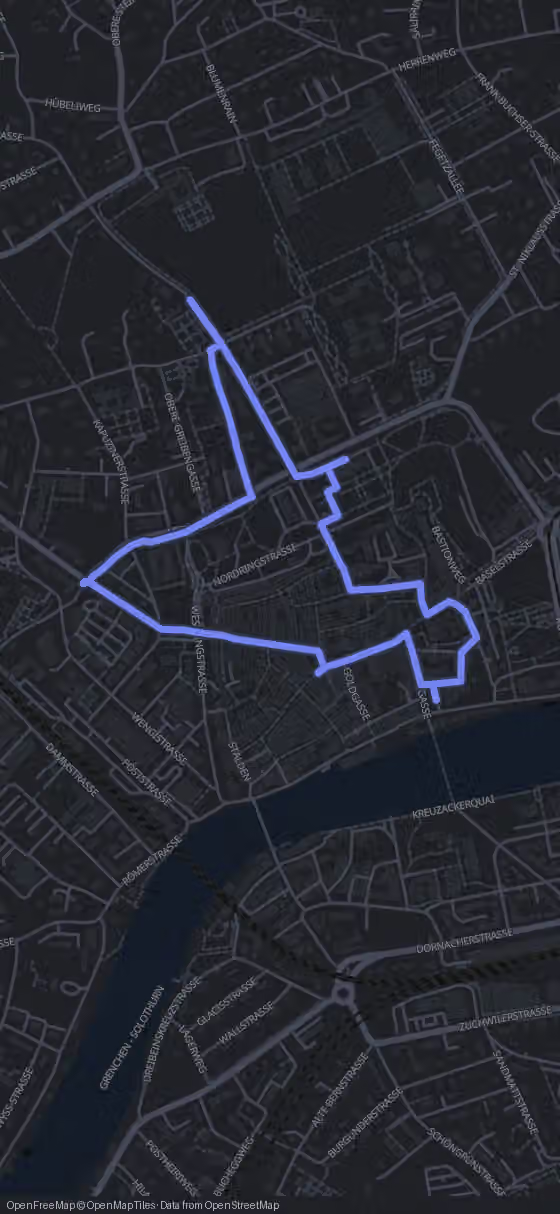
13 Stops 2.3 km ~32 min walking
Route map for the Solothurn walking tour
Stop 1 of 13
170 m·2 min
Bieltor
Head east through the Bieltor arch toward Märetplatz Weekly Market.
Grüezi, welcome to Solothurn. I'm Alex, and three figures above an old city gate have performed the same drama for centuries.
Try this tour with Alex

The Solothurn loop at a glance

13 stops on a 2.3 km loop that starts and ends at the Bieltor, with 32 minutes of pure walking. Allow a little over two hours for the outside sights and the free churches, and around five and a half hours if you go into every museum.

Almost everything is free: only the Museum Altes Zeughaus charges admission, and the Zeitglockenturm opens inside only on guided tours. Route, map and GPS navigation are free in your browser, and the optional AI Tour Guide tells the stories as you walk.

Open free GPS & optional AI Tour Guide
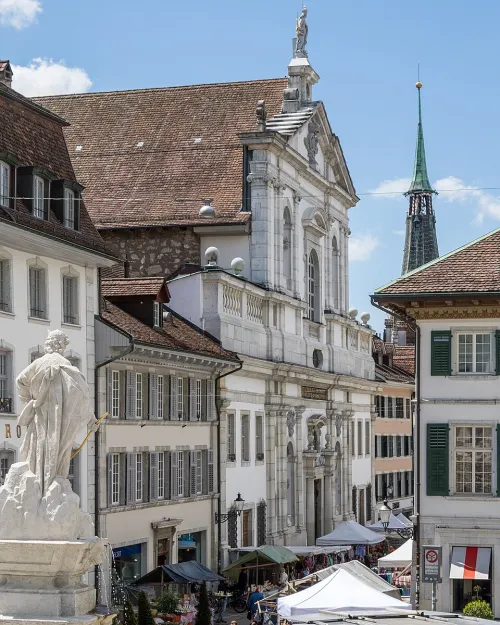
View of Solothurn

The Route

Walking map of Solothurn's old town loop

13 stops 2.3 km 32 min walking
Tap to load interactive map

The 13 stops along this route

  1. Bieltor in Solothurn, stop 1 on the self-guided walking tour
    1Bieltor
  2. 2Märetplatz Weekly Market
  3. Zeitglockenturm in Solothurn, stop 3 on the self-guided walking tour
    3Zeitglockenturm
  4. Steinmuseum Solothurn, stop 4 on the self-guided walking tour
    4Steinmuseum Solothurn
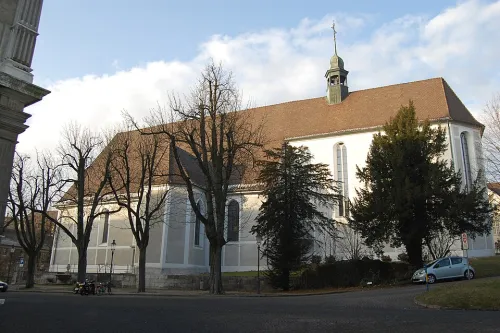
  5. Jesuitenkirche in Solothurn, stop 5 on the self-guided walking tour
    5Jesuitenkirche
  6. Naturmuseum in Solothurn, stop 6 on the self-guided walking tour
    6Naturmuseum
  7. Baseltor in Solothurn, stop 7 on the self-guided walking tour
    7Baseltor
  8. St. Urs Cathedral in Solothurn, stop 8 on the self-guided walking tour
    8St. Urs Cathedral
  9. Museum Altes Zeughaus in Solothurn, stop 9 on the self-guided walking tour
    9Museum Altes Zeughaus
  10. Franziskanerkirche in Solothurn, stop 10 on the self-guided walking tour
    10Franziskanerkirche
  11. Kunstmuseum Solothurn, stop 11 on the self-guided walking tour
    11Kunstmuseum Solothurn
  12. Sommerhaus Vigier in Solothurn, stop 12 on the self-guided walking tour
    12Sommerhaus Vigier
  13. 13Aare Riverfront Promenade
  14. That's the full loop.

    Walk it with an AI Tour Guide talking you through every one of these streets.

    Start free in your browser
    You made it

Solothurn walking tour: 13 stops from gate to gate

  1. 1

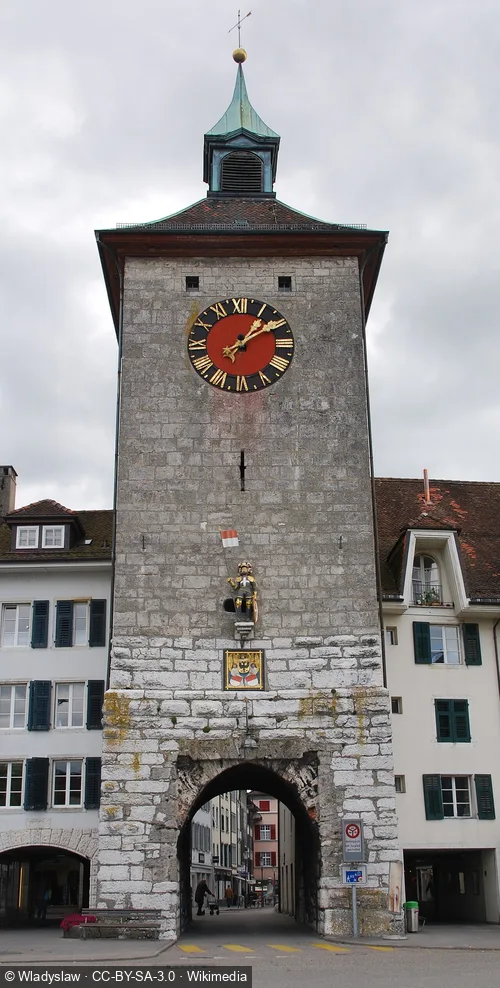
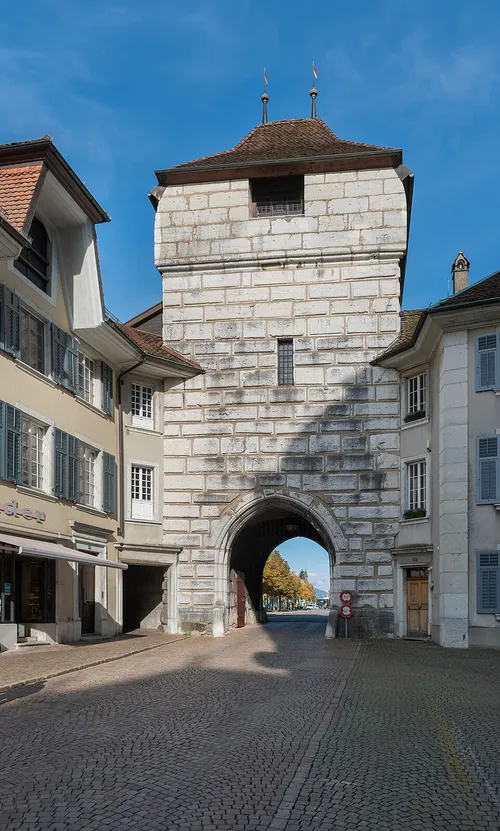
    Bieltor

    Bieltor in Solothurn, stop 1 on the self-guided walking tour

    Start at the Bieltor, the historic gate on the western edge of Solothurn's old town. It is also where you finish: the last leg of the loop brings you back to exactly this spot, so treat the gate as your fixed point for the day.

    There is no interior to visit, and for a gate that is no loss. Look at it from outside, walk through it, then turn once from the inside and look back at the arch you just passed. No ticket, no queue. Right beside the gate you also pass the Kosciuszko Museum.

    From here the route turns into the old town and reaches the market square after 170 m, about 2 minutes on foot.

    Hours
    Open 24/7 (exterior viewing only; no public interior access)
  2. 2

    Märetplatz Weekly Market

    The Märetplatz is the market square in the historic centre, and it works on two levels. The square itself is open public space, free at any hour. The weekly Märet only fills it on certain mornings, and on those mornings this stop turns from a place into an event.

    If your dates allow it, build the day around a market morning: stalls first, then the churches, and keep the museums for later, once they have opened. On any other day you get the square as architecture rather than as market, which is still a good first look at the old town you are about to walk through.

    The Zeitglockenturm is only 30 m away, a minute's walk. If the top of the hour is close, head over now and come back to the stalls afterwards.

    Hours
    Wed, Sat 07:15–12:15; market square itself always accessible
    Price
    Free
  3. 3

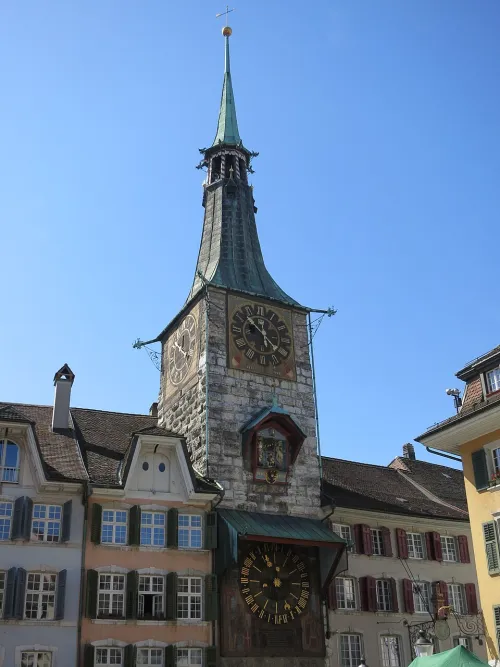
    Zeitglockenturm

    Zeitglockenturm in Solothurn, stop 3 on the self-guided walking tour

    Just off the square, on Hauptgasse, stands the oldest building in Solothurn. Nothing else on this route is older than the Zeitglockenturm, and its centrepiece still earns its keep: the astronomical clock on the tower dates from 1545 and performs every hour.

    So time your arrival for the top of the hour. The clock face and its figures put on their show for the street, free, on any day, and that performance is what most visitors take home. Stand back far enough to see the whole face at once, and use the waiting minutes to give the rest of the facade a proper look.

    The interior with the clock movement is a different matter: it opens only on official guided tours, so without a booking the tower stays an outside sight. For a first visit that is enough. If clockwork is your specific reason for coming to Solothurn, book the tour before you travel.

    The Steinmuseum Solothurn is 60 m further, a minute's walk, and it begins a short stretch where museums and churches sit close together.

    Hours
    Exterior viewable 24/7; astronomical clock animation hourly; interior visit by guided tour only
    Price
    Interior visit via guided tour only
  4. 4

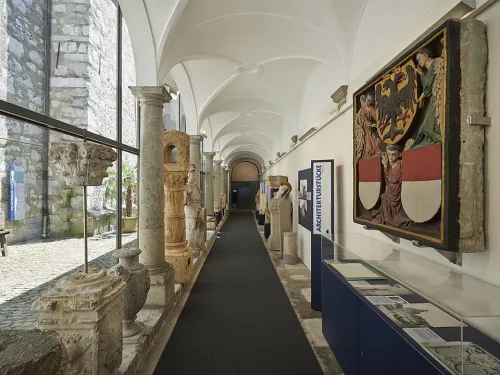
    Steinmuseum Solothurn

    Steinmuseum Solothurn, stop 4 on the self-guided walking tour

    The Steinmuseum Solothurn is devoted to a single material, Solothurn limestone, and to the craft of working it. Historic pieces in stone fill the rooms, and a large part of them came from the lapidarium in the former cloister of the neighbouring Jesuit college.

    What makes it different is that you are meant to touch. Under a project called “Mit den Händen sehen”, seeing with your hands, the exhibits are there to be felt as well as looked at, and in 2013 that idea earned the museum a tourism prize from the canton. An audioguide tells you what you are holding, and interactive installations and films explain the craft.

    The museum is run by a volunteer association, the Solothurner Steinfreunde, founded in 1980 as the Friends of Solothurn Stone; the pieces themselves belong to the town and the canton. It opened in 1983 in the Kreuzen property in Rüttenen and moved in 1997 to its present home beside the Jesuitenkirche.

    Entry is free, but this is a seasonal museum, not open all year. It is worth twenty minutes for anyone curious about craft, and for children who like to put their hands on things. The Jesuitenkirche is right next door, 20 m away.

    Hours
    May–Oct: Tue–Sat 14:00–17:00, Sun 10:00–17:00, Mon closed; Nov 1 – May 1 closed
    Price
    Free
  5. 5

    Jesuitenkirche

    Jesuitenkirche in Solothurn, stop 5 on the self-guided walking tour

    The Jesuitenkirche carries a name it has not strictly held since 1773. The Jesuits ran it only until the pope dissolved their order that year, yet Solothurn still calls it the Jesuit church. It is a Roman Catholic church dedicated to the Assumption of Mary, built between 1680 and 1689, probably to plans by the Jesuit Heinrich Mayer, and protected as a cultural asset of national significance.

    The story begins in 1646, when the aristocratic Great Council called the Jesuits to Solothurn, above all to push the Counter-Reformation. A provisional college opened that same year as the town's grammar school. The new college rose between 1676 and 1679, the church followed, and both were paid for largely by the French royal house, whose ambassador lived in Solothurn, together with the town's patrician families. The building of today's Stadttheater belonged to that complex too.

    After 1773 the council kept the college going and services continued without the Jesuits. The organ on the second gallery was built between 1791 and 1794. When French revolutionary troops occupied Switzerland in 1798, two citizens, Josef Lüthy and Hieronymus Vogelsang, made sure that college and church passed to the town instead of becoming national property. In 1832 the college gave way to a secular cantonal school.

    Entry is free, and it is worth going in for anyone who wants to see what French money and Counter-Reformation ambition built in a Swiss town. Look up at the organ gallery before you leave. The Naturmuseum is 190 m away, about 3 minutes.

    Hours
    Daily 09:00–17:00
    Price
    Free
  6. 6

    Naturmuseum

    Naturmuseum in Solothurn, stop 6 on the self-guided walking tour

    The Naturmuseum shows the animals, plants, fossils and minerals of the region, arranged systematically with an ecological slant, plus a special exhibition twice a year. Entry is free. It is run by the town together with the Kunstmuseum Solothurn and the Historisches Museum Blumenstein.

    Its roots go back a long way. As early as 1765 an economic and agricultural society in Solothurn kept a library and a mineral collection, and in 1823 the Naturforschende Gesellschaft was founded, still active today. One of its patrons, the abbé and professor Franz Joseph Hugi, sold his natural history collection to the town in 1825 and set up a first museum in the old orphanage. In 1902 a museum of art and science opened in the green belt along the town moat; in 1978 it was dissolved and turned into today's Kunstmuseum, while natural history moved out.

    The best story here belongs to the Solothurn sculptor Urs Eggenschwyler, who ran an animal menagerie on the Milchbuck in Zurich and designed rock enclosures for zoos of European standing, among them the Tierpark Hagenbeck and the sea lion rocks at Zoo Basel. His favourites were lions and bears; the “Zürileuli” and the Kamchatka bear “Urs” became famous. The museum keeps bears, lions and several other mounted animals from his menagerie, so look out for them.

    Allow about forty minutes; with children, this is the museum of the loop. The Baseltor is 210 m on, about 4 minutes.

    Hours
    Tue–Sat 14:00–17:00, Sun 10:00–17:00, Mon closed
    Price
    Free
  7. 7

    Baseltor

    Baseltor in Solothurn, stop 7 on the self-guided walking tour

    The second gate of the loop, and the more martial of the two. The Baseltor is a gate fortress, built between 1504 and 1508 when late Gothic was giving way to the Renaissance, and it looks exactly like what it is: a fortification with a road running through it rather than a decorated archway.

    Its rooms are rented out for private events and meetings, so there is no walk-in interior to plan for. If the gate looks busy, that is a booking, not a door you failed to find.

    Give the exterior a few minutes, walk through, and notice how close the cathedral is: St. Urs Cathedral is only 20 m away, a minute's walk.

    Hours
    Open 24/7 (exterior viewing only; no public interior access)
  8. 8

    St. Urs Cathedral

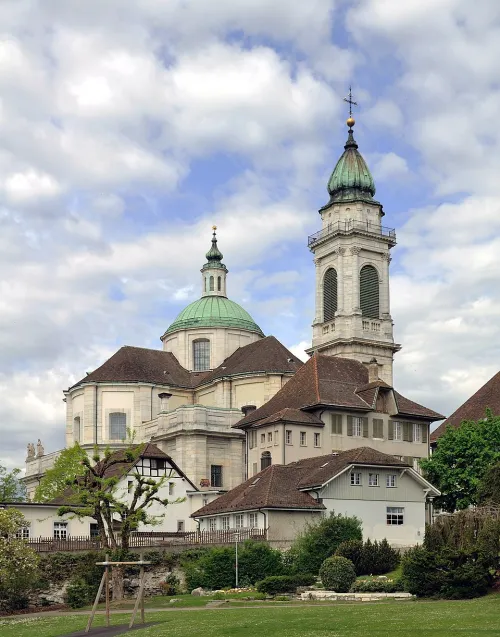
    St. Urs Cathedral in Solothurn, stop 8 on the self-guided walking tour

    Look at the title before you go in: St. Urs Cathedral is the cathedral of the Roman Catholic Diocese of Basel, yet it stands in Solothurn. It is a Swiss heritage site of national significance and the centrepiece of this route.

    It is named after Ursus, who with Victor is remembered as a 3rd-century Roman martyr. Very early on both were linked to the Theban Legion, whose soldiers, according to the legend, died for refusing to worship the emperor. In the 5th century Eucherius of Lyon wrote that Ursus was tortured and beheaded under Emperor Maximian and the governor Hyrtacus around 286 for refusing to worship idols. By the 5th century he was already venerated in the town.

    A church has stood on this site since the early Middle Ages. By 870 there was a college of canons, founded and supported by the Carolingian kings, whose members ate and lived together. The Gothic church is first documented in 1294, with altars consecrated in 1293 and 1298. The Basel earthquake of 1356 probably damaged its twin towers; in 1360 a single tower, the Wendelstein, rose above the church, and a Gothic facade was added on the west side. The choir was rebuilt in 1544, the nave rebuilt and widened in 1644, the sacristy extended in 1664. The church that stood here until 1762 still had a two-part crypt, which one historian took as a sign that the crypt was older than the year 1100.

    Entry is free and the interior is worth it for everyone on this walk; just avoid service times, when visits are not possible. The Museum Altes Zeughaus is 80 m away, a minute on foot.

    Hours
    Daily 08:00–18:30 (cathedral interior; no visits during church services)
    Price
    Free
  9. 9

    Museum Altes Zeughaus

    Museum Altes Zeughaus in Solothurn, stop 9 on the self-guided walking tour

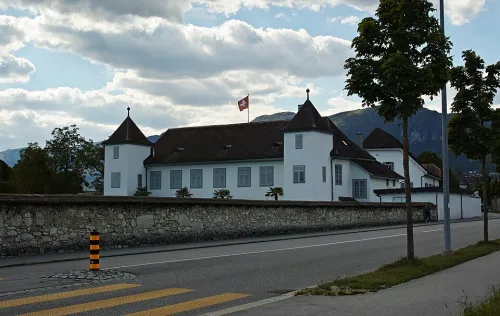
    Built around 1609, this building served for centuries as the armoury of Solothurn's troops, back when the town was still a sovereign state within the Swiss Confederation, and it kept that role even after the federal state of 1848 began to centralise the army. When the canton opened new armouries in the early 20th century, the old one became a museum in 1907. A full renovation between 2014 and 2016 brought a completely new exhibition.

    It is one of the largest historical arms and armour collections in Switzerland, with its focus firmly on the canton. Heavy artillery fills the ground floor. Along the west wall of the ground and first floors, display depots let you follow how infantry weapons changed over centuries: cutting and thrusting weapons, pole arms, firearms. The armour hall on the second floor holds around 400 suits of armour, and that is the room people remember.

    The exhibition also explains why all this was needed. In the Swabian War, at the Battle of Dornach in 1499, Solothurn fought for the first time as a full member of the Confederation, and what was at stake was de facto independence from the Holy Roman Empire. Solothurn's mercenaries and the military entrepreneurs who made money from other people's wars get their own space too. The story runs from the Middle Ages to the First World War.

    This is the only stop on the loop that charges admission. It pays off for anyone drawn to military or political history; give it about an hour. The Franziskanerkirche is 70 m away, a minute's walk.

    Hours
    Tue–Sat 13:00–17:00, Sun 10:00–17:00, Mon closed
    Price
    CHF 8 adults, CHF 6 students/seniors (AHV/IV)/groups, CHF 10 families, free under 12

  10. 10

    Franziskanerkirche

    Franziskanerkirche in Solothurn, stop 10 on the self-guided walking tour

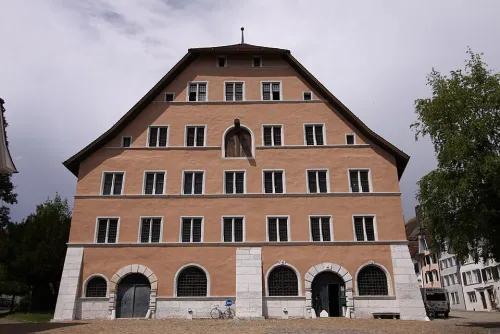
    The Franziskanerkirche began as the church of a Franciscan friary and is today the Christ Catholic church of Solothurn. The Franciscans settled here in 1280 and consecrated their first church in 1299. After a fire in 1426 it was rebuilt by 1436 as a late Gothic mendicant church.

    Its history mirrors the town's swings. During the Reformation the friary stood empty and the Bernese reformer Berchtold Haller preached here; from 1546 friars lived in it again. While foreign ambassadors resided in Solothurn, until the end of the Ancien Régime, it served as the court church of the French envoy, and the high altar received a painting of the Assumption of Mary donated by King Louis XIV. What you see today comes mostly from a classicist remodelling between 1823 and 1825.

    During the Kulturkampf the friary was dissolved. In 1876 Joseph Meier led the first Christ Catholic service in Solothurn here, and after long negotiations the Christ Catholic parish bought the church in 1896.

    Entry is free, and a short visit is enough: go in for the altar painting with its royal donor. From here it is 280 m, about 4 minutes, to the Kunstmuseum Solothurn.

    Hours
    Daily 09:00–17:00
    Price
    Free
  11. 11

    Kunstmuseum Solothurn

    Kunstmuseum Solothurn, stop 11 on the self-guided walking tour

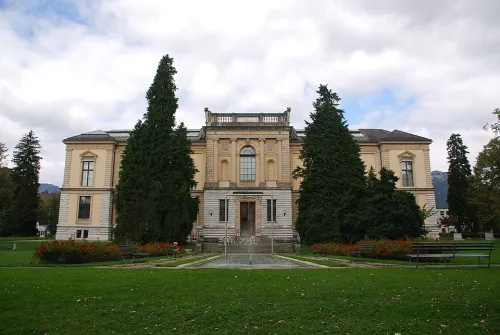
    The Kunstmuseum Solothurn opened in 1902 as a “Museum of Art and Science”, and it is one of the town's leading cultural institutions. Its collection runs from the late Middle Ages to the present, with the emphasis on Swiss art of the 19th and 20th centuries, plus outstanding single works and groups by major artists from other countries. Generous gifts from Solothurn collectors such as Oscar Miller, Josef Müller and Gertrud Dübi-Müller built it up.

    Head first for the small old masters collection and its two highlights: the Madonna in the Strawberries, painted around 1425 by the Master of the Paradise Garden, and the Solothurn Madonna by Hans Holbein the Younger from 1522. Those two alone justify the visit, and entry is free.

    The building has an uncomfortable past worth knowing. Its original natural history department mixed exotic insects, parts of mammoth tusks and a crocodile with an “ethnological collection”, and the 1902 opening publication reflects the colonial thinking and racial theories of its time. That department closed in the 1970s and moved to the Naturmuseum, and the space has belonged to the visual arts ever since. In the garden some exotic trees from that era still stand, including a sequoia.

    Plan about an hour if art is your thing. Then it is 380 m, about 6 minutes, to the Sommerhaus Vigier.

    Hours
    Tue–Fri 11:00–17:00, Sat–Sun 10:00–17:00, Mon closed
    Price
    Free
  12. 12

    Sommerhaus Vigier

    Sommerhaus Vigier in Solothurn, stop 12 on the self-guided walking tour

    The Sommerhaus Vigier is a large residence from the middle of the 17th century, north of the old town at Untere Steingrubenstrasse 21. The name tells you what it was built for: a summer house, a place to spend the warm months outside the town.

    The interior is private and used only for events, so this is a stop for the outside view from the street and the edges of the park. Take a few minutes, then set off on the longest leg of the loop: 600 m, about 8 minutes, down to the Aare.

    Hours
    Exterior viewable from street/park boundaries 24/7; interior private / event-only
  13. 13

    Aare Riverfront Promenade

    The longest walk of the route ends at the water. The promenade along the Aare, the Landhausquai, is public street space in the best sense: no hours, no fence, no fee, never closed.

    This is where the tour stops being a list and becomes a walk, so take the pause. If you began with the market in the morning, the riverbank is the calm end your day was waiting for.

    From here the loop closes with one short leg back to the Bieltor, 200 m and about 3 minutes. Nothing to retrace and no return trip to plan: you are back where you started.

    Hours
    Open 24/7
Walking tour route map of Solothurn Route loaded
BieltorZeitglockenturmSteinmuseum SolothurnJesuitenkirche+9
All 13 stops are already on the map.
You just press start.
AI Tour Guide

You have the route. Now walk it with a guide in your ear.

Press start wherever you are, even hundreds of kilometres from Solothurn, and the guide begins telling its stories right away. In the city, pick any of the 13 stops to start from: it leads you there, then talks with you the whole route, asking, listening, remembering, and shaping the tour around your answers.

13stops 2.3km 32 minwalking 13languages
▶Start the tour free

Free to start · Runs in your browser · No app, no download

Shorter ways to walk Solothurn

The loop is compact, so cutting it is easy. These three versions follow the recommended order.

Old town core

Stops: 1, 2, 3, 4, 5, 6, 7, 8, 9, 10

For a first visit with limited time: the western gate, market square, clock tower, both churches of the Jesuit and Franciscan orders, the Baseltor and the cathedral. About 850 m and 15 minutes of walking, ending at the Franziskanerkirche. The only stop that charges admission is the Museum Altes Zeughaus, which you can easily pass by.

Museums and churches

Stops: 4, 5, 6, 7, 8, 9, 10, 11

For a rainy day or a culture afternoon: from the Steinmuseum Solothurn through the Naturmuseum, cathedral and armoury to the Kunstmuseum Solothurn. About 870 m and 15 minutes of walking. Everything is free except the Museum Altes Zeughaus.

Art, summer house and river

Stops: 11, 12, 13, 1

For a relaxed late stroll: from the Kunstmuseum Solothurn past the Sommerhaus Vigier to the Aare and back to the Bieltor. About 1.2 km and 17 minutes of walking, with no admission anywhere.

How long the Solothurn tour takes, with and without museums

The pure walking time is 32 minutes for 2.3 km. Most legs are a minute or two; the longest is the 600 m between the Sommerhaus Vigier and the Aare Riverfront Promenade. What fills the day is what you go into.

Looking at the gates and the clock, going into the two churches and the cathedral and pausing at the market and on the river comes to a little over two hours. Add the Steinmuseum and the Naturmuseum, plus about an hour each in the armoury and the Kunstmuseum, and you are at around five and a half hours. The old town core and the museum version each take 15 minutes of walking, the river stretch 17 minutes.

Before you set off in Solothurn

  • Start and finish: The Bieltor, since the route is a loop. You can join at any stop, but the order on the route is the recommended one.
  • Time of day: On a market morning, see the stalls on the Märetplatz first. If the museums are your priority, a start around midday suits the order of the loop better, as the museums do not open early.
  • On the hour: Plan to stand in front of the Zeitglockenturm at the top of an hour, when the astronomical clock performs.
  • Admission: Only the Museum Altes Zeughaus charges admission. The churches, the cathedral and the other three museums are free; the Zeitglockenturm opens inside only on guided tours, and the cathedral cannot be visited during services.
Walking tour route map of Solothurn
AI Tour Guide

Your guide starts whenever you do

Press start and a voice AI Tour Guide takes it from here: leading the route through Solothurn, telling the stories, and turning your walk into a real back-and-forth conversation. No app or download is needed; it runs in your browser.

13stops 2.3km 32 minwalking 13languages
▶Start the tour free

Free to start · Runs in your browser · No app, no download

What the AI Tour Guide adds in Solothurn

On this loop the AI Tour Guide turns thirteen stops into one conversation: it greets you at the Bieltor, tells the stories of each place, asks what you noticed and remembers whether you lingered at the armour or the Holbein. Wondering who the figures on the clock represent, or how limestone was worked before it reached the Steinmuseum? Just interrupt and ask. You start with 100 free credits; after that you choose between this tour all-inclusive for €19.99 with no time limit, or €5 per hour.

A Real Conversation A voice AI Tour Guide greets you, leads the whole route, and tells the stories and facts as you walk, asking what you want to see and keeping a real conversation going. Not a recording you press play on.
Map Navigation Follow the route on the map and walk at your own pace. You choose where to start and when to move to the next stop.
Ask Anything Curious about a building you pass? Ask your AI Tour Guide on the spot and the conversation carries on.
13 Languages Switch language anytime. No separate tour needed.
Start free in your browser

Common questions about Solothurn

Does the tour work on a rainy day?

Better than most. The two churches, the cathedral and three free museums give you plenty of time indoors, and the walks between them are short. Only the gates, the Sommerhaus Vigier and the Aare promenade are purely outdoor stops.

Can I combine Solothurn with another town in one day?

Yes, the 32 minutes of walking leave room. The closest towns with their own routes are Biel/Bienne at 23 km and Bern at 30 km.

Is the loop good with children?

Very. Kids can touch the exhibits at the Steinmuseum, meet the bears and lions at the Naturmuseum, watch the clock perform on the hour and see around 400 suits of armour at the Zeughaus.

Which museum should I pick if I only have time for one?

For art, the Kunstmuseum Solothurn and its Holbein. For history, the Museum Altes Zeughaus, the only one that charges admission. With a family, the Naturmuseum.

Is the tour really free?

Yes. The whole tour is free: the route, the interactive map and the navigation cost you nothing. Only the voice AI Tour Guide is optional and paid: you test it with 100 free credits, then you pay either €5 per hour or €19.99 for this whole tour, with no time limit. Admission to one of the 13 stops is not included: Museum Altes Zeughaus charges its own entry fee.

Do I need to download an app?

No. Everything runs in your phone browser. Open the route and start walking, no download and no sign-up required.

Do I need to book the walking tour in advance?

No booking needed. This self-guided tour is available anytime. Open the route in your browser and start walking. The AI Tour Guide works instantly, no app, no reservation required.

What languages is the AI Tour Guide available in?

The AI Tour Guide speaks 13 languages, so you take the tour in your own language and can switch at any time.

Can I skip stops or change the route?

Yes. Skip any stop, spend extra time at places you like, or start the route from any point. It is your walk, you set the pace.
Image credits
▶ Start free in your browser Runs in your browser, no app, no download