Free Walking Tour Fribourg: Upper Town to the Sarine

Thirteen stops from the Gothic cathedral down to a covered bridge from 1250 and back, past Fribourg's oldest church, Tinguely's art and a Saturday market.

13 Stops 5.9 km ~1 h 38 min walking
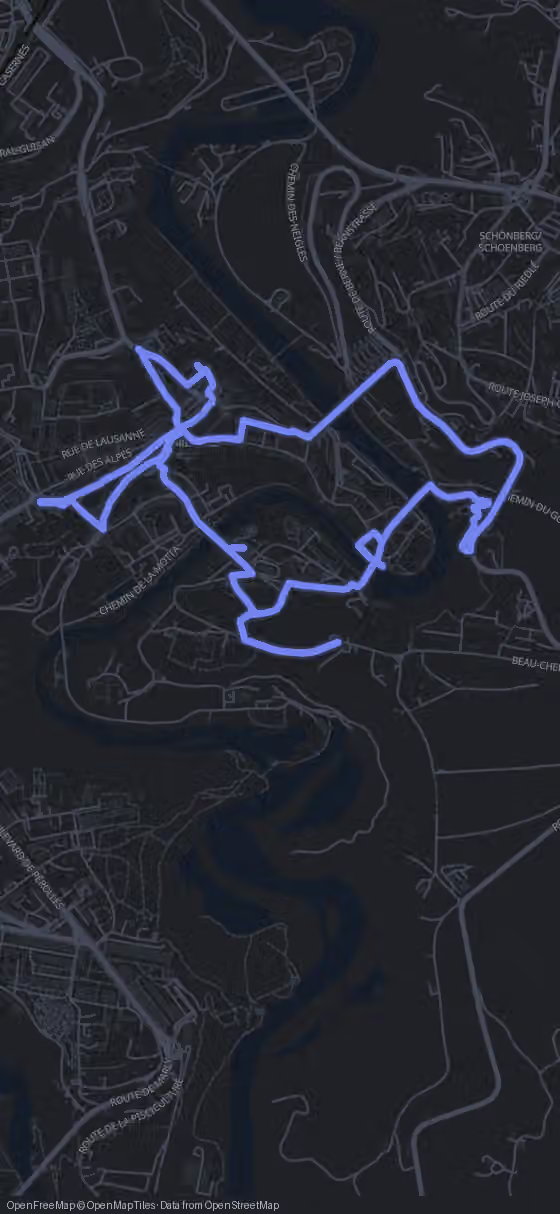
Route map for the Fribourg walking tour
Stop 1 of 13
120 m·2 min
Cathédrale Saint-Nicolas
Head west from the cathedral square toward the Funiculaire de Fribourg station.
Bonjour, welcome to Fribourg. I'm Alex, and one of this city's smartest machines runs on something most cities throw away.
Try this tour with Alex

The Fribourg Loop at a Glance

Thirteen stops on a 5.9 km loop that starts and ends at the Cathédrale Saint-Nicolas and drops from the upper town to the bridges over the Sarine. Pure walking time is 1 h 38 min; with church interiors and pauses, plan on about four hours.

Churches, squares and bridges are free. Tickets apply at the Espace Jean Tinguely - Nki de Saint Phalle, the Musée d'Art et d'Histoire and the Musée suisse de la marionnette. The GPS route runs free in your browser; the AI Tour Guide is optional.

Open free GPS & optional AI Tour Guide
This short shows highlights of the route. All 13 stops follow below.

The Route

Walking Map of Fribourg: The 5.9 km Loop

13 stops 5.9 km 1 h 38 min walking
Tap to load interactive map

The 13 stops along this route

  1. Cathédrale Saint-Nicolas in Fribourg, stop 1 on the self-guided walking tour
    1Cathédrale Saint-Nicolas
  2. Funiculaire de Fribourg, stop 2 on the self-guided walking tour
    2Funiculaire de Fribourg
  3. Église des Cordeliers in Fribourg, stop 3 on the self-guided walking tour
    3Église des Cordeliers
  4. Basilique Notre-Dame in Fribourg, stop 4 on the self-guided walking tour
    4Basilique Notre-Dame
  5. Espace Jean Tinguely - Nki de Saint Phalle in Fribourg, stop 5 on the self-guided walking tour
    5Espace Jean Tinguely - Nki de Saint Phalle
  6. Musée d'Art et d'Histoire in Fribourg, stop 6 on the self-guided walking tour
    6Musée d'Art et d'Histoire
  7. Hôtel de Ville de Fribourg, stop 7 on the self-guided walking tour
    7Hôtel de Ville de Fribourg
  8. 8Marché de la Place de l'Hôtel de Ville
  9. Saint-Jean in Fribourg, stop 9 on the self-guided walking tour
    9Saint-Jean
  10. Lorette / Chapelle de Lorette in Fribourg, stop 10 on the self-guided walking tour
    10Lorette / Chapelle de Lorette
  11. Musée suisse de la marionnette in Fribourg, stop 11 on the self-guided walking tour
    11Musée suisse de la marionnette
  12. Pont de Berne in Fribourg, stop 12 on the self-guided walking tour
    12Pont de Berne
  13. Pont du Gottéron in Fribourg, stop 13 on the self-guided walking tour
    13Pont du Gottéron
  14. That's the full loop.

    Walk it with an AI Tour Guide talking you through every one of these streets.

    Start free in your browser
    You made it

Your Fribourg Walking Tour, Stop by Stop from Saint-Nicolas to the Gottéron

  1. 1

    Cathédrale Saint-Nicolas

    Cathédrale Saint-Nicolas in Fribourg, stop 1 on the self-guided walking tour

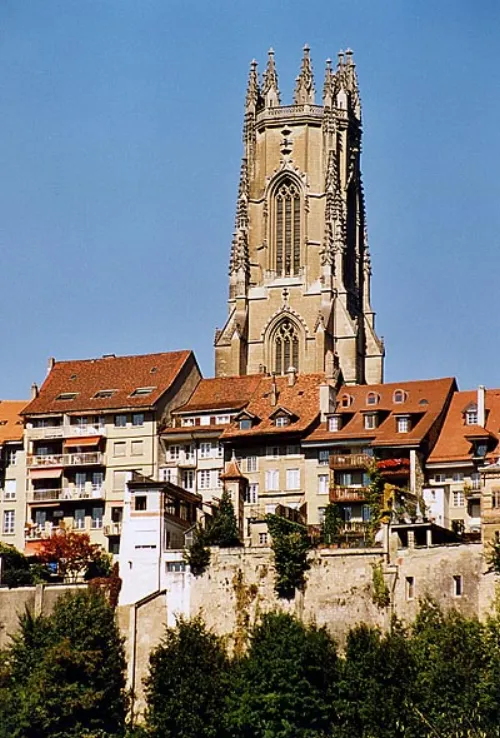
    Start where the whole town looks up to: the Cathédrale Saint-Nicolas stands on raised ground above the old town, and its bell tower rises 74 metres. Builders worked on it from 1283 to 1490, so what you see is two centuries of Gothic work in one silhouette. Before going in, take a minute at the main portal and read the bas-relief of the Last Judgement carved above the doors.

    That west portal only became the main entrance when the building was finished in 1490. For two centuries people came in through the south portal instead, because the Bourg quarter opposite the west side was cut off by a ditch. From the 1970s the south portal disappeared under a wooden shell that protected it from the exhaust of heavy traffic rolling past. Only after the Poya Bridge project was approved in 2006 and traffic around the cathedral dropped could it be restored.

    Inside is free, and the windows alone justify twenty minutes. Polish painter Józef Mehoffer designed them between 1896 and 1936, one of the most important complete ensembles of Art Nouveau church glass in Europe, joined in 1970 by work from Alfred Manessier. The organ comes from local builder Aloys Moser, built between 1824 and 1834, and it drew Franz Liszt and Anton Bruckner to Fribourg.

    For most of its life this was a collegiate church; a papal bull of 17 October 1924 raised it to a cathedral, and on 1 February 1925 Marius Besson took possession as the first bishop of the Diocese of Lausanne, Geneva and Fribourg. The tower charges admission, which you pay at the tower entrance. Go up if you want to see the town you are about to walk spread out beneath you.

    From the cathedral it is 620 metres, about 9 minutes, to the funicular that once linked the upper town with the Neuveville.
    Hours
    Mon–Sat 07:30–19:00, Sun 09:00–21:30, Holidays 09:00–19:00 (Tour: 01 Mar – 30 Nov Mon–Sat 10:00–17:00, Sun & Holidays 12:00–17:00)
    Price
    Free
  2. 2

    Funiculaire de Fribourg

    Funiculaire de Fribourg, stop 2 on the self-guided walking tour

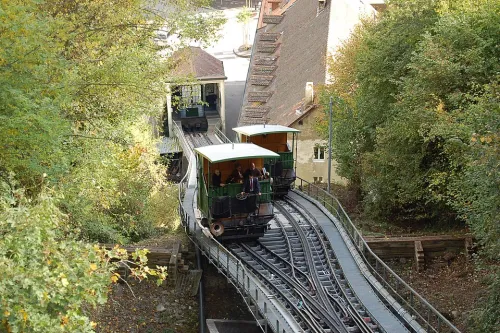
    The Funiculaire de Fribourg, the 'Funi' to locals, is currently closed, so treat this as an outdoor stop and take in the line from the outside. It links the Neuveville in the lower town with the upper town across a height difference of 56.4 metres, and it is the last water-ballast funicular in Switzerland, listed as a national cultural asset.

    The trick is the ballast: the descending car is weighted with water, and here that water is the town's wastewater. A company founded on 22 April 1897 built the line between March and December 1898 for 140,000 francs, the federal government licensed it on 4 February 1899, and within a few years it was making a profit. The town bought a majority of the shares in 1965.

    Age caught up with it. When a car broke an axle in October 1996, the federal transport office ordered a complete overhaul, and the town considered scrapping the line for buses. Residents pushed back hard, and Von Roll, the firm that had built it, restored it for 400,000 francs. The cars got their original green paint back after decades in red, and service resumed on 3 July 1998.

    From here it is 760 metres, around 11 minutes, to the Église des Cordeliers.

    Status
    Currently closed
  3. 3

    Église des Cordeliers

    Église des Cordeliers in Fribourg, stop 3 on the self-guided walking tour

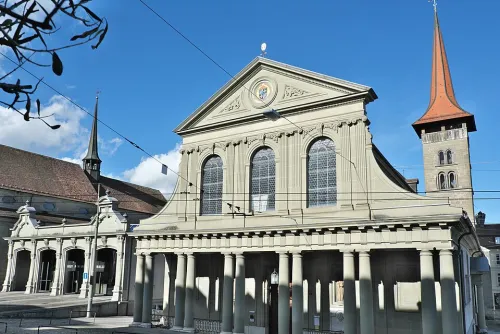
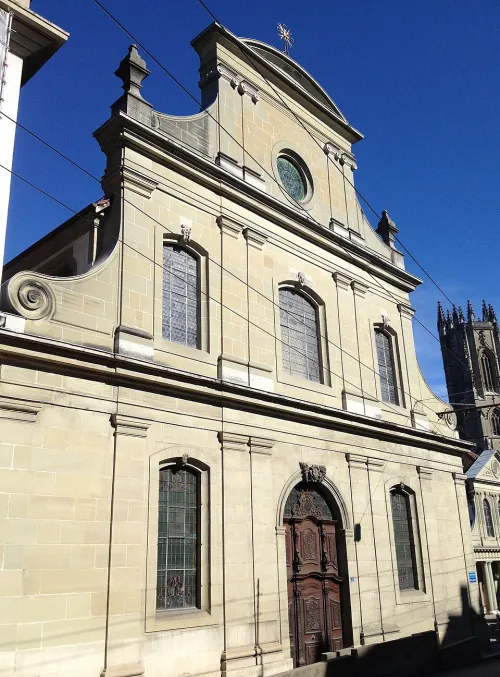
    The Église des Cordeliers, the Franciscan church of the Holy Cross, is listed together with its monastery as a cultural asset of national importance. Look at the west front first: it stands before the nave almost like a stage set, three unequal bands linked by volutes and by curved triangles topped with vases, under a curved gable.

    The building tells two stories at once. The tall, narrow choir dates from the third quarter of the 13th century, when the friars had just been brought inside the town by the third ring of walls, begun around 1275. The broader nave, Baroque with a classical touch, dates from 1745 and gained two extra bays over its predecessor. Inside you find a single flat-ceilinged nave lined with side chapels.

    Go in, it is free and open daily. The high altar is a winged altarpiece by the so-called Masters of the Carnation, once the largest altar painting in Switzerland and the oldest surviving work by the painters who signed with two carnations. Look for the little flowers. Then walk to the rearmost side chapel on the south side for the Furno altar, named after its donor.

    Notre-Dame is only 60 metres away, a one-minute walk.

    Hours
    Daily (monastery reception: Mon, Thu, Fri 09:00–12:00, Tue 14:00–17:00, Wed closed)
    Price
    Free
  4. 4

    Basilique Notre-Dame

    Basilique Notre-Dame in Fribourg, stop 4 on the self-guided walking tour

    The Basilique Notre-Dame is the oldest church in Fribourg, a Romanesque building from the 12th century near the Zähringen bridge. What you see today, though, is mostly the remodelling of 1785 to 1787, which gave the facade and interior their Baroque and classical look. Pope Pius XI raised it to a minor basilica in 1932.

    Its survival was never a given: the church was threatened with demolition more than once. Since 1968 it has belonged to the Fondation Basilique Notre-Dame, which commissioned extensive conservation work, most recently from 1991 to 2011.

    Step inside; it is free. Seek out the Neapolitan nativity scene with 75 figures, the oldest from the 18th century: shepherds hearing the news on the left, the birth of Christ with the procession of the Three Kings in the middle, and on the right everyday life with a tavern, a market and a street scene. A window by Kirsch & Fleckner from 1897 shows Saint Peter Canisius and the Assumption.

    The organ story is a small saga. There has been an organ here since 1501; Joseph Anton Mooser completed one in 1786, it was replaced in 1916 and sold to Massonnens in 1948, and since then an electronic Wurlitzer has provided the music while plans for a new instrument by the Alsatian firm Blumenroeder took shape. Your next stop is just 10 metres away.

    Hours
    Mon, Tue, Thu, Fri 08:30–19:15, Wed, Sat, Sun 08:30–18:00
    Price
    Free
  5. 5

    Espace Jean Tinguely - Nki de Saint Phalle

    Espace Jean Tinguely - Nki de Saint Phalle in Fribourg, stop 5 on the self-guided walking tour

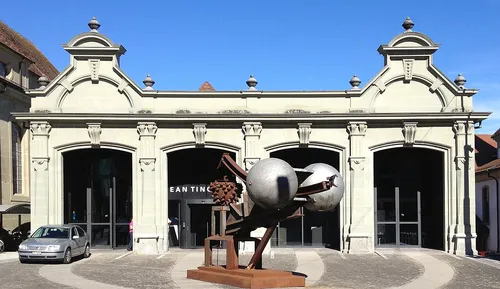
    Ten metres from a Romanesque basilica stands a neo-Baroque hall full of moving, rattling modern art. The Espace Jean Tinguely opened on 16 March 1998 and exists because Niki de Saint Phalle wanted to give the canton of Fribourg works by Jean Tinguely; later donations added many of her own pieces. A foundation directs it, and the Musée d'Art et d'Histoire has run it from the start.

    Study the building before you enter. Its monumental molasse facade with pilasters and neo-Baroque gables follows the line of the two churches that frame it. Léon Hertling built it in 1899 as Fribourg's first tram depot: eight cars on four tracks, served by a turntable outside, in a hall of 500 square metres and 6 metres high, lit from above. In 1948 it became the 'garage du Bourg', and from 1996 to 1998 architect Michel Waeber converted it into a museum.

    The ground itself has a past: from the Middle Ages into the 18th century, the chapel and cemetery of the Cordeliers occupied this spot. The centrepiece inside is the monumental Retable de l'Abondance occidentale et du Mercantilisme totalitaire from 1990.

    Tickets are inexpensive, so it is an easy yes if you like modern art even a little. The Musée d'Art et d'Histoire is 180 metres on, about 3 minutes.

    Local name
    Espace Jean-Tinguely–Niki-de-Saint-Phalle
    Hours
    Wed–Sun 11:00–18:00 (Thu until 20:00), Mon–Tue closed
    Price
    7.00 CHF full, 5.00 CHF reduced (AVS/Students/Groups)
  6. 6

    Musée d'Art et d'Histoire

    Musée d'Art et d'Histoire in Fribourg, stop 6 on the self-guided walking tour

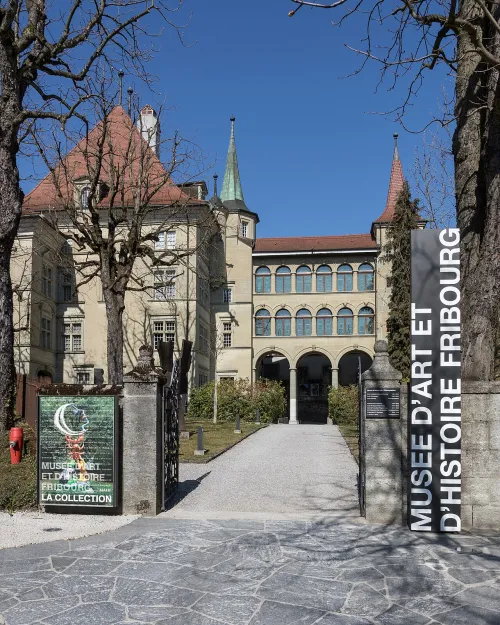
    The Musée d'Art et d'Histoire collects and shows art from the canton of Fribourg, spread over two buildings that both rank as cultural assets of national importance: the Ratzé house, a 16th-century town palace, and a former slaughterhouse across the Rue de Morat. An underground passage links the two.

    The collection began with one man: in 1774 Tobias Gerfer left his collection of medals to the Jesuit college, laying the foundation of the town's first public collection. The cantonal museum was set up there in 1823, grew with treasures from the secularised monastery of Hauterive, and moved into the Ratzé house in 1922.

    Go in if medieval and Renaissance art speaks to you. The rooms trace sculpture and painting in Fribourg from the Middle Ages to around 1500, including works by Hans Fries, through the masters of the 16th century, Baroque piety, guilds and trades, goldsmith work and art of the 19th and 20th centuries. There is also a gallery devoted to the sculptor Adèle d'Affry, known as Marcello, and a gallery of stained glass.

    Admission is charged, and there is also a combined ticket, so ask at the desk what it includes. The Hôtel de Ville is 300 metres away, about 5 minutes.

    Hours
    Tue–Sun: 11:00–18:00 (Thu until 20:00)
    Price
    CHF 12 adult; CHF 10 reduced; combined ticket CHF 17 / CHF 13
  7. 7

    Hôtel de Ville de Fribourg

    Hôtel de Ville de Fribourg, stop 7 on the self-guided walking tour

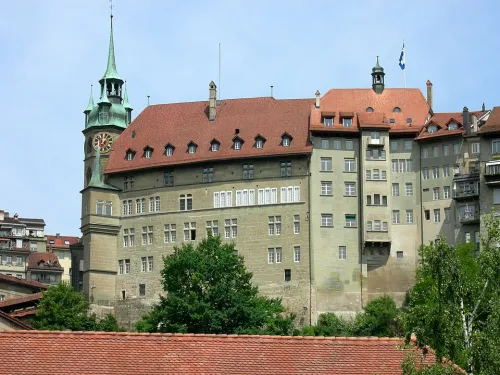
    The Hôtel de Ville is an exterior stop. The building stands in open street space on its square, free and visible at any hour, so give its facade a proper look from the square.

    The interior can be visited on free guided tours, but only if you arranged that in advance with the cantonal parliament. That is not something you can organise spontaneously at the door, so plan ahead if it matters to you, and otherwise keep moving.

    If it is Saturday, do not move far: the market is 60 metres away, one minute on foot.

    Hours
    Always open
    Price
    Free
  8. 8

    Marché de la Place de l'Hôtel de Ville

    Check the day before you plan around this stop. The market does not run every day; when it does, it spreads across the Place de l'Hôtel-de-Ville and down Grand-Rue, and it is free to browse.

    On any other day this is simply a handsome square, and you can cross it without regret. If your visit includes a Saturday, shape the loop around it: get here before noon, buy whatever looks good and eat it on the walk to Saint-Jean.

    From the square it is 450 metres, about 7 minutes, to Saint-Jean.

    Hours
    Sat 06:30–12:00
    Price
    Free
  9. 9

    Saint-Jean

    Saint-Jean in Fribourg, stop 9 on the self-guided walking tour

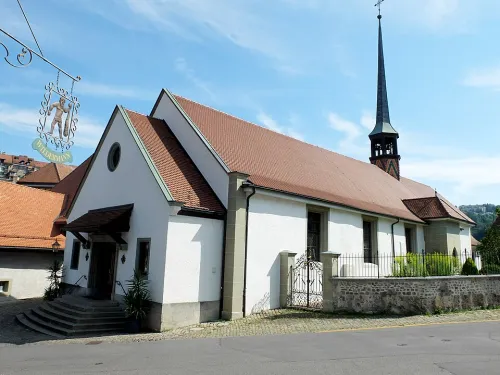
    Saint-Jean is a medieval church remodelled in the 18th century, and it belonged closely to the neighbouring commandery of the Knights Hospitaller of Saint John of Jerusalem. Choir and nave were consecrated in 1264 to the Virgin and to John the Baptist; the bell tower followed in 1281 with a bell that is one of the oldest in the canton, taken down in 1981.

    The Hospitallers left their mark inside. Shortly before 1385, commander Guillaume Huser added a canopied chapel bearing his arms, and two more followed by the end of the 14th century. Together the three canopied chapels recall the church of Saint John in the Collachium of Rhodes, the order's base at the time.

    Later centuries layered on: the parish church from 1511, the ossuary chapel of Sainte-Anne consecrated in 1514, new altarpieces from commander Pierre d'Englisberg, a big rebuild in 1712 with a new high altar and organ, and an enlarged nave with a new facade by Adolphe Fraisse in 1885 to 1887. The last general restoration came in 2009.

    It is free, and a ten-minute look inside is enough to find the canopied chapels. Then comes the longest stretch so far: 640 metres, about 14 minutes, to Lorette.

    Hours
    Daily 09:00–17:00
    Price
    Free
  10. 10

    Lorette / Chapelle de Lorette

    Lorette / Chapelle de Lorette in Fribourg, stop 10 on the self-guided walking tour

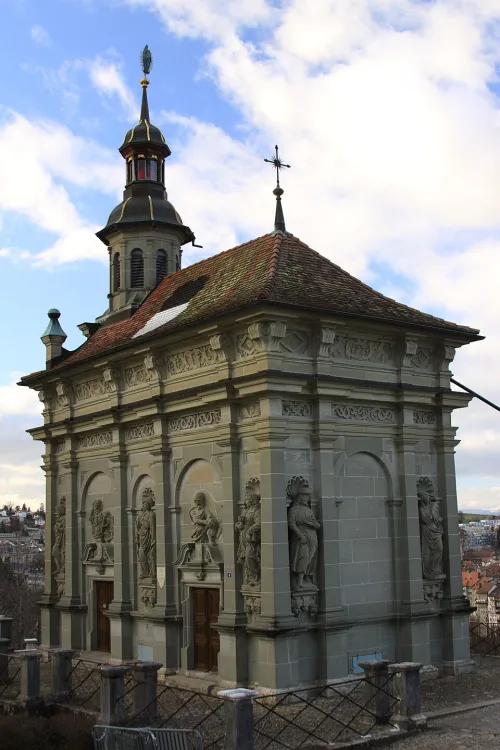
    The Chapelle de Lorette sits on a rocky spur above the old town, near the Porte de Bourguillon. From the outside it copies the Santa Casa in Loreto, the Holy House venerated in the basilica there. An artificial terrace evens out the sloping ground, ringed by a balustrade of square stone blocks with wrought iron grilles in between.

    That terrace is the reason many people come: it opens a wide view over the old town of Fribourg and the Schoenberg quarter. Take your time here, it is the best place on the loop to see how much ground you have covered.

    Hans-Franz Reyff built the chapel in 1647 and 1648, shortly after becoming town architect; it was his first church building. With it the people of Fribourg thanked Our Lady of Loreto for sparing them the devastation of the Thirty Years' War, which was nearly over, and the town presented itself once more as a Catholic stronghold of the Counter-Reformation. Built entirely of molasse in large, regular blocks, it looks light and elegant thanks to its balanced proportions and richly ordered decoration.

    Entry to the chapel is free, but it is not open every day, so check before you count on going in. From here it is 950 metres, about 16 minutes, to the marionette museum.

    Local name
    Chapelle Notre-Dame-de-Lorette
    Hours
    01 Mar – 31 Oct: Tue, Thu–Sun 09:00–18:00 (Mon, Wed closed)
    Price
    Free
  11. 11

    Musée suisse de la marionnette

    Musée suisse de la marionnette in Fribourg, stop 11 on the self-guided walking tour

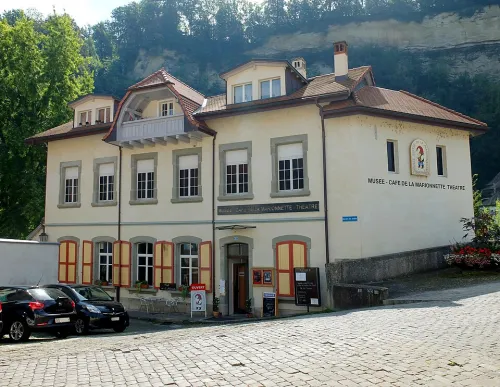
    The Musée suisse de la marionnette is the only museum in Switzerland devoted entirely to puppet theatre, and the one with the largest collection. Around 5,000 pieces come from all over the world: puppets and shadow figures from China, India, Indonesia, Africa, South America and several European countries, Switzerland included, plus sets and props.

    The collection covers every technique: string marionettes, rod, finger and shadow puppets, and puppet masks. Among the makers represented are Jakob Flach, Else Hausin, Erich Weiss and Jean Bindschedler. A specialist library of around 1,500 titles holds publications found nowhere else in Switzerland.

    Since 2008 museum, theatre and café have shared one roof beside the Pont du Milieu, at Derrière les Jardins 2. The museum charges admission, and if you travel with children, or simply like craftsmanship, this is the museum on the loop to choose.

    The Pont de Berne is 320 metres away, about 5 minutes.

    Hours
    Wed–Sun 13:00–17:00, Mon–Tue closed
    Price
    5.00 CHF full, 4.00 CHF reduced (AVS/Students), 3.00 CHF children (6-16)
  12. 12

    Pont de Berne

    Pont de Berne in Fribourg, stop 12 on the self-guided walking tour

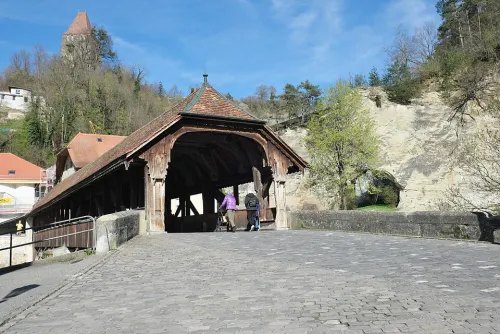
    The Pont de Berne is a covered wooden bridge over the Sarine, built in 1250, about a century after the town was founded. That makes it one of the oldest bridges in Switzerland, and today it is the last covered wooden bridge in Fribourg. It is one of five bridges of the lower town, and a few metres downstream the Gottéron stream flows into the Sarine.

    Walk through slowly and look at what holds it up. The central stone pier dates from the 17th century, like the tuff arch on the south side, now filled with earth. The bridge got its present look in 1653. Until 1838 a gate tower, the Tour des Mouches, guarded the crossing as an opening in the lower town walls.

    It has been listed as a cultural asset of national importance since 1995, and it needs constant care: after a renovation in 2011, weak oak beams forced urgent new work in 2023, including a new roof and deck. Crossing is free at any hour.

    From here it is 590 metres, about 14 minutes, to the Pont du Gottéron.

    Hours
    Always open
    Price
    Free
  13. 13

    Pont du Gottéron

    Pont du Gottéron in Fribourg, stop 13 on the self-guided walking tour

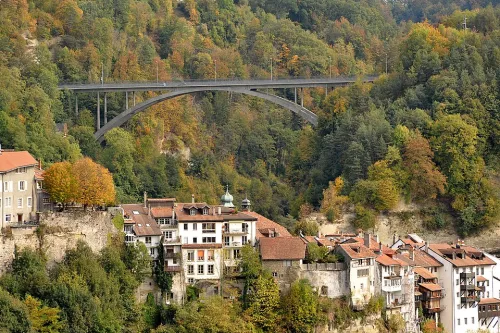
    The Pont du Gottéron is the only bridge across the Gottéron and its valley, just before the stream meets the Sarine at the gates of the town. The concrete arch you cross today is 176 metres long and carries 45 tonnes.

    Its predecessor was a daring one. In 1840 Joseph Chaley, fresh from building Fribourg's Grand Pont suspension bridge, strung a light suspension bridge 151 metres long and 76 metres above the river. A storm nearly flipped it in 1895, and on 9 May 1919 an overloaded truck carrying logs broke through the crossbeams and fell into the void. The accident pushed the cantonal parliament to build the Pont de Pérolles, planned since 1862, for truck traffic, while the old bridge was repaired.

    The replacement took a long time to decide. Engineer Henri Gicot studied a new crossing from 1942, offering a steel suspension bridge or a concrete arch; after nearly three years of debate, the design by Fribourg engineer Pierre Brasey won. It was built in 18 months for 1,170,000 francs and blessed by the bishop on 29 June 1960.

    This is the last stop. From here it is 1,010 metres, about 13 minutes, back to the Cathédrale Saint-Nicolas, where the loop closes.

    Hours
    Always open
    Price
    Free
Walking tour route map of Fribourg Route loaded
Cathédrale Saint-NicolasFuniculaire de FribourgÉglise des CordeliersBasilique Notre-Dame+9
All 13 stops are already on the map.
You just press start.
AI Tour Guide

You've read the route. Now walk it with a guide in your ear.

Press start wherever you are, even hundreds of kilometres from Fribourg, and the guide begins telling its stories right away. In the city, pick any of the 13 stops to start from: it leads you there, then talks with you the whole route, asking, listening, remembering, and shaping the tour around your answers.

13stops 5.9km 1 h 38 minwalking 13languages
▶Start the tour free

Free to start · Runs in your browser · No app, no download

Shorter Ways Through Fribourg

Not every visit has room for the full loop. These three cuts keep the walking logic intact and differ mainly in how much time and money you spend indoors.

Upper town: churches and museums

Stops: 1, 2, 3, 4, 5, 6, 7, 8

For art lovers and anyone short on time. From the cathedral to the market square you walk only 31 minutes, so most of your time goes into interiors. Tickets: the Espace Jean Tinguely and the Musée d'Art et d'Histoire; all churches are free.

Lower town and bridges

Stops: 9, 10, 11, 12, 13

For families and walkers who want the river, the views from Lorette and the old bridges. Saint-Jean to the Pont du Gottéron is 49 minutes on foot, plus 13 minutes back up to the cathedral. The only ticket is the marionette museum, and this half suits the afternoon.

The zero-franc loop

Stops: 1, 2, 3, 4, 5, 6, 7, 8, 9, 10, 11, 12, 13

For budget travellers: all thirteen stops, 1 h 38 min of walking, and you skip the three museum interiors. Cathedral, churches, Lorette, squares and bridges cost nothing.

How Long Does This Fribourg Tour Take, Museums Included?

The 1 h 38 min of pure walking is the easy part. Add about 50 minutes at the cathedral if you go up the tower, a quarter of an hour each at the Cordeliers, Notre-Dame, Saint-Jean and Lorette, and short pauses on the bridges, and you land at roughly four hours without museums. Each museum you enter adds 45 minutes to an hour.

On a Saturday, this timing works: start at the cathedral at 09:30, go up the tower and leave at 10:20. With short visits you reach the Cordeliers at 10:45 and pass the Espace Jean Tinguely at 11:17 and the Musée d'Art et d'Histoire at 11:20; save both for later. You are at the Hôtel de Ville at 11:25 and in the market at 11:31.

From the market you reach Saint-Jean at 12:07, Lorette at 12:36 and the marionette museum at 13:07. After 45 minutes inside you stand on the Pont de Berne at 13:57, on the Pont du Gottéron at 14:21 and back at the cathedral at 14:44, with the afternoon free for the two upper-town museums.

The upper-town variant is 31 minutes of walking and fits a morning with one museum; the lower-town variant needs about 62 minutes on foot including the return to the cathedral, plus your time at Lorette and among the puppets.

Before You Set Off in Fribourg

  • Start and finish: The loop starts and ends at the Cathédrale Saint-Nicolas. You can join at any stop; the order given is the recommended one.
  • Best day: Pick a day when the market is on and the three museums and Lorette are open, and check before you go, because their days differ from place to place.
  • Season: The Chapelle de Lorette and the cathedral tower are seasonal and stay closed for part of the year.
  • Costs: The three museums charge admission; everything else on the loop is free. The GPS route is free; for the AI Tour Guide you get 100 free credits, then choose this tour all-inclusive for €19.99 with no time limit, or €5 per hour.
Walking tour route map of Fribourg
AI Tour Guide

Your guide is ready when you are, right at the cathedral door.

Press start and a voice AI Tour Guide takes it from here: leading the route through Fribourg, telling the stories, and turning your walk into a real back-and-forth conversation. No app or download is needed; it runs in your browser.

13stops 5.9km 1 h 38 minwalking 13languages
▶Start the tour free

Free to start · Runs in your browser · No app, no download

What the AI Tour Guide Adds Between Cathedral and Bridges

On this loop the AI Tour Guide turns the longer legs, like the walk to Lorette or down to the Pont de Berne, into conversation. It greets you at the cathedral, tells the stories behind each place, asks what you care about and leans the talk that way. Curious about Hans Fries, about the Hospitallers who ran Saint-Jean, or about Niki de Saint Phalle herself? Just interrupt. The route and the free GPS navigation from stop to stop stay exactly as they are.

A Real Conversation A voice AI Tour Guide greets you, leads the whole route, and tells the stories and facts as you walk, asking what you want to see and keeping a real conversation going. Not a recording you press play on.
Map Navigation Follow the route on the map and walk at your own pace. You choose where to start and when to move to the next stop.
Ask Anything Curious about a building you pass? Ask your AI Tour Guide on the spot and the conversation carries on.
13 Languages Switch language anytime. No separate tour needed.
Start free in your browser

Common Questions About Walking Fribourg

Is the marionette museum worth it with children?

Yes. Children get reduced admission, the collection spans puppets and shadow figures from several continents, and the museum runs its own puppet theatre with regular shows for young and old.

Can I walk part of the loop in the evening?

Partly. The Hôtel de Ville, its square and both bridges are always accessible. The cathedral usually stays open into the evening, and the Espace Jean Tinguely and the Musée d'Art et d'Histoire have a late opening one evening a week.

What can I combine with Fribourg in one day?

Murten is just 14 km away and makes a compact second walk. Bern and Neuchâtel are both 27 km away if you want a bigger city on the same trip.

Is the tour really free?

Yes. The whole tour is free: the route, the interactive map and the navigation cost you nothing. Only the voice AI Tour Guide is optional and paid: you test it with 100 free credits, then you pay either €5 per hour or €19.99 for this whole tour, with no time limit. Admission to 3 of the 13 stops is not included: Espace Jean Tinguely - Nki de Saint Phalle, Musée d'Art et d'Histoire and Musée suisse de la marionnette charge their own entry fees.

Do I need to download an app?

No. Everything runs in your phone browser. Open the route and start walking, no download and no sign-up required.

Do I need to book the walking tour in advance?

No booking needed. This self-guided tour is available anytime. Open the route in your browser and start walking. The AI Tour Guide works instantly, no app, no reservation required.

What languages is the AI Tour Guide available in?

The AI Tour Guide speaks 13 languages, so you take the tour in your own language and can switch at any time.

Can I skip stops or change the route?

Yes. Skip any stop, spend extra time at places you like, or start the route from any point. It is your walk, you set the pace.
Image credits
▶ Start free in your browser Runs in your browser, no app, no download