Free Walking Tour Córdoba, Argentina: Jesuits to Palaces

From the colonial Plaza San Martín to a Beaux Arts palace and the Jesuit Block: 4.7 km through four centuries of Córdoba, at your own pace.

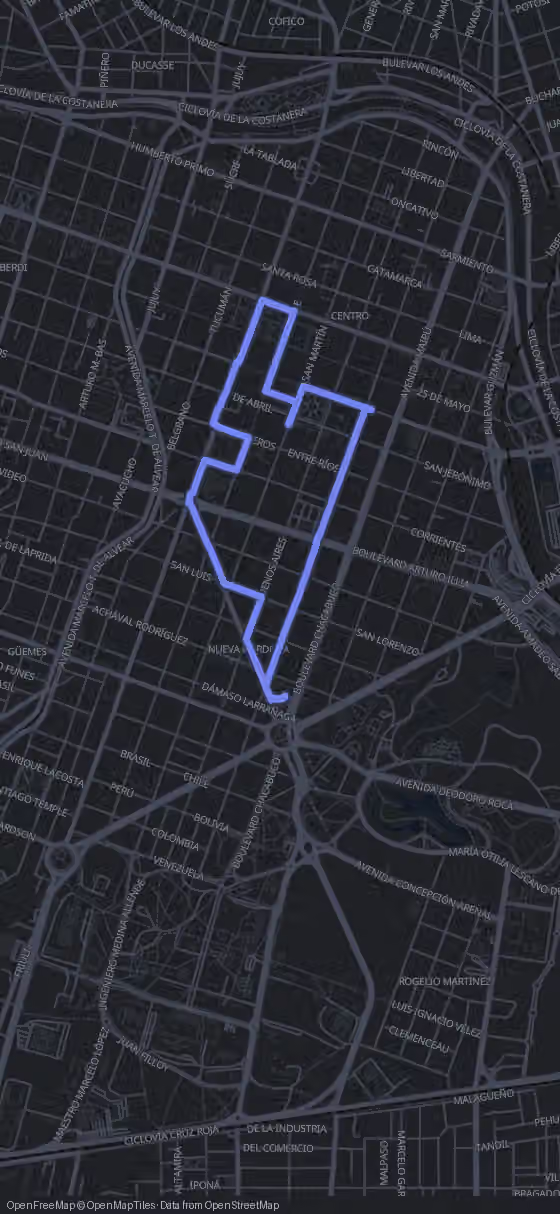
13 Stops 4.7 km ~1 h 5 min walking
Route map for the Córdoba, Argentina walking tour
Stop 1 of 13
320 m·4 min
Plaza San Martín
Head east along Rosario de Santa Fe toward the Sobremonte museum
Hola, welcome to Córdoba. I'm Alex, and Argentina's oldest church carries the memory of a shipbuilder's hands.
Try this tour with Alex

What This Córdoba Walk Covers

13 stops on 4.7 km, from Plaza San Martín out to Nueva Córdoba, back through the Jesuit Block and on to the Cabildo de Córdoba. Pure walking time is 1 h 5 min; with two museums and a few interiors, plan about five hours.

Squares, churches and the Cabildo are free; the art and history museums and the theatre tour charge entry. Route, map and GPS navigation from stop to stop are free in your browser, and the AI Tour Guide is optional.

Open free GPS & optional AI Tour Guide
This short shows highlights of the route. All 13 stops follow below.

The Route

Walking Map of Córdoba, Argentina, from Plaza to Cabildo

13 stops 4.7 km 1 h 5 min walking
Tap to load interactive map

The 13 stops along this route

  1. Plaza San Martín in Córdoba, Argentina, stop 1 on the self-guided walking tour
    1Plaza San Martín
  2. Museo Histórico Provincial Marqués de Sobremonte in Córdoba, Argentina, stop 2 on the self-guided walking tour
    2Museo Histórico Provincial Marqués de Sobremonte
  3. Museo Superior de Bellas Artes Evita - Palacio Ferreyra in Córdoba, Argentina, stop 3 on the self-guided walking tour
    3Museo Superior de Bellas Artes Evita - Palacio Ferreyra
  4. Paseo del Buen Pastor in Córdoba, Argentina, stop 4 on the self-guided walking tour
    4Paseo del Buen Pastor
  5. Teatro del Libertador General San Martín in Córdoba, Argentina, stop 5 on the self-guided walking tour
    5Teatro del Libertador General San Martín
  6. Colegio Nacional de Monserrat in Córdoba, Argentina, stop 6 on the self-guided walking tour
    6Colegio Nacional de Monserrat
  7. Iglesia de la Compañía de Jesús in Córdoba, Argentina, stop 7 on the self-guided walking tour
    7Iglesia de la Compañía de Jesús
  8. Capilla Doméstica in Córdoba, Argentina, stop 8 on the self-guided walking tour
    8Capilla Doméstica
  9. Basílica de Santo Domingo in Córdoba, Argentina, stop 9 on the self-guided walking tour
    9Basílica de Santo Domingo
  10. Cripta Jesuítica del Noviciado Viejo in Córdoba, Argentina, stop 10 on the self-guided walking tour
    10Cripta Jesuítica del Noviciado Viejo
  11. Catedral de Nuestra Señora de la Asunción in Córdoba, Argentina, stop 11 on the self-guided walking tour
    11Catedral de Nuestra Señora de la Asunción
  12. Museo de Arte Religioso Juan de Tejeda in Córdoba, Argentina, stop 12 on the self-guided walking tour
    12Museo de Arte Religioso Juan de Tejeda
  13. Cabildo de Córdoba in Córdoba, Argentina, stop 13 on the self-guided walking tour
    13Cabildo de Córdoba
  14. That's the full route.

    Walk it with an AI Tour Guide talking you through every one of these streets.

    Start free in your browser
    You made it

Your Córdoba, Argentina Walking Tour: 13 Stops in Order

  1. 1

    Plaza San Martín

    Plaza San Martín in Córdoba, Argentina, stop 1 on the self-guided walking tour

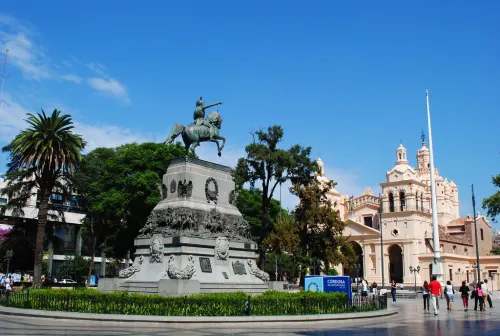
    Plaza San Martín is where Córdoba began to take shape. In 1577, four years after the city was founded, Lieutenant Governor Lorenzo Suárez de Figueroa laid out a grid of 70 blocks and put this square in the middle. The most important buildings went on the blocks around it: you can see the cathedral on one side and, next to it, the arcades of the Cabildo, where this walk will end.

    In colonial times this was the Plaza Mayor and, in fact, the only real square in town; the unbuilt plots elsewhere were simply called huecos, holes. Fairs, patron saint festivals and civic celebrations took place here, even bullfights. The first street lamps arrived in 1790, installed by the viceroy Rafael de Sobremonte, a name you will meet again at the next stop.

    What you walk through today is the work of the landscape architect Carlos Thays, who replanted the square in 1901 with lapachos, tipas, magnolias and the plane trees locals call carolinos, plus a few subtropical palms. In the centre stands the bronze equestrian statue of José de San Martín, there since 1916, its base wrapped in bronze reliefs of his liberation campaigns. Look out for the votive lamp and the small octagonal pond, which sometimes holds red fish.

    The square measures roughly 102 by 115 metres and is free and open around the clock, so it works as a starting point at any hour. From here the Sobremonte house is just 320 metres away, a four minute walk.
    Hours
    Open 24/7
    Price
    Free
  2. 2

    Museo Histórico Provincial Marqués de Sobremonte

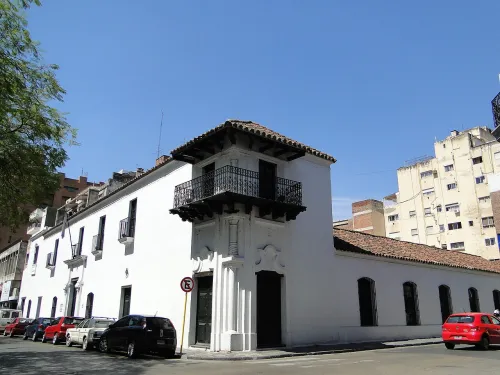
    Museo Histórico Provincial Marqués de Sobremonte in Córdoba, Argentina, stop 2 on the self-guided walking tour

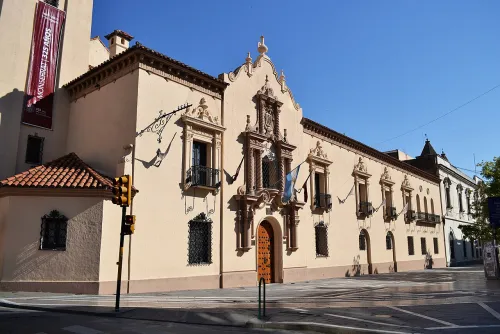
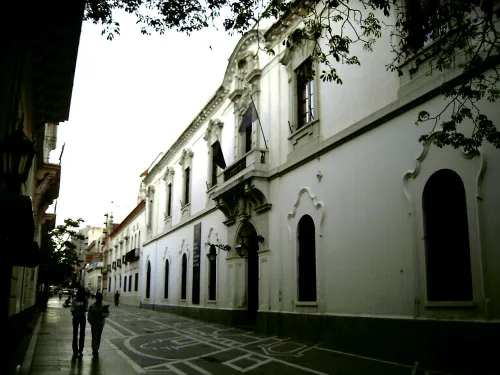
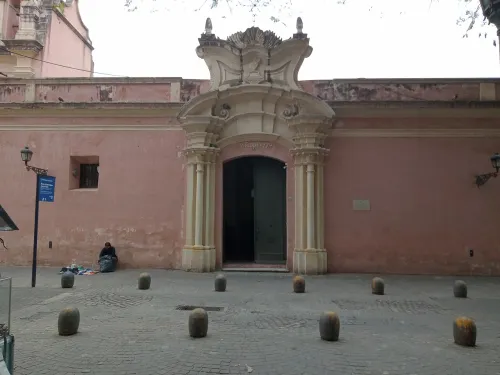
    Look at the corner before you go in. Most corners in Córdoba were later cut off at an angle, but here the building was left whole: a sharp 90 degree corner with two floors, a balcony running round it and a little roof above, covered in so-called muslera tiles. They take their name from the thigh, muslo, of the craftsmen who shaped them over their legs, often enslaved workers.

    The merchant José Rodríguez built the house between 1752 and 1760. From 1783 to 1797 it was rented by Rafael de Sobremonte, then governor of Córdoba del Tucumán and later the highest authority in the Viceroyalty of the Río de la Plata. That is why the provincial history museum now carries his name.

    Inside you find a private chapel, the patio de honor and rooms furnished as a colonial household: tables, chairs, religious carvings, American paintings and a collection of old weapons, along with the collections of Wolf and Monsignor Pablo Cabrera. Concerts are sometimes held in the patio. It is worth 45 minutes if you want to picture how Córdoba's elite lived in the 18th century.

    The museum charges entry, with free admission for children, students and retirees. Afterwards comes the longest leg of the day: 1340 metres, about 20 minutes, out to Nueva Córdoba.

    Hours
    Tue–Sun 10:00–17:30 (ticket box office; museum open until 19:00), Mon closed
    Price
    ARS 1.000 (free Wed; free for under 16, students and retirees)
  3. 3

    Museo Superior de Bellas Artes Evita - Palacio Ferreyra

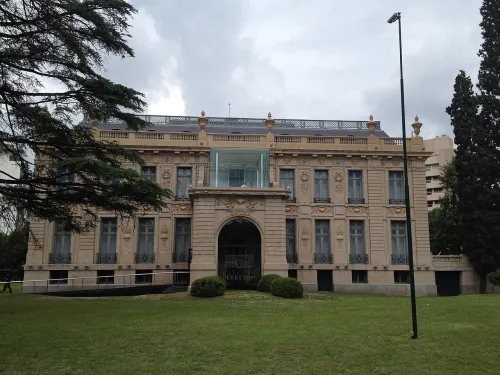
    Museo Superior de Bellas Artes Evita - Palacio Ferreyra in Córdoba, Argentina, stop 3 on the self-guided walking tour

    The Palacio Ferreyra was built as a family home, a very large one. Dr Martín Ferreyra moved in in 1919 with his wife, seven children, his sister-in-law and the servants. The plans came from Paris, drawn between 1912 and 1916 by the French architect Ernest-Paul Sanson and his son Maurice. It stands on a block beside Plaza España and Parque Sarmiento and is counted among the finest examples of the early 20th century revival of French neoclassicism.

    From outside it reads as Beaux Arts, with facades clad in imitation Paris stone. Look closer at the decoration, though: plant and animal motifs give it a touch of art nouveau, and a roof of metal and glass crowns the whole building. The garden around it was designed by Carlos Thays, the same man who replanted Plaza San Martín, mixing geometric beds with naturalistic planting; it is considered the largest and best preserved private urban garden in Argentina.

    Inside, the rooms are arranged around a huge central hall with a balcony running all the way round, under a ceiling that seems to float thanks to natural light coming in at its edge. Today the palace holds the provincial art collection, with a strong focus on Córdoba artists from the 19th century to the present: paintings, drawings, photographs, objects and sculpture, plus temporary shows.

    Give it an hour if you like art or grand interiors. Entry is charged, with lower rates for Argentine and Córdoba residents. The Paseo del Buen Pastor is 470 metres on, a six minute walk.

    Hours
    Tue–Sun 10:00–17:30 (ticket box office; museum open until 19:00), Mon closed
    Price
    ARS 5.000 (residents of Cordoba), ARS 11.000 (national residents), ARS 22.000 (foreigners), ARS 8.000 (seniors 60+ / youth 7-25); free Wed; free <16/students/retirees/disabled
  4. 4

    Paseo del Buen Pastor

    Paseo del Buen Pastor in Córdoba, Argentina, stop 4 on the self-guided walking tour

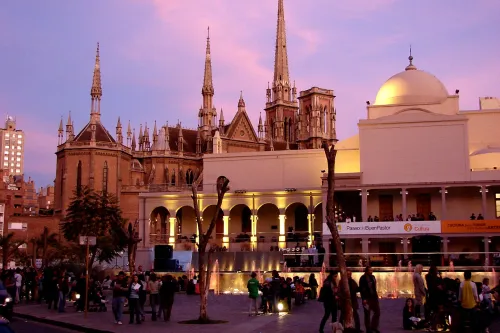
    Today the Paseo del Buen Pastor is one of the favourite meeting places of Córdoba's young crowd: a cultural centre with galleries, shops, two restaurants, bars and a dancing fountain set to music and lights. Its past was far darker. Between 1897 and 1906 the building went up for the Sisters of Our Lady of Charity of the Good Shepherd of Angers, as a correctional home for women and minors, and for almost 100 years it served as an asylum and women's prison.

    The story starts in 1888, when French nuns opened a workshop to protect and educate poor and orphaned girls. Impressed, the provincial government asked them in 1892 to take charge of female inmates, and in 1896 donated land. In 1905 the architect José Montblanch planned the prison and its chapel.

    The worst chapter came under Brigadier Raúl Lacabanne and the last military dictatorship from 1976 to 1983, when political prisoners were held here. The building was already unfit as a prison by 1970 and closed soon after; in 2007 governor José Manuel de la Sota opened it in its new role. Across the way stands the Iglesia de los Capuchinos.

    Entry is free. Spend a quarter of an hour, take a look at the current exhibition, then walk 700 metres, about ten minutes, to the theatre.

    Hours
    Daily 09:00–19:00 (cultural spaces / exhibition galleries); complex and commercial/dining areas accessible earlier/later
    Price
    Free
  5. 5

    Teatro del Libertador General San Martín

    Teatro del Libertador General San Martín in Córdoba, Argentina, stop 5 on the self-guided walking tour

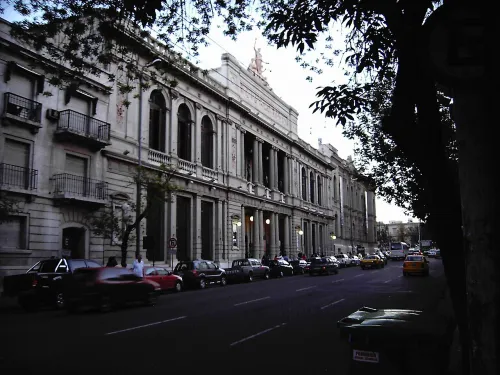
    In 1887 the justice minister Ramón J. Cárcano noticed that his home city had no proper concert hall and proposed one to Governor Ambrosio Olmos. He handed the design to the Italian Argentine architect Francesco Tamburini, who created an eclectic Italianate theatre; Arturo Nembrini Gonzaga added the verdigris interior details, the facade reliefs and the quadriga on top. Every material, fabric and machine was shipped in from Europe.

    The house opened on 26 April 1891 as the Rivera Indarte Theatre, built for 1,000 spectators. Locals called it the Teatro de la Calle Ancha, after the broad street outside. One clever detail: the floor of the hall could be raised to stage level, turning it into a ballroom for the many society balls held here. María Guerrero brought Spanish drama here after 1897, and later came Enrico Caruso, Titta Ruffo, Tito Schipa and Arthur Rubinstein. In 1950 President Juan Perón renamed it after General San Martín, on the centenary of his death.

    To see the hall, join one of the paid guided tours; residents, seniors and young people pay less. Worth it for music lovers and anyone curious about a 19th century stage; otherwise the facade alone is a fine sight.

    The Colegio Nacional de Monserrat is only 210 metres away, three minutes on foot.

    Hours
    Tue–Sat guided tours at 10:00, 11:00, 12:00, 14:00, 15:00, 16:00 (box office Tue–Sat 09:00–20:00, Sun 17:00–20:00 on performance days, Mon closed)
    Price
    ARS 5.000 (Cordoba residents), ARS 16.500 (national residents), ARS 27.500 (foreigners), ARS 8.000 (seniors 60+ / youth 7-25) for guided tour; performance tickets variable
  6. 6

    Colegio Nacional de Monserrat

    Colegio Nacional de Monserrat in Córdoba, Argentina, stop 6 on the self-guided walking tour

    This is Argentina's oldest school of its kind, and it is still teaching. Father Ignacio Duarte Quirós, a Córdoba priest, founded it on 1 August 1687 for the Jesuits and gave all his property to make it happen; King Charles II of Spain signed the decree. It opened as a boarding school in 1695, modelled on the European gymnasium.

    Its history mirrors the city's. When the Pope suppressed the Jesuits in 1767, the Franciscans took over, and by 1782 the school had moved to the site you see now. In 1807 it passed to the secular clergy as part of the Royal University of San Carlos and Our Lady of Montserrat, the forerunner of the National University of Córdoba, with reforms led by Dean Gregorio Funes. It was nationalised in 1854, became a secondary school in 1858 and moved into a new building in 1864, commissioned by Dr Eusebio de Bedoya. Since 1907 it has been affiliated with the university, and since 1938 it has been a National Historic Monument.

    You can only go inside on a guided tour, which is free with a voluntary contribution. If the timing fits, it is a rare look inside a working colonial school.

    The Iglesia de la Compañía de Jesús is 200 metres on, three minutes away.

    Hours
    Mon–Fri guided tours at 15:00 and 16:00; Thu–Fri additional tours at 11:00 and 12:00; Sat 10:00, 11:00, 12:00; Sun closed
    Price
    Free (voluntary contribution; historical museum of the UNC)
  7. 7

    Iglesia de la Compañía de Jesús

    Iglesia de la Compañía de Jesús in Córdoba, Argentina, stop 7 on the self-guided walking tour

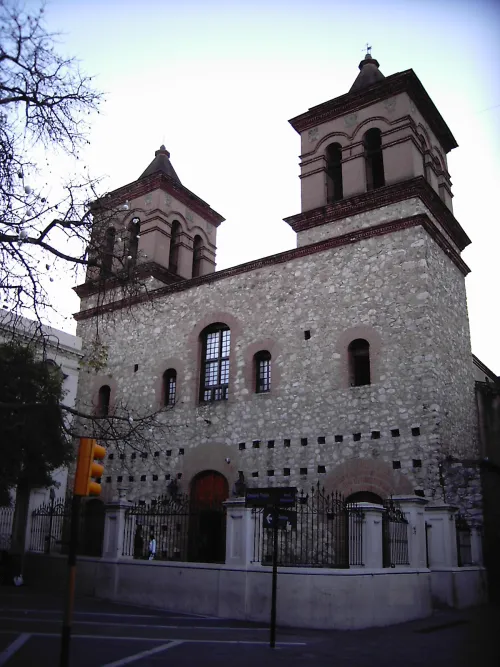
    You are now in the Jesuit Block, the city block the Jesuits took over in 1599 and made the headquarters of their province until their expulsion in 1767. It was one of the original 70 blocks of the colonial grid, and together with the Jesuit estancias in the countryside, which financed the order's work, its surviving buildings have been a UNESCO World Heritage Site since 2000.

    The church was completed in 1671, making it the oldest church still standing in Argentina. Inside, look for the altar, which came from Cuzco in Peru. To the left of the church, in a chapel from the same period, the National University of Córdoba now holds its graduation ceremonies.

    Entry is free. The church opens in two blocks built around mass times, and in between it may be locked, so plan your arrival accordingly. Give it a quiet few minutes, then don't go far: the Capilla Doméstica is right next door.

    Hours
    Mon–Fri 09:00–13:00, 16:30–20:30; Sat 09:00–12:00, 17:30–21:00; Sun 07:30–12:30, 17:30–21:30
    Price
    Free
  8. 8

    Capilla Doméstica

    Capilla Doméstica in Córdoba, Argentina, stop 8 on the self-guided walking tour

    The Capilla Doméstica was the private chapel of the Jesuit residence, built, like the church beside it, in 1671. It is considered one of the masterpieces of Argentine colonial architecture, and because it served the Jesuit community rather than the public, it feels more intimate than the church.

    Around it, the rest of the Jesuit Block tells the story of education in Córdoba. The rectorate of the university stands on the site of the Colegio Máximo, founded in 1613; the university itself was formally established in 1622. Its ground floor walls and vaults date from the 18th century, the upper floor from the 19th, and the facade was redesigned by Johannes Kronfuß around 1910 to 1920.

    Entry is free, as a guided visit when space allows, and it is one of the stops most worth going inside. From here it is 320 metres, about five minutes, to the Basílica de Santo Domingo.

    Hours
    Mon–Fri: 08:00–20:00 | Sat–Sun: Closed
    Price
    Free (guided visit, access subject to availability)
  9. 9

    Basílica de Santo Domingo

    Basílica de Santo Domingo in Córdoba, Argentina, stop 9 on the self-guided walking tour

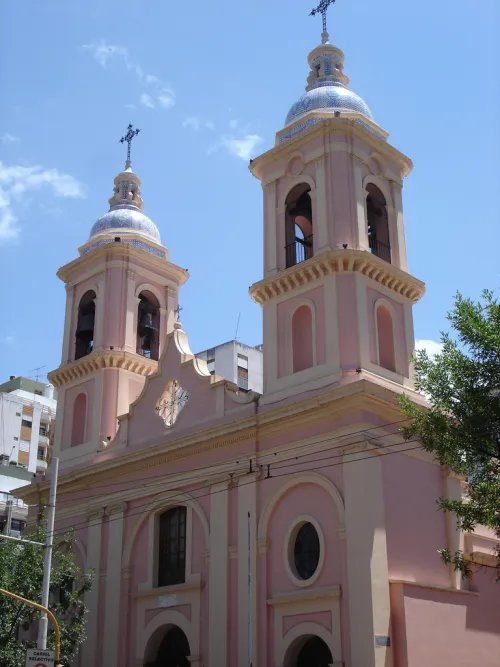
    Four towers with tiled domes mark the Basílica de Santo Domingo, at the corner of Deán Funes and Vélez Sársfield. The Dominicans have been in Córdoba for 400 years, but the church you see is the third on this site. The two earlier ones, from the 17th century, were swept away by the La Cañada stream, which regularly flooded the young city. The present building went up between 1857 and 1861.

    The fine tiles on the domes were a gift from Justo José de Urquiza, the man who gave Argentina its constitution in 1853. Until the early 20th century the whole church was painted white; the colour you see now came later.

    Inside, the plan is a Latin cross. In the central nave stands a silver altar made in Upper Peru in the 18th century, with figures of the crucified Christ, Saint Dominic and Saint Francis, plus the coats of arms of the wealthy families who paid for the building. Look up for the paintings of the Evangelists in the domes. Above the altar is the Virgen del Rosario del Milagro, declared patroness of the archdiocese in 1937.

    Entry is free. Then walk 440 metres, six minutes, to the crypt.

    Hours
    Mon–Sat 07:30–12:00, 17:00–20:30; Sun 08:00–12:30, 17:00–20:30
    Price
    Free
  10. 10

    Cripta Jesuítica del Noviciado Viejo

    Cripta Jesuítica del Noviciado Viejo in Córdoba, Argentina, stop 10 on the self-guided walking tour

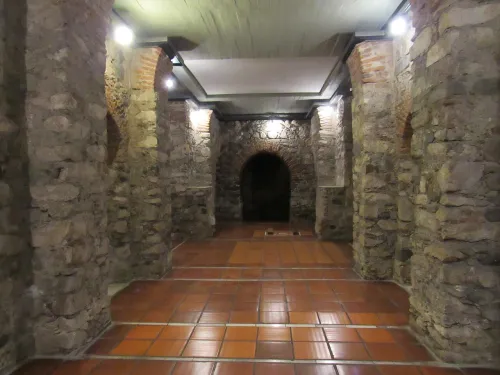
    This one was found by accident. In 1928, workers widening Avenida Colón saw old vaults breaking through the surface of the pavement. They had hit the buried remains of the Jesuit novitiate, and what you visit today is that underground ruin, turned into a municipal museum with guided visits and an exhibition hall.

    The Jesuits founded their novitiate in 1608 inside the Jesuit Block, but space ran short. Money was tight too, until in 1700 the brothers Ignacio and Francisco Mujica, both members of the order, donated their property for it. A chapel was added, so large it was thought of as a church, attributed to the Bohemian architect Johann Krauss, and one of the first works was this crypt.

    Then the order's Father General, Miguel A. Tamburini, ordered the work stopped from Rome. The building was left half finished and became a retreat house; Francisco Mujica stayed until his death soon after. In 1726 the new use became official, and the door leading down to the chapel had already been walled up two years earlier.

    Entry is free. A short but atmospheric stop, especially if you like the idea of history hiding under a busy street. From here it is 440 metres, six minutes, to the cathedral.

    Hours
    Mon–Fri 09:00–17:30, Sat–Sun closed
    Price
    Free
  11. 11

    Catedral de Nuestra Señora de la Asunción

    Catedral de Nuestra Señora de la Asunción in Córdoba, Argentina, stop 11 on the self-guided walking tour

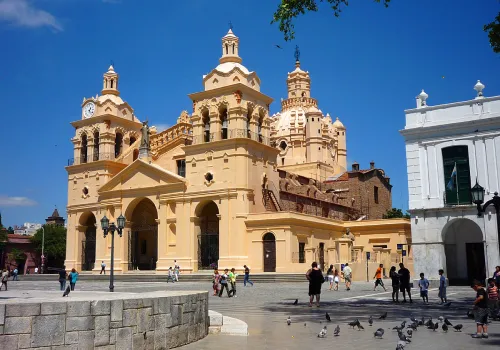
    The cathedral fills the block on the west side of Plaza San Martín, separated from the Cabildo by the old Santa Catalina alley. It is the oldest church in continuous service in Argentina and the oldest intact colonial building still in use, which makes it a National Historic Monument.

    Work began in 1582 under the name it still carries, Our Lady of the Assumption. In 1598 the master builder Gregorio Ferreira and the stonemason Juan Rodríguez took over and built it in solid stone, brick and lime. One oddity: churches of its time were supposed to point their main altar towards Jerusalem, but this one does not, which made it unusual among its contemporaries.

    Behind the cathedral lies the small Plazoleta del Fundador, with a patinated bronze statue of the city's founder, Jerónimo Luis de Cabrera, standing tall. Walk round to see it.

    Entry is free. Go inside; for a colonial building in daily use, it is the essential stop of the walk. The Tejeda museum is only 140 metres away, two minutes on foot.

    Hours
    Mon–Fri 09:00–19:00; Sat–Sun 09:00–12:00, 16:00–20:00 (parish office Mon–Fri 09:00–15:00, Tue–Thu 15:30–17:00)
    Price
    Free
  12. 12

    Museo de Arte Religioso Juan de Tejeda

    Museo de Arte Religioso Juan de Tejeda in Córdoba, Argentina, stop 12 on the self-guided walking tour

    This plot was given to Tristán de Tejeda, who came with the founder Jerónimo Luis de Cabrera. His son Juan built the first house here, with quarters for enslaved people, space for carriages and carts, animals and a vegetable garden. In 1628 Juan founded the monastery of the Discalced Carmelites and the church of Santa Teresa on the same land, and the house was also the birthplace of Luis José de Tejeda y Guzmán, considered Argentina's first poet.

    You enter through a portal with Andalusian and Portuguese echoes. Inside, look for an old door whose wooden panels play with light and shadow, and another with two mortar niches decorated with flowers and pomegranates, once painted blue. The cell walls are lime and stone, just as in 1600, and from the patio of the first cloister you can see the cathedral towers. Among the pieces are El Señor de la Paciencia, a unique work from the old Catalinas monastery, and a portable altar with polychrome carving.

    The museum had been closed for some years until the city and the archdiocese agreed to reopen it in 2013. It charges entry, and there is also a general guided tour at extra cost. Worth it for lovers of religious art and quiet cloisters, if your timing allows.

    The Cabildo is just 110 metres away, a one minute walk.

    Hours
    Mon–Sat 10:00–14:00, Sun closed (general guided tours Mon–Sat at 12:00)
    Price
    ARS 4.000 general, ARS 2.000 Argentine residents & retirees, ARS 5.000 foreigners; guided tour ARS 6.000 residents / ARS 7.000 foreigners; free <6 / disabled
  13. 13

    Cabildo de Córdoba

    Cabildo de Córdoba in Córdoba, Argentina, stop 13 on the self-guided walking tour

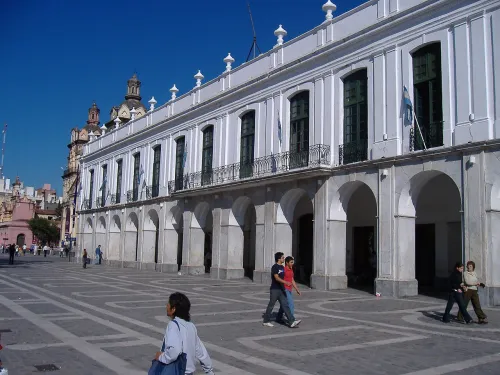
    You end where colonial power sat. The Cabildo, facing Plaza San Martín, was the town council that ran everything: laws, prices of goods, schools, health, public safety and the jail. In the first years after 1573 the councillors met in their own homes; a simple adobe building with a thatched roof followed in 1588, then a wooden one by Alonso de Encinas in 1610.

    In 1749 the mayor José Moyano Oscariz ordered a larger building, but it dragged on until the Marquis of Sobremonte, the tenant of the house you saw at the start, became governor in 1783 and pushed it through. His architect Juan Manuel López added a chapel, a patio and the arcade of fifteen columns along the facade, with space for shops underneath. It was finished in 1786, along with the Santa Catalina passage beside the cathedral.

    Its role as Cabildo ended in 1824 under Juan Bautista Bustos. It then housed the provincial government, the municipality from 1857 and the provincial police until 1989, before returning to the city as a museum and cultural centre. It has been a National Historic Monument since 1941.

    Entry is free, there are guided tours, and the tourist information office is inside. Walk through the arcade and you are back on Plaza San Martín, where it all began.

    Hours
    Mon–Sat 09:00–20:00, Sun & holidays 09:00–18:00 (guided tours Mon–Sat at 12:00 and 16:00; tourist info office daily 08:00–20:00)
    Price
    Free
Walking tour route map of Córdoba, Argentina Route loaded
Plaza San MartínMuseo Histórico Provincial Marqués de SobremonteMuseo Superior de Bellas Artes Evita - Palacio FerreyraPaseo del Buen Pastor+9
All 13 stops are already on the map.
You just press start.
AI Tour Guide

You know the route now. Walk it with a guide who talks with you.

Press start wherever you are, even hundreds of kilometres from Córdoba, Argentina, and the guide begins telling its stories right away. In the city, pick any of the 13 stops to start from: it leads you there, then talks with you the whole route, asking, listening, remembering, and shaping the tour around your answers.

13stops 4.7km 1 h 5 minwalking 13languages
▶Start the tour free

Free to start · Runs in your browser · No app, no download

Shorter Ways Through Córdoba's Centre

Not every day has room for all 13 stops. These two halves of the route stand on their own.

Jesuit Block and colonial core

Stops: 6, 7, 8, 9, 10, 11, 12, 13

For history lovers with a morning or an afternoon. From the Colegio Nacional de Monserrat through the Jesuit buildings, Santo Domingo and the crypt to the cathedral and the Cabildo, about 24 minutes of walking. Everything is free except the Museo de Arte Religioso Juan de Tejeda; do it on a weekday so the Capilla Doméstica and the crypt are open.

Museums and Nueva Córdoba

Stops: 1, 2, 3, 4, 5

For art and architecture fans. From Plaza San Martín to the Sobremonte house, the Palacio Ferreyra, the Paseo del Buen Pastor and the Teatro del Libertador, about 40 minutes of walking. Entry applies at the two museums and for the theatre tour.

How Long This Córdoba, Argentina Walk Really Takes

The route is laid out in a single line: walking alone takes 1 h 5 min, and the one long leg is the 20 minute walk from the Sobremonte house to the Palacio Ferreyra. After that the stops sit close together, most of them three to six minutes apart.

Realistically you need about five hours if you give the Palacio Ferreyra a good hour, the Sobremonte house 45 minutes, join a theatre tour and look inside the churches. Skipping the museum interiors brings the day down to roughly two and a half hours. The museum half alone takes about three hours with its visits, the Jesuit half about two and a half with the guided tours at Monserrat and the Cabildo.

Before You Set Off in Córdoba

  • Start and finish: The recommended start is Plaza San Martín, and you finish at the Cabildo de Córdoba, right back on the same square. You can join the route at any stop.
  • Best days: Not every stop opens every day, above all the two museums, the theatre, the Capilla Doméstica and the Cripta Jesuítica, so check before you go that the ones you care about are open.
  • Time of day: Start in the morning, when the Sobremonte house is open. If the Tejeda museum matters to you, see it early: it lies two minutes from the cathedral on Plaza San Martín.
  • Costs: Most stops are free. You pay at the Sobremonte house, the Palacio Ferreyra, the Tejeda museum and for the theatre tour.
Walking tour route map of Córdoba, Argentina
AI Tour Guide

Your guide is waiting at Plaza San Martín

Press start and a voice AI Tour Guide takes it from here: leading the route through Córdoba, Argentina, telling the stories, and turning your walk into a real back-and-forth conversation. No app or download is needed; it runs in your browser.

13stops 4.7km 1 h 5 minwalking 13languages
▶Start the tour free

Free to start · Runs in your browser · No app, no download

What the AI Tour Guide Adds on This Route

On this walk the stories run into each other: the Marquis of Sobremonte who rented a house and finished the Cabildo, the Jesuits who left churches, a school and a buried crypt. The AI Tour Guide leads you through them as a conversation, notices whether you lean towards colonial history, architecture or music, and goes deeper there. Ask it what daily life was like for the women held at the Buen Pastor, or what Caruso sang on the Córdoba stage, and interrupt whenever something catches your eye.

A Real Conversation A voice AI Tour Guide greets you, leads the whole route, and tells the stories and facts as you walk, asking what you want to see and keeping a real conversation going. Not a recording you press play on.
Map Navigation Follow the route on the map and walk at your own pace. You choose where to start and when to move to the next stop.
Ask Anything Curious about a building you pass? Ask your AI Tour Guide on the spot and the conversation carries on.
13 Languages Switch language anytime. No separate tour needed.
Start free in your browser

Common Questions About Walking Córdoba

What can I see in Córdoba without a ticket?

The churches, the Cabildo, the Paseo del Buen Pastor, the Cripta Jesuítica and the Capilla Doméstica are free, and the guided tours at the Colegio Nacional de Monserrat only ask for a voluntary contribution. The two museums, the Tejeda museum and the theatre tour charge entry.

Are there discounts at the museums?

Yes. At the Sobremonte house and the Palacio Ferreyra, children, students and retirees get in free, and the Palacio Ferreyra also has a reduced rate for seniors and young people.

Can I see the Teatro del Libertador without a ticket to a show?

Yes, on one of the guided tours through the hall. The box office also sells performance tickets, with prices depending on the show.

Where can I go after Córdoba?

Rosario is the nearest of the big cities at 374 km, Mendoza lies 468 km away, and Buenos Aires 647 km. Each has its own free walking route.

Is the tour really free?

Yes. The whole tour is free: the route, the interactive map and the navigation cost you nothing. Only the voice AI Tour Guide is optional and paid: you test it with 100 free credits, then you pay either €5 per hour or €19.99 for this whole tour, with no time limit. Admission to 3 of the 13 stops is not included: Museo Histórico Provincial Marqués de Sobremonte, Museo Superior de Bellas Artes Evita - Palacio Ferreyra and Museo de Arte Religioso Juan de Tejeda charge their own entry fees.

Do I need to download an app?

No. Everything runs in your phone browser. Open the route and start walking, no download and no sign-up required.

Do I need to book the walking tour in advance?

No booking needed. This self-guided tour is available anytime. Open the route in your browser and start walking. The AI Tour Guide works instantly, no app, no reservation required.

What languages is the AI Tour Guide available in?

The AI Tour Guide speaks 13 languages, so you take the tour in your own language and can switch at any time.

Can I skip stops or change the route?

Yes. Skip any stop, spend extra time at places you like, or start the route from any point. It is your walk, you set the pace.
Image credits
▶ Start free in your browser Runs in your browser, no app, no download