Free Walking Tour Salta: Churches, Cabildo and Incas

Start under the arcades of the main square, walk out to the foot of Cerro San Bernardo and finish with the Inca children of Llullaillaco, all on 5.1 km of colonial Salta.

10 Stops 5.1 km ~1 h 11 min walking
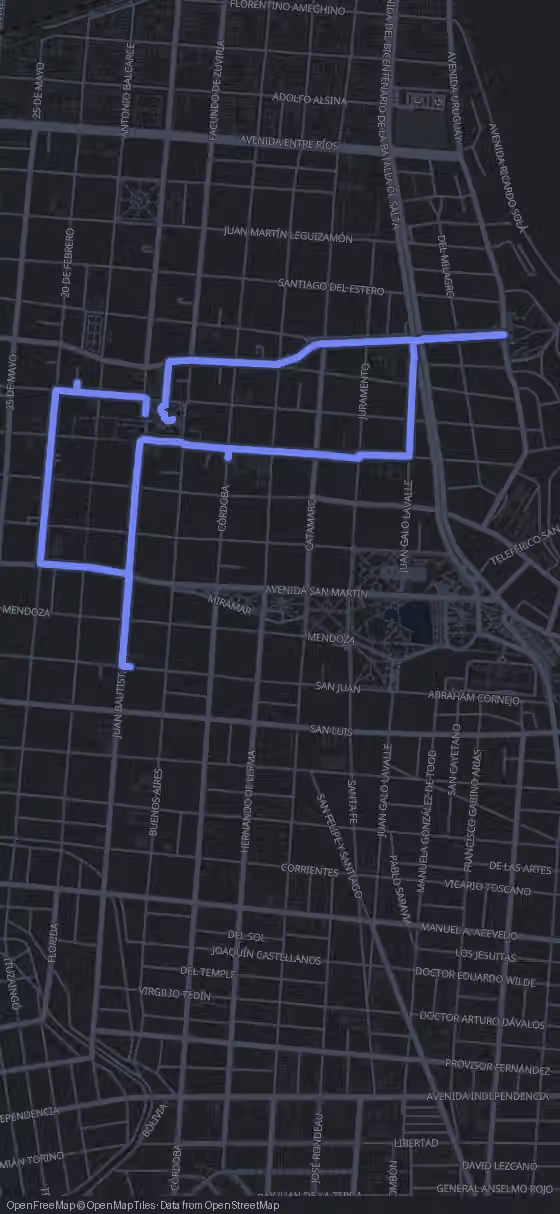
Route map for the Salta walking tour
Stop 1 of 10
140 m·2 min
Plaza 9 de Julio
Head north across the plaza toward Catedral Basílica de Salta
Hola, welcome to Salta. I'm Alex, and one museum here preserves a discovery from a summit far above the city.
Try this tour with Alex

What This Salta Walk Covers

This walk links 10 stops, from Plaza 9 de Julio past the Catedral Basílica de Salta and out to the Monumento a Güemes, then back through the colonial centre to the MAAM - Museo de Arqueología de Alta Montaña. It covers 5.1 km with 1 h 11 min of pure walking; with both museums, plan close to six hours.

Eight stops are free; the Museo de Güemes and the MAAM charge admission. Route, map and GPS navigation run free in your browser, and the optional AI Tour Guide tells the stories as you go.

Open free GPS & optional AI Tour Guide
View of Salta

The Route

Walking Map of Salta: From the Plaza to Cerro San Bernardo and Back

10 stops 5.1 km 1 h 11 min walking
Tap to load interactive map

The 10 stops along this route

  1. Plaza 9 de Julio in Salta, stop 1 on the self-guided walking tour
    1Plaza 9 de Julio
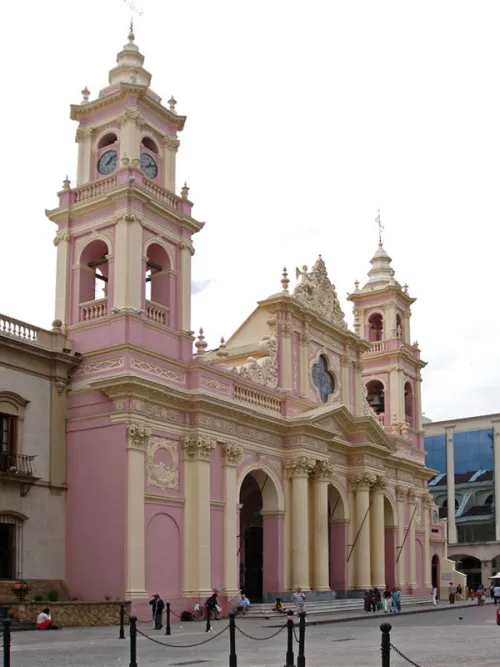
  2. Catedral Basílica de Salta, stop 2 on the self-guided walking tour
    2Catedral Basílica de Salta
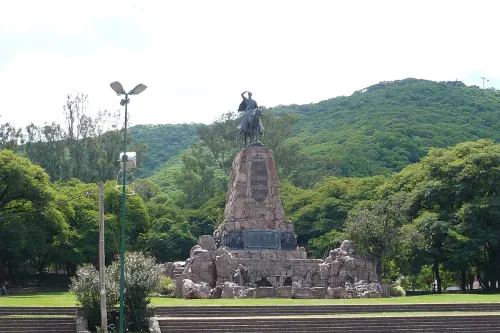
  3. Monumento a Güemes in Salta, stop 3 on the self-guided walking tour
    3Monumento a Güemes
  4. Convento de San Bernardo in Salta, stop 4 on the self-guided walking tour
    4Convento de San Bernardo
  5. Iglesia y Convento San Francisco in Salta, stop 5 on the self-guided walking tour
    5Iglesia y Convento San Francisco
  6. Cabildo Histórico de Salta, stop 6 on the self-guided walking tour
    6Cabildo Histórico de Salta
  7. Iglesia de la Viña in Salta, stop 7 on the self-guided walking tour
    7Iglesia de la Viña
  8. 8Mercado Municipal de Salta
  9. Museo de Güemes in Salta, stop 9 on the self-guided walking tour
    9Museo de Güemes
  10. MAAM - Museo de Arqueología de Alta Montaña in Salta, stop 10 on the self-guided walking tour
    10MAAM - Museo de Arqueología de Alta Montaña
  11. That's the full route.

    Walk it with an AI Tour Guide talking you through every one of these streets.

    Start free in your browser
    You made it

The Salta Walking Tour, Stop by Stop through Churches, Convents and Museums

  1. 1

    Plaza 9 de Julio

    Plaza 9 de Julio in Salta, stop 1 on the self-guided walking tour

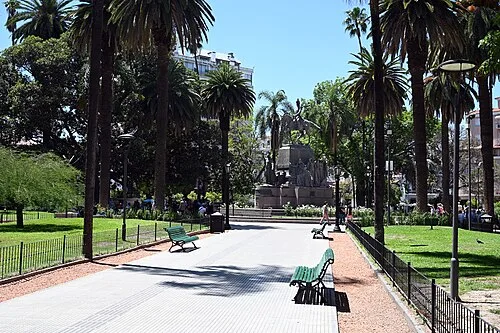
    Start where Salta itself started. Plaza 9 de Julio is the city's founding site and still its political, social and commercial centre, framed by the streets Mitre, España, Zuviría and Caseros. Look at the edges first: the arcade that runs around almost the entire square has survived nearly intact, which sets it apart from most main squares in Argentina. That is no accident. More than twenty resolutions, most of them passed in the 1990s, protect the square and the historic centre around it.

    The shape follows a royal rulebook. In 1573 Philip II issued ordinances on how towns in the Americas should be laid out, and the main square had to be a rectangle one and a half times as long as it was wide. When the Spanish explorer Hernando de Lerma came down from Lima on 16 April 1582 to found Salta, he set aside a plot of exactly the size you see. The name came later and honours 9 July, Argentina's independence day.

    Now picture it bare. Until the middle of the 19th century this was a dry, empty square where officials of the Cabildo kept their horses and carriages, where criminals were executed and royal decrees were read aloud. Only over time did it become the park around you, with more than 250 trees of native and exotic species and more than 7000 dwarf flowering plants. Kerosene lamps first lit its paths in 1871.

    Take a slow lap and you can already see much of the walk ahead: the Cabildo, the cathedral and the MAAM all face this square, along with the Centro Cultural América and the Teatro Provincial. Your first move is the shortest of the day, 140 m and 2 minutes to the cathedral.
    Hours
    Open 24/7
    Price
    Free
  2. 2

    Catedral Basílica de Salta

    Catedral Basílica de Salta, stop 2 on the self-guided walking tour

    The cathedral facing the plaza is the seat of the Archdiocese of Salta and, above all, a shrine. It keeps the two images the city calls miraculous: a life-size crucified Christ from the 16th century and an Immaculate Conception from the 17th. On 13 September 1692 a severe earthquake struck, and the faithful credit these two images with sparing the city the worst. Ever since, they have been venerated here as the Lord and the Virgin of the Miracle, and the church carries their name in its full title.

    The irony is that the earlier church did not survive the next quake. It was destroyed in 1856, and two years later Bishop José Eusebio Colombres began a new building to plans by the architect Philip Bertres. Consecration came after twenty years of work, and by 1882 the missing facade, the towers and the bells were added with help from Italian, Brazilian and Bolivian artists. Together with the Archbishop's Palace, the richly decorated church forms a neo-baroque, classicist ensemble. It has been a national historic monument since 1941 and holds the title of minor basilica.

    Inside, look for the pantheon of the heroes of the Northern Army, who fought the royalists in the war of independence between 1810 and 1820. Here lie Martín Miguel de Güemes, revolutionary general and first governor of the province of Salta, and his wife, along with the independence heroes Rudecindo Alvarado and Juan Antonio Álvarez de Arenales. Keep Güemes in mind; he is the thread of the next part of the walk.

    Entry is free, and this is a working church, so go in even if you only have ten minutes, but keep it quiet during mass. From here the longest leg of the route leads out to the foot of Cerro San Bernardo: 1150 m, about 17 minutes, to the monument raised to the same Güemes.

    Hours
    Mon–Thu 06:30–12:00 & 17:00–20:00, Fri 06:30–12:00 & 16:30–20:00, Sat 07:30–12:00 & 16:30–20:00 (Sat/holidays 07:30–12:00 & 17:00–20:15), Sun 07:30–13:00 & 17:00–21:30
    Price
    Free (active place of worship; guided "Experiencia Catedral" tours separately priced)
  3. 3

    Monumento a Güemes

    Monumento a Güemes in Salta, stop 3 on the self-guided walking tour

    At the end of Paseo Güemes, at the foot of Cerro San Bernardo, the general whose tomb you just saw stands on a memorial 25 m tall. The site was chosen for a reason: this is where Güemes, riding with a bullet wound towards the Cañada de la Horqueta, first fell from his horse. He died there a few days later. The monument marks the moment his end began.

    Look closely at the stone. The structure is built from rocks of more than 75 kg each, taken from Cerro San Bernardo itself, so the hill behind the monument is quite literally part of it. The sculptor Víctor Juan Garino drew up the plans at the government's request, but they stalled for lack of money. Construction began in 1920, during the first government of Hipólito Yrigoyen, under the national architecture office, with the architect Andrés Iñigo as general director and René Villeminot and Alberto Milillo in charge of the artistic work. Workers from the army's Arsenal Esteban de Luca fitted the bronze pieces.

    It took until 1931. President José Félix Uriburu attended the inauguration on 20 February of that year, eleven years after the first stones were set. The monument is free, and it is the one place on the route where the city's history meets the hill directly.

    From here the route turns back into the old centre: 750 m, about 10 minutes, to the Convento de San Bernardo.

    Hours
    Open 24/7
    Price
    Free
  4. 4

    Convento de San Bernardo

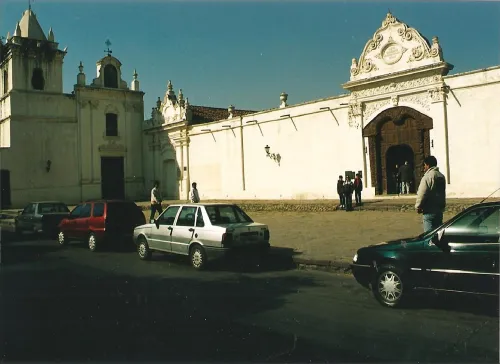
    Convento de San Bernardo in Salta, stop 4 on the self-guided walking tour

    This is one of the oldest buildings in Salta, raised in the late 16th or early 17th century, and it is still very much in use: Discalced Carmelite nuns live here in a cloistered convent, so the interior is closed to the public. You see it from the street, and the street is where its finest piece waits for you.

    Look at the entrance door. It was carved by hand from algarrobo wood by native craftsmen in 1762 and once belonged to the family of Bernardo de la Cámara. Twisted Solomonic columns frame it and carry an unusual lintel of two arches, joined in the middle by leaf motifs and a small cartouche with the monogram of Christ. The door came here when the nuns took over: the old hospital entrance next to the chapel was closed, a new portal was opened, and the priest Isidoro Fernández decorated it himself.

    The building's past is a chain of reinventions. It began as the hermitage of San Bernardo, the city's patron saint in its early years. In 1586 a hospital named San Andrés was built next to it, and it vanished in the earthquake of 1692. Rebuilding dragged on until 1726, and afterwards the hospital closed and reopened under new names, in 1787 and again on 20 August 1805, when the Bethlemite fathers took charge. As it lost importance, Isidoro Fernández brought Carmelite nuns from Chile in 1846, and hermitage and hospital became the Nuevo Carmelo de San Bernardo. It has been a national historic monument since 14 July 1941.

    Next comes a short walk of 500 m, about 7 minutes, to the Iglesia y Convento San Francisco.

    Hours
    Interior closed to public (active cloistered Carmelite convent); exterior/facade viewable anytime
    Price
    Free (exterior only; cloistered convent, a small shop sells rosaries and crafts made by the nuns)
  5. 5

    Iglesia y Convento San Francisco

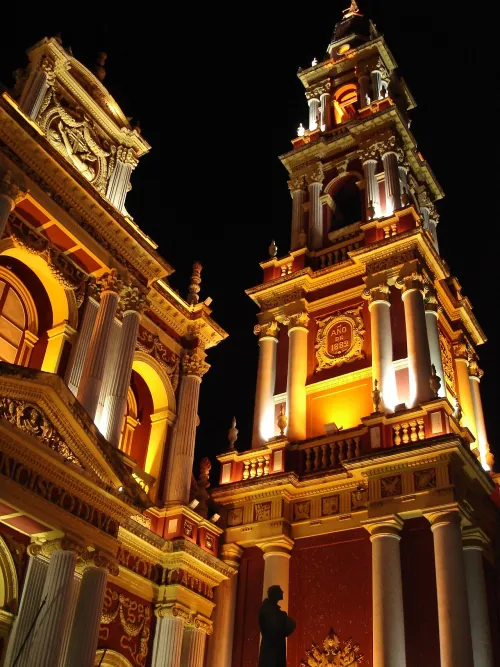
    Iglesia y Convento San Francisco in Salta, stop 5 on the self-guided walking tour

    Watch for the tower as you approach: together with that of La Viña, the tower of San Francisco counts among the tallest church towers in Argentina. The church stands on the corner of Caseros and Córdoba, 100 m from Plaza 9 de Julio, and its place here goes back to Salta's founding charter of 1582, in which Hernando de Lerma already set aside the site for a Franciscan church and convent.

    Getting a church to stand here took two centuries. A first building of mud and reed was finished in 1625 and proved unstable, so a second one, of wood, followed in 1674, and a fire destroyed it in the 18th century. The masonry church you see was begun under Brother Vicente Muñoz from Seville, who died during the works in 1784. Fires in 1761 and 1772 set it back, the second one forcing the friars to move into the church the Jesuits had left empty after their expulsion. Then the economic decline that followed the war of independence delayed the finish until the 19th century.

    One date is worth stopping for: on 13 March 1813 Manuel Belgrano attended a requiem mass here for the victors and the vanquished of the Battle of Salta, fought on 20 February that year. A mass for both sides says a lot about the moment. Today the church is a minor basilica and a national historic monument, in a colonial quarter counted among the best preserved in Argentina.

    Entry is free and guided tours run here as well; if church history and convent life interest you, this is the place on the route to go inside. The Cabildo is only 240 m, about 3 minutes, away.

    Hours
    Mon–Sat 08:30–12:00 & 17:00–21:00 (guided tours Mon–Fri 09:30–13:00 & 14:00–18:30 every 30 min)
    Price
    Free
  6. 6

    Cabildo Histórico de Salta

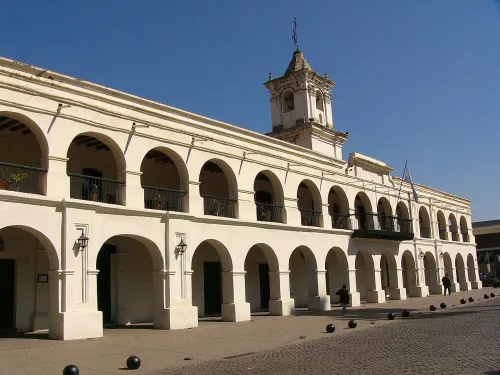
    Cabildo Histórico de Salta, stop 6 on the self-guided walking tour

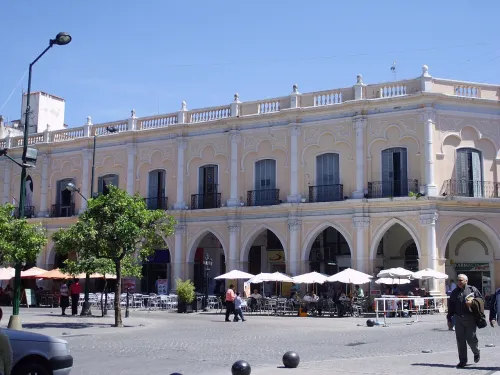
    Back on the plaza, the Cabildo was the seat of colonial town government. A cabildo stood here from 1582, but the building you see dates from 1789, and the tower was added in 1797. It ranks among the best-preserved colonial buildings in Argentina, which is remarkable given how close it came to disappearing.

    It served as prison, police headquarters and government house until 1880. In 1889 it was sold, and in the following years it was used as housing, shops and a hotel. During the first two decades of the 20th century much of the building was torn down and the rest left to decay, until it was declared a national historic monument in 1936. The restoration was finished six years later.

    Since 25 August 1949 it has housed the historical museum of northern Argentina, and the museum has its own unsolved case: under the de facto governor Roberto Ulloa, every piece in the collection disappeared. The theft was never cleared up, and only some of the objects were later recovered.

    Visits are free and guided, which makes this the easiest museum on the route to say yes to; give it about 40 minutes if colonial Salta interests you. Then you leave the plaza for 790 m, about 11 minutes, to the Iglesia de la Viña.

    Local name
    Museo Histórico del Norte
    Hours
    Tue–Fri 09:00–17:00, Sat 14:00–18:00, Sun 10:00–14:00, Mon closed
    Price
    Free (guided visits)
  7. 7

    Iglesia de la Viña

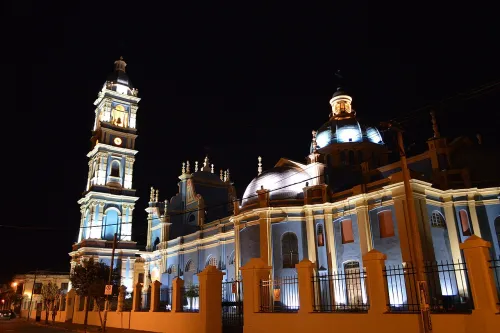
    Iglesia de la Viña in Salta, stop 7 on the self-guided walking tour

    The first thing you notice is that the bell tower stands apart from the church. It rises 44 m on its own, and alongside the tower of San Francisco it ranks among the tallest church towers in Argentina. The full name, Nuestra Señora de la Candelaria de la Viña, explains why the church exists: it was built from 1873 to 1884 mainly to house a statue of the Virgin of Candelaria.

    That statue travelled far. It was brought from Coimbra in Portugal, and in 1630 the Fernández Pedroso family, owners of the La Viña estate, built a chapel for it. Around 1735 it was moved to the hermitage of the Nazarenes in the city, and by the end of that century the sanctuary was almost in ruins. The estate's name stayed with the Virgin, and later with this church.

    The present church was designed and built by the architect and businessman Noé Macchi, count of Cellere, who was also its main financier, alongside donations from Catholics across Argentina. It was finished in early 1884 and blessed by the archbishop of Salta on 25 March 1886. The tower had a bumpier path. The German civil engineer José Enrique Teodoro Rauch planned it with Carlos Lecumberri, work stopped when the money ran out, and the Swiss Francesco Righetti resumed it in 1907 and completed it in 1908 with changes of his own.

    La Viña is an active parish church and free to enter. Take one last look up at the tower, then walk 550 m, about 8 minutes, to the Mercado Municipal.

    Hours
    Mon 11:30–12:30 (mass only), Tue–Fri 09:00–19:00, Sat 09:00–12:00 & 17:30–19:00, Sun 09:00–13:30
    Price
    Free (active parish church)
  8. 8

    Mercado Municipal de Salta

    After seven stops of monuments and churches, the Mercado Municipal de Salta is everyday Salta: a public retail market, free to enter, where the city shops for itself. The change of tone is part of the route, a moment to watch the city live rather than read about it.

    Know what to expect. Structural restoration is under way, and the stalls operate partly in the main building and partly in municipal annexes on Ituzaingó and 20 de Febrero, so you will find a market spread over several places rather than one full hall. It makes a natural pause before the two museums that close the walk.

    From here it is 670 m, about 9 minutes, to the Museo de Güemes.

    Hours
    Mon–Sat 08:00–14:00 & 17:00–21:30, Sun closed
    Price
    Free (public municipal market, no admission fee)
  9. 9

    Museo de Güemes

    Museo de Güemes in Salta, stop 9 on the self-guided walking tour

    Here the Güemes thread comes together. The cathedral showed you his tomb, the monument the place where he fell; this museum is the city's dedicated space for the rest of his life. It is the first of the two stops on the route that charge admission, and you pay at the counter.

    Whether to go in is your call. If the story at the foot of Cerro San Bernardo caught you, spend about 45 minutes here. If it did not, save your time and money for the MAAM, the stronger single visit on this walk, only 300 m and about 4 minutes away.

    Hours
    Tue–Sun 11:00–19:00, Mon closed (open on holidays 11:00–19:00)
    Price
    ARS 2.270 (general; free Sun for Salta residents with DNI)
  10. 10

    MAAM - Museo de Arqueología de Alta Montaña

    MAAM - Museo de Arqueología de Alta Montaña in Salta, stop 10 on the self-guided walking tour

    The walk ends where it began, facing Plaza 9 de Julio, in a stately building from the middle of the 19th century. Its restored facade follows a neo-Gothic style with a clear Victorian stamp, while the interior was remodelled for the museum's work. The province of Salta created the MAAM to protect, study and present the Children of Llullaillaco, one of the most important archaeological discoveries of recent times.

    The finds date back more than 500 years, to the height of the Inca state, shortly before the Spanish conquerors arrived. What makes the museum unusual is how they are kept: the bodies rest in capsules with reduced oxygen, at a stable -20 °C, under lighting filtered of ultraviolet and infrared radiation, with constant electronic monitoring. Besides the permanent exhibition there is space for temporary shows, and laboratories for scientific study and conservation.

    Admission is charged and tiered, with separate rates for foreign visitors, Argentines and Salta residents. Plan on about 75 minutes, and if you pay for only one museum in Salta, make it this one. The building also has a café, a shop and a bar whose menu features dishes by local chefs made with the same ingredients the Incas used, a fitting place to end the walk.

    Hours
    Tue–Sun 11:00–19:00 (last entry 18:30), Mon closed
    Price
    ARS 16.000 foreigners, ARS 8.000 Argentine nationals, ARS 4.000 Salta residents, ARS 2.500 Argentine seniors/students, free for children under 12 and persons with disabilities
Walking tour route map of Salta Route loaded
Plaza 9 de JulioCatedral Basílica de SaltaMonumento a GüemesConvento de San Bernardo+6
All 10 stops are already on the map.
You just press start.
AI Tour Guide

You've read the Salta route. Now walk it with a guide in your ear.

Press start wherever you are, even hundreds of kilometres from Salta, and the guide begins telling its stories right away. In the city, pick any of the 10 stops to start from: it leads you there, then talks with you the whole route, asking, listening, remembering, and shaping the tour around your answers.

10stops 5.1km 1 h 11 minwalking 13languages
▶Start the tour free

Free to start · Runs in your browser · No app, no download

Shorter Ways to Walk Salta

Not every day has room for close to six hours. These three cuts follow the route order, so the GPS navigation still leads you from stop to stop.

The free walk

Stops: 1, 2, 3, 4, 5, 6, 7, 8

For anyone who wants the full story of the city without paying admission. From Plaza 9 de Julio out to the Güemes monument, through the convents and the Cabildo to La Viña and the market: 58 minutes of walking, every stop free, about three and a half hours with the guided Cabildo visit.

Colonial core and the hill

Stops: 1, 2, 3, 4, 5, 6

For a half day. You walk 39 minutes, see the cathedral, the monument, San Bernardo and San Francisco, and end inside the Cabildo, back on the plaza. All free, about 2 h 40 min in total.

Churches and museums

Stops: 5, 6, 7, 8, 9, 10

For museum lovers who skip the walk out to the hill. Start at San Francisco, take in the Cabildo, La Viña and the market, then the Museo de Güemes and the MAAM, both with paid admission. Only 35 minutes of walking, a little over four hours with the visits.

How Long Does This Salta Tour Take with Both Museums?

The pure walking time is 1 h 11 min over 5.1 km, and the longest leg, from the cathedral out to the Monumento a Güemes, takes 17 minutes. Short stops at the plaza, the churches and the market plus a guided visit to the Cabildo bring the free part of the walk, through to the market, to about three and a half hours.

Add about 45 minutes for the Museo de Güemes and about 75 minutes for the MAAM, and the whole walk comes to close to six hours. If you keep only one museum, make it the MAAM and you are at roughly five hours.

Before You Set Out in Salta

  • Start and finish: Start at Plaza 9 de Julio, the recommended order, though you can join at any stop. You finish at the MAAM, which faces the same plaza, and the GPS navigation can also lead you from the last stop back to the start.
  • Time of day: A morning start brings you to the Cabildo during visiting hours and to the two museums around midday. The Cabildo, the market and both museums do not open every day, so check their hours for your date before you set out.
  • Admission: Eight stops are free. The Museo de Güemes and the MAAM charge admission, which you pay on site.
  • Working churches: The cathedral, San Francisco and La Viña are active places of worship, so keep your visit quiet during mass.
Walking tour route map of Salta
AI Tour Guide

Your guide for Salta is ready when you are.

Press start and a voice AI Tour Guide takes it from here: leading the route through Salta, telling the stories, and turning your walk into a real back-and-forth conversation. No app or download is needed; it runs in your browser.

10stops 5.1km 1 h 11 minwalking 13languages
▶Start the tour free

Free to start · Runs in your browser · No app, no download

What the AI Tour Guide Adds on the Streets of Salta

On this route the stories overlap: Güemes turns up in the cathedral, at the foot of the hill and in his museum, and earthquakes shaped both the cathedral and San Bernardo. The AI Tour Guide carries those threads from stop to stop as a conversation, remembers what caught your interest and goes deeper there, for example into why Carmelite nuns came all the way from Chile or how the children of Llullaillaco were found. You start with 100 free credits; after that you choose this tour all-inclusive for €19.99 with no time limit, or credits at €5 per hour.

A Real Conversation A voice AI Tour Guide greets you, leads the whole route, and tells the stories and facts as you walk, asking what you want to see and keeping a real conversation going. Not a recording you press play on.
Map Navigation Follow the route on the map and walk at your own pace. You choose where to start and when to move to the next stop.
Ask Anything Curious about a building you pass? Ask your AI Tour Guide on the spot and the conversation carries on.
13 Languages Switch language anytime. No separate tour needed.
Start free in your browser

Common Questions about Walking Salta

Can I buy anything from the nuns at the Convento de San Bernardo?

Yes. The cloister stays closed, but a small shop sells rosaries and crafts made by the nuns.

Does the Catedral Basílica de Salta offer guided tours?

Yes, the Experiencia Catedral tours, which are priced separately. Walking into the church on your own is free.

How high is Salta?

The city lies at about 1150 m above sea level.

Where can I walk next after Salta?

Across the borders there are free routes for San Pedro de Atacama, Uyuni and Potosí; within Argentina, try Córdoba or Buenos Aires.

Is the tour really free?

Yes. The whole tour is free: the route, the interactive map and the navigation cost you nothing. Only the voice AI Tour Guide is optional and paid: you test it with 100 free credits, then you pay either €5 per hour or €19.99 for this whole tour, with no time limit. Admission to 2 of the 10 stops is not included: Museo de Güemes and MAAM - Museo de Arqueología de Alta Montaña charge their own entry fees.

Do I need to download an app?

No. Everything runs in your phone browser. Open the route and start walking, no download and no sign-up required.

Do I need to book the walking tour in advance?

No booking needed. This self-guided tour is available anytime. Open the route in your browser and start walking. The AI Tour Guide works instantly, no app, no reservation required.

What languages is the AI Tour Guide available in?

The AI Tour Guide speaks 13 languages, so you take the tour in your own language and can switch at any time.

Can I skip stops or change the route?

Yes. Skip any stop, spend extra time at places you like, or start the route from any point. It is your walk, you set the pace.
Image credits
▶ Start free in your browser Runs in your browser, no app, no download