Free Walking Tour Rosario: Opera, River and Flag

From Rosario's founding square past an opera house, a grain silo turned art museum and the Paraná shore to the monument that tells the flag's story.

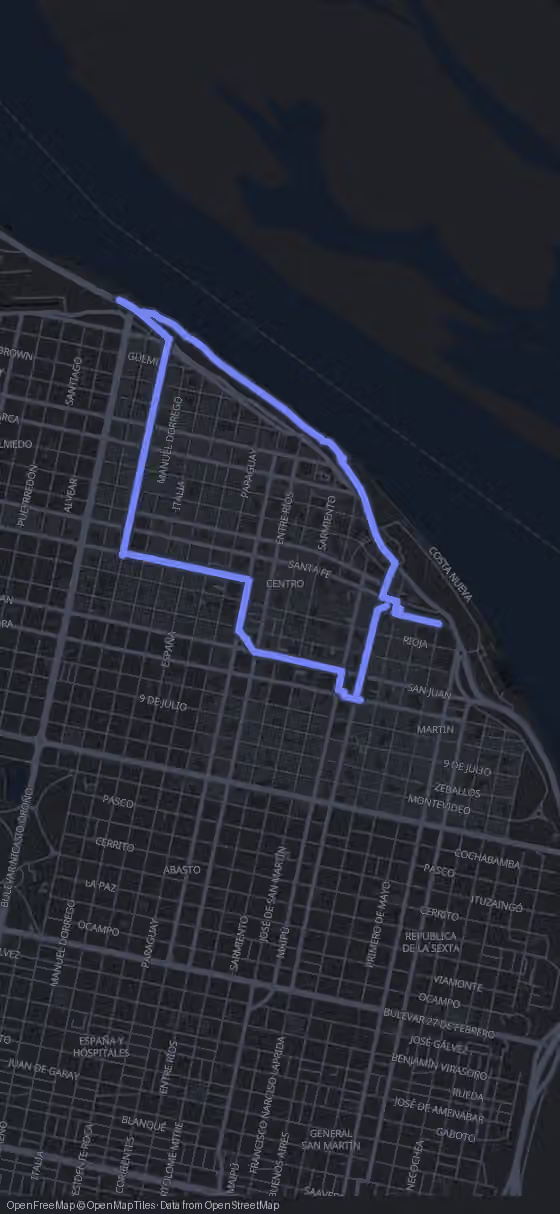
10 Stops 7.7 km ~1 h 46 min walking
Route map for the Rosario walking tour
Stop 1 of 10
650 m·8 min
Plaza 25 de Mayo
Head south toward Teatro El Círculo
Hola, welcome to Rosario. I'm Alex, and the city's great national symbol began with a single moment beside the Paraná.
Try this tour with Alex

Your route through Rosario at a glance

This route links 10 stops, from Plaza 25 de Mayo out through the old centre to the Paraná shore and back to the Monumento Histórico Nacional a la Bandera. It covers 7.7 km with 1 h 46 min of pure walking; with the museums, plan about six hours.

Most stops are free, the museums included. Teatro El Círculo shows its hall only on paid guided tours, and the tower at the Flag Memorial costs a ticket. Route, map and GPS navigation are free in your browser, and the AI Tour Guide is optional.

Open free GPS & optional AI Tour Guide
View of Rosario

The Route

Walking Map of Rosario, from the Plaza to the River

10 stops 7.7 km 1 h 46 min walking
Tap to load interactive map

The 10 stops along this route

  1. Plaza 25 de Mayo in Rosario, stop 1 on the self-guided walking tour
    1Plaza 25 de Mayo
  2. Teatro El Círculo in Rosario, stop 2 on the self-guided walking tour
    2Teatro El Círculo
  3. Paseo del Siglo in Rosario, stop 3 on the self-guided walking tour
    3Paseo del Siglo
  4. Museo de la Memoria in Rosario, stop 4 on the self-guided walking tour
    4Museo de la Memoria
  5. Museo de Arte Contemporáneo (MACRo) in Rosario, stop 5 on the self-guided walking tour
    5Museo de Arte Contemporáneo (MACRo)
  6. Parque de España in Rosario, stop 6 on the self-guided walking tour
    6Parque de España
  7. Museo de Arte Decorativo Firma y Odilo Estévez in Rosario, stop 7 on the self-guided walking tour
    7Museo de Arte Decorativo Firma y Odilo Estévez
  8. Palacio de los Leones in Rosario, stop 8 on the self-guided walking tour
    8Palacio de los Leones
  9. Catedral Basílica de Nuestra Señora del Rosario, stop 9 on the self-guided walking tour
    9Catedral Basílica de Nuestra Señora del Rosario
  10. Monumento Histórico Nacional a la Bandera in Rosario, stop 10 on the self-guided walking tour
    10Monumento Histórico Nacional a la Bandera
  11. That's the full route.

    Walk it with an AI Tour Guide talking you through every one of these streets.

    Start free in your browser
    You made it

Your Rosario Walking Tour, Stop by Stop from Opera to Flag

  1. 1

    Plaza 25 de Mayo

    Plaza 25 de Mayo in Rosario, stop 1 on the self-guided walking tour

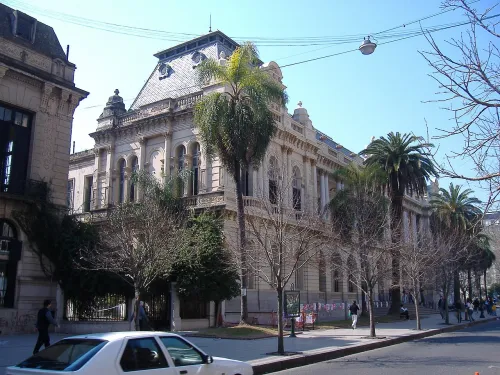
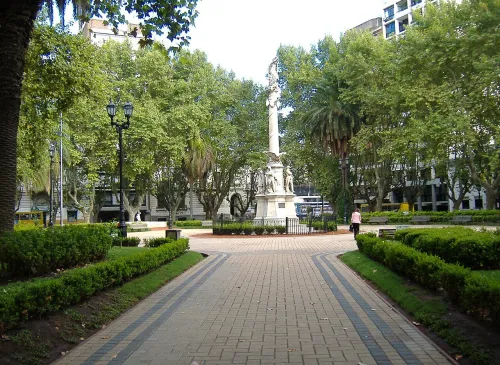
    This is where Rosario began. The square sits on the core of the original settlement, one block framed by Santa Fe, Buenos Aires, Laprida and Córdoba streets, not far from the Paraná River. Until 1852 it had no grand name: people simply called it Plaza Principal or Plaza de Armas. Then it took the date of the May Revolution, 25 May 1810, which led to the first local Argentine government in Buenos Aires.

    In the middle rises the Columna a la Libertad, a monumental column with Liberty standing on top. Around its base you meet four national heroes: José de San Martín, Manuel Belgrano, Mariano Moreno and Bernardino Rivadavia. Alejandro Biggi carved the monument in Carrara marble in 1883. Before that, the spot held the first monument to the Argentine Constitution of 1853, set up on 25 May 1855.

    Turn slowly and half of this walk is already in view. The Palacio de los Leones and the cathedral face the square, separated by the pedestrian Pasaje Juramento, and through that passage you can clearly see the Flag Memorial and its Propylaeum. The Estévez family's house museum, the Correo Central and the building known as Bola de Nieve frame the square too. You come back to all of them at the end, so for now just take in the overview.

    From here the route heads into the centre: 650 m, about 9 minutes, to Teatro El Círculo.
    Hours
    Open 24/7
    Price
    Free
  2. 2

    Teatro El Círculo

    Teatro El Círculo in Rosario, stop 2 on the self-guided walking tour

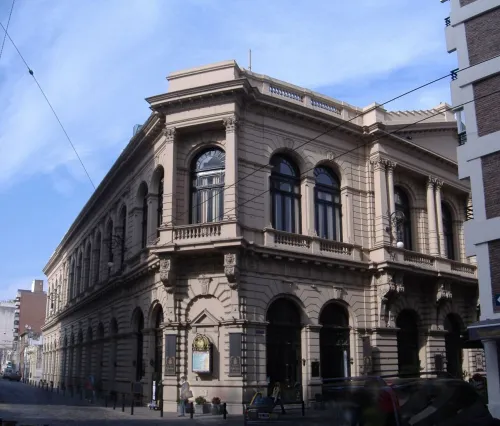
    Rosario's great opera house had a rough start. In 1888 a company called La Ópera began building a hall here, then went bankrupt and left it half finished. The empty shell, with its pits and passageways, drew vagrants and petty criminals, and mysterious stories spread about its depths. The town called it the Cueva de los Ladrones, the Thieves' Cave.

    The rescue came from Emilio Schiffner, a German who bought the site as it stood and finished it with changes, following plans drawn in 1903 by the engineer and architect George Goldammer. Schiffner hired an acoustics specialist from Germany, and the main hall is still known for its sound. The sculpture and plasterwork outside are by Pellegrini, those inside by Belotti, so give the facade a proper look.

    It opened on 7 June 1904 as the Teatro de la Ópera with Verdi's Otello, a major social and artistic event for the city. In its heyday there was an opera almost every day. Any international company of note that came to Buenos Aires played here as well, and some European companies sailed straight to Rosario before appearing in Buenos Aires and New York. Pietro Mascagni came, and Enrico Caruso sang here in 1915. After decades of glory, economic crises and new kinds of entertainment emptied the house and it fell into the shadows.

    You see the auditorium only at a performance or on a paid guided tour. If you love opera or old theatres, it's worth planning your day around one; otherwise the facade and the story are enough. Next comes a longer stretch: 1770 m, about 24 minutes, to Paseo del Siglo.

    Hours
    Guided tours: Mon, Wed, Fri, Sat 10:30 (Teatro & Museo Barnes, ~75 min); Tue 18:00, Thu & Sat 11:00 (Museo de la Ópera, ~60 min). Box office: Mon–Fri 10:00–13:00 & 16:00–20:00, Sat 10:00–12:30, Sun & holidays closed (open 3h prior to performances)
    Price
    ARS 15.000 general (ARS 18.000 general, bilingual tour; ARS 8.000 students/retirees/C.U.D.; ARS 6.000 schoolchildren; ARS 9.000 schoolchildren, bilingual tour)
  3. 3

    Paseo del Siglo

    Paseo del Siglo in Rosario, stop 3 on the self-guided walking tour

    Paseo del Siglo is not a single building but eight blocks of Calle Córdoba, from Boulevard Oroño to Calle Corrientes, in Rosario's historic centre. Public buildings and the mansions of wealthy families line the way, preserved or restored under a municipal preservation programme. Walk it slowly and look up at the facades.

    Watch for the former provincial courthouse, now the law faculty of the Universidad Nacional de Rosario, and Escuela Normal N.º 2, a National Historic Monument. The former police headquarters now houses the provincial government delegation and some city offices. Along the street and close by you also find the Museo Provincial de Ciencias Naturales Dr. Ángel Gallardo, the Biblioteca Argentina Dr. Juan Álvarez and the building of the Molinos Fénix.

    On the one pedestrian block of the Paseo, the Palacio de la Bolsa de Comercio and the Palacio Minetti stand side by side. Two squares give you room to breathe: Plaza San Martín and Plaza Pringles, good spots to sit for a moment.

    Not everything here speaks of wealth. The Memorial Centro Popular de la Memoria stands on the very site of an illegal detention centre from the years of state terrorism. It's a quiet introduction to the next stop, 370 m and about 5 minutes away: the Museo de la Memoria.

    Hours
    Open 24/7
    Price
    Free (public pedestrian street)
  4. 4

    Museo de la Memoria

    Museo de la Memoria in Rosario, stop 4 on the self-guided walking tour

    This municipal museum deals with political violence and state terrorism in Argentina in the 1970s and 1980s. It keeps the memory of the men and women who lived through the last military dictatorship, as protagonists and as witnesses.

    The building is part of the story. Since December 2010 the museum has occupied the former headquarters of the II Army Corps, where war councils sat in judgement over many victims of state terrorism. The institution itself goes back to 1998, when a city ordinance created it to promote research and public knowledge about human rights and social and political memory in the region, in Argentina and across Latin America.

    Inside you find a permanent exhibition with works designed by Rosario artists and a room for temporary shows. There's also a documentation centre, a specialised library with more than 3,500 volumes, an education department and an auditorium for over 120 people. The museum counts among the pioneers in Latin America in dealing with memory after genocide and works with academic and memory institutions in Latin America and Europe.

    Entry is free. If the subject matters to you, plan around 45 minutes; it is heavy material, and the walk that follows helps you process it: 1740 m, about 24 minutes, out towards the river and the MACRo.

    Hours
    Wed–Sun and holidays 10:00–18:00 (Mon–Tue closed); guided tours for general public Sat, Sun and holidays at 12:00
    Price
    Free (voluntary contribution ARS 1.000)
  5. 5

    Museo de Arte Contemporáneo (MACRo)

    Museo de Arte Contemporáneo (MACRo) in Rosario, stop 5 on the self-guided walking tour

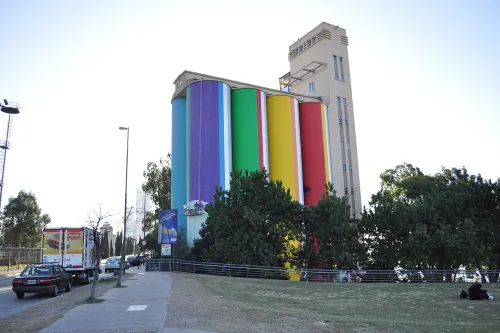
    You recognise the MACRo by its shape: the museum fills a former grain silo where Boulevard Oroño meets the Paraná. Known as Silo Davis, it was a grain storage plant in the old port zone on the riverbank. The building was designed by Ermete de Lorenzi, one of the most important Rosario architects of the twentieth century.

    When the port activities moved away from the central riverfront at the end of the twentieth century, the city began reworking the whole area. Silo Davis was among the buildings judged historically valuable and was chosen for a new museum of contemporary art, which opened on 16 November 2004. Administratively it's an annex of the Museo Municipal de Bellas Artes Juan B. Castagnino.

    The collection started with a condition. Fundación Antorchas offered to donate 27 works selected by Marcelo Pacheco, then director of MALBA in Buenos Aires, if a major collection of Argentine art was built around them. The city, the Fundación Museo Castagnino, companies and private donors raised the money. Today it holds the country's most important collection of contemporary Argentine art, with works by Nicola Costantino, Marcos López, Marta Minujín, Marcelo Pombo and León Ferrari and by groups such as Tucumán Arde. The museum also promotes Rosario art and keeps buying contemporary work from all over Argentina.

    Entry is free with a voluntary contribution. If contemporary art speaks to you, linger here; if not, the silo from outside is still worth the detour. Then follow the river: 1670 m, about 22 minutes, to Parque de España.

    Hours
    Wed–Sat and holidays 13:00–19:00, Sun 10:00–19:00 (Mon–Tue closed); guided tours Wed–Sun and holidays at 17:00
    Price
    Free (voluntary contribution voucher)
  6. 6

    Parque de España

    Parque de España in Rosario, stop 6 on the self-guided walking tour

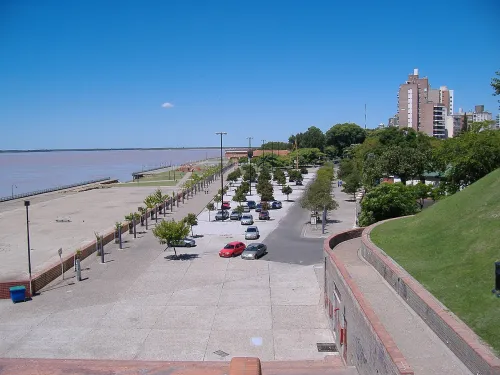
    Parque de España follows the shore of the Paraná: grass, trees and paved paths for walkers, with a cultural centre at its northern end. The whole complex covers 10,000 m² close to the historic centre.

    Spain paid for it. As part of the celebrations for the 500th anniversary of the first European landing in the Americas, the Spanish government funded a cultural centre on land granted by the city, and Princess Cristina of Spain attended the inauguration in November 1992. The Catalan urbanist Oriol Bohigas worked on part of the design. Since a new agreement in 2002, the city and the Spanish Agency for International Cooperation run it, and in November 2004 it hosted events of the Third International Congress of the Spanish Language.

    Look at the south facade of the cultural centre: it rises from the lower shore level as an open-air grandstand where up to 5,000 people can sit for shows in the park. Inside are a 500-seat theatre, a conference room, three art galleries and a video library. The complex also houses a school set up by the Spanish Ministry of Education, whose students earn equivalent qualifications in the Spanish system.

    The park is free to walk; the galleries open on fewer days, so treat them as a bonus. Sit by the water for a while before heading back into town: 1070 m, about 16 minutes, to the Museo de Arte Decorativo Firma y Odilo Estévez.

    Hours
    Public promenade open 24/7; exhibition galleries Thu–Sat 15:00–19:00
    Price
    Free (public park)
  7. 7

    Museo de Arte Decorativo Firma y Odilo Estévez

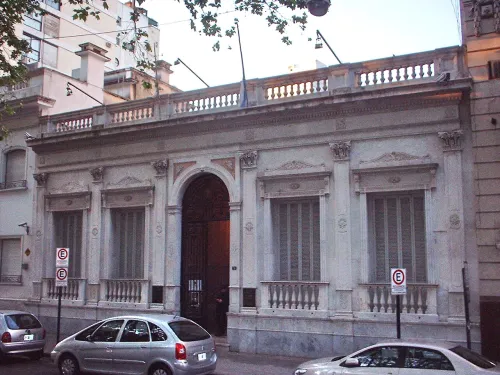
    Museo de Arte Decorativo Firma y Odilo Estévez in Rosario, stop 7 on the self-guided walking tour

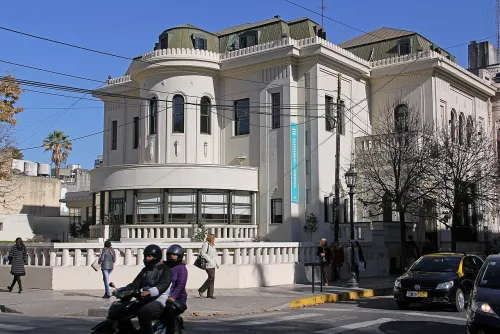
    You're back where the old town began: this house faces Plaza 25 de Mayo, a few metres from the town hall, the cathedral and the Correo Central. It was the home of the Estévez family, given to the city complete with its furniture, art collections and decoration.

    Odilo Estévez Yáñez was born in 1870 in Freas de Eiras, in the Spanish province of Orense, and reached Argentina at 14. He founded the Yerbatera Paraguaya, which grew into Estévez y Cía., sat on the city council for the Liga del Sur from 1911 and was vice president of the city's Fine Arts Commission. His wife Firma Mayor Taltabull, born in Rosario in 1874 as the daughter of a Catalan immigrant, collected art with him from 1914 and later helped organise the Museo Histórico Provincial.

    In 1921 the couple bought the house at Santa Fe 748 from Melitón de Ibarlucea and restored it in 1924 to hold their collection. Odilo died in 1944, Firma in 1964, and her will left house and collection to Rosario. The museum opened on 8 July 1968, and the building became a National Historic Monument in 2011. When burst drainpipes forced repairs in 2020, workers uncovered remains of the old house, including a cistern and two drains.

    Entry is free, and this is the place to see how a wealthy Rosario family lived among its collections; allow about 40 minutes. The town hall is only 130 m away, 2 minutes on foot.

    Hours
    Tue–Sun and holidays 09:00–19:00 (Mon closed); guided tours daily at 11:00 and 16:00
    Price
    Free
  8. 8

    Palacio de los Leones

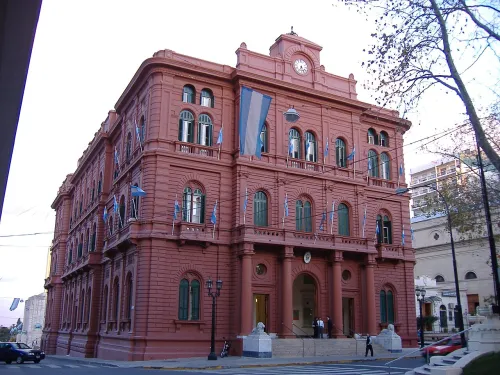
    Palacio de los Leones in Rosario, stop 8 on the self-guided walking tour

    The Palacio de los Leones is Rosario's town hall, seat of the municipal executive, on the corner of Buenos Aires and Santa Fe streets. The city government, created in 1858, had no building of its own for decades. A provincial law of 7 October 1886 finally allowed it to take out a foreign loan in gold pesos for a building of greater importance and appearance.

    The design went to Gaetano Rezzara, also known as Cayetano, accepted on 27 November 1888. Born in Vicenza and a supporter of Garibaldi, he belonged to the generation of European professionals who reached Argentina at the end of the nineteenth century and made its cities look more like Europe. Mayor Gabriel Carrasco had the foundation stone laid on 1 October 1891, and the palace opened around 1896.

    Read the facade as a lesson in the Renaissance of northern Italy: a compact, simple volume, round arches, rounded corners, bull's eye windows and balconies. Inside, the building wraps around a central courtyard with arcades and Ionic columns. It's a working town hall, so free cultural visits to the Salón Carrasco happen only at set times; otherwise the facade is the show.

    The cathedral stands right next door, across Pasaje Juramento: 130 m, 2 minutes.

    Hours
    Mon–Fri 07:30–18:00 (Sat–Sun closed); cultural visits to Salón Carrasco business days 16:00–19:00
    Price
    Free
  9. 9

    Catedral Basílica de Nuestra Señora del Rosario

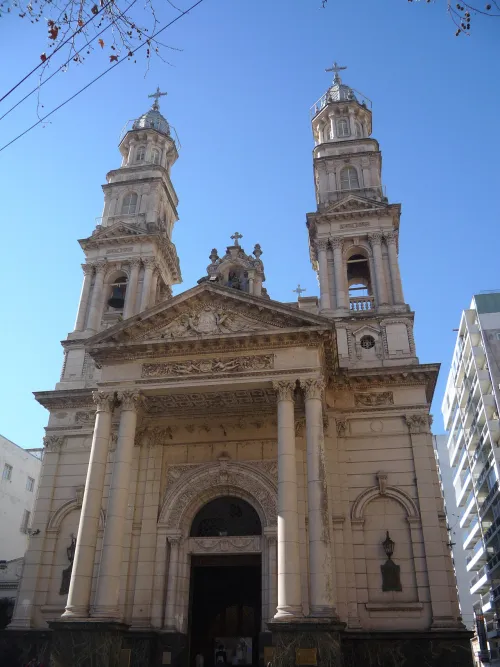
    Catedral Basílica de Nuestra Señora del Rosario, stop 9 on the self-guided walking tour

    The cathedral stands in the oldest part of Rosario, at Buenos Aires 789, facing Plaza 25 de Mayo. A first parish church went up on this site in 1731; the present building dates from the late nineteenth century. It became a cathedral on 20 April 1934, when the Diocese of Rosario was created, and a minor basilica on 7 October 1966.

    The image of the Virgen del Rosario was brought from Cádiz in Spain in 1773. Beneath the church lies the Camarín de la Virgen, opened in May 1925, with room for 150 people. The high altar of Carrara marble came from Italy and was put in place in 1898. Four archbishops are buried inside: Silvino Martínez, Guillermo Bolatti, Jorge Manuel López and Eduardo Vicente Mirás.

    Don't miss the stained glass window in the atrium: “Creación de la Bandera” by Francisco Stella, showing the national flag flying for the first time on the high banks of the Paraná. The Buenos Aires firm Vilella y Thomas made it, and it was installed in 1927. It sets up the last stop perfectly.

    Entry is free. This is a working church with Mass several times a day, so keep your voice down and step aside during services. Then walk through Pasaje Juramento to the Flag Memorial: 210 m, about 3 minutes.

    Hours
    Daily 08:30–12:30 and 17:00–20:30; Mass: Mon–Fri 08:45, 11:45, 19:30; Sat 08:45, 11:45, 18:00, 19:30; Sun 09:00, 10:30, 12:00, 18:00, 19:30, 20:30
    Price
    Free
  10. 10

    Monumento Histórico Nacional a la Bandera

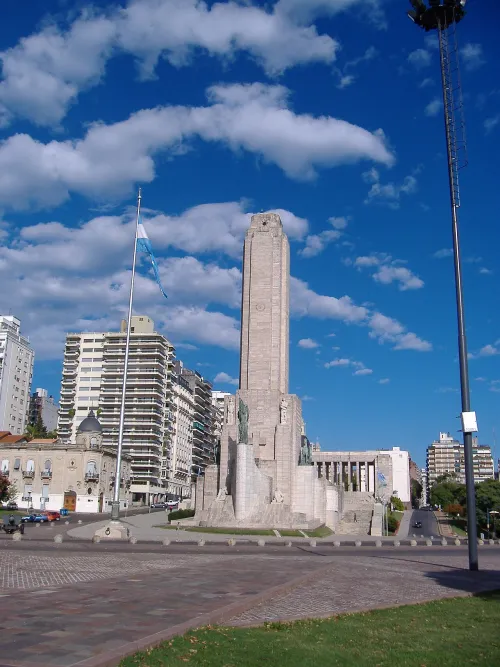
    Monumento Histórico Nacional a la Bandera in Rosario, stop 10 on the self-guided walking tour

    The walk ends where Argentina tells the story of its flag. You arrive through Pasaje Juramento, the Oath Passage, flanked by statues by Lola Mora, and reach the Propylaeum. The memorial was inaugurated on 20 June 1957, the anniversary of the death of Manuel Belgrano, who created the flag and first raised it on 27 February 1812 on an island on the opposite shore of the river.

    Architects Ángel Guido and Alejandro Bustillo directed the work, with the sculptors José Fioravanti, Alfredo Bigatti and Eduardo Barnes. Most of the stone came from the Andes, and the complex covers about 10,000 m². Each of its three parts carries a meaning: the 70 m tower stands for the May Revolution of 1810 and holds Belgrano's crypt at its base; the Civic Courtyard symbolises the effort of organising the state and hosts big open-air shows; the Triumphal Propylaeum represents the nation as organised after the 1853 Constitution.

    Under the Propylaeum, the Honour Room displays the flags of all the nations of the Americas. The civic area, the crypt and the flag gallery are free; only the ascent to the viewpoint in the tower takes a ticket. Take it if you want to see the city and the river from above, after a full day on foot it's a fitting reward.

    For the 50th anniversary in 2007, the complex received a new lighting system. When you're done, Plaza 25 de Mayo, where you started, is just back through Pasaje Juramento.

    Hours
    Civic outdoor area: always accessible 24/7. Galería de Honor de las Banderas: Mon & day after holiday 13:00–18:00, Tue–Sun 09:00–18:00. Cripta de Belgrano: Mon–Fri 13:00–18:00, Sat–Sun & holidays 09:00–18:00. Mirador Tower ascent: Mon–Fri 13:00–18:00, Sat–Sun & holidays 09:00–13:00 and 14:00–18:00 (ticket sales close 30 min prior)
    Price
    Free (tower viewpoint ascent: ARS 2.000; under 5 & disabled free)
Walking tour route map of Rosario Route loaded
Plaza 25 de MayoTeatro El CírculoPaseo del SigloMuseo de la Memoria+6
All 10 stops are already on the map.
You just press start.
AI Tour Guide

You know the route now. Walk Rosario with a guide in your ear.

Press start wherever you are, even hundreds of kilometres from Rosario, and the guide begins telling its stories right away. In the city, pick any of the 10 stops to start from: it leads you there, then talks with you the whole route, asking, listening, remembering, and shaping the tour around your answers.

10stops 7.7km 1 h 46 minwalking 13languages
▶Start the tour free

Free to start · Runs in your browser · No app, no download

Shorter ways to walk Rosario

Short on time or energy? These three cuts keep the parts of Rosario that belong together.

Civic heart around the plaza

Stops: 1, 7, 8, 9, 10

For a first afternoon or a short stopover. The Estévez house, the town hall, the cathedral and the Flag Memorial all sit around Plaza 25 de Mayo and Pasaje Juramento, with about 7 minutes of walking between them. Everything is free; only the tower ascent at the memorial costs a ticket.

Opera and Paseo del Siglo

Stops: 1, 2, 3, 4

For architecture and history lovers. From the plaza to the opera house, along the mansions of Calle Córdoba and on to the Museo de la Memoria: 38 minutes of walking. The museum is free; Teatro El Círculo charges only if you join a guided tour.

River and contemporary art

Stops: 4, 5, 6

For a riverside half day. From the Museo de la Memoria to the MACRo silo and along to Parque de España: 46 minutes of walking, and every stop is free.

How Long Does This Rosario Tour Take with the Museums?

Pure walking time is 1 h 46 min over 7.7 km. Most of it falls on three legs: 24 minutes from Teatro El Círculo to Paseo del Siglo, 24 minutes from the Museo de la Memoria to the MACRo and 22 minutes on to Parque de España. The last four stops are only a few minutes apart.

With time inside the Museo de la Memoria, the MACRo, the Estévez house, the cathedral and the Flag Memorial, plan about six hours. A guided tour of Teatro El Círculo adds more on top.

The civic heart variant takes about two hours with visits, the opera and Paseo del Siglo variant about two and a half, the river and art variant about three.

Before you set off in Rosario

  • Start and finish: Start at Plaza 25 de Mayo and finish at the Monumento Histórico Nacional a la Bandera, a short walk back through Pasaje Juramento from where you began. You can join at any stop; the suggested order is the one that flows best.
  • Best time to go: Start in the morning: with the museums the walk fills most of a day. The museums and the town hall keep their own opening days, so check them before you pick your date.
  • What costs money: Only the guided tours of Teatro El Círculo and the tower ascent at the Flag Memorial. The squares, the Paseo del Siglo, the park, the cathedral, the town hall and all four museums on the route are free.
  • Finding your way: Open the free route in your browser; the GPS navigation leads you from stop to stop, and you can switch on the AI Tour Guide whenever you like.
Walking tour route map of Rosario
AI Tour Guide

Your Rosario guide is ready when you are.

Press start and a voice AI Tour Guide takes it from here: leading the route through Rosario, telling the stories, and turning your walk into a real back-and-forth conversation. No app or download is needed; it runs in your browser.

10stops 7.7km 1 h 46 minwalking 13languages
▶Start the tour free

Free to start · Runs in your browser · No app, no download

What the AI Tour Guide adds on this Rosario route

This walk jumps from opera to dictatorship, from grain silos to the flag, and the AI Tour Guide keeps those threads together as one conversation. It greets you, tells the stories of each place, asks what you think and remembers whether you lean towards architecture, art or politics, then shifts its storytelling to match. Wonder what the Bola de Nieve building on the plaza is, or who the Liga del Sur were, and it picks up from there; you can interrupt it at any moment.

A Real Conversation A voice AI Tour Guide greets you, leads the whole route, and tells the stories and facts as you walk, asking what you want to see and keeping a real conversation going. Not a recording you press play on.
Map Navigation Follow the route on the map and walk at your own pace. You choose where to start and when to move to the next stop.
Ask Anything Curious about a building you pass? Ask your AI Tour Guide on the spot and the conversation carries on.
13 Languages Switch language anytime. No separate tour needed.
Start free in your browser

Common Questions About Walking Rosario

Can I tour Teatro El Círculo if I don't speak Spanish?

Yes, there is a bilingual version of the guided tour besides the regular one. Tours cover either the theatre with the Museo Barnes or the Museo de la Ópera, and students, retirees and schoolchildren get reduced tickets. Ask at the box office for the current schedule.

When is Flag Day in Rosario?

On 20 June, the anniversary of Manuel Belgrano's death. The main celebrations take place at the Flag Memorial and the National Flag Park in front of it.

Do the free museums offer guided visits?

Yes. The Estévez house, the MACRo and the Museo de la Memoria all run guided visits at fixed times at no charge; ask at the entrance when you arrive.

Can I combine Rosario with another city walk?

Rosario is 279 km from Buenos Aires, so many travellers pair the two; the Buenos Aires walking tour works the same way. Heading inland instead, try the Córdoba walking tour.

Is the tour really free?

Yes. The whole tour is free: the route, the interactive map and the navigation cost you nothing. Only the voice AI Tour Guide is optional and paid: you test it with 100 free credits, then you pay either €5 per hour or €19.99 for this whole tour, with no time limit. Admission to one of the 10 stops is not included: Teatro El Círculo charges its own entry fee.

Do I need to download an app?

No. Everything runs in your phone browser. Open the route and start walking, no download and no sign-up required.

Do I need to book the walking tour in advance?

No booking needed. This self-guided tour is available anytime. Open the route in your browser and start walking. The AI Tour Guide works instantly, no app, no reservation required.

What languages is the AI Tour Guide available in?

The AI Tour Guide speaks 13 languages, so you take the tour in your own language and can switch at any time.

Can I skip stops or change the route?

Yes. Skip any stop, spend extra time at places you like, or start the route from any point. It is your walk, you set the pace.
Image credits
▶ Start free in your browser Runs in your browser, no app, no download